TOPIC: Simplified Characters versus Traditional Characters in Chinese 
Subject: Chinese Language Arts 
Grade level: 7th grade Chinese Immersion 
Task type: Curriculum embedded tasks 
Context: 
Simplified characters and traditional characters in Chinese co-exist in the Chinese world. Simplified 
characters are mainly used in China, Singapore and Malaysia and traditional characters are mainly 
used Taiwan and Hong Kong. In the United States, both character systems co-exist in different 
schools, communities, and media. To be an effective Chinese user, one should master either one 
character system or both. In order to deepen the learning of the lesson, “simplified characters and 
traditional characters” in the textbook, a series of tasks and assessments will be given to ask 
students to think and to demonstrate their learning 
through justification of the choice of using simplified or traditional characters. 
Task 1: Student self-reflection to tap into prior knowledge through a Constructed Response 
Task. 
Students will be given a prompt to reflect upon their learning history and process of the character 
systems. The amount of information, completion of task, organization of ideas, and 
comprehensibility will be assessed. 
Task 2: Experiments on reading aloud in both character systems 
In order to collect data of reading fluency in simplified and traditional characters, students will be 
asked to do timed reading in both simplified and traditional characters on the same paragraph. 
Each student will read two paragraphs. First, read paragraph 1 in simplified characters, then read 
paragraph 1 in traditional characters. Record the time of each reading. Second, read paragraph 2 
in traditional characters, then read paragraph 2 in simplified characters. Record the time of each 
reading and calculate the average time of reading in simplified characters and reading in traditional 
characters. 
Students are suggested to work in pairs to ensure the validity and reliability of data collection. 
Task 3: Writing assessment in both characters through two Constructed Response tasks 
Prompt 1: 
You will be attending an overnight Chinese camp next weekend. You are asked to prepare for a 
speech in Mandarin to share with the participants at the camp fire. Make sure your speech is 
interesting. Use simplified characters to write at least 15 sentences. Use pinyin when you do not 
know how to write the characters. Amount of information, organization of ideas, accuracy of 
characters will be assessed. Finish the task in 20 minutes.
Prompt 2: 
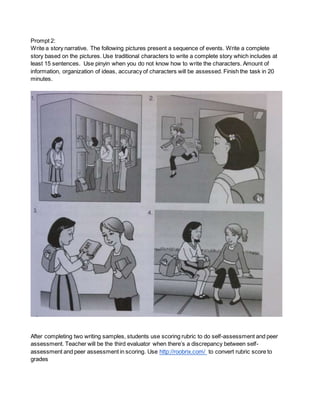
Write a story narrative. The following pictures present a sequence of events. Write a complete 
story based on the pictures. Use traditional characters to write a complete story which includes at 
least 15 sentences. Use pinyin when you do not know how to write the characters. Amount of 
information, organization of ideas, accuracy of characters will be assessed. Finish the task in 20 
minutes. 
After completing two writing samples, students use scoring rubric to do self-assessment and peer 
assessment. Teacher will be the third evaluator when there’s a discrepancy between self-assessment 
and peer assessment in scoring. Use http://roobrix.com/ to convert rubric score to 
grades
Students’ reflection: 
1. Based on the collected data, how proficient am I as a reader in simplified characters? 
2. Based on the collected data, how proficient am I as a reader in traditional characters? 
3. Based on the scoring rubric, how proficient am I as a writer in simplified characters? 
4. Based on the scoring rubric, how proficient am I as a writer in traditional characters? 
Task 4: 
Have students to self-select two books about 100 pages long or two articles about 500 characters at 
their reading level: one in simplified characters and the other in traditional characters. Write a short 
summary of each text. 
Students’ Reflection: 
1. Is there a discrepancy between the difficulty level of the two books? 
2. Why is there a discrepancy? Support your reasons. 
3. What do you prefer in reading: simplified or traditional characters? 
Task 5: Make conclusion through a Constructed Response Task 
Based on the data and reflection, identify if you are a better reader and writer in simplified and/or 
traditional characters. Decide on which character system you will focus based on your learning 
needs. Justify your choice with strong supporting ideas. If you choose to focus on both character 
systems, justify your choice too. 
If time permits, the class will be divided into debate teams. 
Task 6: Debate 
Topic: The Mandarin immersion programs in United States should only teach simplified characters

Simplified Characters Versus Traditional Characters

  • 1.
    TOPIC: Simplified Charactersversus Traditional Characters in Chinese Subject: Chinese Language Arts Grade level: 7th grade Chinese Immersion Task type: Curriculum embedded tasks Context: Simplified characters and traditional characters in Chinese co-exist in the Chinese world. Simplified characters are mainly used in China, Singapore and Malaysia and traditional characters are mainly used Taiwan and Hong Kong. In the United States, both character systems co-exist in different schools, communities, and media. To be an effective Chinese user, one should master either one character system or both. In order to deepen the learning of the lesson, “simplified characters and traditional characters” in the textbook, a series of tasks and assessments will be given to ask students to think and to demonstrate their learning through justification of the choice of using simplified or traditional characters. Task 1: Student self-reflection to tap into prior knowledge through a Constructed Response Task. Students will be given a prompt to reflect upon their learning history and process of the character systems. The amount of information, completion of task, organization of ideas, and comprehensibility will be assessed. Task 2: Experiments on reading aloud in both character systems In order to collect data of reading fluency in simplified and traditional characters, students will be asked to do timed reading in both simplified and traditional characters on the same paragraph. Each student will read two paragraphs. First, read paragraph 1 in simplified characters, then read paragraph 1 in traditional characters. Record the time of each reading. Second, read paragraph 2 in traditional characters, then read paragraph 2 in simplified characters. Record the time of each reading and calculate the average time of reading in simplified characters and reading in traditional characters. Students are suggested to work in pairs to ensure the validity and reliability of data collection. Task 3: Writing assessment in both characters through two Constructed Response tasks Prompt 1: You will be attending an overnight Chinese camp next weekend. You are asked to prepare for a speech in Mandarin to share with the participants at the camp fire. Make sure your speech is interesting. Use simplified characters to write at least 15 sentences. Use pinyin when you do not know how to write the characters. Amount of information, organization of ideas, accuracy of characters will be assessed. Finish the task in 20 minutes.
  • 2.
    Prompt 2: Writea story narrative. The following pictures present a sequence of events. Write a complete story based on the pictures. Use traditional characters to write a complete story which includes at least 15 sentences. Use pinyin when you do not know how to write the characters. Amount of information, organization of ideas, accuracy of characters will be assessed. Finish the task in 20 minutes. After completing two writing samples, students use scoring rubric to do self-assessment and peer assessment. Teacher will be the third evaluator when there’s a discrepancy between self-assessment and peer assessment in scoring. Use http://roobrix.com/ to convert rubric score to grades
  • 3.
    Students’ reflection: 1.Based on the collected data, how proficient am I as a reader in simplified characters? 2. Based on the collected data, how proficient am I as a reader in traditional characters? 3. Based on the scoring rubric, how proficient am I as a writer in simplified characters? 4. Based on the scoring rubric, how proficient am I as a writer in traditional characters? Task 4: Have students to self-select two books about 100 pages long or two articles about 500 characters at their reading level: one in simplified characters and the other in traditional characters. Write a short summary of each text. Students’ Reflection: 1. Is there a discrepancy between the difficulty level of the two books? 2. Why is there a discrepancy? Support your reasons. 3. What do you prefer in reading: simplified or traditional characters? Task 5: Make conclusion through a Constructed Response Task Based on the data and reflection, identify if you are a better reader and writer in simplified and/or traditional characters. Decide on which character system you will focus based on your learning needs. Justify your choice with strong supporting ideas. If you choose to focus on both character systems, justify your choice too. If time permits, the class will be divided into debate teams. Task 6: Debate Topic: The Mandarin immersion programs in United States should only teach simplified characters