Learning Exchange: Strategic Reading/Study Skills Lesson Plan Template
Group Hensel 1/Maas/Hintz/Harvey Week of: 12/09/13
21st
Century Skill High Productivity HOTS: Application
Performance
Objective
By the end of this
unit, students will
be able to…
Target date:
12/19/13
Students will apply their awareness of a narrative paragraph to create a six
paneled comic narrative using “Comic Creator”. Students will then synthesize
their knowledge of using the five senses, similes, metaphors, and descriptive
phrases to produce a high quality descriptive paragraph about a book character
of their choice. They will be able to distinguish by definition and recognition the
difference between a narrative and descriptive paragraph.
Content Area
Vocabulary
Adjective
Descriptive Phrases
Similes
Metaphors
Day 1:
Activity
Description
Include page
numbers, specific
prompts, etc.
Reader’s Handbook
pp 49
Study Strategies
Made Easy
Content Area
Connection
Before class begins, write four headings
on the board: Adjectives, Descriptive
Phrases, Similes, and Metaphors, with
room to write examples under each.
Ask students to picture a fictional
character in an AR Book they have read.
Ask them how they know what the
character looks like. Discuss how the
author's description and our own
imaginations contribute to our image of a
character. Tell students that they will be
studying how to write a creative
character description, and will then use
their descriptions to play a class game.
Distribute copies of the Sample
Character Descriptions and read one of
the examples aloud to the class. Ask
students if they can visualize what the
character looks like. Point out the four
headings written on the board:
Adjectives, Descriptive Phrases, Similes,
and Metaphors. Read the description
again and ask which words and phrases
helped them form their image of the
character. List students' responses under
the appropriate headings, pointing out
how figurative language enriches the
image.
4. Read several additional character
descriptions from the handout and add to
Mimio/ELL/Web Link
Describe location of link or file on computer
http://www.readwritethink.org/classroom-
resources/lesson-plans/describe-that-face-
interactive-1125.html
CCS: RI/RL 1: Cite strong and thorough
textual evidence to support analysis of what
the text says explicitly as well as inferences
drawn from the text.
the examples of figurative language
under the appropriate headings on the
board.
WORD WORK: Versatiles
Exit Ticket: Distribute slip with five
examples of simile/metaphors--identify
Day 2:
Activity
Description
Include page
numbers, specific
prompts, etc.
Reader’s Handbook
49
Study Strategies
Made Easy
Content Area
Connection
1.
Review the definition of simile and
metaphor. Watch the clip “Similes
and Metaphors in Pop Music”.
Have students demonstrate their
ability to distinguish the difference
between a simile and a metaphor
and pick them out from pop music
lyrics.
1.Pass out the Character
Description Vocabulary
list and go over the first
10 words or so. Have
student volunteers try
to define each word,
and explain the words
they are not sure of,
giving examples of how
each word could be used
to describe a character.
2.Ask students to read the
rest of the list and put
question marks next to
words if they are unsure
of the meanings.
Explain that they will
use online dictionaries
and thesauruses to find
definitions and
synonyms for the
unfamiliar words.
Explain that by using
the new words they
learn in their writing,
they will have an
opportunity to expand
their vocabularies.
Mimio/ELL/Web Link
http://www.readwritethink.org/classroom-
resources/lesson-plans/describe-that-face-
interactive-1125.html
https://www.youtube.com/watch?v=G1c6zF9aJxs
https://www.youtube.com/watch?
v=zNFeAgUzpEQ
Bookmarked: www.dictionary.com
CCS: RI/RL 1: Cite strong and thorough
textual evidence to support analysis of what
the text says explicitly as well as inferences
drawn from the text.
3.Distribute laptops. Tell
them to access the
bookmarked
dictionaries and look up
at least 10 unfamiliar
words from the list.
They will practice their
dictionary usage skills.
Explain that students
should write only
definitions or synonyms
that are meaningful to
them-if they don't
understand a definition
or synonym; it won't
help them understand
the original word.
Encourage them to use
more than one source
to find a definition or
synonym that makes
sense to them. They
can write multiple
synonyms or
definitions, whatever
helps them understand
the word.

STRATEGIC READING LESSON PLAN LE

  • 1.
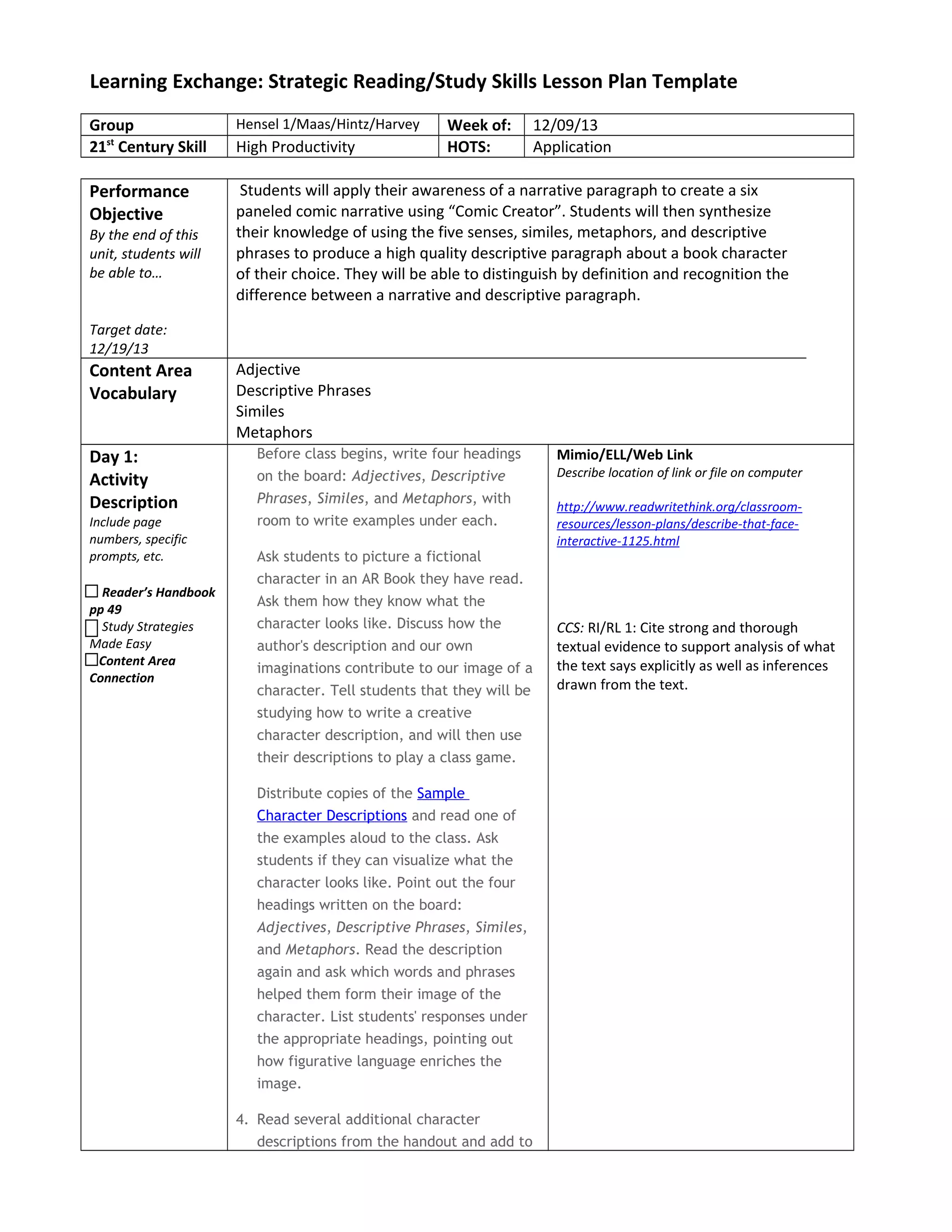
    Learning Exchange: StrategicReading/Study Skills Lesson Plan Template Group Hensel 1/Maas/Hintz/Harvey Week of: 12/09/13 21st Century Skill High Productivity HOTS: Application Performance Objective By the end of this unit, students will be able to… Target date: 12/19/13 Students will apply their awareness of a narrative paragraph to create a six paneled comic narrative using “Comic Creator”. Students will then synthesize their knowledge of using the five senses, similes, metaphors, and descriptive phrases to produce a high quality descriptive paragraph about a book character of their choice. They will be able to distinguish by definition and recognition the difference between a narrative and descriptive paragraph. Content Area Vocabulary Adjective Descriptive Phrases Similes Metaphors Day 1: Activity Description Include page numbers, specific prompts, etc. Reader’s Handbook pp 49 Study Strategies Made Easy Content Area Connection Before class begins, write four headings on the board: Adjectives, Descriptive Phrases, Similes, and Metaphors, with room to write examples under each. Ask students to picture a fictional character in an AR Book they have read. Ask them how they know what the character looks like. Discuss how the author's description and our own imaginations contribute to our image of a character. Tell students that they will be studying how to write a creative character description, and will then use their descriptions to play a class game. Distribute copies of the Sample Character Descriptions and read one of the examples aloud to the class. Ask students if they can visualize what the character looks like. Point out the four headings written on the board: Adjectives, Descriptive Phrases, Similes, and Metaphors. Read the description again and ask which words and phrases helped them form their image of the character. List students' responses under the appropriate headings, pointing out how figurative language enriches the image. 4. Read several additional character descriptions from the handout and add to Mimio/ELL/Web Link Describe location of link or file on computer http://www.readwritethink.org/classroom- resources/lesson-plans/describe-that-face- interactive-1125.html CCS: RI/RL 1: Cite strong and thorough textual evidence to support analysis of what the text says explicitly as well as inferences drawn from the text.
  • 2.
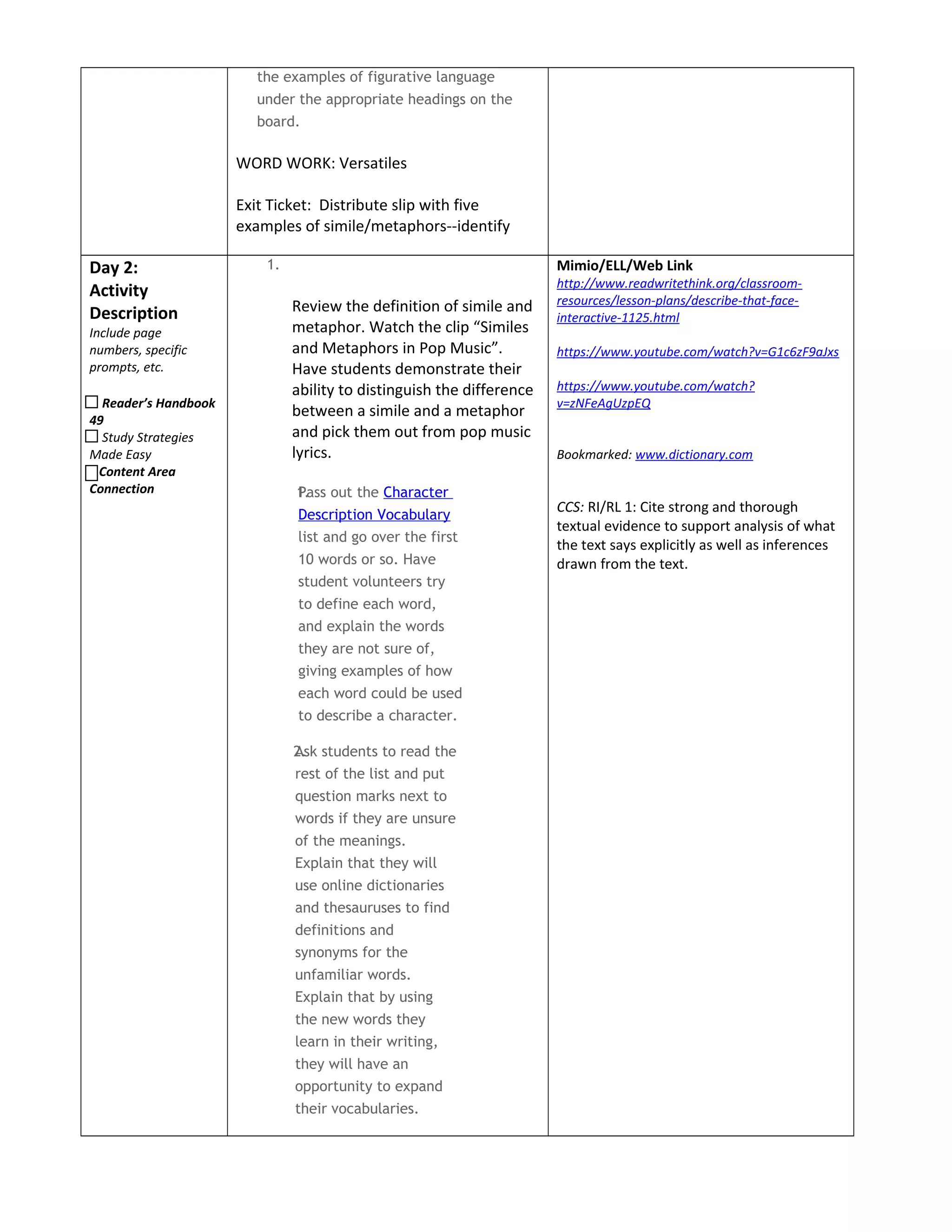
    the examples offigurative language under the appropriate headings on the board. WORD WORK: Versatiles Exit Ticket: Distribute slip with five examples of simile/metaphors--identify Day 2: Activity Description Include page numbers, specific prompts, etc. Reader’s Handbook 49 Study Strategies Made Easy Content Area Connection 1. Review the definition of simile and metaphor. Watch the clip “Similes and Metaphors in Pop Music”. Have students demonstrate their ability to distinguish the difference between a simile and a metaphor and pick them out from pop music lyrics. 1.Pass out the Character Description Vocabulary list and go over the first 10 words or so. Have student volunteers try to define each word, and explain the words they are not sure of, giving examples of how each word could be used to describe a character. 2.Ask students to read the rest of the list and put question marks next to words if they are unsure of the meanings. Explain that they will use online dictionaries and thesauruses to find definitions and synonyms for the unfamiliar words. Explain that by using the new words they learn in their writing, they will have an opportunity to expand their vocabularies. Mimio/ELL/Web Link http://www.readwritethink.org/classroom- resources/lesson-plans/describe-that-face- interactive-1125.html https://www.youtube.com/watch?v=G1c6zF9aJxs https://www.youtube.com/watch? v=zNFeAgUzpEQ Bookmarked: www.dictionary.com CCS: RI/RL 1: Cite strong and thorough textual evidence to support analysis of what the text says explicitly as well as inferences drawn from the text.
  • 3.
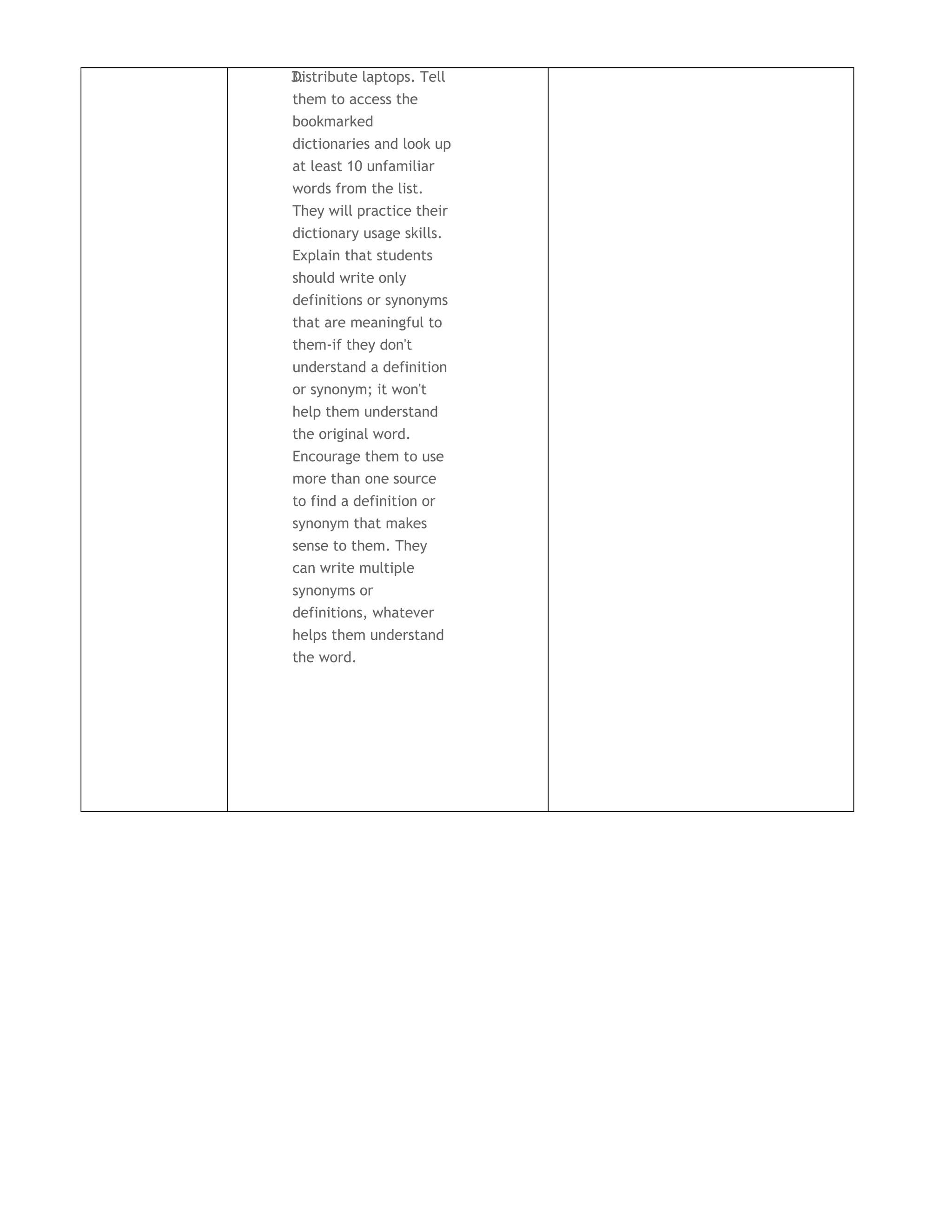
    3.Distribute laptops. Tell themto access the bookmarked dictionaries and look up at least 10 unfamiliar words from the list. They will practice their dictionary usage skills. Explain that students should write only definitions or synonyms that are meaningful to them-if they don't understand a definition or synonym; it won't help them understand the original word. Encourage them to use more than one source to find a definition or synonym that makes sense to them. They can write multiple synonyms or definitions, whatever helps them understand the word.