1
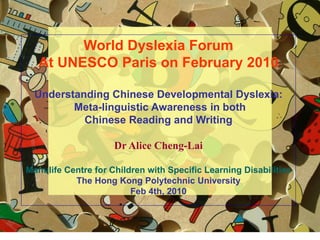
World Dyslexia Forum
At UNESCO Paris on February 2010
Understanding Chinese Developmental Dyslexia:
Meta-linguistic Awareness in both
Chinese Reading and Writing
Dr Alice Cheng-Lai
Manulife Centre for Children with Specific Learning Disabilities
The Hong Kong Polytechnic University
Feb 4th, 2010
Abstract
1. Learning to read Chinese requires rather different
insights from young readers than does an alphabetic
system.
2. Chinese readers with dyslexia were best distinguished
from age-matched controls with tasks of morphological
awareness, speeded number naming, and vocabulary
skill;
3. Performance on tasks of visual skills or phonological
awareness failed to distinguish the group.
4. Findings suggest that morphological awareness may
be a core theoretical construct necessary for
explaining variability in reading Chinese.
5. Morphological instruction helped Chinese
Developmental Dyslexia to master the structural rules
of different types of characters and to apply the rules
analytically when learning to read and write Chinese
characters.
Behavioral Evidence of Chinese
Developmental Dyslexia
• Logistic regression analyses revealed that Chinese
readers with dyslexia were best distinguished from age-
matched controls with tasks of morphological awareness,
speeded number naming, and vocabulary skill (Shu,
McBride-Chang, Wu & Liu, 2006)
• Path analyses further revealed that a construct of
morphological awareness was the strongest consistent
predictor of a variety of literacy-related skills across both
groups.
• The nature of the meta-linguistic insights that are
important for Chinese reading depends upon the writing
system.
Phonological Awareness in
Chinese
• Children in Mainland China have Pin-Yin (spell-
sound) training (which is, the teaching of
phonetics) before they start learning to read
Chinese, and it has been suggested to be
effective in Chinese reading acquisition and
development
• Zhu-Yin-Fu-Hao (sound annotating graphs) in
Taiwan has led to increased phonological
awareness which is important in Chinese
reading acquisition and development
Differences between
Mandarin & Cantonese
No. of Mandarin Cantonese
Tones 4 6 to 9
Distinct “tone syllables” 1300 2000
Syllables before differentiation 403 627
Rimes 36 53
* Cantonese has a more complicated
phonetic system than Mandarin *
Phonetic Systems
In Mainland China:
Spoken dialect: Putonghua
Phonetic system taught: Pin-Yin
In Taiwan:
Spoken dialect: Mandarin
Phonetic system taught: Zhu-Yin-Fu-Hao
In Hong Kong:
Spoken dialect: Cantonese
Phonetic system taught: None
Morphological Awareness Is Important
to Chinese Reading
• Morpheme awareness is the understanding that
words with the same pronunciation and may
have different meanings.
• Homograph awareness is the understanding that
the same character may have different meaning.
• Radical awareness concerns understanding the
role of radicals in the Chinese writing systems
Chinese Characters
Morpheme awareness -
Homophones (Initial)
Morpheme awareness
- Homophones (final)
Homographic awareness (Initial)
由
命
Homographic awareness (final)
水
右
Radical awareness
曷
昌
The role of phonological and morphological awareness
in learning to read Chinese (Shu, Anderson & Li, 2006)
Vocabulary
Sentence1
Sentence2
Tone
Morpheme1
Morpheme2
Radical1
Radical3
Phonological
Morphological
0.57
0.70
0.31
0.00
0.54
0.68
Cloze
Passage
Reading
0.48
0.57
1.00
0.68
0.57
0.45
0.13
0.60
0.80
Radical2
0.64
0.97
0.98
0.67
0.61
0.91
0.77
0.51
0.35
Caes QZY: Phonological awareness
• QZY Control (n=5)
• ----------------------------------------------------------------------------------------------
Auditory memory 0.60 0.96
Identification (single syllable) 0.50 0.88
Identification (word) 0.50 0.92
Syllable identification (real word) 0.94 0.98
(pseudo word) 0.92 1.00
Rime judgment 0.81 0.98
Concernment identification 0.42 0.90
Rime identification 0.42 0.92
Tone identification 0.50 0.90
Phoneme deletion 0.56 0.80
--------------------------------------------------------------------------------------------
QZY’s phonological awareness was week.
Case L: Morphological awareness
L Control(n=5)
-----------------------------------------------------------------------------------
Morpheme judgment 0.64 0.70
Meaning selection 0.25 0.58
-----------------------------------------------------------------------------------
Homophone selection
Radical 0.62 0.91
Morpheme 0.68 0.98
-----------------------------------------------------------------------------------
L performed poorly in morphological awareness tasks.
The unit of Chinese writing system map not onto phonemes or
syllables, but onto morphemes, units defined in term of both sound
and meaning
Morphological Awareness is a Core
Cognitive Construct in Chinese Reading
Significant Variables in First Step Logistic Regression
Variable x (1,N = 152)
Morpheme production 49.95
Phoneme deletion 23.53
No. naming 23.97
Vocabulary 27.99
No. repetition 18.04
2
Note: Chi-square is the change in -2log-likelihood if the predictor is removed
from the model. All ps<.001.
(Shu et al., 2006)
Morphological Awareness is a Core
Cognitive Construct in Chinese Reading
Prediction of Dyslexia
Note: Cutoff value p<.5.
(Shu et al., 2006)
Predicted
Observed Dyslexia Control Prediction
Rate
Dyslexic 59 16 78.7%
Control 18 59 76.7%
Production Rate 76.7% 78.7%
Model of Chinese character
recognition
Character
Reading
Morpheme
production
Number
naming
Vocabulary
Phoneme
delection
.509***
-.115*
.200**
.192**
-.327***
-.228***
-.377***
-.485***
-.261***
-.491***
R =.633
2
*p<.05. **p<.01. ***p<.001
Model of Chinese character
dictation
Character
Dictation
Morpheme
production
Number
naming
Vocabulary
Phoneme
delection
.422***
-.170*
.114
.193**
-.327***
-.228***
-.377***
-.485***
-.261***
R =.474
2
*p<.05. **p<.01. ***p<.001
.491***
Model of Chinese reading
comprehension
Comprehension
Morpheme
production
Number
naming
Vocabulary
Phoneme
delection
.320***
-.190*
.152**
.176**
-.327***
-.228***
-.377***
-.485***
-.261***
R =.633
2
*p<.05. **p<.01. ***p<.001
.491***
Chinese Morphological
Awareness Instruction
多媒體中英文訓練軟件
Chinese Morphological Awareness Instruction
( HK PolyU, 2007)
• Pictographic characters
• Simple ideographic characters
• Compound ideographic characters
• Semantic phonetic compound characters
• Orthographical awareness
• Selection of radical elements
• Homophones differentiation
• Homograph awareness
• Reading and writing activities
多媒體中英文訓練軟件
多媒體中英文訓練軟件
Chinese Morphological
Awareness Training Results
(HK PolyU, 2008)
Morphological Awareness
Measures
Morpheme production
The experimenter gave the word ‘cao3di4’
(meaning lawn), the child was asked to produce a
new word with the morpheme [cao3] had the
same meaning as it did in ‘cao3di4’.. One
acceptable answer would be xiao3cao3 (meaning
grass). The child was also asked to say a word
that included the morpheme [cao3] in which its
meaning was different from that in ‘cao3di’
Pre-
test
Post-
test % p
Exp. Mean 10.71 13.55 26.52% *** <.0001
SD 2.94 2.99
Con. Mean 11.4 12.82 12.46% *** <.0001
SD 3.52 3.17
Pseudo Word
Please put a ‘tick’ next to the real characters, and a ‘cross’ next to the
pseudo characters with illegal structures
Pre-
test
Post-
test % p
Exp. Mean 24.55 26.93 9.69% *** <.0001
SD 3.08 2.78
Con. Mean 24.76 26.08 5.33% *** <.0001
SD 3.12 3.62
Morphological Radical
Instructions:
In every trial you will hear a complete sentence, but the same sentence
in written form that you can see below misses a character. Circle the
missed character from the four options provided.
Practice:
野__是一種非常兇猛的動物。
A boar is a kind of very fierce animal.
(1) 渚 (islet) (2) 猪 (pig) (3) 諸 (various) (4) 著 (manifest)
Pre-
test
Post-
test % p
Exp. Mean 12.32 15.87 28.81% *** <.0001
SD 4.25 3.22
Con. Mean 13.21 15.45 16.96% *** <.0001
SD 4.28 3.64
Comprehension
Instructions
There are some sentences below. Some are acceptable while the
others are unacceptable. Please read silently and judge whether
These sentences are acceptable or not. If you think the sentence is
acceptable, put a ‘tick’ in the bracket, if not, put a ‘cross’ in the
bracket.
Examples
我喜歡吃書本 I like eating books ( )
我喜歡看電視 I like watching TV programs ( )
Pre-
test
Post-
test % p
Exp. Mean 15.55 17.15 10.29% *** <.0001
SD 2.72 2.14
Cont. Mean 16.46 17.27 4.92% *** <.0001
SD 2.76 2.48
Word Identification
Which of the following is the character ‘cun1’ in the
word ‘cun1 tin1’ (Spring)? …..Yes, it’s the first one,
you’re right, so you should circle the option 1. All right,
we will now start, and I will read twice for each item.
Listen carefully.
Practice: ____ tin1
1) cun1 (Spring) 2) ha6 (Summer) 3) cau1 (Autumn) 4)
dong1 (Winter)
Pre-
test
Post-
test % p
Exp. Mean 22.82 26.08 14.29% *** <.0001
SD 5.08 4.96
Cont. Mean 23.58 25.96 10.09% *** <.0001
SD 4.9 4.09
Word Meaning
There are pairs of words in the following. Each pair
has one common character. You have to judge
whether the common character of the pair of words
has the same meaning.
For example, the ‘mei5’ in ‘mei5 lai6’ (beautiful) is
different from that in ‘mei5 gwok3’ (United States), so
you should put a cross in the bracket.
Pre-
test
Post-
test % p
Exp. Mean 12.87 14.73 14.45% *** <.0001
SD 2.78 3.67
Cont. Mean 13.71 14.24 3.87% 0.110
SD 3.56 3.38
Morphological Instruction and Teacher
Training in Beijing & Hong Kong
• From various experimental findings, it could be concluded that
explicit teaching of the internal structures of Chinese characters
would be beneficial to character learning
• A well-structured pedagogy of morphological instruction should
enable children to use the structural rules analytically when they are
exposed to any new or unfamiliar Chinese characters
• Teachers in Beijing and Hong Kong found the pedagogy of
morphological instruction useful for children with dyslexia. They
observed that children can make use of such analytic strategies in
learning any new Chinese characters, which indicated that they
have learned the morphological rules of the Chinese orthography.
41
Thank You!
Dr Alice Cheng
ssalai@inet.polyu.edu.hk
Manulife Centre for Children with
Specific Learning Disabilities
The Hong Kong Polytechnic University
www.mccsld.org

'Understanding Chinese Developmental Dyslexia...' By Professor Alice Lai

  • 1.
    1 World Dyslexia Forum AtUNESCO Paris on February 2010 Understanding Chinese Developmental Dyslexia: Meta-linguistic Awareness in both Chinese Reading and Writing Dr Alice Cheng-Lai Manulife Centre for Children with Specific Learning Disabilities The Hong Kong Polytechnic University Feb 4th, 2010
  • 2.
    Abstract 1. Learning toread Chinese requires rather different insights from young readers than does an alphabetic system. 2. Chinese readers with dyslexia were best distinguished from age-matched controls with tasks of morphological awareness, speeded number naming, and vocabulary skill; 3. Performance on tasks of visual skills or phonological awareness failed to distinguish the group. 4. Findings suggest that morphological awareness may be a core theoretical construct necessary for explaining variability in reading Chinese. 5. Morphological instruction helped Chinese Developmental Dyslexia to master the structural rules of different types of characters and to apply the rules analytically when learning to read and write Chinese characters.
  • 3.
    Behavioral Evidence ofChinese Developmental Dyslexia • Logistic regression analyses revealed that Chinese readers with dyslexia were best distinguished from age- matched controls with tasks of morphological awareness, speeded number naming, and vocabulary skill (Shu, McBride-Chang, Wu & Liu, 2006) • Path analyses further revealed that a construct of morphological awareness was the strongest consistent predictor of a variety of literacy-related skills across both groups. • The nature of the meta-linguistic insights that are important for Chinese reading depends upon the writing system.
  • 4.
    Phonological Awareness in Chinese •Children in Mainland China have Pin-Yin (spell- sound) training (which is, the teaching of phonetics) before they start learning to read Chinese, and it has been suggested to be effective in Chinese reading acquisition and development • Zhu-Yin-Fu-Hao (sound annotating graphs) in Taiwan has led to increased phonological awareness which is important in Chinese reading acquisition and development
  • 5.
    Differences between Mandarin &Cantonese No. of Mandarin Cantonese Tones 4 6 to 9 Distinct “tone syllables” 1300 2000 Syllables before differentiation 403 627 Rimes 36 53 * Cantonese has a more complicated phonetic system than Mandarin *
  • 6.
    Phonetic Systems In MainlandChina: Spoken dialect: Putonghua Phonetic system taught: Pin-Yin In Taiwan: Spoken dialect: Mandarin Phonetic system taught: Zhu-Yin-Fu-Hao In Hong Kong: Spoken dialect: Cantonese Phonetic system taught: None
  • 7.
    Morphological Awareness IsImportant to Chinese Reading • Morpheme awareness is the understanding that words with the same pronunciation and may have different meanings. • Homograph awareness is the understanding that the same character may have different meaning. • Radical awareness concerns understanding the role of radicals in the Chinese writing systems
  • 8.
  • 9.
  • 10.
  • 11.
  • 12.
  • 13.
  • 14.
    The role ofphonological and morphological awareness in learning to read Chinese (Shu, Anderson & Li, 2006) Vocabulary Sentence1 Sentence2 Tone Morpheme1 Morpheme2 Radical1 Radical3 Phonological Morphological 0.57 0.70 0.31 0.00 0.54 0.68 Cloze Passage Reading 0.48 0.57 1.00 0.68 0.57 0.45 0.13 0.60 0.80 Radical2 0.64 0.97 0.98 0.67 0.61 0.91 0.77 0.51 0.35
  • 15.
    Caes QZY: Phonologicalawareness • QZY Control (n=5) • ---------------------------------------------------------------------------------------------- Auditory memory 0.60 0.96 Identification (single syllable) 0.50 0.88 Identification (word) 0.50 0.92 Syllable identification (real word) 0.94 0.98 (pseudo word) 0.92 1.00 Rime judgment 0.81 0.98 Concernment identification 0.42 0.90 Rime identification 0.42 0.92 Tone identification 0.50 0.90 Phoneme deletion 0.56 0.80 -------------------------------------------------------------------------------------------- QZY’s phonological awareness was week.
  • 16.
    Case L: Morphologicalawareness L Control(n=5) ----------------------------------------------------------------------------------- Morpheme judgment 0.64 0.70 Meaning selection 0.25 0.58 ----------------------------------------------------------------------------------- Homophone selection Radical 0.62 0.91 Morpheme 0.68 0.98 ----------------------------------------------------------------------------------- L performed poorly in morphological awareness tasks. The unit of Chinese writing system map not onto phonemes or syllables, but onto morphemes, units defined in term of both sound and meaning
  • 17.
    Morphological Awareness isa Core Cognitive Construct in Chinese Reading Significant Variables in First Step Logistic Regression Variable x (1,N = 152) Morpheme production 49.95 Phoneme deletion 23.53 No. naming 23.97 Vocabulary 27.99 No. repetition 18.04 2 Note: Chi-square is the change in -2log-likelihood if the predictor is removed from the model. All ps<.001. (Shu et al., 2006)
  • 18.
    Morphological Awareness isa Core Cognitive Construct in Chinese Reading Prediction of Dyslexia Note: Cutoff value p<.5. (Shu et al., 2006) Predicted Observed Dyslexia Control Prediction Rate Dyslexic 59 16 78.7% Control 18 59 76.7% Production Rate 76.7% 78.7%
  • 19.
    Model of Chinesecharacter recognition Character Reading Morpheme production Number naming Vocabulary Phoneme delection .509*** -.115* .200** .192** -.327*** -.228*** -.377*** -.485*** -.261*** -.491*** R =.633 2 *p<.05. **p<.01. ***p<.001
  • 20.
    Model of Chinesecharacter dictation Character Dictation Morpheme production Number naming Vocabulary Phoneme delection .422*** -.170* .114 .193** -.327*** -.228*** -.377*** -.485*** -.261*** R =.474 2 *p<.05. **p<.01. ***p<.001 .491***
  • 21.
    Model of Chinesereading comprehension Comprehension Morpheme production Number naming Vocabulary Phoneme delection .320*** -.190* .152** .176** -.327*** -.228*** -.377*** -.485*** -.261*** R =.633 2 *p<.05. **p<.01. ***p<.001 .491***
  • 22.
  • 23.
  • 24.
    Chinese Morphological AwarenessInstruction ( HK PolyU, 2007) • Pictographic characters • Simple ideographic characters • Compound ideographic characters • Semantic phonetic compound characters • Orthographical awareness • Selection of radical elements • Homophones differentiation • Homograph awareness • Reading and writing activities
  • 25.
  • 26.
  • 27.
  • 28.
    Morphological Awareness Measures Morpheme production Theexperimenter gave the word ‘cao3di4’ (meaning lawn), the child was asked to produce a new word with the morpheme [cao3] had the same meaning as it did in ‘cao3di4’.. One acceptable answer would be xiao3cao3 (meaning grass). The child was also asked to say a word that included the morpheme [cao3] in which its meaning was different from that in ‘cao3di’
  • 29.
    Pre- test Post- test % p Exp.Mean 10.71 13.55 26.52% *** <.0001 SD 2.94 2.99 Con. Mean 11.4 12.82 12.46% *** <.0001 SD 3.52 3.17
  • 30.
    Pseudo Word Please puta ‘tick’ next to the real characters, and a ‘cross’ next to the pseudo characters with illegal structures
  • 31.
    Pre- test Post- test % p Exp.Mean 24.55 26.93 9.69% *** <.0001 SD 3.08 2.78 Con. Mean 24.76 26.08 5.33% *** <.0001 SD 3.12 3.62
  • 32.
    Morphological Radical Instructions: In everytrial you will hear a complete sentence, but the same sentence in written form that you can see below misses a character. Circle the missed character from the four options provided. Practice: 野__是一種非常兇猛的動物。 A boar is a kind of very fierce animal. (1) 渚 (islet) (2) 猪 (pig) (3) 諸 (various) (4) 著 (manifest)
  • 33.
    Pre- test Post- test % p Exp.Mean 12.32 15.87 28.81% *** <.0001 SD 4.25 3.22 Con. Mean 13.21 15.45 16.96% *** <.0001 SD 4.28 3.64
  • 34.
    Comprehension Instructions There are somesentences below. Some are acceptable while the others are unacceptable. Please read silently and judge whether These sentences are acceptable or not. If you think the sentence is acceptable, put a ‘tick’ in the bracket, if not, put a ‘cross’ in the bracket. Examples 我喜歡吃書本 I like eating books ( ) 我喜歡看電視 I like watching TV programs ( )
  • 35.
    Pre- test Post- test % p Exp.Mean 15.55 17.15 10.29% *** <.0001 SD 2.72 2.14 Cont. Mean 16.46 17.27 4.92% *** <.0001 SD 2.76 2.48
  • 36.
    Word Identification Which ofthe following is the character ‘cun1’ in the word ‘cun1 tin1’ (Spring)? …..Yes, it’s the first one, you’re right, so you should circle the option 1. All right, we will now start, and I will read twice for each item. Listen carefully. Practice: ____ tin1 1) cun1 (Spring) 2) ha6 (Summer) 3) cau1 (Autumn) 4) dong1 (Winter)
  • 37.
    Pre- test Post- test % p Exp.Mean 22.82 26.08 14.29% *** <.0001 SD 5.08 4.96 Cont. Mean 23.58 25.96 10.09% *** <.0001 SD 4.9 4.09
  • 38.
    Word Meaning There arepairs of words in the following. Each pair has one common character. You have to judge whether the common character of the pair of words has the same meaning. For example, the ‘mei5’ in ‘mei5 lai6’ (beautiful) is different from that in ‘mei5 gwok3’ (United States), so you should put a cross in the bracket.
  • 39.
    Pre- test Post- test % p Exp.Mean 12.87 14.73 14.45% *** <.0001 SD 2.78 3.67 Cont. Mean 13.71 14.24 3.87% 0.110 SD 3.56 3.38
  • 40.
    Morphological Instruction andTeacher Training in Beijing & Hong Kong • From various experimental findings, it could be concluded that explicit teaching of the internal structures of Chinese characters would be beneficial to character learning • A well-structured pedagogy of morphological instruction should enable children to use the structural rules analytically when they are exposed to any new or unfamiliar Chinese characters • Teachers in Beijing and Hong Kong found the pedagogy of morphological instruction useful for children with dyslexia. They observed that children can make use of such analytic strategies in learning any new Chinese characters, which indicated that they have learned the morphological rules of the Chinese orthography.
  • 41.
    41 Thank You! Dr AliceCheng ssalai@inet.polyu.edu.hk Manulife Centre for Children with Specific Learning Disabilities The Hong Kong Polytechnic University www.mccsld.org