2.1 Fundamental Conceptsof Atom and Bonding
1. Atomic structure (โครงสร้างอะตอม)
จะเป็ นโครงสร้างของแต่ละอะตอมซึ่งประกอบไปด้วย
electrons และ นิวเคลียส (protons + neutrons)
Diameter of nucleus ~ 10-14 m
Diameter of atom ~ 10-10 m
Electron demonstration
Matsci by M Orings
6
7.
Electron จะวิ่งล้อมรอบ
ตัวเอง และรอบนิวเคลียสเป็ น
ชันๆ (shell)
้
ในแต่ละ shell จะมีจานวน
อิเลคตรอนที่บรรจุอยู่ได้มาก
ที่สด เท่ากับ 2n2 , n= shell
ุ
e-
number N
K
L
M
แบบจาลองอะตอมของ Bohr 7
8.
2.1 Fundamental Conceptsof Atom and Bonding
Elements Mass
Proton ~ 1.673×10⁻²⁴ g
Neutron ~ 1.675×10⁻²⁴ g
Electron ~ 9.11 ×10⁻²⁸ g
จากตารางธาตุ, Atomic number เป็ นตัวเลขที่
บอกจานวน protons ที่อยู่ในนิวเคลียส ซึ่งเท่ากับ
จานวนของ electrons
8
9.
2.1 Fundamental Conceptsof Atom and Bonding
เลขอะตอม (Atomic number) แทนด้วย Z
คือ จานวนของ protons ในนิวเคลียส = จานวนของ
electrons ในอะตอม
เลขมวล (Mass number) แทนด้วย A
คือ จานวนของ neutrons + protons
เช่น คาร์บอนจะมีจานวนอิเลคตรอนเท่ากับ 6 ดังนัน Z=6,
้
and A=12 แทนด้วยสัญลักษณ์ 6 C
12
9
10.
2.1 Fundamental Conceptsof Atom and Bonding
มวลอะตอม 1 หน่ วย (an atomic mass unit) หรือ
1 amu = 1.6610-24 g, มีค่าเท่ากับ 1/12 เท่าของมวลของ
อะตอมคาร์บอน ดังนัน คาร์บอน 1 อะตอม หนัก 12 amu
้
มวลอะตอม (Atomic mass, M)
หมายถึง มวลเป็ นกรัมของ 6.023 1023 atoms ของธาตุ
นันๆ
้
10
11.
โมล (Mole)
คือจานวนของสสารที่มีมวล (กรัม) เท่ากับมวลอะตอม เช่น 1 โมล
ของ คาร์บอนจะมีมวลเท่ากับ 12 กรัม หรือ โครเมียม 5 โมลมี
น้าหนัก 5 x 52 = 260 กรัม (Cr 1 mol. = 52 g.)
จานวนของอะตอมใน 1 โมล (The number of atoms in a mole)
เรียกว่า ‘the Avogadro number’, Nav มีค่าเท่ากับ 6.023 1023
atoms/mol, จานวนของอะตอมในปริมาตร (The number of
atoms, n) ต่อ cm3 เท่ากับ
dN av สมการ 2.1
n
M
M is the atomic mass in amu (grams per mol)
d is density (g/cm3) 11
ตัวอย่าง 2 Calculate the number of atoms per cm3(n) of
carbon with a density, d = 1.8 g/cm3, M =12 amu
n (Carbon) = 1.8 g/cm3 6.023 1023 atoms/mol = 9 1022 C/cm3
12 g/mol
For a molecular solid like ice, one uses the molecular mass, M
(H2O) = 18. With a density of 1 g/cm3,
n (H2O) = 1 g/cm3 6.023 1023 atoms/mol = 3.31022 H2O/cm3
18 g/mol
Note that since the water molecule contains 3 atoms, this is
equivalent to 9.9 1022 atoms/cm3. 13
‘A wave-mechanic model’
e-
N
K
L
M
รูปที่ 2.2 แบบจาลองการเคลื่อนที่ของอิเลคตรอนล้อมรอบนิวตรอน
จะมีจานวนวงโคจรจากัดที่สามารถเคลื่อนที่รอบๆนิวเคลียส
และวงโคจรเหล่านี้ จะเรียกโดยใช้ เลขควันตัม
15
16.
Quantum numbers
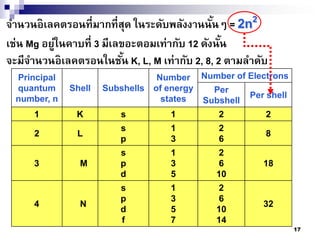
ตัวเลขควันตัมหลัก(a principal quantum number) n, เป็ นเลขจานวน
นับ หรือ บางครังจะใช้ตวอักษร K, L, M, N, O, P, Q แทน 1, 2, 3, 4, 5, 6,
้ ั
7 Shell (ชันหลัก)
้
ตัวเลขควันตัมที่ 2 The angular momentum, l จะบ่งถึงรูปร่างของ
อิเลคตรอนที่อยู่ใน Subshell แต่ละ Subshell จะแทนด้วยตัวอักษรพิมพ์
เล็ก s, p, d, f ทังหมด 4 ชันย่อย
้ ้
ตัวเลขควันตัมที่ 3 the number of energy states, ml จะบ่งถึงระดับ
พลังงานของอิเลคตรอน กล่าวคือ ในชัน s มีระดับพลังงานเดียว ส่วน
้
ชัน p, d และ f จะมี 3, 5 และ 7 ระดับพลังงาน ตามลาดับ
้
ตัวเลขควันตัมที่ 4 the projection in a specific direction, ms จะบ่งถึง
ทิศทางการหมุนขึน (+½) หรือ ลง (-½)
้ 16
17.
จานวนอิเลคตรอนที่มากที่สด ในระดับพลังงานนันๆ =2n2
ุ ้
เช่น Mg อยู่ในคาบที่ 3 มีเลขอะตอมเท่ากับ 12 ดังนัน
้
จะมีจานวนอิเลคตรอนในชัน K, L, M เท่ากับ 2, 8, 2 ตามลาดับ
้
Principal Number Number of Electrons
quantum Shell Subshells of energy Per
number, n states Per shell
Subshell
1 K s 1 2 2
s 1 2
2 L 8
p 3 6
s 1 2
3 M p 3 6 18
d 5 10
s 1 2
p 3 6
4 N 32
d 5 10
f 7 14
17
จานวน อิเลคตรอน
Level of
1s1 ใน subshell นันๆ
้
Subshells Subshells
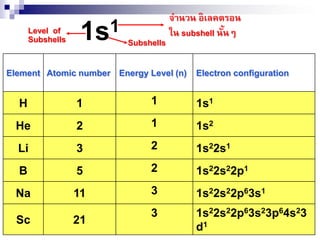
Element Atomic number Energy Level (n) Electron configuration
H 1 1 1s1
He 2 1 1s2
Li 3 2 1s22s1
B 5 2 1s22s22p1
Na 11 3 1s22s22p63s1
3 1s22s22p63s23p64s23
Sc 21
d1 19
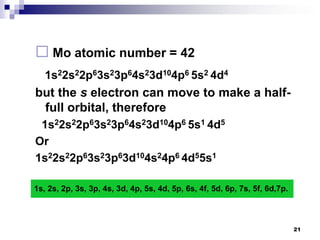
Mo atomicnumber = 42
1s22s22p63s23p64s23d104p6 5s2 4d4
but the s electron can move to make a half-
full orbital, therefore
1s22s22p63s23p64s23d104p6 5s1 4d5
Or
1s22s22p63s23p63d104s24p6 4d55s1
1s, 2s, 2p, 3s, 3p, 4s, 3d, 4p, 5s, 4d, 5p, 6s, 4f, 5d, 6p, 7s, 5f, 6d,7p.
21
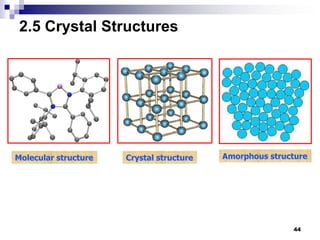
Figure 4. Anatomic resolution TEM image of Si/TbSi2/Si
heterostructure with simulated images pasted for direct comparison.
www.tms.org/pubs/journals/JOM/0509/fig4.large.gif 32
Covalent bond
คือพัน ธะหลัก ที่ เ กิ ด จากอะตอมที่ มี อิเ ลคตรอนไม่ เ ต็ม วง
นอกสุดมาทับกันและใช้อิเลคตรอนร่วมกัน จะเป็ นพันธะที่
มีทิศทางที่ แน่ นอน เช่นพันธะของ ceramics, เพชร เป็ น
ต้น N
N
1+ 7+ 1+
1+ 7+ 1+
H H
H H
1+
H
1+
H
36
37.
Covalent bond
Some CommonFeatures of Materials with Covalent
Bonds:
Hard
Good insulators
Transparent
Brittle or cleave rather than deform
37
Figure 3.2 BasicSi-0
tetrahedron in silicate
glass.
(c) 2003 Brooks/Cole Publishing / Thomson Learning™
The Science and Engineering of Materials, 4th ed
Donald R. Askeland – Pradeep P. Phulé 41
Metallic bond
Free Valence
Electron
Some Common Features of Materials with Metallic
Bonds:
Good electrical and thermal conductors due to their free
valence electrons
Opaque(ทึบแสง)
Relatively ductile
43
ระด ับของโครงสร้าง
1. Nanostructure
Nano-sized particles (5–10 nm) of
iron oxide are used in ferrofluids or
liquid magnets.
These nano-sized iron oxide
particles are dispersed in liquids and
commercially used as ferrofluids.
An application of these liquid
magnets is as a cooling (heat
transfer) medium for loudspeakers.
47
48.
ระด ับของโครงสร้าง
2. Microstructure
The mechanical strength of many
metals and alloys depends very strongly
on the grain size.
The grains and grain boundaries in
this accompanying micrograph of steel
are part of the microstructural features of
this crystalline material.
In general, at room temperature a
finer grain size leads to higher strength.
Many important properties of materials
are sensitive to the microstructure.
48
(a) Photograph ofa silicon single
crystal. (b) Micrograph of a
polycrystalline stainless steel
showing grains and grain
boundaries (Courtesy Dr. M. Hua,
Dr. I. Garcia, and Dr. A.J.
Deardo.)
The Science and Engineering of Materials, 4th ed
Donald R. Askeland – Pradeep P. Phulé 65
2.7 โครงสร้างผลึกของโลหะ
Metallic CrystalStructure
There are 3 common crystal structures of
metals
1. Body centered cubic structure-BCC
2. Face centered cubic structure-FCC
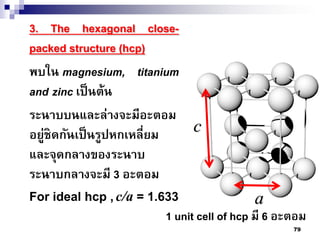
3. Hexagonal closed packed structure -
HCP
74
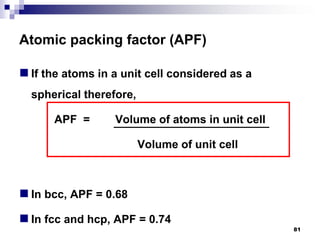
Atomic packing factor(APF)
If the atoms in a unit cell considered as a
spherical therefore,
APF = Volume of atoms in unit cell
Volume of unit cell
In bcc, APF = 0.68
In fcc and hcp, APF = 0.74
81
82.
แบบฝึ กหัด
Calculate the lattice constant (a) for BCC
structure of the iron unit cell with atomic
radius R=0.124 nm
Lead has a FCC crystal structure, an
atomic radius of 0.175 nm. Compute the
volume of Lead atoms in a unit cell
82
83.
2.8 ทิศทางของผลึก
Crystallographic Directions
เป็ นเวกเตอร์บงบอกทิศทางในผลึก ใช้แทนโดย [uvw] ซึ่ง
่
จะเป็ นตัวเลขนับ(integer number) ที่น้อยที่สดที่ฉาย
ุ
(projection) ของแกน x, y and z ใน unit cell
ทิศทางที่ เป็ นลบ จะมีขีดอยู่ข้างบน เช่น [100] จะตรงข้าม
กับ [100] [001] Z
[111]
Y [010]
[100] X
83
[110]
z
h d
gh = [011]
c
f
oa = [100] cd=fh = [100]
g y
ob = [110] oe = [120]
o
1/2
e
oc = [111] of = [101]
a b
x
oe ระยะฉายบนแกน X Y Z คือ (½ , 1, 0)
×2 ทุกค่ า เพือทาให้ เป็ นเลขจานวนเต็มทีน้อยทีสุด
่ ่ ่
จะได้ ดชนี [120]
ั
86
2.9 ระนาบผลึก
Crystallographic planes
Miller* indices is ‘ the reciprocals (ส่วนกลับ) of the
fractional intercepts (เศษส่วนของส่วนตัด) which the
plane makes with the crystallographic x, y and z axes
of the three nonparallel edges of the cubic unit cell’
For cubic plane ใช้สญลักษณ์ (hkl) for x, y and z axes
ั
* William Hallowes Miller (1801-1880)
88
89.
การหาค่าดัชนี มิลเลอร์
1. ่
เลือกระนาบที่ไม่ผานจุด (000)
2. หาจุดตัดบนแกนทัง 3 ของระนาบนัน ซึ่งอาจจะเป็ น
้ ้
เศษส่วนก็ได้แล้วกลับเศษเป็ นส่วน
3. คูณค่าทังสามที่ได้ด้วยค่า ค.ร.น ก็จะได้ค่าดัชนี ของ
้
ระนาบ
z
จากรูป
จุดตัดแกน X, Y, Z คือ 1, ,
0 ดังนัน กลับเศษส่วน ได้ 1, 0, 0
้
y
ดัชนี ระนาบแรเงา คือ (100)
(100)
89
x
90.
z จากรูป
จุดตัดแกน X, Y, Z คือ 1, 1,
(110)
ดังนัน กลับเศษส่วน ได้ 1, 1, 0
้
y ดัชนี ระนาบแรเงา คือ (110)
x
(111)
z
จากรูป
จุดตัดแกน X, Y, Z คือ 1, 1, 1
ดังนัน กลับเศษส่วน ได้ 1, 1, 1
้
y
ดัชนี ระนาบแรเงา คือ (111)
x
90
91.
z ½ จากรูป
½ จุดตัดแกน X, Y, Z คือ ½ , ½ ,
ดังนัน กลับเศษส่วน ได้ 2, 2, 0
้
y
ดัชนี ระนาบแรเงา คือ (220)
ทาให้เป็ นจานวนเต็มน้ อยที่สด ได้ (110)
ุ
x z
จากรูป
จุดตัดแกน X, Y, Z คือ , 1 , 1
ดังนัน กลับเศษส่วน ได้ 0, 1, 1
้
y ดัชนี ระนาบแรเงา คือ (011)
x
91
92.
z
กลับเศษส่วน เพือหาจุดตัดบนแกน X Y Z
่
(121) ดัชนี (121) กลับเศษส่วน ได้ 1 ½ 1
½ Plot on the unit cell
y
x
z
กลับเศษส่วน เพือหาจุดตัดบนแกน X Y Z
่
(121) ดัชนี (121) กลับเศษส่วน ได้ 1 -½ 1
-½
000
y Plot on the unit cell
x 92
A
B
C
การจัดเรียงตัวของอะตอมใน The hexagonal close-packed
structure
98
99.
2.10 Density Computations
2.10.1ความหนาแน่ นเชิงปริมาตร
ความหนาแน่ นของโลหะ () สามารถประมาณได้
จากความหนาแน่ นของ the unit cell ของธาตุนันๆ
้
สามารถคานวณได้จาก นามวลของอะตอมทังหมด ้
หารด้วยปริมาตรของ 1 unit cell
ถ้ามวลของอะตอม, A มีหน่ วยเป็ น amu, เราต้อง
นามาหารด้วย the Avogadro number เพื่อที่จะได้มวล
อะตอม Matom ดังนี้
99
100.
nA
VC N A
n= จานวนอะตอมใน 1 unit cell
A= มวลอะตอม (amu)
VC = the volume of the cell
NA= the Avogadro number = 6.023 1023 atoms/mol
100
101.
Example
Determining the Density of BCC Iron
Determine the density of BCC iron, which has a lattice
parameter of 0.2866 nm.
Example 3.4 SOLUTION
Atoms/cell = 2, a0 = 0.2866 nm = 2.866 10-8 cm
Atomic mass = 55.847 g/mol
3
Volume of unit cell = a0 (2.866 10-8 cm)3 = 23.54 10-24
=
cm3/cell
Avogadro’s number NA = 6.02 1023 atoms/mol
(number of atoms/cell )(atomic mass of iron)
Density
(volume of unit cell)(Avogadro' s number)
(2)(55.847)
24
7.882 g / cm
3
(23.54 10 )(6.02 10 )
23
The Science and Engineering of Materials, 4th ed
Donald R. Askeland – Pradeep P. Phulé 101
102.
2.10.2 ความหนาแน่ นเชิงระนาบ
เป็นความหนาแน่ นของอะตอมในระนาบต่างๆ สามารถคานวณได้
จากสมการดังต่อไปนี้ n
p
A สมการ 2.7
เมื่อ n = จานวนอะตอมในระนาบ, A คือ พืนที่หน้ าตัด
้
2.10.3 ความหนาแน่ นเชิงเส้น
เป็ นความหนาแน่ นของอะตอมในทิศทางต่างๆ ในโครงสร้างผลึก
สามารถคานวณได้จากสมการดังต่อไปนี้
n สมการ 2.8
l
l
เมื่อ n = จานวนอะตอมที่ถกตัดผ่านในทิศทางนันๆ, l คือ ความยาว
ู ้ 102
ตาแหน่ งของอะตอมแปลกปลอมได้แก่
Substitutional atom อะตอมแปลกปลอมที่ มีขนาด
ใกล้เคียงกับอะตอมหลักจะเข้ามาแทนที่
Interstitial atom อะตอมแปลกปลอมที่มีขนาดเล็ก
กว่าจะเข้ามาแทรกอยู่ระหว่างอะตอมหลัก
Substitutional Interstitial atom
atom
113
114.
The Science andEngineering of Materials, 4th ed
Donald R. Askeland – Pradeep P. Phulé 114
















![2.8 ทิศทางของผลึก
Crystallographic Directions
เป็ นเวกเตอร์บงบอกทิศทางในผลึก ใช้แทนโดย [uvw] ซึ่ง
่
จะเป็ นตัวเลขนับ(integer number) ที่น้อยที่สดที่ฉาย
ุ
(projection) ของแกน x, y and z ใน unit cell
ทิศทางที่ เป็ นลบ จะมีขีดอยู่ข้างบน เช่น [100] จะตรงข้าม
กับ [100] [001] Z
[111]
Y [010]
[100] X
83
[110]](https://image.slidesharecdn.com/2thestructureofsolid-120228055949-phpapp02/85/2-the-structure-of-solid-83-320.jpg)
![Z [001]
[111]
000 Y [010]
X [110]
[100]
84](https://image.slidesharecdn.com/2thestructureofsolid-120228055949-phpapp02/85/2-the-structure-of-solid-84-320.jpg)
![วิธีการหาทิศทางของผลึก
1. กาหนด coordinate ของจุดเริ่มต้น(x1,y1,z1) และ สิ้นสุด
ของทิศทาง (x2,y2,z2)
2. ใช้ coordinate ปลายทาง ลบด้วย coordinate ต้นทาง
(x2,y2,z2) - (x1,y1,z1)= (x2-x1), (y2-y1), (z2-z1)
3. หากมีเศษส่วน ทาให้เป็ นเลขจานวนเต็มที่มีค่าน้ อย
4. ได้ดชนี [uvw] ไม่ต้องมีคอมม่าคัน หากค่าเป็ นลบให้
ั ่
เขียนไว้ด้านบนตัวเลขนัน ้
85](https://image.slidesharecdn.com/2thestructureofsolid-120228055949-phpapp02/85/2-the-structure-of-solid-85-320.jpg)
![z
h d
gh = [011]
c
f
oa = [100] cd=fh = [100]
g y
ob = [110] oe = [120]
o
1/2
e
oc = [111] of = [101]
a b
x
oe ระยะฉายบนแกน X Y Z คือ (½ , 1, 0)
×2 ทุกค่ า เพือทาให้ เป็ นเลขจานวนเต็มทีน้อยทีสุด
่ ่ ่
จะได้ ดชนี [120]
ั
86](https://image.slidesharecdn.com/2thestructureofsolid-120228055949-phpapp02/85/2-the-structure-of-solid-86-320.jpg)
![ ทุก direction vectors ที่ขนานกันจะสามารถใช้ดชนี แทน
ั
กันได้เพราะจุดเริ่มต้นสามารถเปลี่ยนได้
ถ้าระยะห่างระหว่างอะตอม (atom spacing) ในทิศที่ ขนาน
กับทิศทางเวกเตอร์นันเท่ากัน เราจะถือว่าทิศทางเวกเตอร์
้
นันๆเท่ากัน เช่น ในทิศทางของขอบผลึก (cubic edge)
้
Family System <100> = [100],[010],[001],[100],[010],[001]
<110> = ทิศทางทแยงด้านทัง 6 (cubic face diagonals)
้
<111> = ทิศทางทแยงมุมทัง 4 (cubic body diagonals)
้
87](https://image.slidesharecdn.com/2thestructureofsolid-120228055949-phpapp02/85/2-the-structure-of-solid-87-320.jpg)


![For hexagonal plane indices called Miller-Bravais
indices
Direction ใช้แทนโดย [uvtw],t=-(u+v)
Plane ใช้แทนโดย (hkil), i=-(h+k)
c (0001)
a3
a2
a1
96](https://image.slidesharecdn.com/2thestructureofsolid-120228055949-phpapp02/85/2-the-structure-of-solid-96-320.jpg)


