The Grid: past, present, future
Sandeep Kumar Poonia
Head Of Dept. CS/IT
B.E., M.Tech., UGC-NET
LM-IAENG, LM-IACSIT,LM-CSTA, LM-AIRCC, LM-SCIEI, AM-UACEE
The Grid
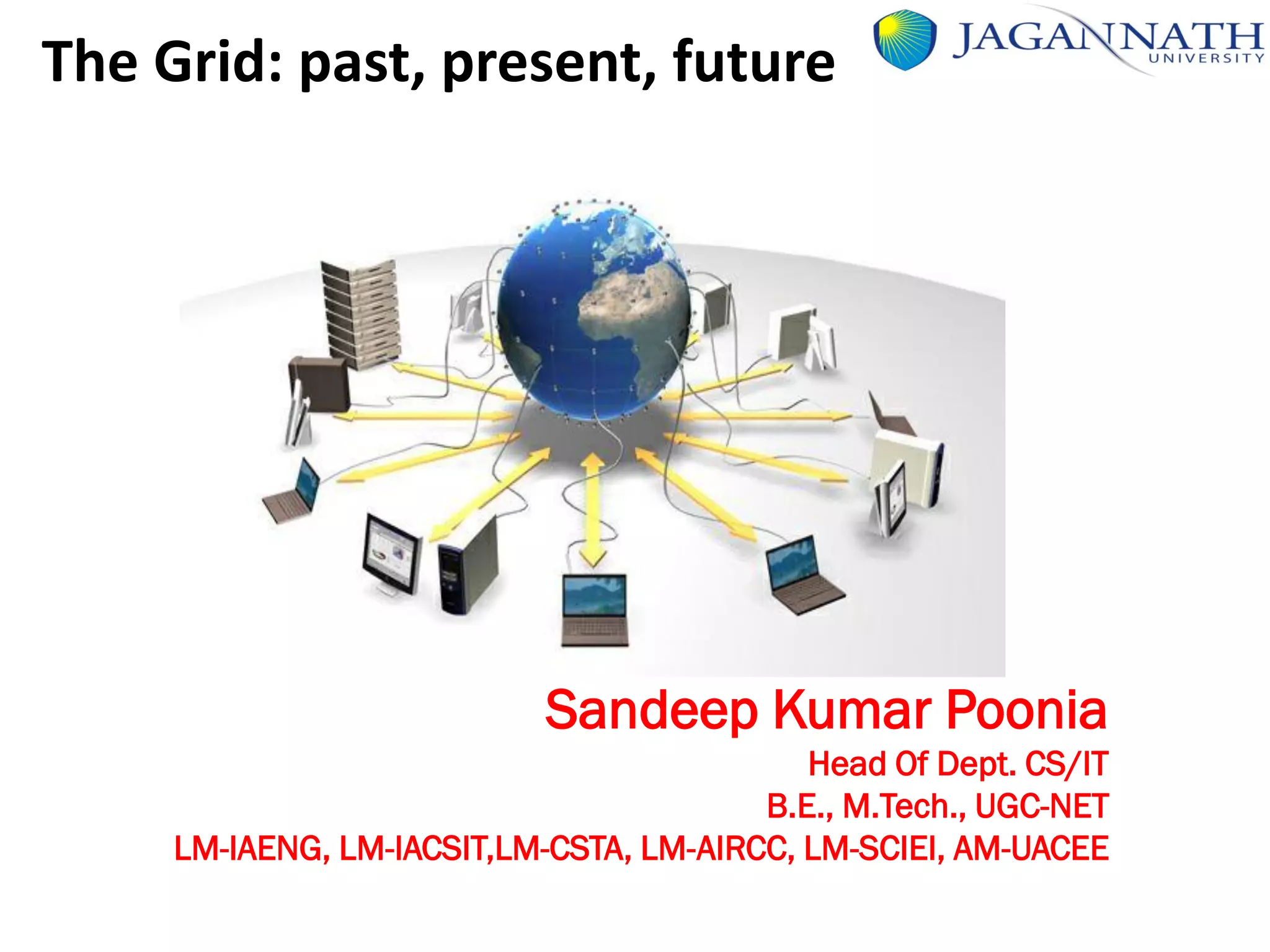
• The Grid is the computing and data
management infrastructure that will provide
the electronic underpinning for a global
society in business, government, research,
science and entertainment
“Grid infrastructure will provide us with the ability to
dynamically link together resources as an
ensemble to support the execution of large-scale,
resource-intensive, and distributed applications.”
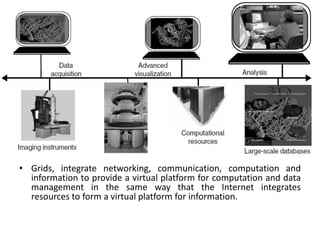
• Grids, integrate networking, communication, computation and
information to provide a virtual platform for computation and data
management in the same way that the Internet integrates
resources to form a virtual platform for information.
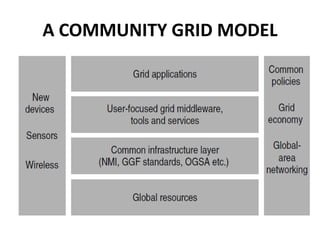
A COMMUNITY GRID MODEL
Global Resources
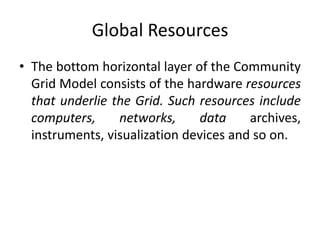
• The bottom horizontal layer of the Community
Grid Model consists of the hardware resources
that underlie the Grid. Such resources include
computers, networks, data archives,
instruments, visualization devices and so on.
Common Infrastructure
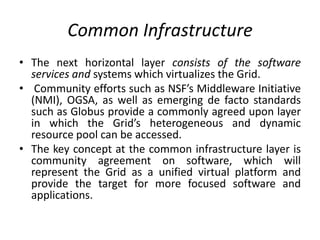
• The next horizontal layer consists of the software
services and systems which virtualizes the Grid.
• Community efforts such as NSF’s Middleware Initiative
(NMI), OGSA, as well as emerging de facto standards
such as Globus provide a commonly agreed upon layer
in which the Grid’s heterogeneous and dynamic
resource pool can be accessed.
• The key concept at the common infrastructure layer is
community agreement on software, which will
represent the Grid as a unified virtual platform and
provide the target for more focused software and
applications.
User and Application-Focused Grid
Middleware, Tools and Services
• The next horizontal layer contains software
packages built atop the common infrastructure.
• This software serves to enable applications to
more productively use Grid resources by masking
some of the complexity involved in system
activities such as authentication, file transfer, and
so on.
• Portals, community codes, application scheduling
software and so on reside in this layer and
provide middleware that connects applications
and users with the common Grid infrastructure.
Grid applications
• The topmost horizontal layer represents
applications and users.
• The Grid will ultimately be only as successful
as its user community and all of the other
horizontal layers must ensure that the Grid
presents a robust, stable, usable and useful
computational and data management
platform to the user.
New Devices – Sensors, PDAs, and
Wireless.
• The vertical layers represent the next steps for
the development of the Grid.
• The vertical layer on the left represents the
influence of new devices – sensors, PDAs, and
wireless.
• Over the next 10 years, these and other new
devices will need to be integrated with the Grid
and will exacerbate the challenges of managing
heterogeneity and promoting performance.
Policies for Sharing and using
Resources
• At the same time, the increasing globalization of the
Grid will require serious consideration of policies for
sharing and using resources, global-area networking
and the development of Grid economies.
• As we link together national Grids to form a Global
Grid, it will be increasingly important to develop Grid
social and economic policies which ensure the stability
of the system, promote the performance of the users
and successfully integrate disparate political,
technological and application cultures.
BUILDING BLOCKS OF THE GRID
Networks
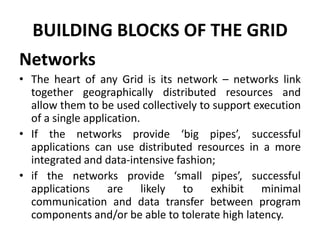
• The heart of any Grid is its network – networks link
together geographically distributed resources and
allow them to be used collectively to support execution
of a single application.
• If the networks provide ‘big pipes’, successful
applications can use distributed resources in a more
integrated and data-intensive fashion;
• if the networks provide ‘small pipes’, successful
applications are likely to exhibit minimal
communication and data transfer between program
components and/or be able to tolerate high latency.
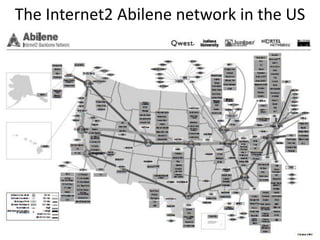
The Internet2 Abilene network in the US
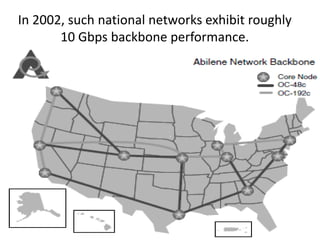
In 2002, such national networks exhibit roughly
10 Gbps backbone performance.
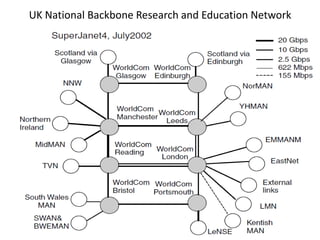
UK National Backbone Research and Education Network
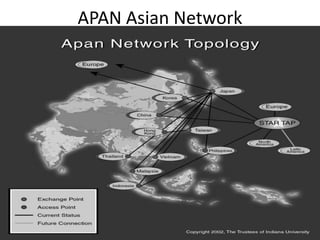
APAN Asian Network
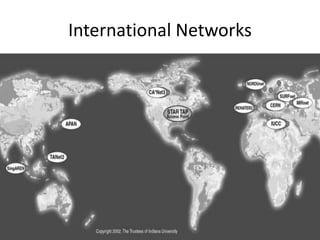
International Networks
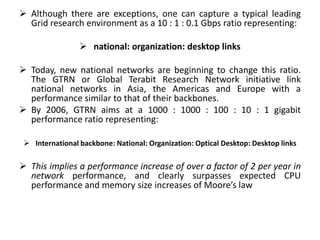
 Although there are exceptions, one can capture a typical leading
Grid research environment as a 10 : 1 : 0.1 Gbps ratio representing:
 national: organization: desktop links
 Today, new national networks are beginning to change this ratio.
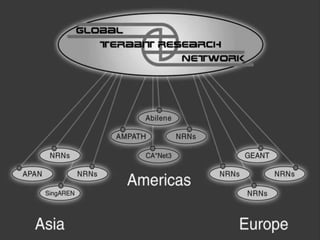
The GTRN or Global Terabit Research Network initiative link
national networks in Asia, the Americas and Europe with a
performance similar to that of their backbones.
 By 2006, GTRN aims at a 1000 : 1000 : 100 : 10 : 1 gigabit
performance ratio representing:
 International backbone: National: Organization: Optical Desktop: Desktop links
 This implies a performance increase of over a factor of 2 per year in
network performance, and clearly surpasses expected CPU
performance and memory size increases of Moore’s law
Common Infrastructure: Standards
 The development of key standards that allow the
complexity of the Grid to be managed by software
developers and users without heroic efforts is critical to
the success of the Grid.
 Both the Internet and the IETF , and the Web and the
W3C consortium have defined key standards such as
TCP/IP, HTTP, SOAP, XML and now WSDL – the Web
services definition language that underlines OGSA.
 Such standards have been critical for progress in these
communities.
 The GGF is now building key Grid-specific standards
such as OGSA, the emerging de facto standard for Grid
infrastructure.
Common Infrastructure: Standards
 In addition, NMI and the UK’s Grid Core Program are
seeking to extend, standardize and make more robust
key pieces of software for the Grid arsenal such as
Globus, Condor, OGSA-DAI and the Network Weather
Service.
 In the last two decades, the development of PVM and
MPI, which pre-dated the modern Grid vision,
introduced parallel and distributed computing
concepts to an entire community and provided the
seeds for the community collaboration, which
characterizes the Grid community today.
GRID APPLICATIONS AND APPLICATION
MIDDLEWARE
Life science applications
One of the fastest-growing application areas in
Grid Computing is the Life Sciences.
Computational biology, bioinformatics, genomics,
computational neuroscience and other areas are
embracing Grid technology as a way to access,
collect and mine data [e.g. the Protein Data Bank,
the myGrid Project , the Biomedical Information
Research Network (BIRN)], accomplish large-scale
simulation and analysis (e.g. MCell), and to
connect to remote instruments
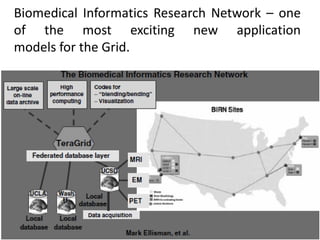
Biomedical Informatics Research Network – one
of the most exciting new application
models for the Grid.
Engineering-oriented applications
The Grid has provided an important platform for making resource
intensive engineering applications more cost-effective. One of the
most comprehensive approaches to deploying production Grid
infrastructure and developing large-scale engineering-oriented Grid
applications is the NASA IPG in the United States. The NASA IPG
vision provides a blueprint for revolutionizing the way in which
NASA executes large-scale science and engineering problems via
the development of
 persistent Grid infrastructure supporting ‘highly capable’ computing
and data management services that, on demand, will locate and co-
schedule the multicenter resources needed to address large-scale
and/or widely distributed problems,
 ancillary services needed to support the workflow management
frameworks that coordinate the processes of distributed science
and engineering problems.
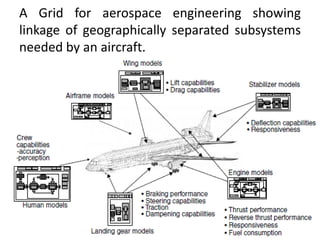
A Grid for aerospace engineering showing
linkage of geographically separated subsystems
needed by an aircraft.
Data-oriented applications
Data is emerging as the ‘killer application’ of
the Grid.
Over the next decade, data will come from
everywhere – scientific instruments,
experiments, sensors and sensornets, as well
as a plethora of new devices.
The Grid will be used to collect, store and
analyze data and information, as well as to
synthesize knowledge from data.
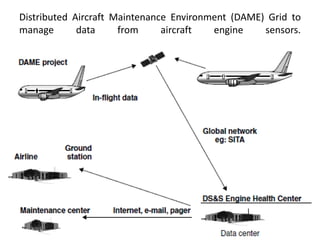
Distributed Aircraft Maintenance Environment (DAME) Grid to
manage data from aircraft engine sensors.
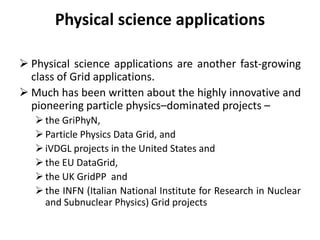
Physical science applications
 Physical science applications are another fast-growing
class of Grid applications.
 Much has been written about the highly innovative and
pioneering particle physics–dominated projects –
the GriPhyN,
Particle Physics Data Grid, and
iVDGL projects in the United States and
the EU DataGrid,
the UK GridPP and
the INFN (Italian National Institute for Research in Nuclear
and Subnuclear Physics) Grid projects
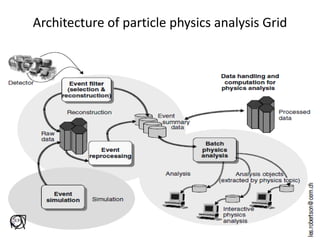
Architecture of particle physics analysis Grid
Commercial Applications
In the commercial world, Grid, Web and distributed computing, and
information concepts are being used in an innovative way in a wide variety
of areas including inventory control, enterprise computing, games and so
on.
Enterprise computing areas where the Grid approach can be applied include
end-to-end automation,
end-to-end security,
virtual server hosting,
disaster recovery,
heterogeneous workload
management,
end-to-end systems management,
scalable clustering,
accessing the infrastructure,
‘utility’ computing,
accessing new capability more
quickly,
better performance,
reducing up-front investment,
gaining expertise not available
internally, and
Web-based access (portal) for
control (programming) of enterprise
function.
Next-generation Grid applications
Next-generation Grid applications will include
the following:
Adaptive applications (run where you can find
resources satisfying criteria X),
Real-time and on-demand applications (do
something right now),
Coordinated applications (dynamic programming,
branch and bound) and
Poly-applications (choice of resources for different
components).

2. the grid

  • 1.
    The Grid: past,present, future Sandeep Kumar Poonia Head Of Dept. CS/IT B.E., M.Tech., UGC-NET LM-IAENG, LM-IACSIT,LM-CSTA, LM-AIRCC, LM-SCIEI, AM-UACEE
  • 2.
    The Grid • TheGrid is the computing and data management infrastructure that will provide the electronic underpinning for a global society in business, government, research, science and entertainment “Grid infrastructure will provide us with the ability to dynamically link together resources as an ensemble to support the execution of large-scale, resource-intensive, and distributed applications.”
  • 3.
    • Grids, integratenetworking, communication, computation and information to provide a virtual platform for computation and data management in the same way that the Internet integrates resources to form a virtual platform for information.
  • 4.
  • 5.
    Global Resources • Thebottom horizontal layer of the Community Grid Model consists of the hardware resources that underlie the Grid. Such resources include computers, networks, data archives, instruments, visualization devices and so on.
  • 6.
    Common Infrastructure • Thenext horizontal layer consists of the software services and systems which virtualizes the Grid. • Community efforts such as NSF’s Middleware Initiative (NMI), OGSA, as well as emerging de facto standards such as Globus provide a commonly agreed upon layer in which the Grid’s heterogeneous and dynamic resource pool can be accessed. • The key concept at the common infrastructure layer is community agreement on software, which will represent the Grid as a unified virtual platform and provide the target for more focused software and applications.
  • 7.
    User and Application-FocusedGrid Middleware, Tools and Services • The next horizontal layer contains software packages built atop the common infrastructure. • This software serves to enable applications to more productively use Grid resources by masking some of the complexity involved in system activities such as authentication, file transfer, and so on. • Portals, community codes, application scheduling software and so on reside in this layer and provide middleware that connects applications and users with the common Grid infrastructure.
  • 8.
    Grid applications • Thetopmost horizontal layer represents applications and users. • The Grid will ultimately be only as successful as its user community and all of the other horizontal layers must ensure that the Grid presents a robust, stable, usable and useful computational and data management platform to the user.
  • 9.
    New Devices –Sensors, PDAs, and Wireless. • The vertical layers represent the next steps for the development of the Grid. • The vertical layer on the left represents the influence of new devices – sensors, PDAs, and wireless. • Over the next 10 years, these and other new devices will need to be integrated with the Grid and will exacerbate the challenges of managing heterogeneity and promoting performance.
  • 10.
    Policies for Sharingand using Resources • At the same time, the increasing globalization of the Grid will require serious consideration of policies for sharing and using resources, global-area networking and the development of Grid economies. • As we link together national Grids to form a Global Grid, it will be increasingly important to develop Grid social and economic policies which ensure the stability of the system, promote the performance of the users and successfully integrate disparate political, technological and application cultures.
  • 11.
    BUILDING BLOCKS OFTHE GRID Networks • The heart of any Grid is its network – networks link together geographically distributed resources and allow them to be used collectively to support execution of a single application. • If the networks provide ‘big pipes’, successful applications can use distributed resources in a more integrated and data-intensive fashion; • if the networks provide ‘small pipes’, successful applications are likely to exhibit minimal communication and data transfer between program components and/or be able to tolerate high latency.
  • 12.
    The Internet2 Abilenenetwork in the US
  • 13.
    In 2002, suchnational networks exhibit roughly 10 Gbps backbone performance.
  • 14.
    UK National BackboneResearch and Education Network
  • 15.
  • 16.
  • 18.
     Although thereare exceptions, one can capture a typical leading Grid research environment as a 10 : 1 : 0.1 Gbps ratio representing:  national: organization: desktop links  Today, new national networks are beginning to change this ratio. The GTRN or Global Terabit Research Network initiative link national networks in Asia, the Americas and Europe with a performance similar to that of their backbones.  By 2006, GTRN aims at a 1000 : 1000 : 100 : 10 : 1 gigabit performance ratio representing:  International backbone: National: Organization: Optical Desktop: Desktop links  This implies a performance increase of over a factor of 2 per year in network performance, and clearly surpasses expected CPU performance and memory size increases of Moore’s law
  • 19.
    Common Infrastructure: Standards The development of key standards that allow the complexity of the Grid to be managed by software developers and users without heroic efforts is critical to the success of the Grid.  Both the Internet and the IETF , and the Web and the W3C consortium have defined key standards such as TCP/IP, HTTP, SOAP, XML and now WSDL – the Web services definition language that underlines OGSA.  Such standards have been critical for progress in these communities.  The GGF is now building key Grid-specific standards such as OGSA, the emerging de facto standard for Grid infrastructure.
  • 20.
    Common Infrastructure: Standards In addition, NMI and the UK’s Grid Core Program are seeking to extend, standardize and make more robust key pieces of software for the Grid arsenal such as Globus, Condor, OGSA-DAI and the Network Weather Service.  In the last two decades, the development of PVM and MPI, which pre-dated the modern Grid vision, introduced parallel and distributed computing concepts to an entire community and provided the seeds for the community collaboration, which characterizes the Grid community today.
  • 21.
    GRID APPLICATIONS ANDAPPLICATION MIDDLEWARE Life science applications One of the fastest-growing application areas in Grid Computing is the Life Sciences. Computational biology, bioinformatics, genomics, computational neuroscience and other areas are embracing Grid technology as a way to access, collect and mine data [e.g. the Protein Data Bank, the myGrid Project , the Biomedical Information Research Network (BIRN)], accomplish large-scale simulation and analysis (e.g. MCell), and to connect to remote instruments
  • 22.
    Biomedical Informatics ResearchNetwork – one of the most exciting new application models for the Grid.
  • 23.
    Engineering-oriented applications The Gridhas provided an important platform for making resource intensive engineering applications more cost-effective. One of the most comprehensive approaches to deploying production Grid infrastructure and developing large-scale engineering-oriented Grid applications is the NASA IPG in the United States. The NASA IPG vision provides a blueprint for revolutionizing the way in which NASA executes large-scale science and engineering problems via the development of  persistent Grid infrastructure supporting ‘highly capable’ computing and data management services that, on demand, will locate and co- schedule the multicenter resources needed to address large-scale and/or widely distributed problems,  ancillary services needed to support the workflow management frameworks that coordinate the processes of distributed science and engineering problems.
  • 24.
    A Grid foraerospace engineering showing linkage of geographically separated subsystems needed by an aircraft.
  • 25.
    Data-oriented applications Data isemerging as the ‘killer application’ of the Grid. Over the next decade, data will come from everywhere – scientific instruments, experiments, sensors and sensornets, as well as a plethora of new devices. The Grid will be used to collect, store and analyze data and information, as well as to synthesize knowledge from data.
  • 26.
    Distributed Aircraft MaintenanceEnvironment (DAME) Grid to manage data from aircraft engine sensors.
  • 27.
    Physical science applications Physical science applications are another fast-growing class of Grid applications.  Much has been written about the highly innovative and pioneering particle physics–dominated projects – the GriPhyN, Particle Physics Data Grid, and iVDGL projects in the United States and the EU DataGrid, the UK GridPP and the INFN (Italian National Institute for Research in Nuclear and Subnuclear Physics) Grid projects
  • 28.
    Architecture of particlephysics analysis Grid
  • 29.
    Commercial Applications In thecommercial world, Grid, Web and distributed computing, and information concepts are being used in an innovative way in a wide variety of areas including inventory control, enterprise computing, games and so on. Enterprise computing areas where the Grid approach can be applied include end-to-end automation, end-to-end security, virtual server hosting, disaster recovery, heterogeneous workload management, end-to-end systems management, scalable clustering, accessing the infrastructure, ‘utility’ computing, accessing new capability more quickly, better performance, reducing up-front investment, gaining expertise not available internally, and Web-based access (portal) for control (programming) of enterprise function.
  • 30.
    Next-generation Grid applications Next-generationGrid applications will include the following: Adaptive applications (run where you can find resources satisfying criteria X), Real-time and on-demand applications (do something right now), Coordinated applications (dynamic programming, branch and bound) and Poly-applications (choice of resources for different components).