Revised by LBS , March 2010 Fundamentals of Management 5 th  Edition   Work  Adaption from: Stephen P. Robbins David A. DeCenzo
Classical Contributions Classical approach The term used to describe the hypotheses of the scientific management theorists and the general administrative theorists. Scientific management theorists Fredrick W. Taylor, Frank and Lillian Gilbreth, and Henry Gantt General administrative theorists Henri Fayol and Max Weber Revised by LBS , March 2010
Classical Contributions Emphasis is on: a. rationality b. making organizations and workers as efficient as possible.  Revised by LBS , March 2010
Scientific Management Frederick W. Taylor The Principles of Scientific Management (1911) Advocated the use of the scientific method to define the “one best way” for a job to be done Believed that increased efficiency could be achieved by selecting the right people for the job and training them to do it precisely in the one best way. (specialization) Revised by LBS , March 2010
Scientific Management Frederick W. Taylor To motivate workers, he favored incentive wage plans. Separated managerial work from operative work. Also known as “Taylorism” , an adaption study in globalization. Taylor’s model being utilized by firms around the world.  Revised by LBS , March 2010
Taylor’s Four Principles of Management Develop a science for each element of an individual’s work, which replaces the old rule-of-thumb method. Scientifically select and then train, teach, and develop the worker. (Previously, workers chose their own work and trained themselves as best they could.) Heartily cooperate with the workers so as to ensure that all work is done in accordance with the principles of the science that has been developed. Divide work and responsibility almost equally between management and workers. Management takes over all work for which it is better fitted than the workers. (Previously, almost all the work and the greater part of the responsibility were thrown upon the workers.) Revised by LBS , March 2010
Scientific Management Frank & Lilian Gilbreth  - Studied work to eliminate inefficient hand-and-body motions. └  using motion picture - experimented with the design and use of the proper tools and  equipment for optimizing work performance. └  best known for his brick-laying experiment. - 17 basic hand motions (search,grasp,hold…)  “ therbilgs” Revised by LBS , March 2010
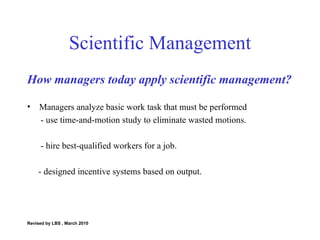
Scientific Management How managers today apply scientific management? Managers analyze basic work task that must be performed - use time-and-motion study to eliminate wasted motions. - hire best-qualified workers for a job. - designed incentive systems based on output. Revised by LBS , March 2010
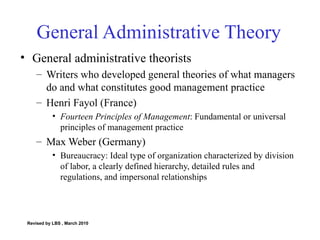
General Administrative Theory General administrative theorists Writers who developed general theories of what managers do and what constitutes good management practice Henri Fayol (France) Fourteen Principles of Management : Fundamental or universal principles of management practice Max Weber (Germany) Bureaucracy: Ideal type of organization characterized by division of labor, a clearly defined hierarchy, detailed rules and regulations, and impersonal relationships Revised by LBS , March 2010
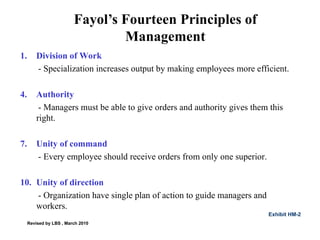
Fayol’s Fourteen Principles of Management Exhibit HM-2 Division of Work - Specialization increases output by making employees more efficient. Authority - Managers must be able to give orders and authority gives them this right. Unity of command - Every employee should receive orders from only one superior. Unity of direction - Organization have single plan of action to guide managers and workers. Revised by LBS , March 2010
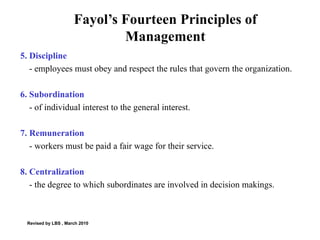
Fayol’s Fourteen Principles of Management 5. Discipline  - employees must obey and respect the rules that govern the organization. 6. Subordination  - of individual interest to the general interest.  7. Remuneration - workers must be paid a fair wage for their service. 8. Centralization - the degree to which subordinates are involved in decision makings. Revised by LBS , March 2010
Fayol’s Fourteen Principles of Management 9. Scalar chain - line of authority from top management to lowest rank 10. Order - people and materials should be in the right place at the right time. 11. Equity - managers should be kind and fair to their subordinates.  12. Stability of tenure of personnel  - orderly personnel planning  - human resource management. Revised by LBS , March 2010
Fayol’s Fourteen Principles of Management 13. Initiative -  employees allowed to originate and carry out plans will exert high levels of effort.  14. Espirit de corps - promoting team spirit will build harmony and unity within the organizations ( 1 Malaysia?) Revised by LBS , March 2010
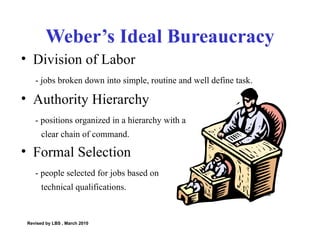
Weber’s Ideal Bureaucracy Division of Labor - jobs broken down into simple, routine and well define task. Authority Hierarchy - positions organized in a hierarchy with a  clear chain of command.  Formal Selection - people selected for jobs based on  technical qualifications. Revised by LBS , March 2010
Weber’s Ideal Bureaucracy Formal Rules and Regulations - Systems of written rules and standard operating  procedures. Impersonality - Uniform applications of rules and controls, not according to personalities. Career Orientation -Managers are career professionals, not owners of units they manage.  Revised by LBS , March 2010
General Administrative Theories How managers today apply GMT? Functional view of  the manager’s job – Fayol  Fayol 14 principle – framework for current management concepts. Weber’s bureacracy  - ideal prototype for organizations. - evident in large companies. - may hinder employees’ creativity └   flexible organizations Revised by LBS , March 2010
Quantitative Approach Also known as decision science / science management. Involves applying  statistics, optimization models, information models, computer simulations to management activities. Linear-programming – improve allocation resource decisions  Total Quality Management  - important contributor.  Revised by LBS , March 2010
Quantitative Approach Total Quality Management - a management philosophy devoted to continual improvement and  responding to customer needs and expectations. “ Customers “ , encompass employees & suppliers , the people who purchase the goods and services. Continuous improvement - accurate measurements which require statistical measurement are  compared against standards to identify and correct problems.  Revised by LBS , March 2010
How managers today apply Quantitative approach? Queue management (Tesco – queue buster uses this technique) Budgeting, scheduling, quality control (with the help of specialized software) Quantitative Approach Revised by LBS , March 2010
Managers get things done by working with people └  explains why some writers choose to look at management by  focusing on an organization’s people.  Organizational behavior  - field of study that researches the action (behavior) of people at  work └  motivation, leadership, conflict , sabotage, absenteeism  Behavioral Approach Revised by LBS , March 2010
Hawthorne Studies A series of studies done by Elton Mayo during the 1920s and 1930s that provided new insights into group norms and behaviors Hawthorne effect Social norms or standards of the group are the key determinants of individual work behavior. Changed the prevalent view of the time that people were no different than machines. Revised by LBS , March 2010
Human Relations Movement Based on a belief in the importance of employee satisfaction—a satisfied worker was believed to be a productive worker. Advocates believed in people’s capabilities and were concerned with making management practices more humane. Dale Carnegie Abraham Maslow Revised by LBS , March 2010
How managers today apply Behavioral approach? Largely shape how today’s organization are managed. How to build teams How to motivate today’s employees. Money is no longer the main key motivator. Other intrinsic values.  Transactional leadership skills to motivate and lead employees.  Behavioral Approach Revised by LBS , March 2010
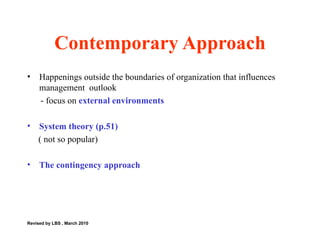
Happenings outside the boundaries of organization that influences management  outlook - focus on  external environments  System theory (p.51) ( not so popular) The contingency approach  Contemporary Approach Revised by LBS , March 2010
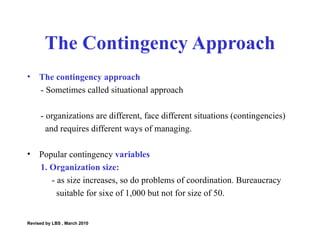
The contingency approach  -  Sometimes called situational approach  - organizations are different, face different situations (contingencies)  and requires different ways of managing.  Popular contingency  variables 1. Organization size: - as size increases, so do problems of coordination. Bureaucracy  suitable for sixe of 1,000 but not for size of 50.  The Contingency Approach Revised by LBS , March 2010
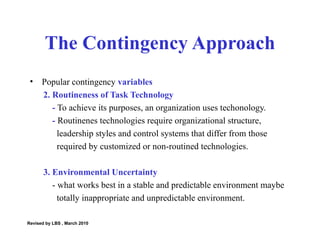
Popular contingency  variables 2. Routineness of Task Technology -  To achieve its purposes, an organization uses techonology. -  Routinenes technologies require organizational structure,  leadership styles and control systems that differ from those  required by customized or non-routined technologies.  3. Environmental Uncertainty - what works best in a stable and predictable environment maybe  totally inappropriate and unpredictable environment.  The Contingency Approach Revised by LBS , March 2010
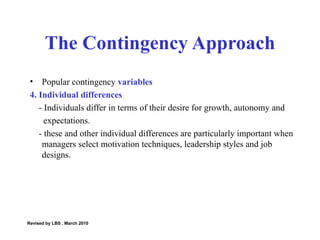
Popular contingency  variables 4. Individual differences -  Individuals differ in terms of their desire for growth, autonomy and  expectations.  - these and other individual differences are particularly important when managers select motivation techniques, leadership styles and job designs.  The Contingency Approach Revised by LBS , March 2010
The contingency approach and managers “ If” this is the situation, “then” this is the best way to manage Intuitively logical  - depends on situation The Contingency Approach Revised by LBS , March 2010

2 History Module

  • 1.
    Revised by LBS, March 2010 Fundamentals of Management 5 th Edition Work Adaption from: Stephen P. Robbins David A. DeCenzo
  • 2.
    Classical Contributions Classicalapproach The term used to describe the hypotheses of the scientific management theorists and the general administrative theorists. Scientific management theorists Fredrick W. Taylor, Frank and Lillian Gilbreth, and Henry Gantt General administrative theorists Henri Fayol and Max Weber Revised by LBS , March 2010
  • 3.
    Classical Contributions Emphasisis on: a. rationality b. making organizations and workers as efficient as possible. Revised by LBS , March 2010
  • 4.
    Scientific Management FrederickW. Taylor The Principles of Scientific Management (1911) Advocated the use of the scientific method to define the “one best way” for a job to be done Believed that increased efficiency could be achieved by selecting the right people for the job and training them to do it precisely in the one best way. (specialization) Revised by LBS , March 2010
  • 5.
    Scientific Management FrederickW. Taylor To motivate workers, he favored incentive wage plans. Separated managerial work from operative work. Also known as “Taylorism” , an adaption study in globalization. Taylor’s model being utilized by firms around the world. Revised by LBS , March 2010
  • 6.
    Taylor’s Four Principlesof Management Develop a science for each element of an individual’s work, which replaces the old rule-of-thumb method. Scientifically select and then train, teach, and develop the worker. (Previously, workers chose their own work and trained themselves as best they could.) Heartily cooperate with the workers so as to ensure that all work is done in accordance with the principles of the science that has been developed. Divide work and responsibility almost equally between management and workers. Management takes over all work for which it is better fitted than the workers. (Previously, almost all the work and the greater part of the responsibility were thrown upon the workers.) Revised by LBS , March 2010
  • 7.
    Scientific Management Frank& Lilian Gilbreth - Studied work to eliminate inefficient hand-and-body motions. └ using motion picture - experimented with the design and use of the proper tools and equipment for optimizing work performance. └ best known for his brick-laying experiment. - 17 basic hand motions (search,grasp,hold…) “ therbilgs” Revised by LBS , March 2010
  • 8.
    Scientific Management Howmanagers today apply scientific management? Managers analyze basic work task that must be performed - use time-and-motion study to eliminate wasted motions. - hire best-qualified workers for a job. - designed incentive systems based on output. Revised by LBS , March 2010
  • 9.
    General Administrative TheoryGeneral administrative theorists Writers who developed general theories of what managers do and what constitutes good management practice Henri Fayol (France) Fourteen Principles of Management : Fundamental or universal principles of management practice Max Weber (Germany) Bureaucracy: Ideal type of organization characterized by division of labor, a clearly defined hierarchy, detailed rules and regulations, and impersonal relationships Revised by LBS , March 2010
  • 10.
    Fayol’s Fourteen Principlesof Management Exhibit HM-2 Division of Work - Specialization increases output by making employees more efficient. Authority - Managers must be able to give orders and authority gives them this right. Unity of command - Every employee should receive orders from only one superior. Unity of direction - Organization have single plan of action to guide managers and workers. Revised by LBS , March 2010
  • 11.
    Fayol’s Fourteen Principlesof Management 5. Discipline - employees must obey and respect the rules that govern the organization. 6. Subordination - of individual interest to the general interest. 7. Remuneration - workers must be paid a fair wage for their service. 8. Centralization - the degree to which subordinates are involved in decision makings. Revised by LBS , March 2010
  • 12.
    Fayol’s Fourteen Principlesof Management 9. Scalar chain - line of authority from top management to lowest rank 10. Order - people and materials should be in the right place at the right time. 11. Equity - managers should be kind and fair to their subordinates. 12. Stability of tenure of personnel - orderly personnel planning - human resource management. Revised by LBS , March 2010
  • 13.
    Fayol’s Fourteen Principlesof Management 13. Initiative - employees allowed to originate and carry out plans will exert high levels of effort. 14. Espirit de corps - promoting team spirit will build harmony and unity within the organizations ( 1 Malaysia?) Revised by LBS , March 2010
  • 14.
    Weber’s Ideal BureaucracyDivision of Labor - jobs broken down into simple, routine and well define task. Authority Hierarchy - positions organized in a hierarchy with a clear chain of command. Formal Selection - people selected for jobs based on technical qualifications. Revised by LBS , March 2010
  • 15.
    Weber’s Ideal BureaucracyFormal Rules and Regulations - Systems of written rules and standard operating procedures. Impersonality - Uniform applications of rules and controls, not according to personalities. Career Orientation -Managers are career professionals, not owners of units they manage. Revised by LBS , March 2010
  • 16.
    General Administrative TheoriesHow managers today apply GMT? Functional view of the manager’s job – Fayol Fayol 14 principle – framework for current management concepts. Weber’s bureacracy - ideal prototype for organizations. - evident in large companies. - may hinder employees’ creativity └ flexible organizations Revised by LBS , March 2010
  • 17.
    Quantitative Approach Alsoknown as decision science / science management. Involves applying statistics, optimization models, information models, computer simulations to management activities. Linear-programming – improve allocation resource decisions Total Quality Management - important contributor. Revised by LBS , March 2010
  • 18.
    Quantitative Approach TotalQuality Management - a management philosophy devoted to continual improvement and responding to customer needs and expectations. “ Customers “ , encompass employees & suppliers , the people who purchase the goods and services. Continuous improvement - accurate measurements which require statistical measurement are compared against standards to identify and correct problems. Revised by LBS , March 2010
  • 19.
    How managers todayapply Quantitative approach? Queue management (Tesco – queue buster uses this technique) Budgeting, scheduling, quality control (with the help of specialized software) Quantitative Approach Revised by LBS , March 2010
  • 20.
    Managers get thingsdone by working with people └ explains why some writers choose to look at management by focusing on an organization’s people. Organizational behavior - field of study that researches the action (behavior) of people at work └ motivation, leadership, conflict , sabotage, absenteeism Behavioral Approach Revised by LBS , March 2010
  • 21.
    Hawthorne Studies Aseries of studies done by Elton Mayo during the 1920s and 1930s that provided new insights into group norms and behaviors Hawthorne effect Social norms or standards of the group are the key determinants of individual work behavior. Changed the prevalent view of the time that people were no different than machines. Revised by LBS , March 2010
  • 22.
    Human Relations MovementBased on a belief in the importance of employee satisfaction—a satisfied worker was believed to be a productive worker. Advocates believed in people’s capabilities and were concerned with making management practices more humane. Dale Carnegie Abraham Maslow Revised by LBS , March 2010
  • 23.
    How managers todayapply Behavioral approach? Largely shape how today’s organization are managed. How to build teams How to motivate today’s employees. Money is no longer the main key motivator. Other intrinsic values. Transactional leadership skills to motivate and lead employees. Behavioral Approach Revised by LBS , March 2010
  • 24.
    Happenings outside theboundaries of organization that influences management outlook - focus on external environments System theory (p.51) ( not so popular) The contingency approach Contemporary Approach Revised by LBS , March 2010
  • 25.
    The contingency approach - Sometimes called situational approach - organizations are different, face different situations (contingencies) and requires different ways of managing. Popular contingency variables 1. Organization size: - as size increases, so do problems of coordination. Bureaucracy suitable for sixe of 1,000 but not for size of 50. The Contingency Approach Revised by LBS , March 2010
  • 26.
    Popular contingency variables 2. Routineness of Task Technology - To achieve its purposes, an organization uses techonology. - Routinenes technologies require organizational structure, leadership styles and control systems that differ from those required by customized or non-routined technologies. 3. Environmental Uncertainty - what works best in a stable and predictable environment maybe totally inappropriate and unpredictable environment. The Contingency Approach Revised by LBS , March 2010
  • 27.
    Popular contingency variables 4. Individual differences - Individuals differ in terms of their desire for growth, autonomy and expectations. - these and other individual differences are particularly important when managers select motivation techniques, leadership styles and job designs. The Contingency Approach Revised by LBS , March 2010
  • 28.
    The contingency approachand managers “ If” this is the situation, “then” this is the best way to manage Intuitively logical - depends on situation The Contingency Approach Revised by LBS , March 2010