TOPIC:
KINEMATIC
S
SUB-TOPIC: DYNAMICS
VIEWS ON MOTION
10NM
Aristotle’s (384-322
BCE) Views on
Motion
• Felt that a force was needed to keep a
body moving because the object
would stop if the force was taken
away.
• He observed and compared a rock and
a leaf as they fell (under normal
circumstances), and proposed that it
was because of the greater weight of
the rock that caused it to fall first;
hence, the greater the force, the faster
the object moves.
• Force ∝ Velocity
Imagine this!!!
• If you had a leaf that had a
mass of 0.12g, and s stone
had a mass of 12g. It would
mean that the stone is 100
times heavier than the
feather. Even if we were to
factor in air resistance, the
stone would still NOT fall
100 times faster than the
feather.
Shortcomings of
His Theory
• He could not explain the reason a body
stopped momentarily in the air when
thrown upwards and appeared not to
need a force to get it back down. For
this he claimed that air rushed around
from the front of a moving object to the
back and push it.
• He could not explain the reason celestial
bodies, such as planets and the moon,
move for unexplained reasons. For this
he claimed that celestial matter was
different from earthly matter and that
they had “built-in” force required to
maintain their motion.
Note Well…
Aristotle’s views were based on assumption and
observation and not on experimentation.
Galileo and Newton had contradictory arguments through
made via experimentation that proved Aristotle’s views
inadequate.
Galileo’s (Galilei)
(1564-1642) Views on
Motion
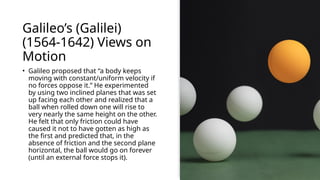
• Galileo proposed that “a body keeps
moving with constant/uniform velocity if
no forces oppose it.” He experimented
by using two inclined planes that was set
up facing each other and realized that a
ball when rolled down one will rise to
very nearly the same height on the other.
He felt that only friction could have
caused it not to have gotten as high as
the first and predicted that, in the
absence of friction and the second plane
horizontal, the ball would go on forever
(until an external force stops it).
Galileo’s (Galilei)
(1564-1642) Views
on Motion
He proposed that a force is not
necessary to keep a body
moving, however, a net force is
needed to change the velocity
by increasing or decreasing it,
hence:
Force ∝ Acceleration
Imagine this!!
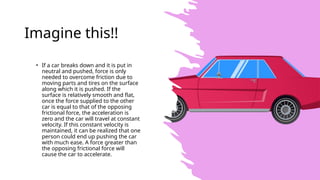
• If a car breaks down and it is put in
neutral and pushed, force is only
needed to overcome friction due to
moving parts and tires on the surface
along which it is pushed. If the
surface is relatively smooth and flat,
once the force supplied to the other
car is equal to that of the opposing
frictional force, the acceleration is
zero and the car will travel at constant
velocity. If this constant velocity is
maintained, it can be realized that one
person could end up pushing the car
with much ease. A force greater than
the opposing frictional force will
cause the car to accelerate.
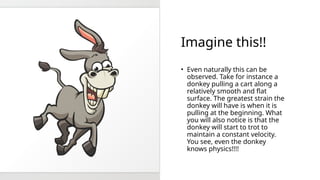
Imagine this!!
• Even naturally this can be
observed. Take for instance a
donkey pulling a cart along a
relatively smooth and flat
surface. The greatest strain the
donkey will have is when it is
pulling at the beginning. What
you will also notice is that the
donkey will start to trot to
maintain a constant velocity.
You see, even the donkey
knows physics!!!!
Galileo’s (Galilei)
(1564-1642) Views
on Motion
• He also demonstrated that a heavy
and light object, when dropped at
the same time, fell at the same rate.
• Galileo explained that why a leaf
and a rock fell at different rates was
because of air resistance. He
developed equations to predict the
velocities of moving bodies.
Experiments done later using a
vacuum showed that a heavy and
light objects do fall at the same rate.
Other Contributions…
• Was the first to suggest that things looked at under ideal
conditions.
• Developed the scientific method.
• Supported the Copernican theory: This model positioned the
Sun at the center of the Universe, motionless, with Earth
and the other planets orbiting around it in circular paths,
modified by epicycles, and at uniform speeds. By doing this,
he went against the Catholic Church.
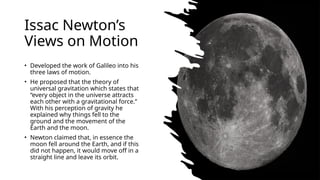
Issac Newton’s
Views on Motion
• Developed the work of Galileo into his
three laws of motion.
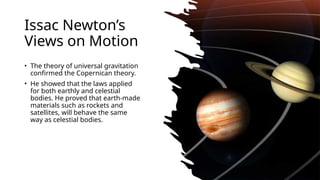
• He proposed that the theory of
universal gravitation which states that
“every object in the universe attracts
each other with a gravitational force.”
With his perception of gravity he
explained why things fell to the
ground and the movement of the
Earth and the moon.
• Newton claimed that, in essence the
moon fell around the Earth, and if this
did not happen, it would move off in a
straight line and leave its orbit.
Issac Newton’s
Views on Motion
• The theory of universal gravitation
confirmed the Copernican theory.
• He showed that the laws applied
for both earthly and celestial
bodies. He proved that earth-made
materials such as rockets and
satellites, will behave the same
way as celestial bodies.
Newton’s First Law
of Motion- The Law
of Inertia
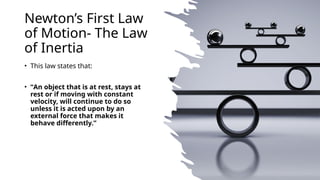
• This law states that:
• “An object that is at rest, stays at
rest or if moving with constant
velocity, will continue to do so
unless it is acted upon by an
external force that makes it
behave differently.”
Applications….
• A spacecraft in outer space will travel at
high speeds without an engine or fuel.
• An object/body at rest on a level
surface.
• A satellite in orbit.
Inertia
• This is the reluctance of a body to resist a
change in its state of motion. Mass is a
measure of the inertia of a body,
therefore the amount of inertia a body
has depends on its mass.
• A very heavy body is hard to move from
its stationary position, but when it starts
to move it is hard to stop, whereas it is
opposite for lighter objects.
Activities…
• Consider activities/Conditions that prove
inertia:

!>> Wondershare Dr.Fone Crack Version 2025?

  • 1.
  • 2.
    Aristotle’s (384-322 BCE) Viewson Motion • Felt that a force was needed to keep a body moving because the object would stop if the force was taken away. • He observed and compared a rock and a leaf as they fell (under normal circumstances), and proposed that it was because of the greater weight of the rock that caused it to fall first; hence, the greater the force, the faster the object moves. • Force ∝ Velocity
  • 3.
    Imagine this!!! • Ifyou had a leaf that had a mass of 0.12g, and s stone had a mass of 12g. It would mean that the stone is 100 times heavier than the feather. Even if we were to factor in air resistance, the stone would still NOT fall 100 times faster than the feather.
  • 4.
    Shortcomings of His Theory •He could not explain the reason a body stopped momentarily in the air when thrown upwards and appeared not to need a force to get it back down. For this he claimed that air rushed around from the front of a moving object to the back and push it. • He could not explain the reason celestial bodies, such as planets and the moon, move for unexplained reasons. For this he claimed that celestial matter was different from earthly matter and that they had “built-in” force required to maintain their motion.
  • 5.
    Note Well… Aristotle’s viewswere based on assumption and observation and not on experimentation. Galileo and Newton had contradictory arguments through made via experimentation that proved Aristotle’s views inadequate.
  • 6.
    Galileo’s (Galilei) (1564-1642) Viewson Motion • Galileo proposed that “a body keeps moving with constant/uniform velocity if no forces oppose it.” He experimented by using two inclined planes that was set up facing each other and realized that a ball when rolled down one will rise to very nearly the same height on the other. He felt that only friction could have caused it not to have gotten as high as the first and predicted that, in the absence of friction and the second plane horizontal, the ball would go on forever (until an external force stops it).
  • 7.
    Galileo’s (Galilei) (1564-1642) Views onMotion He proposed that a force is not necessary to keep a body moving, however, a net force is needed to change the velocity by increasing or decreasing it, hence: Force ∝ Acceleration
  • 8.
    Imagine this!! • Ifa car breaks down and it is put in neutral and pushed, force is only needed to overcome friction due to moving parts and tires on the surface along which it is pushed. If the surface is relatively smooth and flat, once the force supplied to the other car is equal to that of the opposing frictional force, the acceleration is zero and the car will travel at constant velocity. If this constant velocity is maintained, it can be realized that one person could end up pushing the car with much ease. A force greater than the opposing frictional force will cause the car to accelerate.
  • 9.
    Imagine this!! • Evennaturally this can be observed. Take for instance a donkey pulling a cart along a relatively smooth and flat surface. The greatest strain the donkey will have is when it is pulling at the beginning. What you will also notice is that the donkey will start to trot to maintain a constant velocity. You see, even the donkey knows physics!!!!
  • 10.
    Galileo’s (Galilei) (1564-1642) Views onMotion • He also demonstrated that a heavy and light object, when dropped at the same time, fell at the same rate. • Galileo explained that why a leaf and a rock fell at different rates was because of air resistance. He developed equations to predict the velocities of moving bodies. Experiments done later using a vacuum showed that a heavy and light objects do fall at the same rate.
  • 11.
    Other Contributions… • Wasthe first to suggest that things looked at under ideal conditions. • Developed the scientific method. • Supported the Copernican theory: This model positioned the Sun at the center of the Universe, motionless, with Earth and the other planets orbiting around it in circular paths, modified by epicycles, and at uniform speeds. By doing this, he went against the Catholic Church.
  • 12.
    Issac Newton’s Views onMotion • Developed the work of Galileo into his three laws of motion. • He proposed that the theory of universal gravitation which states that “every object in the universe attracts each other with a gravitational force.” With his perception of gravity he explained why things fell to the ground and the movement of the Earth and the moon. • Newton claimed that, in essence the moon fell around the Earth, and if this did not happen, it would move off in a straight line and leave its orbit.
  • 13.
    Issac Newton’s Views onMotion • The theory of universal gravitation confirmed the Copernican theory. • He showed that the laws applied for both earthly and celestial bodies. He proved that earth-made materials such as rockets and satellites, will behave the same way as celestial bodies.
  • 14.
    Newton’s First Law ofMotion- The Law of Inertia • This law states that: • “An object that is at rest, stays at rest or if moving with constant velocity, will continue to do so unless it is acted upon by an external force that makes it behave differently.”
  • 15.
    Applications…. • A spacecraftin outer space will travel at high speeds without an engine or fuel. • An object/body at rest on a level surface. • A satellite in orbit.
  • 16.
    Inertia • This isthe reluctance of a body to resist a change in its state of motion. Mass is a measure of the inertia of a body, therefore the amount of inertia a body has depends on its mass. • A very heavy body is hard to move from its stationary position, but when it starts to move it is hard to stop, whereas it is opposite for lighter objects.
  • 17.