EARLY
CIVILIZATIONSCREATED BY BRIAN SALAS
MIDWESTERNCAREERCOLLEGE
JULY 2019
■ Four major areas of agriculture and
writing
■ Created independently and spread
throughout the world
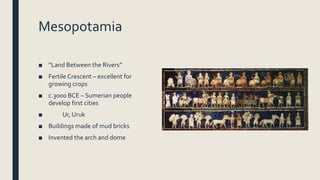
Mesopotamia
■ “Land Between the Rivers”
■ Fertile Crescent – excellent for
growing crops
■ c.3000 BCE – Sumerian people
develop first cities
■ Ur, Uruk
■ Buildings made of mud bricks
■ Invented the arch and dome
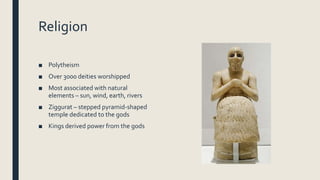
Religion
■ Polytheism
■ Over 3000 deities worshipped
■ Most associated with natural
elements – sun, wind, earth, rivers
■ Ziggurat – stepped pyramid-shaped
temple dedicated to the gods
■ Kings derived power from the gods
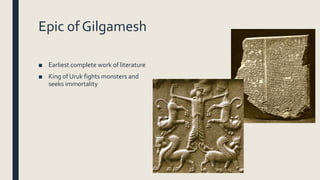
Epic of Gilgamesh
■ Earliest complete work of literature
■ King of Uruk fights monsters and
seeks immortality
Ancient Egypt
■ Civilization arose around the Nile
River
■ Pharaoh – ruler
■ Dual nature of the body
– Physical body
– Spiritual body – Ka
■ Once physical body dies, spiritual
one can live on if proper rituals are
preformed
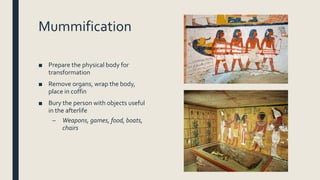
Mummification
■ Prepare the physical body for
transformation
■ Remove organs, wrap the body,
place in coffin
■ Bury the person with objects useful
in the afterlife
– Weapons, games, food, boats,
chairs
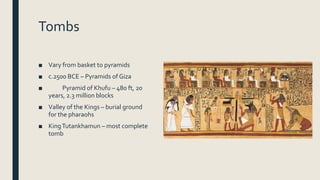
Tombs
■ Vary from basket to pyramids
■ c.2500 BCE – Pyramids of Giza
■ Pyramid of Khufu – 480 ft, 20
years, 2.3 million blocks
■ Valley of the Kings – burial ground
for the pharaohs
■ KingTutankhamun – most complete
tomb
■ Why do almost all cultures believe in an afterlife?
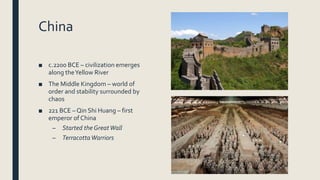
China
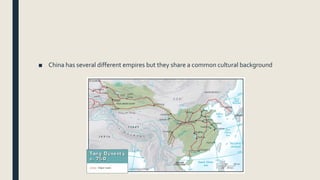
■ c.2200 BCE – civilization emerges
along theYellow River
■ The Middle Kingdom – world of
order and stability surrounded by
chaos
■ 221 BCE – Qin Shi Huang – first
emperor of China
– Started the GreatWall
– TerracottaWarriors
■ China has several different empires but they share a common cultural background
Characteristics of Early Societies
■ Major ancient societies develop:
■ Writing
■ Economy
■ Hierarchy of leadership – king,
emperor, pharaoh
■ Government
■ Religion and rituals
■ Warfare
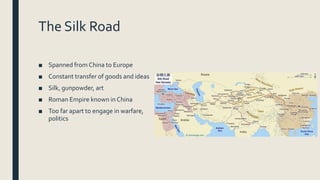
The Silk Road
■ Spanned from China to Europe
■ Constant transfer of goods and ideas
■ Silk, gunpowder, art
■ Roman Empire known in China
■ Too far apart to engage in warfare,
politics
Ancient Greece
■ 5th century BCE
■ Not a unified empire
■ City-State (polis) – the city the unit
of loyalty
■ Sparta,Athens, Olympia
■ Athenian Democracy – citizens
gather and vote
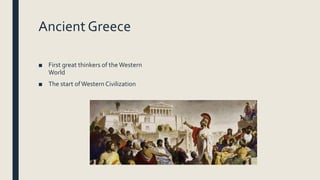
Ancient Greece
■ First great thinkers of theWestern
World
■ The start ofWestern Civilization
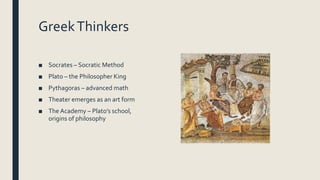
GreekThinkers
■ Socrates – Socratic Method
■ Plato – the Philosopher King
■ Pythagoras – advanced math
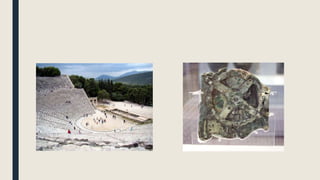
■ Theater emerges as an art form
■ The Academy – Plato’s school,
origins of philosophy
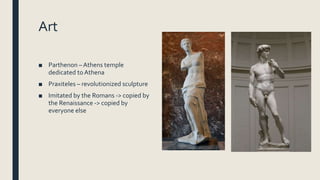
Art
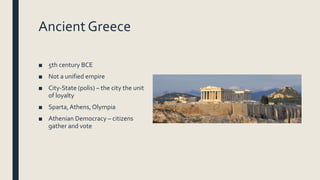
■ Parthenon – Athens temple
dedicated to Athena
■ Praxiteles – revolutionized sculpture
■ Imitated by the Romans -> copied by
the Renaissance -> copied by
everyone else
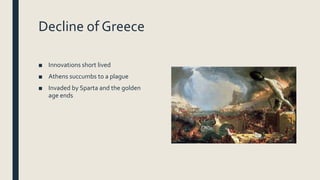
Decline of Greece
■ Innovations short lived
■ Athens succumbs to a plague
■ Invaded by Sparta and the golden
age ends
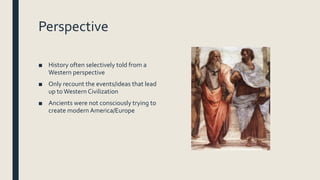
Perspective
■ History often selectively told from a
Western perspective
■ Only recount the events/ideas that lead
up toWestern Civilization
■ Ancients were not consciously trying to
create modern America/Europe

2 early civilizations

  • 1.
    EARLY CIVILIZATIONSCREATED BY BRIANSALAS MIDWESTERNCAREERCOLLEGE JULY 2019
  • 2.
    ■ Four majorareas of agriculture and writing ■ Created independently and spread throughout the world
  • 3.
    Mesopotamia ■ “Land Betweenthe Rivers” ■ Fertile Crescent – excellent for growing crops ■ c.3000 BCE – Sumerian people develop first cities ■ Ur, Uruk ■ Buildings made of mud bricks ■ Invented the arch and dome
  • 4.
    Religion ■ Polytheism ■ Over3000 deities worshipped ■ Most associated with natural elements – sun, wind, earth, rivers ■ Ziggurat – stepped pyramid-shaped temple dedicated to the gods ■ Kings derived power from the gods
  • 5.
    Epic of Gilgamesh ■Earliest complete work of literature ■ King of Uruk fights monsters and seeks immortality
  • 6.
    Ancient Egypt ■ Civilizationarose around the Nile River ■ Pharaoh – ruler ■ Dual nature of the body – Physical body – Spiritual body – Ka ■ Once physical body dies, spiritual one can live on if proper rituals are preformed
  • 7.
    Mummification ■ Prepare thephysical body for transformation ■ Remove organs, wrap the body, place in coffin ■ Bury the person with objects useful in the afterlife – Weapons, games, food, boats, chairs
  • 8.
    Tombs ■ Vary frombasket to pyramids ■ c.2500 BCE – Pyramids of Giza ■ Pyramid of Khufu – 480 ft, 20 years, 2.3 million blocks ■ Valley of the Kings – burial ground for the pharaohs ■ KingTutankhamun – most complete tomb
  • 9.
    ■ Why doalmost all cultures believe in an afterlife?
  • 10.
    China ■ c.2200 BCE– civilization emerges along theYellow River ■ The Middle Kingdom – world of order and stability surrounded by chaos ■ 221 BCE – Qin Shi Huang – first emperor of China – Started the GreatWall – TerracottaWarriors
  • 11.
    ■ China hasseveral different empires but they share a common cultural background
  • 12.
    Characteristics of EarlySocieties ■ Major ancient societies develop: ■ Writing ■ Economy ■ Hierarchy of leadership – king, emperor, pharaoh ■ Government ■ Religion and rituals ■ Warfare
  • 13.
    The Silk Road ■Spanned from China to Europe ■ Constant transfer of goods and ideas ■ Silk, gunpowder, art ■ Roman Empire known in China ■ Too far apart to engage in warfare, politics
  • 14.
    Ancient Greece ■ 5thcentury BCE ■ Not a unified empire ■ City-State (polis) – the city the unit of loyalty ■ Sparta,Athens, Olympia ■ Athenian Democracy – citizens gather and vote
  • 15.
    Ancient Greece ■ Firstgreat thinkers of theWestern World ■ The start ofWestern Civilization
  • 16.
    GreekThinkers ■ Socrates –Socratic Method ■ Plato – the Philosopher King ■ Pythagoras – advanced math ■ Theater emerges as an art form ■ The Academy – Plato’s school, origins of philosophy
  • 18.
    Art ■ Parthenon –Athens temple dedicated to Athena ■ Praxiteles – revolutionized sculpture ■ Imitated by the Romans -> copied by the Renaissance -> copied by everyone else
  • 19.
    Decline of Greece ■Innovations short lived ■ Athens succumbs to a plague ■ Invaded by Sparta and the golden age ends
  • 20.
    Perspective ■ History oftenselectively told from a Western perspective ■ Only recount the events/ideas that lead up toWestern Civilization ■ Ancients were not consciously trying to create modern America/Europe