1
Muhammad Touseef Alam
Pakistan Meteorological Department
Director
Environmental Prediction into the Next Decade: Weather,
Climate, Water and the Air We Breathe
Incheon, Republic of Korea, 16-17, November 2009
2
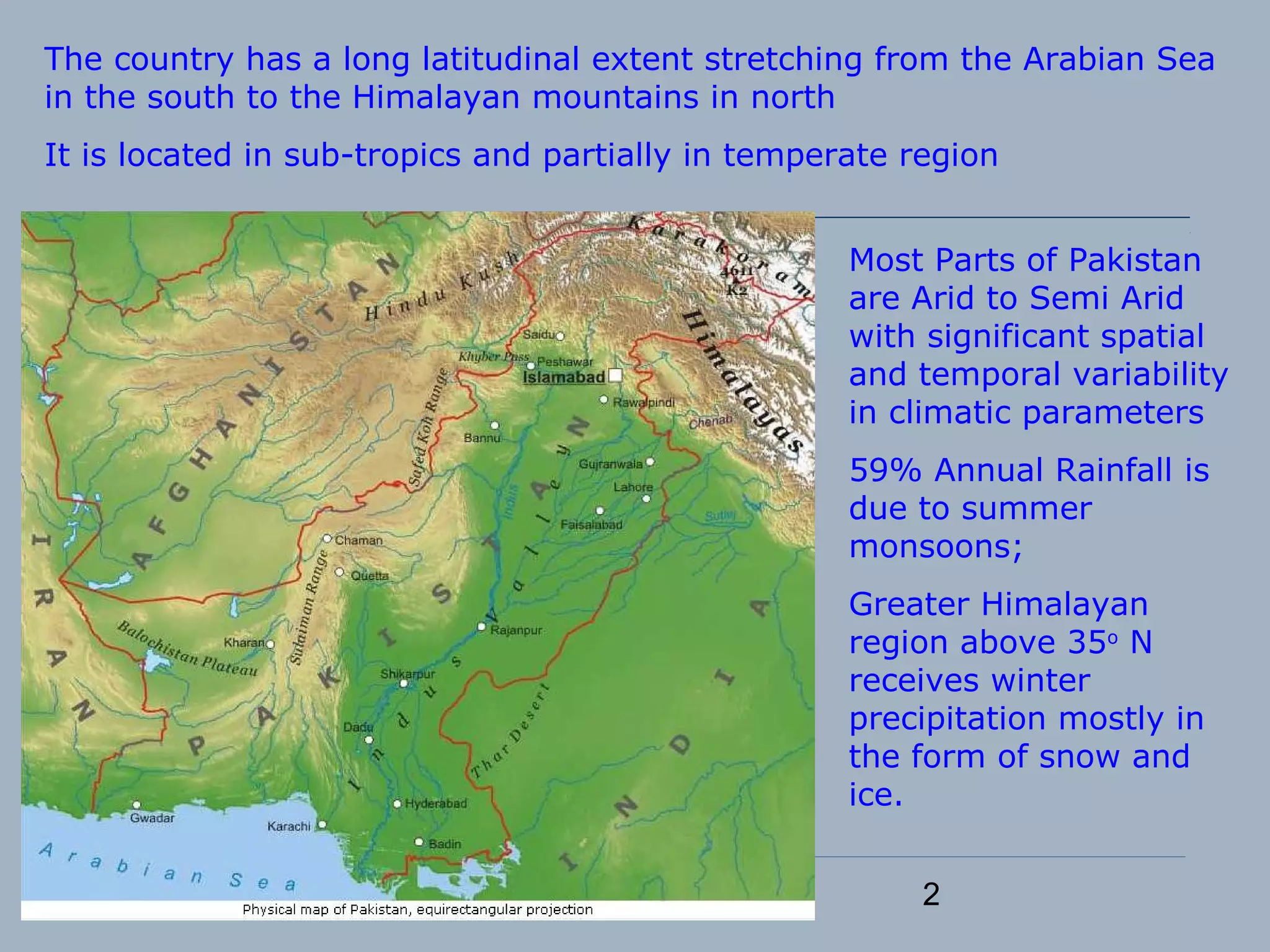
The country has a long latitudinal extent stretching from the Arabian Sea
in the south to the Himalayan mountains in north
It is located in sub-tropics and partially in temperate region
Most Parts of Pakistan
are Arid to Semi Arid
with significant spatial
and temporal variability
in climatic parameters
59% Annual Rainfall is
due to summer
monsoons;
Greater Himalayan
region above 35o
N
receives winter
precipitation mostly in
the form of snow and
ice.
3
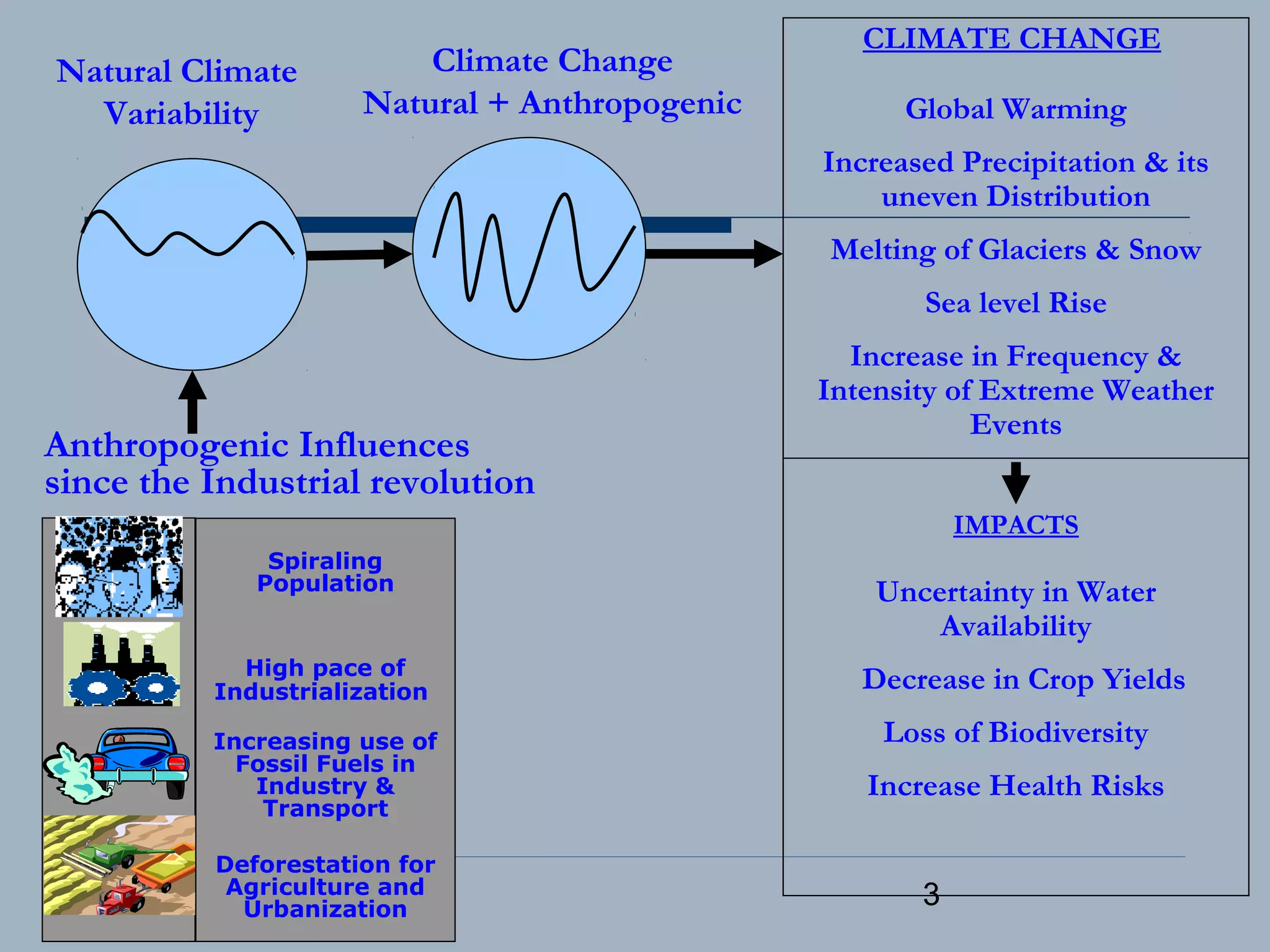
Natural Climate
Variability
Anthropogenic Influences
since the Industrial revolution
CLIMATE CHANGE
Global Warming
Increased Precipitation & its
uneven Distribution
Melting of Glaciers & Snow
Sea level Rise
Increase in Frequency &
Intensity of Extreme Weather
Events
IMPACTS
Uncertainty in Water
Availability
Decrease in Crop Yields
Loss of Biodiversity
Increase Health Risks
Spiraling
Population
High pace of
Industrialization
Increasing use of
Fossil Fuels in
Industry &
Transport
Deforestation for
Agriculture and
Urbanization
Climate Change
Natural + Anthropogenic
4
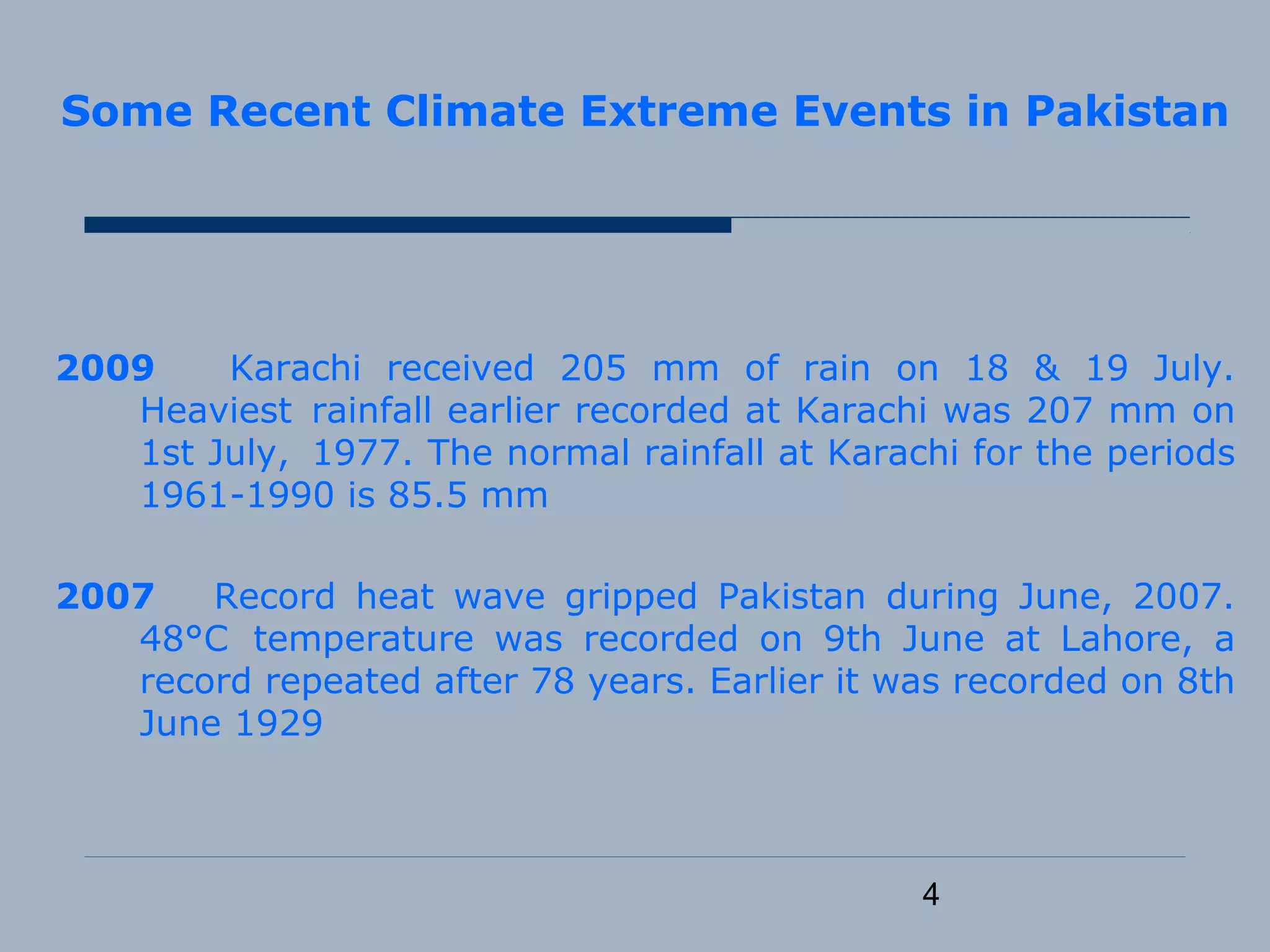
Some Recent Climate Extreme Events in Pakistan
2009 Karachi received 205 mm of rain on 18 & 19 July.
Heaviest rainfall earlier recorded at Karachi was 207 mm on
1st July, 1977. The normal rainfall at Karachi for the periods
1961-1990 is 85.5 mm
2007 Record heat wave gripped Pakistan during June, 2007.
48°C temperature was recorded on 9th June at Lahore, a
record repeated after 78 years. Earlier it was recorded on 8th
June 1929
5
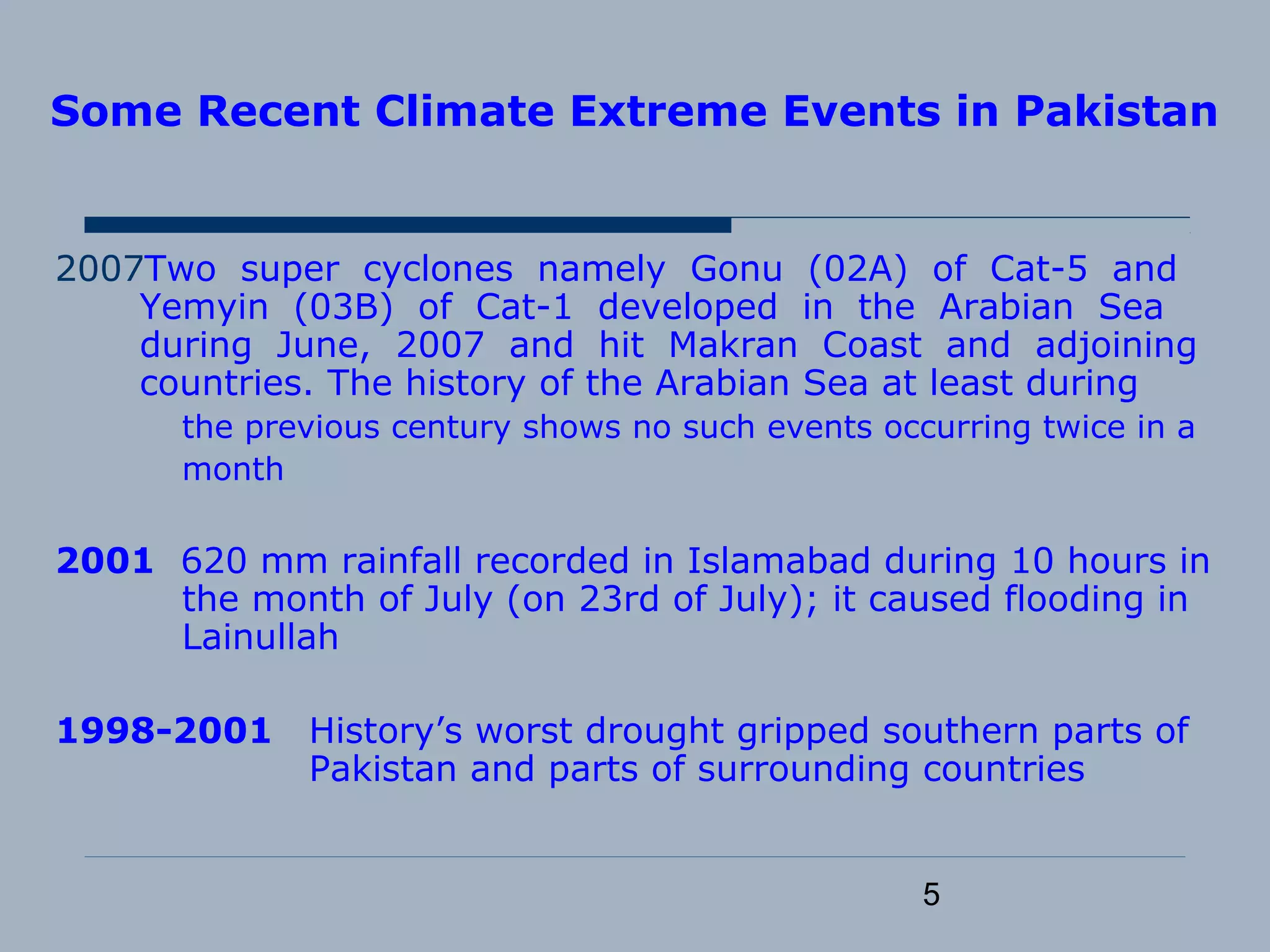
Some Recent Climate Extreme Events in Pakistan
2007Two super cyclones namely Gonu (02A) of Cat-5 and
Yemyin (03B) of Cat-1 developed in the Arabian Sea
during June, 2007 and hit Makran Coast and adjoining
countries. The history of the Arabian Sea at least during
the previous century shows no such events occurring twice in a
month
2001 620 mm rainfall recorded in Islamabad during 10 hours in
the month of July (on 23rd of July); it caused flooding in
Lainullah
1998-2001 History’s worst drought gripped southern parts of
Pakistan and parts of surrounding countries
6
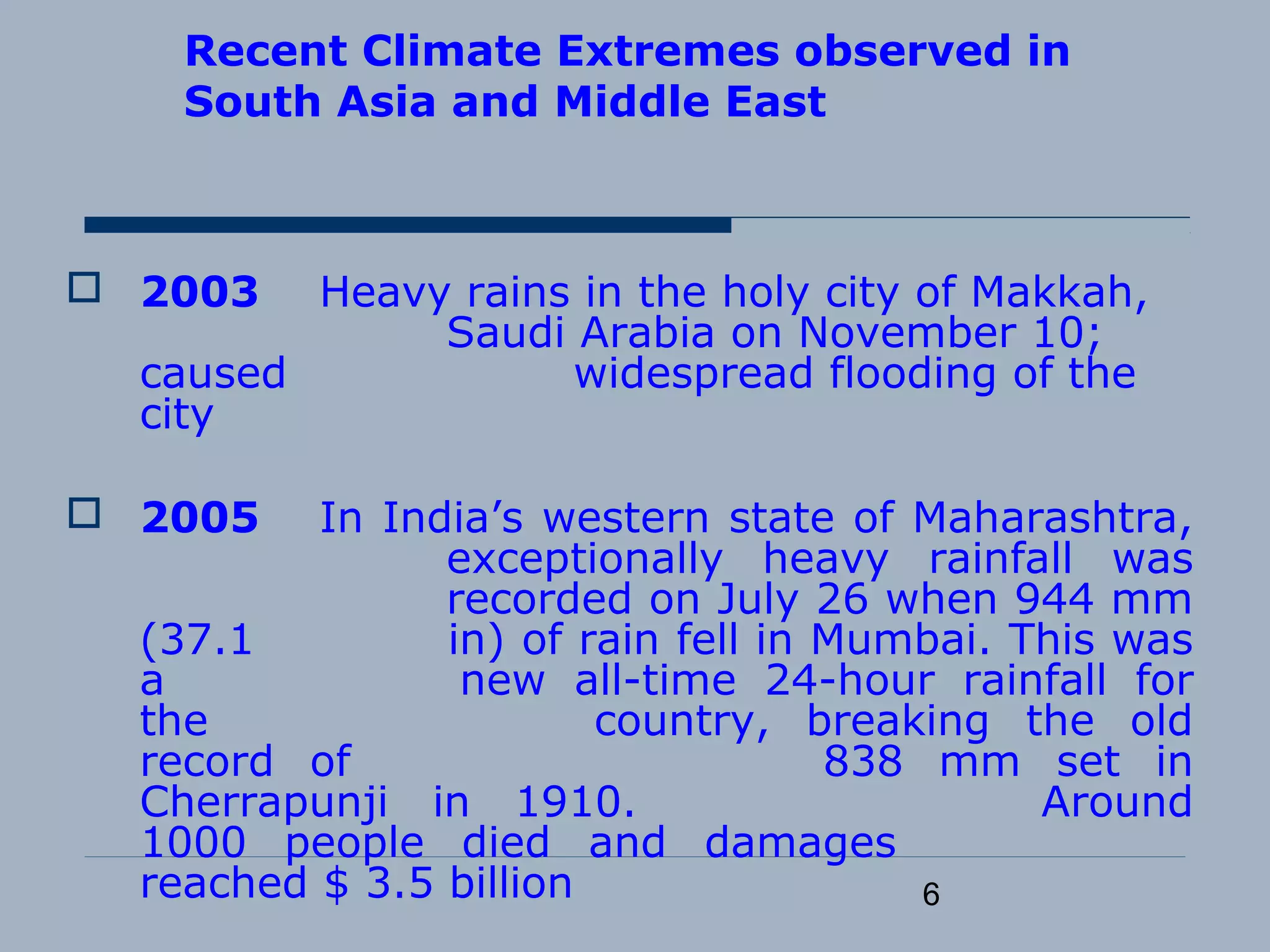
Recent Climate Extremes observed in
South Asia and Middle East
 2003 Heavy rains in the holy city of Makkah,
Saudi Arabia on November 10;
caused widespread flooding of the
city
 2005 In India’s western state of Maharashtra,
exceptionally heavy rainfall was
recorded on July 26 when 944 mm
(37.1 in) of rain fell in Mumbai. This was
a new all-time 24-hour rainfall for
the country, breaking the old
record of 838 mm set in
Cherrapunji in 1910. Around
1000 people died and damages
reached $ 3.5 billion
7
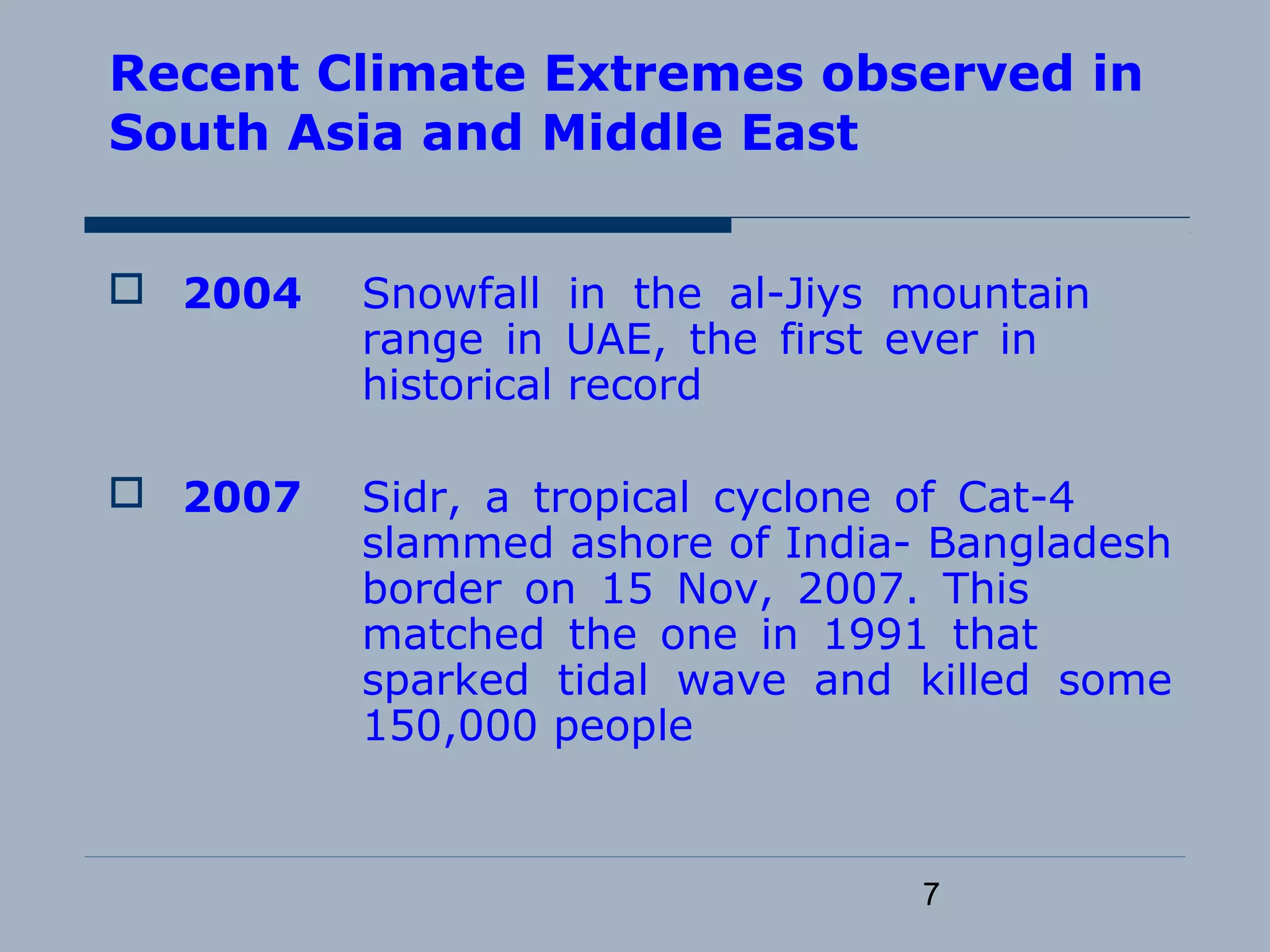
Recent Climate Extremes observed in
South Asia and Middle East
 2004 Snowfall in the al-Jiys mountain
range in UAE, the first ever in
historical record
 2007 Sidr, a tropical cyclone of Cat-4
slammed ashore of India- Bangladesh
border on 15 Nov, 2007. This
matched the one in 1991 that
sparked tidal wave and killed some
150,000 people
8
9
10
11
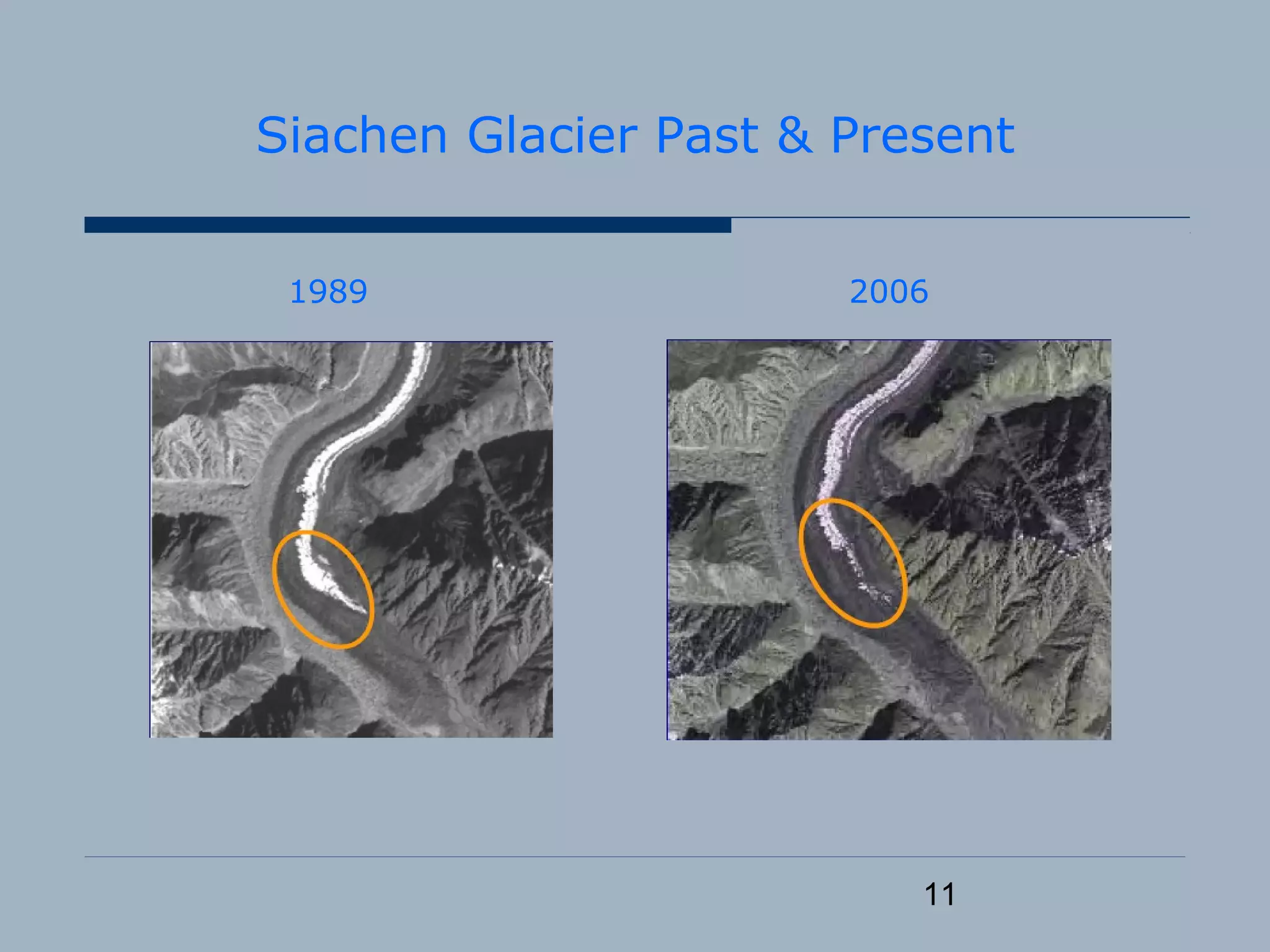
Siachen Glacier Past & Present
1989 2006
12
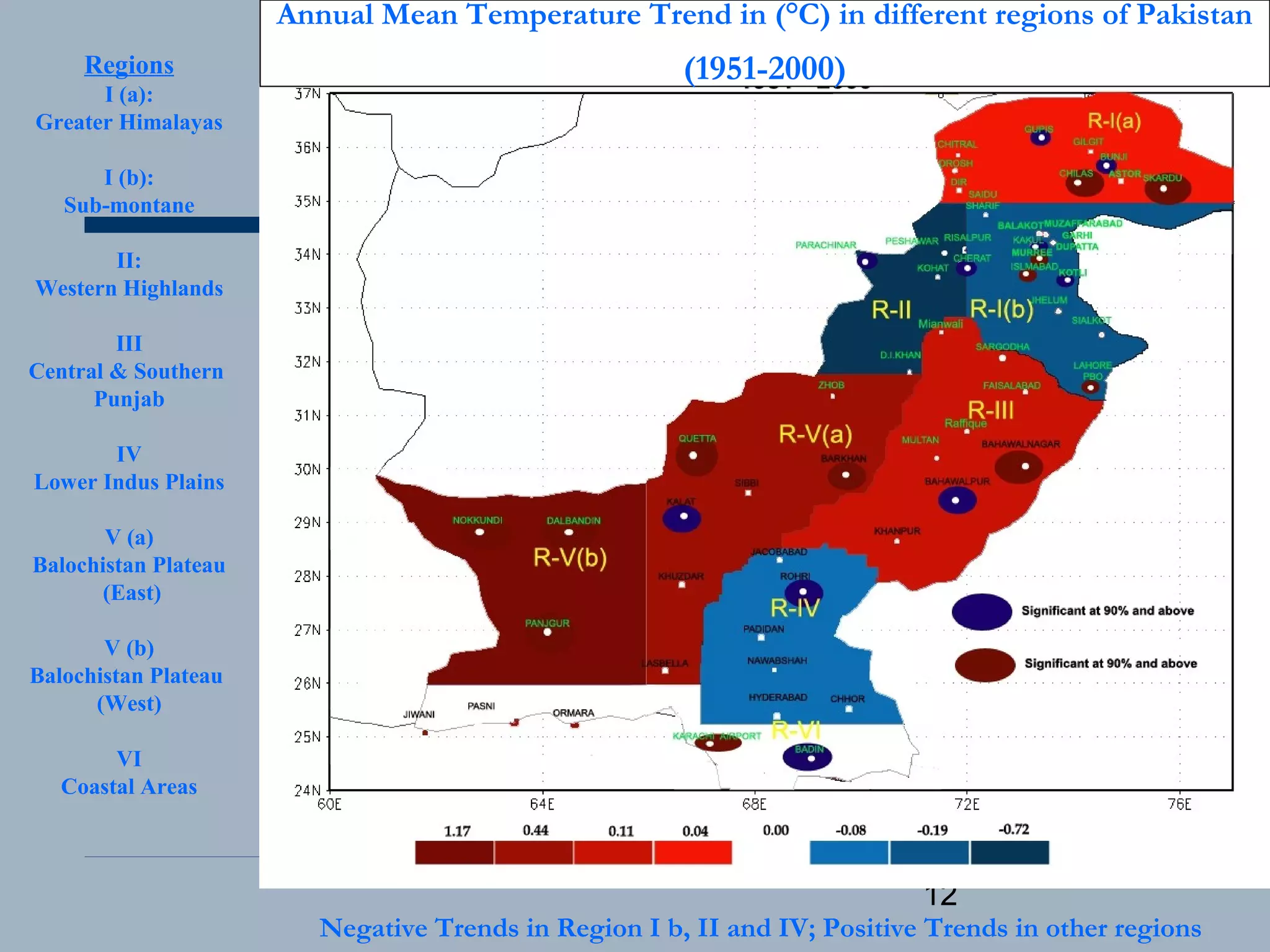
Negative Trends in Region I b, II and IV; Positive Trends in other regions
Regions
I (a):
Greater Himalayas
I (b):
Sub-montane
II:
Western Highlands
III
Central & Southern
Punjab
IV
Lower Indus Plains
V (a)
Balochistan Plateau
(East)
V (b)
Balochistan Plateau
(West)
VI
Coastal Areas
Annual Mean Temperature Trend in (°C) in different regions of Pakistan
(1951-2000)
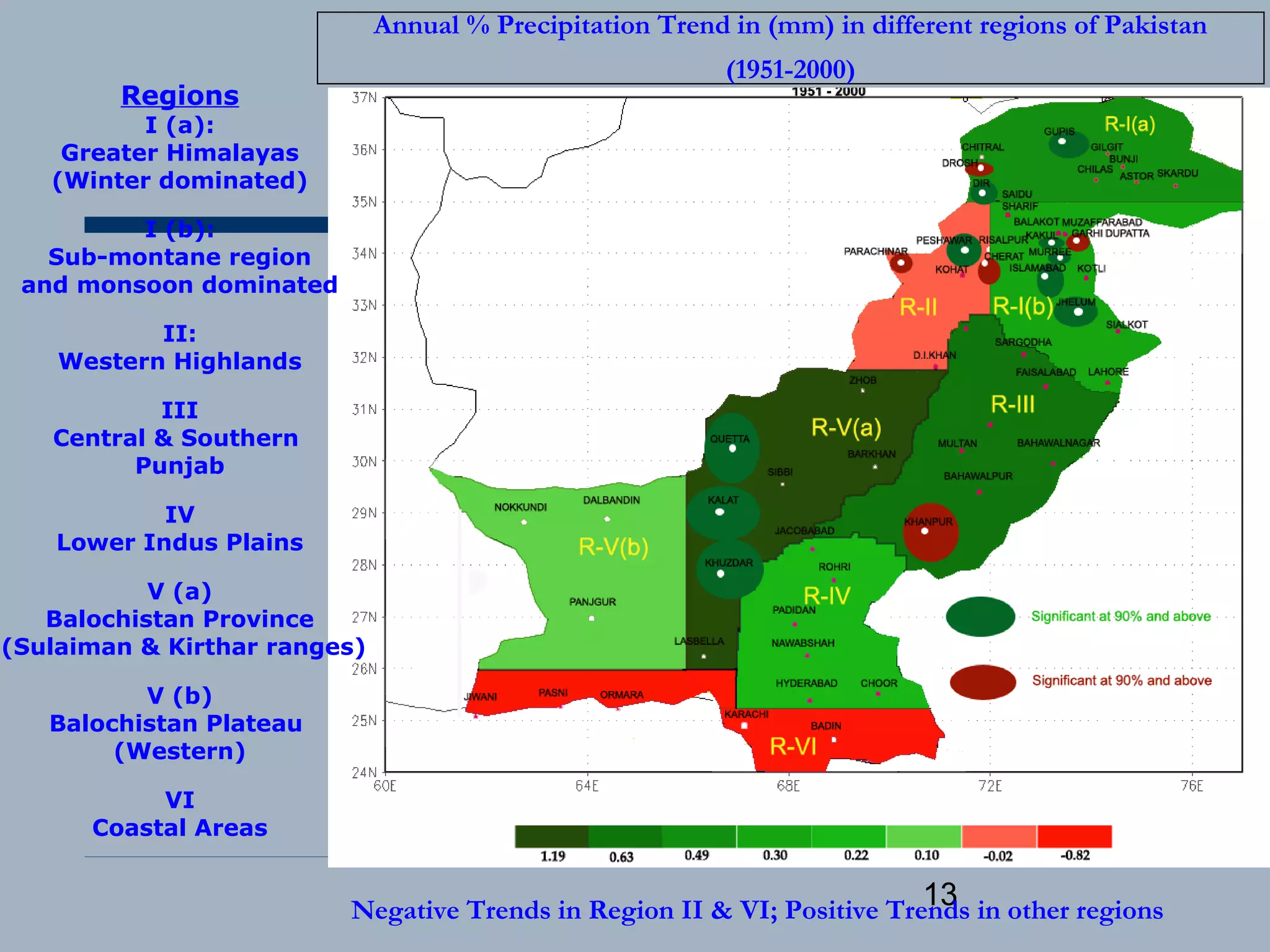
13Negative Trends in Region II & VI; Positive Trends in other regions
Annual % Precipitation Trend in (mm) in different regions of Pakistan
(1951-2000)
Regions
I (a):
Greater Himalayas
(Winter dominated)
I (b):
Sub-montane region
and monsoon dominated
II:
Western Highlands
III
Central & Southern
Punjab
IV
Lower Indus Plains
V (a)
Balochistan Province
(Sulaiman & Kirthar ranges)
V (b)
Balochistan Plateau
(Western)
VI
Coastal Areas
14
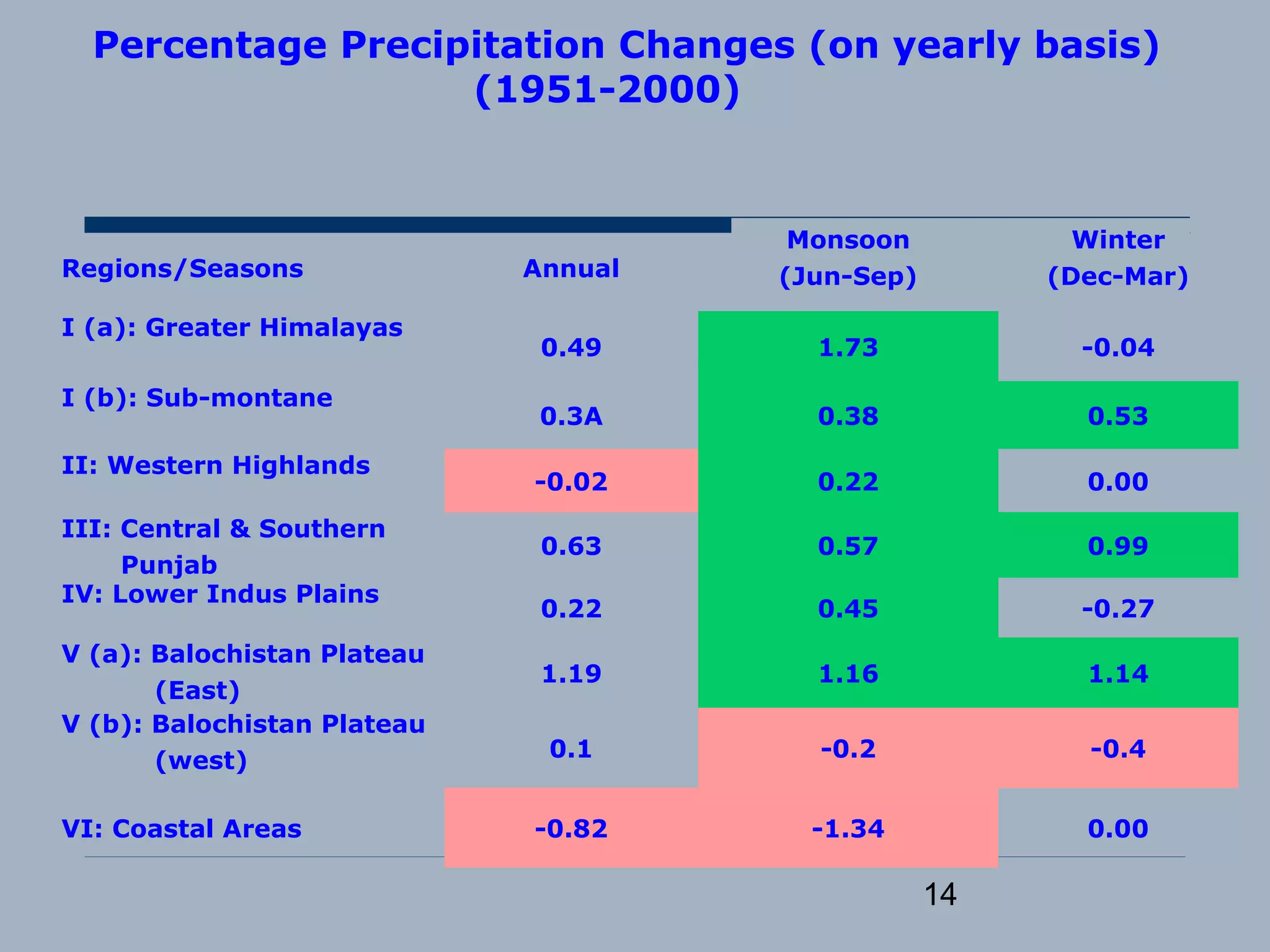
Percentage Precipitation Changes (on yearly basis)
(1951-2000)
Regions/Seasons Annual
Monsoon
(Jun-Sep)
Winter
(Dec-Mar)
I (a): Greater Himalayas
0.49 1.73 -0.04
I (b): Sub-montane
0.3A 0.38 0.53
II: Western Highlands
-0.02 0.22 0.00
III: Central & Southern
Punjab
0.63 0.57 0.99
IV: Lower Indus Plains
0.22 0.45 -0.27
V (a): Balochistan Plateau
(East)
1.19 1.16 1.14
V (b): Balochistan Plateau
(west) 0.1 -0.2 -0.4
VI: Coastal Areas -0.82 -1.34 0.00
15
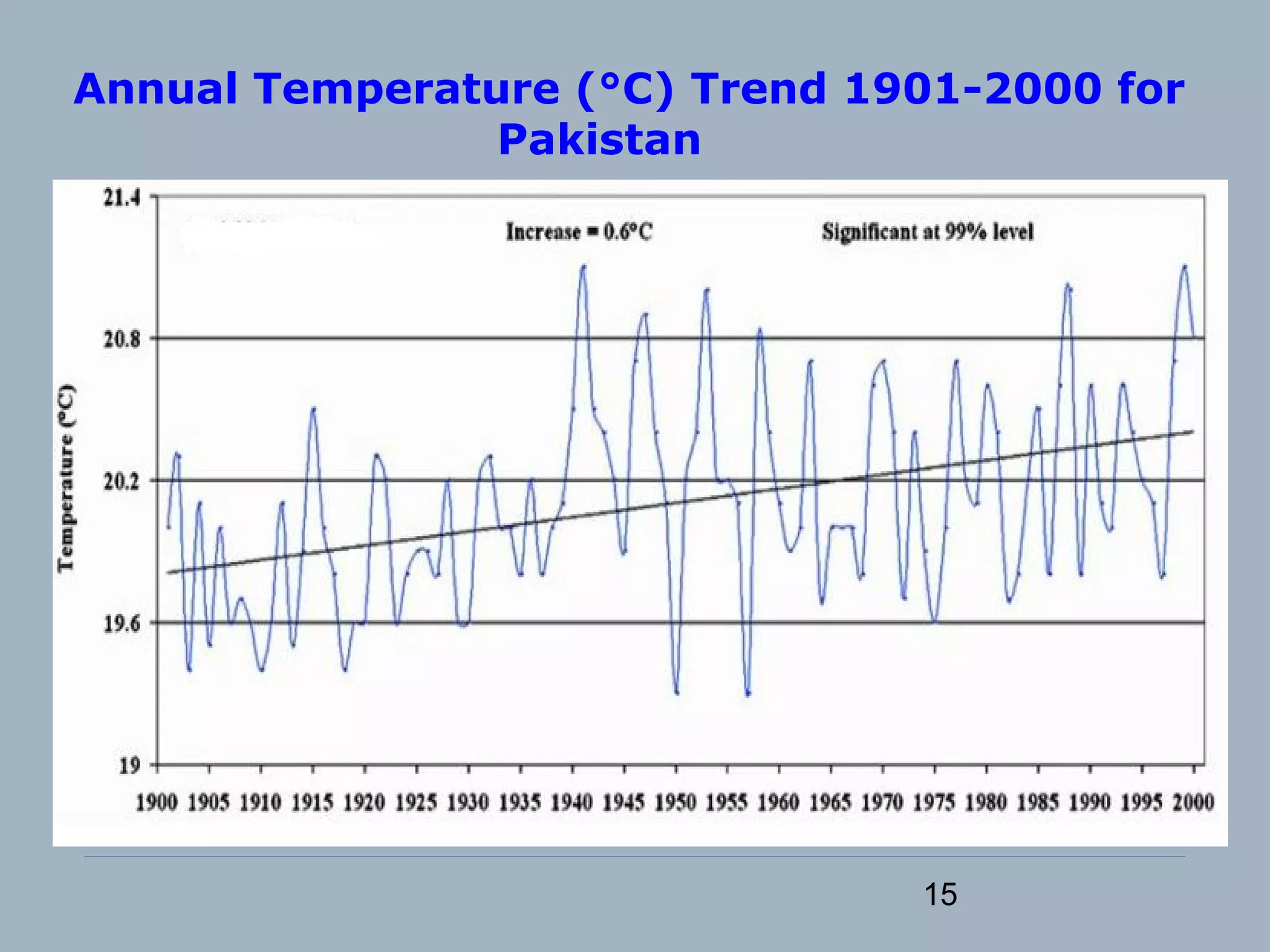
Annual Temperature (°C) Trend 1901-2000 for
Pakistan
16
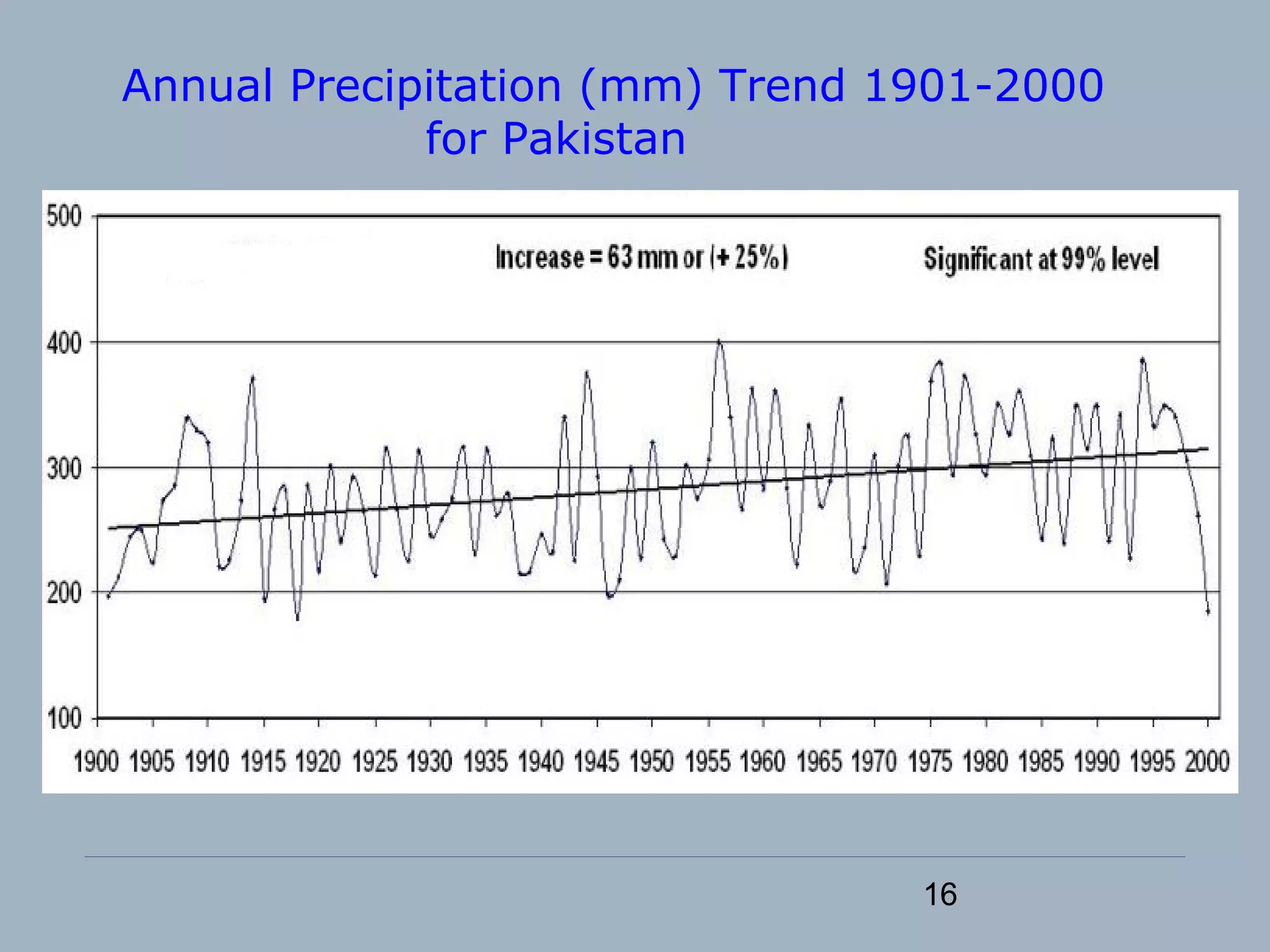
Annual Precipitation (mm) Trend 1901-2000
for Pakistan
17
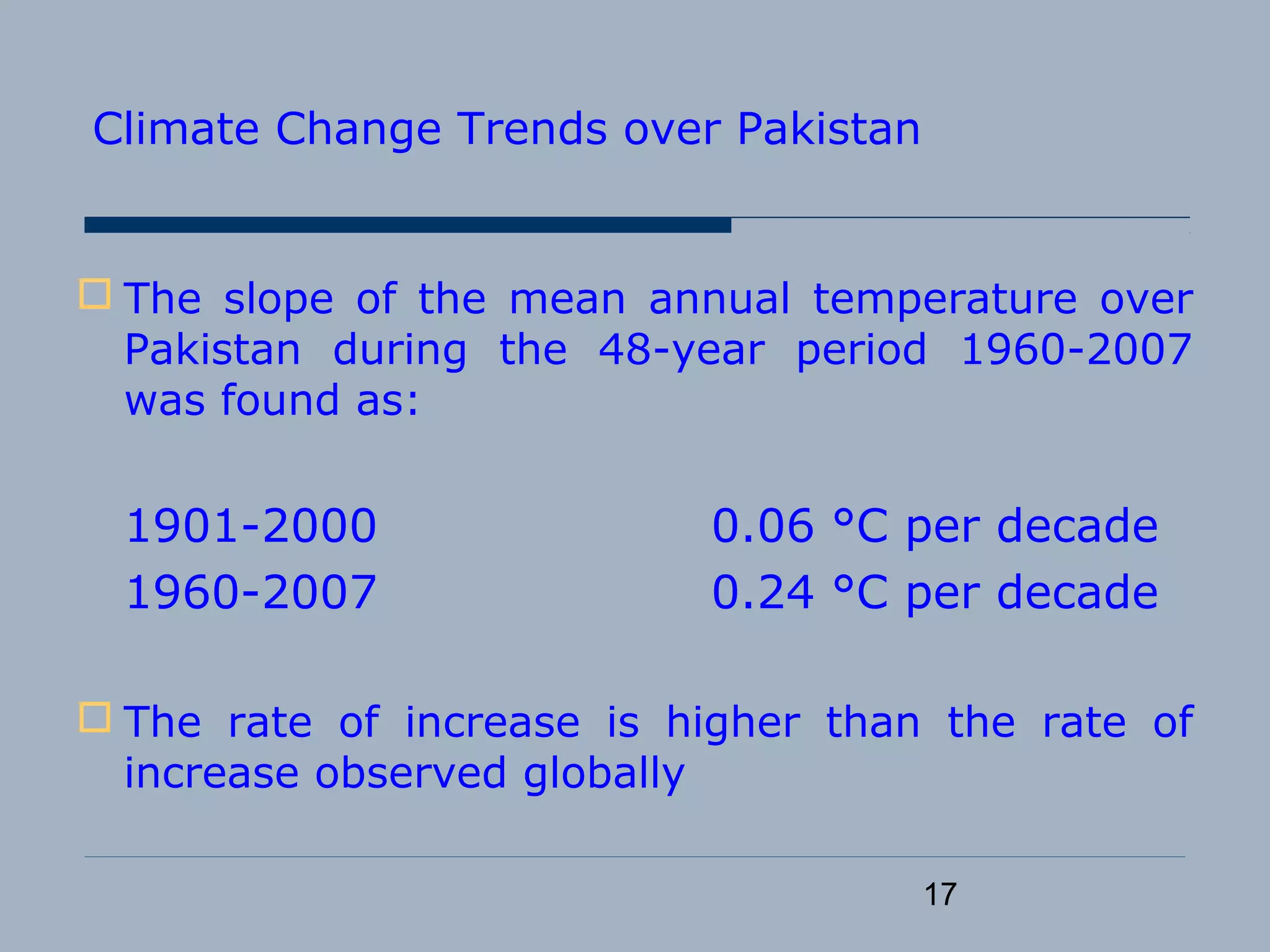
Climate Change Trends over Pakistan
 The slope of the mean annual temperature over
Pakistan during the 48-year period 1960-2007
was found as:
1901-2000 0.06 °C per decade
1960-2007 0.24 °C per decade
 The rate of increase is higher than the rate of
increase observed globally
18
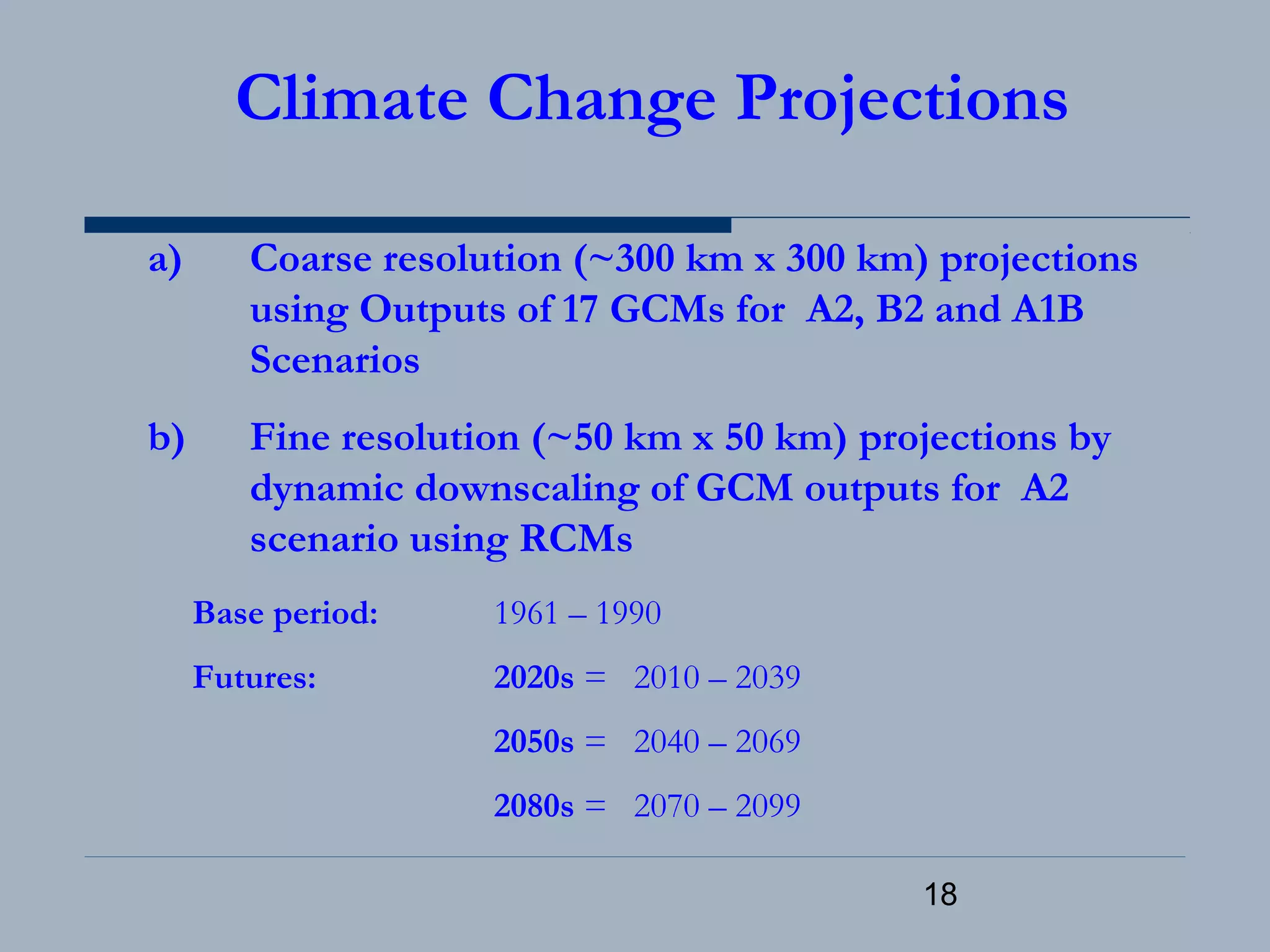
Climate Change Projections
a) Coarse resolution (~300 km x 300 km) projections
using Outputs of 17 GCMs for A2, B2 and A1B
Scenarios
b) Fine resolution (~50 km x 50 km) projections by
dynamic downscaling of GCM outputs for A2
scenario using RCMs
Base period: 1961 – 1990
Futures: 2020s = 2010 – 2039
2050s = 2040 – 2069
2080s = 2070 – 2099
19
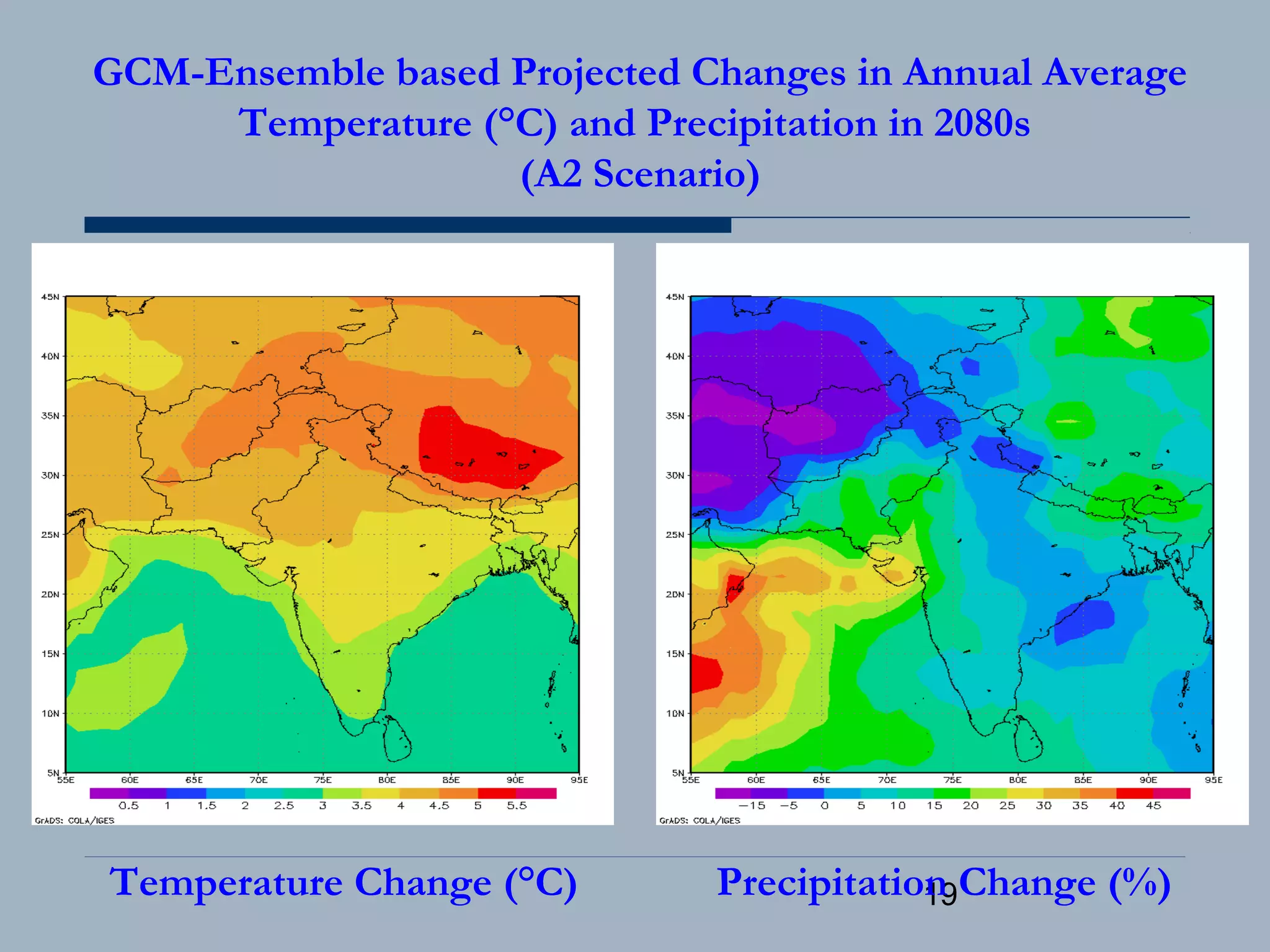
GCM-Ensemble based Projected Changes in Annual Average
Temperature (°C) and Precipitation in 2080s
(A2 Scenario)
Precipitation Change (%)Temperature Change (°C)
20
Pakistan
Northern
Pakistan
Southern
Pakistan
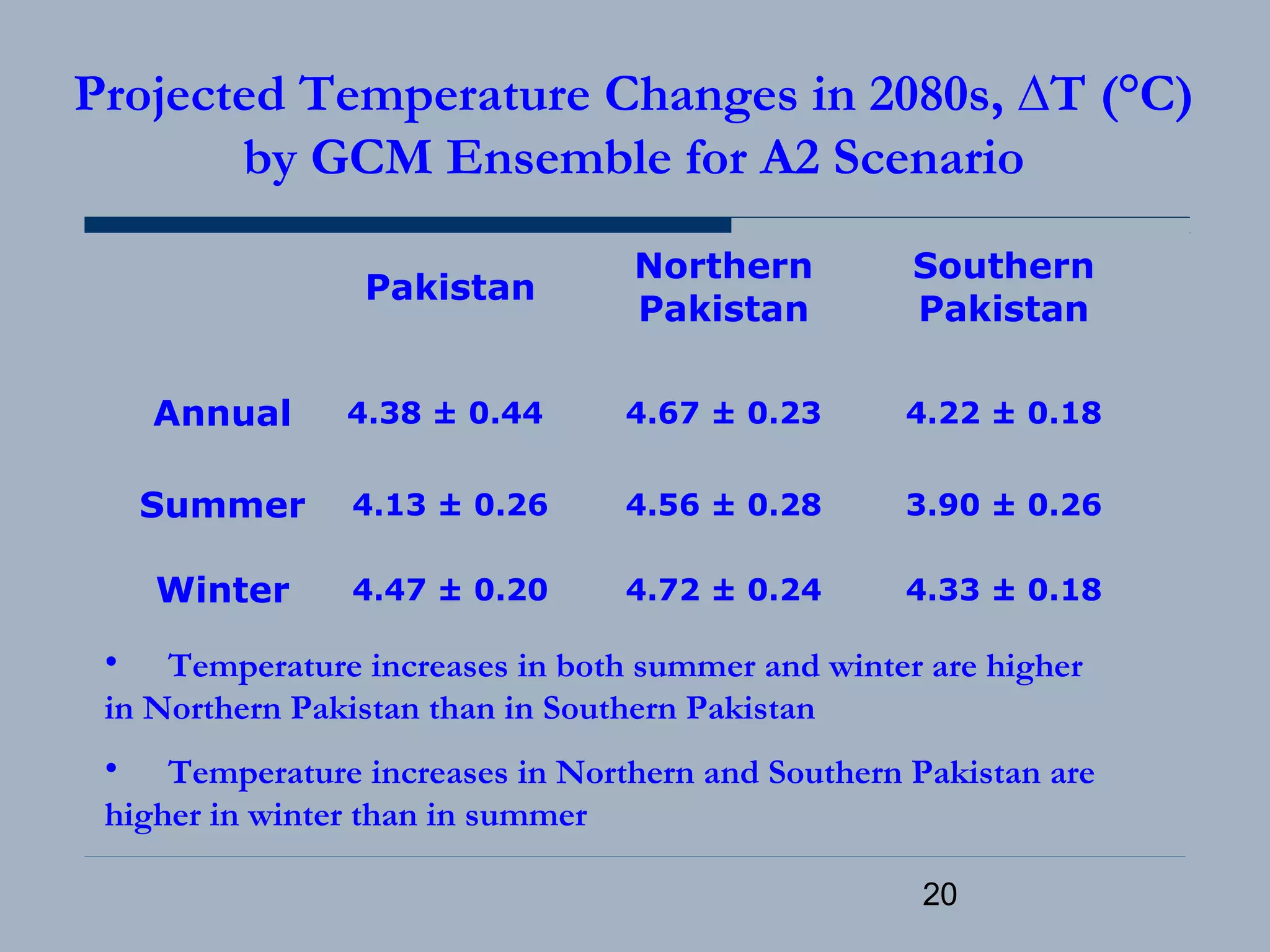
Annual 4.38 ± 0.44 4.67 ± 0.23 4.22 ± 0.18
Summer 4.13 ± 0.26 4.56 ± 0.28 3.90 ± 0.26
Winter 4.47 ± 0.20 4.72 ± 0.24 4.33 ± 0.18
Projected Temperature Changes in 2080s, ∆T (°C)
by GCM Ensemble for A2 Scenario
• Temperature increases in both summer and winter are higher
in Northern Pakistan than in Southern Pakistan
• Temperature increases in Northern and Southern Pakistan are
higher in winter than in summer
21
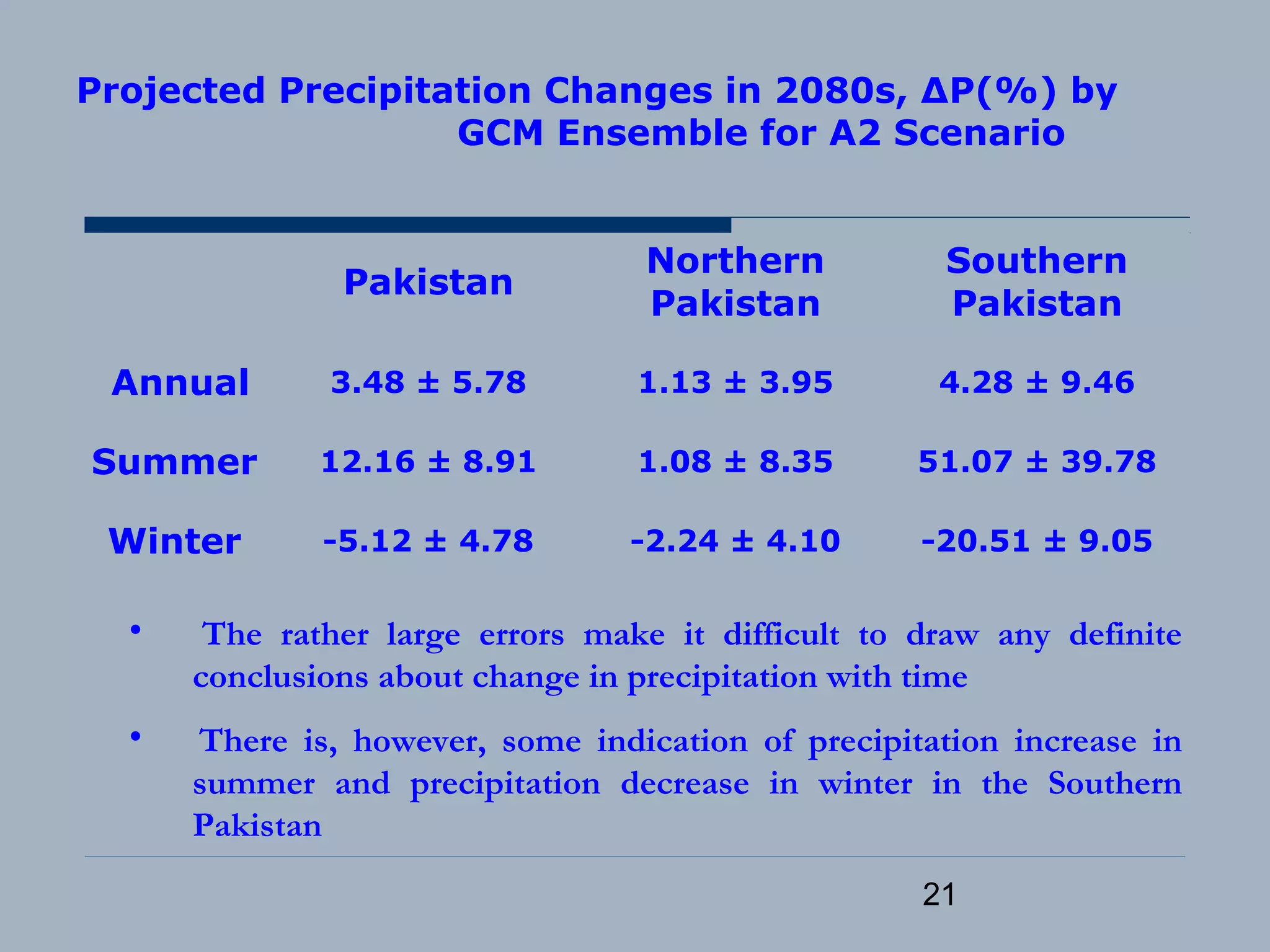
Projected Precipitation Changes in 2080s, ∆P(%) by
GCM Ensemble for A2 Scenario
Pakistan
Northern
Pakistan
Southern
Pakistan
Annual 3.48 ± 5.78 1.13 ± 3.95 4.28 ± 9.46
Summer 12.16 ± 8.91 1.08 ± 8.35 51.07 ± 39.78
Winter -5.12 ± 4.78 -2.24 ± 4.10 -20.51 ± 9.05
• The rather large errors make it difficult to draw any definite
conclusions about change in precipitation with time
• There is, however, some indication of precipitation increase in
summer and precipitation decrease in winter in the Southern
Pakistan
22
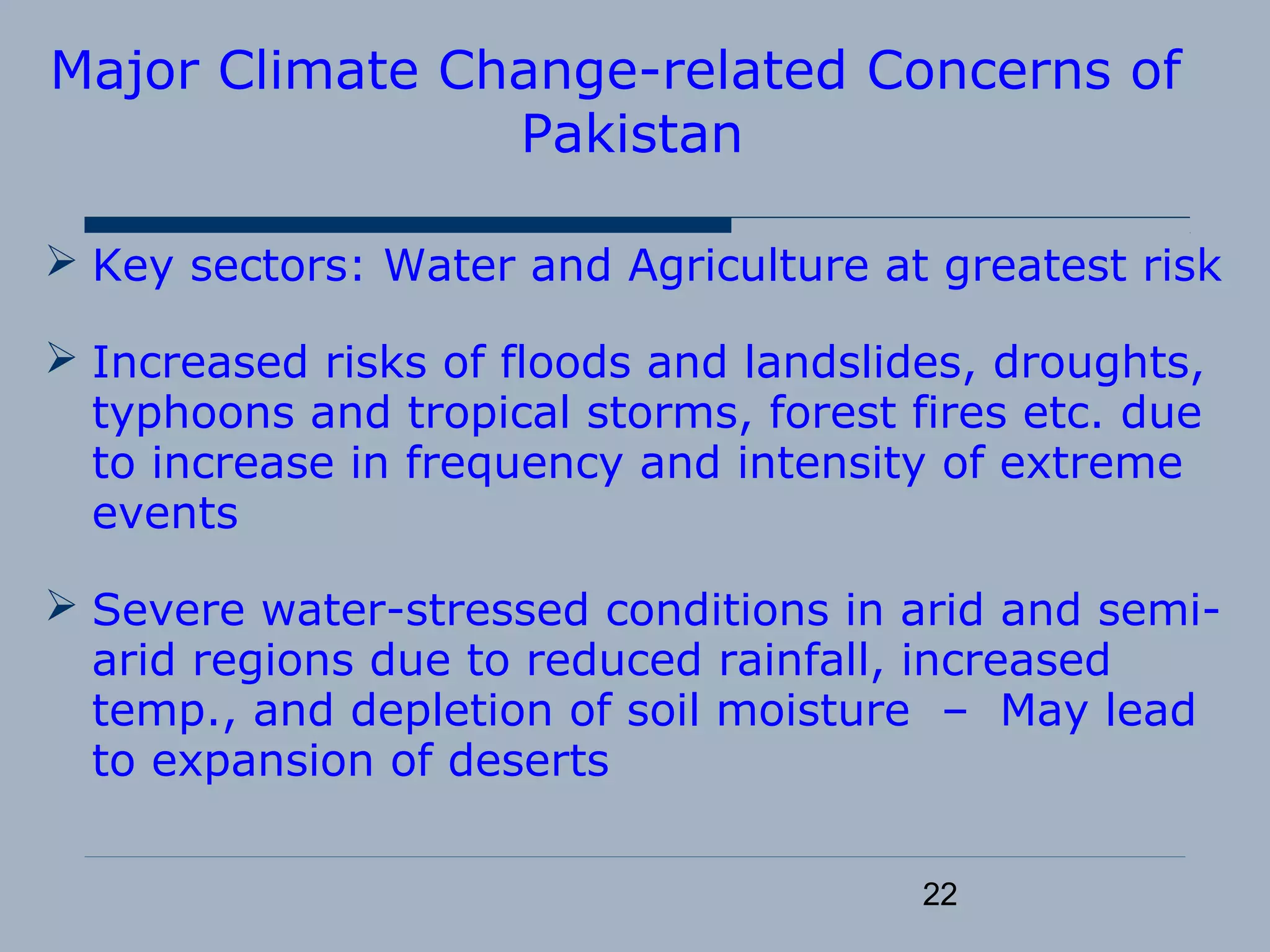
Major Climate Change-related Concerns of
Pakistan
 Key sectors: Water and Agriculture at greatest risk
 Increased risks of floods and landslides, droughts,
typhoons and tropical storms, forest fires etc. due
to increase in frequency and intensity of extreme
events
 Severe water-stressed conditions in arid and semi-
arid regions due to reduced rainfall, increased
temp., and depletion of soil moisture – May lead
to expansion of deserts
23
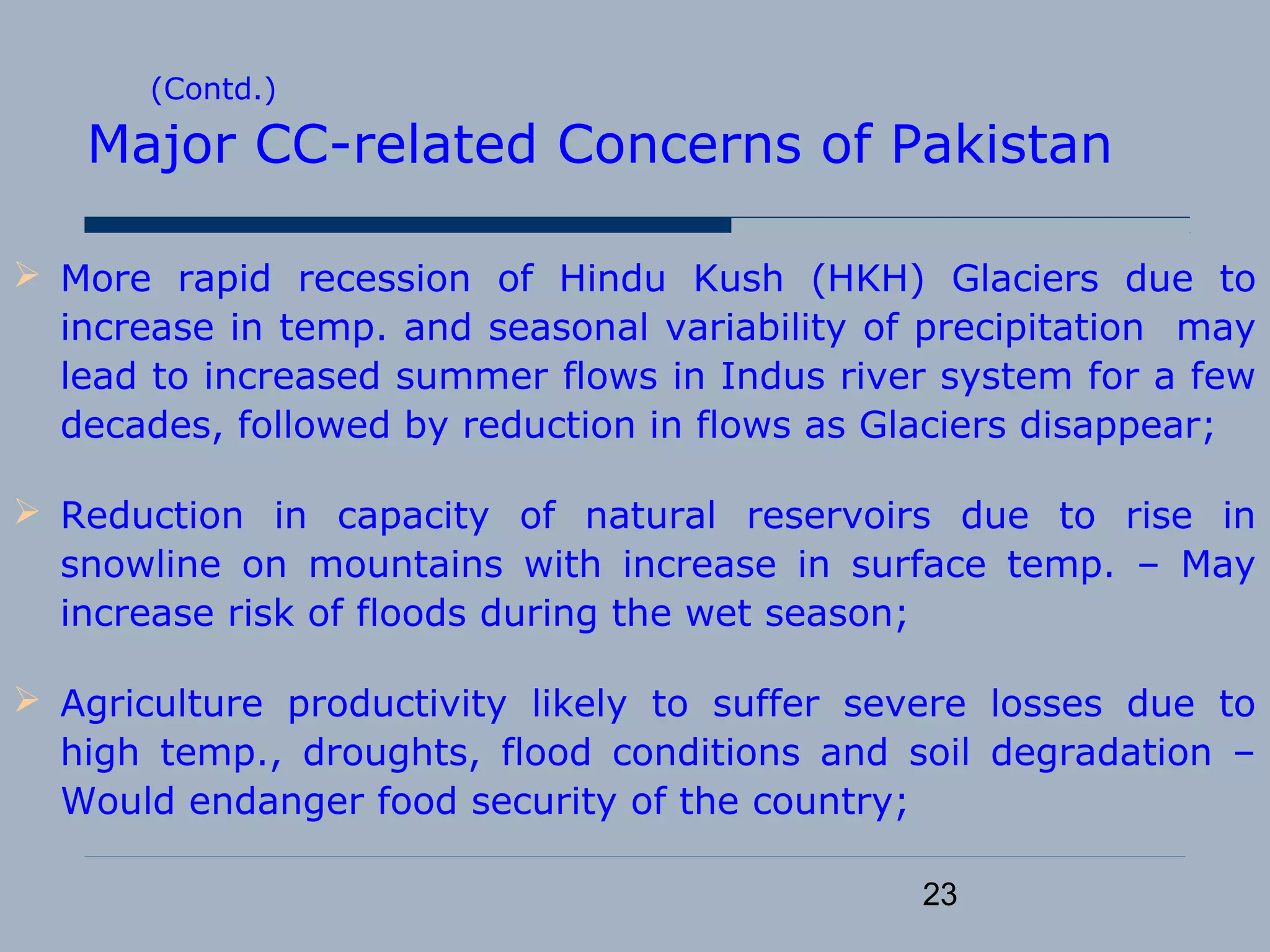
(Contd.)
Major CC-related Concerns of Pakistan
 More rapid recession of Hindu Kush (HKH) Glaciers due to
increase in temp. and seasonal variability of precipitation may
lead to increased summer flows in Indus river system for a few
decades, followed by reduction in flows as Glaciers disappear;
 Reduction in capacity of natural reservoirs due to rise in
snowline on mountains with increase in surface temp. – May
increase risk of floods during the wet season;
 Agriculture productivity likely to suffer severe losses due to
high temp., droughts, flood conditions and soil degradation –
Would endanger food security of the country;
24
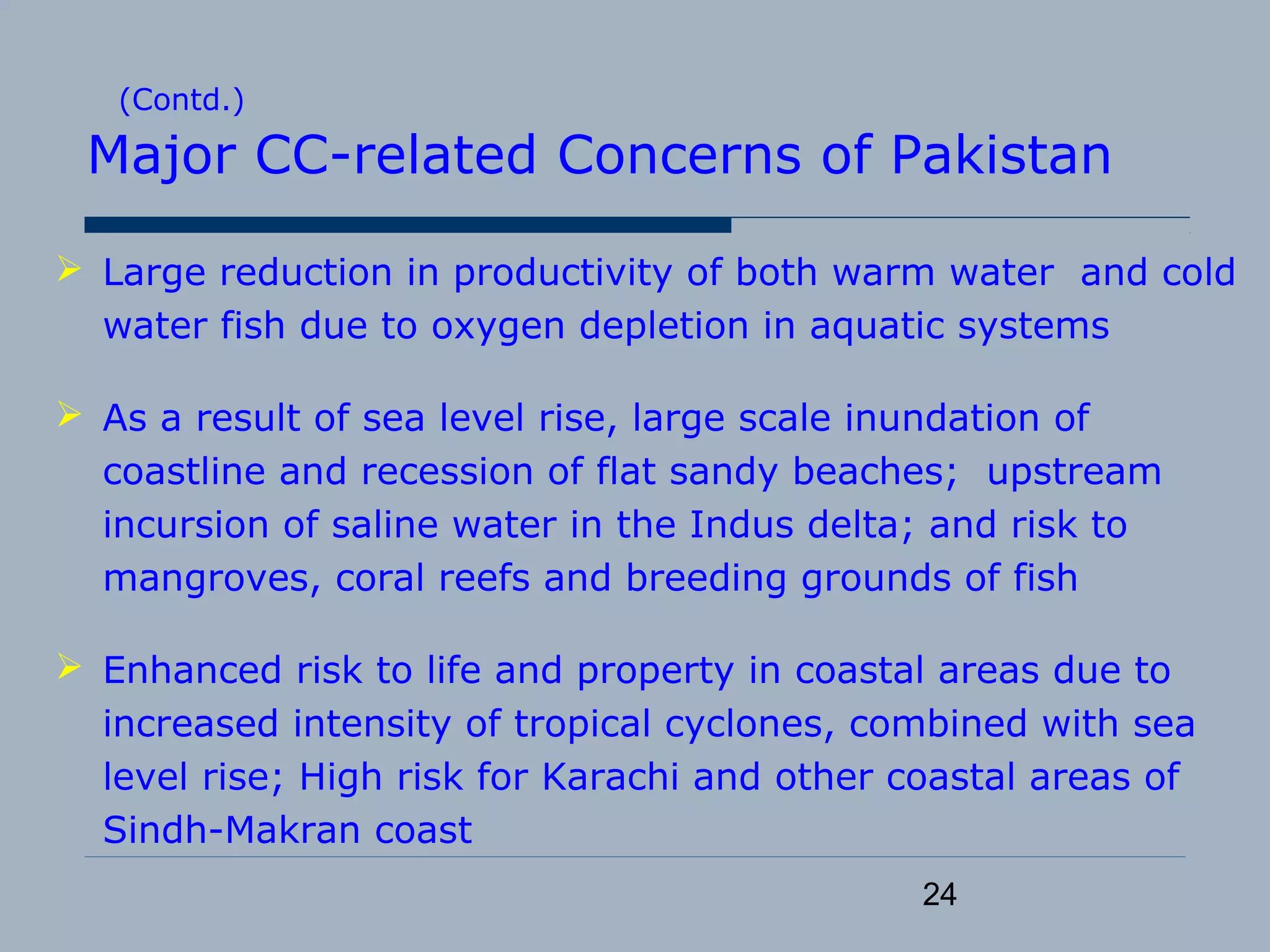
(Contd.)
Major CC-related Concerns of Pakistan
 Large reduction in productivity of both warm water and cold
water fish due to oxygen depletion in aquatic systems
 As a result of sea level rise, large scale inundation of
coastline and recession of flat sandy beaches; upstream
incursion of saline water in the Indus delta; and risk to
mangroves, coral reefs and breeding grounds of fish
 Enhanced risk to life and property in coastal areas due to
increased intensity of tropical cyclones, combined with sea
level rise; High risk for Karachi and other coastal areas of
Sindh-Makran coast
25
(Contd.)
Major CC-related Concerns of Pakistan
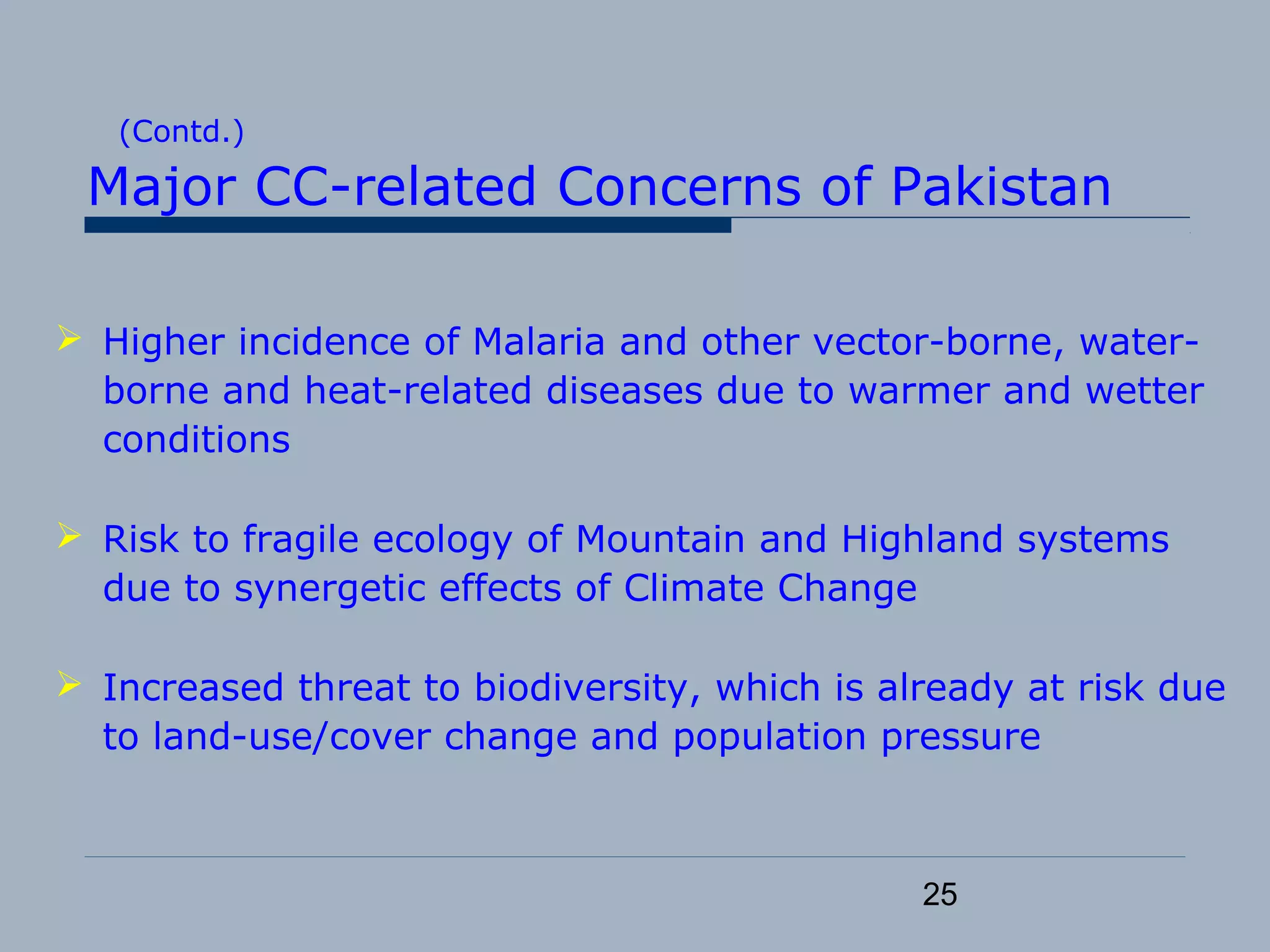
 Higher incidence of Malaria and other vector-borne, water-
borne and heat-related diseases due to warmer and wetter
conditions
 Risk to fragile ecology of Mountain and Highland systems
due to synergetic effects of Climate Change
 Increased threat to biodiversity, which is already at risk due
to land-use/cover change and population pressure
26
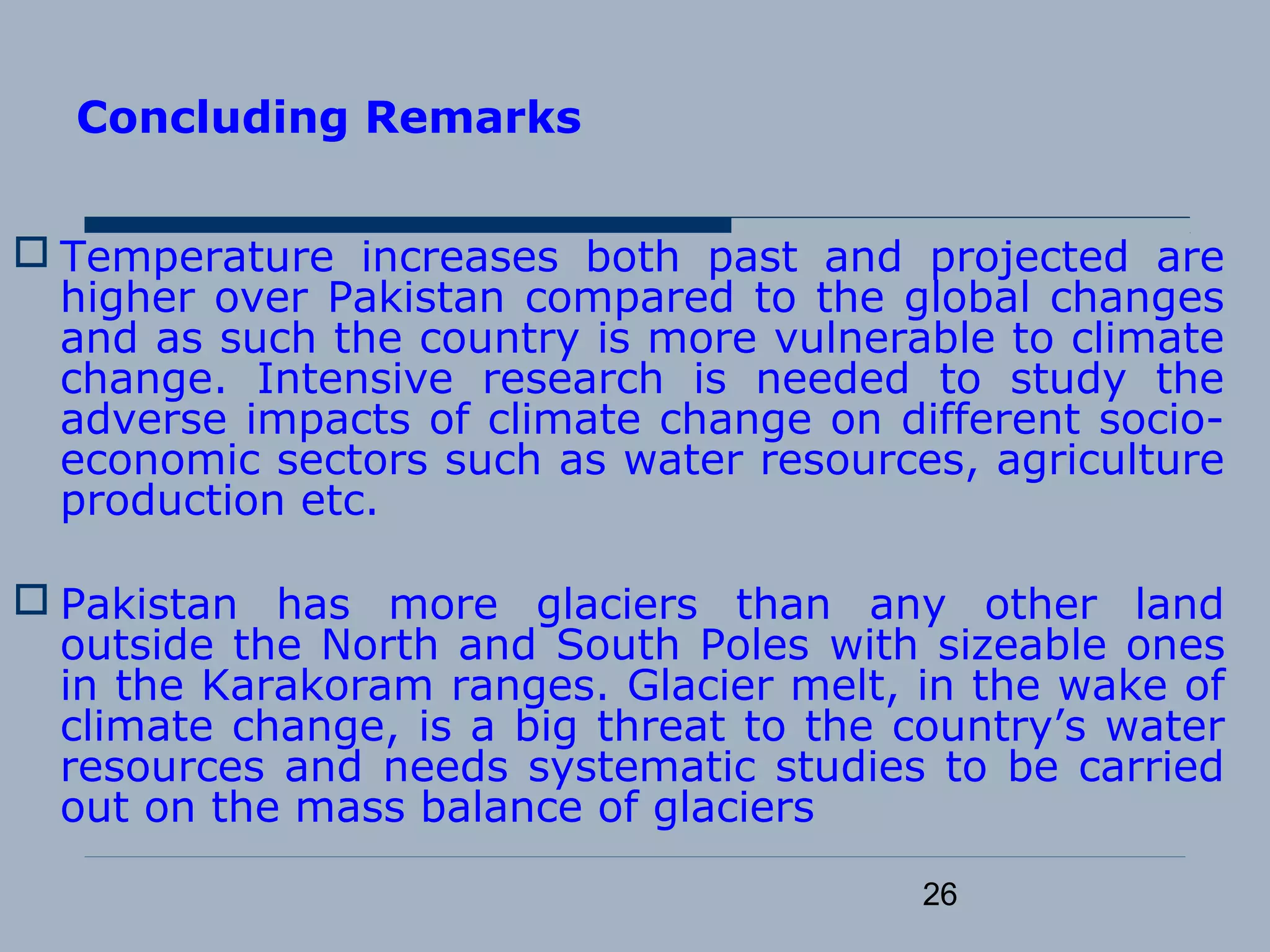
Concluding Remarks
 Temperature increases both past and projected are
higher over Pakistan compared to the global changes
and as such the country is more vulnerable to climate
change. Intensive research is needed to study the
adverse impacts of climate change on different socio-
economic sectors such as water resources, agriculture
production etc.
 Pakistan has more glaciers than any other land
outside the North and South Poles with sizeable ones
in the Karakoram ranges. Glacier melt, in the wake of
climate change, is a big threat to the country’s water
resources and needs systematic studies to be carried
out on the mass balance of glaciers
27
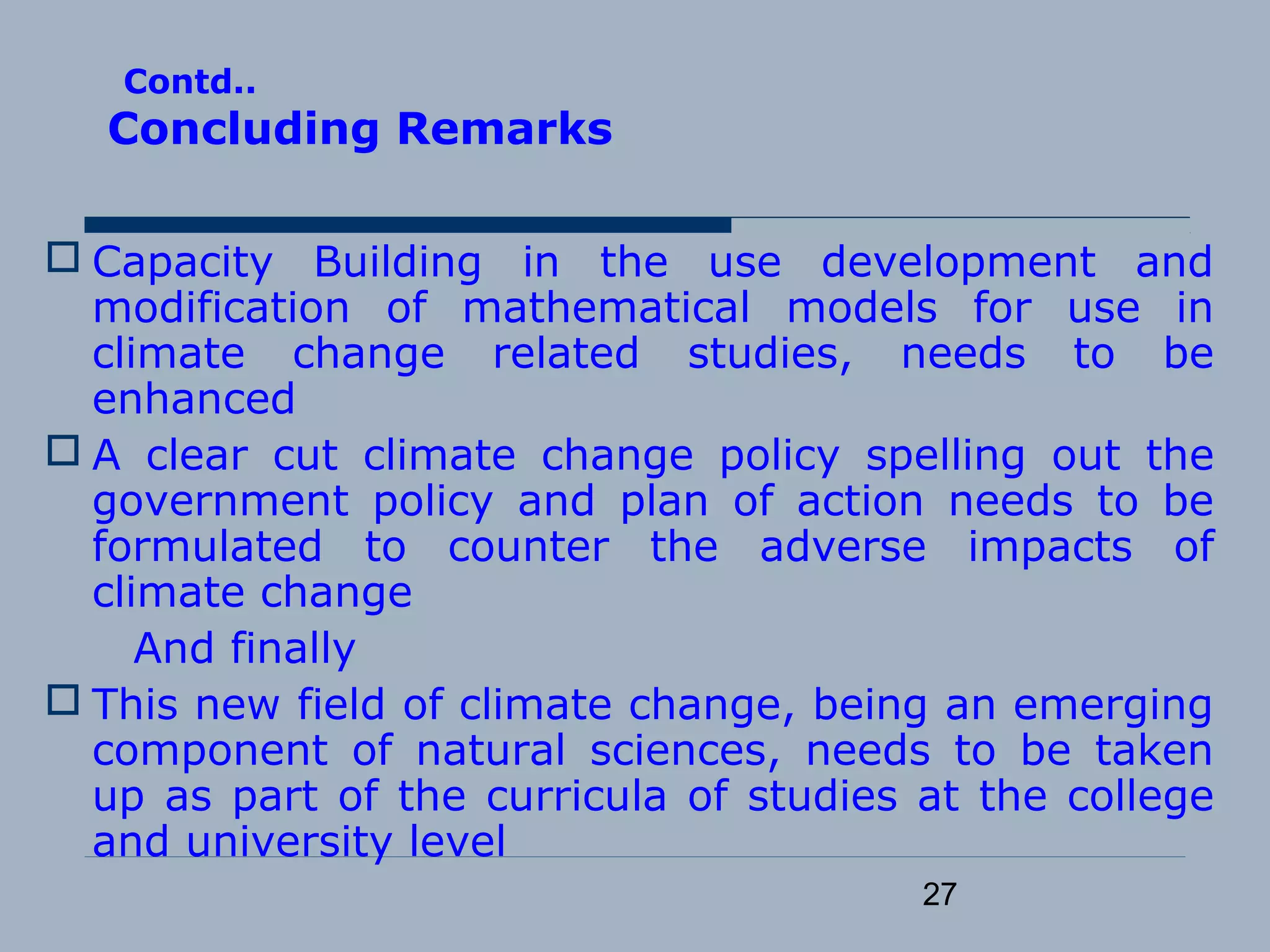
Contd..
Concluding Remarks
 Capacity Building in the use development and
modification of mathematical models for use in
climate change related studies, needs to be
enhanced
 A clear cut climate change policy spelling out the
government policy and plan of action needs to be
formulated to counter the adverse impacts of
climate change
And finally
 This new field of climate change, being an emerging
component of natural sciences, needs to be taken
up as part of the curricula of studies at the college
and university level
28

2 9 alam_cliamate_change_touseef_alam

  • 1.
    1 Muhammad Touseef Alam PakistanMeteorological Department Director Environmental Prediction into the Next Decade: Weather, Climate, Water and the Air We Breathe Incheon, Republic of Korea, 16-17, November 2009
  • 2.
    2 The country hasa long latitudinal extent stretching from the Arabian Sea in the south to the Himalayan mountains in north It is located in sub-tropics and partially in temperate region Most Parts of Pakistan are Arid to Semi Arid with significant spatial and temporal variability in climatic parameters 59% Annual Rainfall is due to summer monsoons; Greater Himalayan region above 35o N receives winter precipitation mostly in the form of snow and ice.
  • 3.
    3 Natural Climate Variability Anthropogenic Influences sincethe Industrial revolution CLIMATE CHANGE Global Warming Increased Precipitation & its uneven Distribution Melting of Glaciers & Snow Sea level Rise Increase in Frequency & Intensity of Extreme Weather Events IMPACTS Uncertainty in Water Availability Decrease in Crop Yields Loss of Biodiversity Increase Health Risks Spiraling Population High pace of Industrialization Increasing use of Fossil Fuels in Industry & Transport Deforestation for Agriculture and Urbanization Climate Change Natural + Anthropogenic
  • 4.
    4 Some Recent ClimateExtreme Events in Pakistan 2009 Karachi received 205 mm of rain on 18 & 19 July. Heaviest rainfall earlier recorded at Karachi was 207 mm on 1st July, 1977. The normal rainfall at Karachi for the periods 1961-1990 is 85.5 mm 2007 Record heat wave gripped Pakistan during June, 2007. 48°C temperature was recorded on 9th June at Lahore, a record repeated after 78 years. Earlier it was recorded on 8th June 1929
  • 5.
    5 Some Recent ClimateExtreme Events in Pakistan 2007Two super cyclones namely Gonu (02A) of Cat-5 and Yemyin (03B) of Cat-1 developed in the Arabian Sea during June, 2007 and hit Makran Coast and adjoining countries. The history of the Arabian Sea at least during the previous century shows no such events occurring twice in a month 2001 620 mm rainfall recorded in Islamabad during 10 hours in the month of July (on 23rd of July); it caused flooding in Lainullah 1998-2001 History’s worst drought gripped southern parts of Pakistan and parts of surrounding countries
  • 6.
    6 Recent Climate Extremesobserved in South Asia and Middle East  2003 Heavy rains in the holy city of Makkah, Saudi Arabia on November 10; caused widespread flooding of the city  2005 In India’s western state of Maharashtra, exceptionally heavy rainfall was recorded on July 26 when 944 mm (37.1 in) of rain fell in Mumbai. This was a new all-time 24-hour rainfall for the country, breaking the old record of 838 mm set in Cherrapunji in 1910. Around 1000 people died and damages reached $ 3.5 billion
  • 7.
    7 Recent Climate Extremesobserved in South Asia and Middle East  2004 Snowfall in the al-Jiys mountain range in UAE, the first ever in historical record  2007 Sidr, a tropical cyclone of Cat-4 slammed ashore of India- Bangladesh border on 15 Nov, 2007. This matched the one in 1991 that sparked tidal wave and killed some 150,000 people
  • 8.
  • 9.
  • 10.
  • 11.
    11 Siachen Glacier Past& Present 1989 2006
  • 12.
    12 Negative Trends inRegion I b, II and IV; Positive Trends in other regions Regions I (a): Greater Himalayas I (b): Sub-montane II: Western Highlands III Central & Southern Punjab IV Lower Indus Plains V (a) Balochistan Plateau (East) V (b) Balochistan Plateau (West) VI Coastal Areas Annual Mean Temperature Trend in (°C) in different regions of Pakistan (1951-2000)
  • 13.
    13Negative Trends inRegion II & VI; Positive Trends in other regions Annual % Precipitation Trend in (mm) in different regions of Pakistan (1951-2000) Regions I (a): Greater Himalayas (Winter dominated) I (b): Sub-montane region and monsoon dominated II: Western Highlands III Central & Southern Punjab IV Lower Indus Plains V (a) Balochistan Province (Sulaiman & Kirthar ranges) V (b) Balochistan Plateau (Western) VI Coastal Areas
  • 14.
    14 Percentage Precipitation Changes(on yearly basis) (1951-2000) Regions/Seasons Annual Monsoon (Jun-Sep) Winter (Dec-Mar) I (a): Greater Himalayas 0.49 1.73 -0.04 I (b): Sub-montane 0.3A 0.38 0.53 II: Western Highlands -0.02 0.22 0.00 III: Central & Southern Punjab 0.63 0.57 0.99 IV: Lower Indus Plains 0.22 0.45 -0.27 V (a): Balochistan Plateau (East) 1.19 1.16 1.14 V (b): Balochistan Plateau (west) 0.1 -0.2 -0.4 VI: Coastal Areas -0.82 -1.34 0.00
  • 15.
    15 Annual Temperature (°C)Trend 1901-2000 for Pakistan
  • 16.
    16 Annual Precipitation (mm)Trend 1901-2000 for Pakistan
  • 17.
    17 Climate Change Trendsover Pakistan  The slope of the mean annual temperature over Pakistan during the 48-year period 1960-2007 was found as: 1901-2000 0.06 °C per decade 1960-2007 0.24 °C per decade  The rate of increase is higher than the rate of increase observed globally
  • 18.
    18 Climate Change Projections a)Coarse resolution (~300 km x 300 km) projections using Outputs of 17 GCMs for A2, B2 and A1B Scenarios b) Fine resolution (~50 km x 50 km) projections by dynamic downscaling of GCM outputs for A2 scenario using RCMs Base period: 1961 – 1990 Futures: 2020s = 2010 – 2039 2050s = 2040 – 2069 2080s = 2070 – 2099
  • 19.
    19 GCM-Ensemble based ProjectedChanges in Annual Average Temperature (°C) and Precipitation in 2080s (A2 Scenario) Precipitation Change (%)Temperature Change (°C)
  • 20.
    20 Pakistan Northern Pakistan Southern Pakistan Annual 4.38 ±0.44 4.67 ± 0.23 4.22 ± 0.18 Summer 4.13 ± 0.26 4.56 ± 0.28 3.90 ± 0.26 Winter 4.47 ± 0.20 4.72 ± 0.24 4.33 ± 0.18 Projected Temperature Changes in 2080s, ∆T (°C) by GCM Ensemble for A2 Scenario • Temperature increases in both summer and winter are higher in Northern Pakistan than in Southern Pakistan • Temperature increases in Northern and Southern Pakistan are higher in winter than in summer
  • 21.
    21 Projected Precipitation Changesin 2080s, ∆P(%) by GCM Ensemble for A2 Scenario Pakistan Northern Pakistan Southern Pakistan Annual 3.48 ± 5.78 1.13 ± 3.95 4.28 ± 9.46 Summer 12.16 ± 8.91 1.08 ± 8.35 51.07 ± 39.78 Winter -5.12 ± 4.78 -2.24 ± 4.10 -20.51 ± 9.05 • The rather large errors make it difficult to draw any definite conclusions about change in precipitation with time • There is, however, some indication of precipitation increase in summer and precipitation decrease in winter in the Southern Pakistan
  • 22.
    22 Major Climate Change-relatedConcerns of Pakistan  Key sectors: Water and Agriculture at greatest risk  Increased risks of floods and landslides, droughts, typhoons and tropical storms, forest fires etc. due to increase in frequency and intensity of extreme events  Severe water-stressed conditions in arid and semi- arid regions due to reduced rainfall, increased temp., and depletion of soil moisture – May lead to expansion of deserts
  • 23.
    23 (Contd.) Major CC-related Concernsof Pakistan  More rapid recession of Hindu Kush (HKH) Glaciers due to increase in temp. and seasonal variability of precipitation may lead to increased summer flows in Indus river system for a few decades, followed by reduction in flows as Glaciers disappear;  Reduction in capacity of natural reservoirs due to rise in snowline on mountains with increase in surface temp. – May increase risk of floods during the wet season;  Agriculture productivity likely to suffer severe losses due to high temp., droughts, flood conditions and soil degradation – Would endanger food security of the country;
  • 24.
    24 (Contd.) Major CC-related Concernsof Pakistan  Large reduction in productivity of both warm water and cold water fish due to oxygen depletion in aquatic systems  As a result of sea level rise, large scale inundation of coastline and recession of flat sandy beaches; upstream incursion of saline water in the Indus delta; and risk to mangroves, coral reefs and breeding grounds of fish  Enhanced risk to life and property in coastal areas due to increased intensity of tropical cyclones, combined with sea level rise; High risk for Karachi and other coastal areas of Sindh-Makran coast
  • 25.
    25 (Contd.) Major CC-related Concernsof Pakistan  Higher incidence of Malaria and other vector-borne, water- borne and heat-related diseases due to warmer and wetter conditions  Risk to fragile ecology of Mountain and Highland systems due to synergetic effects of Climate Change  Increased threat to biodiversity, which is already at risk due to land-use/cover change and population pressure
  • 26.
    26 Concluding Remarks  Temperatureincreases both past and projected are higher over Pakistan compared to the global changes and as such the country is more vulnerable to climate change. Intensive research is needed to study the adverse impacts of climate change on different socio- economic sectors such as water resources, agriculture production etc.  Pakistan has more glaciers than any other land outside the North and South Poles with sizeable ones in the Karakoram ranges. Glacier melt, in the wake of climate change, is a big threat to the country’s water resources and needs systematic studies to be carried out on the mass balance of glaciers
  • 27.
    27 Contd.. Concluding Remarks  CapacityBuilding in the use development and modification of mathematical models for use in climate change related studies, needs to be enhanced  A clear cut climate change policy spelling out the government policy and plan of action needs to be formulated to counter the adverse impacts of climate change And finally  This new field of climate change, being an emerging component of natural sciences, needs to be taken up as part of the curricula of studies at the college and university level
  • 28.