7
1
CLIMATE CHANGE IMPACTS ON PAKISTAN
7
2
• The distribution of weather patterns can vary due to climate
change when such change persists for a long time The World
Meteorological Organization defines climate change as a
change in average weather conditions or in the time variation
of weather within the context of longer-term average
conditions, which are defined as a timeframe of 30 yrs or
more.
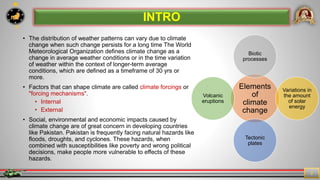
• Factors that can shape climate are called climate forcings or
"forcing mechanisms".
• Internal
• External
• Social, environmental and economic impacts caused by
climate change are of great concern in developing countries
like Pakistan. Pakistan is frequently facing natural hazards like
floods, droughts, and cyclones. These hazards, when
combined with susceptibilities like poverty and wrong political
decisions, make people more vulnerable to effects of these
hazards.
INTRO
Elements
of
climate
change
Biotic
processes
Variations in
the amount
of solar
energy
Tectonic
plates
Volcanic
eruptions
7
3
To analyse the impact of climate change in Pakistan and finding
viable solutions to overcome this problem.
AIM
7
4
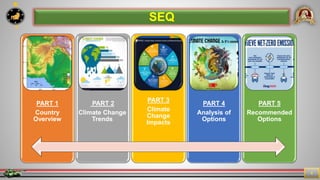
PART 1
Country
Overview
PART 2
Climate Change
Trends
PART 3
Climate
Change
Impacts
PART 4
Analysis of
Options
PART 5
Recommended
Options
SEQ
7
5
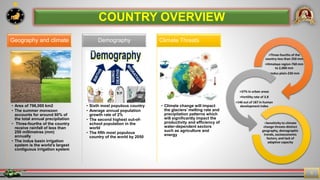
COUNTRY OVERVIEW
• Area of 796,000 km2
• The summer monsoon
accounts for around 60% of
the total annual precipitation
• Three-fourths of the country
receive rainfall of less than
250 millimetres (mm)
annually
• The indus basin irrigation
system is the world’s largest
contiguous irrigation system
Geography and climate
• Sixth most populous country
• Average annual population
growth rate of 2%
• The second highest out-of-
school population in the
world
• The fifth most populous
country of the world by 2050
Demography
• Climate change will impact
the glaciers’ melting rate and
precipitation patterns which
will significantly impact the
productivity and efficiency of
water-dependent sectors
such as agriculture and
energy
Climate Threats
>Three-fourths of the
country-less than 250 mm
>Himalaya region-760 mm
to 2,000 mm
>Indus plain-230 mm
>37% in urban areas
>Fertility rate of 3.8
>146 out of 187 in human
development index
>Sensitivity to climate
change threats-distinct
geography, demographic
trends, socioeconomic
factors, and lack of
adaptive capacity
7
6
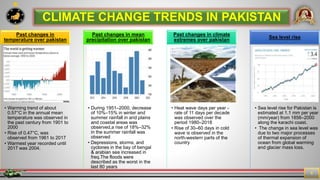
CLIMATE CHANGE TRENDS IN PAKISTAN
• Warming trend of about
0.57°C in the annual mean
temperature was observed in
the past century from 1901 to
2000
• Rise of 0.47°C, was
observed from 1961 to 2017
• Warmest year recorded until
2017 was 2004.
Past changes in
temperature over pakistan
• During 1951–2000, decrease
of 10%–15% in winter and
summer rainfall in arid plains
and coastal areas was
observed,a rise of 18%–32%
in the summer rainfall was
observed
• Depressions, storms, and
cyclones in the bay of bengal
& arabian sea increased in
freq.The floods were
described as the worst in the
last 80 years
Past changes in mean
precipitation over pakistan
• Heat wave days per year -
rate of 11 days per decade
was observed over the
period 1980–2018
• Rise of 30–60 days in cold
wave is observed in the
north-western parts of the
country
Past changes in climate
extremes over pakistan
• Sea level rise for Pakistan is
estimated at 1.1 mm per year
(mm/year) from 1856–2000
along the karachi coast.
• The change in sea level was
due to two major processes
of thermal expansion of
ocean from global warming
and glacier mass loss.
Sea level rise
7
7
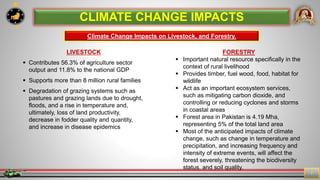
LIVESTOCK
 Contributes 56.3% of agriculture sector
output and 11.8% to the national GDP
 Supports more than 8 million rural families
 Degradation of grazing systems such as
pastures and grazing lands due to drought,
floods, and a rise in temperature and,
ultimately, loss of land productivity,
decrease in fodder quality and quantity,
and increase in disease epidemics
CLIMATE CHANGE IMPACTS
Climate Change Impacts on Livestock, and Forestry.
FORESTRY
 Important natural resource specifically in the
context of rural livelihood
 Provides timber, fuel wood, food, habitat for
wildlife
 Act as an important ecosystem services,
such as mitigating carbon dioxide, and
controlling or reducing cyclones and storms
in coastal areas
 Forest area in Pakistan is 4.19 Mha,
representing 5% of the total land area
 Most of the anticipated impacts of climate
change, such as change in temperature and
precipitation, and increasing frequency and
intensity of extreme events, will affect the
forest severely, threatening the biodiversity
status, and soil quality.
7
8
CLIMATE CHANGE IMPACTS
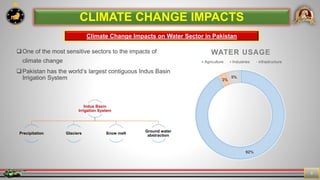
Climate Change Impacts on Water Sector in Pakistan
One of the most sensitive sectors to the impacts of
climate change
Pakistan has the world’s largest contiguous Indus Basin
Irrigation System
Indus Basin
Irrigation System
Precipitation Glaciers Snow melt
Ground water
abstraction
92%
3%
5%
WATER USAGE
Agriculture Industries infrastructure
7
9
CLIMATE CHANGE IMPACTS
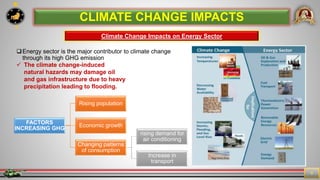
Climate Change Impacts on Energy Sector
Energy sector is the major contributor to climate change
through its high GHG emission
FACTORS
INCREASING GHG
Rising population
Economic growth
Changing patterns
of consumption
rising demand for
air conditioning
Increase in
transport
 The climate change-induced
natural hazards may damage oil
and gas infrastructure due to heavy
precipitation leading to flooding.
7
10
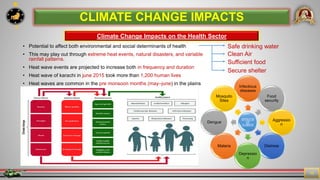
• Potential to affect both environmental and social determinants of health
• This may play out through extreme heat events, natural disasters, and variable
rainfall patterns.
• Heat wave events are projected to increase both in frequency and duration
• Heat wave of karachi in june 2015 took more than 1,200 human lives
• Heat waves are common in the pre monsoon months (may–june) in the plains
CLIMATE CHANGE IMPACTS
Climate Change Impacts on the Health Sector
Safe drinking water
Clean Air
Sufficient food
Secure shelter
EFFECTS
OF
CLIMATE
Infectious
diseases
Food
security
Aggressio
n
Distress
Depressio
n
Malaria
Dengue
Mosquito
Sites
7
11
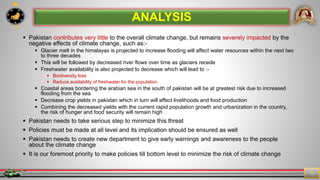
 Pakistan contributes very little to the overall climate change, but remains severely impacted by the
negative effects of climate change, such as:-
 Glacier melt in the himalayas is projected to increase flooding will affect water resources within the next two
to three decades
 This will be followed by decreased river flows over time as glaciers recede
 Freshwater availability is also projected to decrease which will lead to :-
 Biodiversity loss
 Reduce availability of freshwater for the population
 Coastal areas bordering the arabian sea in the south of pakistan will be at greatest risk due to increased
flooding from the sea
 Decrease crop yields in pakistan which in turn will affect livelihoods and food production
 Combining the decreased yields with the current rapid population growth and urbanization in the country,
the risk of hunger and food security will remain high
 Pakistan needs to take serious step to minimize this threat
 Policies must be made at all level and its implication should be ensured as well
 Pakistan needs to create new department to give early warnings and awareness to the people
about the climate change
 It is our foremost priority to make policies till bottom level to minimize the risk of climate change
ANALYSIS
7
12
 More and more trees should be planted
 Energy should be used efficiently
 Renewable power sources should be adopted
 The garbage should not be burned or burry in landfills. It may be made composts for kitchen
gardens
 The loss of water in any form should be checked
 Electric automobiles should be preferred
 Recycling is one of the most effective ways to check carbon emissions
 Media should spread awareness regarding the effects of climate change
 Use eco-friendly appliances
 The treatment of industrial waste should be made mandatory all over the world
 Governments should start taking this problem seriously
 They should implement Paris agreement in their countries
 They should start investing in projects which can try to minimize climate change
RECOM
7
13
 Plastic should not be used. Environment-friendly shopper bags should be used
 Use of aerosol sprays should be minimized
 The misuse of fertilizers should be avoided
 Water should be used wisely
 The power generation should be done by environmentally friendly means
 Conservation practices should be adopted regarding agriculture
 National Conservation Strategy was a major landmark of start of conservation of natural resources and
wildlife in Pakistan.
 Resource-managed man-made forests like Changa Manga, Kamalia plantation and Chichawatni plantation
have also been planted to serve purpose and conserve forests.
 Through conservation, a large region of Thal desert has been afforested
RECOM
7
14
CONCL

Climate change impact on pakistan.pptx

  • 1.
  • 2.
    7 2 • The distributionof weather patterns can vary due to climate change when such change persists for a long time The World Meteorological Organization defines climate change as a change in average weather conditions or in the time variation of weather within the context of longer-term average conditions, which are defined as a timeframe of 30 yrs or more. • Factors that can shape climate are called climate forcings or "forcing mechanisms". • Internal • External • Social, environmental and economic impacts caused by climate change are of great concern in developing countries like Pakistan. Pakistan is frequently facing natural hazards like floods, droughts, and cyclones. These hazards, when combined with susceptibilities like poverty and wrong political decisions, make people more vulnerable to effects of these hazards. INTRO Elements of climate change Biotic processes Variations in the amount of solar energy Tectonic plates Volcanic eruptions
  • 3.
    7 3 To analyse theimpact of climate change in Pakistan and finding viable solutions to overcome this problem. AIM
  • 4.
    7 4 PART 1 Country Overview PART 2 ClimateChange Trends PART 3 Climate Change Impacts PART 4 Analysis of Options PART 5 Recommended Options SEQ
  • 5.
    7 5 COUNTRY OVERVIEW • Areaof 796,000 km2 • The summer monsoon accounts for around 60% of the total annual precipitation • Three-fourths of the country receive rainfall of less than 250 millimetres (mm) annually • The indus basin irrigation system is the world’s largest contiguous irrigation system Geography and climate • Sixth most populous country • Average annual population growth rate of 2% • The second highest out-of- school population in the world • The fifth most populous country of the world by 2050 Demography • Climate change will impact the glaciers’ melting rate and precipitation patterns which will significantly impact the productivity and efficiency of water-dependent sectors such as agriculture and energy Climate Threats >Three-fourths of the country-less than 250 mm >Himalaya region-760 mm to 2,000 mm >Indus plain-230 mm >37% in urban areas >Fertility rate of 3.8 >146 out of 187 in human development index >Sensitivity to climate change threats-distinct geography, demographic trends, socioeconomic factors, and lack of adaptive capacity
  • 6.
    7 6 CLIMATE CHANGE TRENDSIN PAKISTAN • Warming trend of about 0.57°C in the annual mean temperature was observed in the past century from 1901 to 2000 • Rise of 0.47°C, was observed from 1961 to 2017 • Warmest year recorded until 2017 was 2004. Past changes in temperature over pakistan • During 1951–2000, decrease of 10%–15% in winter and summer rainfall in arid plains and coastal areas was observed,a rise of 18%–32% in the summer rainfall was observed • Depressions, storms, and cyclones in the bay of bengal & arabian sea increased in freq.The floods were described as the worst in the last 80 years Past changes in mean precipitation over pakistan • Heat wave days per year - rate of 11 days per decade was observed over the period 1980–2018 • Rise of 30–60 days in cold wave is observed in the north-western parts of the country Past changes in climate extremes over pakistan • Sea level rise for Pakistan is estimated at 1.1 mm per year (mm/year) from 1856–2000 along the karachi coast. • The change in sea level was due to two major processes of thermal expansion of ocean from global warming and glacier mass loss. Sea level rise
  • 7.
    7 7 LIVESTOCK  Contributes 56.3%of agriculture sector output and 11.8% to the national GDP  Supports more than 8 million rural families  Degradation of grazing systems such as pastures and grazing lands due to drought, floods, and a rise in temperature and, ultimately, loss of land productivity, decrease in fodder quality and quantity, and increase in disease epidemics CLIMATE CHANGE IMPACTS Climate Change Impacts on Livestock, and Forestry. FORESTRY  Important natural resource specifically in the context of rural livelihood  Provides timber, fuel wood, food, habitat for wildlife  Act as an important ecosystem services, such as mitigating carbon dioxide, and controlling or reducing cyclones and storms in coastal areas  Forest area in Pakistan is 4.19 Mha, representing 5% of the total land area  Most of the anticipated impacts of climate change, such as change in temperature and precipitation, and increasing frequency and intensity of extreme events, will affect the forest severely, threatening the biodiversity status, and soil quality.
  • 8.
    7 8 CLIMATE CHANGE IMPACTS ClimateChange Impacts on Water Sector in Pakistan One of the most sensitive sectors to the impacts of climate change Pakistan has the world’s largest contiguous Indus Basin Irrigation System Indus Basin Irrigation System Precipitation Glaciers Snow melt Ground water abstraction 92% 3% 5% WATER USAGE Agriculture Industries infrastructure
  • 9.
    7 9 CLIMATE CHANGE IMPACTS ClimateChange Impacts on Energy Sector Energy sector is the major contributor to climate change through its high GHG emission FACTORS INCREASING GHG Rising population Economic growth Changing patterns of consumption rising demand for air conditioning Increase in transport  The climate change-induced natural hazards may damage oil and gas infrastructure due to heavy precipitation leading to flooding.
  • 10.
    7 10 • Potential toaffect both environmental and social determinants of health • This may play out through extreme heat events, natural disasters, and variable rainfall patterns. • Heat wave events are projected to increase both in frequency and duration • Heat wave of karachi in june 2015 took more than 1,200 human lives • Heat waves are common in the pre monsoon months (may–june) in the plains CLIMATE CHANGE IMPACTS Climate Change Impacts on the Health Sector Safe drinking water Clean Air Sufficient food Secure shelter EFFECTS OF CLIMATE Infectious diseases Food security Aggressio n Distress Depressio n Malaria Dengue Mosquito Sites
  • 11.
    7 11  Pakistan contributesvery little to the overall climate change, but remains severely impacted by the negative effects of climate change, such as:-  Glacier melt in the himalayas is projected to increase flooding will affect water resources within the next two to three decades  This will be followed by decreased river flows over time as glaciers recede  Freshwater availability is also projected to decrease which will lead to :-  Biodiversity loss  Reduce availability of freshwater for the population  Coastal areas bordering the arabian sea in the south of pakistan will be at greatest risk due to increased flooding from the sea  Decrease crop yields in pakistan which in turn will affect livelihoods and food production  Combining the decreased yields with the current rapid population growth and urbanization in the country, the risk of hunger and food security will remain high  Pakistan needs to take serious step to minimize this threat  Policies must be made at all level and its implication should be ensured as well  Pakistan needs to create new department to give early warnings and awareness to the people about the climate change  It is our foremost priority to make policies till bottom level to minimize the risk of climate change ANALYSIS
  • 12.
    7 12  More andmore trees should be planted  Energy should be used efficiently  Renewable power sources should be adopted  The garbage should not be burned or burry in landfills. It may be made composts for kitchen gardens  The loss of water in any form should be checked  Electric automobiles should be preferred  Recycling is one of the most effective ways to check carbon emissions  Media should spread awareness regarding the effects of climate change  Use eco-friendly appliances  The treatment of industrial waste should be made mandatory all over the world  Governments should start taking this problem seriously  They should implement Paris agreement in their countries  They should start investing in projects which can try to minimize climate change RECOM
  • 13.
    7 13  Plastic shouldnot be used. Environment-friendly shopper bags should be used  Use of aerosol sprays should be minimized  The misuse of fertilizers should be avoided  Water should be used wisely  The power generation should be done by environmentally friendly means  Conservation practices should be adopted regarding agriculture  National Conservation Strategy was a major landmark of start of conservation of natural resources and wildlife in Pakistan.  Resource-managed man-made forests like Changa Manga, Kamalia plantation and Chichawatni plantation have also been planted to serve purpose and conserve forests.  Through conservation, a large region of Thal desert has been afforested RECOM
  • 14.