w

w
ap
eP

m

e
tr
.X

w
om
.c

s
er

JUNE 2003

INTERNATIONAL GCSE

MARK SCHEME
MAXIMUM MARK: 40

SYLLABUS/COMPONENT: 0610/01
BIOLOGY
Paper 1 (Multiple Choice)
Page 1

Mark Scheme
IGCSE EXAMINATIONS – JUNE 2003

Syllabus
0610

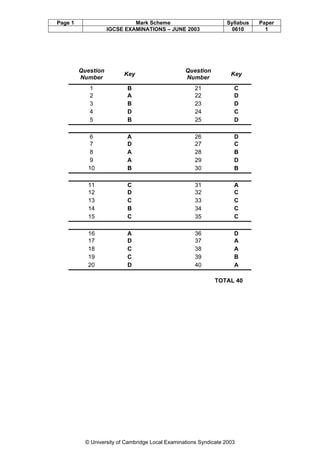
Question
Number

Key

Question
Number

Key

1
2
3
4
5

B
A
B
D
B

21
22
23
24
25

C
D
D
C
D

6
7
8
9
10

A
D
A
A
B

26
27
28
29
30

D
C
B
D
B

11
12
13
14
15

C
D
C
B
C

31
32
33
34
35

A
C
C
C
C

16
17
18
19
20

A
D
C
C
D

36
37
38
39
40

D
A
A
B
A
TOTAL 40

© University of Cambridge Local Examinations Syndicate 2003

Paper
1
JUNE 2003

INTERNATIONAL GCSE

MARK SCHEME
MAXIMUM MARK: 70

SYLLABUS/COMPONENT: 0610/02
BIOLOGY
Paper 2 (Core)
Page 1

1

(a)

Mark Scheme
IGCSE EXAMINATIONS – JUNE 2003

Syllabus
0610

Paper
2

excretion;
growth;
movement;

ignore - locomotion

nutrition;

ignore - feeding

reproduction;
sensitivity/irritability;
Accept descriptions
Any three – 1 mark each

(b)

[3]

put mud in muslin bag/equivalent – workable apparatus;
suspend over limewater/calcium hydroxide solution/hydrogencarbonate/
bicarbonate indicator;
in sealed container;
incubate/leave for 12+ hours;
look for limewater to go cloudy/milky/white/hydrogen carbonate to go yellow;
carbon dioxide released indicates respiration;
reference to use of control;
Apply pattern of mark scheme to alternative approaches
e.g. release of heat from or use of oxygen for respiration.
Credit annotated diagrams
Any four – 1 mark each

[4]
Total [7]

© University of Cambridge Local Examinations Syndicate 2003
Page 2

2

(a)

Mark Scheme
IGCSE EXAMINATIONS – JUNE 2003

(i)

Syllabus
0610

Paper
2

X – stigma/carpel;
Y – anther/stamen;

(ii)

[2]

small/insignificant “petals”/flowers “open”;
do not prevent wind access to anthers/stigma/pollen;
stamens/anthers hang outside of flower/petals;
to release pollen into wind/air;
stigma feathery;
trap/filter pollen (from air);
stigma hangs outside flower/petals;
to catch pollen (in the wind);
Any feature plus explanation – 1 mark each

[2]

(iii) no smell/scent;
no bright colours of petals/flowers/coloured green;
no nectar/nectary;
inconspicuous shape/size of flower/petals;
dry/dusty pollen;
large quantities/smaller size pollen;
Also features listed in (ii) above but not given
in candidate’s response to (ii)
Any two – 1 mark each

(b)

[2]

(i)

southwest;

[1]

(ii)

most fruit found to north and east;

apply error carried forward

[1]

(iii) distribution of fruit on branches;
distribution of branches on tree;
animals feed on/collect fruits from one region around tree;
other valid biological suggestions;

ignore - human intervention.

Any one – 1 mark

[1]
Total [9]

© University of Cambridge Local Examinations Syndicate 2003
Page 3

3

(a)

Mark Scheme
IGCSE EXAMINATIONS – JUNE 2003

Syllabus
0610

Paper
2

(i)

C/(i) alongside a relevant arrow;

[1]

(ii)

D/(ii) alongside a relevant arrow;

[1]

(iii) P/(iii) alongside a relevant arrow;

[1]

(iv) R/(iv) alongside a relevant arrow;

[1]

If in any section more than one label is given all of that label must be correct

(b)

(i)

less/no (trees/leaves) to photosynthesise;
more carbon dioxide in air/less removed from air;
no/less (leaves/wood) to decay;
Any two – 1 mark each

(ii)

[2]

less (leaves to) transpire/evaporation of water/evapotranspiration;
less roots/plants to absorb water (from deep layers);
less water v/water vapour in air/less rainfall;
Ignore - refs to floods/droughts/erosion/desertification.
Any two – 1 mark each

[2]
Total [8]

© University of Cambridge Local Examinations Syndicate 2003
Page 4

4

(a)

Mark Scheme
IGCSE EXAMINATIONS – JUNE 2003

(i)

Syllabus
0610

Paper
2

A – nucleus/nuclear membrane;
B – cytoplasm;

(ii)

(b)

[2]

label C clearly linked to a cell membrane in each cell;

[1]

(i)

has cilia (on one surface/end of cell);
to move mucus;

ignore - hair

reject - trap bacteria/dust, etc.
[2]

Credit valid references to goblet cells and function of producing mucus

(ii)

has haemoglobin/no nucleus/biconcave;
transport oxygen;

(c)

(i)

movement of molecules/particles/ions;
down concentration gradient/from higher to lower concentration;

(ii)

[2]

[2]

movement of water (molecules);
across/through partially/semi/differentially/selectively
permeable membrane.

[2]
Total [11]

© University of Cambridge Local Examinations Syndicate 2003
Page 5

5

(a)

Mark Scheme
IGCSE EXAMINATIONS – JUNE 2003

Syllabus
0610

Paper
2

mitosis;
diploid;
meiosis;
haploid;
gametes;

(b)

[5]

use of correct symbols/X and Y;
parent genotypes shown;
gamete genotypes shown;
offspring genotypes shown;
phenotypes for both sexes identified.
parent genotype wrong – max 3
Any four – 1 mark each

[4]
Total [9]

© University of Cambridge Local Examinations Syndicate 2003
Page 6

6

Mark Scheme
IGCSE EXAMINATIONS – JUNE 2003

Syllabus
0610

Paper
2

top left box to 2nd right box;

(a)

2nd left box to top right box;
bottom left box to bottom right box;

(b)

[3]

(i)

label to colon/large intestine;

[1]

(ii)

label to liver;

reject - gall bladder

(iii) label to liver;

(iv) label to pancreas;

[1]

[1]

reject - small intestine.

[1]
Total [7]

© University of Cambridge Local Examinations Syndicate 2003
Page 7

7

Mark Scheme
IGCSE EXAMINATIONS – JUNE 2003

(a)

Syllabus
0610

Paper
2

A – refracts/bends light rays/lets light enter eye;
ignore - protection
B – focuses light rays/image on to the retina/fovea;
ignore - accommodation/change in shape
C – controls light entering (inner) eye/reaching retina/lens;
ignore - change in pupil
D – changes light into/generates nerve/electrical impulses;
ignore - signals unqualified/messages

(b)

[4]

more/too much light enters/reaches retina;
dazzles person/causes blurred vision/damages retina;
ignore - double vision.

[2]
Total [6]

© University of Cambridge Local Examinations Syndicate 2003
Page 8

8

(a)

Mark Scheme
IGCSE EXAMINATIONS – JUNE 2003

Syllabus
0610

Paper
2

(translocation) is movement of soluble materials/sugars/amino acids;
from supply to demand/clearly identified example;
in phloem;
(transpiration) is diffusion/loss of water vapour/evaporation of water;
from leaves/through stomata to atmosphere;
down concentration gradient;
Any four – 1 mark each

(b)

[4]

leaves lose water;
water moves/passes/is drawn up/ref to transpiration stream;
up stem/leaf stalk;
through xylem/vessels;
(dye) dissolved/carried in water.
Any four – 1 mark each

[4]
Total [8]

© University of Cambridge Local Examinations Syndicate 2003
Page 9

9

(a)

Mark Scheme
IGCSE EXAMINATIONS – JUNE 2003

Syllabus
0610

Paper
2

ignore - solar

[1]

chemical (energy);

ignore - potential

[1]

(i)

bacteria/fungi;

ignore - decomposers/saprophytes [1]

(ii)

(c)

light/sunlight (energy);

(ii)

(b)

(i)

heat/thermal (energy);

[1]

energy is not passed back to the sun/grass/producer/
not recycled/OWTTE.

[1]
Total [5]

© University of Cambridge Local Examinations Syndicate 2003
JUNE 2003

INTERNATIONAL GCSE

MARK SCHEME
MAXIMUM MARK: 70

SYLLABUS/COMPONENT: 0610/03
BIOLOGY
Paper 3 (Extended)
Page 1

1

(a)

Mark Scheme
IGCSE EXAMINATIONS – JUNE 2003

Syllabus
0610

Paper
3

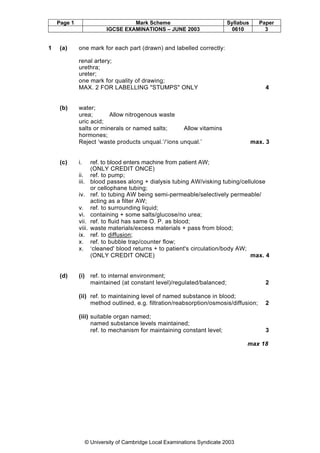
one mark for each part (drawn) and labelled correctly:
renal artery;
urethra;
ureter;
one mark for quality of drawing;
MAX. 2 FOR LABELLING "STUMPS" ONLY

(b)

(c)

water;
urea;
Allow nitrogenous waste
uric acid;
salts or minerals or named salts;
Allow vitamins
hormones;
Reject ‘waste products unqual.’/‘ions unqual.’

i.
ii.
iii.
iv.
v.
vi.
vii.
viii.
ix.
x.
x.

(d)

4

max. 3

ref. to blood enters machine from patient AW;
(ONLY CREDIT ONCE)
ref. to pump;
blood passes along + dialysis tubing AW/visking tubing/cellulose
or cellophane tubing;
ref. to tubing AW being semi-permeable/selectively permeable/
acting as a filter AW;
ref. to surrounding liquid;
containing + some salts/glucose/no urea;
ref. to fluid has same O. P. as blood;
waste materials/excess materials + pass from blood;
ref. to diffusion;
ref. to bubble trap/counter flow;
‘cleaned' blood returns + to patient's circulation/body AW;
(ONLY CREDIT ONCE)
max. 4

(i) ref. to internal environment;
maintained (at constant level)/regulated/balanced;

2

(ii) ref. to maintaining level of named substance in blood;
method outlined, e.g. filtration/reabsorption/osmosis/diffusion;

2

(iii) suitable organ named;
named substance levels maintained;
ref. to mechanism for maintaining constant level;

3
max 18

© University of Cambridge Local Examinations Syndicate 2003
Page 2

2

Mark Scheme
IGCSE EXAMINATIONS – JUNE 2003

Syllabus
0610

Paper
3

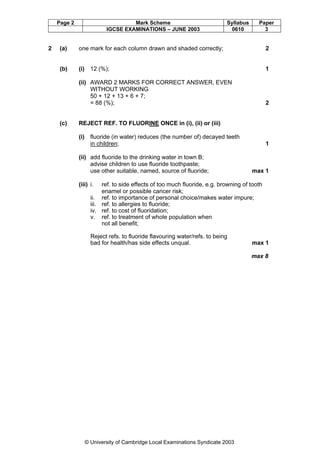
(a)

one mark for each column drawn and shaded correctly;

2

(b)

(i) 12 (%);

1

(ii) AWARD 2 MARKS FOR CORRECT ANSWER, EVEN
WITHOUT WORKING
50 + 12 + 13 + 6 + 7;
= 88 (%);

2

(c)

REJECT REF. TO FLUORINE ONCE in (i), (ii) or (iii)
(i) fluoride (in water) reduces (the number of) decayed teeth
in children;
(ii) add fluoride to the drinking water in town B;
advise children to use fluoride toothpaste;
use other suitable, named, source of fluoride;

1

max 1

(iii) i.

ref. to side effects of too much fluoride, e.g. browning of tooth
enamel or possible cancer risk;
ii. ref. to importance of personal choice/makes water impure;
iii. ref. to allergies to fluoride;
iv. ref. to cost of fluoridation;
v. ref. to treatment of whole population when
not all benefit;
Reject refs. to fluoride flavouring water/refs. to being
bad for health/has side effects unqual.

max 1
max 8

© University of Cambridge Local Examinations Syndicate 2003
Page 3

3

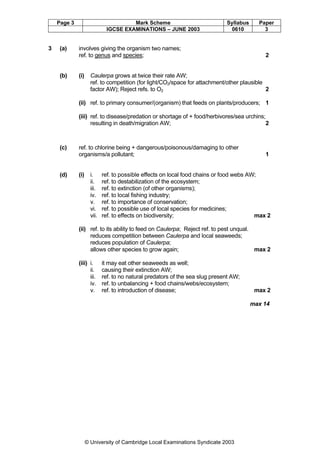
(a)

(b)

Mark Scheme
IGCSE EXAMINATIONS – JUNE 2003

Syllabus
0610

involves giving the organism two names;
ref. to genus and species;

(i)

Paper
3

2

Caulerpa grows at twice their rate AW;
ref. to competition (for light/CO2/space for attachment/other plausible
factor AW); Reject refs. to O2
2

(ii) ref. to primary consumer/(organism) that feeds on plants/producers; 1
(iii) ref. to disease/predation or shortage of + food/herbivores/sea urchins;
resulting in death/migration AW;
2

(c)

(d)

ref. to chlorine being + dangerous/poisonous/damaging to other
organisms/a pollutant;

(i)

i.
ii.
iii.
iv.
v.
vi.
vii.

1

ref. to possible effects on local food chains or food webs AW;
ref. to destabilization of the ecosystem;
ref. to extinction (of other organisms);
ref. to local fishing industry;
ref. to importance of conservation;
ref. to possible use of local species for medicines;
ref. to effects on biodiversity;
max 2

(ii) ref. to its ability to feed on Caulerpa; Reject ref. to pest unqual.
reduces competition between Caulerpa and local seaweeds;
reduces population of Caulerpa;
allows other species to grow again;
max 2
(iii) i.
ii.
iii.
iv.
v.

it may eat other seaweeds as well;
causing their extinction AW;
ref. to no natural predators of the sea slug present AW;
ref. to unbalancing + food chains/webs/ecosystem;
ref. to introduction of disease;

max 2
max 14

© University of Cambridge Local Examinations Syndicate 2003
Page 4

4

(a)

Mark Scheme
IGCSE EXAMINATIONS – JUNE 2003

Syllabus
0610

Paper
3

(i) (SIMILARITIES)
i. ref. to exoskeleton;
ii. ref. to jointed limbs AW;
iii. no backbone/ref. to invertebrate;
iv. both have segmented body;
v. both members of the arthropod group;
Accept ref. to stages of development, e.g. ecdysis/instars max 3
(ii) (DIFFERENCES)
1 MARK FOR TABLE, MAX. 4 FOR DIFFERENCES
i. table format with suitable headings;
ii. insects have 3 pairs of legs + arachnids have 4 pairs;
iii. insects have wings + arachnids do not; Allow refs to ability to fly
iv. insects have antennae + arachnids do not;
v. insects have compound eyes + arachnids do not/ref. to simple
eyes;
vi. insects have 3 parts to the body + arachnids have 2 parts;
vii. arachnids have chelicerae/pincer-like jaws + insects do not;
viii. arachnids spin webs + insects do not; Allow insects can
be social + arachnids are not AW;
max 5

(b)

i.
ii.
iii.
iv.
v.
vi.

named insect;
ref. to variation AW;
due to sexual reproduction/mating;
ref. to mutation;
variation/mutation + leads to differential survival AW;
suggestion for environmental change, e.g. temperature, food
available;
vii. suggested change to insect, e.g. thicker cuticle, larger wings;
viii. ref. to benefit of change to the organism;
ix. ref. to survival of fittest/natural selection;
x. favoured genes passed on to next generation AW;
max 7
max 15

© University of Cambridge Local Examinations Syndicate 2003
Page 5

5

Mark Scheme
IGCSE EXAMINATIONS – JUNE 2003

Syllabus
0610

Paper
3

(a)

ACCEPT OTHER PLAUSIBLE ANSWERS
i.
ref. to unsuitable climate/temperature/rainfall/ref. to pollution;
ii.
ref. to natural disasters, e.g. flooding/drought;
iii.
water used for other purposes/diversion of rivers/building
dams/poor irrigation;
iv.
so plants are killed/poor germination/no food for animals;
(linked to i. or ii. or iii.)
v.
next year's seeds eaten through need for food;
vi.
poor soil/lack of inorganic ions or fertiliser;
vii. so plants do not grow well; (linked to vi.)
viii. ref. to desertification/poor or thin soil;
ix.
due to + deforestation/slash and burn; (linked to viii.)
x.
ref. to lack of money + to buy seeds/fertiliser/pesticides/machinery/
import food;
xi.
ref. to war/farm redistribution;
xii. so there is no-one to harvest crops/too dangerous to tend crops/no
experienced farmers AW; (linked to xi.)
xiii. ref. to urbanisation AW;
xiv. so there are fewer people to work the land/less land to grow crops
on; (linked to xiii.)
xv. ref. to increasing population requiring food;
xvi. ref. to growth of + cash crops/monoculture/food for export (not
suitable for local diet);
xvii. ref. to selling of food reserves to + settle national debt/maintain
economy;
xviii. ref. to pest damage/disease (in crops or stored food);
xix. heat causes fresh produce to rot quickly AW;
xx. lack of suitable land to farm/ref. to overgrazing;
xxi. farmers poorly educated;
xxii. forests destroyed + so nothing to hunt/no food to collect;
xxiii. ref. to outmoded farm practices;
xxiv. ref. to poor transport/distribution;
max 10

(b)

i.
ii.
iii.
iv.
v.
vi.

ref. to auxin;
sprayed onto e.g. tomato flowers to induce fruit production;
happens even if pollination has not occurred;
ref. to use of auxins in + weedkiller/herbicide;
so crops have less competition;
ref. to effect (only) on broad leaved plants (so monocot crops
unaffected);
vii. ref. to use of hormones (e.g. cytokinin) in tissue culture;
viii. to promote root and shoot formation/form a callus;
ix.
ref. to BST (bovine somatotropin);
x.
used with cattle to increase milk production (linked to ix)
xi.
ref. to growth hormone/testosterone;
xii. used to increase meat production;
xiii. ref. to production of seedless fruit;
xiv. ref. to promotion of seed germination;
xv. ref. to production of short plants (to resist wind damage);
xvi. ref. to delaying fruit production/ripening;
xvii. ref. to increasing fruit yield AW;
max 5
max 15

© University of Cambridge Local Examinations Syndicate 2003
Page 6

6

(a)

(b)

Mark Scheme
IGCSE EXAMINATIONS – JUNE 2003

Syllabus
0610

Paper
3

i.
ii.

ref. to a pair of alleles; Reject gene ref. once
in which one is not dominant over the other AW;
Reject both dominant; Allow both equally dominant
iii. so both alleles have an effect in phenotype/heterozygous
organism AW;

3

ACCEPT PUNNETT SQUARE
IF LINES ARE USED TO LINK GAMETES AND F1, THEY MUST BE
CORRECT
i. mother = IA IO;
ii. father = IB IO;
iii. (parents) IA IO

Allow AO, IA i
I B I O;

X

IA

v.

IO

I A IB

iv. (gametes)

I A IO

IA

I AI B
I AI O

IO

IB I O

I O I O;

I BI O

IO

IB

IO

IB

(X)

I OI O

vi. IO IO = baby with blood group;

(c)

(i) i.
ii.
iii.
iv.

6

blood may + clump/clot/coagulate/agglutinate;
due to presence of antigens on (the surface of) blood cells;
and different antibodies present in other blood AW;
ref. to no clumping if donor blood group is group O;
max 3

(ii) i. placenta keeps the blood of mother and fetus separate AW;
ii. since the blood types could be different AW;
iii. but allows exchange of materials between mother
and fetus AW;

3

max 15

© University of Cambridge Local Examinations Syndicate 2003
Page 7

7

(a)

Mark Scheme
IGCSE EXAMINATIONS – JUNE 2003

Syllabus
0610

Paper
3

MARK FIRST FIVE PARTS AND FUNCTIONS GIVEN ANY FIVE FROM:
i.
ii.

penis + to insert sperm/semen + into vagina AW/ref. to erectile tissue;
urethra + to pass sperm/semen + through penis;
Allow ref. to penis/ urethra + urine once;
iii. testis + to make sperm/testosterone;
iv. vas deferens/sperm duct + pass sperm from testis to urethra;
v. epididymis + to store/mature/move + sperm;
vi. scrotum + contain testes/to keep testes at lower temperature than that
of body AW;
vii. prostate gland/seminal vesicles/cowper's gland + to produce seminal
fluid AW;
5

(b)

(i)

i.
ii.
iii.
iv.
v.
vi.
vii.

(ii) i.
ii.
iii.
iv.
v.
vi.

(c)

ref. to swimming;
using tail;
ref. to passing through cervix;
ref. to passing through uterus/womb;
enter an oviduct/fallopian tube;
ref. to chemical sensor AW;
ref. to mitochondria + energy;

max 4

ref. to zona pellucida;
sperm penetrates egg membrane;
ref. to use of enzymes/acrosome;
head of sperm enters egg;
sperm nucleus and egg nucleus fuse;
ref. to formation of zygote;

max 3

i.
ii.
iii.
iv.

ref. to use of condom/femidom (during sexual intercourse);
ref. to abstinence from sexual intercourse;
ref. to screening of blood for transfusions/blood checked for HIV;
ref. to use of sterile needles (for injecting drugs)/don't share needles;
Reject refs to clean needles;
v. ref. to maintaining one partner/not sleeping around;
vi. ref. to health education;
vii. avoiding contact with blood + example;
max 3
max 15

© University of Cambridge Local Examinations Syndicate 2003
JUNE 2003

INTERNATIONAL GCSE

MARK SCHEME
MAXIMUM MARK: 40

SYLLABUS/COMPONENT: 0610/05
BIOLOGY
(Practical)
Page 1

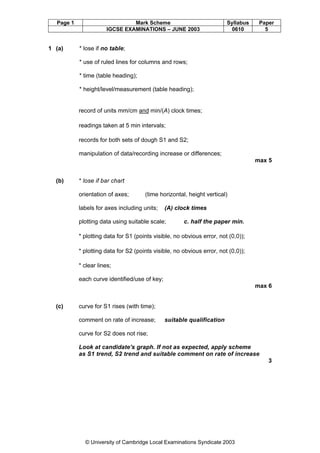
1 (a)

Mark Scheme
IGCSE EXAMINATIONS – JUNE 2003

Syllabus
0610

Paper
5

* lose if no table;
* use of ruled lines for columns and rows;
* time (table heading);
* height/level/measurement (table heading);

record of units mm/cm and min/(A) clock times;
readings taken at 5 min intervals;
records for both sets of dough S1 and S2;
manipulation of data/recording increase or differences;
max 5

(b)

* lose if bar chart
orientation of axes;

(time horizontal, height vertical)

labels for axes including units;

(A) clock times

plotting data using suitable scale;

c. half the paper min.

* plotting data for S1 (points visible, no obvious error, not (0,0));
* plotting data for S2 (points visible, no obvious error, not (0,0));
* clear lines;
each curve identified/use of key;
max 6

(c)

curve for S1 rises (with time);
comment on rate of increase;

suitable qualification

curve for S2 does not rise;
Look at candidate's graph. If not as expected, apply scheme
as S1 trend, S2 trend and suitable comment on rate of increase
3

© University of Cambridge Local Examinations Syndicate 2003
Page 2

(d)

Mark Scheme
IGCSE EXAMINATIONS – JUNE 2003

Syllabus
0610

Paper
5

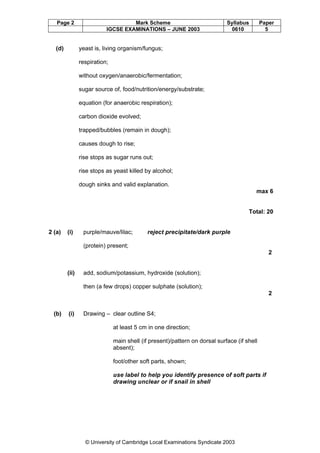
yeast is, living organism/fungus;
respiration;
without oxygen/anaerobic/fermentation;
sugar source of, food/nutrition/energy/substrate;
equation (for anaerobic respiration);
carbon dioxide evolved;
trapped/bubbles (remain in dough);
causes dough to rise;
rise stops as sugar runs out;
rise stops as yeast killed by alcohol;
dough sinks and valid explanation.
max 6

Total: 20

2 (a)

(i)

purple/mauve/lilac;

reject precipitate/dark purple

(protein) present;
2

(ii)

add, sodium/potassium, hydroxide (solution);
then (a few drops) copper sulphate (solution);
2

(b)

(i)

Drawing – clear outline S4;
at least 5 cm in one direction;
main shell (if present)/pattern on dorsal surface (if shell
absent);
foot/other soft parts, shown;
use label to help you identify presence of soft parts if
drawing unclear or if snail in shell

© University of Cambridge Local Examinations Syndicate 2003
Page 3

Mark Scheme
IGCSE EXAMINATIONS – JUNE 2003

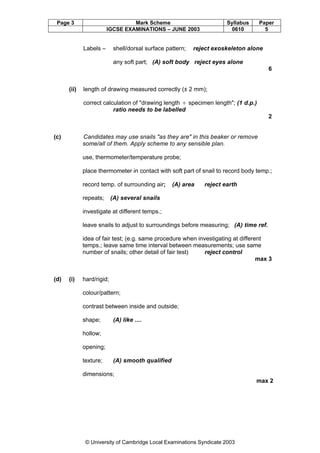
Labels –

shell/dorsal surface pattern;

Syllabus
0610

Paper
5

reject exoskeleton alone

any soft part; (A) soft body reject eyes alone
6

(ii)

length of drawing measured correctly (± 2 mm);
correct calculation of "drawing length ¸ specimen length"; (1 d.p.)
ratio needs to be labelled
2

(c)

Candidates may use snails "as they are" in this beaker or remove
some/all of them. Apply scheme to any sensible plan.
use, thermometer/temperature probe;
place thermometer in contact with soft part of snail to record body temp.;
record temp. of surrounding air;
repeats;

(A) area

reject earth

(A) several snails

investigate at different temps.;
leave snails to adjust to surroundings before measuring; (A) time ref.
idea of fair test; (e.g. same procedure when investigating at different
temps.; leave same time interval between measurements; use same
number of snails; other detail of fair test)
reject control
max 3

(d)

(i)

hard/rigid;
colour/pattern;
contrast between inside and outside;
shape;

(A) like ....

hollow;
opening;
texture;

(A) smooth qualified

dimensions;
max 2

© University of Cambridge Local Examinations Syndicate 2003
Page 4

(ii)

Mark Scheme
IGCSE EXAMINATIONS – JUNE 2003

Syllabus
0610

Paper
5

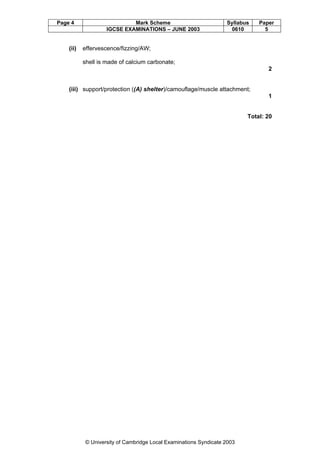
effervescence/fizzing/AW;
shell is made of calcium carbonate;
2

(iii) support/protection ((A) shelter)/camouflage/muscle attachment;
1

Total: 20

© University of Cambridge Local Examinations Syndicate 2003
JUNE 2003

INTERNATIONAL GCSE

MARK SCHEME
MAXIMUM MARK: 40

SYLLABUS/COMPONENT: 0610/06
BIOLOGY
(Alternative to Practical)
Page 1

1

(a)

Mark Scheme
IGCSE EXAMINATIONS – JUNE 2003

Syllabus
0610

Paper
6

Two from:
temperature or warmth or heat/[same type of] [amount of] yeast/type
of flour/same size measuring cylinder/same mass or weight of dough/
[same quantity of] [type of] sugar
[2]
(ignore water [in q], amount of ingredients, pH, light, carbon dioxide,
time, humidity, reading at eye level, cold)

(b)

(i) Graph:
O

orientation of axes and label of axes plus units;

S

use of appropriate and even scale to fill half of the grid;

P

plotting data A; B; C;

K

key for separate date;

max [5]

(ii) Line A - rises steadily;
Line B - does not rise/rises slightly/at a constant level;
Line C - rises and flattens; [2 stages]

(iii) 80;

[3]

[1]

(iv) Two from:
1. comment on volume difference, A more;
2. A has yeast [and B has none];
3. correct ref. to production of carbon dioxide;

[2]

(v) Two from:
1. comment on rate difference/speeding up/faster;
2. substance X present in C [A has no X];
3. reasonable suggestion for role of substance X;
(accept enzyme, catalyst, improver, AW)

[2]
Total 15

© University of Cambridge Local Examinations Syndicate 2003
Page 2

2

(a)

Mark Scheme
IGCSE EXAMINATIONS – JUNE 2003

Syllabus
0610

Paper
6

2 conditions = 1 mark. No ½ marks.
warmth [correct/suitable temperature/10 to 30°C if specified];
oxygen;
but apply ecf for part (b)

(b)

[1]

Three from:
1. identification of one workable condition from (a) for investigation - two
sets one with and one without;
2. idea of sample size many seeds, a few seeds must be more than one
seed for repetition idea;
3. some common factor of treatment between the two sets [with and
without the condition] under investigation;
(equal watering, equal number of seeds, same species AW)
4. left to grow for same time period;
(if stated minimum 1 + days, accept up to 3 weeks)
max [3]
Total 4

© University of Cambridge Local Examinations Syndicate 2003
Page 3

3

(a)

Mark Scheme
IGCSE EXAMINATIONS – JUNE 2003

Syllabus
0610

Paper
6

(i) Drawing:
clear outline;
correct proportions;

Labels – 2 from:
Tentacles;
eye [to be located at the end of the larger tentacles];
foot [qualified];
shell [dorsal/visceral shell or hump];
unsegmented body;
(ignore reference to negative features)

[4]

(ii) Magnification:
Check measurements given are those transcribed into the formula drawing size;
actual size
calculation is correct stated as ....x 1+
(this must be more than 1 if drawings is as large as fig 3.1) max [2]

(iii) Similarity – one from:
both have tentacles/eyes/same head/shell;

Difference – one from:
A has no large external shell and B has/shell has different
shape or comment on shape; AW

(iv) mollusc:

[2]

[1]
Total: 9

© University of Cambridge Local Examinations Syndicate 2003
Page 4

4

(a)

Mark Scheme
IGCSE EXAMINATIONS – JUNE 2003

Syllabus
0610

Paper
6

(i) introduce a glowing splint/spill
(do not award for match will burn/candles lighting/splints that are
already burning)
addition of pyrogallol;

[1]

(ii) photosynthesis;

[1]

(iii) 10 cm 3 ;
10 ¸ 5 = 2cm3;

[2]

(iv) Two from, for design of experiment:
1. method for setting up different light intensities;
(bright light in introduction - so maybe dimmer or less light but
must have detail of how this is to be achieved/distances away
from light bulb/AW)
2. describe how to control a factor that may alter rate over a
certain time
(temperature - heat shield, carbon dioxide by adding hydrogen
carbonate/AW)
3. additional feature of design –
(same time period for comparison of results/eliminate background
light, carry out investigation in a darkened room/replicates/
repetition/same piece of pondweed/recovery time between sets of
measurements AW)
max [2]
(b)
(i)

Colour
purple

(ii)

red/orange

[1]
[1]
(iii)

yellow
[1]

Explanation
carbon dioxide used up/
photosynthesis
[1]
balance [between photosynthesis
and respiration]
[1]
respiration of 3 water shrimps/
produce carbon dioxide [1]
Total: 12

© University of Cambridge Local Examinations Syndicate 2003
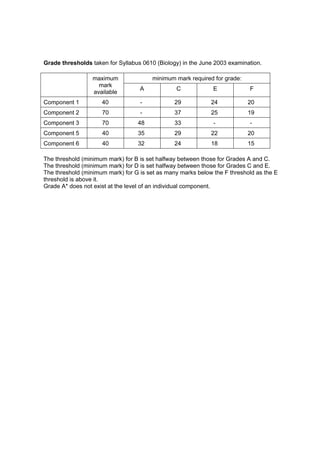
Grade thresholds taken for Syllabus 0610 (Biology) in the June 2003 examination.
maximum
mark
available

minimum mark required for grade:
A

C

E

F

Component 1

40

-

29

24

20

Component 2

70

-

37

25

19

Component 3

70

48

33

-

-

Component 5

40

35

29

22

20

Component 6

40

32

24

18

15

The threshold (minimum mark) for B is set halfway between those for Grades A and C.
The threshold (minimum mark) for D is set halfway between those for Grades C and E.
The threshold (minimum mark) for G is set as many marks below the F threshold as the E
threshold is above it.
Grade A* does not exist at the level of an individual component.

2

  • 1.
    w w ap eP m e tr .X w om .c s er JUNE 2003 INTERNATIONAL GCSE MARKSCHEME MAXIMUM MARK: 40 SYLLABUS/COMPONENT: 0610/01 BIOLOGY Paper 1 (Multiple Choice)
  • 2.
    Page 1 Mark Scheme IGCSEEXAMINATIONS – JUNE 2003 Syllabus 0610 Question Number Key Question Number Key 1 2 3 4 5 B A B D B 21 22 23 24 25 C D D C D 6 7 8 9 10 A D A A B 26 27 28 29 30 D C B D B 11 12 13 14 15 C D C B C 31 32 33 34 35 A C C C C 16 17 18 19 20 A D C C D 36 37 38 39 40 D A A B A TOTAL 40 © University of Cambridge Local Examinations Syndicate 2003 Paper 1
  • 3.
    JUNE 2003 INTERNATIONAL GCSE MARKSCHEME MAXIMUM MARK: 70 SYLLABUS/COMPONENT: 0610/02 BIOLOGY Paper 2 (Core)
  • 4.
    Page 1 1 (a) Mark Scheme IGCSEEXAMINATIONS – JUNE 2003 Syllabus 0610 Paper 2 excretion; growth; movement; ignore - locomotion nutrition; ignore - feeding reproduction; sensitivity/irritability; Accept descriptions Any three – 1 mark each (b) [3] put mud in muslin bag/equivalent – workable apparatus; suspend over limewater/calcium hydroxide solution/hydrogencarbonate/ bicarbonate indicator; in sealed container; incubate/leave for 12+ hours; look for limewater to go cloudy/milky/white/hydrogen carbonate to go yellow; carbon dioxide released indicates respiration; reference to use of control; Apply pattern of mark scheme to alternative approaches e.g. release of heat from or use of oxygen for respiration. Credit annotated diagrams Any four – 1 mark each [4] Total [7] © University of Cambridge Local Examinations Syndicate 2003
  • 5.
    Page 2 2 (a) Mark Scheme IGCSEEXAMINATIONS – JUNE 2003 (i) Syllabus 0610 Paper 2 X – stigma/carpel; Y – anther/stamen; (ii) [2] small/insignificant “petals”/flowers “open”; do not prevent wind access to anthers/stigma/pollen; stamens/anthers hang outside of flower/petals; to release pollen into wind/air; stigma feathery; trap/filter pollen (from air); stigma hangs outside flower/petals; to catch pollen (in the wind); Any feature plus explanation – 1 mark each [2] (iii) no smell/scent; no bright colours of petals/flowers/coloured green; no nectar/nectary; inconspicuous shape/size of flower/petals; dry/dusty pollen; large quantities/smaller size pollen; Also features listed in (ii) above but not given in candidate’s response to (ii) Any two – 1 mark each (b) [2] (i) southwest; [1] (ii) most fruit found to north and east; apply error carried forward [1] (iii) distribution of fruit on branches; distribution of branches on tree; animals feed on/collect fruits from one region around tree; other valid biological suggestions; ignore - human intervention. Any one – 1 mark [1] Total [9] © University of Cambridge Local Examinations Syndicate 2003
  • 6.
    Page 3 3 (a) Mark Scheme IGCSEEXAMINATIONS – JUNE 2003 Syllabus 0610 Paper 2 (i) C/(i) alongside a relevant arrow; [1] (ii) D/(ii) alongside a relevant arrow; [1] (iii) P/(iii) alongside a relevant arrow; [1] (iv) R/(iv) alongside a relevant arrow; [1] If in any section more than one label is given all of that label must be correct (b) (i) less/no (trees/leaves) to photosynthesise; more carbon dioxide in air/less removed from air; no/less (leaves/wood) to decay; Any two – 1 mark each (ii) [2] less (leaves to) transpire/evaporation of water/evapotranspiration; less roots/plants to absorb water (from deep layers); less water v/water vapour in air/less rainfall; Ignore - refs to floods/droughts/erosion/desertification. Any two – 1 mark each [2] Total [8] © University of Cambridge Local Examinations Syndicate 2003
  • 7.
    Page 4 4 (a) Mark Scheme IGCSEEXAMINATIONS – JUNE 2003 (i) Syllabus 0610 Paper 2 A – nucleus/nuclear membrane; B – cytoplasm; (ii) (b) [2] label C clearly linked to a cell membrane in each cell; [1] (i) has cilia (on one surface/end of cell); to move mucus; ignore - hair reject - trap bacteria/dust, etc. [2] Credit valid references to goblet cells and function of producing mucus (ii) has haemoglobin/no nucleus/biconcave; transport oxygen; (c) (i) movement of molecules/particles/ions; down concentration gradient/from higher to lower concentration; (ii) [2] [2] movement of water (molecules); across/through partially/semi/differentially/selectively permeable membrane. [2] Total [11] © University of Cambridge Local Examinations Syndicate 2003
  • 8.
    Page 5 5 (a) Mark Scheme IGCSEEXAMINATIONS – JUNE 2003 Syllabus 0610 Paper 2 mitosis; diploid; meiosis; haploid; gametes; (b) [5] use of correct symbols/X and Y; parent genotypes shown; gamete genotypes shown; offspring genotypes shown; phenotypes for both sexes identified. parent genotype wrong – max 3 Any four – 1 mark each [4] Total [9] © University of Cambridge Local Examinations Syndicate 2003
  • 9.
    Page 6 6 Mark Scheme IGCSEEXAMINATIONS – JUNE 2003 Syllabus 0610 Paper 2 top left box to 2nd right box; (a) 2nd left box to top right box; bottom left box to bottom right box; (b) [3] (i) label to colon/large intestine; [1] (ii) label to liver; reject - gall bladder (iii) label to liver; (iv) label to pancreas; [1] [1] reject - small intestine. [1] Total [7] © University of Cambridge Local Examinations Syndicate 2003
  • 10.
    Page 7 7 Mark Scheme IGCSEEXAMINATIONS – JUNE 2003 (a) Syllabus 0610 Paper 2 A – refracts/bends light rays/lets light enter eye; ignore - protection B – focuses light rays/image on to the retina/fovea; ignore - accommodation/change in shape C – controls light entering (inner) eye/reaching retina/lens; ignore - change in pupil D – changes light into/generates nerve/electrical impulses; ignore - signals unqualified/messages (b) [4] more/too much light enters/reaches retina; dazzles person/causes blurred vision/damages retina; ignore - double vision. [2] Total [6] © University of Cambridge Local Examinations Syndicate 2003
  • 11.
    Page 8 8 (a) Mark Scheme IGCSEEXAMINATIONS – JUNE 2003 Syllabus 0610 Paper 2 (translocation) is movement of soluble materials/sugars/amino acids; from supply to demand/clearly identified example; in phloem; (transpiration) is diffusion/loss of water vapour/evaporation of water; from leaves/through stomata to atmosphere; down concentration gradient; Any four – 1 mark each (b) [4] leaves lose water; water moves/passes/is drawn up/ref to transpiration stream; up stem/leaf stalk; through xylem/vessels; (dye) dissolved/carried in water. Any four – 1 mark each [4] Total [8] © University of Cambridge Local Examinations Syndicate 2003
  • 12.
    Page 9 9 (a) Mark Scheme IGCSEEXAMINATIONS – JUNE 2003 Syllabus 0610 Paper 2 ignore - solar [1] chemical (energy); ignore - potential [1] (i) bacteria/fungi; ignore - decomposers/saprophytes [1] (ii) (c) light/sunlight (energy); (ii) (b) (i) heat/thermal (energy); [1] energy is not passed back to the sun/grass/producer/ not recycled/OWTTE. [1] Total [5] © University of Cambridge Local Examinations Syndicate 2003
  • 13.
    JUNE 2003 INTERNATIONAL GCSE MARKSCHEME MAXIMUM MARK: 70 SYLLABUS/COMPONENT: 0610/03 BIOLOGY Paper 3 (Extended)
  • 14.
    Page 1 1 (a) Mark Scheme IGCSEEXAMINATIONS – JUNE 2003 Syllabus 0610 Paper 3 one mark for each part (drawn) and labelled correctly: renal artery; urethra; ureter; one mark for quality of drawing; MAX. 2 FOR LABELLING "STUMPS" ONLY (b) (c) water; urea; Allow nitrogenous waste uric acid; salts or minerals or named salts; Allow vitamins hormones; Reject ‘waste products unqual.’/‘ions unqual.’ i. ii. iii. iv. v. vi. vii. viii. ix. x. x. (d) 4 max. 3 ref. to blood enters machine from patient AW; (ONLY CREDIT ONCE) ref. to pump; blood passes along + dialysis tubing AW/visking tubing/cellulose or cellophane tubing; ref. to tubing AW being semi-permeable/selectively permeable/ acting as a filter AW; ref. to surrounding liquid; containing + some salts/glucose/no urea; ref. to fluid has same O. P. as blood; waste materials/excess materials + pass from blood; ref. to diffusion; ref. to bubble trap/counter flow; ‘cleaned' blood returns + to patient's circulation/body AW; (ONLY CREDIT ONCE) max. 4 (i) ref. to internal environment; maintained (at constant level)/regulated/balanced; 2 (ii) ref. to maintaining level of named substance in blood; method outlined, e.g. filtration/reabsorption/osmosis/diffusion; 2 (iii) suitable organ named; named substance levels maintained; ref. to mechanism for maintaining constant level; 3 max 18 © University of Cambridge Local Examinations Syndicate 2003
  • 15.
    Page 2 2 Mark Scheme IGCSEEXAMINATIONS – JUNE 2003 Syllabus 0610 Paper 3 (a) one mark for each column drawn and shaded correctly; 2 (b) (i) 12 (%); 1 (ii) AWARD 2 MARKS FOR CORRECT ANSWER, EVEN WITHOUT WORKING 50 + 12 + 13 + 6 + 7; = 88 (%); 2 (c) REJECT REF. TO FLUORINE ONCE in (i), (ii) or (iii) (i) fluoride (in water) reduces (the number of) decayed teeth in children; (ii) add fluoride to the drinking water in town B; advise children to use fluoride toothpaste; use other suitable, named, source of fluoride; 1 max 1 (iii) i. ref. to side effects of too much fluoride, e.g. browning of tooth enamel or possible cancer risk; ii. ref. to importance of personal choice/makes water impure; iii. ref. to allergies to fluoride; iv. ref. to cost of fluoridation; v. ref. to treatment of whole population when not all benefit; Reject refs. to fluoride flavouring water/refs. to being bad for health/has side effects unqual. max 1 max 8 © University of Cambridge Local Examinations Syndicate 2003
  • 16.
    Page 3 3 (a) (b) Mark Scheme IGCSEEXAMINATIONS – JUNE 2003 Syllabus 0610 involves giving the organism two names; ref. to genus and species; (i) Paper 3 2 Caulerpa grows at twice their rate AW; ref. to competition (for light/CO2/space for attachment/other plausible factor AW); Reject refs. to O2 2 (ii) ref. to primary consumer/(organism) that feeds on plants/producers; 1 (iii) ref. to disease/predation or shortage of + food/herbivores/sea urchins; resulting in death/migration AW; 2 (c) (d) ref. to chlorine being + dangerous/poisonous/damaging to other organisms/a pollutant; (i) i. ii. iii. iv. v. vi. vii. 1 ref. to possible effects on local food chains or food webs AW; ref. to destabilization of the ecosystem; ref. to extinction (of other organisms); ref. to local fishing industry; ref. to importance of conservation; ref. to possible use of local species for medicines; ref. to effects on biodiversity; max 2 (ii) ref. to its ability to feed on Caulerpa; Reject ref. to pest unqual. reduces competition between Caulerpa and local seaweeds; reduces population of Caulerpa; allows other species to grow again; max 2 (iii) i. ii. iii. iv. v. it may eat other seaweeds as well; causing their extinction AW; ref. to no natural predators of the sea slug present AW; ref. to unbalancing + food chains/webs/ecosystem; ref. to introduction of disease; max 2 max 14 © University of Cambridge Local Examinations Syndicate 2003
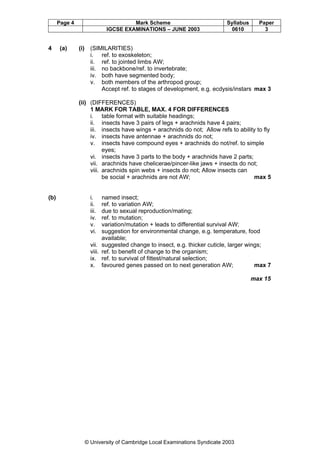
  • 17.
    Page 4 4 (a) Mark Scheme IGCSEEXAMINATIONS – JUNE 2003 Syllabus 0610 Paper 3 (i) (SIMILARITIES) i. ref. to exoskeleton; ii. ref. to jointed limbs AW; iii. no backbone/ref. to invertebrate; iv. both have segmented body; v. both members of the arthropod group; Accept ref. to stages of development, e.g. ecdysis/instars max 3 (ii) (DIFFERENCES) 1 MARK FOR TABLE, MAX. 4 FOR DIFFERENCES i. table format with suitable headings; ii. insects have 3 pairs of legs + arachnids have 4 pairs; iii. insects have wings + arachnids do not; Allow refs to ability to fly iv. insects have antennae + arachnids do not; v. insects have compound eyes + arachnids do not/ref. to simple eyes; vi. insects have 3 parts to the body + arachnids have 2 parts; vii. arachnids have chelicerae/pincer-like jaws + insects do not; viii. arachnids spin webs + insects do not; Allow insects can be social + arachnids are not AW; max 5 (b) i. ii. iii. iv. v. vi. named insect; ref. to variation AW; due to sexual reproduction/mating; ref. to mutation; variation/mutation + leads to differential survival AW; suggestion for environmental change, e.g. temperature, food available; vii. suggested change to insect, e.g. thicker cuticle, larger wings; viii. ref. to benefit of change to the organism; ix. ref. to survival of fittest/natural selection; x. favoured genes passed on to next generation AW; max 7 max 15 © University of Cambridge Local Examinations Syndicate 2003
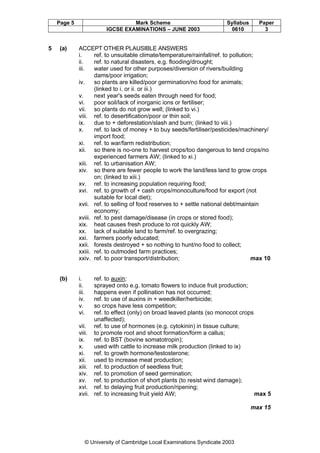
  • 18.
    Page 5 5 Mark Scheme IGCSEEXAMINATIONS – JUNE 2003 Syllabus 0610 Paper 3 (a) ACCEPT OTHER PLAUSIBLE ANSWERS i. ref. to unsuitable climate/temperature/rainfall/ref. to pollution; ii. ref. to natural disasters, e.g. flooding/drought; iii. water used for other purposes/diversion of rivers/building dams/poor irrigation; iv. so plants are killed/poor germination/no food for animals; (linked to i. or ii. or iii.) v. next year's seeds eaten through need for food; vi. poor soil/lack of inorganic ions or fertiliser; vii. so plants do not grow well; (linked to vi.) viii. ref. to desertification/poor or thin soil; ix. due to + deforestation/slash and burn; (linked to viii.) x. ref. to lack of money + to buy seeds/fertiliser/pesticides/machinery/ import food; xi. ref. to war/farm redistribution; xii. so there is no-one to harvest crops/too dangerous to tend crops/no experienced farmers AW; (linked to xi.) xiii. ref. to urbanisation AW; xiv. so there are fewer people to work the land/less land to grow crops on; (linked to xiii.) xv. ref. to increasing population requiring food; xvi. ref. to growth of + cash crops/monoculture/food for export (not suitable for local diet); xvii. ref. to selling of food reserves to + settle national debt/maintain economy; xviii. ref. to pest damage/disease (in crops or stored food); xix. heat causes fresh produce to rot quickly AW; xx. lack of suitable land to farm/ref. to overgrazing; xxi. farmers poorly educated; xxii. forests destroyed + so nothing to hunt/no food to collect; xxiii. ref. to outmoded farm practices; xxiv. ref. to poor transport/distribution; max 10 (b) i. ii. iii. iv. v. vi. ref. to auxin; sprayed onto e.g. tomato flowers to induce fruit production; happens even if pollination has not occurred; ref. to use of auxins in + weedkiller/herbicide; so crops have less competition; ref. to effect (only) on broad leaved plants (so monocot crops unaffected); vii. ref. to use of hormones (e.g. cytokinin) in tissue culture; viii. to promote root and shoot formation/form a callus; ix. ref. to BST (bovine somatotropin); x. used with cattle to increase milk production (linked to ix) xi. ref. to growth hormone/testosterone; xii. used to increase meat production; xiii. ref. to production of seedless fruit; xiv. ref. to promotion of seed germination; xv. ref. to production of short plants (to resist wind damage); xvi. ref. to delaying fruit production/ripening; xvii. ref. to increasing fruit yield AW; max 5 max 15 © University of Cambridge Local Examinations Syndicate 2003
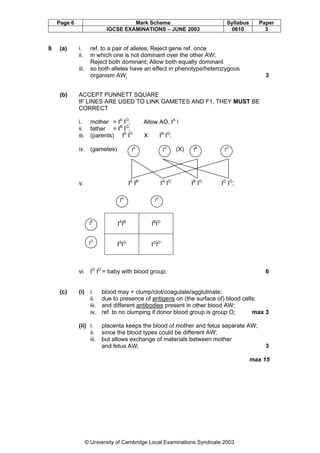
  • 19.
    Page 6 6 (a) (b) Mark Scheme IGCSEEXAMINATIONS – JUNE 2003 Syllabus 0610 Paper 3 i. ii. ref. to a pair of alleles; Reject gene ref. once in which one is not dominant over the other AW; Reject both dominant; Allow both equally dominant iii. so both alleles have an effect in phenotype/heterozygous organism AW; 3 ACCEPT PUNNETT SQUARE IF LINES ARE USED TO LINK GAMETES AND F1, THEY MUST BE CORRECT i. mother = IA IO; ii. father = IB IO; iii. (parents) IA IO Allow AO, IA i I B I O; X IA v. IO I A IB iv. (gametes) I A IO IA I AI B I AI O IO IB I O I O I O; I BI O IO IB IO IB (X) I OI O vi. IO IO = baby with blood group; (c) (i) i. ii. iii. iv. 6 blood may + clump/clot/coagulate/agglutinate; due to presence of antigens on (the surface of) blood cells; and different antibodies present in other blood AW; ref. to no clumping if donor blood group is group O; max 3 (ii) i. placenta keeps the blood of mother and fetus separate AW; ii. since the blood types could be different AW; iii. but allows exchange of materials between mother and fetus AW; 3 max 15 © University of Cambridge Local Examinations Syndicate 2003
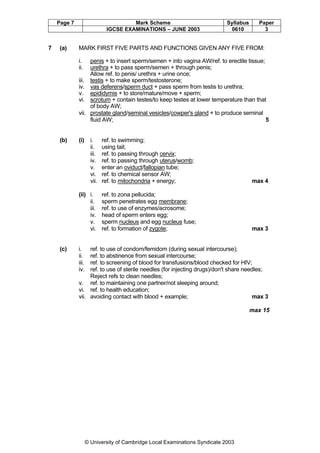
  • 20.
    Page 7 7 (a) Mark Scheme IGCSEEXAMINATIONS – JUNE 2003 Syllabus 0610 Paper 3 MARK FIRST FIVE PARTS AND FUNCTIONS GIVEN ANY FIVE FROM: i. ii. penis + to insert sperm/semen + into vagina AW/ref. to erectile tissue; urethra + to pass sperm/semen + through penis; Allow ref. to penis/ urethra + urine once; iii. testis + to make sperm/testosterone; iv. vas deferens/sperm duct + pass sperm from testis to urethra; v. epididymis + to store/mature/move + sperm; vi. scrotum + contain testes/to keep testes at lower temperature than that of body AW; vii. prostate gland/seminal vesicles/cowper's gland + to produce seminal fluid AW; 5 (b) (i) i. ii. iii. iv. v. vi. vii. (ii) i. ii. iii. iv. v. vi. (c) ref. to swimming; using tail; ref. to passing through cervix; ref. to passing through uterus/womb; enter an oviduct/fallopian tube; ref. to chemical sensor AW; ref. to mitochondria + energy; max 4 ref. to zona pellucida; sperm penetrates egg membrane; ref. to use of enzymes/acrosome; head of sperm enters egg; sperm nucleus and egg nucleus fuse; ref. to formation of zygote; max 3 i. ii. iii. iv. ref. to use of condom/femidom (during sexual intercourse); ref. to abstinence from sexual intercourse; ref. to screening of blood for transfusions/blood checked for HIV; ref. to use of sterile needles (for injecting drugs)/don't share needles; Reject refs to clean needles; v. ref. to maintaining one partner/not sleeping around; vi. ref. to health education; vii. avoiding contact with blood + example; max 3 max 15 © University of Cambridge Local Examinations Syndicate 2003
  • 21.
    JUNE 2003 INTERNATIONAL GCSE MARKSCHEME MAXIMUM MARK: 40 SYLLABUS/COMPONENT: 0610/05 BIOLOGY (Practical)
  • 22.
    Page 1 1 (a) MarkScheme IGCSE EXAMINATIONS – JUNE 2003 Syllabus 0610 Paper 5 * lose if no table; * use of ruled lines for columns and rows; * time (table heading); * height/level/measurement (table heading); record of units mm/cm and min/(A) clock times; readings taken at 5 min intervals; records for both sets of dough S1 and S2; manipulation of data/recording increase or differences; max 5 (b) * lose if bar chart orientation of axes; (time horizontal, height vertical) labels for axes including units; (A) clock times plotting data using suitable scale; c. half the paper min. * plotting data for S1 (points visible, no obvious error, not (0,0)); * plotting data for S2 (points visible, no obvious error, not (0,0)); * clear lines; each curve identified/use of key; max 6 (c) curve for S1 rises (with time); comment on rate of increase; suitable qualification curve for S2 does not rise; Look at candidate's graph. If not as expected, apply scheme as S1 trend, S2 trend and suitable comment on rate of increase 3 © University of Cambridge Local Examinations Syndicate 2003
  • 23.
    Page 2 (d) Mark Scheme IGCSEEXAMINATIONS – JUNE 2003 Syllabus 0610 Paper 5 yeast is, living organism/fungus; respiration; without oxygen/anaerobic/fermentation; sugar source of, food/nutrition/energy/substrate; equation (for anaerobic respiration); carbon dioxide evolved; trapped/bubbles (remain in dough); causes dough to rise; rise stops as sugar runs out; rise stops as yeast killed by alcohol; dough sinks and valid explanation. max 6 Total: 20 2 (a) (i) purple/mauve/lilac; reject precipitate/dark purple (protein) present; 2 (ii) add, sodium/potassium, hydroxide (solution); then (a few drops) copper sulphate (solution); 2 (b) (i) Drawing – clear outline S4; at least 5 cm in one direction; main shell (if present)/pattern on dorsal surface (if shell absent); foot/other soft parts, shown; use label to help you identify presence of soft parts if drawing unclear or if snail in shell © University of Cambridge Local Examinations Syndicate 2003
  • 24.
    Page 3 Mark Scheme IGCSEEXAMINATIONS – JUNE 2003 Labels – shell/dorsal surface pattern; Syllabus 0610 Paper 5 reject exoskeleton alone any soft part; (A) soft body reject eyes alone 6 (ii) length of drawing measured correctly (± 2 mm); correct calculation of "drawing length ¸ specimen length"; (1 d.p.) ratio needs to be labelled 2 (c) Candidates may use snails "as they are" in this beaker or remove some/all of them. Apply scheme to any sensible plan. use, thermometer/temperature probe; place thermometer in contact with soft part of snail to record body temp.; record temp. of surrounding air; repeats; (A) area reject earth (A) several snails investigate at different temps.; leave snails to adjust to surroundings before measuring; (A) time ref. idea of fair test; (e.g. same procedure when investigating at different temps.; leave same time interval between measurements; use same number of snails; other detail of fair test) reject control max 3 (d) (i) hard/rigid; colour/pattern; contrast between inside and outside; shape; (A) like .... hollow; opening; texture; (A) smooth qualified dimensions; max 2 © University of Cambridge Local Examinations Syndicate 2003
  • 25.
    Page 4 (ii) Mark Scheme IGCSEEXAMINATIONS – JUNE 2003 Syllabus 0610 Paper 5 effervescence/fizzing/AW; shell is made of calcium carbonate; 2 (iii) support/protection ((A) shelter)/camouflage/muscle attachment; 1 Total: 20 © University of Cambridge Local Examinations Syndicate 2003
  • 27.
    JUNE 2003 INTERNATIONAL GCSE MARKSCHEME MAXIMUM MARK: 40 SYLLABUS/COMPONENT: 0610/06 BIOLOGY (Alternative to Practical)
  • 28.
    Page 1 1 (a) Mark Scheme IGCSEEXAMINATIONS – JUNE 2003 Syllabus 0610 Paper 6 Two from: temperature or warmth or heat/[same type of] [amount of] yeast/type of flour/same size measuring cylinder/same mass or weight of dough/ [same quantity of] [type of] sugar [2] (ignore water [in q], amount of ingredients, pH, light, carbon dioxide, time, humidity, reading at eye level, cold) (b) (i) Graph: O orientation of axes and label of axes plus units; S use of appropriate and even scale to fill half of the grid; P plotting data A; B; C; K key for separate date; max [5] (ii) Line A - rises steadily; Line B - does not rise/rises slightly/at a constant level; Line C - rises and flattens; [2 stages] (iii) 80; [3] [1] (iv) Two from: 1. comment on volume difference, A more; 2. A has yeast [and B has none]; 3. correct ref. to production of carbon dioxide; [2] (v) Two from: 1. comment on rate difference/speeding up/faster; 2. substance X present in C [A has no X]; 3. reasonable suggestion for role of substance X; (accept enzyme, catalyst, improver, AW) [2] Total 15 © University of Cambridge Local Examinations Syndicate 2003
  • 29.
    Page 2 2 (a) Mark Scheme IGCSEEXAMINATIONS – JUNE 2003 Syllabus 0610 Paper 6 2 conditions = 1 mark. No ½ marks. warmth [correct/suitable temperature/10 to 30°C if specified]; oxygen; but apply ecf for part (b) (b) [1] Three from: 1. identification of one workable condition from (a) for investigation - two sets one with and one without; 2. idea of sample size many seeds, a few seeds must be more than one seed for repetition idea; 3. some common factor of treatment between the two sets [with and without the condition] under investigation; (equal watering, equal number of seeds, same species AW) 4. left to grow for same time period; (if stated minimum 1 + days, accept up to 3 weeks) max [3] Total 4 © University of Cambridge Local Examinations Syndicate 2003
  • 30.
    Page 3 3 (a) Mark Scheme IGCSEEXAMINATIONS – JUNE 2003 Syllabus 0610 Paper 6 (i) Drawing: clear outline; correct proportions; Labels – 2 from: Tentacles; eye [to be located at the end of the larger tentacles]; foot [qualified]; shell [dorsal/visceral shell or hump]; unsegmented body; (ignore reference to negative features) [4] (ii) Magnification: Check measurements given are those transcribed into the formula drawing size; actual size calculation is correct stated as ....x 1+ (this must be more than 1 if drawings is as large as fig 3.1) max [2] (iii) Similarity – one from: both have tentacles/eyes/same head/shell; Difference – one from: A has no large external shell and B has/shell has different shape or comment on shape; AW (iv) mollusc: [2] [1] Total: 9 © University of Cambridge Local Examinations Syndicate 2003
  • 31.
    Page 4 4 (a) Mark Scheme IGCSEEXAMINATIONS – JUNE 2003 Syllabus 0610 Paper 6 (i) introduce a glowing splint/spill (do not award for match will burn/candles lighting/splints that are already burning) addition of pyrogallol; [1] (ii) photosynthesis; [1] (iii) 10 cm 3 ; 10 ¸ 5 = 2cm3; [2] (iv) Two from, for design of experiment: 1. method for setting up different light intensities; (bright light in introduction - so maybe dimmer or less light but must have detail of how this is to be achieved/distances away from light bulb/AW) 2. describe how to control a factor that may alter rate over a certain time (temperature - heat shield, carbon dioxide by adding hydrogen carbonate/AW) 3. additional feature of design – (same time period for comparison of results/eliminate background light, carry out investigation in a darkened room/replicates/ repetition/same piece of pondweed/recovery time between sets of measurements AW) max [2] (b) (i) Colour purple (ii) red/orange [1] [1] (iii) yellow [1] Explanation carbon dioxide used up/ photosynthesis [1] balance [between photosynthesis and respiration] [1] respiration of 3 water shrimps/ produce carbon dioxide [1] Total: 12 © University of Cambridge Local Examinations Syndicate 2003
  • 32.
    Grade thresholds takenfor Syllabus 0610 (Biology) in the June 2003 examination. maximum mark available minimum mark required for grade: A C E F Component 1 40 - 29 24 20 Component 2 70 - 37 25 19 Component 3 70 48 33 - - Component 5 40 35 29 22 20 Component 6 40 32 24 18 15 The threshold (minimum mark) for B is set halfway between those for Grades A and C. The threshold (minimum mark) for D is set halfway between those for Grades C and E. The threshold (minimum mark) for G is set as many marks below the F threshold as the E threshold is above it. Grade A* does not exist at the level of an individual component.