w

w
ap
eP

m

e
tr
.X

w

Paper 3 Practical Test
CONFIDENTIAL INSTRUCTIONS

5070/03
May/June 2004

Great care should be taken that any confidential information given does not reach
the candidates either directly or indirectly.

INSTRUCTIONS TO SUPERVISORS
Teachers responsible for the examination are NOT allowed to consult the question paper before the day of
the examination. However, they are asked to carry out a titration between solutions P and Q, to ensure that
the concentrations of the two solutions fall within the given range.
On the day of the examination, the Supervisor is asked to perform the experiments in Questions 1 and 2
and to record the results on a spare copy of the question paper clearly labelled “Supervisor’s Results”,
followed by the number of the Centre. This must be enclosed with the scripts. Unless this is done
candidates may be unavoidably penalised.
It is essential that candidates accept the descriptions of the solutions as they appear in the question paper.
If candidates from more than one Centre are taking the examination, it is essential that a copy of the
Supervisor’s Results should be sent with the scripts for each Centre.
If you have any problems or queries regarding these Instructions, please contact CIE
by e-mail:
International@ucles.org.uk,
by phone:
+44 1223 553554,
by fax:
+44 1223 553558,
stating the nature of the query and the syllabus number quoted above.

This document consists of 5 printed pages and 3 blank pages.
SP (NF) S62899/1
© UCLES 2004

[Turn over

om
.c

CHEMISTRY

s
er

UNIVERSITY OF CAMBRIDGE INTERNATIONAL EXAMINATIONS
General Certificate of Education Ordinary Level
2
INSTRUCTIONS TO SUPERVISORS
For Question 1
Candidates will require the following.
(a) Approximately 2.0 mol/dm3 hydrochloric acid (HCl), labelled P.
Allow each candidate approximately 200 cm3.
(b) Approximately 2.0 mol/dm3 sodium hydroxide (80 g/dm3 NaOH), labelled Q.
Allow each candidate approximately 200 cm3.
Note: Some variation in the above concentrations is acceptable but it is essential that 25.0 cm3 of Q
reacts with between 24.0 cm3 and 26.0 cm3 of P when titrated with an indicator in the normal manner.
P and Q should each be at laboratory temperature at the start of the examination.
It is essential that candidates accept the descriptions of these solutions on the question paper.
The following apparatus should be provided for each candidate;
a 50 cm3 burette;
a 50 cm3 or 100 cm3 measuring cylinder;
an expanded polystyrene (or other light plastic) cup of at least 150 cm3 capacity supported in a suitable
beaker;
a 0 °C to 100 °C, or 0 °C to 50 °C, thermometer graduated at 1 °C.

© UCLES 2004

5070/03/M/J/04 (Inst)
3
INSTRUCTIONS TO SUPERVISORS
For Question 2
Each candidate will require the following.
(a) A solution prepared by dissolving 50 g of hydrated copper(II) sulphate, CuSO4.5H2O, in 1 dm3 of
distilled water and then adding dilute aqueous ammonia until the precipitate just dissolves
(approximately 400 cm3 of 2.0 mol/dm3 aqueous ammonia). The final solution should be labelled
S. If the final solution appears cloudy, it should be filtered before use.
Allow each candidate approximately 30 cm3.
(b) Access to
(i)

approximately 1.0 mol/dm3 hydrochloric acid,

(ii)

approximately 1.0 mol/dm3 nitric acid,

(iii)

approximately 0.2 mol/dm3 aqueous barium nitrate (or approximately 0.2 mol/dm3 aqueous
barium chloride, labelled ‘barium nitrate’),

(iv)

approximately 0.05 mol/dm3 aqueous silver nitrate,

(v)

approximately 0.1 mol/dm3 aqueous potassium iodide,

(vi)

approximately 0.2 mol/dm3 aqueous sodium thiosulphate,

(vi)

the usual reagents needed to test for the gases mentioned in the syllabus, including
limewater, approximately 0.1 mol/dm3 aqueous potassium dichromate(VI), K2Cr2O7, red and
blue litmus paper or Universal Indicator paper, and splints.

(c) A supply of test-tubes, approximately 125 mm × 16 mm.
(d) A boiling tube, approximately 150 mm × 24 mm.
(e) A stirring rod.
It is advisable to issue candidates with safety goggles.
In both questions, more material may be issued without penalty, if required, but this should not be
necessary.

The standard Report Form to be included with the scripts is given on pages 7 and 8. Please detach
and enclose it with the scripts in the normal way.
See also the side lined notes on pages 1, 7 and 8.

© UCLES 2004

5070/03/M/J/04 (Inst)
4
BLANK PAGE

5070/03/M/J/04 (Inst)
5
BLANK PAGE

5070/03/M/J/04 (Inst)
6
BLANK PAGE

5070/03/M/J/04 (Inst)
7

5070/03
This form must be completed and returned in the envelope with the scripts.
REPORT ON PRACTICAL CHEMISTRY
ORDINARY LEVEL, JUNE 2004
1

(a) Supervisor’s results
Supervisors must use a spare copy of the question paper to report their results for Q.1
and Q.2 and enclose this copy of the question paper with the candidates’ answers. This
copy of the question paper should be clearly labelled ‘Supervisor’s Results’. Failure to
enclose these results and this report form may lead to candidates being unavoidably
penalised.
If candidates from more than one Centre are taking the examination, it is essential that
a copy of the ‘Supervisor’s Results’ should be sent with the scripts from each Centre. At
larger centres where scripts are to be despatched in more than one envelope, it is
essential that a copy of the Supervisor’s Results is enclosed in each envelope.
(b) The index number of the candidates in each session were as follows.
First session

© UCLES 2004

Second session

5070/03/M/J/04 (Inst)

[Turn over
8

5070/03
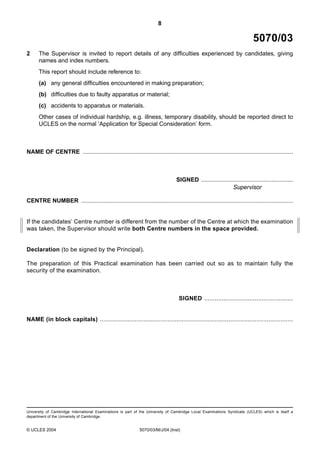
2

The Supervisor is invited to report details of any difficulties experienced by candidates, giving
names and index numbers.
This report should include reference to:
(a) any general difficulties encountered in making preparation;
(b) difficulties due to faulty apparatus or material;
(c) accidents to apparatus or materials.
Other cases of individual hardship, e.g. illness, temporary disability, should be reported direct to
UCLES on the normal ‘Application for Special Consideration’ form.

NAME OF CENTRE ................................................................................................................................

SIGNED ........................................................
Supervisor
CENTRE NUMBER .................................................................................................................................

If the candidates’ Centre number is different from the number of the Centre at which the examination
was taken, the Supervisor should write both Centre numbers in the space provided.

Declaration (to be signed by the Principal).
The preparation of this Practical examination has been carried out so as to maintain fully the
security of the examination.

SIGNED ...................................................

NAME (in block capitals) ...............................................................................................................

University of Cambridge International Examinations is part of the University of Cambridge Local Examinations Syndicate (UCLES) which is itself a
department of the University of Cambridge.

© UCLES 2004

5070/03/M/J/04 (Inst)

0620 15

  • 1.
    w w ap eP m e tr .X w Paper 3 PracticalTest CONFIDENTIAL INSTRUCTIONS 5070/03 May/June 2004 Great care should be taken that any confidential information given does not reach the candidates either directly or indirectly. INSTRUCTIONS TO SUPERVISORS Teachers responsible for the examination are NOT allowed to consult the question paper before the day of the examination. However, they are asked to carry out a titration between solutions P and Q, to ensure that the concentrations of the two solutions fall within the given range. On the day of the examination, the Supervisor is asked to perform the experiments in Questions 1 and 2 and to record the results on a spare copy of the question paper clearly labelled “Supervisor’s Results”, followed by the number of the Centre. This must be enclosed with the scripts. Unless this is done candidates may be unavoidably penalised. It is essential that candidates accept the descriptions of the solutions as they appear in the question paper. If candidates from more than one Centre are taking the examination, it is essential that a copy of the Supervisor’s Results should be sent with the scripts for each Centre. If you have any problems or queries regarding these Instructions, please contact CIE by e-mail: International@ucles.org.uk, by phone: +44 1223 553554, by fax: +44 1223 553558, stating the nature of the query and the syllabus number quoted above. This document consists of 5 printed pages and 3 blank pages. SP (NF) S62899/1 © UCLES 2004 [Turn over om .c CHEMISTRY s er UNIVERSITY OF CAMBRIDGE INTERNATIONAL EXAMINATIONS General Certificate of Education Ordinary Level
  • 2.
    2 INSTRUCTIONS TO SUPERVISORS ForQuestion 1 Candidates will require the following. (a) Approximately 2.0 mol/dm3 hydrochloric acid (HCl), labelled P. Allow each candidate approximately 200 cm3. (b) Approximately 2.0 mol/dm3 sodium hydroxide (80 g/dm3 NaOH), labelled Q. Allow each candidate approximately 200 cm3. Note: Some variation in the above concentrations is acceptable but it is essential that 25.0 cm3 of Q reacts with between 24.0 cm3 and 26.0 cm3 of P when titrated with an indicator in the normal manner. P and Q should each be at laboratory temperature at the start of the examination. It is essential that candidates accept the descriptions of these solutions on the question paper. The following apparatus should be provided for each candidate; a 50 cm3 burette; a 50 cm3 or 100 cm3 measuring cylinder; an expanded polystyrene (or other light plastic) cup of at least 150 cm3 capacity supported in a suitable beaker; a 0 °C to 100 °C, or 0 °C to 50 °C, thermometer graduated at 1 °C. © UCLES 2004 5070/03/M/J/04 (Inst)
  • 3.
    3 INSTRUCTIONS TO SUPERVISORS ForQuestion 2 Each candidate will require the following. (a) A solution prepared by dissolving 50 g of hydrated copper(II) sulphate, CuSO4.5H2O, in 1 dm3 of distilled water and then adding dilute aqueous ammonia until the precipitate just dissolves (approximately 400 cm3 of 2.0 mol/dm3 aqueous ammonia). The final solution should be labelled S. If the final solution appears cloudy, it should be filtered before use. Allow each candidate approximately 30 cm3. (b) Access to (i) approximately 1.0 mol/dm3 hydrochloric acid, (ii) approximately 1.0 mol/dm3 nitric acid, (iii) approximately 0.2 mol/dm3 aqueous barium nitrate (or approximately 0.2 mol/dm3 aqueous barium chloride, labelled ‘barium nitrate’), (iv) approximately 0.05 mol/dm3 aqueous silver nitrate, (v) approximately 0.1 mol/dm3 aqueous potassium iodide, (vi) approximately 0.2 mol/dm3 aqueous sodium thiosulphate, (vi) the usual reagents needed to test for the gases mentioned in the syllabus, including limewater, approximately 0.1 mol/dm3 aqueous potassium dichromate(VI), K2Cr2O7, red and blue litmus paper or Universal Indicator paper, and splints. (c) A supply of test-tubes, approximately 125 mm × 16 mm. (d) A boiling tube, approximately 150 mm × 24 mm. (e) A stirring rod. It is advisable to issue candidates with safety goggles. In both questions, more material may be issued without penalty, if required, but this should not be necessary. The standard Report Form to be included with the scripts is given on pages 7 and 8. Please detach and enclose it with the scripts in the normal way. See also the side lined notes on pages 1, 7 and 8. © UCLES 2004 5070/03/M/J/04 (Inst)
  • 4.
  • 5.
  • 6.
  • 7.
    7 5070/03 This form mustbe completed and returned in the envelope with the scripts. REPORT ON PRACTICAL CHEMISTRY ORDINARY LEVEL, JUNE 2004 1 (a) Supervisor’s results Supervisors must use a spare copy of the question paper to report their results for Q.1 and Q.2 and enclose this copy of the question paper with the candidates’ answers. This copy of the question paper should be clearly labelled ‘Supervisor’s Results’. Failure to enclose these results and this report form may lead to candidates being unavoidably penalised. If candidates from more than one Centre are taking the examination, it is essential that a copy of the ‘Supervisor’s Results’ should be sent with the scripts from each Centre. At larger centres where scripts are to be despatched in more than one envelope, it is essential that a copy of the Supervisor’s Results is enclosed in each envelope. (b) The index number of the candidates in each session were as follows. First session © UCLES 2004 Second session 5070/03/M/J/04 (Inst) [Turn over
  • 8.
    8 5070/03 2 The Supervisor isinvited to report details of any difficulties experienced by candidates, giving names and index numbers. This report should include reference to: (a) any general difficulties encountered in making preparation; (b) difficulties due to faulty apparatus or material; (c) accidents to apparatus or materials. Other cases of individual hardship, e.g. illness, temporary disability, should be reported direct to UCLES on the normal ‘Application for Special Consideration’ form. NAME OF CENTRE ................................................................................................................................ SIGNED ........................................................ Supervisor CENTRE NUMBER ................................................................................................................................. If the candidates’ Centre number is different from the number of the Centre at which the examination was taken, the Supervisor should write both Centre numbers in the space provided. Declaration (to be signed by the Principal). The preparation of this Practical examination has been carried out so as to maintain fully the security of the examination. SIGNED ................................................... NAME (in block capitals) ............................................................................................................... University of Cambridge International Examinations is part of the University of Cambridge Local Examinations Syndicate (UCLES) which is itself a department of the University of Cambridge. © UCLES 2004 5070/03/M/J/04 (Inst)