協作資訊尋求系統
Collaborative Information Seeking
Systems
James Chuang
2016.12.28
報告大綱
一.緒論
二.協作資訊尋求
三.協作資訊尋求系統
四.系統議題
五.結論
緒論
緒論
 人們不只一同創造與分析資訊,很多時候也
會一同參與尋求資訊的過程。(Shah, 2012)
 資訊科學領域對資訊行為的研究,歷來主要
是以「個人」為探討與焦點。(謝珍妮,2010)
 資訊科技的進步,以科技協助協作。
二、協作資訊尋求
協作之定義
 London (1995) 認為協作簡單而言就是互相促
進地一起工作。
 Gray(1989) 認為協作是一個問題範圍之中的
一群利害關係人,他們共同進行決策的過程。
 Roberts與Bradley (1991) 協作是一個分享變
化目的的互動過程。
合作與協作 (Austin & Baldwin, 1991; Panitz, 1996)
Cooperation
 指透過訂定規則來幫
助人們相互交流,以
完成特定目標或開發
擁有具體內容成果。
 每個人事先建立各自
想要獲取的利益,最
後達成各自的目標。
Collaboration
 在團隊與他人進行關
係上的聯結,彼此尊
重差異與分享知識。
 強調團隊活動中的權
力分配與責任分擔,
同時成員間有著共同
定義達成的目標。
合作的層次 (Shah, 2014)
Communication
Contribution
Coordination
Cooperation
Collaboration
以資訊密集性任務舉例 (Shah, 2014)
動作模式 定義(資訊任務中) 舉例
Communication 兩個人之間交換資訊 電子郵件、聊天
Contribution
將個人的資訊提供給
其他人
線上社群、Q&A、
Yahoo 知 識 + 、
LineQ
Coordination
在一般的場合下連結
不同人的想法
會議、線上視訊會議
Cooperation
所有人遵循互動的規
則
維基百科
Collaboration
一同工作並且完成一
個有共識的目標
腦力激盪、共同作者
協作資訊尋求
Collaborative Information Seeking
Shah, C. (2012). Collaborative information seeking: The art and science of making the whole greater than the sum
of all (The Information Retrieval Series) (p. 185). Berlin, Germany: Springer
協作資訊尋求之定義
 Foster (2006) 在資訊科學與技術年度評論
(ARIST)認為協作資訊尋求是研究個人和他人
合作資訊的尋求、搜尋,和檢索時,所利用
的系統與過程。
 協作資訊尋求是一個資訊尋求的過程。由明
確的參與者、互動與內在利益所組成,同時
包含資訊分享,進而使在小組中的成員對於
獲取資訊有一致的共識。
(Karamuftuoglu, 1998; Shah, 2009)
 協作資訊尋求是藉由不同小組人員的參與,
加上彼此擁有不同的技能與角色,進而在內
外部的互動之下獲得共同的利益。
(吳美美,2012;Shah, 2014)
協作資訊尋求的相關領域
協作資訊尋求之重要因素
時間與空間
(Golovchinsky, Pickens, & Back, 2009; Hansen & Järvelin, 2005;
Twidale & Nichols, 1996)
協作資訊檢索(Collaborative Information Retrieval)
控制、溝通與察覺
溝通
Communication
控制
Control
察覺
Awarenees
察覺 Awarenees
四種與協作資訊尋求有關的察覺型態:
 團體察覺
 工作場域察覺
 情境察覺
 次要察覺
(Liechti and Sumi, 2002; Shah and Marchionini, 2010)
三、協作資訊尋求系統
早期的協作系統─Ariadne
(Twidale, Nichols, Smith, & Trevor, 1995)
協作資訊尋求系統
 系統中介 (System-mediated) 或演算法中介
(Algorithmically-mediated)
 使用者中介 (User-mediated) 或介面中介
(Interface-mediated)
(Pickens, Golovchinsky, Shah, Qvarfordt and Back, 2008)
以介面中介為主
協作資訊尋求系統
SearchTogether
(Morris and Horvitz, 2007)
SearchTogether (cont'd )
(Morris and Horvitz, 2007)
CoSense
(Amershi and Morris, 2008)
CoSense (cont'd )
(Amershi and Morris, 2008)
以系統中介為主
協作資訊尋求系統
Cerchiamo
 FX Palo Alto 實驗室
(Golovchinsky, Adcock, Pickens, Qvarfordt, & Back, 2008)
Cerchiamo (cont'd )
 相關度變數𝑤𝑟 L 𝑘 與新鮮度變數𝑤𝑓 L 𝑘
 𝑤𝑟 L 𝑘 =
𝑢𝑛𝑠𝑒𝑒𝑛 ∈ 𝐿 𝑘
𝑠𝑒𝑒𝑛 ∈ 𝐿 𝑘
 𝑤𝑟 L 𝑘 =
𝑟𝑒𝑙 ∈ 𝐿 𝑘
𝑛𝑜𝑛𝑟𝑒𝑙 ∈ 𝐿 𝑘
(Golovchinsky, Adcock, Pickens, Qvarfordt, & Back, 2008)
Cerchiamo (cont'd )
𝑠𝑐𝑜𝑟𝑒 𝑡 =
𝐿 𝑘∈ 𝐿
𝑤𝑟 L 𝑘 𝑤𝑓 L 𝑘 𝑟𝑙𝑓 𝑡, 𝐿 𝑘
𝑠𝑐𝑜𝑟𝑒 𝑑 =
𝐿 𝑘∈ 𝐿
𝑤𝑟 L 𝑘 𝑤𝑓 L 𝑘 𝑏𝑜𝑟𝑑𝑎 𝑑, 𝐿 𝑘
Prospector
Miner
與先前系統之差異
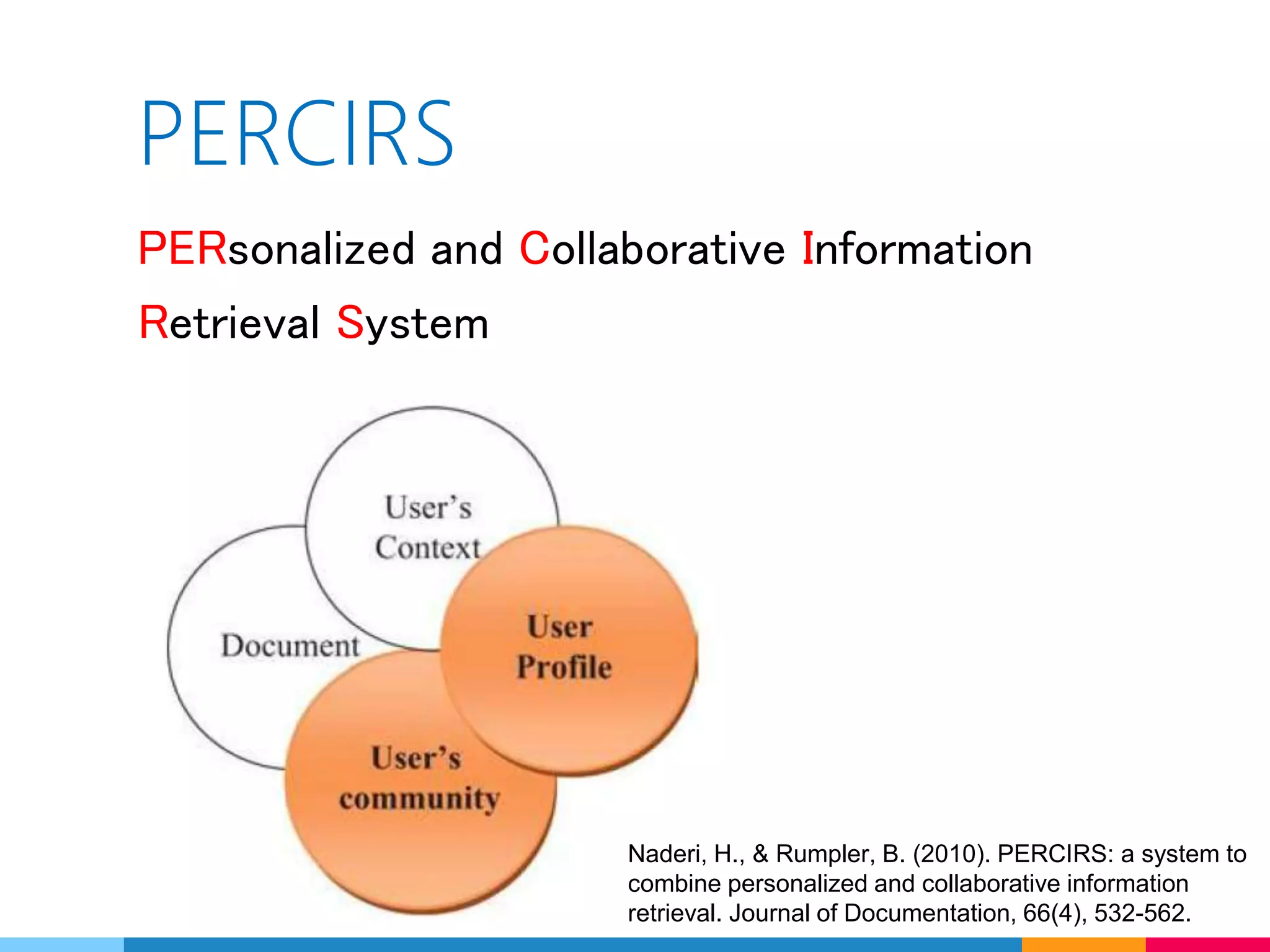
PERCIRS
PERsonalized and Collaborative Information
Retrieval System
Naderi, H., & Rumpler, B. (2010). PERCIRS: a system to
combine personalized and collaborative information
retrieval. Journal of Documentation, 66(4), 532-562.
PERCIRS (cont'd )
PERCIRS (cont'd )
 User community
 User profile similarity calculation (UPSC)
PERCIRS (cont'd )
 Document similarity
PERCIRS (cont'd )
 Equality-based UPSC
 Similarity-based UPSC
PERCIRS (cont'd )
 Graph-based UPSC
G =(V = (X,Y), E)
 Matching
 Cardinality
 Bipartite Graph
http://www.csie.ntnu.edu.tw/~u91029/Matching.html
PERCIRS (cont'd )
 Maximum weighted bipartite
http://www.csie.ntnu.edu.tw/~u91029/Matching.html
四、系統議題
“協作資訊尋求系統的開發與設計
目前主要都聚焦在二個方面:
溝通與協調
操作上的成本問題
 學習成本
 適應成本
 認知負荷(Cognitive load)
五、建議與結論
建議與結論
 了解協作者的實際需求
 保持系統的易用性
 嘗試符合使用者原有的使用習慣
 提供正確的工具
 允許隱私作業
Thanks!
Any questions?
參考文獻
 朱海燕(2002)。行動數據服務業創新協同合作模式之研究。取自
http://nccuir.lib.nccu.edu.tw/handle/140.119/35358
 吳美美(2012)。協作資訊尋求。雙語詞彙、學術名詞暨辭書資訊網。取自
http://terms.naer.edu.tw/detail/1679202/?index=10
 吳美美與Foster(2009)。探究小組協作資訊尋求的成功與困難因素。教育資料與圖書館學,47(2),123-146.
 邱銘心(2012)。意義建構理論(sense-making theory)。雙語詞彙、學術名詞暨辭書資訊網。取自
http://terms.naer.edu.tw/detail/1679177/
 謝珍妮(2010)。科技機構研究人員協同合作與資訊行為之研究(未出版碩士論文)。國立臺灣大學,臺北市。
 Austin, A. E., & Baldwin, R. G. (1991). Faculty Collaboration: Enhancing the Quality of Scholarship and Teaching.
ASHE-ERIC Higher Education Report No. 7, 1991. ERIC. Retrieved Jan. 19, 2016, from
http://eric.ed.gov/?id=ED346805
 Belkin, N. J., Kantor, P., Fox, E. A., & Shaw, J. A. (1995).Combining the evidence of multiple query
representations for information retrieval. Information Processing and Management, 31(3):431–448.
 Chalmers, M. (2002). Awareness, representation and interpretation. Computer Supported Cooperative Work
(CSCW), 11(3–4):389–409.
 Denning, P. J., & Yaholkovsky, P. (2008). Getting to “we”. Communications of the ACM, 51(4), 19-24.
 Donath, J.S., & Robertson, N. (1994). The sociable Web. In Proceedings of the World Wide Web (WWW)
Conference. Geneva, Switzerland: CERN. Retrieved Jan. 19, 2016, from
http://smg.media.mit.edu/people/Judith/SocialWeb/SociableWeb.html
 Fidel, R., Pejtersen, A. M., Bryan, C. & Bruce, H. (2004). A multidimensional approach to the study of human–
information interaction: a case study of collaborative information retrieval. Journal of the American Society for
Information Science and Technology, 55(11), 939–953.
參考文獻
 Foster, J. (2006). Collaborative information seeking and retrieval. Annual review of information science and
technology, 40(1), 329-356.
 Golovchinsky, G., Adcock, J., Pickens, J., Qvarfordt, P., & Back, M. (2008). Cerchiamo: a collaborative exploratory
search tool. In Proceedings of Computer Supported Cooperative Work (CSCW).
 Golovchinsky, G., Pickens, J., & Back, M. (2009). A taxonomy of collaboration in online information seeking. arXiv
preprint arXiv:0908.0704. Retrieved Jan. 19, 2016, from http://arxiv.org/abs/0908.0704
 González-Ibáñez, R., Haseki, M., & Shah, C. (2013). Let’s search together, but not too close! An analysis of
communication and performance in collaborative information seeking. Information Processing &
Management, 49(5), 1165-1179.
 Gray, B. (1989). Collaborating: Finding common ground for multiparty problems. Retrieved Jan. 19, 2016, from
https://www.ncjrs.gov/App/abstractdb/AbstractDBDetails.aspx?id=122117
 Grudin, J. (1994). Groupware and social dynamics: eight challenges for developers. Communications of the ACM,
37(1), 92–105.
 Gutwin, C. & Greenberg, S. (2002). A descriptive framework of workspace awareness for real-time groupware.
Computer Supported Cooperative Work (CSCW), 11(3-4), 411-446.
 Hansen, P., & Järvelin, K. (2005). Collaborative information retrieval in an information-intensive
domain. Information Processing & Management, 41(5), 1101-1119.
 Hansen, P., Shah, C., Klas, C.-P. (2015). Collaborative information seeking: best practices, new domains and new
thoughts. Cham: Springer International Publishing.
 Hertzum, M. (2008). Collaborative information seeking: The combined activity of information seeking and
collaborative grounding. Information Processing & Management, 44(2), 957-962.
 Karamuftuoglu, M. (1998). Collaborative information retrieval: toward a social informatics view of IR
interaction. Journal of the American Society for Information Science (1986-1998), 49(12), 1070.
參考文獻
 Karunakaran, A., Reddy, M. C., & Spence, P. R. (2013). Toward a model of collaborative information behavior in
organizations. Journal of the American Society for Information Science and Technology, 64(12), 2437-2451.
 Lai, K.-Y., Malone, T. W., & Yu, K.-C. (1988). Object lens: a “spreadsheet” for cooperative work. ACM Transactions
on Information Systems (TOIS), 6(4), 332-353.
 London, S. (1995). Collaboration and community. Richmond, VA: Pew Partnership for Civic Change, University of
Richmond. Retrieved Dec. 29, 2016, from
http://www.upperskeena.ca/storytellers/CCL%20research/ccl/themes/micro-macro/collaboration.pdf
 Malone, T. W., Grant, K. R., Turbak, F. A., Brobst, S. A., & Cohen, M. D. (1987). Intelligent information-sharing
systems. Communications of the ACM, 30(5), 390-402.
 Morris, M. R., & Horvitz, E. (2007). SearchTogether: an interface for collaborative web search. In Proceedings of
the 20th annual ACM symposium on User interface software and technology(pp. 3-12). ACM.
 Panitz, T. (1996). A definition of collaborative vs cooperative learning, 1996. Retrieved Jan. 19, 2016, from:
http://www. lgu. ac. uk/deliberations/collab. learning/panitz2.
 Pickens, J., Golovchinsky, G., Shah, C., Qvarfordt, P., & Back, M. (2008). lgorithmic mediation for collaborative
exploratory search. In Proceedings of the Annual ACM Conference on Research and Development in nformation
Retrieval (SIGIR) (pp. 315-22). Singapore.
 Reddy, M. C., & Jansen, B. J. (2008). A model for understanding collaborative information behavior in context: A
study of two healthcare teams. Information Processing & Management, 44(1), 256-273.
 Roberts, N. C., & Bradley, R. T. (1991). Stakeholder collaboration and innovation: A study of public policy initiation
at the state level. The Journal of applied behavioral science, 27(2), 209-227.
 Schmidt, K. (2002). The problem with ‘Awareness’: introductory remarks on ‘Awareness in CSCW’. Computer
Supported Cooperative Work (CSCW), 11(3), 285–298.
參考文獻
 Shah, C. (2008a). Toward collaborative information seeking (CIS). arXiv preprint arXiv:0908.0709. Retrieved Jan. 19,
2016, from http://arxiv.org/abs/0908.0709
 Shah, C. (2008b). Understanding system implementation and user behavior in a collaborative information seeking
environment. In Proceedings of the 31st annual international ACM SIGIR conference on Research and
development in information retrieval (pp. 896–896). ACM. Retrieved Jan. 19, 2016, from
http://dl.acm.org/citation.cfm?id=1390571
 Shah, C. (2009). Lessons and challenges for Collaborative Information Seeking (CIS) systems developers. In
GROUP 2009 Workshop on Collaborative Information Behavior, Sanibel Island, Florida.
 Shah, C. (2010). Coagmento - A Collaborative Information Seeking, Synthesis and Sense-Making Framework.
Integrated demo at Computer Supported Cooperative Work (CSCW). Savannah, GA: February 6-11.
 Shah, C. (2012). Collaborative Information Seeking - The Art and Science of Making the Whole Greater than the
Sum of All. Springer-Verlag.
 Shah, C. (2013). Effects of awareness on coordination in collaborative information seeking. Journal of the
American Society for Information Science and Technology, 64(6), 1122-1143.
 Shah, C. (2014). Collaborative information seeking. Journal of the Association for Information Science and
Technology, 65(2), 215-236.
 Shah, C., & Marchionini, G. (2010). Awareness in collaborative information seeking. Journal of the American
Society for Information Science and Technology, 61(10), 1970-1986.
 Shah, C., Capra, R., & Hansen, P. (2014). Collaborative Information Seeking [Guest editors’
introduction]. Computer, 47(3), 22-25. Advance online publication. Doi: 10.1109/MC.2014.54
 Shaw, J. A. & Fox, E. A. (1994). Combination of multiple searches. In Text (REtrieval) Conference, 105–108.
參考文獻
 Simone, C. & Bandini, S. (2002). Integrating awareness in cooperative applications through the reaction-diffusion
metaphor. Computer Supported Cooperative Work (CSCW), 11(3–4), 495–530.
 Smyth, B., & others (2010). Social summarization in collaborative web search. Information processing &
management, 46(6), 782-798.
 Sonnenwald, D. H. (1996). Communication roles that support collaboration during the design process. Design
studies, 17(3), 277-301.
 Talja, S., & Hansen, P. (2006). Information sharing. In Spink, A., & Cole, C. (Eds.), New directions in human
information behavior (pp. 113-134). Springer Science & Business Media. Retrieved Jan. 19, 2016, from:
http://link.springer.com/chapter/10.1007/1-4020-3670-1_7
 Taylor-Powell, E., Rossing, B., & Geran, J. (1998). Evaluating collaboratives: Reaching the potential. University of
Wisconsin–Extension, Cooperative Extension, Program Development and Evaluation, Madison, WI.
 Twidale, M., & Nichols, D. (1996). Collaborative browsing and visualisation of the search process. Aslib
Proceedings, 48(7-8), pp. 177-182. Retrieved Jan. 19, 2016, from:
http://eprints.lancs.ac.uk/53455/1/twidale_aslib_96.pdf
 Villa, R., Gildea, N., Jose, J. M. (2008). A study of awareness in multimedia search. In: Proceedings ofthe 8th
ACM/IEEE-CS joint conference on digital libraries. ACM, New York, pp 221–230
 Wilbur, S. B., & Young, R. E. (1988). The COSMOS project: a multi-disciplinary approach to design of computer
supported group working. Euteco, 88, 20–22.
 Wilson, M. L. (2010). Evaluating collaborative information-seeking interfaces with a search-oriented inspection
method and re-framed information seeking theory.Information processing & management, 46(6), 718–732.

協作資訊尋求系統 Collaborative Information Seeking Systems

  • 1.
  • 2.
  • 3.
  • 4.
    緒論  人們不只一同創造與分析資訊,很多時候也 會一同參與尋求資訊的過程。(Shah, 2012) 資訊科學領域對資訊行為的研究,歷來主要 是以「個人」為探討與焦點。(謝珍妮,2010)  資訊科技的進步,以科技協助協作。
  • 5.
  • 6.
    協作之定義  London (1995)認為協作簡單而言就是互相促 進地一起工作。  Gray(1989) 認為協作是一個問題範圍之中的 一群利害關係人,他們共同進行決策的過程。  Roberts與Bradley (1991) 協作是一個分享變 化目的的互動過程。
  • 7.
    合作與協作 (Austin &Baldwin, 1991; Panitz, 1996) Cooperation  指透過訂定規則來幫 助人們相互交流,以 完成特定目標或開發 擁有具體內容成果。  每個人事先建立各自 想要獲取的利益,最 後達成各自的目標。 Collaboration  在團隊與他人進行關 係上的聯結,彼此尊 重差異與分享知識。  強調團隊活動中的權 力分配與責任分擔, 同時成員間有著共同 定義達成的目標。
  • 8.
  • 9.
    以資訊密集性任務舉例 (Shah, 2014) 動作模式定義(資訊任務中) 舉例 Communication 兩個人之間交換資訊 電子郵件、聊天 Contribution 將個人的資訊提供給 其他人 線上社群、Q&A、 Yahoo 知 識 + 、 LineQ Coordination 在一般的場合下連結 不同人的想法 會議、線上視訊會議 Cooperation 所有人遵循互動的規 則 維基百科 Collaboration 一同工作並且完成一 個有共識的目標 腦力激盪、共同作者
  • 10.
    協作資訊尋求 Collaborative Information Seeking Shah,C. (2012). Collaborative information seeking: The art and science of making the whole greater than the sum of all (The Information Retrieval Series) (p. 185). Berlin, Germany: Springer
  • 11.
    協作資訊尋求之定義  Foster (2006)在資訊科學與技術年度評論 (ARIST)認為協作資訊尋求是研究個人和他人 合作資訊的尋求、搜尋,和檢索時,所利用 的系統與過程。  協作資訊尋求是一個資訊尋求的過程。由明 確的參與者、互動與內在利益所組成,同時 包含資訊分享,進而使在小組中的成員對於 獲取資訊有一致的共識。 (Karamuftuoglu, 1998; Shah, 2009)  協作資訊尋求是藉由不同小組人員的參與, 加上彼此擁有不同的技能與角色,進而在內 外部的互動之下獲得共同的利益。 (吳美美,2012;Shah, 2014)
  • 12.
  • 13.
  • 14.
    時間與空間 (Golovchinsky, Pickens, &Back, 2009; Hansen & Järvelin, 2005; Twidale & Nichols, 1996) 協作資訊檢索(Collaborative Information Retrieval)
  • 15.
  • 16.
    察覺 Awarenees 四種與協作資訊尋求有關的察覺型態:  團體察覺 工作場域察覺  情境察覺  次要察覺 (Liechti and Sumi, 2002; Shah and Marchionini, 2010)
  • 17.
  • 18.
  • 19.
    協作資訊尋求系統  系統中介 (System-mediated)或演算法中介 (Algorithmically-mediated)  使用者中介 (User-mediated) 或介面中介 (Interface-mediated) (Pickens, Golovchinsky, Shah, Qvarfordt and Back, 2008)
  • 20.
  • 21.
  • 22.
  • 23.
  • 24.
    CoSense (cont'd ) (Amershiand Morris, 2008)
  • 25.
  • 26.
    Cerchiamo  FX PaloAlto 實驗室 (Golovchinsky, Adcock, Pickens, Qvarfordt, & Back, 2008)
  • 27.
    Cerchiamo (cont'd ) 相關度變數𝑤𝑟 L 𝑘 與新鮮度變數𝑤𝑓 L 𝑘  𝑤𝑟 L 𝑘 = 𝑢𝑛𝑠𝑒𝑒𝑛 ∈ 𝐿 𝑘 𝑠𝑒𝑒𝑛 ∈ 𝐿 𝑘  𝑤𝑟 L 𝑘 = 𝑟𝑒𝑙 ∈ 𝐿 𝑘 𝑛𝑜𝑛𝑟𝑒𝑙 ∈ 𝐿 𝑘 (Golovchinsky, Adcock, Pickens, Qvarfordt, & Back, 2008)
  • 28.
    Cerchiamo (cont'd ) 𝑠𝑐𝑜𝑟𝑒𝑡 = 𝐿 𝑘∈ 𝐿 𝑤𝑟 L 𝑘 𝑤𝑓 L 𝑘 𝑟𝑙𝑓 𝑡, 𝐿 𝑘 𝑠𝑐𝑜𝑟𝑒 𝑑 = 𝐿 𝑘∈ 𝐿 𝑤𝑟 L 𝑘 𝑤𝑓 L 𝑘 𝑏𝑜𝑟𝑑𝑎 𝑑, 𝐿 𝑘 Prospector Miner
  • 29.
  • 30.
    PERCIRS PERsonalized and CollaborativeInformation Retrieval System Naderi, H., & Rumpler, B. (2010). PERCIRS: a system to combine personalized and collaborative information retrieval. Journal of Documentation, 66(4), 532-562.
  • 31.
  • 32.
    PERCIRS (cont'd ) User community  User profile similarity calculation (UPSC)
  • 33.
    PERCIRS (cont'd ) Document similarity
  • 34.
    PERCIRS (cont'd ) Equality-based UPSC  Similarity-based UPSC
  • 35.
    PERCIRS (cont'd ) Graph-based UPSC G =(V = (X,Y), E)  Matching  Cardinality  Bipartite Graph http://www.csie.ntnu.edu.tw/~u91029/Matching.html
  • 36.
    PERCIRS (cont'd ) Maximum weighted bipartite http://www.csie.ntnu.edu.tw/~u91029/Matching.html
  • 37.
  • 38.
  • 39.
  • 40.
  • 41.
    建議與結論  了解協作者的實際需求  保持系統的易用性 嘗試符合使用者原有的使用習慣  提供正確的工具  允許隱私作業
  • 42.
  • 43.
    參考文獻  朱海燕(2002)。行動數據服務業創新協同合作模式之研究。取自 http://nccuir.lib.nccu.edu.tw/handle/140.119/35358  吳美美(2012)。協作資訊尋求。雙語詞彙、學術名詞暨辭書資訊網。取自 http://terms.naer.edu.tw/detail/1679202/?index=10 吳美美與Foster(2009)。探究小組協作資訊尋求的成功與困難因素。教育資料與圖書館學,47(2),123-146.  邱銘心(2012)。意義建構理論(sense-making theory)。雙語詞彙、學術名詞暨辭書資訊網。取自 http://terms.naer.edu.tw/detail/1679177/  謝珍妮(2010)。科技機構研究人員協同合作與資訊行為之研究(未出版碩士論文)。國立臺灣大學,臺北市。  Austin, A. E., & Baldwin, R. G. (1991). Faculty Collaboration: Enhancing the Quality of Scholarship and Teaching. ASHE-ERIC Higher Education Report No. 7, 1991. ERIC. Retrieved Jan. 19, 2016, from http://eric.ed.gov/?id=ED346805  Belkin, N. J., Kantor, P., Fox, E. A., & Shaw, J. A. (1995).Combining the evidence of multiple query representations for information retrieval. Information Processing and Management, 31(3):431–448.  Chalmers, M. (2002). Awareness, representation and interpretation. Computer Supported Cooperative Work (CSCW), 11(3–4):389–409.  Denning, P. J., & Yaholkovsky, P. (2008). Getting to “we”. Communications of the ACM, 51(4), 19-24.  Donath, J.S., & Robertson, N. (1994). The sociable Web. In Proceedings of the World Wide Web (WWW) Conference. Geneva, Switzerland: CERN. Retrieved Jan. 19, 2016, from http://smg.media.mit.edu/people/Judith/SocialWeb/SociableWeb.html  Fidel, R., Pejtersen, A. M., Bryan, C. & Bruce, H. (2004). A multidimensional approach to the study of human– information interaction: a case study of collaborative information retrieval. Journal of the American Society for Information Science and Technology, 55(11), 939–953.
  • 44.
    參考文獻  Foster, J.(2006). Collaborative information seeking and retrieval. Annual review of information science and technology, 40(1), 329-356.  Golovchinsky, G., Adcock, J., Pickens, J., Qvarfordt, P., & Back, M. (2008). Cerchiamo: a collaborative exploratory search tool. In Proceedings of Computer Supported Cooperative Work (CSCW).  Golovchinsky, G., Pickens, J., & Back, M. (2009). A taxonomy of collaboration in online information seeking. arXiv preprint arXiv:0908.0704. Retrieved Jan. 19, 2016, from http://arxiv.org/abs/0908.0704  González-Ibáñez, R., Haseki, M., & Shah, C. (2013). Let’s search together, but not too close! An analysis of communication and performance in collaborative information seeking. Information Processing & Management, 49(5), 1165-1179.  Gray, B. (1989). Collaborating: Finding common ground for multiparty problems. Retrieved Jan. 19, 2016, from https://www.ncjrs.gov/App/abstractdb/AbstractDBDetails.aspx?id=122117  Grudin, J. (1994). Groupware and social dynamics: eight challenges for developers. Communications of the ACM, 37(1), 92–105.  Gutwin, C. & Greenberg, S. (2002). A descriptive framework of workspace awareness for real-time groupware. Computer Supported Cooperative Work (CSCW), 11(3-4), 411-446.  Hansen, P., & Järvelin, K. (2005). Collaborative information retrieval in an information-intensive domain. Information Processing & Management, 41(5), 1101-1119.  Hansen, P., Shah, C., Klas, C.-P. (2015). Collaborative information seeking: best practices, new domains and new thoughts. Cham: Springer International Publishing.  Hertzum, M. (2008). Collaborative information seeking: The combined activity of information seeking and collaborative grounding. Information Processing & Management, 44(2), 957-962.  Karamuftuoglu, M. (1998). Collaborative information retrieval: toward a social informatics view of IR interaction. Journal of the American Society for Information Science (1986-1998), 49(12), 1070.
  • 45.
    參考文獻  Karunakaran, A.,Reddy, M. C., & Spence, P. R. (2013). Toward a model of collaborative information behavior in organizations. Journal of the American Society for Information Science and Technology, 64(12), 2437-2451.  Lai, K.-Y., Malone, T. W., & Yu, K.-C. (1988). Object lens: a “spreadsheet” for cooperative work. ACM Transactions on Information Systems (TOIS), 6(4), 332-353.  London, S. (1995). Collaboration and community. Richmond, VA: Pew Partnership for Civic Change, University of Richmond. Retrieved Dec. 29, 2016, from http://www.upperskeena.ca/storytellers/CCL%20research/ccl/themes/micro-macro/collaboration.pdf  Malone, T. W., Grant, K. R., Turbak, F. A., Brobst, S. A., & Cohen, M. D. (1987). Intelligent information-sharing systems. Communications of the ACM, 30(5), 390-402.  Morris, M. R., & Horvitz, E. (2007). SearchTogether: an interface for collaborative web search. In Proceedings of the 20th annual ACM symposium on User interface software and technology(pp. 3-12). ACM.  Panitz, T. (1996). A definition of collaborative vs cooperative learning, 1996. Retrieved Jan. 19, 2016, from: http://www. lgu. ac. uk/deliberations/collab. learning/panitz2.  Pickens, J., Golovchinsky, G., Shah, C., Qvarfordt, P., & Back, M. (2008). lgorithmic mediation for collaborative exploratory search. In Proceedings of the Annual ACM Conference on Research and Development in nformation Retrieval (SIGIR) (pp. 315-22). Singapore.  Reddy, M. C., & Jansen, B. J. (2008). A model for understanding collaborative information behavior in context: A study of two healthcare teams. Information Processing & Management, 44(1), 256-273.  Roberts, N. C., & Bradley, R. T. (1991). Stakeholder collaboration and innovation: A study of public policy initiation at the state level. The Journal of applied behavioral science, 27(2), 209-227.  Schmidt, K. (2002). The problem with ‘Awareness’: introductory remarks on ‘Awareness in CSCW’. Computer Supported Cooperative Work (CSCW), 11(3), 285–298.
  • 46.
    參考文獻  Shah, C.(2008a). Toward collaborative information seeking (CIS). arXiv preprint arXiv:0908.0709. Retrieved Jan. 19, 2016, from http://arxiv.org/abs/0908.0709  Shah, C. (2008b). Understanding system implementation and user behavior in a collaborative information seeking environment. In Proceedings of the 31st annual international ACM SIGIR conference on Research and development in information retrieval (pp. 896–896). ACM. Retrieved Jan. 19, 2016, from http://dl.acm.org/citation.cfm?id=1390571  Shah, C. (2009). Lessons and challenges for Collaborative Information Seeking (CIS) systems developers. In GROUP 2009 Workshop on Collaborative Information Behavior, Sanibel Island, Florida.  Shah, C. (2010). Coagmento - A Collaborative Information Seeking, Synthesis and Sense-Making Framework. Integrated demo at Computer Supported Cooperative Work (CSCW). Savannah, GA: February 6-11.  Shah, C. (2012). Collaborative Information Seeking - The Art and Science of Making the Whole Greater than the Sum of All. Springer-Verlag.  Shah, C. (2013). Effects of awareness on coordination in collaborative information seeking. Journal of the American Society for Information Science and Technology, 64(6), 1122-1143.  Shah, C. (2014). Collaborative information seeking. Journal of the Association for Information Science and Technology, 65(2), 215-236.  Shah, C., & Marchionini, G. (2010). Awareness in collaborative information seeking. Journal of the American Society for Information Science and Technology, 61(10), 1970-1986.  Shah, C., Capra, R., & Hansen, P. (2014). Collaborative Information Seeking [Guest editors’ introduction]. Computer, 47(3), 22-25. Advance online publication. Doi: 10.1109/MC.2014.54  Shaw, J. A. & Fox, E. A. (1994). Combination of multiple searches. In Text (REtrieval) Conference, 105–108.
  • 47.
    參考文獻  Simone, C.& Bandini, S. (2002). Integrating awareness in cooperative applications through the reaction-diffusion metaphor. Computer Supported Cooperative Work (CSCW), 11(3–4), 495–530.  Smyth, B., & others (2010). Social summarization in collaborative web search. Information processing & management, 46(6), 782-798.  Sonnenwald, D. H. (1996). Communication roles that support collaboration during the design process. Design studies, 17(3), 277-301.  Talja, S., & Hansen, P. (2006). Information sharing. In Spink, A., & Cole, C. (Eds.), New directions in human information behavior (pp. 113-134). Springer Science & Business Media. Retrieved Jan. 19, 2016, from: http://link.springer.com/chapter/10.1007/1-4020-3670-1_7  Taylor-Powell, E., Rossing, B., & Geran, J. (1998). Evaluating collaboratives: Reaching the potential. University of Wisconsin–Extension, Cooperative Extension, Program Development and Evaluation, Madison, WI.  Twidale, M., & Nichols, D. (1996). Collaborative browsing and visualisation of the search process. Aslib Proceedings, 48(7-8), pp. 177-182. Retrieved Jan. 19, 2016, from: http://eprints.lancs.ac.uk/53455/1/twidale_aslib_96.pdf  Villa, R., Gildea, N., Jose, J. M. (2008). A study of awareness in multimedia search. In: Proceedings ofthe 8th ACM/IEEE-CS joint conference on digital libraries. ACM, New York, pp 221–230  Wilbur, S. B., & Young, R. E. (1988). The COSMOS project: a multi-disciplinary approach to design of computer supported group working. Euteco, 88, 20–22.  Wilson, M. L. (2010). Evaluating collaborative information-seeking interfaces with a search-oriented inspection method and re-framed information seeking theory.Information processing & management, 46(6), 718–732.

Editor's Notes

  • #5 1. 資訊科技進步、資訊搜尋變成基礎能力,資訊分享成為常態 2. 近年才逐漸受到重視
  • #7 最常與合作混淆
  • #8 容易混淆。協作與合作的差異主要可以說合作是事先建立各自想要的利益,各司其職;但是協作是有著一個共同的利益。
  • #9 溝通是最基礎的層次>協作是最高的層次 Cooperation 團體內有中相同興趣者加入規劃活動、溝通角色、分享資源已達成目的。 有別於Coordination,Cooperation是所有參與者遵循一致的互動規則。 Collaboration 參與者可以透過各種不同面相發現問題,並且利用各自擁有專業與視角,了解彼此的差異與尋求共同的解決辦法。與Cooperation不同的是,這樣創造出的解決對策是超出所有人貢獻的總和,指揮的權利並非集中在當一個人身上,而是所有人的地位都相同。
  • #10 協作就包含人員們以明確的互動邁向共同的目標。例如共同作者的文章,作者加入一個計畫不只是付出貢獻或是協調其他作者,他們也因為遵循某些規則,進一步匯聚每個人的產出以及彼此互動的成果。
  • #11 大概理解位置
  • #12 目前最明確的定義是Foster。 但其他後來的其他文獻也差不多,主要還是以獲取共同利益與目的為核心。
  • #13 以顯性─隱性、人─系統作為維度表示協作資訊尋求的相關領域 CIR包含在CIS裡面、共同瀏覽與共同搜尋也有涵蓋到>都是協作資訊尋求重要的部分
  • #15 例子: 將圖書館活動的性質以時間與空間為象限進行劃分 傳統實體圖書館左上
  • #16 控制: 人在協作中的角色與依循規則 溝通: 在協作時的資訊交換、討論等 察覺:目前存在著許多不同的定義與應用,不同的研究取徑則形成對察覺不同的詮釋。 簡單而言,察覺這個狀態只有在一個人對某事有察覺時才有意義。
  • #17 在一定時間內,提供每一個團體成員由關於其他協作者的狀態與行動。 團體成員分享與討論其發現,並且創造出一個共同的成果。 屬於應用的範疇,客觀判斷什麼事物是對團體有用處的,以及什麼目標是符合目前的計畫。 有關個人或團體蒐集歷程的資訊,或是對參與者不重要的資訊。
  • #19 主要目的為支援協作學習資料庫的瀏覽技巧,藉由視覺化共同搜尋流程 但就只是共同瀏覽
  • #20 由系統居中作為協作的協調、分配、運算者,讓每位參與者只需專注於自身負責的任務。 強調協作者之間的溝通,以及對其他協作者之間的感知,因此主要為提供一個介面平台,而非介面後的資訊檢索系統運算。
  • #22 開發靈感源自對 204 位學者的協作方式調查。結果顯示大多數受訪者希望在檢索時和他人合作。 協作者無需詢問他人的檢索歷程與結果,只需專心進行個人的檢索。 還能保存每一個協作者檢索記錄與共同檢索紀錄,達成非同步協同檢索的目的。 (a)為整合所有協作的訊息; (b)為其他協作者輸入的檢索詞彙; (c)為最近的檢索結果,同時上面有組員的評論與評分; (d) 建議的檢索詞彙; (e)到(g) 是檢索功能鍵; (h) 頁面的後設資料; (i)為工具列;(j)檢索結果、文獻的瀏覽頁面。
  • #23 左邊是組員對檢索結果的註解、右邊是顯示即時組員的檢索結果
  • #24 同時CoSense根據CoSearch的基礎,以及融合SearchTogher((因為SearchTogether的不足 主要以瀏覽器的形式呈現,以支援協作網頁檢索為主 分四個頁面: 工作空間:小組工作流程管理中心 檢索策略:提供使用者有關小組成員的檢索歷程 時間軸:顯示組員的檢索歷史,同時記錄組員間的交談紀錄 聊天室
  • #25 檢索策略: 關鍵字文字雲、瀏覽的網站網址、查詢問句數量等等
  • #27 使用者介面:協作者介面分為探勘者(Prospector)與採集者(Miner),以及協作者共享的資訊顯示螢幕。探勘者負責開闢資訊搜尋的新領域;採集者則進行資訊的蒐集與確立資訊的來源管道。 管理與控制二個協作者間的互動,接受輸入與輸出結果。
  • #28  L 𝑘 為以查詢問句k檢索出的文件排序清單 此二變數被設計成可以互相平衡,即若一個查詢問句可檢索到多個相關文件,此查詢問句會擁有較高的相關權重, 但是若某一個查詢問句所檢索到文件受到多次檢索與檢視後,其他查詢問句的新鮮權重則會增加,動態過程
  • #29 尚未被探勘者判斷過的文章會依據相關度與新鮮度權重,重新排序給採集者 「Borda計算融合」合併在同一個搜尋引擎上的不同的查詢問 採集者則是對清單中高排名且沒看過的文件𝑑進行相關判斷 好處: 如此一來採集者不需自行整理蒐集的文件,而探勘者也不需自行決定要傳送哪些文件給採集者。 探勘者 演算方式基本上與採集者相似,最大的差異在於此處使用「排序清單頻率」計算詞彙 取代「Borda計算融合」計算的「未檢視的文件d」 好處在於,若採集者深入相關與新鮮度高的搜尋路徑,就可以發掘更多相關的詞彙; 相反地,若採集者改變的搜尋的方向,建議詞彙議會跟著自動地轉換,而不需要探勘者自行重新設定
  • #30 使得協作者們能夠都專注於個人的任務,但是仍同步地影響與協助彼此,進而增進協作檢索上的效率與成果
  • #32 Step2: 自動且動態地組織使用者分群,尋找其他相同喜好的使用者。 Step3: 與該群使用者的紀錄比對相似的q Step4:文件的排序: 使用者的相似度、q的相似度、使用者對文件相關的判斷
  • #33 使用者檔案已(q1, Dq) 表示 Q>query, Dq是以q為查詢問句,而且使用者標記為相關的文件組
  • #34 以文件相關以距離計算
  • #35 完全一樣的因素為1, 否為0 但是可能相似但是不相等 KN(PX(E),PY(E)) >>使用者相似的因素數量 2. MXN>>(PX(E),PY(E) Ei>使用者檔案中第i個因素 倆倆一對 完全對應,但若其中一個人的喜好很多,就會很無效。
  • #36 一個匹配擁有的匹配邊數目,也就是配對的數目,稱作 Cardinality  一張二分圖的結構是:兩群點(通常標記作 X 集合與 Y 集合)、橫跨這兩群點的邊( X 與 Y 之間)。至於兩群點各自之內是沒有邊的
  • #37 「二分匹配」。一張二分圖上的匹配稱作二分匹配,理所當然所有的匹配邊都是這橫跨這兩群點的邊 如果沒有,就在比較小的那邊補上點
  • #39 存在的問題在於,現今市面上即時通訊軟體眾多,使用者很有可能擁有慣用的通訊軟體。 顯示在系統設計中增加使用者對於協作的察覺(awareness),不只能支持小組成員的協調,同時也能增進小組成員互動與討論想法。 察覺的提升已經被確認有助於協作中的溝通與重複作業,但是似乎未對使用者提升檢索表現存在明顯的助益。
  • #40 由於協作者在協作的過程必須注意到團體的檢索歷程,因此可能對於個體而言在執行任務上增加負擔
  • #42 易用性:減低使用者學習的時間成本 正確工具:使得利用協作系統工具的效益可勝過個人獨自作業。 隱私:必須保證在作業中不受被其他人監視,以及能夠獨立判斷的權力,才可以讓協作者的個體認知不被中斷,同時能夠自由地發表想法。