Roadmap To College Preparing for Middle School And Beyond
Harvard University has historically had the highest graduation rate of any American college.  One study estimates that 97% of their students graduate.  Harvard’s approach to academic success?  The assumption towards each student that: Of course  they can succeed.
Success  Depends on the Individual Elementary School…   the first step on the path to college… the stepping stone for  middle school… which is the launching pad for high school. all of the above =  the path to college
When asked,  many seniors regret  not working as hard  as they could have in school.
Each step a student takes impacts college and their life beyond… students must take advantage  of every opportunity  in and out of the classroom
WHY SHOULD STUDENTS ATTEND COLLEGE? Opportunities to: Conduct research Test new theories Explore new topics Revisit ideas with which they are already familiar Learn from classmates who have a variety of experiences and backgrounds Live independently Take on more responsibility and decision-making
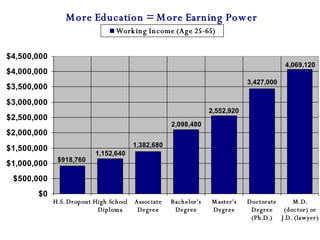
US Census Bureau Data On average  people who attend college earn  significantly more  over a lifetime than high school graduates. In the job market of today and tomorrow,  a bachelor’s degree is  essential .

 
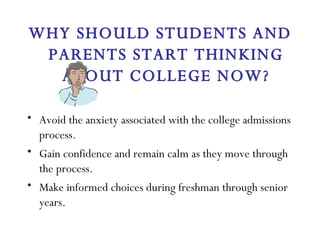
WHY SHOULD STUDENTS AND PARENTS START THINKING ABOUT COLLEGE NOW? Avoid the anxiety associated with the college admissions process. Gain confidence and remain calm as they move through the process. Make informed choices during freshman through senior years.
College serves as an exciting opportunity for academic and personal growth. Students should embrace the exploration!
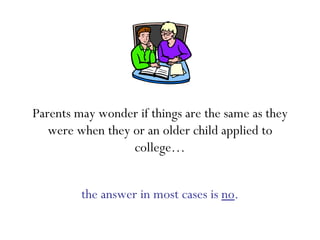
Parents may wonder if things are the same as they were when they or an older child applied to college… the answer in most cases is  no .
HOW HAS APPLYING TO COLLEGE CHANGED IN RECENT YEARS? as a result of demographic changes,  each year more students apply to college  than ever before
2006  Enrollment in United States colleges:  20.5 million  2000  Enrollment in United States colleges:  17.5 million THAT’S A 17% INCREASE
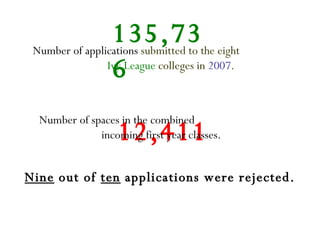
Number of applications   submitted to the eight  Ivy League  colleges in  2007 . 135,736 12,411   Nine  out of  ten  applications were rejected. Number of spaces in the combined  incoming first year classes.
What can students do?
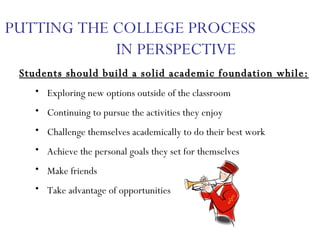
PUTTING THE COLLEGE PROCESS  IN PERSPECTIVE Students should build a solid academic foundation while: Exploring new options outside of the classroom Continuing to pursue the activities they enjoy Challenge themselves academically to do their best work Achieve the personal goals they set for themselves Make friends Take advantage of opportunities
Middle School  Study Skills and Strategies Here’s how to approach it all…
#1 Rule: Be Here Now
Organization Time Study Area School Supplies Assignments MIDDLE SCHOOL STUDY SKILLS AND STRATEGIES
Understanding How A Student Learns Best What is the best study environment? What is their learning style? MIDDLE SCHOOL STUDY SKILLS AND STRATEGIES
Taking Notes from Lectures Review previous notes before class Sit in the front of the room Listen actively Write notes in their own words Review notes immediately after class and add information MIDDLE SCHOOL STUDY SKILLS AND STRATEGIES
Test Taking Strategies Read directions carefully Learn how to approach various types of tests Use old tests to predict expectations for new tests MIDDLE SCHOOL STUDY SKILLS AND STRATEGIES
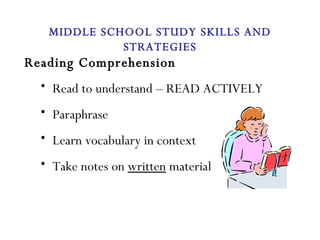
Reading Comprehension Read to understand – READ ACTIVELY Paraphrase Learn vocabulary in context Take notes on  written  material MIDDLE SCHOOL STUDY SKILLS AND STRATEGIES
Goal Setting and Motivation START NOW! Challenge themselves Expect Failure Relate goals to the smaller steps MIDDLE SCHOOL STUDY SKILLS AND STRATEGIES
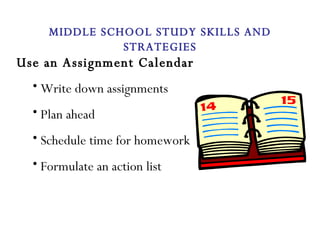
Use an Assignment Calendar Write down assignments Plan ahead Schedule time for homework Formulate an action list MIDDLE SCHOOL STUDY SKILLS AND STRATEGIES
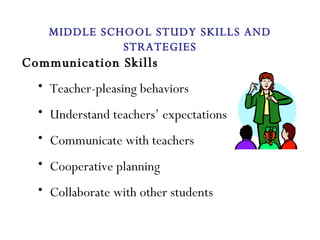
Communication Skills Teacher-pleasing behaviors Understand teachers’ expectations Communicate with teachers Cooperative planning Collaborate with other students MIDDLE SCHOOL STUDY SKILLS AND STRATEGIES
ACADEMIC PLANNING & PERFORMANCE   High School
Before choosing high school classes, become familiar with the academic requirements of the high school and most colleges. CHOOSE ACADEMIC COURSES THAT KEEP YOUR OPTIONS OPEN
Consider: Consequences of Actions College Expectations Academic Prep Grade Trends ACADEMIC PLANNING AND PERFORMANCE – High School
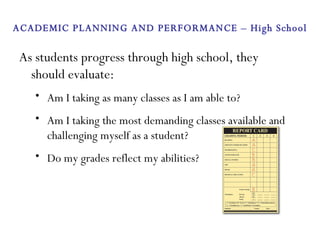
As students progress through high school, they should evaluate: Am I taking as many classes as I am able to? Am I taking the most demanding classes available and challenging myself as a student? Do my grades reflect my abilities? ACADEMIC PLANNING AND PERFORMANCE – High School
take advantage of available support services ACADEMIC PLANNING AND PERFORMANCE – High School
coaches, advisors, and deans all offer support  ACADEMIC PLANNING AND PERFORMANCE – High School
In an increasingly competitive college market,  it is no longer enough  just  to be smart.   Colleges want to know what students will offer to the community. BEYOND THE CLASSROOM
students:  do what you enjoy
use of time outside of academics Activities are important in the context of the college application process,  but also in terms of personal growth.  NOW is the time to explore. BEYOND THE CLASSROOM
Do what you are passionate about -  your enthusiasm and sincerity will shine through. Pursue interests that make you happy  and are enriching and rewarding. BEYOND THE CLASSROOM
Find a balance  between  extra-curricular pursuits &  school work.
During your high school years  dive into one or more  areas of interest.  LEADERSHIP Become a Leader
Make sure colleges clearly recognize your special talents and interests! LEADERSHIP
Not everyone wants to be a leader in the traditional sense… but no matter what,  contribute. LEADERSHIP
Leadership positions  reflect a student’s commitment  and willingness  to take on challenges and responsibility. LEADERSHIP & COLLEGE
TAKE ADVANTAGE  OF THE SUMMER   Unwind and Recharge  This  does not  mean students should spend the summer lounging around on the beach  or in front of the TV or computer screen.
Consider the following ideas: Take a summer review or preparation course Get a job Obtain an internship in a field of interest Volunteer Tour a nearby college campus TAKE ADVANTAGE  OF THE SUMMER
Be sure that your summer experience reflect who you are Are you academically driven? What activity/activities do you enjoy? Have you started a service project for middle school students in your hometown? YOUR SUMMER EXPERIENCES:  WHAT THEY SAY ABOUT YOU Avoid thinking about “what colleges want to see.”  Let your heart and your interests guide you.
STANDARDIZED TESTING Discuss your testing plan with the college counseling office. Each person has different strengths, so each student’s strategies will differ.  Take “practice” standardized tests. Take SAT Subject Tests in your areas of strength. Try to complete all required college testing  before the end of your  Junior year !
PSAT Purpose: Familiarize students with the SAT Reasoning Test Expose students to the SAT in a no-risk manner Give students an analysis of their strengths and weaknesses in: critical reading writing mathematics *PSAT scores determine  National Merit and Achievement Scholarship candidates (Junior year only)
EXPLORE EXAM The ACT test company offers a standardized test called EXPLORE for 8 th  and 9 th  graders. Also consider the PLAN (for 10 th  graders)  along with the ACT (11 th  and 12 th  graders).  All three exams test English, math, reading and science skills.
SAT SUBJECT TESTS The SAT Subject Tests are hour-long multiple choice tests on specific subjects. A handful of colleges require that a student submit three, several dozen ask for or recommend two, and many do not require the Subject Test. SAT Subject Tests include: Literature U.S. History and World History Mathematics I and II Biology-Ecological, Biology-Molecular Chemistry Physics Foreign Languages – Chinese, French, German, Spanish, Modern Hebrew, Italian, Latin, Japanese, and Korean.
PARENTS make sure your child  takes advantage of opportunities Encourage involvement in extra-curricular activities Start early [waiting until junior year will show lack of sincere interest to college admissions officers] Help students explore to determine their passion sample activities  sports, drama, music, the arts,  journalism, community service
PARENTS help your child develop solid study habits Students must develop good study habits in middle school to prepare for both high school and college If they don’t naturally possess good study skills, guide them Experiment with different study methods to determine how to produce the best outcome study skills  can be taught
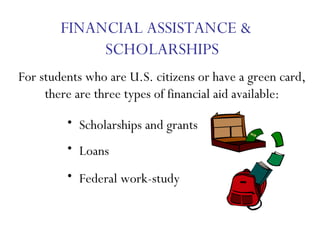
FINANCIAL ASSISTANCE & SCHOLARSHIPS For students who are U.S. citizens or have a green card, there are three types of financial aid available: Scholarships and grants Loans Federal work-study
Success is a Habit. Work ethic  and  mediocrity  are also habits. Students choose which habits dominate their life.
LEARN HOW TO HUSTLE Success is affected not only by one’s own expectations,  but also by what others expect. We must hustle all our lives in order to succeed. Successful students  do more  than the teacher asks and complete work  before  it is due.
“ In the long run you hit only what you aim at.  Therefore, though you should fail immediately,  you had better aim at something high.” ~Henry David Thoreau
Questions/Discussion
Thank you! pick up information and  complete feedback forms Parents remember:  - stay involved  - monitor progress  - encourage students to make decisions

Roadmap To College

  • 1.
    Roadmap To CollegePreparing for Middle School And Beyond
  • 2.
    Harvard University hashistorically had the highest graduation rate of any American college. One study estimates that 97% of their students graduate. Harvard’s approach to academic success? The assumption towards each student that: Of course they can succeed.
  • 3.
    Success Dependson the Individual Elementary School… the first step on the path to college… the stepping stone for middle school… which is the launching pad for high school. all of the above = the path to college
  • 4.
    When asked, many seniors regret not working as hard as they could have in school.
  • 5.
    Each step astudent takes impacts college and their life beyond… students must take advantage of every opportunity in and out of the classroom
  • 6.
    WHY SHOULD STUDENTSATTEND COLLEGE? Opportunities to: Conduct research Test new theories Explore new topics Revisit ideas with which they are already familiar Learn from classmates who have a variety of experiences and backgrounds Live independently Take on more responsibility and decision-making
  • 7.
    US Census BureauData On average people who attend college earn significantly more over a lifetime than high school graduates. In the job market of today and tomorrow, a bachelor’s degree is essential .
  • 8.
  • 9.
    WHY SHOULD STUDENTSAND PARENTS START THINKING ABOUT COLLEGE NOW? Avoid the anxiety associated with the college admissions process. Gain confidence and remain calm as they move through the process. Make informed choices during freshman through senior years.
  • 10.
    College serves asan exciting opportunity for academic and personal growth. Students should embrace the exploration!
  • 11.
    Parents may wonderif things are the same as they were when they or an older child applied to college… the answer in most cases is no .
  • 12.
    HOW HAS APPLYINGTO COLLEGE CHANGED IN RECENT YEARS? as a result of demographic changes, each year more students apply to college than ever before
  • 13.
    2006 Enrollmentin United States colleges: 20.5 million 2000 Enrollment in United States colleges: 17.5 million THAT’S A 17% INCREASE
  • 14.
    Number of applications submitted to the eight Ivy League colleges in 2007 . 135,736 12,411 Nine out of ten applications were rejected. Number of spaces in the combined incoming first year classes.
  • 15.
  • 16.
    PUTTING THE COLLEGEPROCESS IN PERSPECTIVE Students should build a solid academic foundation while: Exploring new options outside of the classroom Continuing to pursue the activities they enjoy Challenge themselves academically to do their best work Achieve the personal goals they set for themselves Make friends Take advantage of opportunities
  • 17.
    Middle School Study Skills and Strategies Here’s how to approach it all…
  • 18.
    #1 Rule: BeHere Now
  • 19.
    Organization Time StudyArea School Supplies Assignments MIDDLE SCHOOL STUDY SKILLS AND STRATEGIES
  • 20.
    Understanding How AStudent Learns Best What is the best study environment? What is their learning style? MIDDLE SCHOOL STUDY SKILLS AND STRATEGIES
  • 21.
    Taking Notes fromLectures Review previous notes before class Sit in the front of the room Listen actively Write notes in their own words Review notes immediately after class and add information MIDDLE SCHOOL STUDY SKILLS AND STRATEGIES
  • 22.
    Test Taking StrategiesRead directions carefully Learn how to approach various types of tests Use old tests to predict expectations for new tests MIDDLE SCHOOL STUDY SKILLS AND STRATEGIES
  • 23.
    Reading Comprehension Readto understand – READ ACTIVELY Paraphrase Learn vocabulary in context Take notes on written material MIDDLE SCHOOL STUDY SKILLS AND STRATEGIES
  • 24.
    Goal Setting andMotivation START NOW! Challenge themselves Expect Failure Relate goals to the smaller steps MIDDLE SCHOOL STUDY SKILLS AND STRATEGIES
  • 25.
    Use an AssignmentCalendar Write down assignments Plan ahead Schedule time for homework Formulate an action list MIDDLE SCHOOL STUDY SKILLS AND STRATEGIES
  • 26.
    Communication Skills Teacher-pleasingbehaviors Understand teachers’ expectations Communicate with teachers Cooperative planning Collaborate with other students MIDDLE SCHOOL STUDY SKILLS AND STRATEGIES
  • 27.
    ACADEMIC PLANNING &PERFORMANCE High School
  • 28.
    Before choosing highschool classes, become familiar with the academic requirements of the high school and most colleges. CHOOSE ACADEMIC COURSES THAT KEEP YOUR OPTIONS OPEN
  • 29.
    Consider: Consequences ofActions College Expectations Academic Prep Grade Trends ACADEMIC PLANNING AND PERFORMANCE – High School
  • 30.
    As students progressthrough high school, they should evaluate: Am I taking as many classes as I am able to? Am I taking the most demanding classes available and challenging myself as a student? Do my grades reflect my abilities? ACADEMIC PLANNING AND PERFORMANCE – High School
  • 31.
    take advantage ofavailable support services ACADEMIC PLANNING AND PERFORMANCE – High School
  • 32.
    coaches, advisors, anddeans all offer support ACADEMIC PLANNING AND PERFORMANCE – High School
  • 33.
    In an increasinglycompetitive college market, it is no longer enough just to be smart. Colleges want to know what students will offer to the community. BEYOND THE CLASSROOM
  • 34.
    students: dowhat you enjoy
  • 35.
    use of timeoutside of academics Activities are important in the context of the college application process, but also in terms of personal growth. NOW is the time to explore. BEYOND THE CLASSROOM
  • 36.
    Do what youare passionate about - your enthusiasm and sincerity will shine through. Pursue interests that make you happy and are enriching and rewarding. BEYOND THE CLASSROOM
  • 37.
    Find a balance between extra-curricular pursuits & school work.
  • 38.
    During your highschool years dive into one or more areas of interest. LEADERSHIP Become a Leader
  • 39.
    Make sure collegesclearly recognize your special talents and interests! LEADERSHIP
  • 40.
    Not everyone wantsto be a leader in the traditional sense… but no matter what, contribute. LEADERSHIP
  • 41.
    Leadership positions reflect a student’s commitment and willingness to take on challenges and responsibility. LEADERSHIP & COLLEGE
  • 42.
    TAKE ADVANTAGE OF THE SUMMER Unwind and Recharge This does not mean students should spend the summer lounging around on the beach or in front of the TV or computer screen.
  • 43.
    Consider the followingideas: Take a summer review or preparation course Get a job Obtain an internship in a field of interest Volunteer Tour a nearby college campus TAKE ADVANTAGE OF THE SUMMER
  • 44.
    Be sure thatyour summer experience reflect who you are Are you academically driven? What activity/activities do you enjoy? Have you started a service project for middle school students in your hometown? YOUR SUMMER EXPERIENCES: WHAT THEY SAY ABOUT YOU Avoid thinking about “what colleges want to see.” Let your heart and your interests guide you.
  • 45.
    STANDARDIZED TESTING Discussyour testing plan with the college counseling office. Each person has different strengths, so each student’s strategies will differ. Take “practice” standardized tests. Take SAT Subject Tests in your areas of strength. Try to complete all required college testing before the end of your Junior year !
  • 46.
    PSAT Purpose: Familiarizestudents with the SAT Reasoning Test Expose students to the SAT in a no-risk manner Give students an analysis of their strengths and weaknesses in: critical reading writing mathematics *PSAT scores determine National Merit and Achievement Scholarship candidates (Junior year only)
  • 47.
    EXPLORE EXAM TheACT test company offers a standardized test called EXPLORE for 8 th and 9 th graders. Also consider the PLAN (for 10 th graders) along with the ACT (11 th and 12 th graders). All three exams test English, math, reading and science skills.
  • 48.
    SAT SUBJECT TESTSThe SAT Subject Tests are hour-long multiple choice tests on specific subjects. A handful of colleges require that a student submit three, several dozen ask for or recommend two, and many do not require the Subject Test. SAT Subject Tests include: Literature U.S. History and World History Mathematics I and II Biology-Ecological, Biology-Molecular Chemistry Physics Foreign Languages – Chinese, French, German, Spanish, Modern Hebrew, Italian, Latin, Japanese, and Korean.
  • 49.
    PARENTS make sureyour child takes advantage of opportunities Encourage involvement in extra-curricular activities Start early [waiting until junior year will show lack of sincere interest to college admissions officers] Help students explore to determine their passion sample activities sports, drama, music, the arts, journalism, community service
  • 50.
    PARENTS help yourchild develop solid study habits Students must develop good study habits in middle school to prepare for both high school and college If they don’t naturally possess good study skills, guide them Experiment with different study methods to determine how to produce the best outcome study skills can be taught
  • 51.
    FINANCIAL ASSISTANCE &SCHOLARSHIPS For students who are U.S. citizens or have a green card, there are three types of financial aid available: Scholarships and grants Loans Federal work-study
  • 52.
    Success is aHabit. Work ethic and mediocrity are also habits. Students choose which habits dominate their life.
  • 53.
    LEARN HOW TOHUSTLE Success is affected not only by one’s own expectations, but also by what others expect. We must hustle all our lives in order to succeed. Successful students do more than the teacher asks and complete work before it is due.
  • 54.
    “ In thelong run you hit only what you aim at. Therefore, though you should fail immediately, you had better aim at something high.” ~Henry David Thoreau
  • 55.
  • 56.
    Thank you! pickup information and complete feedback forms Parents remember: - stay involved - monitor progress - encourage students to make decisions

Editor's Notes

  • #13 Colleges receive record numbers of applications. An admissions representative from one highly selective college remarked that the school rejected more students in 2007 than the total number who applied five years prior. All of this means that across the board, applying to college is more competitive than ever before.
  • #17 Believe it or not, this is exactly what a student should be doing as far as the college process goes. College will assess their preparedness and achievements in academic and personal areas as they consider a students application.
  • #25 Help your student write down their goals (Long/Short, Immediate, To-do lists) Keep several lists according to time scale Set priorities Be specific and include actions Relate goals – when setting a long term goal, write a progression of short term goals that will lead you there
  • #30 Always determine the consequences if you want to switch foreign languages or stop studying one altogether. Learn about what colleges expect from a prospective engineering or studio art major. Of course colleges are primarily concerned with your academic preparation and achievements when they review applications, so your grades are very important. Colleges review your grades when your high school sends your transcripts out with your college applications. Colleges notice improvements, especially upward trends in your grades over time. For example, increase grades between freshman and sophomore year speaks positively to your commitment and growth.
  • #31 When reviewing you application, the transcript is the single most important credential admissions officers consider. Your transcript is an official account of the courses you took and the grades you received. Colleges are very interested in the grades you earn and the level or classes you take. Strive to work diligently and earn the best grades possible.
  • #32 If you are struggling in a course, don’t wait to ask for help; For example, before you turn in a paper, submit a rough draft to your teacher and request guidance and early feedback. When the teacher returns the paper, identify ways to improve your work. Your effort will render positive results in your grades and help you gain insight into ways you can improve your future work.
  • #33 Get to know them and let them get to know you. Remember, some of these people will be writing your college letters of recommendation and they should be able to document the growth they have witnessed over the past few years and write a very thorough letter on your behalf. If you are interested in college athletics, be sure to check regularly regarding the NCAA Clearinghouse requirements to make sure you will meet the very specific academic requirements (http://www.ncaaclearinghouse.net). You will need to earn a minimum GPA in a certain number of academic classes. Speak to your coaches and advisors to let them know if it is your goal to participate in Division I or II college athletics.
  • #34 Will you contribute to student life, the arts, athletics? Colleges expect you to get involved in meaningful activities outside the classroom. High school offers opportunities to try new things and challenge yourself outside of the classroom, including acting plays, joining clubs, playing sports and becoming a leader.
  • #35 Write poetry, play basketball, run, volunteer your time, create art, sign, act, take up juggling
  • #36 There won’t be many times in your later life where you can host your own radio show, have access to a darkroom and photography instruction, try silver-smithing, or volunteer for a particular cause.
  • #38 You will encounter problems if you are so involved that you have no time for your class work. Grades are always the central factor in an admission decision. A laundry list of activities will not compensate for a poor performance in the classroom . Don’t join every group on campus just to have things to list on your college application. College admission officers recognize “resume-builders”.
  • #39 Let’s say you have discovered that you have a talent for working with younger students, and are considering applying to teaching programs. Have you gone and applied for an available proctor position on campus? Did you work at a day camp over the summer? Do you baby-sit on the weekends? Does one of your essays address why you want to teach? All of these activities convey and reinforce the idea that you enjoy teaching and give colleges a sense of who you are, what is important to you, and why you want to apply to education programs.
  • #41 but if you enjoy an activity, lead your peers in the classroom, on the field, or in clubs and organizations. If the spotlight is not for you, contribute positively to the community in less visible ways.
  • #42 If a teacher has seen you functioning as vice president of student council or captain of the basketball teams, perhaps he will comment on that. In addition, he might also address how you serve as a leader in a class discussion, or how you help classmates who struggle with a concept to gain understanding, or even how you look out for younger students who seem a little lost in the dining hall during orientation. Perhaps your advisor has seen you consistently model appropriate behavior and stand up for what you believe it. All of the above makes you a leader.
  • #43 Students should return from the summer break refreshed and ready to take on another year of challenging work inside the classroom. That would be boring and not terribly fulfilling!
  • #45 College applications always ask what you have done during the summer. Admissions officers are interested in how you spend your free time because it shows them what you think is important.
  • #46 Practice = see where you excel
  • #47 In October, all juniors take the PSAT (Preliminary SAT). Prepare for the PSAT by taking the sample test included in the student bulletin which also explains more about the format and content of the test and has helpful tips. Juniors who score in the top two percent of test takers nationwide will be eligible to compete for scholarship funding from select colleges, companies, and organizations. colleges do not typically ask for PSAT scores
  • #48 EXPLORE prepares students for high school coursework as well as their post-high school choices.
  • #49 60 minutes, multiple choice, specific to subject area
  • #52 Most financial aid is offered as a “package” that consists of a combination of scholarships and grants, loans and work-study. You may choose to accept some, none or all of financial assistance offered. If you are not a U.S. citizen, you should check with the government and banking institutions in your home country for information on financial aid and scholarships. Need based aid – when students do not have sufficient financial resources to pay for their education beyond high school Non need-based aid – when students receive merit-based aid and are awarded for recognition of special skills, talents, or academic abilities.