Social Science and Humanities Family Studies - Grade 12 Half Day Workshop Subject Specific Training 2002
Agenda •  Welcome and Introductions •  The Grade 12 Course Profiles •  The Destinations •  Assessment and Evaluation •  Multiple Intelligences •  Critical Thinking Skills •  Cooperative Learning •  Social Science Research Skills •  Technology in the Family Studies Classroom •  Conclusion
What is a Course Profile? •  a sample plan for implementing curriculum policy •  a detailed example for teachers to use in developing their courses •  can be used “as is” or adapted It is one way of presenting a course of study that links:  Expectations Assessment Teaching/  Learning Strategies Course Type
Family Studies - Grade 12 Course Profiles •  Food and Nutrition Sciences - University/College (HFA4M) •  Individuals and Families in a Diverse Society - University/College (HHS4M) •  Issues in Human Growth and Development - University/College (HHG4M) •  Parenting and Human Development - Workplace (HPD4E) •  The Fashion Industry - Open (HNB40)
The Writing Process Individuals and Families in a Diverse Society, University/College, HFA4M Issues in Human Growth and Development, University/College, HHG4M Parenting and Human Development, Workplace, HPD4E Public and Catholic writing teams worked in consultation to create the unit overview, each team wrote one unit, two documents produced
The Writing Process Food and Nutrition Sciences, University/College, HFA4M  The Fashion Industry, Open, HNB40 Public and Catholic writing teams scoped out the courses together, each team wrote one unit; one document produced
Gap Analysis The Fashion Industry, Individual and Families in a Diverse Society, Food and Nutrition Sciences  Similarities to the old courses?? •  Similar topics •  Practical applications/skills •  HHS4M: family life cycle approach has been adapted, Independent Study component
Parenting Courses Four courses that focus on parenting, child development, human development Grade 11  - Parenting  HPC30 - Living and Working With Children HPW3C Grade 12  - Parenting Human Development  HPD4E - Issues in Human Growth and  Development HHG4M
Similarities? Differences? •  Communication Skills and Healthy Relationships •  Stages of childhood - longer time span •  Emphasis on brain research and the importance of the Early Years •  Placement/Practical experiences  •  Other ideas???
Career Education •  Specific expectations address careers in many of the Grade 12 courses •  All students have taken Grade 10 Career Studies course (Prior Knowledge)  •  Family Studies Career Resource package available on the following websites: - Ontario Family Studies Leadership  Council  www.ofslc.org - Ontario Family Studies Home Economics  Educators Association  www.ofsheea.ca
Teaching Careers •  Guest speakers •  Interviews •  Computer applications/Internet •  Placements/practical application (job shadow) •  Grade 10 Career Studies teachers
Safety Issues  •  No expectations within the courses that deal with safety issues •  Practical nature of the courses means that teachers MUST address safety •  Diagnostic assessment - what do students know?? •  Foods - how to address skills and safety issues, students may not have previous food course experiences (HIF, HFN) •  Fashion - safety issues are concern, grade 11 course is not a prerequisite
Grade 12  Destinations Open - The Fashion Industry Workplace Preparation - Parenting and Human Development University/College Preparation - Food and Nutrition Sciences, Individuals and Families in a Diverse Society, Issues in Human Growth and Development
Open Courses  Open courses are designed to broaden  students’ knowledge and skills in subjects that  reflect their interests and to prepare them for  active and rewarding participation in society.  They are not designed with the specific  requirements of universities, colleges, or the workplace in mind  ( The Ontario Curriculum Grades 9 to 12 Program Planning and Assessment, page 12)
Workplace Preparation Workplace preparation courses are designed to equip students with the knowledge and skills they need to meet the expectations of employers, if they plan to enter the workplace directly after graduation, or the requirements for admission to certain apprenticeship or other training programs  (The Ontario Curriculum Grades 9 to 12 Program Planning and Assessment, page 12)
Workplace Courses •  NOT Basic level  •  Destination focus •  OYAP - Ontario Youth Apprenticeship Program  Early Childhood Education Aboriginal Early Childhood Educator Child and Youth Care Worker •  Check with your school board and local community college for status of OYAP in your community
University/College Preparation University/college preparation courses are designed to equip students with the knowledge and skills they need to meet the entrance requirements for specific programs offered at universities and colleges  (The Ontario Curriculum Grades 9 to 12 Program Planning and Assessment, page 12)
Ministry Resources •  Social Sciences and Humanities Curriculum Policy Document Grade 11 and 12 •  Program Planning and Assessment 2000 •  Ontario Secondary Schools, Grade 9 -12: Program and Diploma Requirements, 1999 •  http://www.edu.gov.on.ca   •  http://www.curricululm.org
Assessment and Evaluation
ASSESSMENT •  Informs and motivates students •  Maximizes learning  •  Maximizes student confidence •  Students, teachers and parents should be involved
Key to Success Use assessment to help the student believe that the target is within reach ……
How do we motivate students? How can we help our students want to learn?
The Path to Greater Student Motivation and Achievement •  Student Involved Classroom Assessment •  Student Involved Record Keeping •  Student Involved Communication (Rick Stiggins, Assessment Training Institute, 1998)
Essential Question What assessments might I do that will encourage, build confidence and offer success ?
Assessment and Evaluation ASSESSEMENT A systematic process of collecting information about a student’s achievement in relation to specified curriculum expectations.  EVALUATION  The process of integrating assessment information from a variety of sources to determine how well students have achieved curriculum expectations.
Principles of Assessment
#1  Evaluation strategies should address both  WHAT students learn and HOW WELL they learn   Achievement Chart •  How well students learn •  High standards for all students •  Promote consistency across the province
#2  Assessment and evaluation strategies should be appropriate for the learning activities used, the purposes of instruction and the needs and experiences of students Assessment should be: •  closely tied to expectations •  closely tied to learning activities •  consider students’ prior learning and needs •  reflect student background
#3  Assessment and evaluation strategies should be communicated clearly to students and parents at the beginning and throughout the course/year Methods of Communicating include: •  expectations based on tasks and assignments •  teacher/parent/student conferences •  report cards •  Annual Education Plans •  Individual Education Plans
#4  Assessment and evaluation should be fair to all students Fairness can be achieved by: •  providing choice within the assignment  (i.e. topics) •  providing choice in the mode of response  (i.e.  oral report instead of written report) •  negotiating timelines •  making purpose and expectations of assignment clear to students
#5 Assessment and evaluation strategies should be varied in nature, administered over a period of time and designed to provide opportunities for students to demonstrate the full range of their learnings
Instructional Strategies Panel discussions Quizzes, tests, exams Interviews Written reports/essays Oral reports Observations Think/pair/share Graphic organizers Spreadsheets/graphing  Debates Portfolios Multi-media presentations Performance tasks Case studies Jigsaw Questionnaires Community Involvement Food labs
Assessment Strategies Quizzes Tests Exams Essays Class discussion Teacher/student conference Presentations Demonstration Research paper Teacher observation Performance task Portfolio Select response Self assessment Oral question and answer Learning Log
#6 Assessment and evaluation strategies must be based on the categories of  the Achievement Chart Achievement Chart •  Categories of skills and knowledge •  Levels of achievement •  Provincial standards
#7 Assessment and evaluation strategies should include samples of student work  Samples of Student Work •  Exemplars •  Show student progress •  Portfolios •  Parent and student conferences
Principle #8  Assessment and evaluation strategies should give clear directions for improvement Directions for Improvement •  Task specific rubrics •  Criterion Referenced Marking Schemes •  Task specific next steps •  Report Cards - strengths, weakness, next steps
#9 Assessment and evaluation strategies must promote students’ ability to assess their own learning and to set specific goals Self-Assessment and Goal Setting •  Report Card/Response Form •  Annual Education Plan •  Journals •  Portfolios •  Teacher/Parent/Student Conferences
#10 Assessment and evaluation strategies should accommodate the needs of exceptional students Individual Education Plan (IEP) •  Students identified by an Identification, Placement, and Review Committee (IPRC) •  Students receiving specialized programs but not identified by an IPRC
#11 Assessment and evaluation strategies should accommodate the needs of students who are learning the language of instruction Accommodations •  Additional time •  Oral tests •  Simplify tasks •  Specialized equipment •  Extra support
Types of Assessment
Diagnostic Assessment •  Assessment before starting instruction to determine what students know and can do  •  Purpose is to identify student’s strengths and weaknesses •  Allows teacher to program appropriately
Formative Assessment  •  Ongoing assessment using a variety of strategies to inform students of their progress •  Encourage students to build on strengths and overcome weaknesses •  Help teachers assess current instructional and learning activities
Summative Assessment •  A cumulative description of student achievement of curriculum expectations at the end of a unit or a specified time period
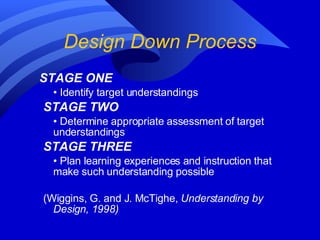
Design Down Process STAGE ONE   •  Identify target understandings STAGE TWO •  Determine appropriate assessment of target understandings STAGE THREE •  Plan learning experiences and instruction that make such understanding possible (Wiggins, G. and J. McTighe,  Understanding by Design, 1998)
Design Down Process STAGE ONE  •  Identify target understandings STAGE TWO •  Determine appropriate assessment of target understandings STAGE THREE •  Plan learning experiences and instruction that make such understanding possible
Stage One  Identify target understandings Use course expectations to establish  curricular priorities according to: •  Enduring understandings •  What is important to know and do? •  What is worth being familiar with?
Enduring Understandings •  Have lasting value •  Are at the heart of the discipline •  Require “uncoverage” (abstract or often misunderstood ideas) •  Are embedded in factual knowledge, skills and activities
STAGE ONE   •  Identify target understandings STAGE TWO •  Determine appropriate assessment of target understandings STAGE THREE •  Plan learning experiences and instruction that make such understanding possible Backward Design Process
Stage Two  Determine appropriate assessment strategies for targeted understandings •  Diagnostic assessment •  Performance tasks and assessments •  Portfolios •  Self-evaluation •  Co-operative learning/group evaluation
Diagnostic Assessment •  Assessment before beginning instruction to determine what students know and can do •  Identify student strengths and weaknesses  •  Used by teacher in the design of program •  Especially important in practical courses like foods and clothing where practical skills need to be determined
Performance Tasks and Assessments •  Open-ended, hands on activity •  Demonstrates specific skills and/or knowledge •  Focus on what students can do - how they apply and extend their knowledge •  Emphasize the process students use, rather than focusing only on the “right” answer •  Allow for a full range of products  •  Use of complex thinking skills
Performance Tasks (con’t) •  Often encourage team effort, collaboration, group discussion and brainstorming •  Directly related to expectations •  Summative •  Assessment criteria clear (rubric, criterion referenced marking scheme) •  Exemplars should be available
Traits of a Strong Performance Task •  CONTENT - the task elicits the correct performance on part of the student •  CLARITY - students know exactly what to do •  FEASIBILITY - the task is practical •  FAIRNESS and ACCURACY - all students have an equal chance  to “shine”, gives an accurate picture of student skill •  SAMPLING - task covers all dimensions of learning expectations to be assessed
What are portfolios? “ A portfolio is a systematic and purposeful collection of student work that displays the learner’s effort, growth, process, and achievement in demonstrating his/her skill, knowledge, and values.” Peel District School Board (2001)
Portfolios can: •  Engage students in the learning context •  Help students learn the skills of reflection and self-evaluation •  Provide documentation of student learning in areas that don’t lend themselves to traditional assessment •  Facilitate communication with parents
Characteristics of Portfolios •  Collection of student work with a clear purpose known by all involved •  Students must reflect on each piece of work  Fosters critical thinking and decision making Allows students to set future goals Reflection is a skill, process needs to be taught
Purpose of Portfolios •  To facilitate assessment of values and skills •  To develop lifelong learning skills •  To provide a basis for conferencing •  To facilitate individualized programming •  To promote accountability (Peel District School Board,  2001)
How do portfolios fit into Ministry policy? Choices into Action: Guidance and Career Education Program Policy for Ontario   Elementary and Secondary Schools  encourages the development and maintenance of an academic and career portfolio for all students. (page 17) The Ontario Curriculum Grades 9 to 12: Program Planning and Assessment  states that assessment and evaluation strategies must “include the use of samples of students’ work that provide evidence of their achievement”  (page 13)
Why ? How? What? (Rolheiser, Bower, Stevahn, The Portfolio Organizer , 2000) Before implementing the use of portfolios in the classroom teachers must consider the following:
Types of Portfolios •  Collection portfolio •  Growth portfolio •  Unit portfolio •  Skills portfolio •  Showcase portfolio •  Comprehensive portfolio •  Exit/ Graduation portfolio •  Professional Career portfolio
The Portfolio Process •  The process involves both the teacher and the student •  Refer to the expectations and decide on the method of assessment •  The reflection process is a very important part of the process
For more information Rolheiser, Carol et. al.  The Portfolio Organizer: Succeeding with Portfolio in Your Classroom.  ASCD, 2000. Danielson, C., L. Abrutyn.  An Introduction to Using Portfolios in the Classroom . 1997.
Self Assessment •  Process of gathering information and reflecting on one’s own learning •  Student’s own assessment of personal progress in knowledge, skills, process or attitudes •  Leads student to greater awareness and understanding of self
Purpose of Self Assessment •  Assist student to take more responsibility and ownership of learning •  Enable student to make decisions about their own learning •  Use assessment as a mean of learning •  Focus on product and process •  Help student critique work
Characteristics of Self Assessment •  Promotes metacognitive ability •  Allows for reflection •  Can include attitude surveys, self-concept questionnaires, interest inventories, personal journals •  Student addresses questions such as “How do I learn best,” “What are my areas of growth?” and “Where do I need to improve?” •  Student’s beliefs = Teacher observations??
Teacher’s Role in Self Assessment •  Guide all students on how to reflect on learning •  Provide time and opportunity for self- assessment •  Design questions and self-assessment tools •  Use self-assessment to determine change or  growth in student’s attitude, understanding,  achievement
Design Down Process STAGE ONE  •  Identify target understandings STAGE T WO •  Determine appropriate assessment of target understandings STAGE THREE •  Plan learning experiences and instruction that make such understanding possible
Stage Three Plan learning experiences and instruction that make such understanding possible  •  Use the Achievement Chart to create  assessment tools that are appropriate for the  learning experience •  Ensure that students are aware of the  expectations/criteria/due dates before the task  begins •  Involve students in the creation of assessment tools
Final Evaluation •  Purpose of grading and reporting is to provide  an accurate description of how the student has progressed in his/her achievement •  70% term grade reflects the most consistent  level of achievement on summative evaluations throughout the course
Final Evaluation (con’t) •  30% final grade reflects achievement derived from summative final evaluation •  Final evaluation may be written exam OR performance task OR a combination of both
Multiple Intelligences •  Howard Gardner  •  Frames of  Mind:The Theory of Multiple Intelligences , 1985  •  defined intelligence in a new way •  students are intelligent in different ways
Gardner identifies eight intelligences: •  Linguistic •  Logical-Mathematical •  Visual-Spatial •  Bodily Kinesthetic •  Musical-Rhythmic •  Interpersonal •  Intrapersonal •  Naturalist
How are you intelligent?  Individually complete the Multiple Intelligences Type Inventory to identify how you are intelligent? Source:  OAFE. Using Your Brain The Urban Use of Pesticides
What do Multiple Intelligences look like in the classroom?
Creating a Multiple Intelligences Learning Environment in Your Classroom •  Avoid isolated, meaningless tasks •  Connect to expectations •  Teach for understanding - problem solving •  Performance tasks that draw on student talents •  Written tests - variety of questions, all  categories of the achievement chart •  Group projects but ensure individual  accountability •  Lay foundation using a multi-sensory  approach
•  Allow students some input into how they will demonstrate learning •  Teach to the assigned task - ensure students have necessary skill/knowledge •  Students maintain a “processfolio” Creating a Multiple Intelligences Learning Environment in Your Classroom (con’t)
Processfolio •  Students maintain a binder of all work leading to the end product •  Purpose of the processfolio:  helps students see the relationship  between process and end product  useful for teacher to ensure that all work is each student’s own
“ Until Multiple Intelligence Theory impacts on assessment and evaluation practices, it will have minimal effect on improving student learning”  (Gini-Newman and Newman, 2001)
Implications for Family Studies/Social Science Teachers •  Summative evaluations at the end of an unit or course should provide for ALL students the opportunity to demonstrate their achievement of curriculum expectations •  Other ideas?
For More Information Ontario Agri-Food Education Inc.  Using your Brain. The Urban Use of Pesticides . Simcoe County District School Board Multiple Intelligence Homepage.   http://www.scdsb.on.ca/mit/mi.htm#RSO Education World - Multiple Intelligences: A Theory for Everyone .  http://www.education-world.com/a_curr/curr054.shtml
Critical Thinking Skills
Group Activity What skills do our students have difficulty with? Think  -  Individually answer the above question Pair  - Share your list with a partner  Share  - Join with another pair and share your new list. In your group prioritize the list. Create your top 5 list. Write each thought/idea on a card. As a group  rearrange the cards and discuss your reasons for  doing this. Keep re-arranging the cards until your  group comes to consensus.
Peel teachers came up with the following list of skills that students have difficulty with: •  Knowing and Applying Basic Skills: Reading, writing, recognizing and comprehending words Developing planning and study skills •  Making Connections: Relating to the material and making connections Developing and expanding on ideas; building on concepts and generalizing Knowing what is important and asking thoughtful questions
•  Developing Intra-personal Skills - Self evaluation  - Taking risks •  Working Together: - Working effectively in groups, being supportive and working with others who are different •  Demonstrating Good Work Habits: - Working independently - Focusing and staying on task for extended periods of time - Listening and following instructions and expectations - Using class time effectively (Peel District School Board, 2001)
The above can be characterized as intelligent behaviour. Some students have these skills and others are lacking. Teachers can help all students to become better thinkers.  Art Costa (1991 and 2000) concluded that intelligent behaviour can become a habit if students are given instruction and the chance to practice. Source: Costa, Arthur L. & Bena Kallick  Habits of Mind - A Developmental Series . ASCD. Alexandria, Virginia. 2000
Characteristics of Good Thinking vs. Poor Thinking (Peel District School Board, 2001) -ignores evidence, no challenge - evidence, challenges Evidence -limited alternatives, impulsive -possibilities, alternatives, analyzes Possibilities -impulsive, no revision -discover goals, revisions Goals - ambiguous, impulsive, thinking won’t help -problem solving, critical, reflective, rational  General Traits The Poor Thinker The Good Thinker Aspect
Critical Thinking Skills - What are they? Analyze for Assumption Analyze for Bias Making Analogy Visualizing Thinking Skills (Gini-Newman, L. Peel District School Board, 2001)
Graphic Organizers Students are faced with learning and making sense of large amounts of new information everyday in school. In the short term they may retain some of the information but long term retention is generally less successful. Information that is presented and organized visually helps many students understand and retain the material.
Graphic Organizers (con’t) •  require students to take information and reorganize it •  students consolidate information in an alternative manner •  good for visual learners •  student becomes creator of new information rather than “ copier of words” •  teacher introduces organizers, goal is to have students use them independently  (Newman, Garfield.  Images of Society Teacher’s Resource , McGraw-Hill, 2001)
Types of Organizers •  Wide variety available •  From simple to complex - charts - mind map - webbing - venn diagrams - fish scale - PMI (plus, minus, interesting) - KWL (what we know, want to know, learned) - ranking ladder Additional Information on Organizers can be found in “ Beyond Menot: The Artful Science of Instructional  Integration”  by Barrie Bennet and Carol Rolheiser
How to use graphic organizers? •  Use as an organizer prior to tasks such as research, writing, group work •  Select organizers that are appropriate to the needs or students and course type •  Can be used as an assessment tool •  Inspiration - computer software application that allows us to develop ideas and organize thinking  http://www.inspiration.com
Thinking Skills Resources •  OAFE . Issues - Complex Issues in Agriculture and Food Production,  1999 .  •  Marzano, R.J. et al . Dimension of Thinking: A Framework for Curriculum and Instructions,  1992 . •  Bennett, B., C. Rolheiser.  Beyond Monet: The Artful Science of Instructional Integration,  2001 .  (905)619-0376 .
Cooperative Learning “ Where the heart meets mind” Is co-operative learning still relevant for the Family Studies classroom in the 21st century?
Consider this… Research on how the brain thinks and the emergence of knowledge regarding intelligence, creativity, and learning styles all argue that social interaction is critical in the development of intelligent behaviour  (Barrie Bennet and Carol Rolheiser,  Cooperative Learning: Where Heart Meets Mind , 1991)
Points to Consider •  learning is socially constructed; we rarely learn in isolation •  everyone in the group must be accountable for the learning •  the importance of actively teaching social skills, communication skills, and critical thinking skills •  group must be aware of how it functions as a group
Points to Consider (con’t) •  tasks must be appropriate for group work •  groups of 2, 3 and 4 encourage interaction •  carefully think about the makeup of the group, how will it be formed? •  cooperative learning is not a solution to all your student’s needs  •  group work done badly can be a very ineffective teaching strategy
Social Science Research Research and Inquiry Skills Strand
Social Science Research Skills • “ social science research skills are introduced in the unit where they are first applied, and they are repeated and developed throughout the  course” •  they are embedded in ALL units of the courses •  grade 12 students may have had little prior  instruction in these skills  - diagnostic assessment needed to   determine where students are
Research and Inquiry Skills Expectations •  the process of social science research •  primary data collection/various methods •  secondary data collection •  using information technology to gather data •  developing research questions/hypothesis  •  note taking skills  •  evidence versus opinion
Research and Inquiry Skills Expectations •  evaluating sources for bias, accuracy, validity,  authority, and relevance •  documenting sources/citations •  communicating results of inquiries using a  variety of methods - graphs, charts, diagrams, oral reports, written reports, reaction papers,  essay
Formative Assessment & Social Science Research Skills •  Conferencing (formal and informal) •  Criterion referenced checklists •  Checkpoints to be met throughout the process •  Anecdotal comments  •  Portfolios
Summative Assessment & Social Science Research Skills Incorporate social science research skills into the summative assessments/performance of the course •  Activities throughout the unit/course •  Culminating activities at the end of each unit •  Culminating activity for the course
Social Science Research - An Instructional Tool •  Provide several opportunities to participate in social science research throughout the course •  May or may not need to write a formal report -  depends on the designation/expectations of the course  •  Social science skills should be incorporated into your lessons throughout the course  •  May include them in any strand or unit of study •  May use various strategies to meet the overall and specific expectations for the course.
Integrating Technology Opportunities for integrating technology are embedded throughout all Family Studies/ Social Science courses
Conclusion •  Questions •  Concerns •  Concluding Discussion

Fam Sthalfday

  • 1.
    Social Science andHumanities Family Studies - Grade 12 Half Day Workshop Subject Specific Training 2002
  • 2.
    Agenda • Welcome and Introductions • The Grade 12 Course Profiles • The Destinations • Assessment and Evaluation • Multiple Intelligences • Critical Thinking Skills • Cooperative Learning • Social Science Research Skills • Technology in the Family Studies Classroom • Conclusion
  • 3.
    What is aCourse Profile? • a sample plan for implementing curriculum policy • a detailed example for teachers to use in developing their courses • can be used “as is” or adapted It is one way of presenting a course of study that links: Expectations Assessment Teaching/ Learning Strategies Course Type
  • 4.
    Family Studies -Grade 12 Course Profiles • Food and Nutrition Sciences - University/College (HFA4M) • Individuals and Families in a Diverse Society - University/College (HHS4M) • Issues in Human Growth and Development - University/College (HHG4M) • Parenting and Human Development - Workplace (HPD4E) • The Fashion Industry - Open (HNB40)
  • 5.
    The Writing ProcessIndividuals and Families in a Diverse Society, University/College, HFA4M Issues in Human Growth and Development, University/College, HHG4M Parenting and Human Development, Workplace, HPD4E Public and Catholic writing teams worked in consultation to create the unit overview, each team wrote one unit, two documents produced
  • 6.
    The Writing ProcessFood and Nutrition Sciences, University/College, HFA4M The Fashion Industry, Open, HNB40 Public and Catholic writing teams scoped out the courses together, each team wrote one unit; one document produced
  • 7.
    Gap Analysis TheFashion Industry, Individual and Families in a Diverse Society, Food and Nutrition Sciences Similarities to the old courses?? • Similar topics • Practical applications/skills • HHS4M: family life cycle approach has been adapted, Independent Study component
  • 8.
    Parenting Courses Fourcourses that focus on parenting, child development, human development Grade 11 - Parenting HPC30 - Living and Working With Children HPW3C Grade 12 - Parenting Human Development HPD4E - Issues in Human Growth and Development HHG4M
  • 9.
    Similarities? Differences? • Communication Skills and Healthy Relationships • Stages of childhood - longer time span • Emphasis on brain research and the importance of the Early Years • Placement/Practical experiences • Other ideas???
  • 10.
    Career Education • Specific expectations address careers in many of the Grade 12 courses • All students have taken Grade 10 Career Studies course (Prior Knowledge) • Family Studies Career Resource package available on the following websites: - Ontario Family Studies Leadership Council www.ofslc.org - Ontario Family Studies Home Economics Educators Association www.ofsheea.ca
  • 11.
    Teaching Careers • Guest speakers • Interviews • Computer applications/Internet • Placements/practical application (job shadow) • Grade 10 Career Studies teachers
  • 12.
    Safety Issues • No expectations within the courses that deal with safety issues • Practical nature of the courses means that teachers MUST address safety • Diagnostic assessment - what do students know?? • Foods - how to address skills and safety issues, students may not have previous food course experiences (HIF, HFN) • Fashion - safety issues are concern, grade 11 course is not a prerequisite
  • 13.
    Grade 12 Destinations Open - The Fashion Industry Workplace Preparation - Parenting and Human Development University/College Preparation - Food and Nutrition Sciences, Individuals and Families in a Diverse Society, Issues in Human Growth and Development
  • 14.
    Open Courses Open courses are designed to broaden students’ knowledge and skills in subjects that reflect their interests and to prepare them for active and rewarding participation in society. They are not designed with the specific requirements of universities, colleges, or the workplace in mind ( The Ontario Curriculum Grades 9 to 12 Program Planning and Assessment, page 12)
  • 15.
    Workplace Preparation Workplacepreparation courses are designed to equip students with the knowledge and skills they need to meet the expectations of employers, if they plan to enter the workplace directly after graduation, or the requirements for admission to certain apprenticeship or other training programs (The Ontario Curriculum Grades 9 to 12 Program Planning and Assessment, page 12)
  • 16.
    Workplace Courses • NOT Basic level • Destination focus • OYAP - Ontario Youth Apprenticeship Program Early Childhood Education Aboriginal Early Childhood Educator Child and Youth Care Worker • Check with your school board and local community college for status of OYAP in your community
  • 17.
    University/College Preparation University/collegepreparation courses are designed to equip students with the knowledge and skills they need to meet the entrance requirements for specific programs offered at universities and colleges (The Ontario Curriculum Grades 9 to 12 Program Planning and Assessment, page 12)
  • 18.
    Ministry Resources • Social Sciences and Humanities Curriculum Policy Document Grade 11 and 12 • Program Planning and Assessment 2000 • Ontario Secondary Schools, Grade 9 -12: Program and Diploma Requirements, 1999 • http://www.edu.gov.on.ca • http://www.curricululm.org
  • 19.
  • 20.
    ASSESSMENT • Informs and motivates students • Maximizes learning • Maximizes student confidence • Students, teachers and parents should be involved
  • 21.
    Key to SuccessUse assessment to help the student believe that the target is within reach ……
  • 22.
    How do wemotivate students? How can we help our students want to learn?
  • 23.
    The Path toGreater Student Motivation and Achievement • Student Involved Classroom Assessment • Student Involved Record Keeping • Student Involved Communication (Rick Stiggins, Assessment Training Institute, 1998)
  • 24.
    Essential Question Whatassessments might I do that will encourage, build confidence and offer success ?
  • 25.
    Assessment and EvaluationASSESSEMENT A systematic process of collecting information about a student’s achievement in relation to specified curriculum expectations. EVALUATION The process of integrating assessment information from a variety of sources to determine how well students have achieved curriculum expectations.
  • 26.
  • 27.
    #1 Evaluationstrategies should address both WHAT students learn and HOW WELL they learn Achievement Chart • How well students learn • High standards for all students • Promote consistency across the province
  • 28.
    #2 Assessmentand evaluation strategies should be appropriate for the learning activities used, the purposes of instruction and the needs and experiences of students Assessment should be: • closely tied to expectations • closely tied to learning activities • consider students’ prior learning and needs • reflect student background
  • 29.
    #3 Assessmentand evaluation strategies should be communicated clearly to students and parents at the beginning and throughout the course/year Methods of Communicating include: • expectations based on tasks and assignments • teacher/parent/student conferences • report cards • Annual Education Plans • Individual Education Plans
  • 30.
    #4 Assessmentand evaluation should be fair to all students Fairness can be achieved by: • providing choice within the assignment (i.e. topics) • providing choice in the mode of response (i.e. oral report instead of written report) • negotiating timelines • making purpose and expectations of assignment clear to students
  • 31.
    #5 Assessment andevaluation strategies should be varied in nature, administered over a period of time and designed to provide opportunities for students to demonstrate the full range of their learnings
  • 32.
    Instructional Strategies Paneldiscussions Quizzes, tests, exams Interviews Written reports/essays Oral reports Observations Think/pair/share Graphic organizers Spreadsheets/graphing Debates Portfolios Multi-media presentations Performance tasks Case studies Jigsaw Questionnaires Community Involvement Food labs
  • 33.
    Assessment Strategies QuizzesTests Exams Essays Class discussion Teacher/student conference Presentations Demonstration Research paper Teacher observation Performance task Portfolio Select response Self assessment Oral question and answer Learning Log
  • 34.
    #6 Assessment andevaluation strategies must be based on the categories of the Achievement Chart Achievement Chart • Categories of skills and knowledge • Levels of achievement • Provincial standards
  • 35.
    #7 Assessment andevaluation strategies should include samples of student work Samples of Student Work • Exemplars • Show student progress • Portfolios • Parent and student conferences
  • 36.
    Principle #8 Assessment and evaluation strategies should give clear directions for improvement Directions for Improvement • Task specific rubrics • Criterion Referenced Marking Schemes • Task specific next steps • Report Cards - strengths, weakness, next steps
  • 37.
    #9 Assessment andevaluation strategies must promote students’ ability to assess their own learning and to set specific goals Self-Assessment and Goal Setting • Report Card/Response Form • Annual Education Plan • Journals • Portfolios • Teacher/Parent/Student Conferences
  • 38.
    #10 Assessment andevaluation strategies should accommodate the needs of exceptional students Individual Education Plan (IEP) • Students identified by an Identification, Placement, and Review Committee (IPRC) • Students receiving specialized programs but not identified by an IPRC
  • 39.
    #11 Assessment andevaluation strategies should accommodate the needs of students who are learning the language of instruction Accommodations • Additional time • Oral tests • Simplify tasks • Specialized equipment • Extra support
  • 40.
  • 41.
    Diagnostic Assessment • Assessment before starting instruction to determine what students know and can do • Purpose is to identify student’s strengths and weaknesses • Allows teacher to program appropriately
  • 42.
    Formative Assessment • Ongoing assessment using a variety of strategies to inform students of their progress • Encourage students to build on strengths and overcome weaknesses • Help teachers assess current instructional and learning activities
  • 43.
    Summative Assessment • A cumulative description of student achievement of curriculum expectations at the end of a unit or a specified time period
  • 44.
    Design Down ProcessSTAGE ONE • Identify target understandings STAGE TWO • Determine appropriate assessment of target understandings STAGE THREE • Plan learning experiences and instruction that make such understanding possible (Wiggins, G. and J. McTighe, Understanding by Design, 1998)
  • 45.
    Design Down ProcessSTAGE ONE • Identify target understandings STAGE TWO • Determine appropriate assessment of target understandings STAGE THREE • Plan learning experiences and instruction that make such understanding possible
  • 46.
    Stage One Identify target understandings Use course expectations to establish curricular priorities according to: • Enduring understandings • What is important to know and do? • What is worth being familiar with?
  • 47.
    Enduring Understandings • Have lasting value • Are at the heart of the discipline • Require “uncoverage” (abstract or often misunderstood ideas) • Are embedded in factual knowledge, skills and activities
  • 48.
    STAGE ONE • Identify target understandings STAGE TWO • Determine appropriate assessment of target understandings STAGE THREE • Plan learning experiences and instruction that make such understanding possible Backward Design Process
  • 49.
    Stage Two Determine appropriate assessment strategies for targeted understandings • Diagnostic assessment • Performance tasks and assessments • Portfolios • Self-evaluation • Co-operative learning/group evaluation
  • 50.
    Diagnostic Assessment • Assessment before beginning instruction to determine what students know and can do • Identify student strengths and weaknesses • Used by teacher in the design of program • Especially important in practical courses like foods and clothing where practical skills need to be determined
  • 51.
    Performance Tasks andAssessments • Open-ended, hands on activity • Demonstrates specific skills and/or knowledge • Focus on what students can do - how they apply and extend their knowledge • Emphasize the process students use, rather than focusing only on the “right” answer • Allow for a full range of products • Use of complex thinking skills
  • 52.
    Performance Tasks (con’t)• Often encourage team effort, collaboration, group discussion and brainstorming • Directly related to expectations • Summative • Assessment criteria clear (rubric, criterion referenced marking scheme) • Exemplars should be available
  • 53.
    Traits of aStrong Performance Task • CONTENT - the task elicits the correct performance on part of the student • CLARITY - students know exactly what to do • FEASIBILITY - the task is practical • FAIRNESS and ACCURACY - all students have an equal chance to “shine”, gives an accurate picture of student skill • SAMPLING - task covers all dimensions of learning expectations to be assessed
  • 54.
    What are portfolios?“ A portfolio is a systematic and purposeful collection of student work that displays the learner’s effort, growth, process, and achievement in demonstrating his/her skill, knowledge, and values.” Peel District School Board (2001)
  • 55.
    Portfolios can: • Engage students in the learning context • Help students learn the skills of reflection and self-evaluation • Provide documentation of student learning in areas that don’t lend themselves to traditional assessment • Facilitate communication with parents
  • 56.
    Characteristics of Portfolios• Collection of student work with a clear purpose known by all involved • Students must reflect on each piece of work Fosters critical thinking and decision making Allows students to set future goals Reflection is a skill, process needs to be taught
  • 57.
    Purpose of Portfolios• To facilitate assessment of values and skills • To develop lifelong learning skills • To provide a basis for conferencing • To facilitate individualized programming • To promote accountability (Peel District School Board, 2001)
  • 58.
    How do portfoliosfit into Ministry policy? Choices into Action: Guidance and Career Education Program Policy for Ontario Elementary and Secondary Schools encourages the development and maintenance of an academic and career portfolio for all students. (page 17) The Ontario Curriculum Grades 9 to 12: Program Planning and Assessment states that assessment and evaluation strategies must “include the use of samples of students’ work that provide evidence of their achievement” (page 13)
  • 59.
    Why ? How?What? (Rolheiser, Bower, Stevahn, The Portfolio Organizer , 2000) Before implementing the use of portfolios in the classroom teachers must consider the following:
  • 60.
    Types of Portfolios• Collection portfolio • Growth portfolio • Unit portfolio • Skills portfolio • Showcase portfolio • Comprehensive portfolio • Exit/ Graduation portfolio • Professional Career portfolio
  • 61.
    The Portfolio Process• The process involves both the teacher and the student • Refer to the expectations and decide on the method of assessment • The reflection process is a very important part of the process
  • 62.
    For more informationRolheiser, Carol et. al. The Portfolio Organizer: Succeeding with Portfolio in Your Classroom. ASCD, 2000. Danielson, C., L. Abrutyn. An Introduction to Using Portfolios in the Classroom . 1997.
  • 63.
    Self Assessment • Process of gathering information and reflecting on one’s own learning • Student’s own assessment of personal progress in knowledge, skills, process or attitudes • Leads student to greater awareness and understanding of self
  • 64.
    Purpose of SelfAssessment • Assist student to take more responsibility and ownership of learning • Enable student to make decisions about their own learning • Use assessment as a mean of learning • Focus on product and process • Help student critique work
  • 65.
    Characteristics of SelfAssessment • Promotes metacognitive ability • Allows for reflection • Can include attitude surveys, self-concept questionnaires, interest inventories, personal journals • Student addresses questions such as “How do I learn best,” “What are my areas of growth?” and “Where do I need to improve?” • Student’s beliefs = Teacher observations??
  • 66.
    Teacher’s Role inSelf Assessment • Guide all students on how to reflect on learning • Provide time and opportunity for self- assessment • Design questions and self-assessment tools • Use self-assessment to determine change or growth in student’s attitude, understanding, achievement
  • 67.
    Design Down ProcessSTAGE ONE • Identify target understandings STAGE T WO • Determine appropriate assessment of target understandings STAGE THREE • Plan learning experiences and instruction that make such understanding possible
  • 68.
    Stage Three Planlearning experiences and instruction that make such understanding possible • Use the Achievement Chart to create assessment tools that are appropriate for the learning experience • Ensure that students are aware of the expectations/criteria/due dates before the task begins • Involve students in the creation of assessment tools
  • 69.
    Final Evaluation • Purpose of grading and reporting is to provide an accurate description of how the student has progressed in his/her achievement • 70% term grade reflects the most consistent level of achievement on summative evaluations throughout the course
  • 70.
    Final Evaluation (con’t)• 30% final grade reflects achievement derived from summative final evaluation • Final evaluation may be written exam OR performance task OR a combination of both
  • 71.
    Multiple Intelligences • Howard Gardner • Frames of Mind:The Theory of Multiple Intelligences , 1985 • defined intelligence in a new way • students are intelligent in different ways
  • 72.
    Gardner identifies eightintelligences: • Linguistic • Logical-Mathematical • Visual-Spatial • Bodily Kinesthetic • Musical-Rhythmic • Interpersonal • Intrapersonal • Naturalist
  • 73.
    How are youintelligent? Individually complete the Multiple Intelligences Type Inventory to identify how you are intelligent? Source: OAFE. Using Your Brain The Urban Use of Pesticides
  • 74.
    What do MultipleIntelligences look like in the classroom?
  • 75.
    Creating a MultipleIntelligences Learning Environment in Your Classroom • Avoid isolated, meaningless tasks • Connect to expectations • Teach for understanding - problem solving • Performance tasks that draw on student talents • Written tests - variety of questions, all categories of the achievement chart • Group projects but ensure individual accountability • Lay foundation using a multi-sensory approach
  • 76.
    • Allowstudents some input into how they will demonstrate learning • Teach to the assigned task - ensure students have necessary skill/knowledge • Students maintain a “processfolio” Creating a Multiple Intelligences Learning Environment in Your Classroom (con’t)
  • 77.
    Processfolio • Students maintain a binder of all work leading to the end product • Purpose of the processfolio: helps students see the relationship between process and end product useful for teacher to ensure that all work is each student’s own
  • 78.
    “ Until MultipleIntelligence Theory impacts on assessment and evaluation practices, it will have minimal effect on improving student learning” (Gini-Newman and Newman, 2001)
  • 79.
    Implications for FamilyStudies/Social Science Teachers • Summative evaluations at the end of an unit or course should provide for ALL students the opportunity to demonstrate their achievement of curriculum expectations • Other ideas?
  • 80.
    For More InformationOntario Agri-Food Education Inc. Using your Brain. The Urban Use of Pesticides . Simcoe County District School Board Multiple Intelligence Homepage. http://www.scdsb.on.ca/mit/mi.htm#RSO Education World - Multiple Intelligences: A Theory for Everyone . http://www.education-world.com/a_curr/curr054.shtml
  • 81.
  • 82.
    Group Activity Whatskills do our students have difficulty with? Think - Individually answer the above question Pair - Share your list with a partner Share - Join with another pair and share your new list. In your group prioritize the list. Create your top 5 list. Write each thought/idea on a card. As a group rearrange the cards and discuss your reasons for doing this. Keep re-arranging the cards until your group comes to consensus.
  • 83.
    Peel teachers cameup with the following list of skills that students have difficulty with: • Knowing and Applying Basic Skills: Reading, writing, recognizing and comprehending words Developing planning and study skills • Making Connections: Relating to the material and making connections Developing and expanding on ideas; building on concepts and generalizing Knowing what is important and asking thoughtful questions
  • 84.
    • DevelopingIntra-personal Skills - Self evaluation - Taking risks • Working Together: - Working effectively in groups, being supportive and working with others who are different • Demonstrating Good Work Habits: - Working independently - Focusing and staying on task for extended periods of time - Listening and following instructions and expectations - Using class time effectively (Peel District School Board, 2001)
  • 85.
    The above canbe characterized as intelligent behaviour. Some students have these skills and others are lacking. Teachers can help all students to become better thinkers. Art Costa (1991 and 2000) concluded that intelligent behaviour can become a habit if students are given instruction and the chance to practice. Source: Costa, Arthur L. & Bena Kallick Habits of Mind - A Developmental Series . ASCD. Alexandria, Virginia. 2000
  • 86.
    Characteristics of GoodThinking vs. Poor Thinking (Peel District School Board, 2001) -ignores evidence, no challenge - evidence, challenges Evidence -limited alternatives, impulsive -possibilities, alternatives, analyzes Possibilities -impulsive, no revision -discover goals, revisions Goals - ambiguous, impulsive, thinking won’t help -problem solving, critical, reflective, rational General Traits The Poor Thinker The Good Thinker Aspect
  • 87.
    Critical Thinking Skills- What are they? Analyze for Assumption Analyze for Bias Making Analogy Visualizing Thinking Skills (Gini-Newman, L. Peel District School Board, 2001)
  • 88.
    Graphic Organizers Studentsare faced with learning and making sense of large amounts of new information everyday in school. In the short term they may retain some of the information but long term retention is generally less successful. Information that is presented and organized visually helps many students understand and retain the material.
  • 89.
    Graphic Organizers (con’t)• require students to take information and reorganize it • students consolidate information in an alternative manner • good for visual learners • student becomes creator of new information rather than “ copier of words” • teacher introduces organizers, goal is to have students use them independently (Newman, Garfield. Images of Society Teacher’s Resource , McGraw-Hill, 2001)
  • 90.
    Types of Organizers• Wide variety available • From simple to complex - charts - mind map - webbing - venn diagrams - fish scale - PMI (plus, minus, interesting) - KWL (what we know, want to know, learned) - ranking ladder Additional Information on Organizers can be found in “ Beyond Menot: The Artful Science of Instructional Integration” by Barrie Bennet and Carol Rolheiser
  • 91.
    How to usegraphic organizers? • Use as an organizer prior to tasks such as research, writing, group work • Select organizers that are appropriate to the needs or students and course type • Can be used as an assessment tool • Inspiration - computer software application that allows us to develop ideas and organize thinking http://www.inspiration.com
  • 92.
    Thinking Skills Resources• OAFE . Issues - Complex Issues in Agriculture and Food Production, 1999 . • Marzano, R.J. et al . Dimension of Thinking: A Framework for Curriculum and Instructions, 1992 . • Bennett, B., C. Rolheiser. Beyond Monet: The Artful Science of Instructional Integration, 2001 . (905)619-0376 .
  • 93.
    Cooperative Learning “Where the heart meets mind” Is co-operative learning still relevant for the Family Studies classroom in the 21st century?
  • 94.
    Consider this… Researchon how the brain thinks and the emergence of knowledge regarding intelligence, creativity, and learning styles all argue that social interaction is critical in the development of intelligent behaviour (Barrie Bennet and Carol Rolheiser, Cooperative Learning: Where Heart Meets Mind , 1991)
  • 95.
    Points to Consider• learning is socially constructed; we rarely learn in isolation • everyone in the group must be accountable for the learning • the importance of actively teaching social skills, communication skills, and critical thinking skills • group must be aware of how it functions as a group
  • 96.
    Points to Consider(con’t) • tasks must be appropriate for group work • groups of 2, 3 and 4 encourage interaction • carefully think about the makeup of the group, how will it be formed? • cooperative learning is not a solution to all your student’s needs • group work done badly can be a very ineffective teaching strategy
  • 97.
    Social Science ResearchResearch and Inquiry Skills Strand
  • 98.
    Social Science ResearchSkills • “ social science research skills are introduced in the unit where they are first applied, and they are repeated and developed throughout the course” • they are embedded in ALL units of the courses • grade 12 students may have had little prior instruction in these skills - diagnostic assessment needed to determine where students are
  • 99.
    Research and InquirySkills Expectations • the process of social science research • primary data collection/various methods • secondary data collection •  using information technology to gather data • developing research questions/hypothesis • note taking skills • evidence versus opinion
  • 100.
    Research and InquirySkills Expectations • evaluating sources for bias, accuracy, validity, authority, and relevance • documenting sources/citations • communicating results of inquiries using a variety of methods - graphs, charts, diagrams, oral reports, written reports, reaction papers, essay
  • 101.
    Formative Assessment &Social Science Research Skills • Conferencing (formal and informal) • Criterion referenced checklists • Checkpoints to be met throughout the process • Anecdotal comments • Portfolios
  • 102.
    Summative Assessment &Social Science Research Skills Incorporate social science research skills into the summative assessments/performance of the course • Activities throughout the unit/course • Culminating activities at the end of each unit • Culminating activity for the course
  • 103.
    Social Science Research- An Instructional Tool • Provide several opportunities to participate in social science research throughout the course • May or may not need to write a formal report - depends on the designation/expectations of the course • Social science skills should be incorporated into your lessons throughout the course • May include them in any strand or unit of study • May use various strategies to meet the overall and specific expectations for the course.
  • 104.
    Integrating Technology Opportunitiesfor integrating technology are embedded throughout all Family Studies/ Social Science courses
  • 105.
    Conclusion • Questions • Concerns • Concluding Discussion

Editor's Notes

  • #2 Have on screen as participants enter