1
Modeling and Simulation of Battery Bank from Cell to Pack for Electric Vehicles 2
OUTLINE
1. Batteries
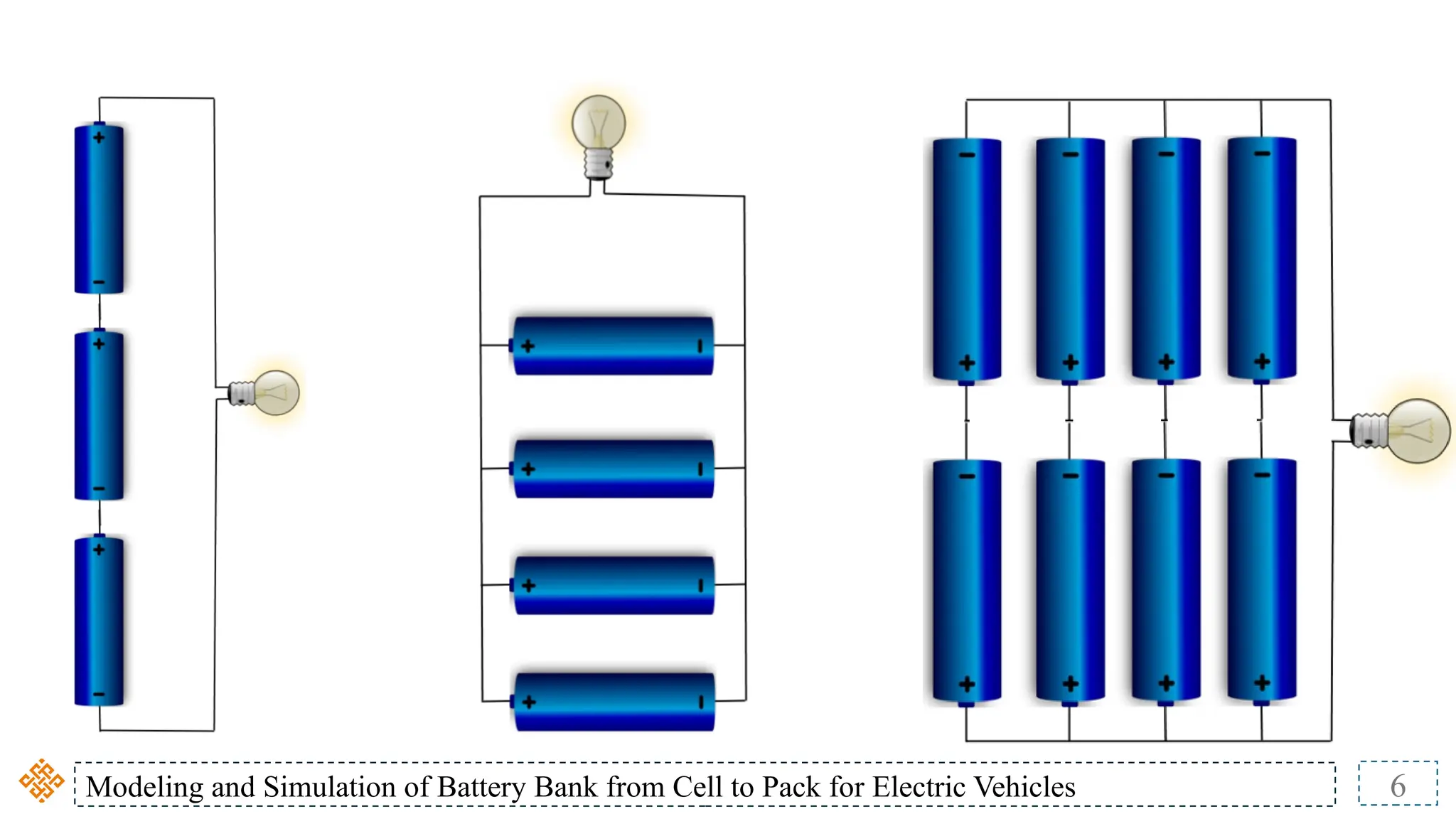
2. Batteries configuration
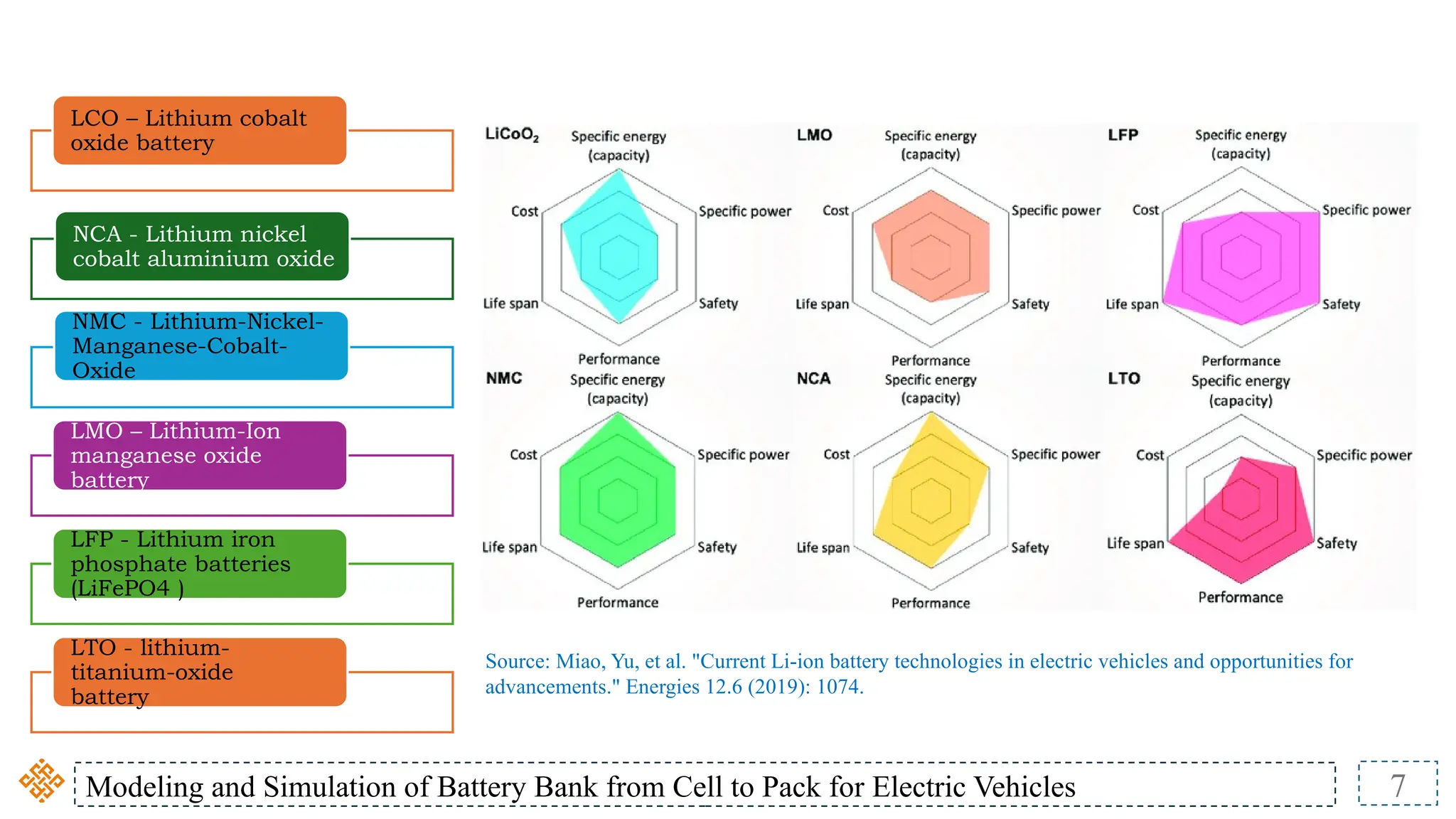
3. Cell voltage for various types of the batteries
4. Roadmap for battery energy storage
5. CCCV Charging
6. Battery capacity, C rates
7. Battery state of charge
8. Battery state of health
9. Various types of the battery modeling methods
10. Cell level modeling
Modeling and Simulation of Battery Bank from Cell to Pack for Electric Vehicles 3
Introduction
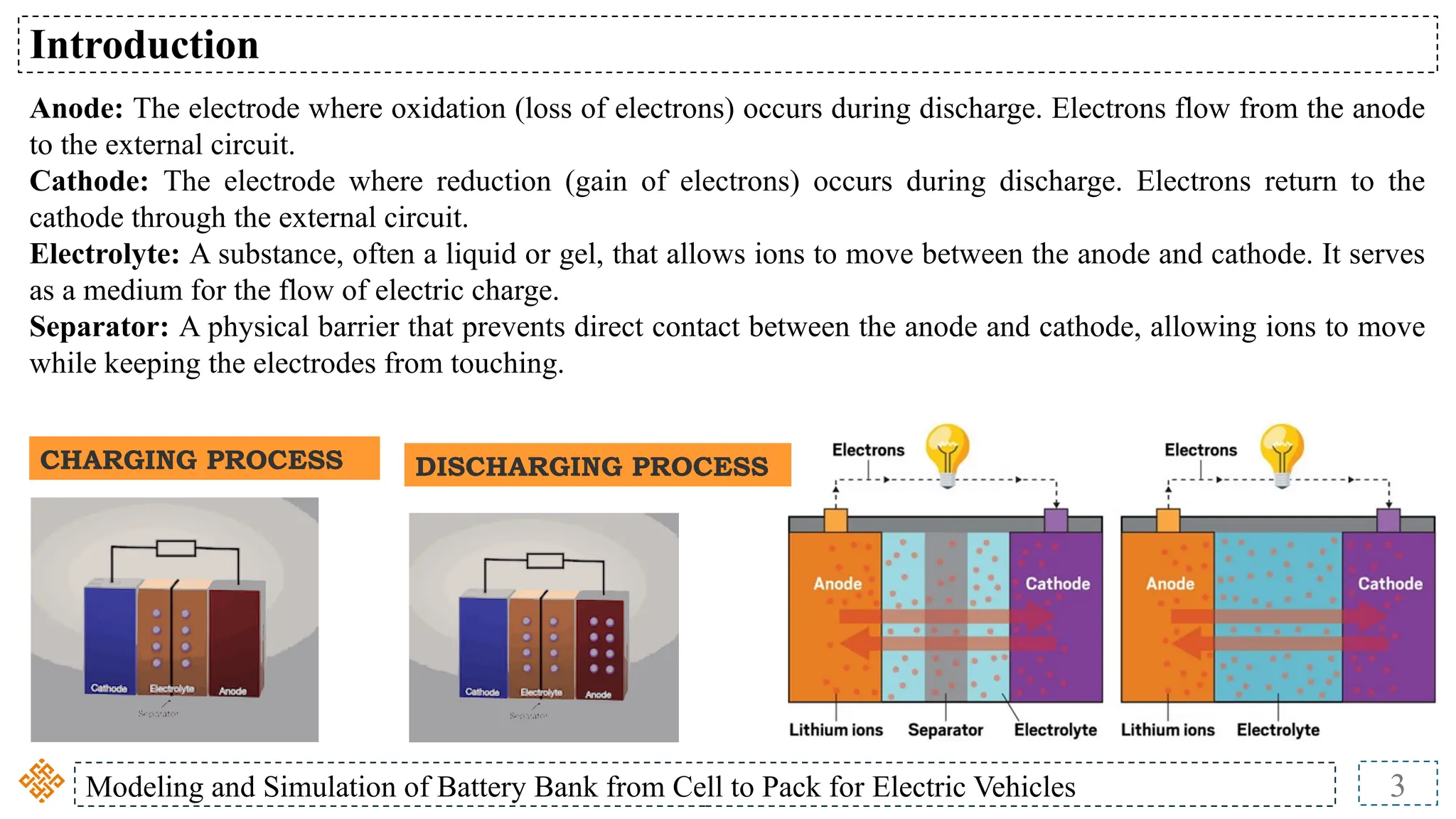
Anode: The electrode where oxidation (loss of electrons) occurs during discharge. Electrons flow from the anode
to the external circuit.
Cathode: The electrode where reduction (gain of electrons) occurs during discharge. Electrons return to the
cathode through the external circuit.
Electrolyte: A substance, often a liquid or gel, that allows ions to move between the anode and cathode. It serves
as a medium for the flow of electric charge.
Separator: A physical barrier that prevents direct contact between the anode and cathode, allowing ions to move
while keeping the electrodes from touching.
CHARGING PROCESS DISCHARGING PROCESS
Modeling and Simulation of Battery Bank from Cell to Pack for Electric Vehicles 4
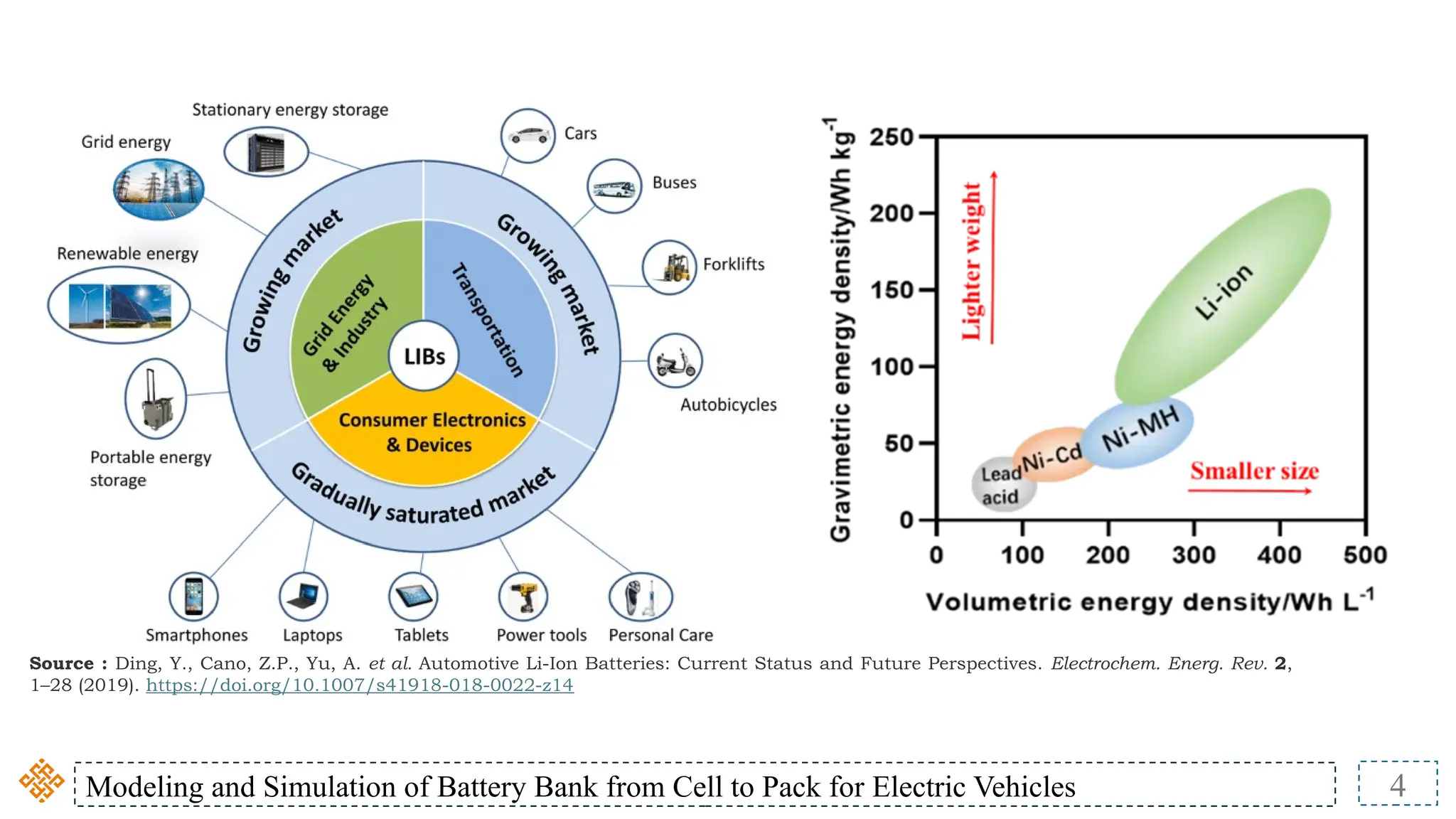
Source : Ding, Y., Cano, Z.P., Yu, A. et al. Automotive Li-Ion Batteries: Current Status and Future Perspectives. Electrochem. Energ. Rev. 2,
1–28 (2019). https://doi.org/10.1007/s41918-018-0022-z14
Modeling and Simulation of Battery Bank from Cell to Pack for Electric Vehicles 5
Ambient Temperature
Losses
C Rate
Aging
Proper sizing of the storage
Parameter identification
Pre-mature failure prediction for
stack level architecture
State estimation under real-time
conditions
Lifetime improvement under
rigorous drive conditions
Stack level health assessment
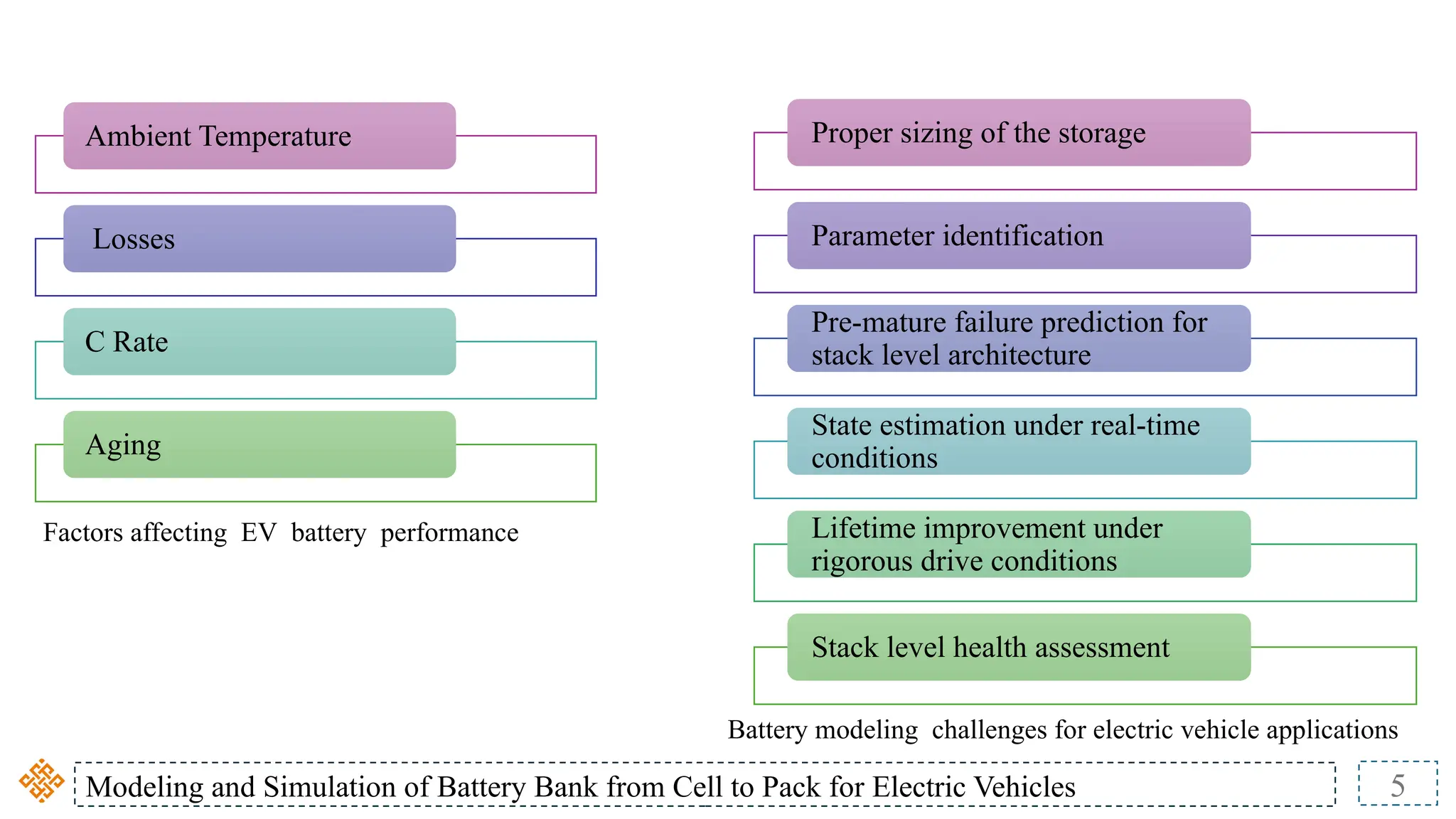
Factors affecting EV battery performance
Battery modeling challenges for electric vehicle applications
Modeling and Simulation of Battery Bank from Cell to Pack for Electric Vehicles 6
Modeling and Simulation of Battery Bank from Cell to Pack for Electric Vehicles 7
LCO – Lithium cobalt
oxide battery
NCA - Lithium nickel
cobalt aluminium oxide
NMC - Lithium-Nickel-
Manganese-Cobalt-
Oxide
LMO – Lithium-Ion
manganese oxide
battery
LFP - Lithium iron
phosphate batteries
(LiFePO4 )
LTO - lithium-
titanium-oxide
battery
Source: Miao, Yu, et al. "Current Li-ion battery technologies in electric vehicles and opportunities for
advancements." Energies 12.6 (2019): 1074.
Modeling and Simulation of Battery Bank from Cell to Pack for Electric Vehicles 8
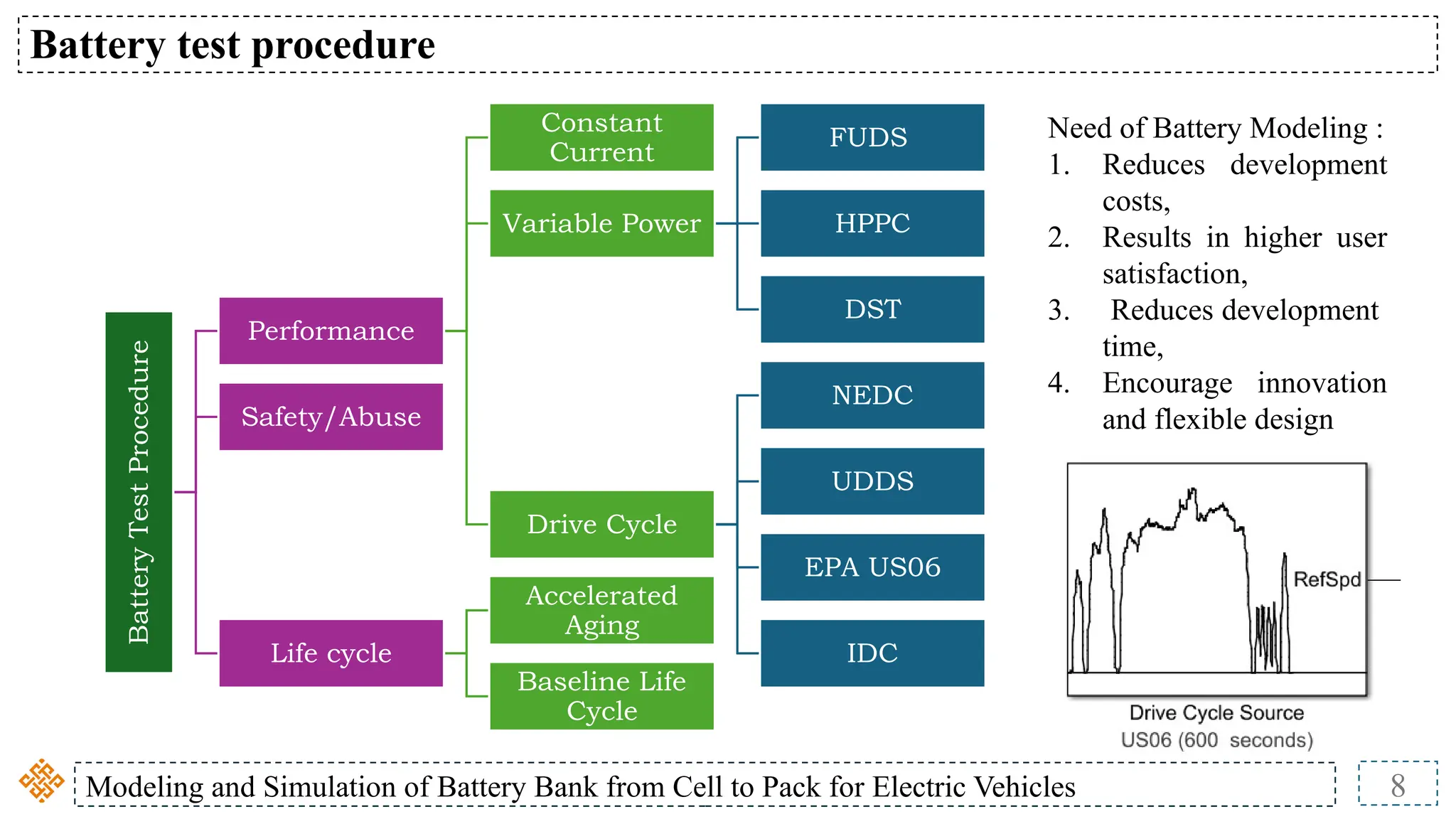
Battery test procedure
Battery
Test
Procedure
Performance
Constant
Current
Variable Power
FUDS
HPPC
DST
Drive Cycle
NEDC
UDDS
EPA US06
IDC
Safety/Abuse
Life cycle
Accelerated
Aging
Baseline Life
Cycle
Need of Battery Modeling :
1. Reduces development
costs,
2. Results in higher user
satisfaction,
3. Reduces development
time,
4. Encourage innovation
and flexible design
Modeling and Simulation of Battery Bank from Cell to Pack for Electric Vehicles 9
Drive Cycles
0 100 200 300 400 500 600
Time [s]
0
10
20
30
40
Velocity
[m/s]
US06
0 200 400 600 800 1000 1200 1400
Time [s]
0
10
20
30
Velocity
[m/s]
UDDS
0 200 400 600 800 1000 1200
Time [s]
0
10
20
30
40
Velocity
[m/s]
NEDC
0 500 1000 1500 2000 2500
Time [s]
0
10
20
30
Velocity
[m/s]
FTP75
Modeling and Simulation of Battery Bank from Cell to Pack for Electric Vehicles 10
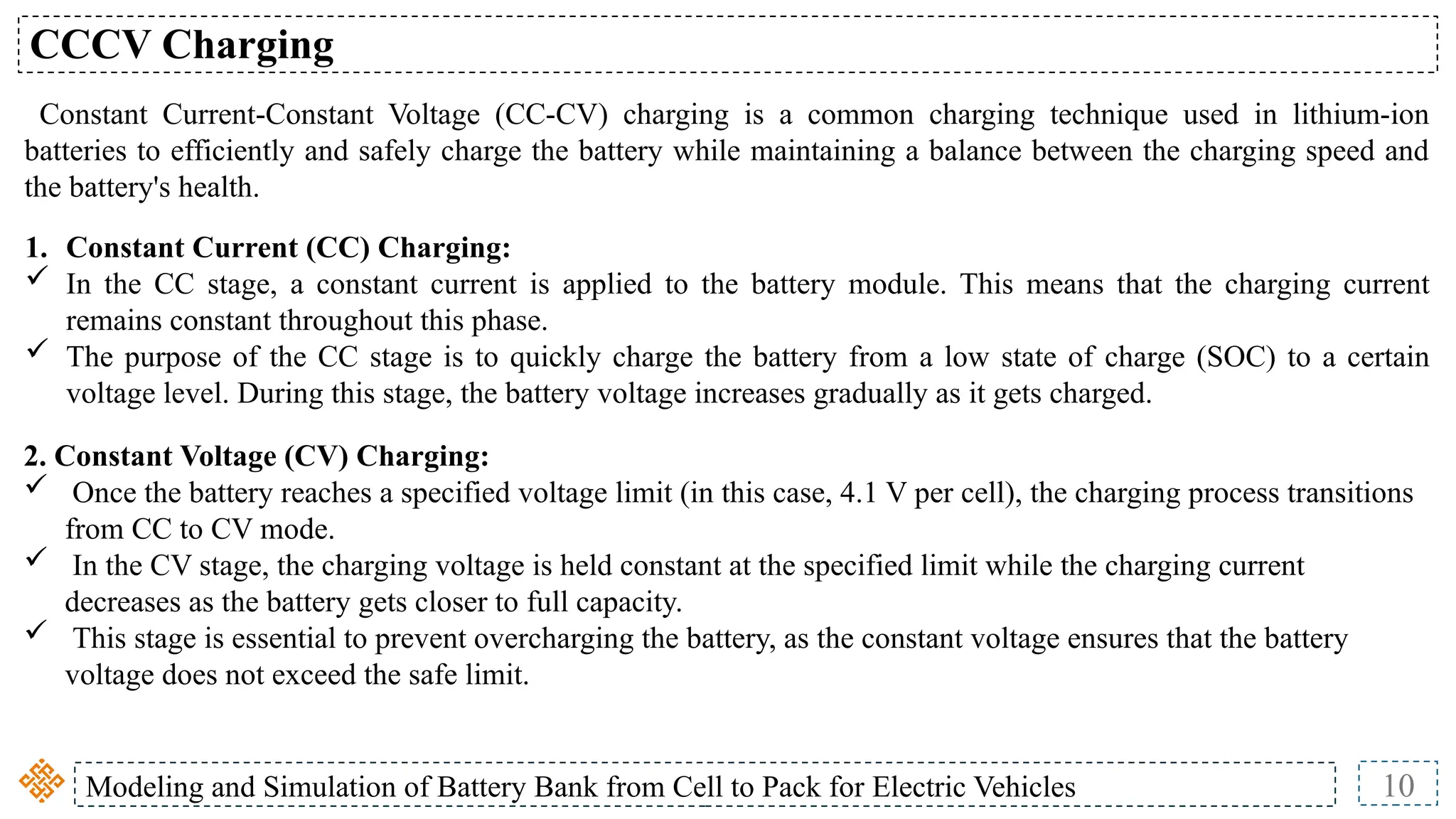
CCCV Charging
Constant Current-Constant Voltage (CC-CV) charging is a common charging technique used in lithium-ion
batteries to efficiently and safely charge the battery while maintaining a balance between the charging speed and
the battery's health.
2. Constant Voltage (CV) Charging:
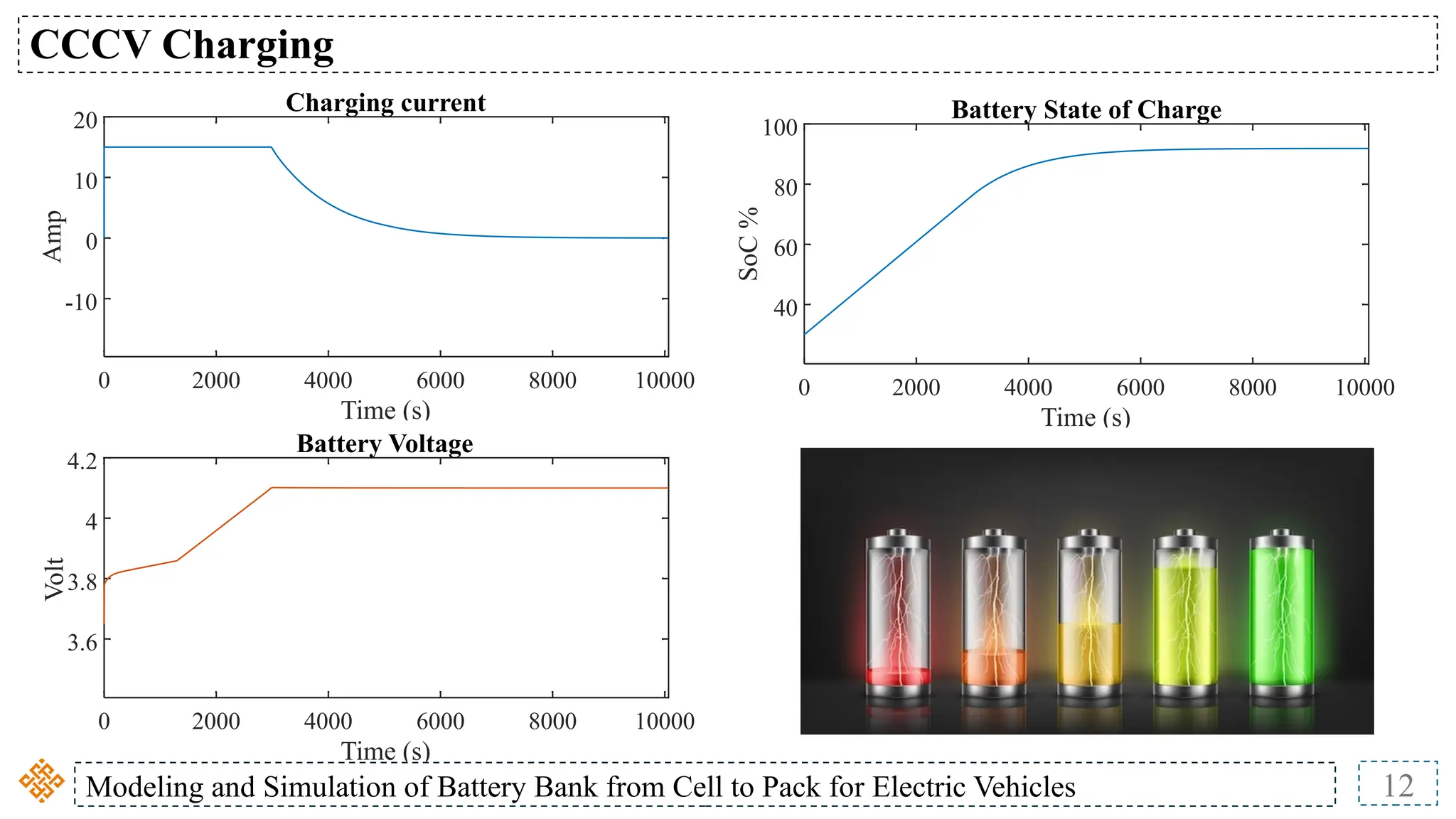
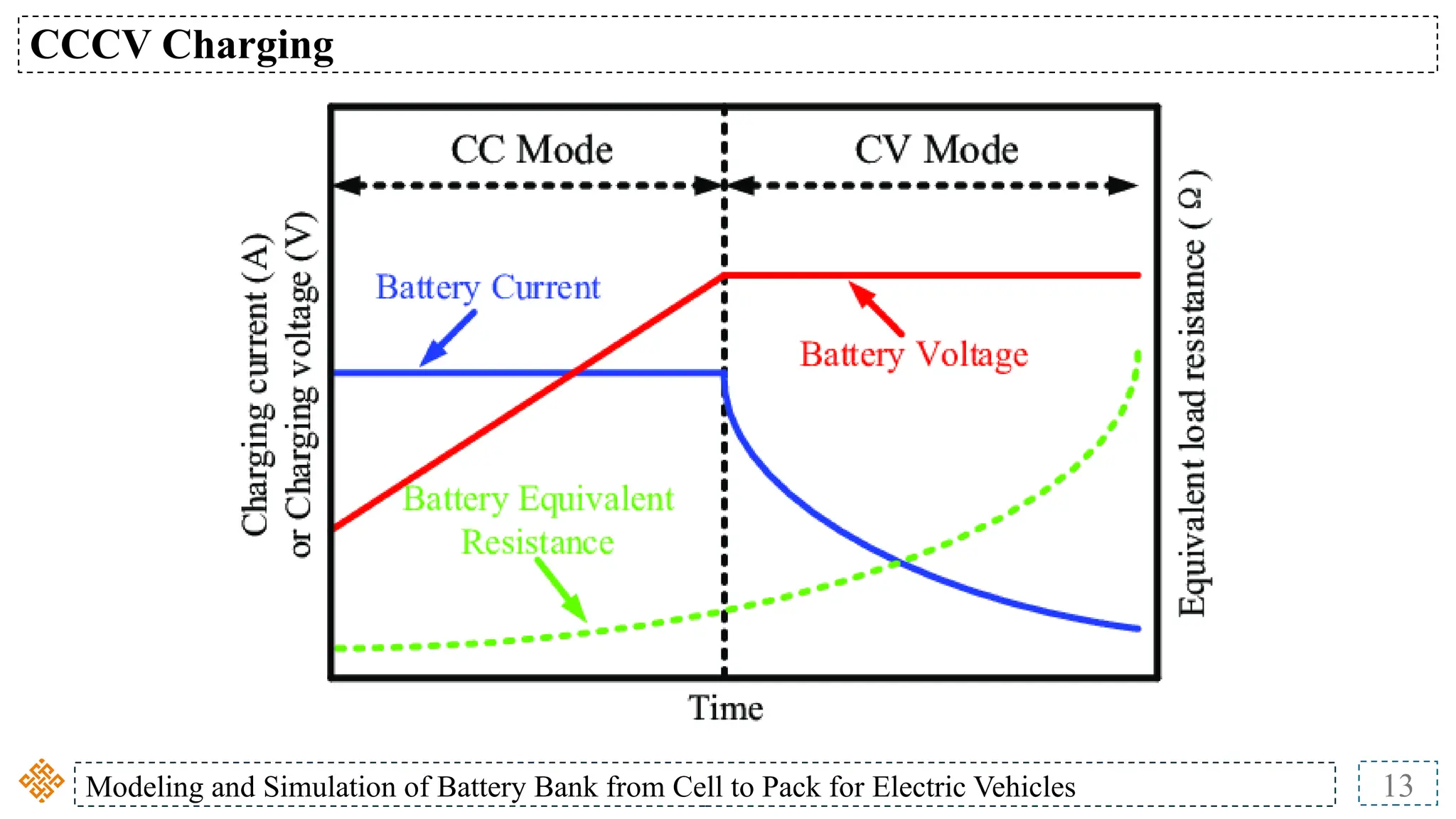
 Once the battery reaches a specified voltage limit (in this case, 4.1 V per cell), the charging process transitions
from CC to CV mode.
 In the CV stage, the charging voltage is held constant at the specified limit while the charging current
decreases as the battery gets closer to full capacity.
 This stage is essential to prevent overcharging the battery, as the constant voltage ensures that the battery
voltage does not exceed the safe limit.
1. Constant Current (CC) Charging:
 In the CC stage, a constant current is applied to the battery module. This means that the charging current
remains constant throughout this phase.
 The purpose of the CC stage is to quickly charge the battery from a low state of charge (SOC) to a certain
voltage level. During this stage, the battery voltage increases gradually as it gets charged.
Modeling and Simulation of Battery Bank from Cell to Pack for Electric Vehicles 11
CCCV Charging
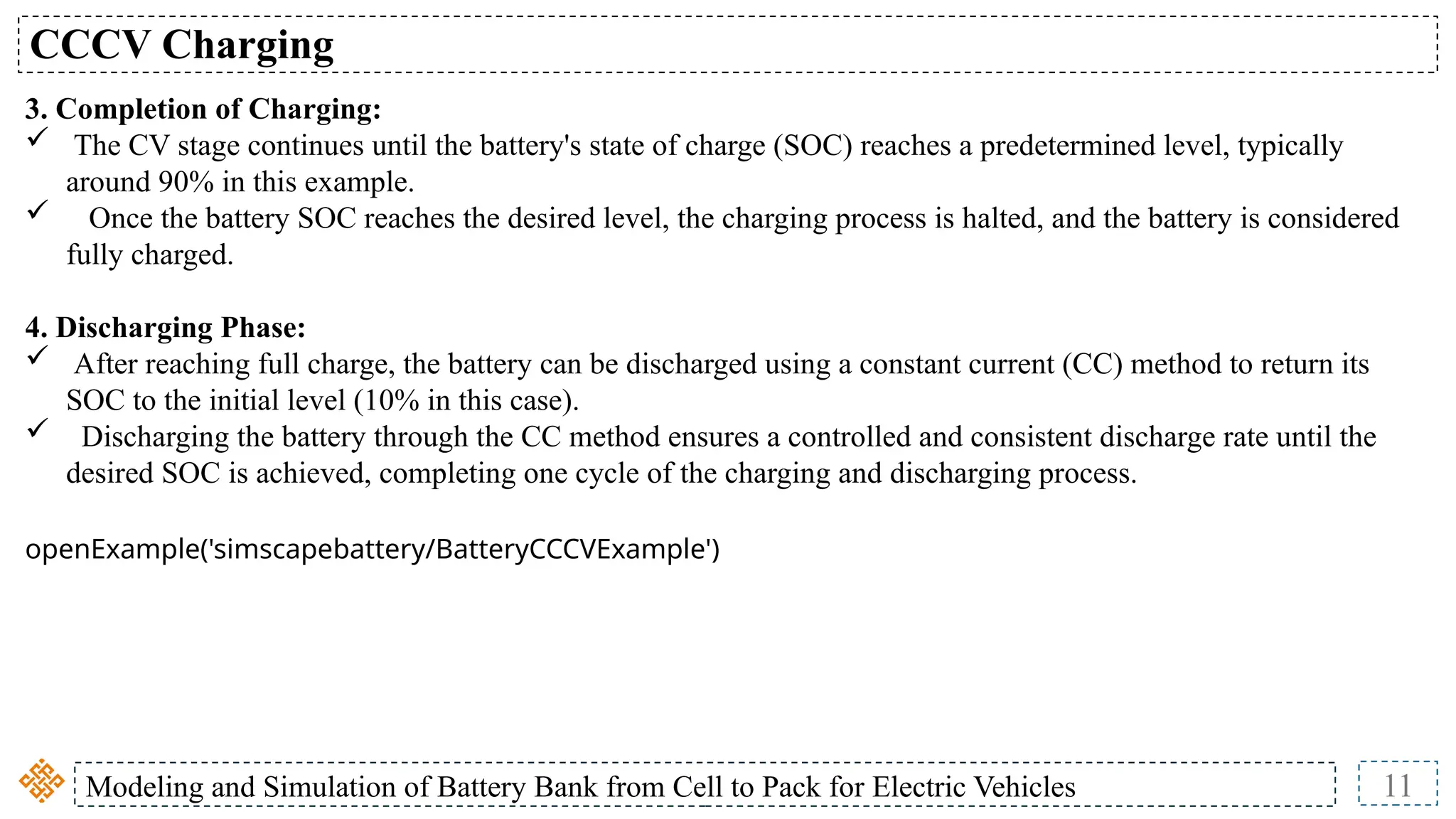
3. Completion of Charging:
 The CV stage continues until the battery's state of charge (SOC) reaches a predetermined level, typically
around 90% in this example.
 Once the battery SOC reaches the desired level, the charging process is halted, and the battery is considered
fully charged.
4. Discharging Phase:
 After reaching full charge, the battery can be discharged using a constant current (CC) method to return its
SOC to the initial level (10% in this case).
 Discharging the battery through the CC method ensures a controlled and consistent discharge rate until the
desired SOC is achieved, completing one cycle of the charging and discharging process.
openExample('simscapebattery/BatteryCCCVExample')
Modeling and Simulation of Battery Bank from Cell to Pack for Electric Vehicles 12
CCCV Charging
0 2000 4000 6000 8000 10000
Time (s)
3.6
3.8
4
4.2
Volt
Battery Voltage
0 2000 4000 6000 8000 10000
Time (s)
-10
0
10
20
Amp
Charging current
0 2000 4000 6000 8000 10000
Time (s)
40
60
80
100
SoC
%
Battery State of Charge
Modeling and Simulation of Battery Bank from Cell to Pack for Electric Vehicles 13
CCCV Charging
Modeling and Simulation of Battery Bank from Cell to Pack for Electric Vehicles 14
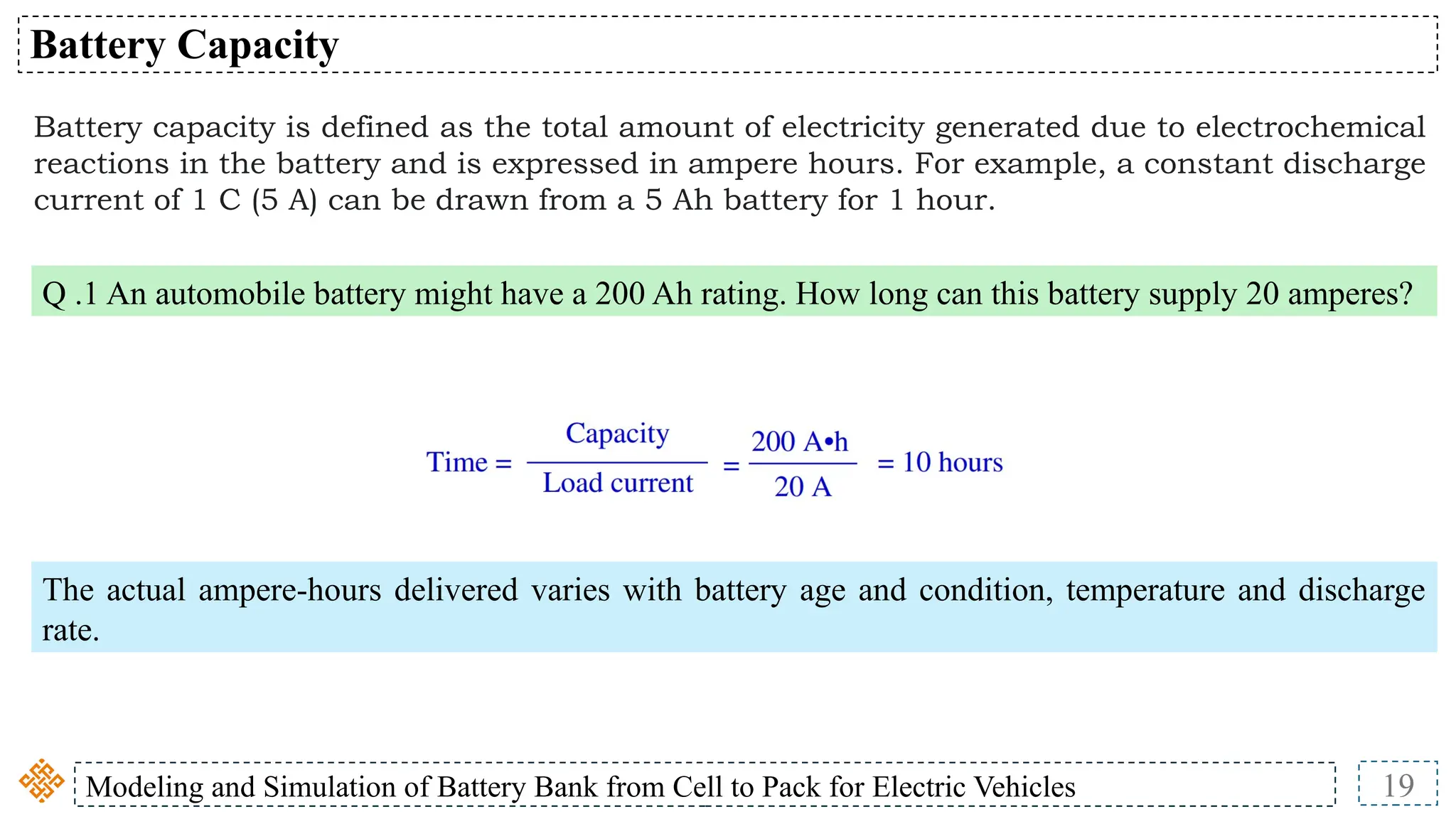
Battery Capacity
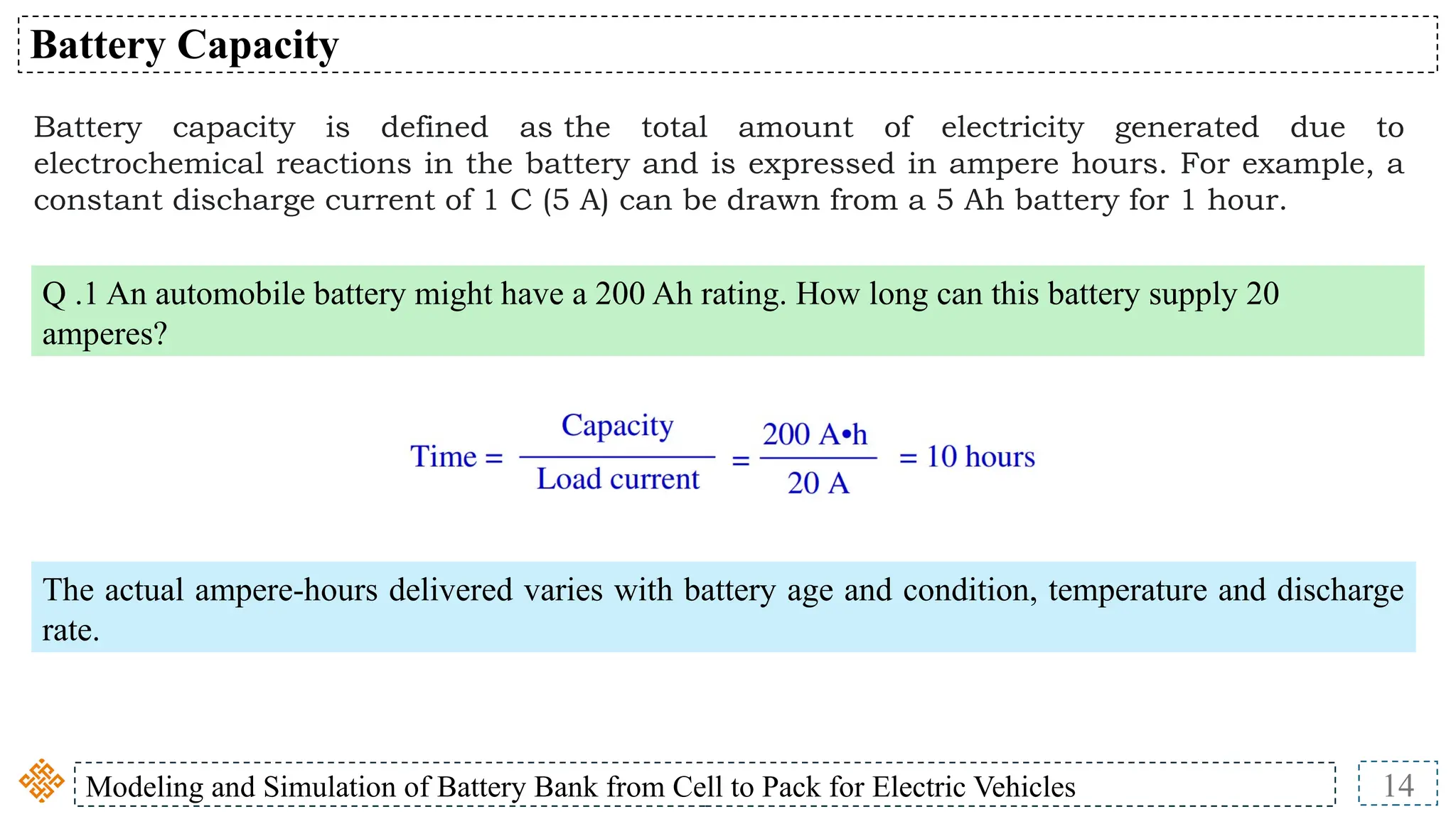
Battery capacity is defined as the total amount of electricity generated due to
electrochemical reactions in the battery and is expressed in ampere hours. For example, a
constant discharge current of 1 C (5 A) can be drawn from a 5 Ah battery for 1 hour.
Q .1 An automobile battery might have a 200 Ah rating. How long can this battery supply 20
amperes?
The actual ampere-hours delivered varies with battery age and condition, temperature and discharge
rate.
Modeling and Simulation of Battery Bank from Cell to Pack for Electric Vehicles 15
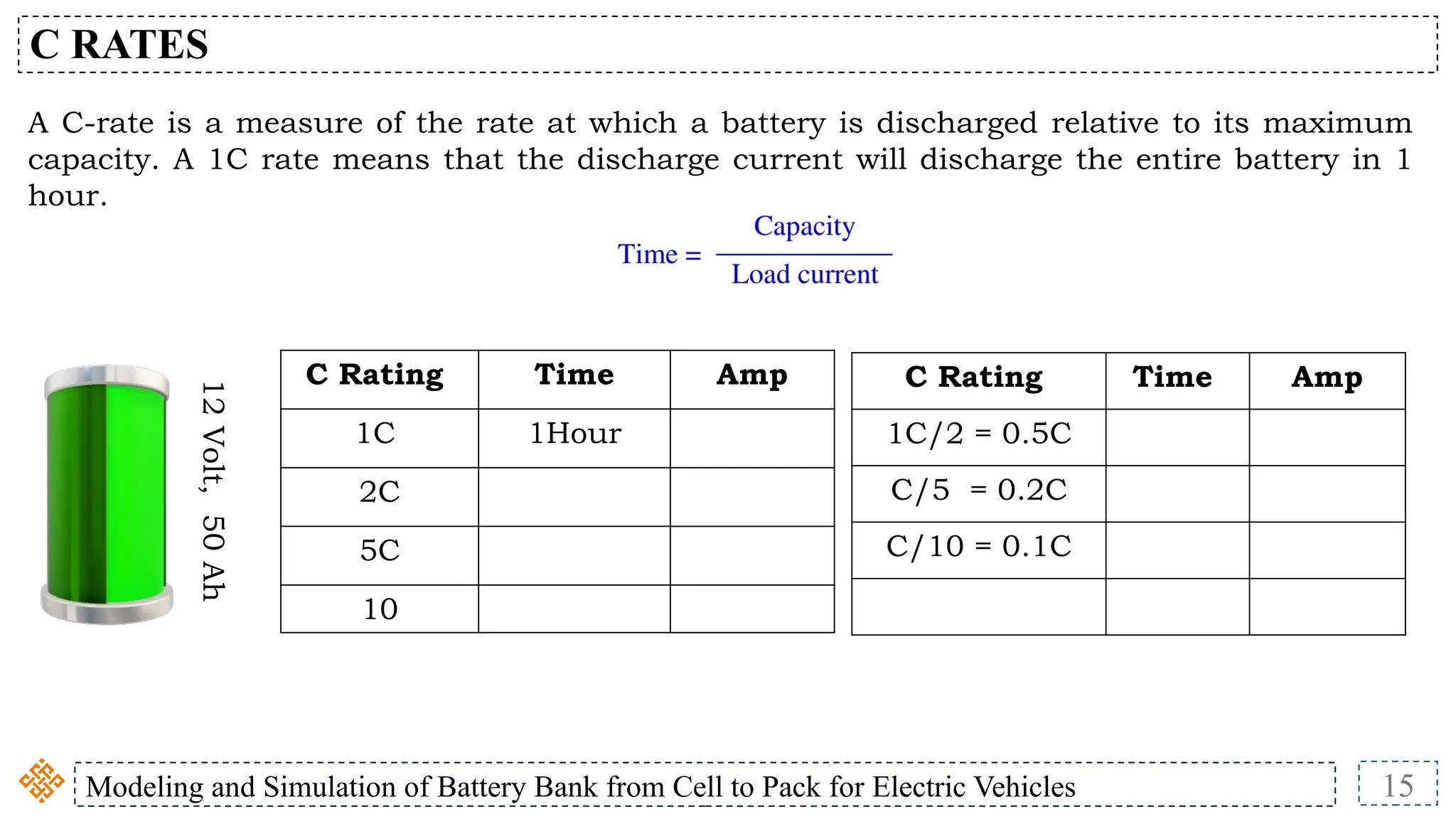
C RATES
A C-rate is a measure of the rate at which a battery is discharged relative to its maximum
capacity. A 1C rate means that the discharge current will discharge the entire battery in 1
hour.
C Rating Time Amp
1C 1Hour
2C
5C
10
C Rating Time Amp
1C/2 = 0.5C
C/5 = 0.2C
C/10 = 0.1C
12
Volt,
50
Ah
Modeling and Simulation of Battery Bank from Cell to Pack for Electric Vehicles 16
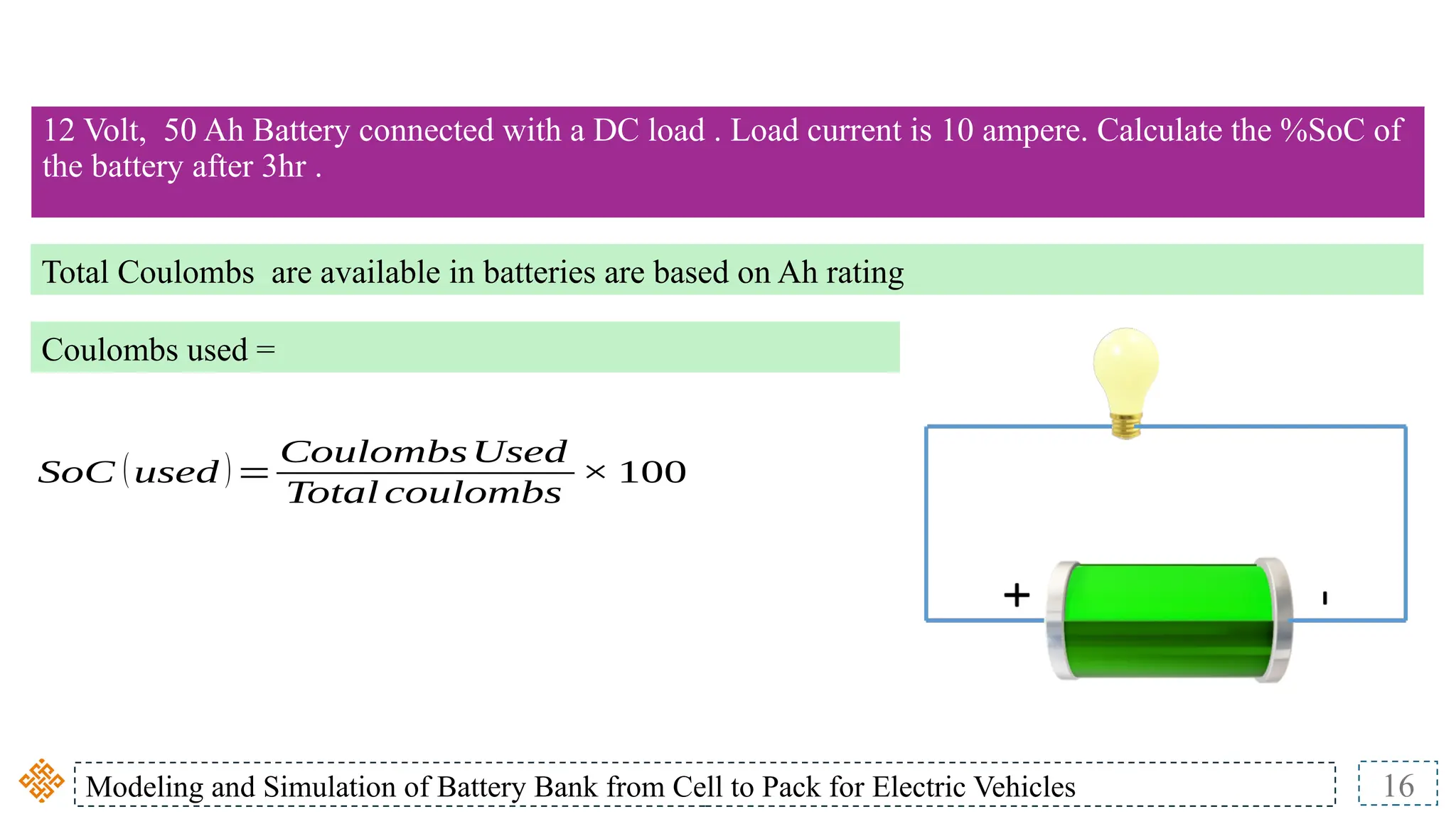
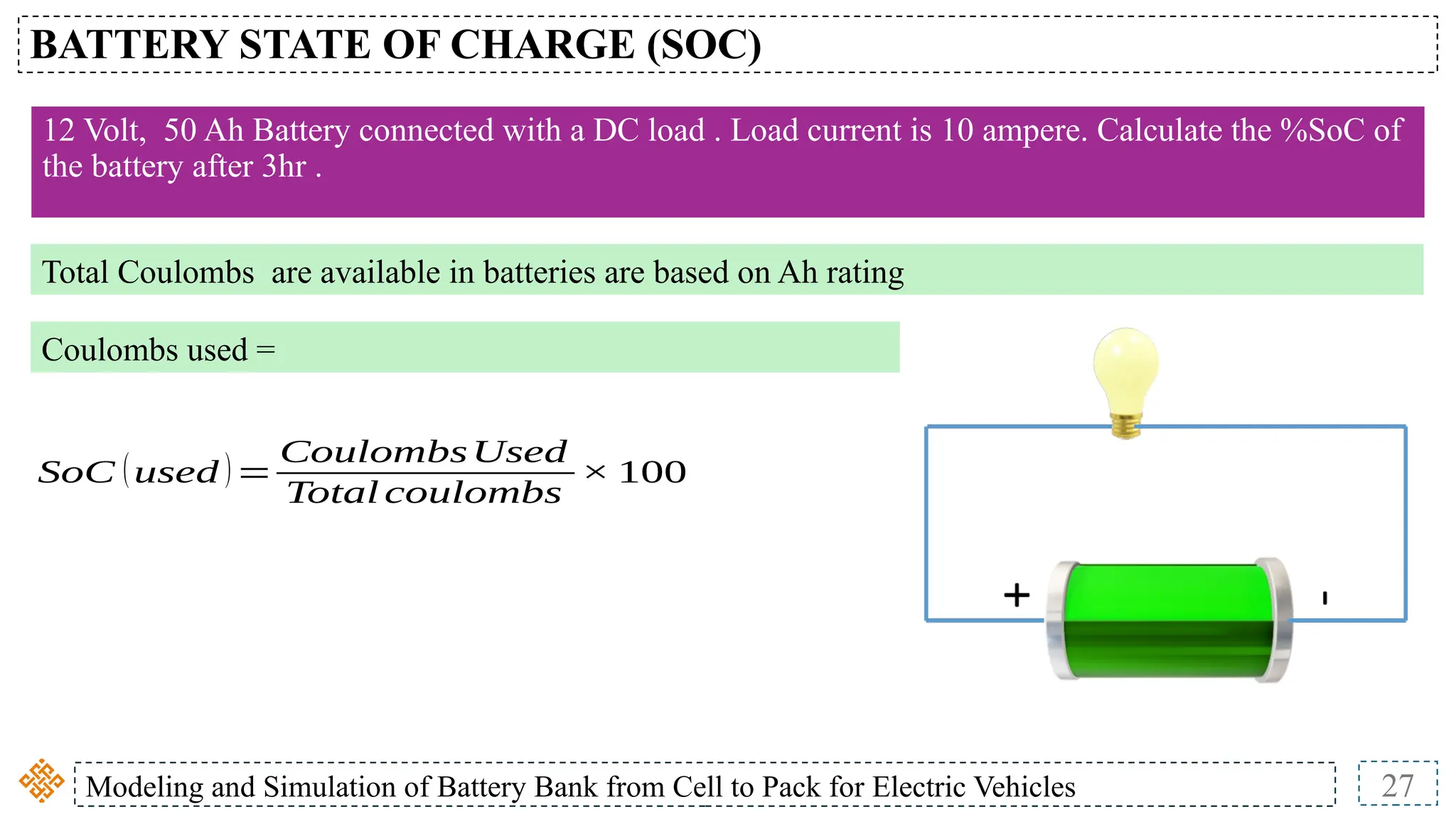
12 Volt, 50 Ah Battery connected with a DC load . Load current is 10 ampere. Calculate the %SoC of
the battery after 3hr .
Total Coulombs are available in batteries are based on Ah rating
Coulombs used =
SoC (used )=
CoulombsUsed
Total coulombs
× 100
Modeling and Simulation of Battery Bank from Cell to Pack for Electric Vehicles 17
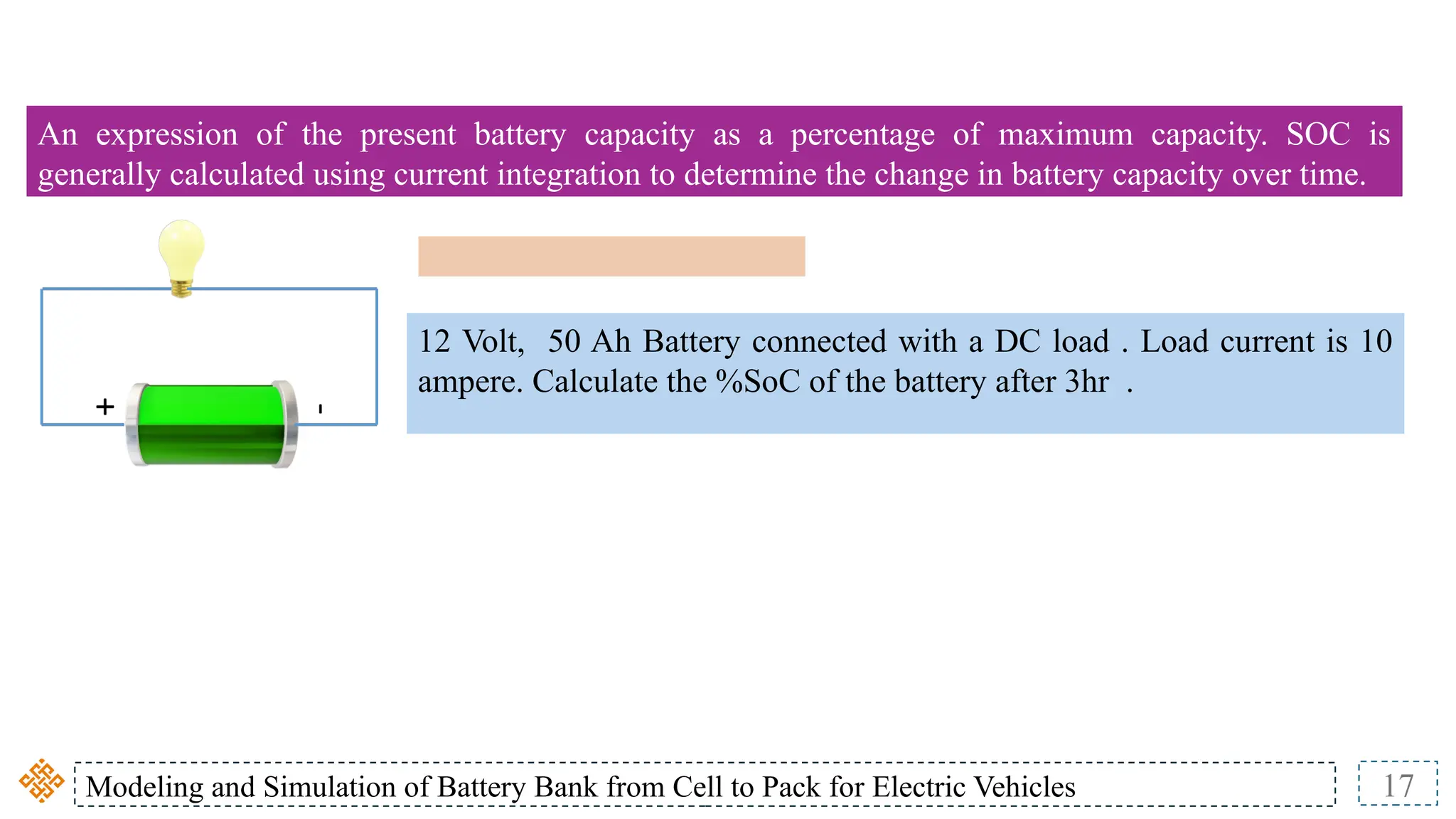
An expression of the present battery capacity as a percentage of maximum capacity. SOC is
generally calculated using current integration to determine the change in battery capacity over time.
12 Volt, 50 Ah Battery connected with a DC load . Load current is 10
ampere. Calculate the %SoC of the battery after 3hr .
Modeling and Simulation of Battery Bank from Cell to Pack for Electric Vehicles 18
Measuring State of Charge in Electric Vehicles
 Electric vehicles (EVs) provide a cleaner alternative to traditional combustion engine vehicles by
using electricity as power source.
 This alternative power source allows the EVs to reduce the reliance on fossil fuels and cut down on
greenhouse gas emissions and air pollution. EVs operate by using electric motors powered by
batteries, which are the heart of any EV.
 These batteries determine the EV range, performance, and environmental footprint. However,
managing the battery inside an EV is complex due to the inherent characteristics of the battery itself,
including the battery energy density and weight, the thermal management, aging and degradation,
and the estimation of the SOC and state of health (SOH).
 The ability to track the SOC is crucial for managing battery systems efficiently and in applications
where the battery performance and longevity are critical.
Modeling and Simulation of Battery Bank from Cell to Pack for Electric Vehicles 19
Battery Capacity
Battery capacity is defined as the total amount of electricity generated due to electrochemical
reactions in the battery and is expressed in ampere hours. For example, a constant discharge
current of 1 C (5 A) can be drawn from a 5 Ah battery for 1 hour.
Q .1 An automobile battery might have a 200 Ah rating. How long can this battery supply 20 amperes?
The actual ampere-hours delivered varies with battery age and condition, temperature and discharge
rate.
Modeling and Simulation of Battery Bank from Cell to Pack for Electric Vehicles 20
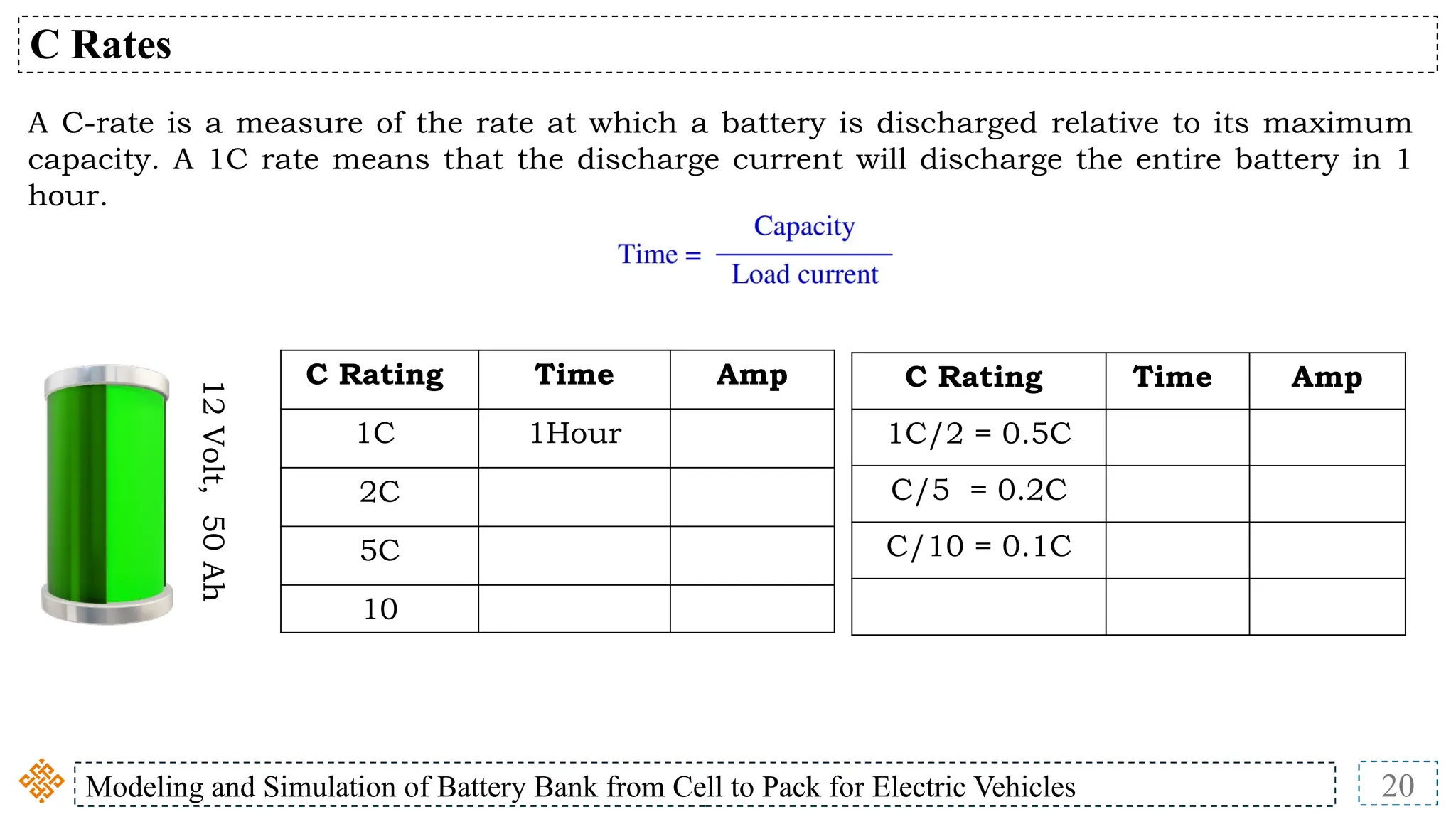
C Rates
A C-rate is a measure of the rate at which a battery is discharged relative to its maximum
capacity. A 1C rate means that the discharge current will discharge the entire battery in 1
hour.
C Rating Time Amp
1C 1Hour
2C
5C
10
C Rating Time Amp
1C/2 = 0.5C
C/5 = 0.2C
C/10 = 0.1C
12
Volt,
50
Ah
Modeling and Simulation of Battery Bank from Cell to Pack for Electric Vehicles 21
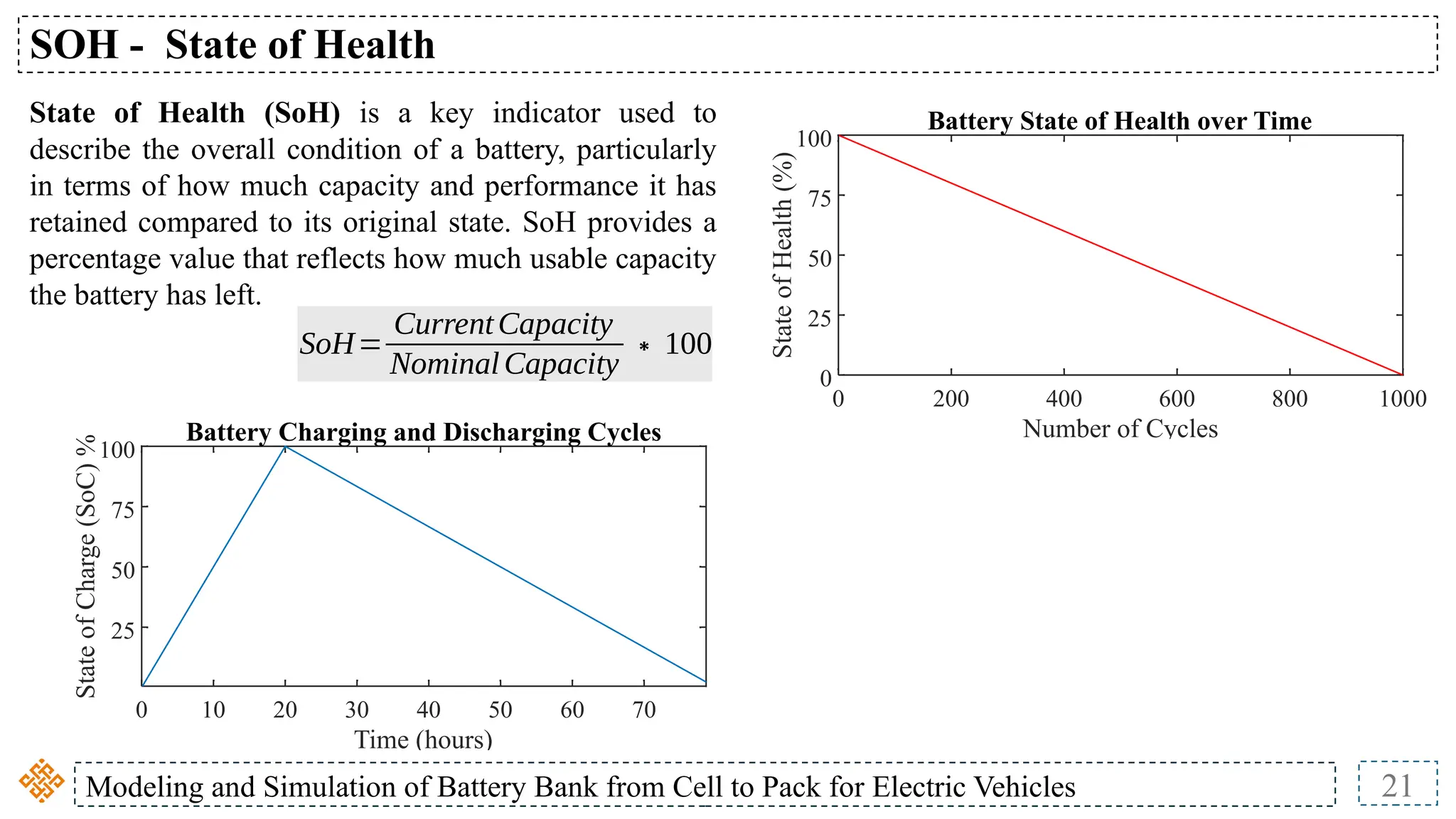
SOH - State of Health
0 200 400 600 800 1000
Number of Cycles
0
25
50
75
100
State
of
Health
(%)
Battery State of Health over Time
State of Health (SoH) is a key indicator used to
describe the overall condition of a battery, particularly
in terms of how much capacity and performance it has
retained compared to its original state. SoH provides a
percentage value that reflects how much usable capacity
the battery has left.
SoH=
CurrentCapacity
NominalCapacity
∗100
0 10 20 30 40 50 60 70
Time (hours)
25
50
75
100
State
of
Charge
(SoC)
%
Battery Charging and Discharging Cycles
Modeling and Simulation of Battery Bank from Cell to Pack for Electric Vehicles 22
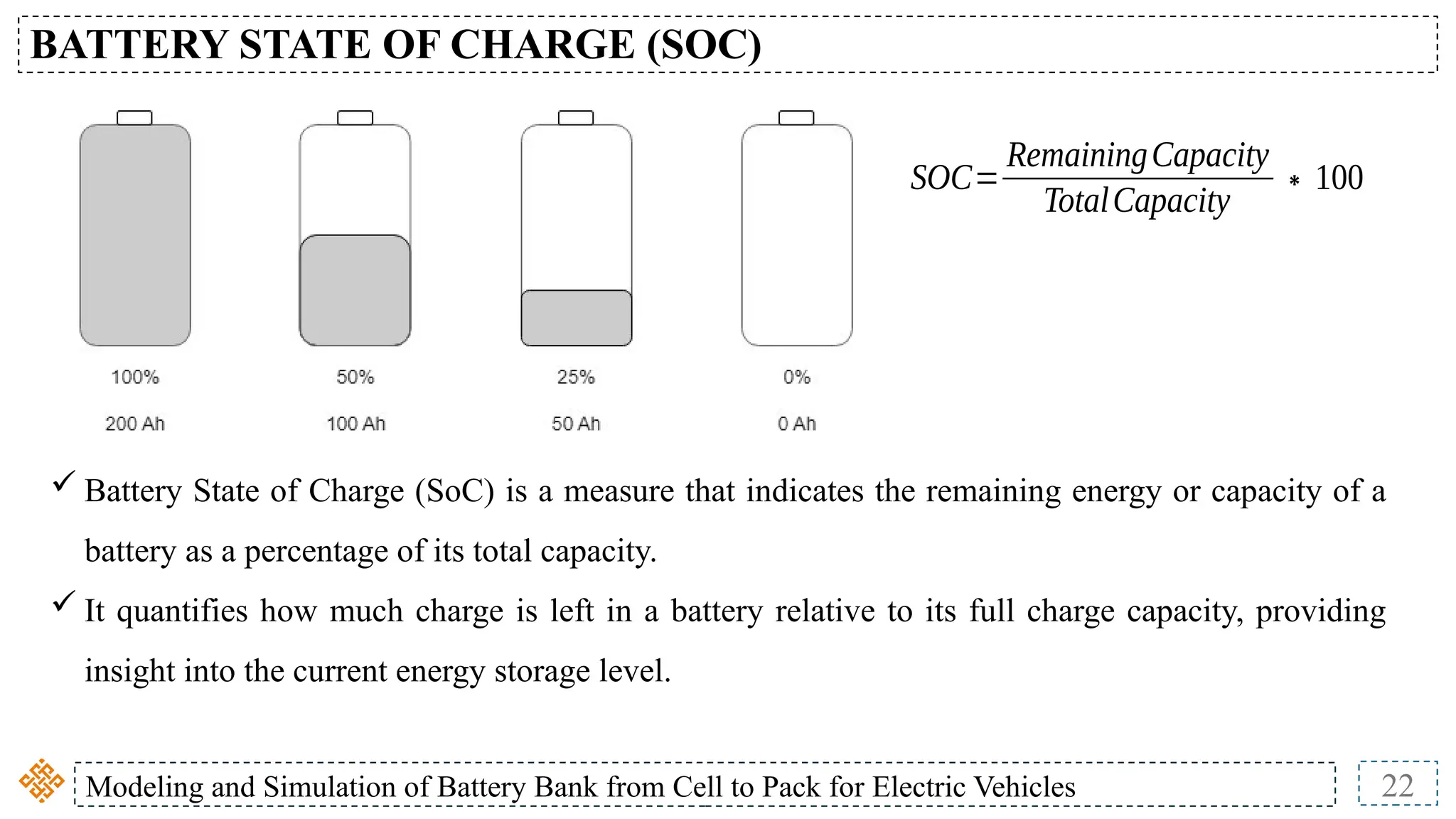
BATTERY STATE OF CHARGE (SOC)
 Battery State of Charge (SoC) is a measure that indicates the remaining energy or capacity of a
battery as a percentage of its total capacity.
 It quantifies how much charge is left in a battery relative to its full charge capacity, providing
insight into the current energy storage level.
SOC=
RemainingCapacity
TotalCapacity
∗100
Modeling and Simulation of Battery Bank from Cell to Pack for Electric Vehicles 23
BATTERY STATE OF CHARGE (SOC)
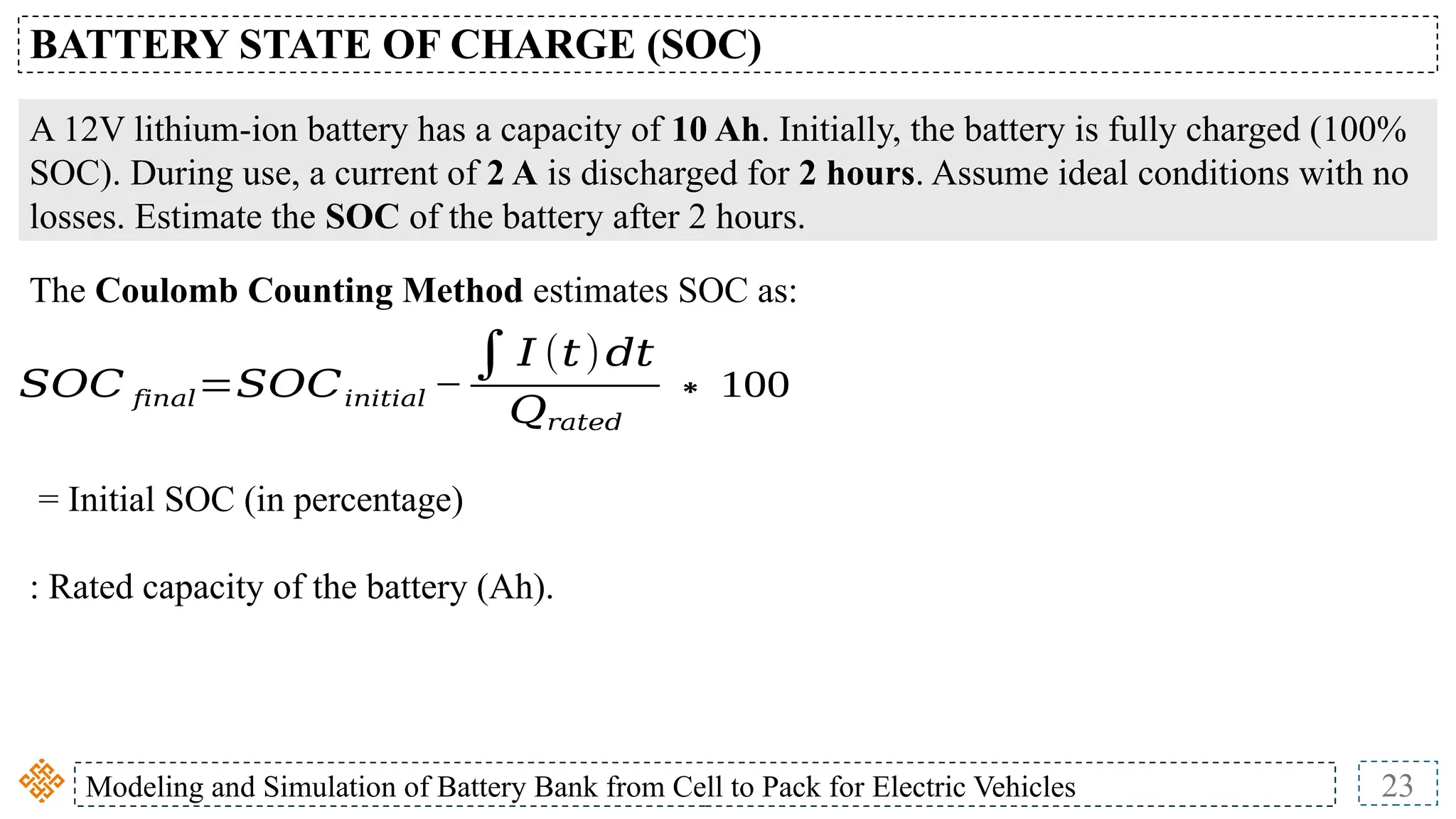
𝑆𝑂𝐶 𝑓𝑖𝑛𝑎𝑙=𝑆𝑂𝐶𝑖𝑛𝑖𝑡𝑖𝑎𝑙 −
∫𝐼 (𝑡)𝑑𝑡
𝑄𝑟𝑎𝑡𝑒𝑑
∗ 100
A 12V lithium-ion battery has a capacity of 10 Ah. Initially, the battery is fully charged (100%
SOC). During use, a current of 2 A is discharged for 2 hours. Assume ideal conditions with no
losses. Estimate the SOC of the battery after 2 hours.
The Coulomb Counting Method estimates SOC as:
= Initial SOC (in percentage)
: Rated capacity of the battery (Ah).
Modeling and Simulation of Battery Bank from Cell to Pack for Electric Vehicles 24
BATTERY STATE OF CHARGE (SOC)
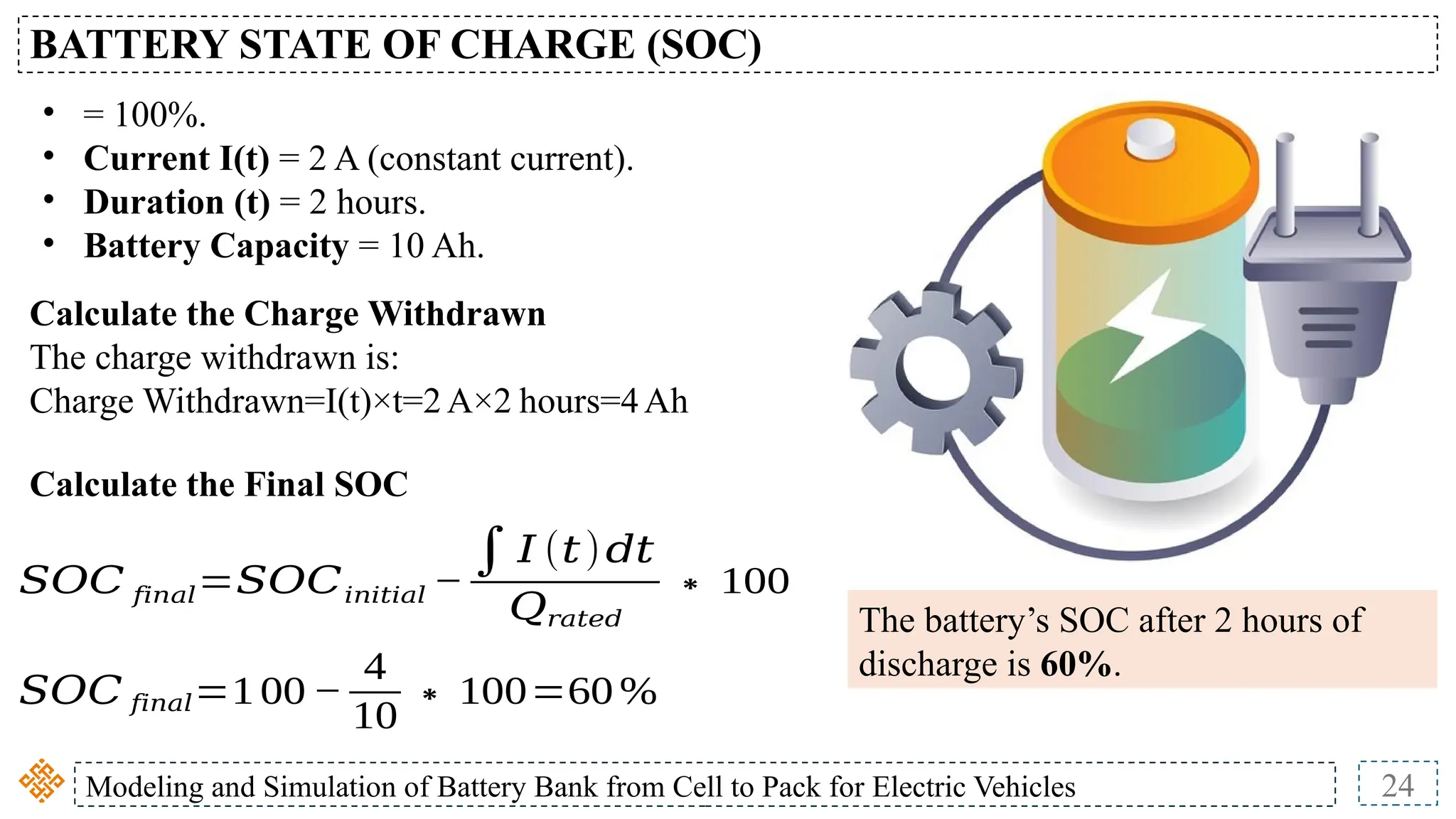
• = 100%.
• Current I(t) = 2 A (constant current).
• Duration (t) = 2 hours.
• Battery Capacity = 10 Ah.
Calculate the Charge Withdrawn
The charge withdrawn is:
Charge Withdrawn=I(t)×t=2A×2 hours=4Ah
𝑆𝑂𝐶 𝑓𝑖𝑛𝑎𝑙=𝑆𝑂𝐶𝑖𝑛𝑖𝑡𝑖𝑎𝑙 −
∫𝐼 (𝑡)𝑑𝑡
𝑄𝑟𝑎𝑡𝑒𝑑
∗ 100
Calculate the Final SOC
𝑆𝑂𝐶 𝑓𝑖𝑛𝑎𝑙=100 −
4
10
∗100=60 %
The battery’s SOC after 2 hours of
discharge is 60%.
Modeling and Simulation of Battery Bank from Cell to Pack for Electric Vehicles 25
BATTERY STATE OF CHARGE (SOC)
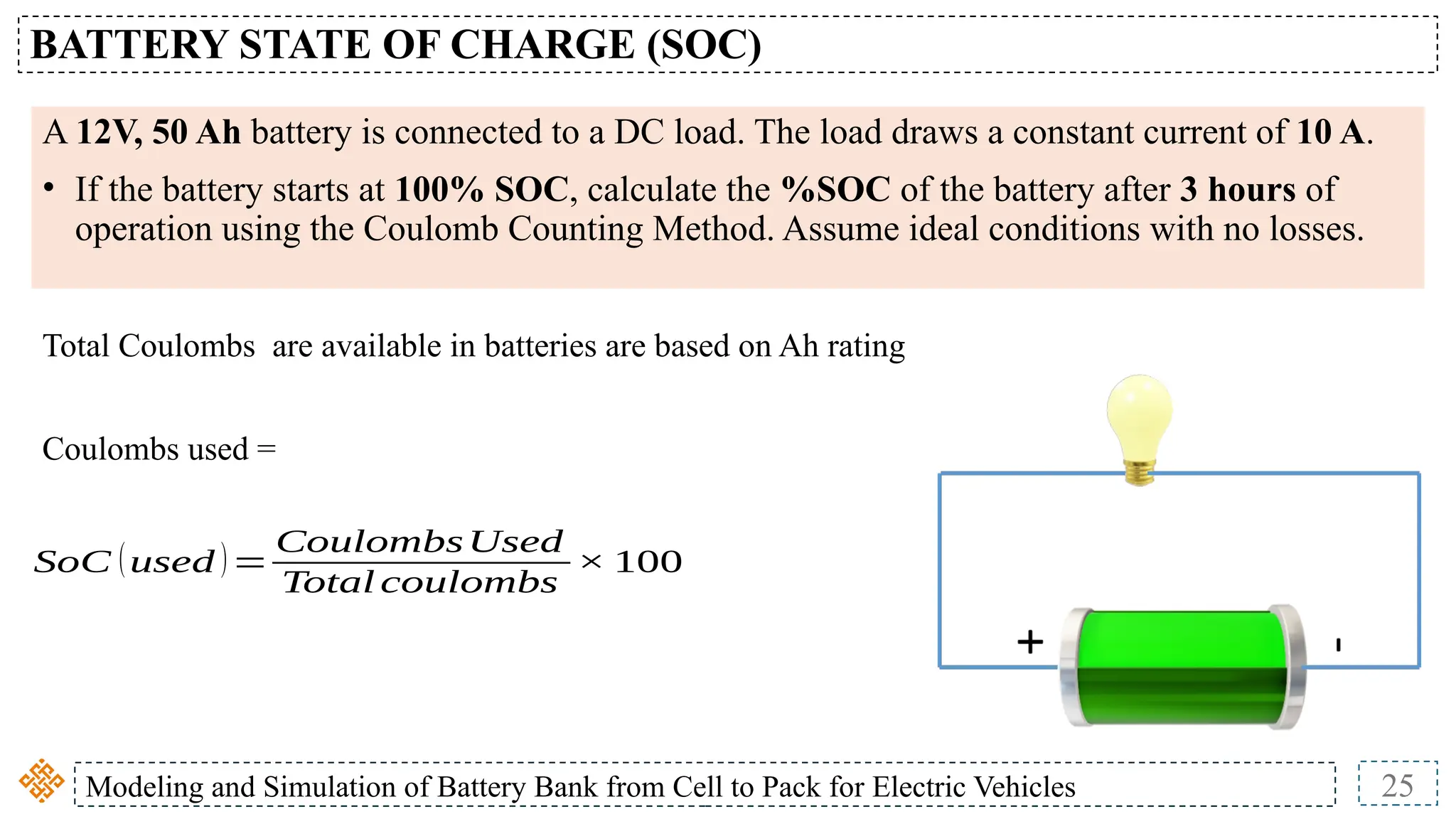
A 12V, 50 Ah battery is connected to a DC load. The load draws a constant current of 10 A.
• If the battery starts at 100% SOC, calculate the %SOC of the battery after 3 hours of
operation using the Coulomb Counting Method. Assume ideal conditions with no losses.
Total Coulombs are available in batteries are based on Ah rating
Coulombs used =
SoC (used )=
CoulombsUsed
Total coulombs
× 100
Modeling and Simulation of Battery Bank from Cell to Pack for Electric Vehicles 26
BATTERY STATE OF CHARGE (SOC)
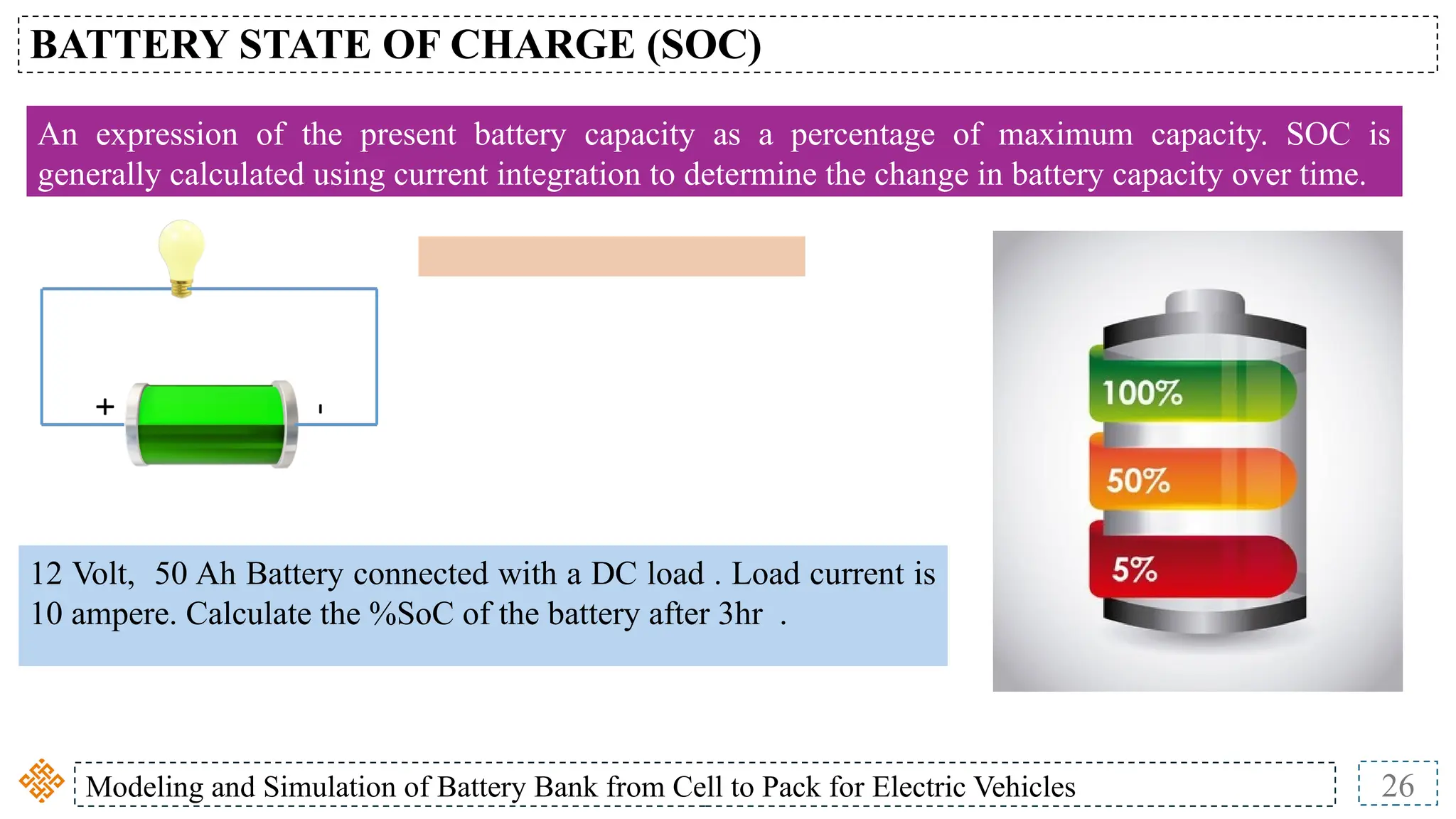
An expression of the present battery capacity as a percentage of maximum capacity. SOC is
generally calculated using current integration to determine the change in battery capacity over time.
12 Volt, 50 Ah Battery connected with a DC load . Load current is
10 ampere. Calculate the %SoC of the battery after 3hr .
Modeling and Simulation of Battery Bank from Cell to Pack for Electric Vehicles 27
BATTERY STATE OF CHARGE (SOC)
12 Volt, 50 Ah Battery connected with a DC load . Load current is 10 ampere. Calculate the %SoC of
the battery after 3hr .
Total Coulombs are available in batteries are based on Ah rating
Coulombs used =
SoC (used )=
CoulombsUsed
Total coulombs
× 100
Modeling and Simulation of Battery Bank from Cell to Pack for Electric Vehicles 28
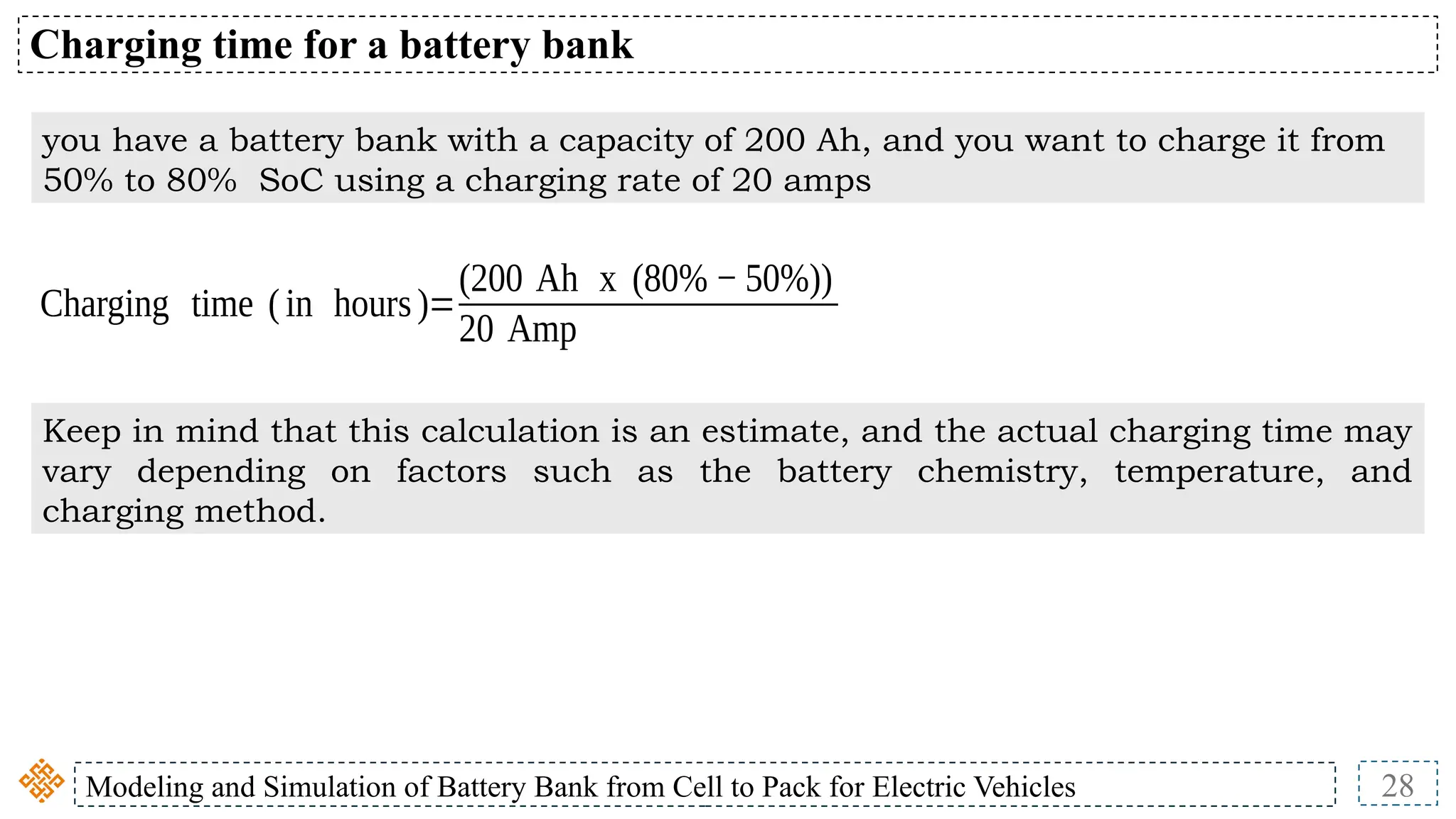
Charging time for a battery bank
you have a battery bank with a capacity of 200 Ah, and you want to charge it from
50% to 80% SoC using a charging rate of 20 amps
Charging time (in hours)=
(200 Ah x (80% − 50%))
20 Amp
Keep in mind that this calculation is an estimate, and the actual charging time may
vary depending on factors such as the battery chemistry, temperature, and
charging method.
Modeling and Simulation of Battery Bank from Cell to Pack for Electric Vehicles 29
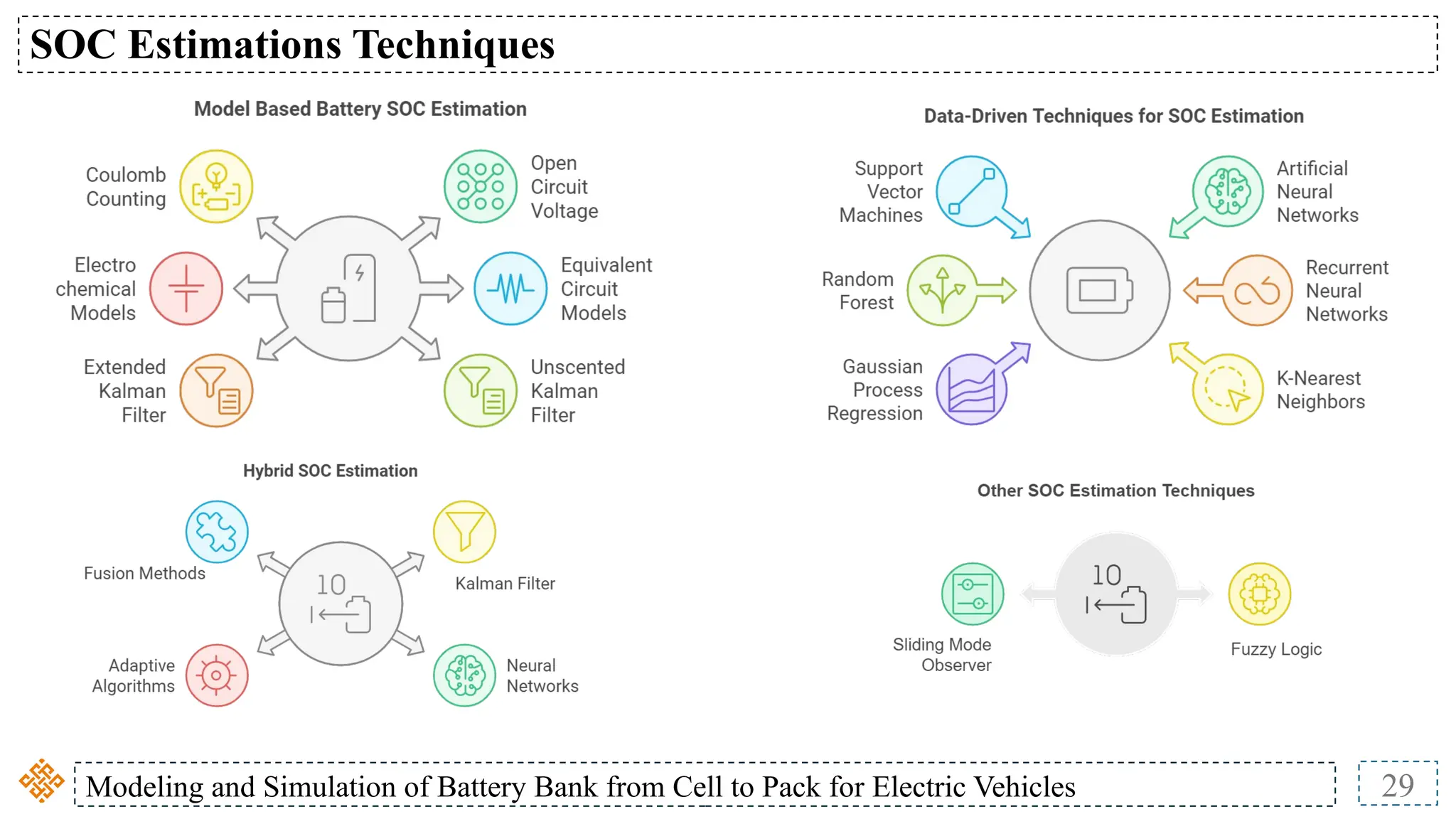
SOC Estimations Techniques
Modeling and Simulation of Battery Bank from Cell to Pack for Electric Vehicles 30
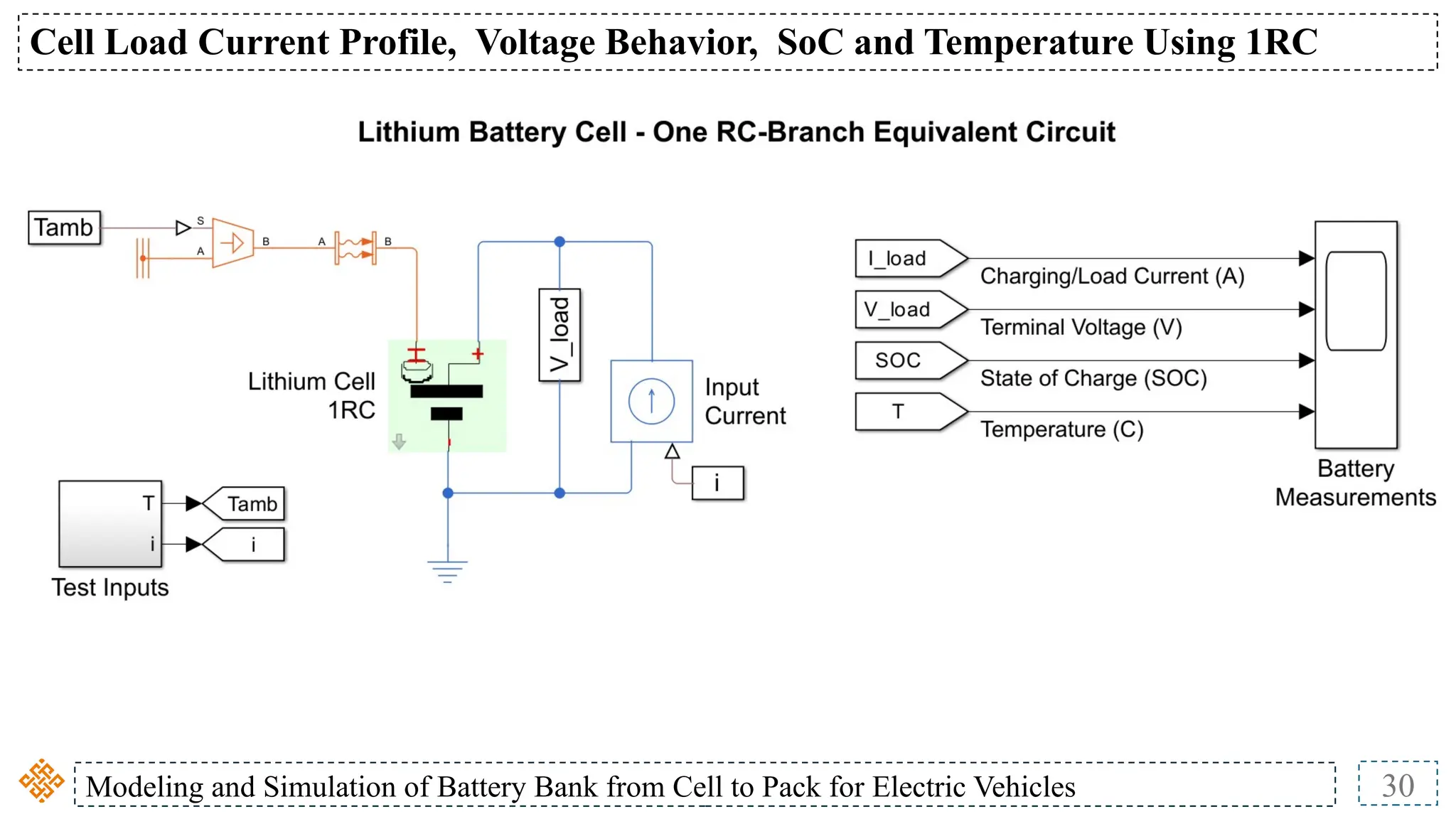
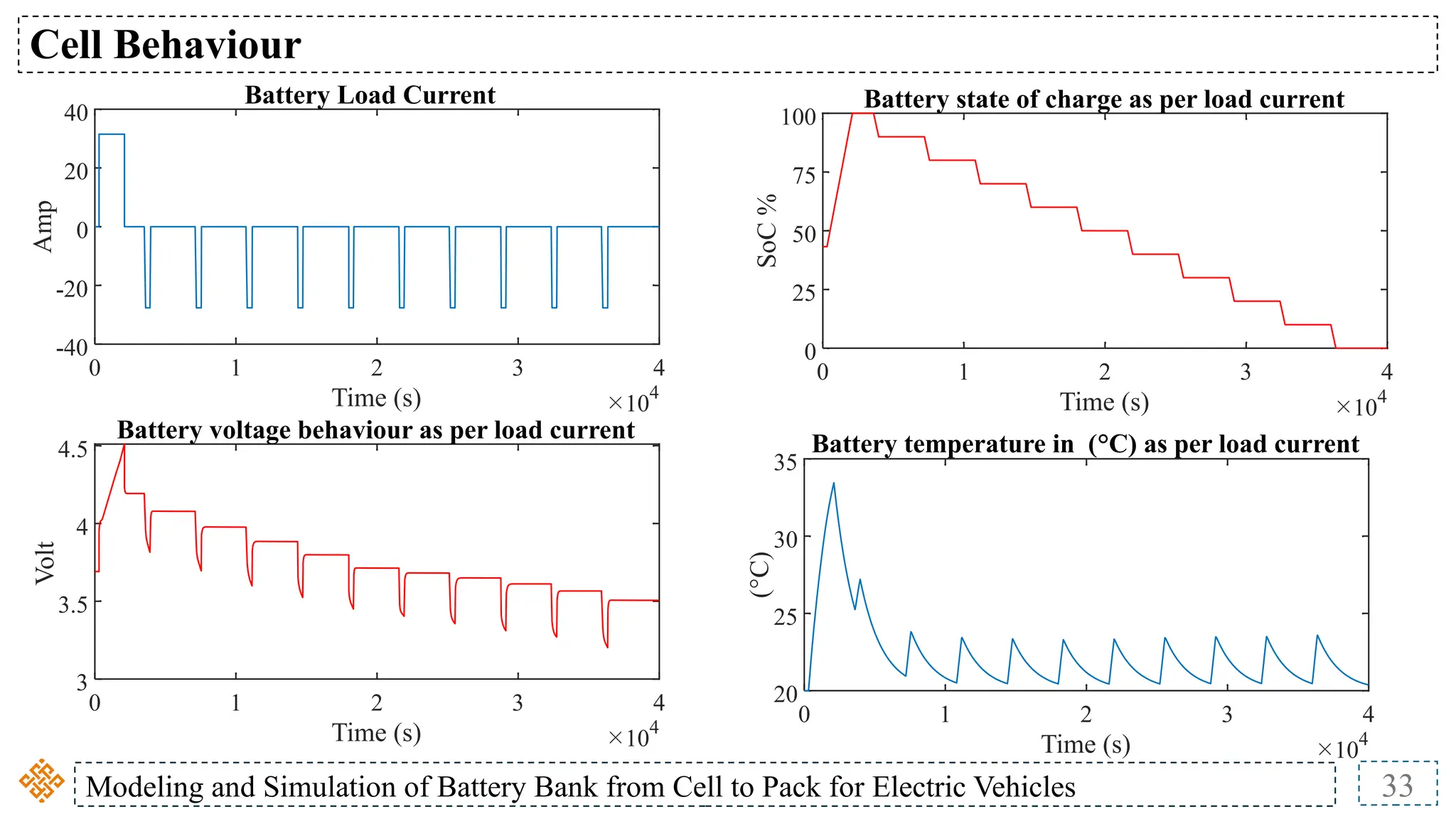
Cell Load Current Profile, Voltage Behavior, SoC and Temperature Using 1RC
Modeling and Simulation of Battery Bank from Cell to Pack for Electric Vehicles 31
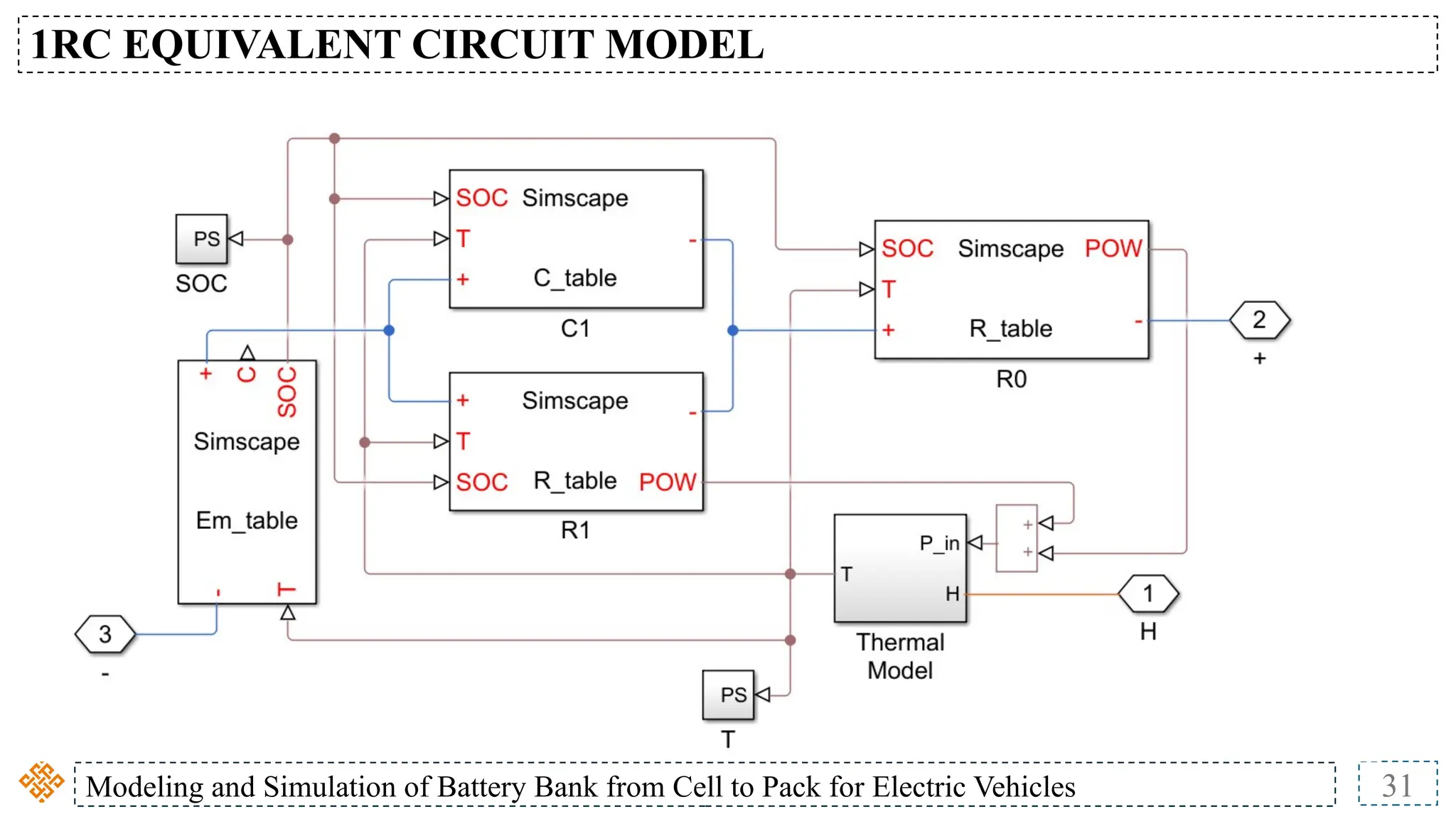
1RC EQUIVALENT CIRCUIT MODEL
Modeling and Simulation of Battery Bank from Cell to Pack for Electric Vehicles 32
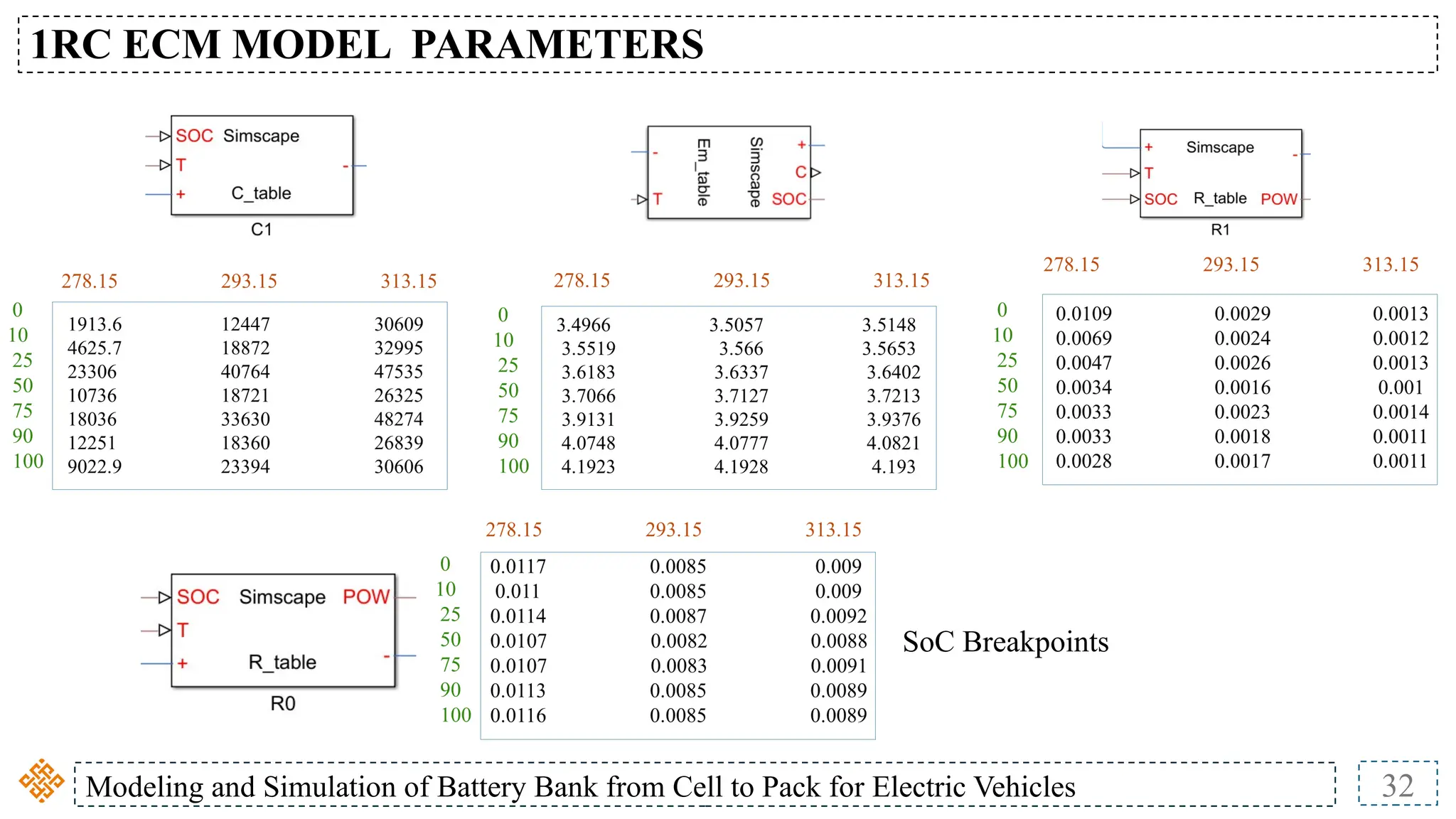
1RC ECM MODEL PARAMETERS
SoC Breakpoints
Modeling and Simulation of Battery Bank from Cell to Pack for Electric Vehicles 33
Cell Behaviour
0 1 2 3 4
Time (s) 10
4
-40
-20
0
20
40
Amp
Battery Load Current
0 1 2 3 4
Time (s) 10
4
3
3.5
4
4.5
Volt
Battery voltage behaviour as per load current
0 1 2 3 4
Time (s) 10
4
0
25
50
75
100
SoC
%
Battery state of charge as per load current
0 1 2 3 4
Time (s) 10
4
20
25
30
35
(°C)
Battery temperature in (°C) as per load current
Modeling and Simulation of Battery Bank from Cell to Pack for Electric Vehicles 34
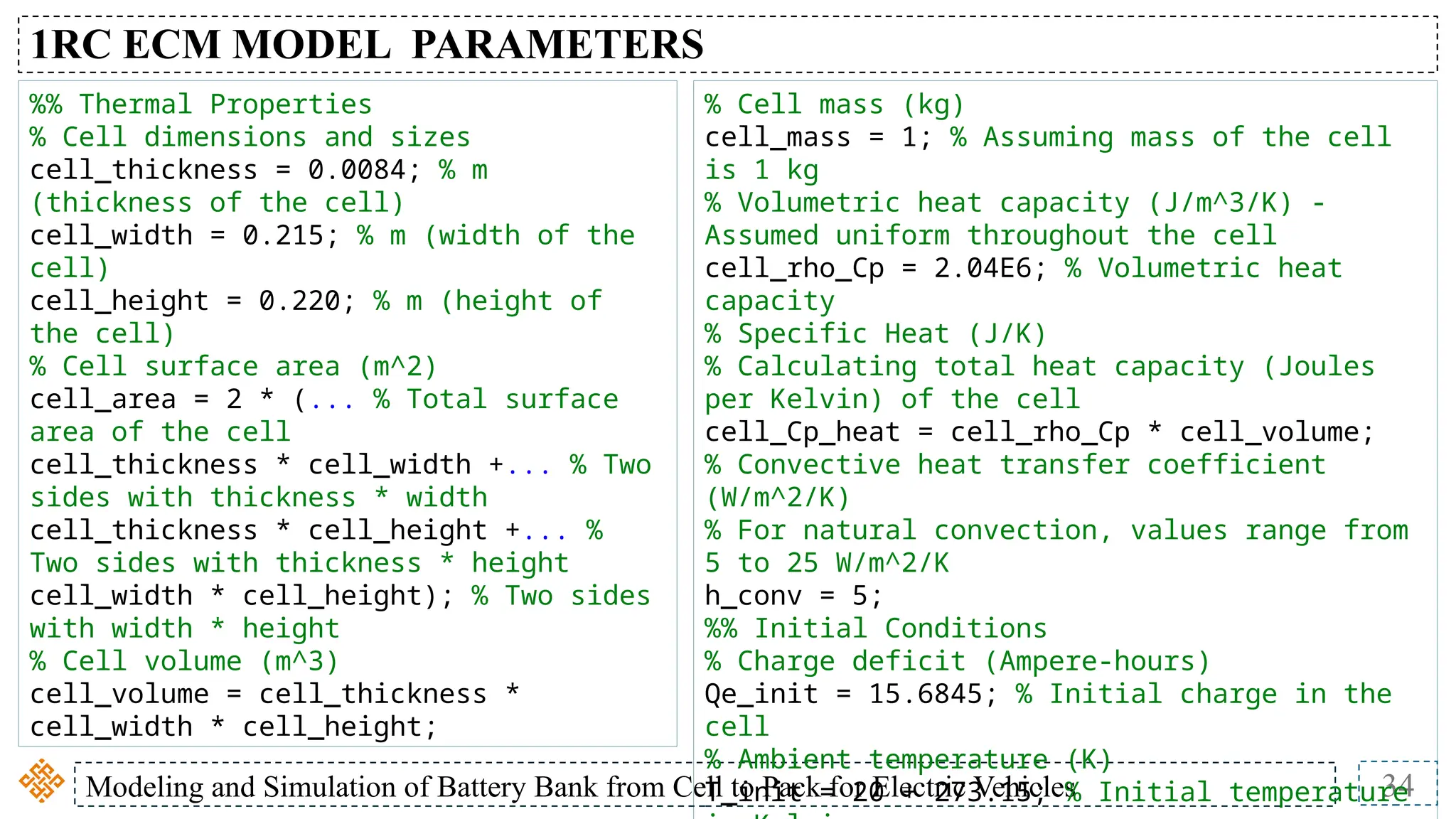
1RC ECM MODEL PARAMETERS
%% Thermal Properties
% Cell dimensions and sizes
cell_thickness = 0.0084; % m
(thickness of the cell)
cell_width = 0.215; % m (width of the
cell)
cell_height = 0.220; % m (height of
the cell)
% Cell surface area (m^2)
cell_area = 2 * (... % Total surface
area of the cell
cell_thickness * cell_width +... % Two
sides with thickness * width
cell_thickness * cell_height +... %
Two sides with thickness * height
cell_width * cell_height); % Two sides
with width * height
% Cell volume (m^3)
cell_volume = cell_thickness *
cell_width * cell_height;
% Cell mass (kg)
cell_mass = 1; % Assuming mass of the cell
is 1 kg
% Volumetric heat capacity (J/m^3/K) -
Assumed uniform throughout the cell
cell_rho_Cp = 2.04E6; % Volumetric heat
capacity
% Specific Heat (J/K)
% Calculating total heat capacity (Joules
per Kelvin) of the cell
cell_Cp_heat = cell_rho_Cp * cell_volume;
% Convective heat transfer coefficient
(W/m^2/K)
% For natural convection, values range from
5 to 25 W/m^2/K
h_conv = 5;
%% Initial Conditions
% Charge deficit (Ampere-hours)
Qe_init = 15.6845; % Initial charge in the
cell
% Ambient temperature (K)
T_init = 20 + 273.15; % Initial temperature
Modeling and Simulation of Battery Bank from Cell to Pack for Electric Vehicles 35
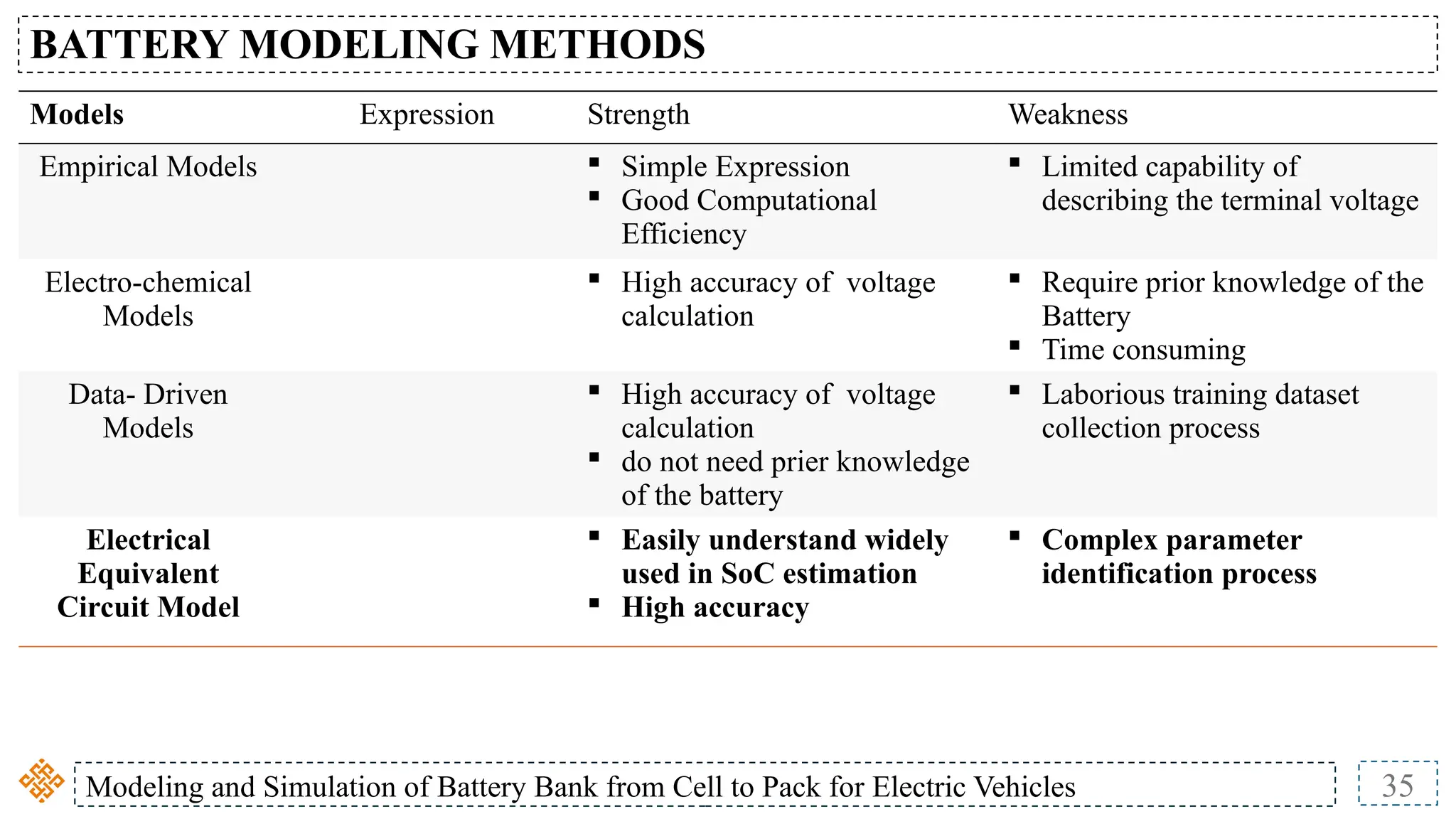
BATTERY MODELING METHODS
Models Expression Strength Weakness
Empirical Models  Simple Expression
 Good Computational
Efficiency
 Limited capability of
describing the terminal voltage
Electro-chemical
Models
 High accuracy of voltage
calculation
 Require prior knowledge of the
Battery
 Time consuming
Data- Driven
Models
 High accuracy of voltage
calculation
 do not need prier knowledge
of the battery
 Laborious training dataset
collection process
Electrical
Equivalent
Circuit Model
 Easily understand widely
used in SoC estimation
 High accuracy
 Complex parameter
identification process
Modeling and Simulation of Battery Bank from Cell to Pack for Electric Vehicles 36
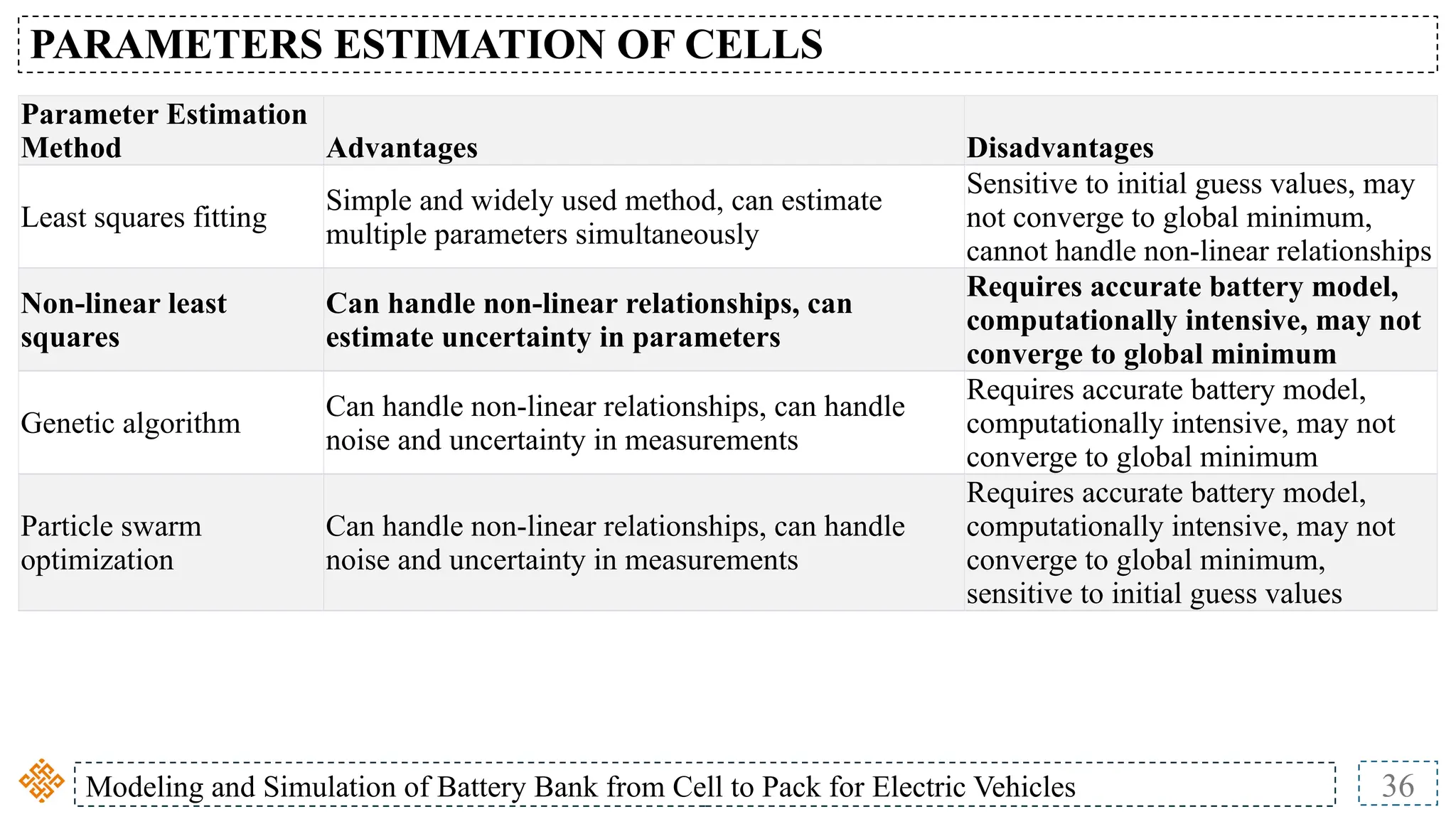
PARAMETERS ESTIMATION OF CELLS
Parameter Estimation
Method Advantages Disadvantages
Least squares fitting
Simple and widely used method, can estimate
multiple parameters simultaneously
Sensitive to initial guess values, may
not converge to global minimum,
cannot handle non-linear relationships
Non-linear least
squares
Can handle non-linear relationships, can
estimate uncertainty in parameters
Requires accurate battery model,
computationally intensive, may not
converge to global minimum
Genetic algorithm
Can handle non-linear relationships, can handle
noise and uncertainty in measurements
Requires accurate battery model,
computationally intensive, may not
converge to global minimum
Particle swarm
optimization
Can handle non-linear relationships, can handle
noise and uncertainty in measurements
Requires accurate battery model,
computationally intensive, may not
converge to global minimum,
sensitive to initial guess values
Modeling and Simulation of Battery Bank from Cell to Pack for Electric Vehicles 37
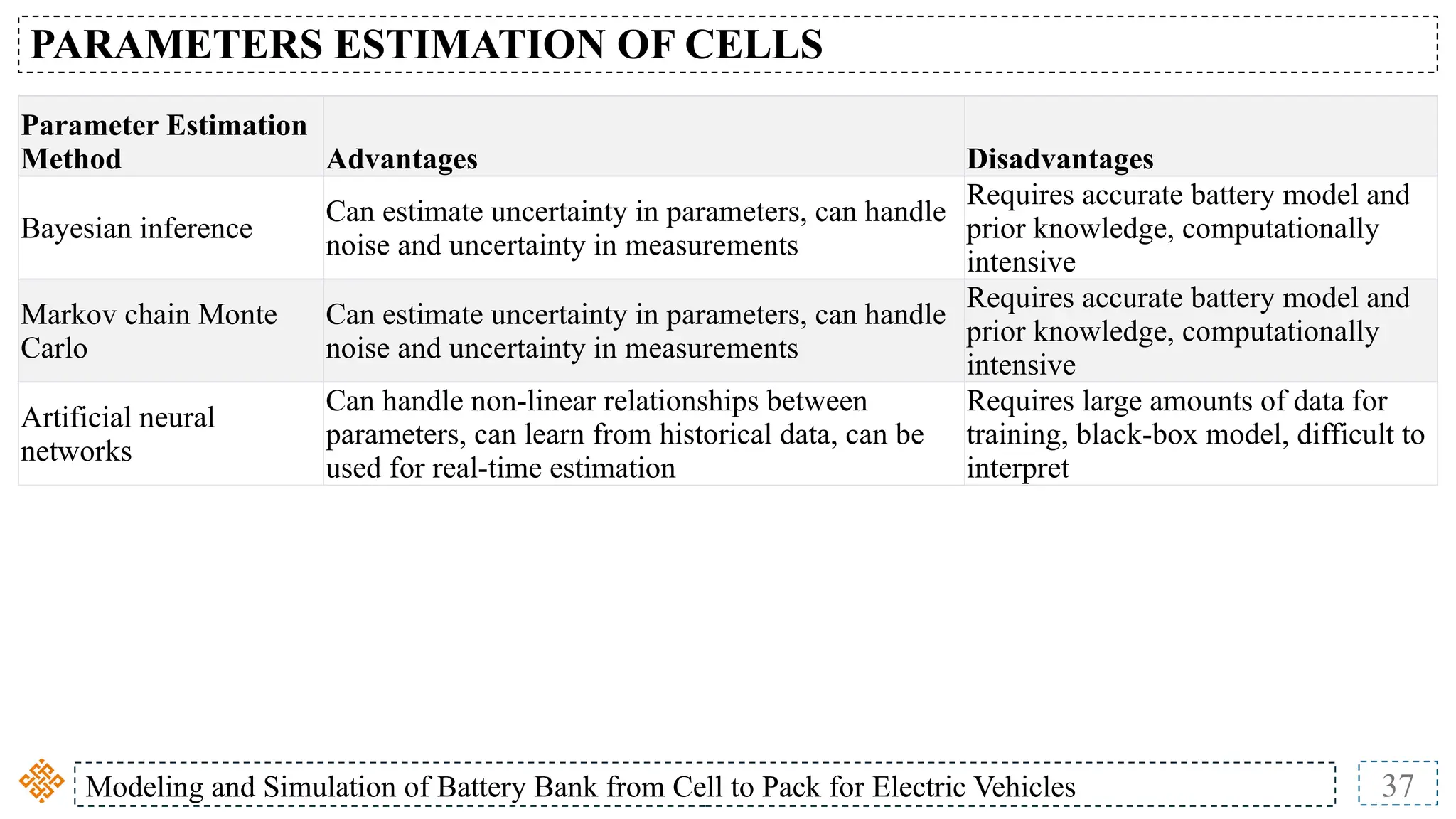
PARAMETERS ESTIMATION OF CELLS
Parameter Estimation
Method Advantages Disadvantages
Bayesian inference
Can estimate uncertainty in parameters, can handle
noise and uncertainty in measurements
Requires accurate battery model and
prior knowledge, computationally
intensive
Markov chain Monte
Carlo
Can estimate uncertainty in parameters, can handle
noise and uncertainty in measurements
Requires accurate battery model and
prior knowledge, computationally
intensive
Artificial neural
networks
Can handle non-linear relationships between
parameters, can learn from historical data, can be
used for real-time estimation
Requires large amounts of data for
training, black-box model, difficult to
interpret
Modeling and Simulation of Battery Bank from Cell to Pack for Electric Vehicles 38
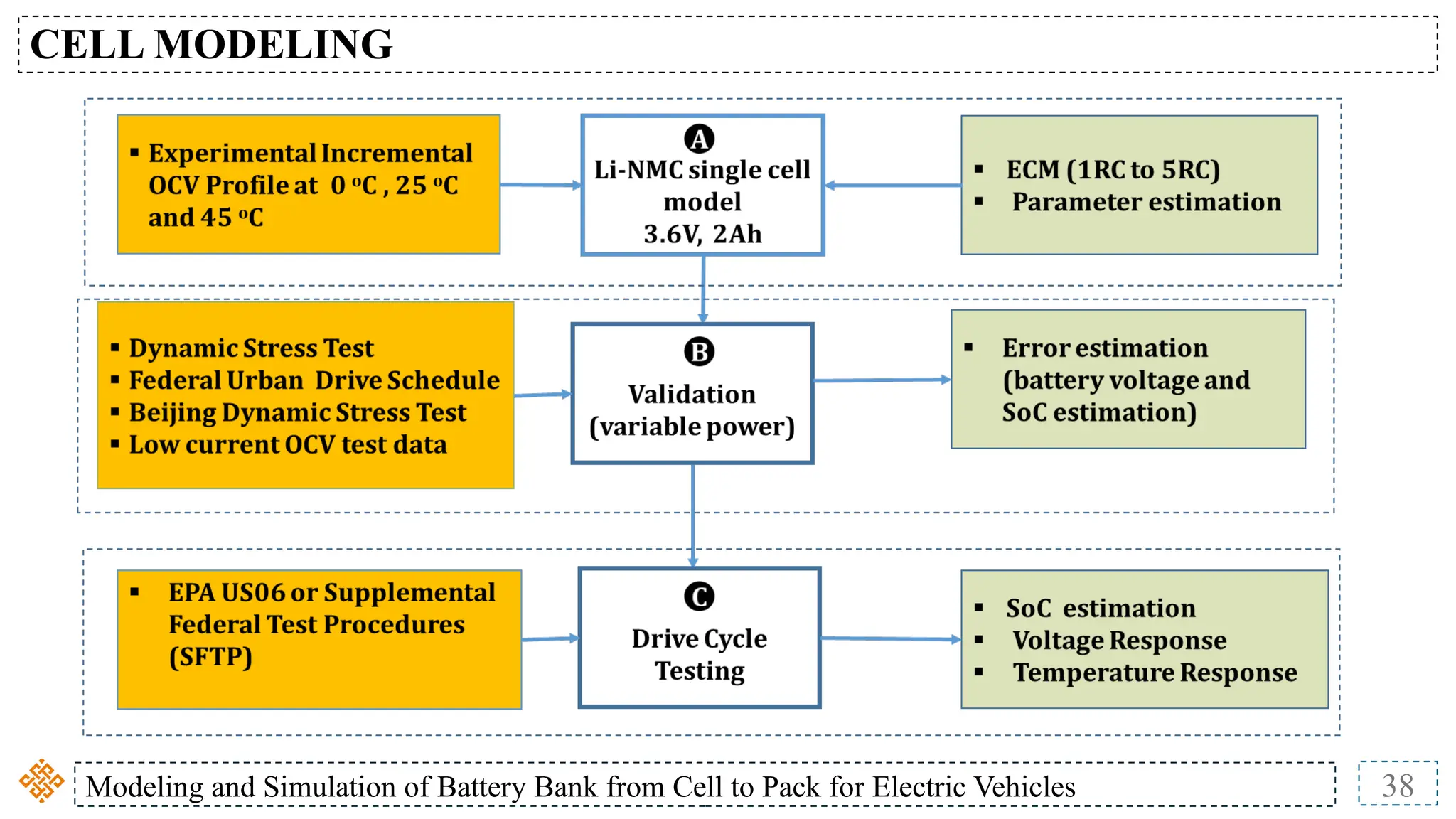
CELL MODELING
Modeling and Simulation of Battery Bank from Cell to Pack for Electric Vehicles 39
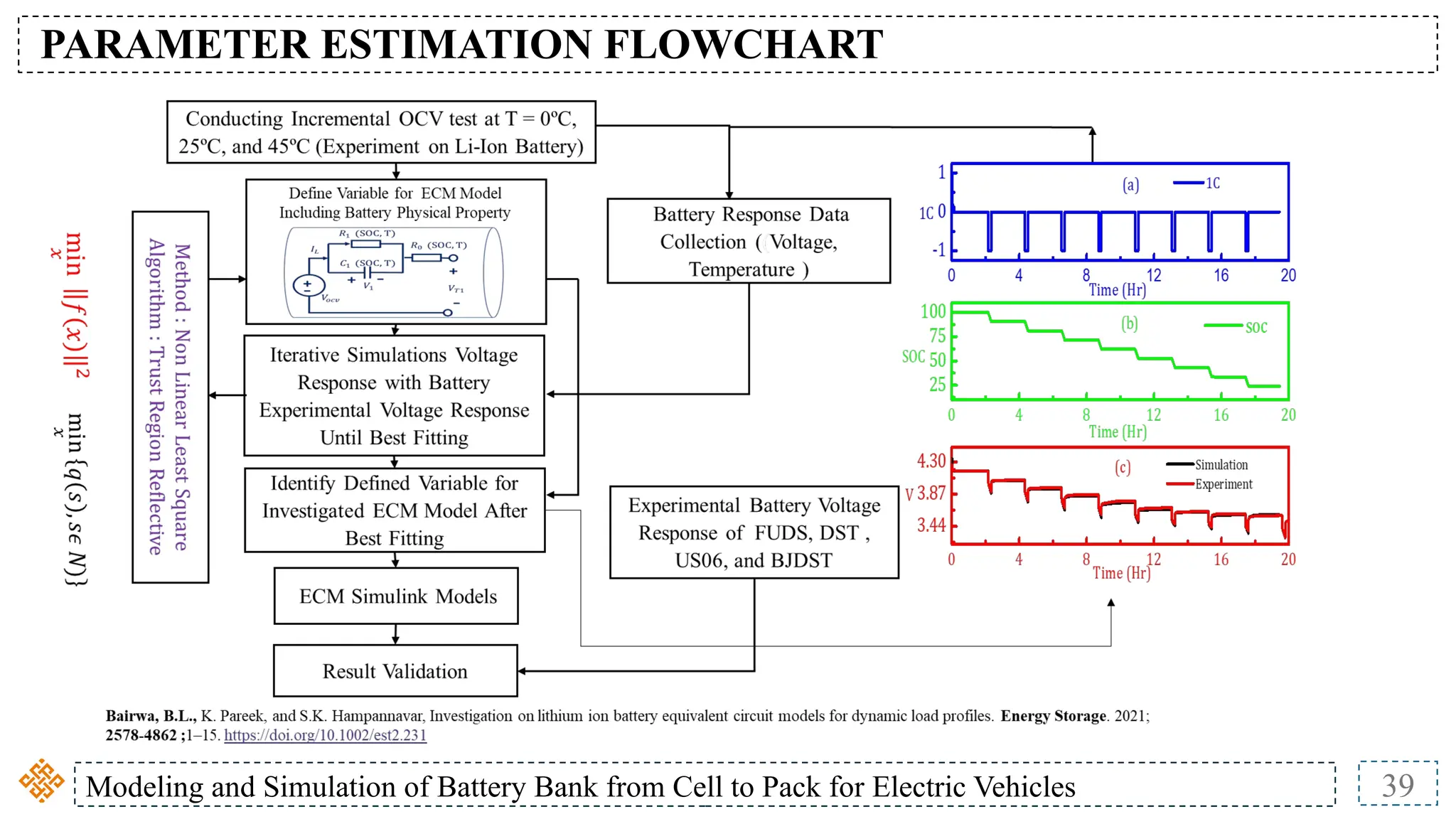
PARAMETER ESTIMATION FLOWCHART
Modeling and Simulation of Battery Bank from Cell to Pack for Electric Vehicles 40
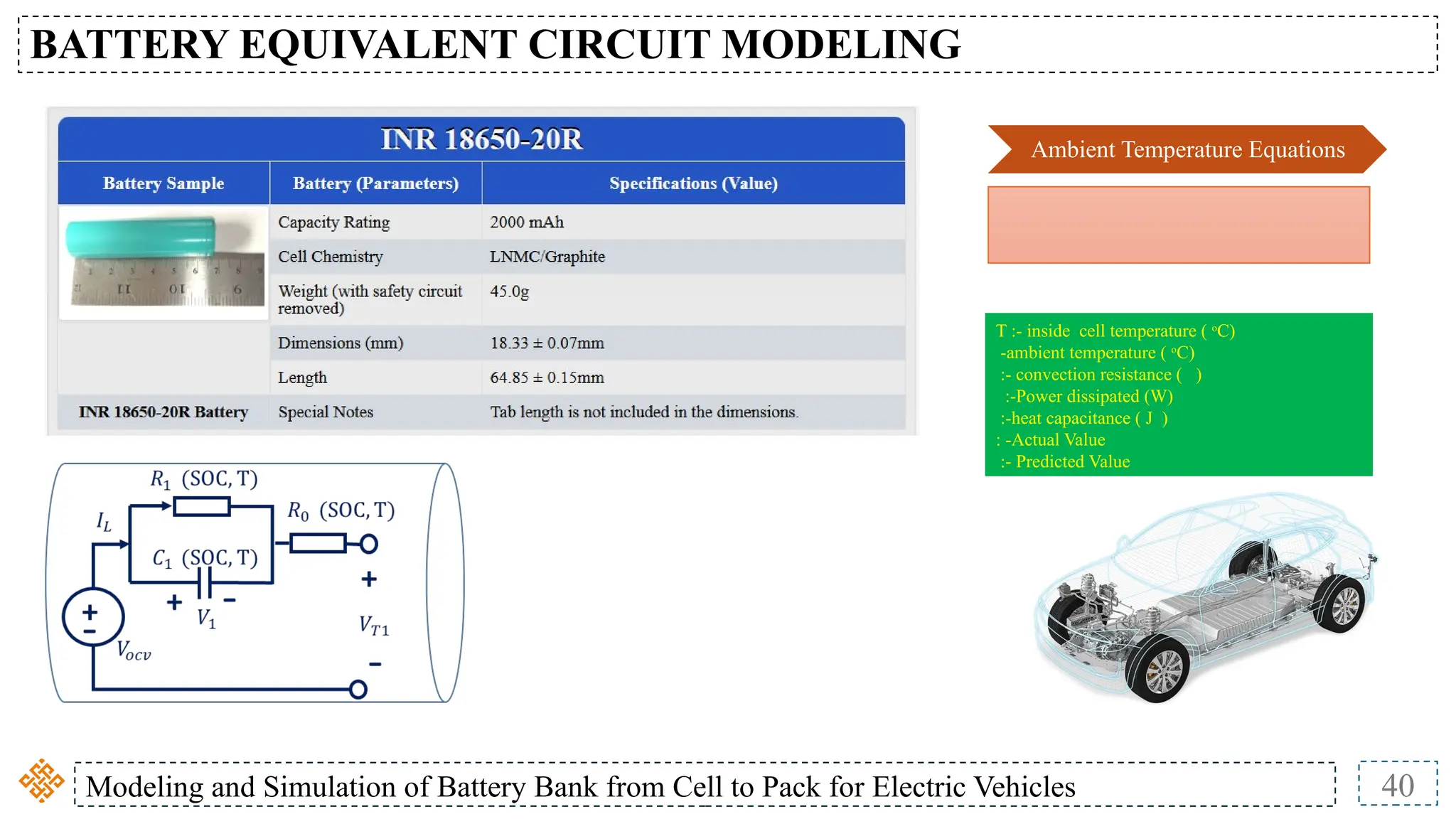
BATTERY EQUIVALENT CIRCUIT MODELING
T :- inside cell temperature ( o
C)
-ambient temperature ( o
C)
:- convection resistance ( )
:-Power dissipated (W)
:-heat capacitance ( J )
: -Actual Value
:- Predicted Value
Ambient Temperature Equations
Modeling and Simulation of Battery Bank from Cell to Pack for Electric Vehicles 41
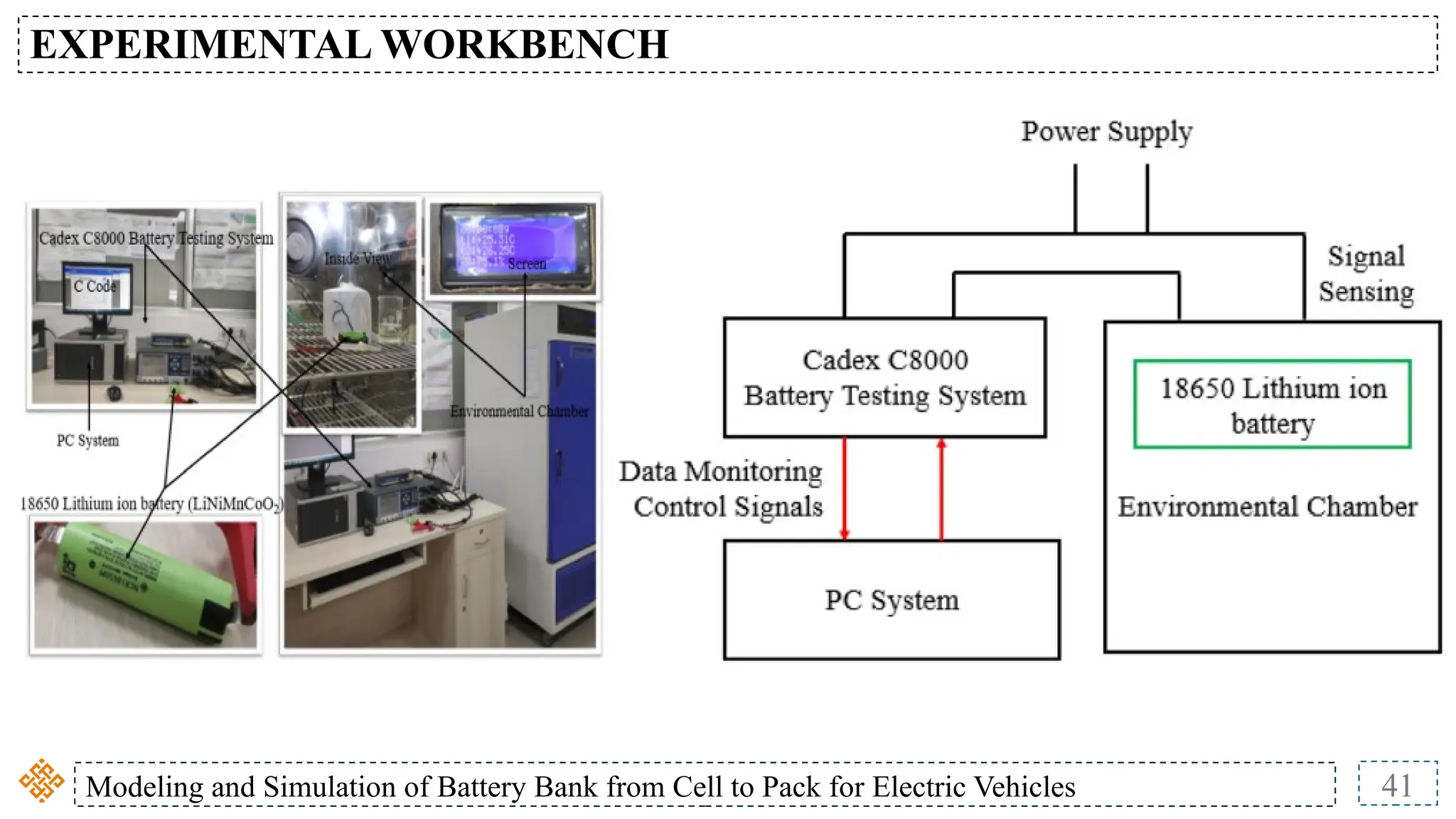
EXPERIMENTAL WORKBENCH
Modeling and Simulation of Battery Bank from Cell to Pack for Electric Vehicles 42
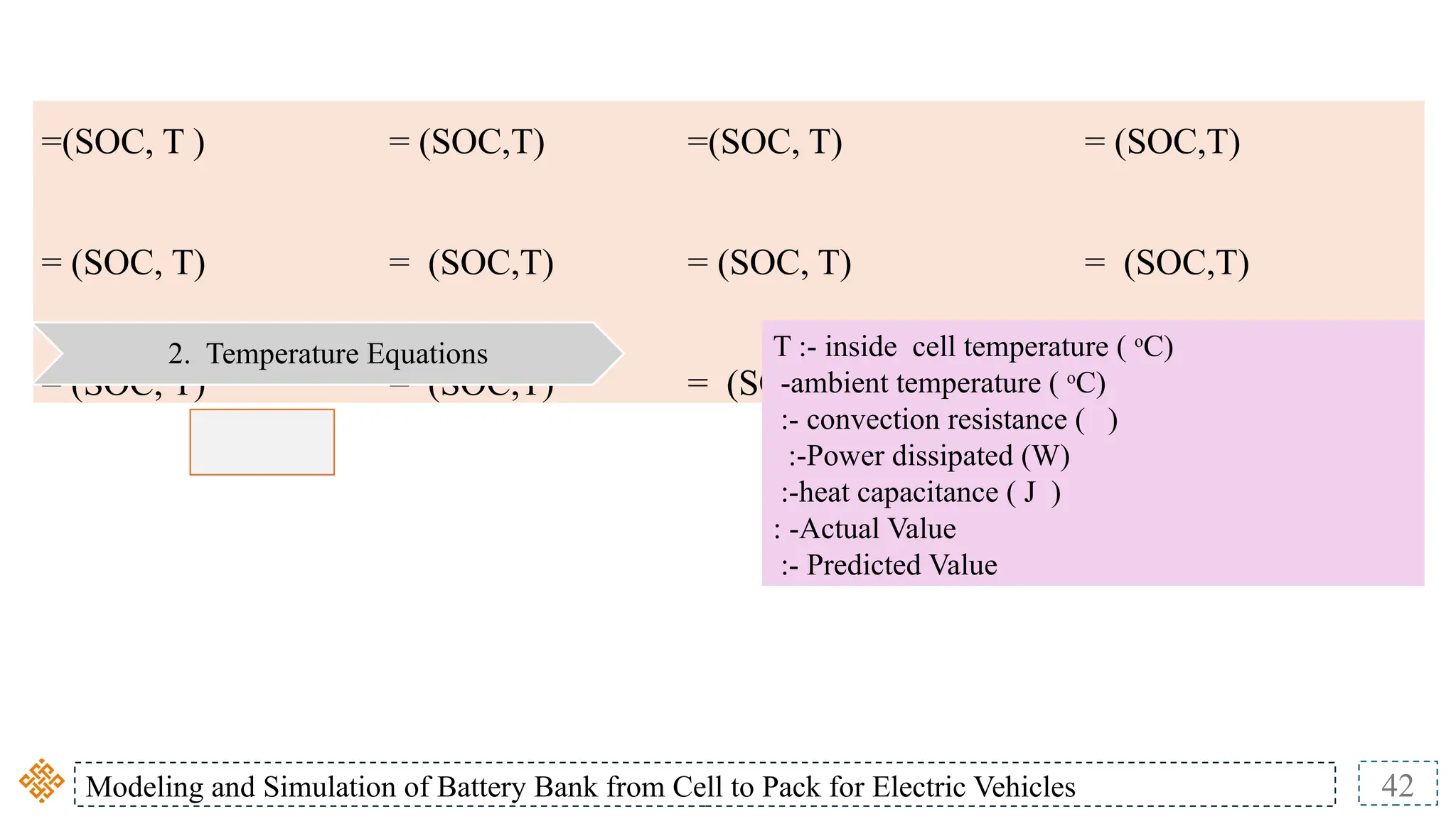
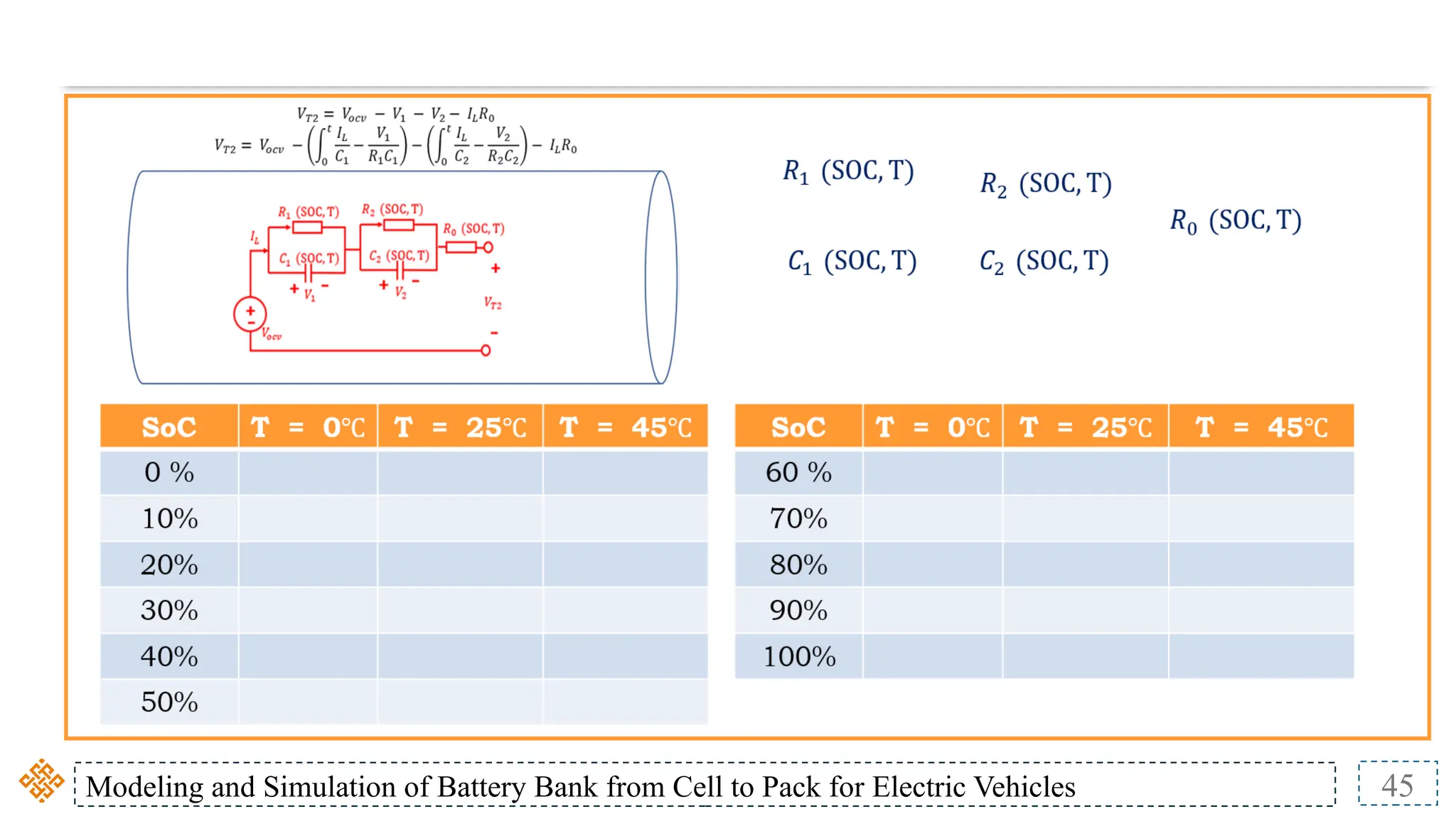
=(SOC, T ) = (SOC,T) =(SOC, T) = (SOC,T)
= (SOC, T) = (SOC,T) = (SOC, T) = (SOC,T)
= (SOC, T) = (SOC,T) = (SOC,T) = (SOC,T)
T :- inside cell temperature ( o
C)
-ambient temperature ( o
C)
:- convection resistance ( )
:-Power dissipated (W)
:-heat capacitance ( J )
: -Actual Value
:- Predicted Value
2. Temperature Equations
Modeling and Simulation of Battery Bank from Cell to Pack for Electric Vehicles 43
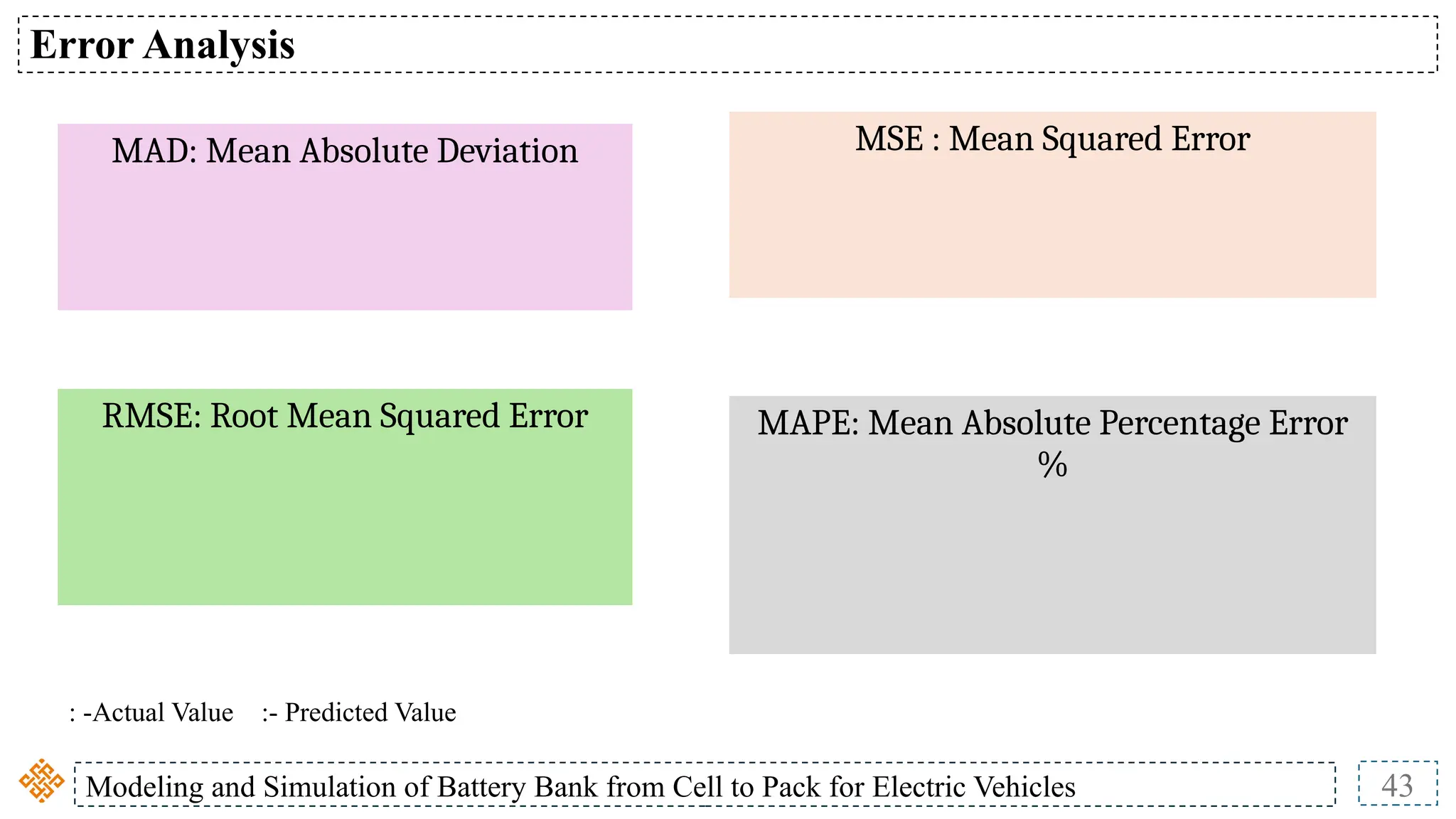
Error Analysis
MAD: Mean Absolute Deviation
RMSE: Root Mean Squared Error
MSE : Mean Squared Error
MAPE: Mean Absolute Percentage Error
%
: -Actual Value :- Predicted Value
Modeling and Simulation of Battery Bank from Cell to Pack for Electric Vehicles 44
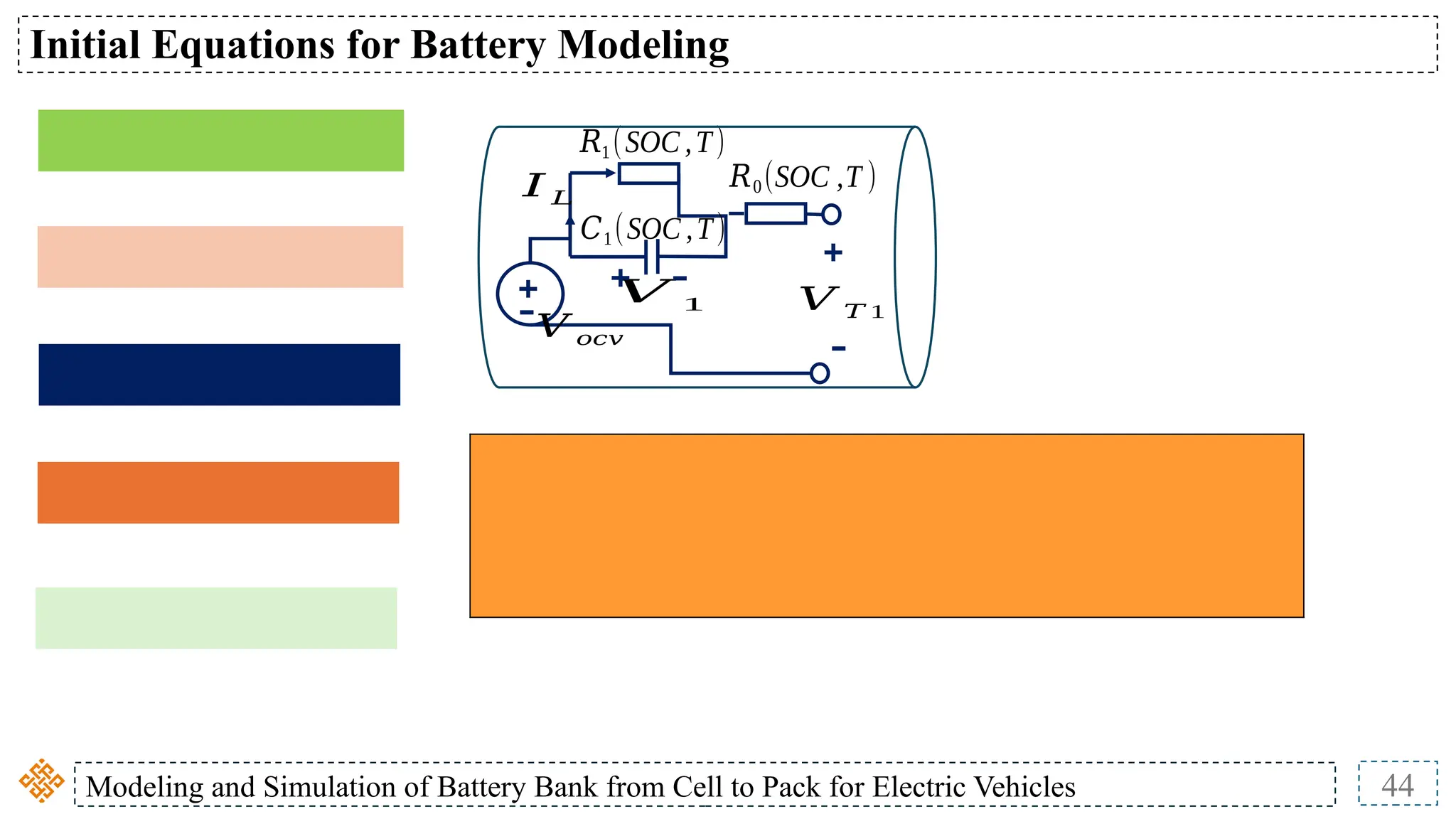
Initial Equations for Battery Modeling
+
-
𝐶1(SOC ,T)
𝑅1(SOC ,T)
𝑅0(SOC ,T )
𝑉 1
-
+
𝑉 𝑇 1
𝐼 𝐿
-
+
𝑉 𝑜𝑐𝑣
Modeling and Simulation of Battery Bank from Cell to Pack for Electric Vehicles 45
Modeling and Simulation of Battery Bank from Cell to Pack for Electric Vehicles 46
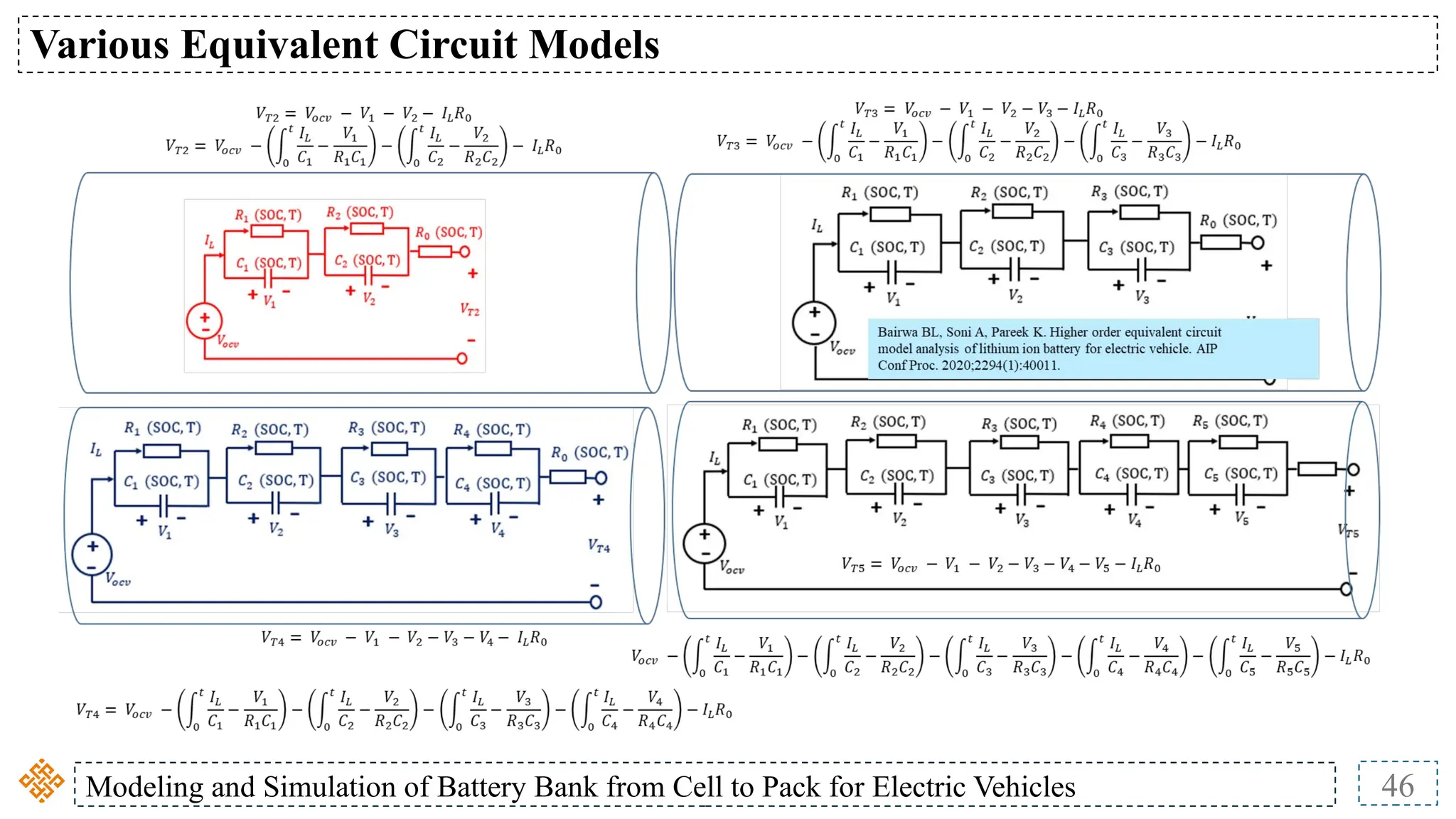
Various Equivalent Circuit Models
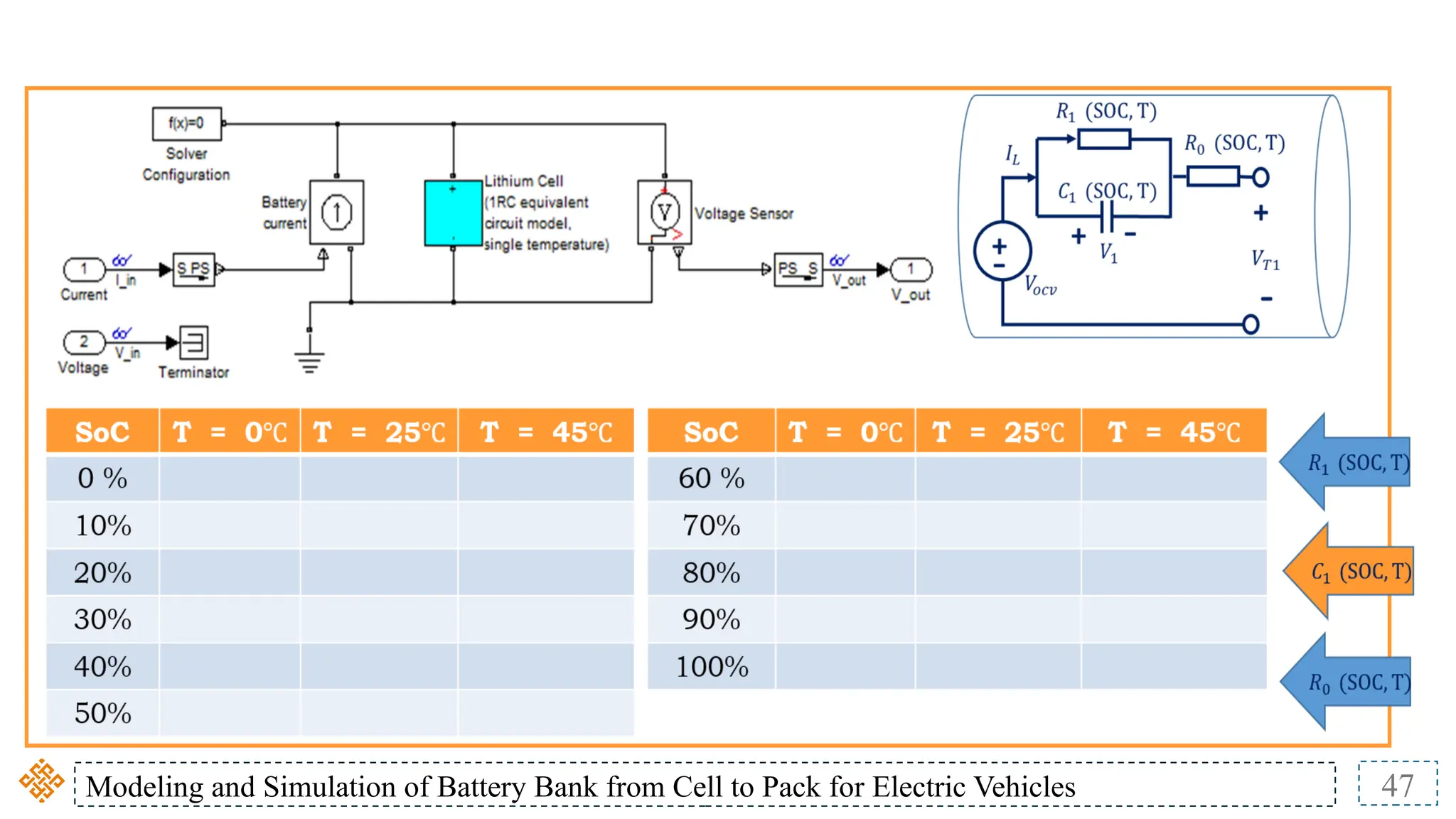
Modeling and Simulation of Battery Bank from Cell to Pack for Electric Vehicles 47
Modeling and Simulation of Battery Bank from Cell to Pack for Electric Vehicles 48
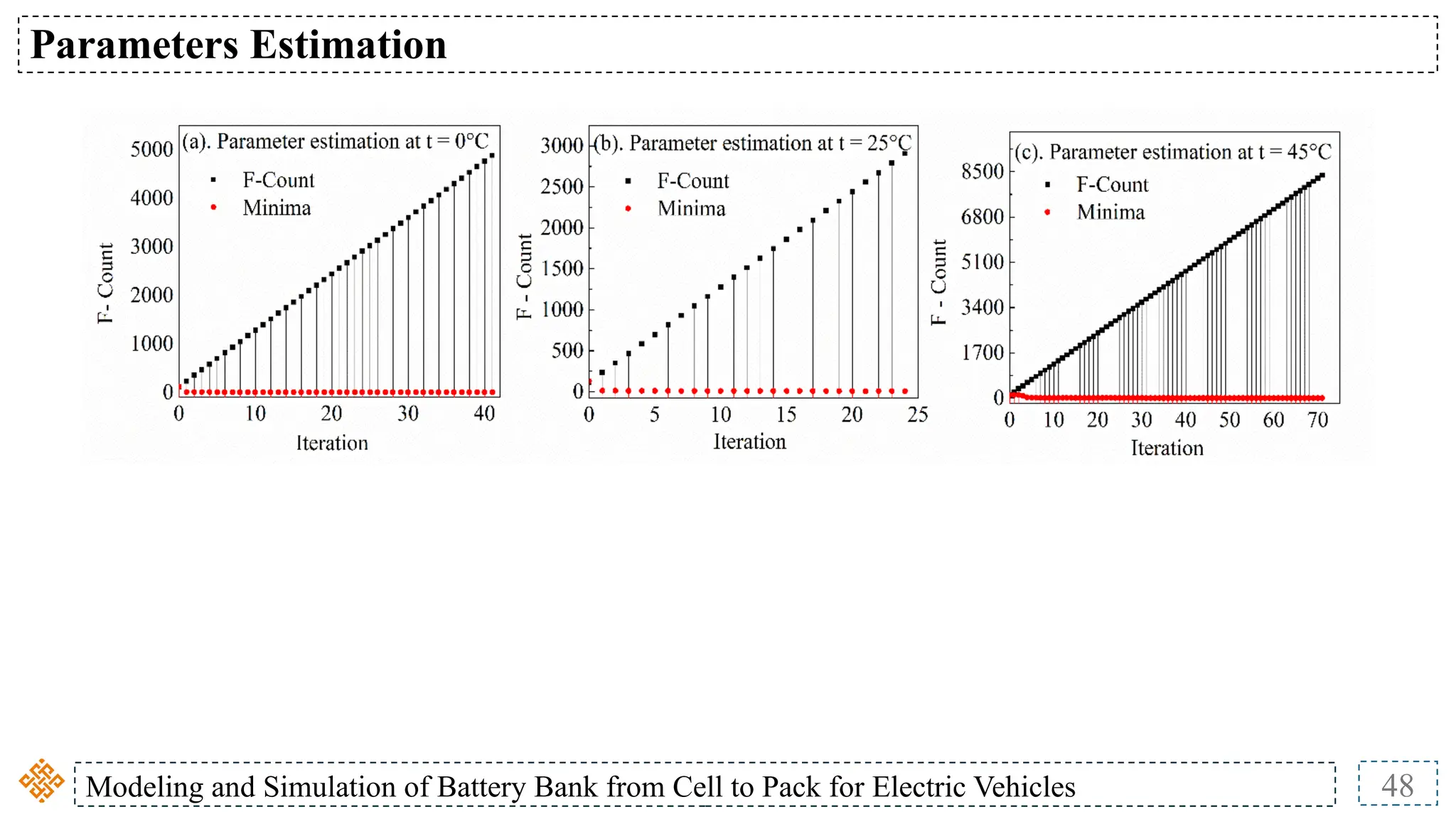
Parameters Estimation
Modeling and Simulation of Battery Bank from Cell to Pack for Electric Vehicles 49
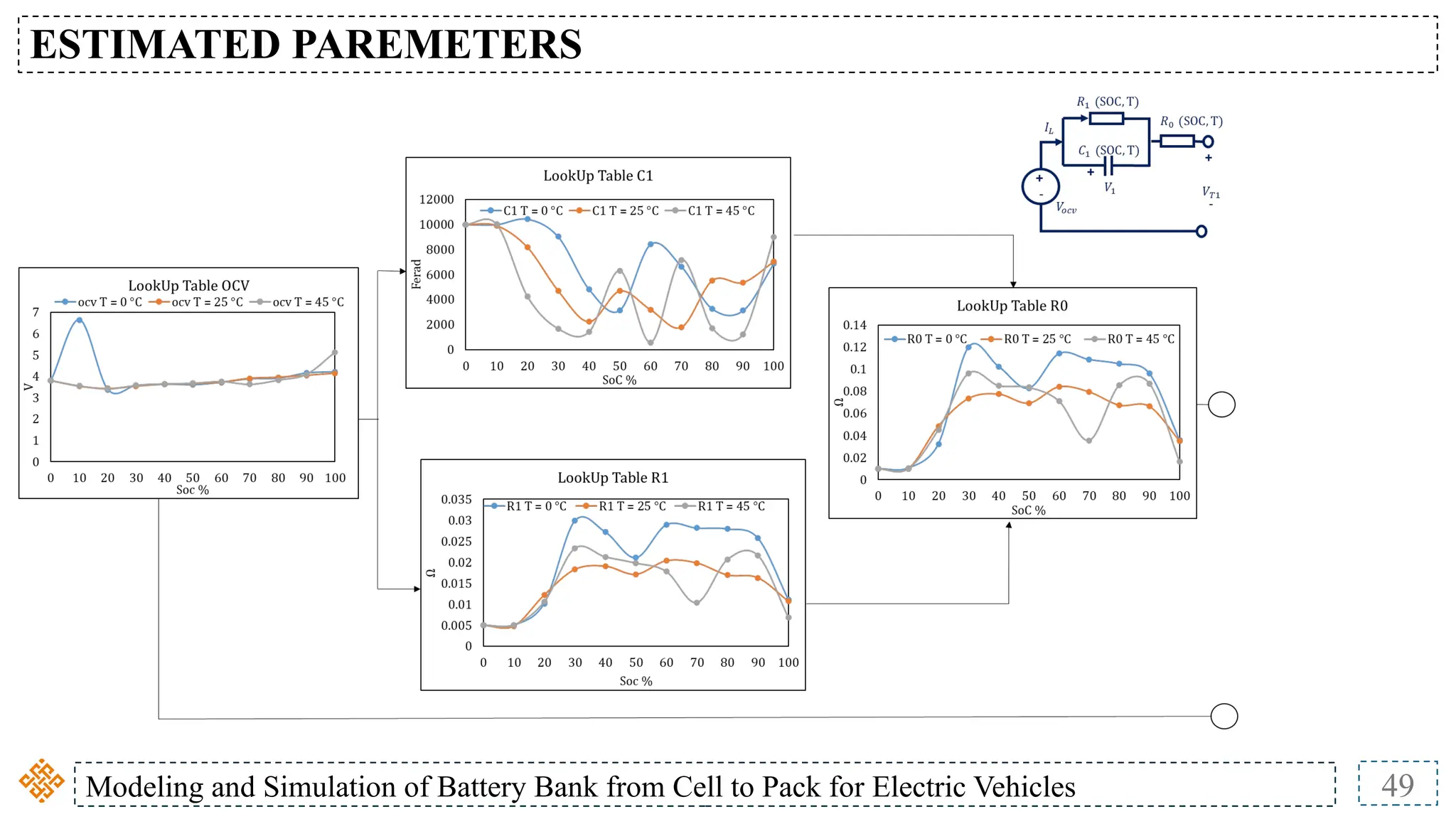
ESTIMATED PAREMETERS
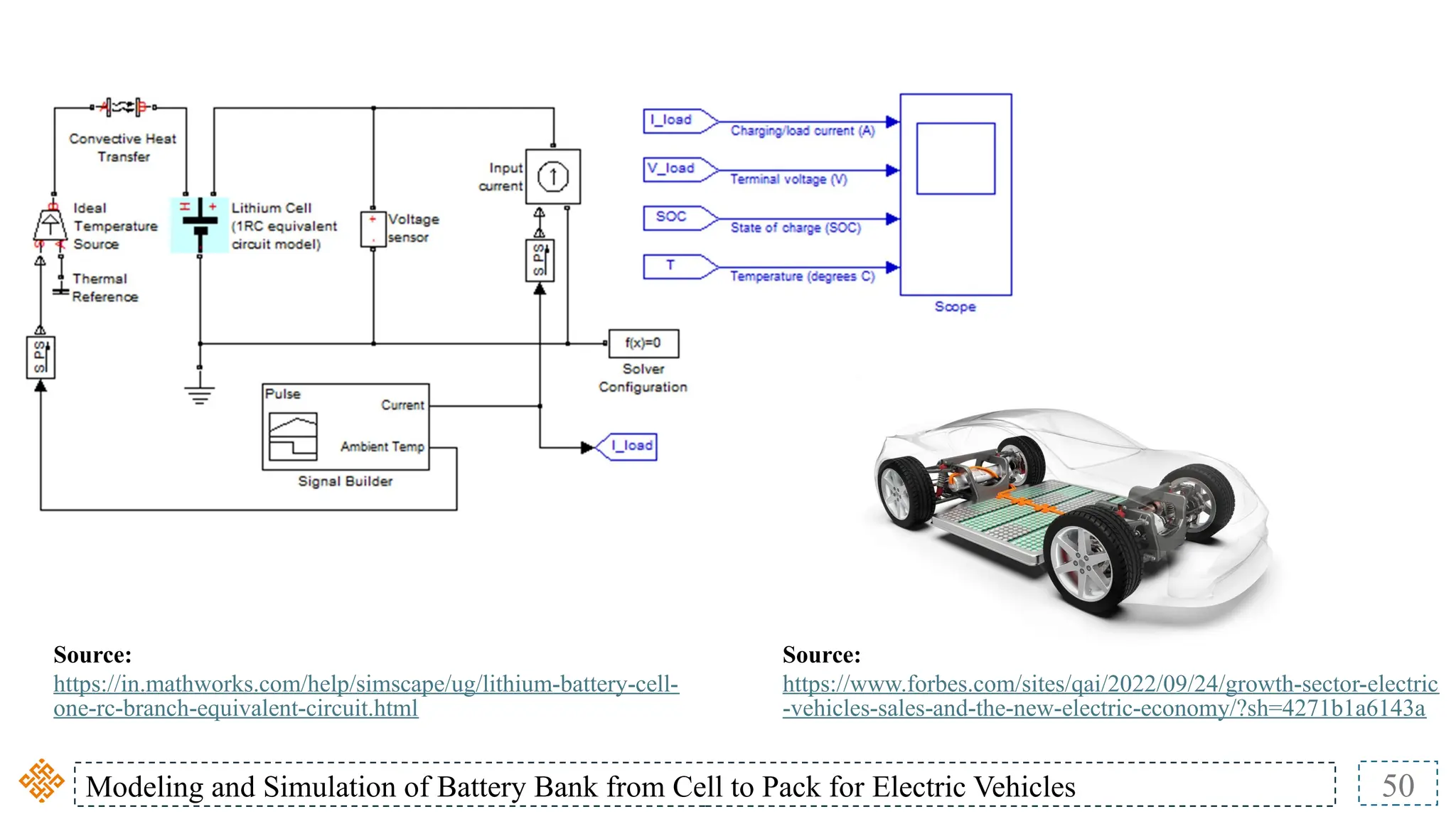
Modeling and Simulation of Battery Bank from Cell to Pack for Electric Vehicles 50
Source:
https://www.forbes.com/sites/qai/2022/09/24/growth-sector-electric
-vehicles-sales-and-the-new-electric-economy/?sh=4271b1a6143a
Source:
https://in.mathworks.com/help/simscape/ug/lithium-battery-cell-
one-rc-branch-equivalent-circuit.html
Modeling and Simulation of Battery Bank from Cell to Pack for Electric Vehicles 51
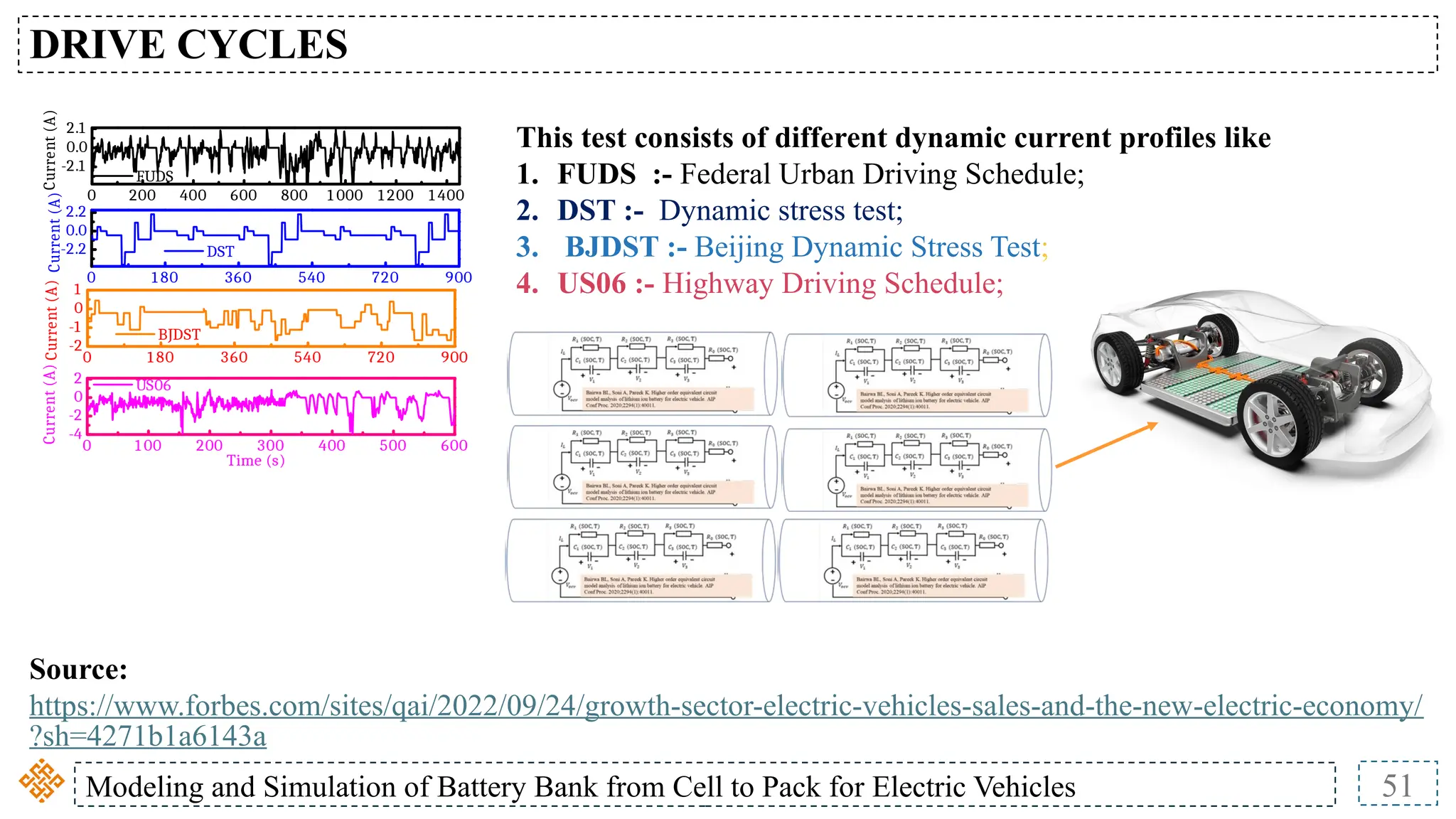
DRIVE CYCLES
0 200 400 600 800 1 000 1 200 1 400
-2.1
0.0
2.1
0 1 80 360 540 720 900
-2.2
0.0
2.2
0 1 80 360 540 720 900
-2
-1
0
1
0 1 00 200 300 400 500 600
-4
-2
0
2
Current
(A)
FUDS
Current
(A)
DST
Current
(A)
BJDST
Current
(A)
Time (s)
US06
This test consists of different dynamic current profiles like
1. FUDS :- Federal Urban Driving Schedule;
2. DST :- Dynamic stress test;
3. BJDST :- Beijing Dynamic Stress Test;
4. US06 :- Highway Driving Schedule;
Source:
https://www.forbes.com/sites/qai/2022/09/24/growth-sector-electric-vehicles-sales-and-the-new-electric-economy/
?sh=4271b1a6143a
Modeling and Simulation of Battery Bank from Cell to Pack for Electric Vehicles 52
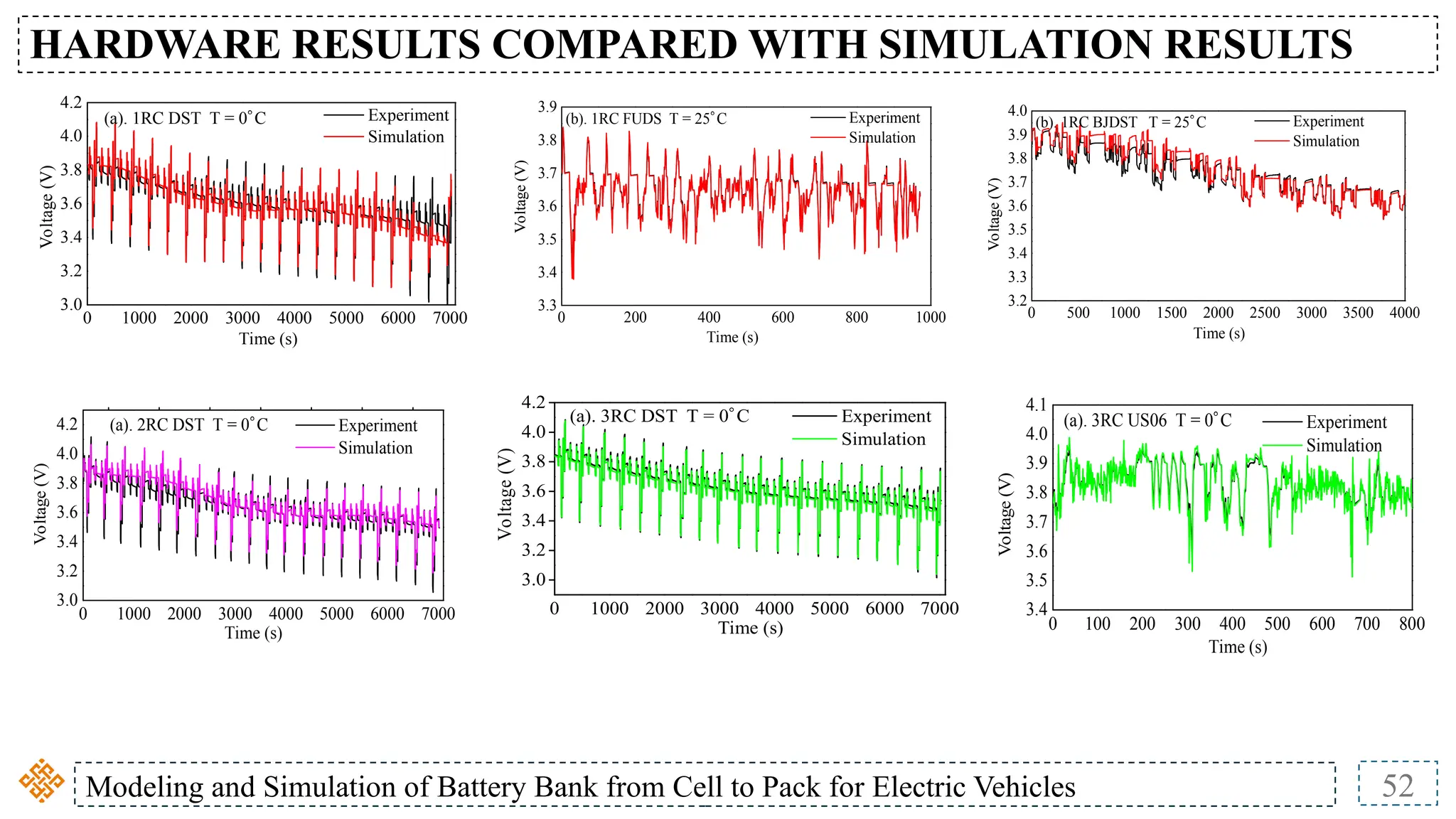
HARDWARE RESULTS COMPARED WITH SIMULATION RESULTS
0 1000 2000 3000 4000 5000 6000 7000
3.0
3.2
3.4
3.6
3.8
4.0
4.2
Voltage
(V)
Time (s)
Experiment
Simulation
(a). 1RC DST T = 0C
0 200 400 600 800 1000
3.3
3.4
3.5
3.6
3.7
3.8
3.9
(b). 1RC FUDS T = 25C Experiment
Simulation
Time (s)
Voltage
(V)
0 500 1000 1500 2000 2500 3000 3500 4000
3.2
3.3
3.4
3.5
3.6
3.7
3.8
3.9
4.0
Time (s)
Voltage
(V)
(b). 1RC BJDST T = 25C Experiment
Simulation
0 1000 2000 3000 4000 5000 6000 7000
3.0
3.2
3.4
3.6
3.8
4.0
4.2
Voltage
(V)
Time (s)
(a). 2RC DST T = 0C Experiment
Simulation
0 1000 2000 3000 4000 5000 6000 7000
3.0
3.2
3.4
3.6
3.8
4.0
4.2
Voltage
(V)
Time (s)
Experiment
Simulation
(a). 3RC DST T = 0C
0 100 200 300 400 500 600 700 800
3.4
3.5
3.6
3.7
3.8
3.9
4.0
4.1
Voltage
(V)
Time (s)
(a). 3RC US06 T = 0C Experiment
Simulation
Modeling and Simulation of Battery Bank from Cell to Pack for Electric Vehicles 53
Modeling and Simulation of Battery Bank from Cell to Pack for Electric Vehicles 54

1b. Battery Basics and Equivalent Circuit Model.pptx

  • 1.
  • 2.
    Modeling and Simulationof Battery Bank from Cell to Pack for Electric Vehicles 2 OUTLINE 1. Batteries 2. Batteries configuration 3. Cell voltage for various types of the batteries 4. Roadmap for battery energy storage 5. CCCV Charging 6. Battery capacity, C rates 7. Battery state of charge 8. Battery state of health 9. Various types of the battery modeling methods 10. Cell level modeling
  • 3.
    Modeling and Simulationof Battery Bank from Cell to Pack for Electric Vehicles 3 Introduction Anode: The electrode where oxidation (loss of electrons) occurs during discharge. Electrons flow from the anode to the external circuit. Cathode: The electrode where reduction (gain of electrons) occurs during discharge. Electrons return to the cathode through the external circuit. Electrolyte: A substance, often a liquid or gel, that allows ions to move between the anode and cathode. It serves as a medium for the flow of electric charge. Separator: A physical barrier that prevents direct contact between the anode and cathode, allowing ions to move while keeping the electrodes from touching. CHARGING PROCESS DISCHARGING PROCESS
  • 4.
    Modeling and Simulationof Battery Bank from Cell to Pack for Electric Vehicles 4 Source : Ding, Y., Cano, Z.P., Yu, A. et al. Automotive Li-Ion Batteries: Current Status and Future Perspectives. Electrochem. Energ. Rev. 2, 1–28 (2019). https://doi.org/10.1007/s41918-018-0022-z14
  • 5.
    Modeling and Simulationof Battery Bank from Cell to Pack for Electric Vehicles 5 Ambient Temperature Losses C Rate Aging Proper sizing of the storage Parameter identification Pre-mature failure prediction for stack level architecture State estimation under real-time conditions Lifetime improvement under rigorous drive conditions Stack level health assessment Factors affecting EV battery performance Battery modeling challenges for electric vehicle applications
  • 6.
    Modeling and Simulationof Battery Bank from Cell to Pack for Electric Vehicles 6
  • 7.
    Modeling and Simulationof Battery Bank from Cell to Pack for Electric Vehicles 7 LCO – Lithium cobalt oxide battery NCA - Lithium nickel cobalt aluminium oxide NMC - Lithium-Nickel- Manganese-Cobalt- Oxide LMO – Lithium-Ion manganese oxide battery LFP - Lithium iron phosphate batteries (LiFePO4 ) LTO - lithium- titanium-oxide battery Source: Miao, Yu, et al. "Current Li-ion battery technologies in electric vehicles and opportunities for advancements." Energies 12.6 (2019): 1074.
  • 8.
    Modeling and Simulationof Battery Bank from Cell to Pack for Electric Vehicles 8 Battery test procedure Battery Test Procedure Performance Constant Current Variable Power FUDS HPPC DST Drive Cycle NEDC UDDS EPA US06 IDC Safety/Abuse Life cycle Accelerated Aging Baseline Life Cycle Need of Battery Modeling : 1. Reduces development costs, 2. Results in higher user satisfaction, 3. Reduces development time, 4. Encourage innovation and flexible design
  • 9.
    Modeling and Simulationof Battery Bank from Cell to Pack for Electric Vehicles 9 Drive Cycles 0 100 200 300 400 500 600 Time [s] 0 10 20 30 40 Velocity [m/s] US06 0 200 400 600 800 1000 1200 1400 Time [s] 0 10 20 30 Velocity [m/s] UDDS 0 200 400 600 800 1000 1200 Time [s] 0 10 20 30 40 Velocity [m/s] NEDC 0 500 1000 1500 2000 2500 Time [s] 0 10 20 30 Velocity [m/s] FTP75
  • 10.
    Modeling and Simulationof Battery Bank from Cell to Pack for Electric Vehicles 10 CCCV Charging Constant Current-Constant Voltage (CC-CV) charging is a common charging technique used in lithium-ion batteries to efficiently and safely charge the battery while maintaining a balance between the charging speed and the battery's health. 2. Constant Voltage (CV) Charging:  Once the battery reaches a specified voltage limit (in this case, 4.1 V per cell), the charging process transitions from CC to CV mode.  In the CV stage, the charging voltage is held constant at the specified limit while the charging current decreases as the battery gets closer to full capacity.  This stage is essential to prevent overcharging the battery, as the constant voltage ensures that the battery voltage does not exceed the safe limit. 1. Constant Current (CC) Charging:  In the CC stage, a constant current is applied to the battery module. This means that the charging current remains constant throughout this phase.  The purpose of the CC stage is to quickly charge the battery from a low state of charge (SOC) to a certain voltage level. During this stage, the battery voltage increases gradually as it gets charged.
  • 11.
    Modeling and Simulationof Battery Bank from Cell to Pack for Electric Vehicles 11 CCCV Charging 3. Completion of Charging:  The CV stage continues until the battery's state of charge (SOC) reaches a predetermined level, typically around 90% in this example.  Once the battery SOC reaches the desired level, the charging process is halted, and the battery is considered fully charged. 4. Discharging Phase:  After reaching full charge, the battery can be discharged using a constant current (CC) method to return its SOC to the initial level (10% in this case).  Discharging the battery through the CC method ensures a controlled and consistent discharge rate until the desired SOC is achieved, completing one cycle of the charging and discharging process. openExample('simscapebattery/BatteryCCCVExample')
  • 12.
    Modeling and Simulationof Battery Bank from Cell to Pack for Electric Vehicles 12 CCCV Charging 0 2000 4000 6000 8000 10000 Time (s) 3.6 3.8 4 4.2 Volt Battery Voltage 0 2000 4000 6000 8000 10000 Time (s) -10 0 10 20 Amp Charging current 0 2000 4000 6000 8000 10000 Time (s) 40 60 80 100 SoC % Battery State of Charge
  • 13.
    Modeling and Simulationof Battery Bank from Cell to Pack for Electric Vehicles 13 CCCV Charging
  • 14.
    Modeling and Simulationof Battery Bank from Cell to Pack for Electric Vehicles 14 Battery Capacity Battery capacity is defined as the total amount of electricity generated due to electrochemical reactions in the battery and is expressed in ampere hours. For example, a constant discharge current of 1 C (5 A) can be drawn from a 5 Ah battery for 1 hour. Q .1 An automobile battery might have a 200 Ah rating. How long can this battery supply 20 amperes? The actual ampere-hours delivered varies with battery age and condition, temperature and discharge rate.
  • 15.
    Modeling and Simulationof Battery Bank from Cell to Pack for Electric Vehicles 15 C RATES A C-rate is a measure of the rate at which a battery is discharged relative to its maximum capacity. A 1C rate means that the discharge current will discharge the entire battery in 1 hour. C Rating Time Amp 1C 1Hour 2C 5C 10 C Rating Time Amp 1C/2 = 0.5C C/5 = 0.2C C/10 = 0.1C 12 Volt, 50 Ah
  • 16.
    Modeling and Simulationof Battery Bank from Cell to Pack for Electric Vehicles 16 12 Volt, 50 Ah Battery connected with a DC load . Load current is 10 ampere. Calculate the %SoC of the battery after 3hr . Total Coulombs are available in batteries are based on Ah rating Coulombs used = SoC (used )= CoulombsUsed Total coulombs × 100
  • 17.
    Modeling and Simulationof Battery Bank from Cell to Pack for Electric Vehicles 17 An expression of the present battery capacity as a percentage of maximum capacity. SOC is generally calculated using current integration to determine the change in battery capacity over time. 12 Volt, 50 Ah Battery connected with a DC load . Load current is 10 ampere. Calculate the %SoC of the battery after 3hr .
  • 18.
    Modeling and Simulationof Battery Bank from Cell to Pack for Electric Vehicles 18 Measuring State of Charge in Electric Vehicles  Electric vehicles (EVs) provide a cleaner alternative to traditional combustion engine vehicles by using electricity as power source.  This alternative power source allows the EVs to reduce the reliance on fossil fuels and cut down on greenhouse gas emissions and air pollution. EVs operate by using electric motors powered by batteries, which are the heart of any EV.  These batteries determine the EV range, performance, and environmental footprint. However, managing the battery inside an EV is complex due to the inherent characteristics of the battery itself, including the battery energy density and weight, the thermal management, aging and degradation, and the estimation of the SOC and state of health (SOH).  The ability to track the SOC is crucial for managing battery systems efficiently and in applications where the battery performance and longevity are critical.
  • 19.
    Modeling and Simulationof Battery Bank from Cell to Pack for Electric Vehicles 19 Battery Capacity Battery capacity is defined as the total amount of electricity generated due to electrochemical reactions in the battery and is expressed in ampere hours. For example, a constant discharge current of 1 C (5 A) can be drawn from a 5 Ah battery for 1 hour. Q .1 An automobile battery might have a 200 Ah rating. How long can this battery supply 20 amperes? The actual ampere-hours delivered varies with battery age and condition, temperature and discharge rate.
  • 20.
    Modeling and Simulationof Battery Bank from Cell to Pack for Electric Vehicles 20 C Rates A C-rate is a measure of the rate at which a battery is discharged relative to its maximum capacity. A 1C rate means that the discharge current will discharge the entire battery in 1 hour. C Rating Time Amp 1C 1Hour 2C 5C 10 C Rating Time Amp 1C/2 = 0.5C C/5 = 0.2C C/10 = 0.1C 12 Volt, 50 Ah
  • 21.
    Modeling and Simulationof Battery Bank from Cell to Pack for Electric Vehicles 21 SOH - State of Health 0 200 400 600 800 1000 Number of Cycles 0 25 50 75 100 State of Health (%) Battery State of Health over Time State of Health (SoH) is a key indicator used to describe the overall condition of a battery, particularly in terms of how much capacity and performance it has retained compared to its original state. SoH provides a percentage value that reflects how much usable capacity the battery has left. SoH= CurrentCapacity NominalCapacity ∗100 0 10 20 30 40 50 60 70 Time (hours) 25 50 75 100 State of Charge (SoC) % Battery Charging and Discharging Cycles
  • 22.
    Modeling and Simulationof Battery Bank from Cell to Pack for Electric Vehicles 22 BATTERY STATE OF CHARGE (SOC)  Battery State of Charge (SoC) is a measure that indicates the remaining energy or capacity of a battery as a percentage of its total capacity.  It quantifies how much charge is left in a battery relative to its full charge capacity, providing insight into the current energy storage level. SOC= RemainingCapacity TotalCapacity ∗100
  • 23.
    Modeling and Simulationof Battery Bank from Cell to Pack for Electric Vehicles 23 BATTERY STATE OF CHARGE (SOC) 𝑆𝑂𝐶 𝑓𝑖𝑛𝑎𝑙=𝑆𝑂𝐶𝑖𝑛𝑖𝑡𝑖𝑎𝑙 − ∫𝐼 (𝑡)𝑑𝑡 𝑄𝑟𝑎𝑡𝑒𝑑 ∗ 100 A 12V lithium-ion battery has a capacity of 10 Ah. Initially, the battery is fully charged (100% SOC). During use, a current of 2 A is discharged for 2 hours. Assume ideal conditions with no losses. Estimate the SOC of the battery after 2 hours. The Coulomb Counting Method estimates SOC as: = Initial SOC (in percentage) : Rated capacity of the battery (Ah).
  • 24.
    Modeling and Simulationof Battery Bank from Cell to Pack for Electric Vehicles 24 BATTERY STATE OF CHARGE (SOC) • = 100%. • Current I(t) = 2 A (constant current). • Duration (t) = 2 hours. • Battery Capacity = 10 Ah. Calculate the Charge Withdrawn The charge withdrawn is: Charge Withdrawn=I(t)×t=2A×2 hours=4Ah 𝑆𝑂𝐶 𝑓𝑖𝑛𝑎𝑙=𝑆𝑂𝐶𝑖𝑛𝑖𝑡𝑖𝑎𝑙 − ∫𝐼 (𝑡)𝑑𝑡 𝑄𝑟𝑎𝑡𝑒𝑑 ∗ 100 Calculate the Final SOC 𝑆𝑂𝐶 𝑓𝑖𝑛𝑎𝑙=100 − 4 10 ∗100=60 % The battery’s SOC after 2 hours of discharge is 60%.
  • 25.
    Modeling and Simulationof Battery Bank from Cell to Pack for Electric Vehicles 25 BATTERY STATE OF CHARGE (SOC) A 12V, 50 Ah battery is connected to a DC load. The load draws a constant current of 10 A. • If the battery starts at 100% SOC, calculate the %SOC of the battery after 3 hours of operation using the Coulomb Counting Method. Assume ideal conditions with no losses. Total Coulombs are available in batteries are based on Ah rating Coulombs used = SoC (used )= CoulombsUsed Total coulombs × 100
  • 26.
    Modeling and Simulationof Battery Bank from Cell to Pack for Electric Vehicles 26 BATTERY STATE OF CHARGE (SOC) An expression of the present battery capacity as a percentage of maximum capacity. SOC is generally calculated using current integration to determine the change in battery capacity over time. 12 Volt, 50 Ah Battery connected with a DC load . Load current is 10 ampere. Calculate the %SoC of the battery after 3hr .
  • 27.
    Modeling and Simulationof Battery Bank from Cell to Pack for Electric Vehicles 27 BATTERY STATE OF CHARGE (SOC) 12 Volt, 50 Ah Battery connected with a DC load . Load current is 10 ampere. Calculate the %SoC of the battery after 3hr . Total Coulombs are available in batteries are based on Ah rating Coulombs used = SoC (used )= CoulombsUsed Total coulombs × 100
  • 28.
    Modeling and Simulationof Battery Bank from Cell to Pack for Electric Vehicles 28 Charging time for a battery bank you have a battery bank with a capacity of 200 Ah, and you want to charge it from 50% to 80% SoC using a charging rate of 20 amps Charging time (in hours)= (200 Ah x (80% − 50%)) 20 Amp Keep in mind that this calculation is an estimate, and the actual charging time may vary depending on factors such as the battery chemistry, temperature, and charging method.
  • 29.
    Modeling and Simulationof Battery Bank from Cell to Pack for Electric Vehicles 29 SOC Estimations Techniques
  • 30.
    Modeling and Simulationof Battery Bank from Cell to Pack for Electric Vehicles 30 Cell Load Current Profile, Voltage Behavior, SoC and Temperature Using 1RC
  • 31.
    Modeling and Simulationof Battery Bank from Cell to Pack for Electric Vehicles 31 1RC EQUIVALENT CIRCUIT MODEL
  • 32.
    Modeling and Simulationof Battery Bank from Cell to Pack for Electric Vehicles 32 1RC ECM MODEL PARAMETERS SoC Breakpoints
  • 33.
    Modeling and Simulationof Battery Bank from Cell to Pack for Electric Vehicles 33 Cell Behaviour 0 1 2 3 4 Time (s) 10 4 -40 -20 0 20 40 Amp Battery Load Current 0 1 2 3 4 Time (s) 10 4 3 3.5 4 4.5 Volt Battery voltage behaviour as per load current 0 1 2 3 4 Time (s) 10 4 0 25 50 75 100 SoC % Battery state of charge as per load current 0 1 2 3 4 Time (s) 10 4 20 25 30 35 (°C) Battery temperature in (°C) as per load current
  • 34.
    Modeling and Simulationof Battery Bank from Cell to Pack for Electric Vehicles 34 1RC ECM MODEL PARAMETERS %% Thermal Properties % Cell dimensions and sizes cell_thickness = 0.0084; % m (thickness of the cell) cell_width = 0.215; % m (width of the cell) cell_height = 0.220; % m (height of the cell) % Cell surface area (m^2) cell_area = 2 * (... % Total surface area of the cell cell_thickness * cell_width +... % Two sides with thickness * width cell_thickness * cell_height +... % Two sides with thickness * height cell_width * cell_height); % Two sides with width * height % Cell volume (m^3) cell_volume = cell_thickness * cell_width * cell_height; % Cell mass (kg) cell_mass = 1; % Assuming mass of the cell is 1 kg % Volumetric heat capacity (J/m^3/K) - Assumed uniform throughout the cell cell_rho_Cp = 2.04E6; % Volumetric heat capacity % Specific Heat (J/K) % Calculating total heat capacity (Joules per Kelvin) of the cell cell_Cp_heat = cell_rho_Cp * cell_volume; % Convective heat transfer coefficient (W/m^2/K) % For natural convection, values range from 5 to 25 W/m^2/K h_conv = 5; %% Initial Conditions % Charge deficit (Ampere-hours) Qe_init = 15.6845; % Initial charge in the cell % Ambient temperature (K) T_init = 20 + 273.15; % Initial temperature
  • 35.
    Modeling and Simulationof Battery Bank from Cell to Pack for Electric Vehicles 35 BATTERY MODELING METHODS Models Expression Strength Weakness Empirical Models  Simple Expression  Good Computational Efficiency  Limited capability of describing the terminal voltage Electro-chemical Models  High accuracy of voltage calculation  Require prior knowledge of the Battery  Time consuming Data- Driven Models  High accuracy of voltage calculation  do not need prier knowledge of the battery  Laborious training dataset collection process Electrical Equivalent Circuit Model  Easily understand widely used in SoC estimation  High accuracy  Complex parameter identification process
  • 36.
    Modeling and Simulationof Battery Bank from Cell to Pack for Electric Vehicles 36 PARAMETERS ESTIMATION OF CELLS Parameter Estimation Method Advantages Disadvantages Least squares fitting Simple and widely used method, can estimate multiple parameters simultaneously Sensitive to initial guess values, may not converge to global minimum, cannot handle non-linear relationships Non-linear least squares Can handle non-linear relationships, can estimate uncertainty in parameters Requires accurate battery model, computationally intensive, may not converge to global minimum Genetic algorithm Can handle non-linear relationships, can handle noise and uncertainty in measurements Requires accurate battery model, computationally intensive, may not converge to global minimum Particle swarm optimization Can handle non-linear relationships, can handle noise and uncertainty in measurements Requires accurate battery model, computationally intensive, may not converge to global minimum, sensitive to initial guess values
  • 37.
    Modeling and Simulationof Battery Bank from Cell to Pack for Electric Vehicles 37 PARAMETERS ESTIMATION OF CELLS Parameter Estimation Method Advantages Disadvantages Bayesian inference Can estimate uncertainty in parameters, can handle noise and uncertainty in measurements Requires accurate battery model and prior knowledge, computationally intensive Markov chain Monte Carlo Can estimate uncertainty in parameters, can handle noise and uncertainty in measurements Requires accurate battery model and prior knowledge, computationally intensive Artificial neural networks Can handle non-linear relationships between parameters, can learn from historical data, can be used for real-time estimation Requires large amounts of data for training, black-box model, difficult to interpret
  • 38.
    Modeling and Simulationof Battery Bank from Cell to Pack for Electric Vehicles 38 CELL MODELING
  • 39.
    Modeling and Simulationof Battery Bank from Cell to Pack for Electric Vehicles 39 PARAMETER ESTIMATION FLOWCHART
  • 40.
    Modeling and Simulationof Battery Bank from Cell to Pack for Electric Vehicles 40 BATTERY EQUIVALENT CIRCUIT MODELING T :- inside cell temperature ( o C) -ambient temperature ( o C) :- convection resistance ( ) :-Power dissipated (W) :-heat capacitance ( J ) : -Actual Value :- Predicted Value Ambient Temperature Equations
  • 41.
    Modeling and Simulationof Battery Bank from Cell to Pack for Electric Vehicles 41 EXPERIMENTAL WORKBENCH
  • 42.
    Modeling and Simulationof Battery Bank from Cell to Pack for Electric Vehicles 42 =(SOC, T ) = (SOC,T) =(SOC, T) = (SOC,T) = (SOC, T) = (SOC,T) = (SOC, T) = (SOC,T) = (SOC, T) = (SOC,T) = (SOC,T) = (SOC,T) T :- inside cell temperature ( o C) -ambient temperature ( o C) :- convection resistance ( ) :-Power dissipated (W) :-heat capacitance ( J ) : -Actual Value :- Predicted Value 2. Temperature Equations
  • 43.
    Modeling and Simulationof Battery Bank from Cell to Pack for Electric Vehicles 43 Error Analysis MAD: Mean Absolute Deviation RMSE: Root Mean Squared Error MSE : Mean Squared Error MAPE: Mean Absolute Percentage Error % : -Actual Value :- Predicted Value
  • 44.
    Modeling and Simulationof Battery Bank from Cell to Pack for Electric Vehicles 44 Initial Equations for Battery Modeling + - 𝐶1(SOC ,T) 𝑅1(SOC ,T) 𝑅0(SOC ,T ) 𝑉 1 - + 𝑉 𝑇 1 𝐼 𝐿 - + 𝑉 𝑜𝑐𝑣
  • 45.
    Modeling and Simulationof Battery Bank from Cell to Pack for Electric Vehicles 45
  • 46.
    Modeling and Simulationof Battery Bank from Cell to Pack for Electric Vehicles 46 Various Equivalent Circuit Models
  • 47.
    Modeling and Simulationof Battery Bank from Cell to Pack for Electric Vehicles 47
  • 48.
    Modeling and Simulationof Battery Bank from Cell to Pack for Electric Vehicles 48 Parameters Estimation
  • 49.
    Modeling and Simulationof Battery Bank from Cell to Pack for Electric Vehicles 49 ESTIMATED PAREMETERS
  • 50.
    Modeling and Simulationof Battery Bank from Cell to Pack for Electric Vehicles 50 Source: https://www.forbes.com/sites/qai/2022/09/24/growth-sector-electric -vehicles-sales-and-the-new-electric-economy/?sh=4271b1a6143a Source: https://in.mathworks.com/help/simscape/ug/lithium-battery-cell- one-rc-branch-equivalent-circuit.html
  • 51.
    Modeling and Simulationof Battery Bank from Cell to Pack for Electric Vehicles 51 DRIVE CYCLES 0 200 400 600 800 1 000 1 200 1 400 -2.1 0.0 2.1 0 1 80 360 540 720 900 -2.2 0.0 2.2 0 1 80 360 540 720 900 -2 -1 0 1 0 1 00 200 300 400 500 600 -4 -2 0 2 Current (A) FUDS Current (A) DST Current (A) BJDST Current (A) Time (s) US06 This test consists of different dynamic current profiles like 1. FUDS :- Federal Urban Driving Schedule; 2. DST :- Dynamic stress test; 3. BJDST :- Beijing Dynamic Stress Test; 4. US06 :- Highway Driving Schedule; Source: https://www.forbes.com/sites/qai/2022/09/24/growth-sector-electric-vehicles-sales-and-the-new-electric-economy/ ?sh=4271b1a6143a
  • 52.
    Modeling and Simulationof Battery Bank from Cell to Pack for Electric Vehicles 52 HARDWARE RESULTS COMPARED WITH SIMULATION RESULTS 0 1000 2000 3000 4000 5000 6000 7000 3.0 3.2 3.4 3.6 3.8 4.0 4.2 Voltage (V) Time (s) Experiment Simulation (a). 1RC DST T = 0C 0 200 400 600 800 1000 3.3 3.4 3.5 3.6 3.7 3.8 3.9 (b). 1RC FUDS T = 25C Experiment Simulation Time (s) Voltage (V) 0 500 1000 1500 2000 2500 3000 3500 4000 3.2 3.3 3.4 3.5 3.6 3.7 3.8 3.9 4.0 Time (s) Voltage (V) (b). 1RC BJDST T = 25C Experiment Simulation 0 1000 2000 3000 4000 5000 6000 7000 3.0 3.2 3.4 3.6 3.8 4.0 4.2 Voltage (V) Time (s) (a). 2RC DST T = 0C Experiment Simulation 0 1000 2000 3000 4000 5000 6000 7000 3.0 3.2 3.4 3.6 3.8 4.0 4.2 Voltage (V) Time (s) Experiment Simulation (a). 3RC DST T = 0C 0 100 200 300 400 500 600 700 800 3.4 3.5 3.6 3.7 3.8 3.9 4.0 4.1 Voltage (V) Time (s) (a). 3RC US06 T = 0C Experiment Simulation
  • 53.
    Modeling and Simulationof Battery Bank from Cell to Pack for Electric Vehicles 53
  • 54.
    Modeling and Simulationof Battery Bank from Cell to Pack for Electric Vehicles 54