AS MEDIA STUDIES
FOUNDATION
PORTOFOLIO
PRELIMINARY TASK
VIDEO CONTINUITY TASK
RESEARCH
Mila Habek
Introduction
 Main focus for this assignment is to produce continuity sequence that last
about 1 minute . This video will show my knowledge of 3 media techniques:
1. The 180 degree rule, it is basic guide line that states that two characters in
the same scene should have the same left/right relationship to each other
2. Shot/reverse shot is when one character is shown looking at another one,
and opposite also
3. Match on action is when an action that begins in one shot is continued or
completed into the next scene
The 180 degree rule
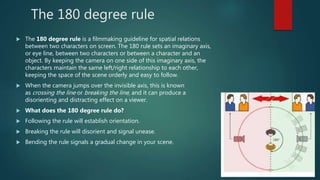
 The 180 degree rule is a filmmaking guideline for spatial relations
between two characters on screen. The 180 rule sets an imaginary axis,
or eye line, between two characters or between a character and an
object. By keeping the camera on one side of this imaginary axis, the
characters maintain the same left/right relationship to each other,
keeping the space of the scene orderly and easy to follow.
 When the camera jumps over the invisible axis, this is known
as crossing the line or breaking the line, and it can produce a
disorienting and distracting effect on a viewer.
 What does the 180 degree rule do?
 Following the rule will establish orientation.
 Breaking the rule will disorient and signal unease.
 Bending the rule signals a gradual change in your scene.
Matched on action
 One of the best ways to preserve continuous motion happens when you edit two different shots that contain
the same action. The action between shots is matched as precisely as possible, which is why it's helpful to
photograph action that is repetitive and when the action overlaps between shots.
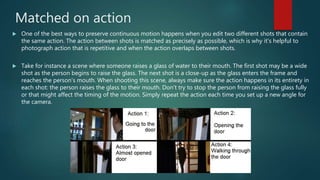
 Take for instance a scene where someone raises a glass of water to their mouth. The first shot may be a wide
shot as the person begins to raise the glass. The next shot is a close-up as the glass enters the frame and
reaches the person’s mouth. When shooting this scene, always make sure the action happens in its entirety in
each shot: the person raises the glass to their mouth. Don't try to stop the person from raising the glass fully
or that might affect the timing of the motion. Simply repeat the action each time you set up a new angle for
the camera.
Shot/reverse shot
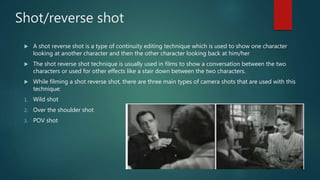
 A shot reverse shot is a type of continuity editing technique which is used to show one character
looking at another character and then the other character looking back at him/her
 The shot reverse shot technique is usually used in films to show a conversation between the two
characters or used for other effects like a stair down between the two characters.
 While filming a shot reverse shot, there are three main types of camera shots that are used with this
technique:
1. Wild shot
2. Over the shoulder shot
3. POV shot

Preliminary task2

  • 1.
    AS MEDIA STUDIES FOUNDATION PORTOFOLIO PRELIMINARYTASK VIDEO CONTINUITY TASK RESEARCH Mila Habek
  • 2.
    Introduction  Main focusfor this assignment is to produce continuity sequence that last about 1 minute . This video will show my knowledge of 3 media techniques: 1. The 180 degree rule, it is basic guide line that states that two characters in the same scene should have the same left/right relationship to each other 2. Shot/reverse shot is when one character is shown looking at another one, and opposite also 3. Match on action is when an action that begins in one shot is continued or completed into the next scene
  • 3.
    The 180 degreerule  The 180 degree rule is a filmmaking guideline for spatial relations between two characters on screen. The 180 rule sets an imaginary axis, or eye line, between two characters or between a character and an object. By keeping the camera on one side of this imaginary axis, the characters maintain the same left/right relationship to each other, keeping the space of the scene orderly and easy to follow.  When the camera jumps over the invisible axis, this is known as crossing the line or breaking the line, and it can produce a disorienting and distracting effect on a viewer.  What does the 180 degree rule do?  Following the rule will establish orientation.  Breaking the rule will disorient and signal unease.  Bending the rule signals a gradual change in your scene.
  • 4.
    Matched on action One of the best ways to preserve continuous motion happens when you edit two different shots that contain the same action. The action between shots is matched as precisely as possible, which is why it's helpful to photograph action that is repetitive and when the action overlaps between shots.  Take for instance a scene where someone raises a glass of water to their mouth. The first shot may be a wide shot as the person begins to raise the glass. The next shot is a close-up as the glass enters the frame and reaches the person’s mouth. When shooting this scene, always make sure the action happens in its entirety in each shot: the person raises the glass to their mouth. Don't try to stop the person from raising the glass fully or that might affect the timing of the motion. Simply repeat the action each time you set up a new angle for the camera.
  • 5.
    Shot/reverse shot  Ashot reverse shot is a type of continuity editing technique which is used to show one character looking at another character and then the other character looking back at him/her  The shot reverse shot technique is usually used in films to show a conversation between the two characters or used for other effects like a stair down between the two characters.  While filming a shot reverse shot, there are three main types of camera shots that are used with this technique: 1. Wild shot 2. Over the shoulder shot 3. POV shot