Learning
Objective
To develop our
understanding of technical
codes through consideration
of editing techniques
Technical codes - Editing
We can analyse:
–how long each shot lasts e.g. longer
shots = more relaxed mood
–the style of edit
–the type of transition
–We can also discuss the VFX in terms
of post production editing.
Editing
Briefly defined:
– the relationship between shots and the
process by which they are combined.
Why is editing important?
– The term editing refers to the changing shots
within a piece of film.
– Pace
– Graphic Match
– Rhythmic relationship
– Spatial relationship:
– Continuity and Non-continuity editing
– Transitions
Continuity editing
– Cutting shots to tell a story with
narrative continuity, helps the viewer
make sense of the action by implying
spatial relationships and ensuring
smooth flow from shot to shot.
– Realism - edit is invisible – a straight
‘cut’ - so action appears real rather
than constructed.
– There are 5 key continuity techniques:
Continuity editing
–master shot/establishing shot
–180 degree rule
–shot/reverse shot
–eyeline match
–match on action
Continuity editing
–master shot (establishing shot)
- This is our establishing or long shot
(establishes the space in which action
is to happen)
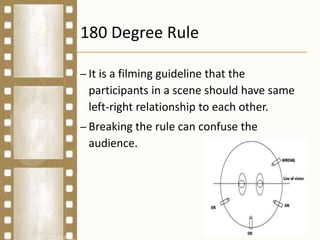
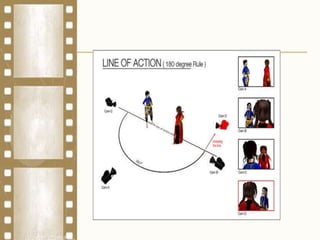
180 Degree Rule
– It is a filming guideline that the
participants in a scene should have same
left-right relationship to each other.
– Breaking the rule can confuse the
audience.
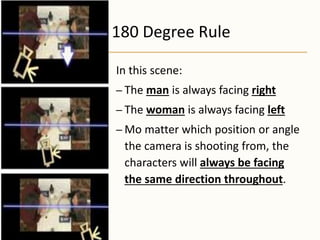
180 Degree Rule
In this scene:
– The man is always facing right
– The woman is always facing left
– Mo matter which position or angle
the camera is shooting from, the
characters will always be facing
the same direction throughout.
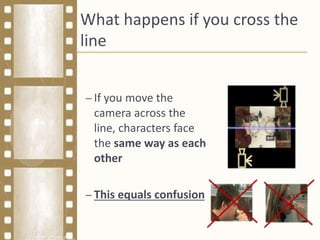
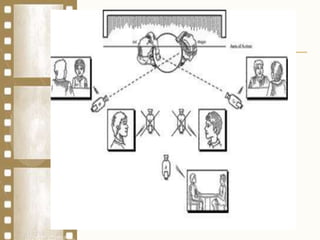
What happens if you cross the
line
– If you move the
camera across the
line, characters face
the same way as each
other
– This equals confusion
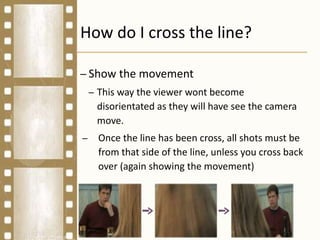
How do I cross the line?
– Show the movement
– This way the viewer wont become
disorientated as they will have see the camera
move.
– Once the line has been cross, all shots must be
from that side of the line, unless you cross back
over (again showing the movement)
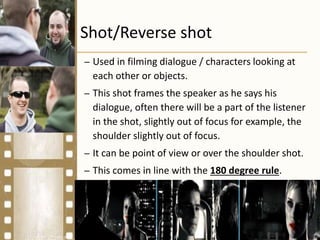
Shot/Reverse shot
– Used in filming dialogue / characters looking at
each other or objects.
– This shot frames the speaker as he says his
dialogue, often there will be a part of the listener
in the shot, slightly out of focus for example, the
shoulder slightly out of focus.
– It can be point of view or over the shoulder shot.
– This comes in line with the 180 degree rule.
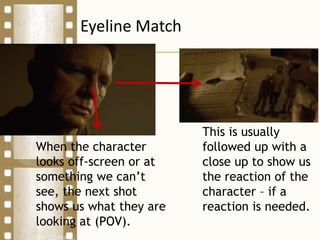
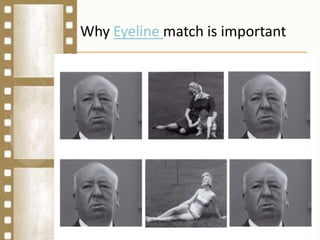
When the character
looks off-screen or at
something we can’t
see, the next shot
shows us what they are
looking at (POV).
This is usually
followed up with a
close up to show us
the reaction of the
character – if a
reaction is needed.
Eyeline Match
Why Eyeline match is important
Match on Action
– It is an editing technique for continuity editing in
which one shot cuts to another shot portraying
the action of the subject in the first shot.
– This creates an impression of continuity – visual
bridge. The view matches the action.
– It portrays a continuous sense of the same action
rather than 2 separate scenarios (although you
may have shot it at different days).
– Watch this scene from the Matrix
Remember:
– Wearing the same clothes
– Appears identical to the previous filming
time
– Lighting (time of day/weather)
– Clocks in the view must be same time.
– Also if person entering on the left they
have to leave on the right.
Non-Continuity
– Montage – giving information in
compressed form – can come under…
– Non-continuity editing – Continuity is
broken and construction is more apparent.
Meaning often created through
juxtaposition and metaphor shot inserts.
Transitions
The process of cutting from one shot to
another. The most common is:
1. The straight cut or simply ‘cut’.
However there are other means of transition
available to a film editor:
2. Fade to black
3. Dissolve/cross fade
4. Wipe
Watch the clip

Lesson 5 Editing

  • 1.
    Learning Objective To develop our understandingof technical codes through consideration of editing techniques
  • 2.
    Technical codes -Editing We can analyse: –how long each shot lasts e.g. longer shots = more relaxed mood –the style of edit –the type of transition –We can also discuss the VFX in terms of post production editing.
  • 3.
    Editing Briefly defined: – therelationship between shots and the process by which they are combined.
  • 4.
    Why is editingimportant? – The term editing refers to the changing shots within a piece of film. – Pace – Graphic Match – Rhythmic relationship – Spatial relationship: – Continuity and Non-continuity editing – Transitions
  • 5.
    Continuity editing – Cuttingshots to tell a story with narrative continuity, helps the viewer make sense of the action by implying spatial relationships and ensuring smooth flow from shot to shot. – Realism - edit is invisible – a straight ‘cut’ - so action appears real rather than constructed. – There are 5 key continuity techniques:
  • 6.
    Continuity editing –master shot/establishingshot –180 degree rule –shot/reverse shot –eyeline match –match on action
  • 7.
    Continuity editing –master shot(establishing shot) - This is our establishing or long shot (establishes the space in which action is to happen)
  • 8.
    180 Degree Rule –It is a filming guideline that the participants in a scene should have same left-right relationship to each other. – Breaking the rule can confuse the audience.
  • 9.
    180 Degree Rule Inthis scene: – The man is always facing right – The woman is always facing left – Mo matter which position or angle the camera is shooting from, the characters will always be facing the same direction throughout.
  • 10.
    What happens ifyou cross the line – If you move the camera across the line, characters face the same way as each other – This equals confusion
  • 11.
    How do Icross the line? – Show the movement – This way the viewer wont become disorientated as they will have see the camera move. – Once the line has been cross, all shots must be from that side of the line, unless you cross back over (again showing the movement)
  • 13.
    Shot/Reverse shot – Usedin filming dialogue / characters looking at each other or objects. – This shot frames the speaker as he says his dialogue, often there will be a part of the listener in the shot, slightly out of focus for example, the shoulder slightly out of focus. – It can be point of view or over the shoulder shot. – This comes in line with the 180 degree rule.
  • 15.
    When the character looksoff-screen or at something we can’t see, the next shot shows us what they are looking at (POV). This is usually followed up with a close up to show us the reaction of the character – if a reaction is needed. Eyeline Match
  • 16.
    Why Eyeline matchis important
  • 17.
    Match on Action –It is an editing technique for continuity editing in which one shot cuts to another shot portraying the action of the subject in the first shot. – This creates an impression of continuity – visual bridge. The view matches the action. – It portrays a continuous sense of the same action rather than 2 separate scenarios (although you may have shot it at different days). – Watch this scene from the Matrix
  • 18.
    Remember: – Wearing thesame clothes – Appears identical to the previous filming time – Lighting (time of day/weather) – Clocks in the view must be same time. – Also if person entering on the left they have to leave on the right.
  • 19.
    Non-Continuity – Montage –giving information in compressed form – can come under… – Non-continuity editing – Continuity is broken and construction is more apparent. Meaning often created through juxtaposition and metaphor shot inserts.
  • 20.
    Transitions The process ofcutting from one shot to another. The most common is: 1. The straight cut or simply ‘cut’. However there are other means of transition available to a film editor: 2. Fade to black 3. Dissolve/cross fade 4. Wipe Watch the clip