ISSN: 2278 – 1323
International Journal of Advanced Research in Computer Engineering & Technology (IJARCET)
Volume 2, No 5, May 2013
1743
www.ijarcet.org
750kv Transmission Line parameter and line Efficiency
calculation and the performance of High Voltage alternating
current Transmission system using MATLAB program
Alka Szeerin Mansoori
M.E. Student of Electrical Engineering Department, Jabalpur Engineering College, Jabalpur
Under guidance of Associate Professor. Mrs. Ranjana Nigam Singh. Professor Electrical
Engg. Department, Jabalpur Engineering College, Jabalpur
______________________________________________________________________________
Abstract— This paper presents the electrical system
for 750kv transmission line and also that have been
built throughout the world to operate above
700kv.This paper is provides information of system
planning, design and programming of the
transmission line. In this paper discussed by the over
head high voltage 3-phase transmission line problem.
The problem is that: 750kv transmission line, it
distance 500km, and it handling capacitive load is
2000MW calculate and discussed . These papers also
consider that important that the design and operation
of transmission line parameter and efficiency
determination. The Line losses and the efficiency of
transmission are depends on line parameter. These
values are greatly influenced by the line constant R,
L and C of transmission line. For instant of voltage
drop in the line depend upon the above value of line
parameter. The system performance is tested under
steady-state condition. The line parameters and
performance have been calculated by using several
MATLAB functions, With MATLAB programs of
transmission line analyzes the behavior and
parameter of transmission line under the shunt
compensation condition to a long transmission line
and performance sending end and receiving end. The
results after simulation help in designing of extra
high voltage long transmission line model. This paper
also show that two condition of transmission line:
with and without shunt compensation. The intent of
this paper is to provide information power handling
capacity per circuit, number of circuits sag, average
height, L, C, line parameter ABCD, receiving end
current, sending end voltage, current, and power,
line losses, and line efficiency.
Keywords: Over head high voltage transmission line,
Shunt compensation, MATLAB programming.
Introduction: Once High voltage AC power
transmission become feasible in this century. The use
of increasingly higher voltages for transmitting
power efficiency over long distance. Higher voltage
transmission lines were also essential for the
development of large interconnected power networks.
This paper is considered that the capacity of
transmission lines is becoming the main bottleneck of
electricity transmission in the unregulated power
industry [1]. The competition of electricity may
aggravate load ability of some transmission lines. To
meet the load demands in a power system and to
satisfy the stability and reliability criteria, the
transmission lines must be utilized more efficiently.
The purpose of the transmission network is to pool
power plants and load centers in order to supply the
load at a required reliability and maximum efficiency
at a lower cost a technically attractive solution to
above problems is to use some efficient controls with
the help of general MATLAB program. The
transmission line parameters have been obtained and
efficiency has been calculated on that transmission
line. This paper also discussed with and without
shunt compensation condition as the same high
voltage transmission line problem at same distance
and for same power frequency [2]. The results reveal
that: Power transfer capability and voltage profile of
transmission line is improved with compensating
device. Moreover the software package developed
using MATLAB is found to be quite useful as its
working is independent of transmission line length
and impedance of with and without shunt
compensation device. The results demonstrate the
performance of transmission line when the location
of compensating device is varied [3].
Performance Analysis of Compensated
Transmission Line
Consider that the transmission line parameters are
uniformly distributed and the line can be modeled by
a two-port, four-terminal network. Electrical power
transmission lines have three main parameters,
namely, resistance, inductance, and capacitance.
These parameters are uniformly distributed along the
entire length of the transmission lines. The inductive
ISSN: 2278 – 1323
International Journal of Advanced Research in Computer Engineering & Technology (IJARCET)
Volume 2, No 5, May 2013
1744
www.ijarcet.org
reactance of a transmission line, which is directly
proportional to the line inductance and the system
frequency, is by far the most important line parameter
because for normal line design, the power transfer
capability is highly affected by its magnitude. Hence,
the inductive reactance of transmission lines becomes
a problem of increasing importance when
transmission line length continues to increase [1, 2].
A decrease in the line inductive reactance increases
the power transfer capability. Paralleling two or more
similar lines is very effective in reducing the line
inductive reactance since the inductive reactance
decreases in inverse proportion to the number of
lines. However, this method is not well practiced
because of economic considerations [3, 4].
Shunt Controllers: The shunt controllers may be
variable impedance, variable source, or a
combination of these. In principle, all shunt
Controllers inject current into the system at the point
of connection. As long as the injected current is in
phase quadrature with the line voltage, the shunt
Controller only supplies or consumes variable
reactive power. For handling real power other phase
relationships are required. E.g. of shunt
controllers[3,4]
Series Controllers: The series Controller could be
variable impedance, such as capacitor, reactor, etc.,
or power electronics based variable source of main
frequency, sub synchronous and harmonic
frequencies to serve the desired need. In principle, all
series controllers inject voltage in series with the line.
As long as the voltage is in phase quadrature with the
line current, the series controller only supplies or
consumes variable reactive power. Any other phase
relationship will involve handling of real power as
well. e.g. of series controllers[3,4]
Design factor under steady state:
Design can be considered as synthesis of
analytical procedures that are available and an
enumerations of the limits and constraints under
which line designs have to be carried out. The steady-
state considerations are following:
1. Maximum allowable bus voltage and across
equipment for a given voltage level.
2. Bundling, energy for these factor s are important
for fixing the conductor diameter and number of
conductors in the bundle and have been
discussed.
3. Electrostatic field under the line at 50Hz
covered.
4. Compensation requirements for voltage control
as described.
MATLAB Module:-
An equations and constraints can be given here:
a. Number of circuit:
The power handling capacity of single circuit
P=0.5𝑉2
/ (Lx) MW/circuit
Where:
V =voltage in kV line-line;
L =line length in km;
x =total series reactance per km per phase.
r =line resistance per km per phase
%power loss is p=50 r/x;
b. Line clearance and phase spacing:
NESC recommends a minimum clearance of 29 feet=
8.84meters for first 33kv and 0.52 meter extra for
each 33kv.
Average height H = Hmin+S/3;
Where;
Hmin=minimum clearance height,
S=sag
c. Conductor Size and Number in
bundle: Using formula;
For the centre phase Emc;
Emc=Vm[1+(N-1)r/R]/[Nrln{2HS/req√(4𝐻2
+ 𝑆2
)}]
For the outer phases Emo;
Emo=Vm/(Nr)[1+(N-1)r/R]/[ln(2H/req)-
0.5ln{√(4𝐻2
+ 𝑆2
)(𝐻2
+ 𝑆2
)/ 𝑆2
}]
Where;
Vm=maximum operating voltage,
N =number of conductors in the bundle,
R =bundle radius,
r =radius of each conductor,
B = bundle spacing,
R=B/2 sin (𝜋/N)
req= √𝑟𝐵
𝑁
d. Electrostatic field:
The potential coefficient matrix elements;
Pii= ln (2H/req)
ISSN: 2278 – 1323
International Journal of Advanced Research in Computer Engineering & Technology (IJARCET)
Volume 2, No 5, May 2013
1745
www.ijarcet.org
Poc= ln ((2𝐻/𝑆)2
+ 1)
Poo= ln ((𝐻/𝑆)2
+ 1)
e. Line compensation Requirements:
From the [P] matrices, the average values of positive-
sequence inductance and capacitance are calculated:
Ls=0.2 Pii3
𝑖=1 mH/km
Lm=0.2(2Poc+Poo) mH/km
L+=Ls-Lm; mH/km
X+= 2𝜋f L+ ohm/km
Cs= 2𝜋eo Mii3
𝑖=1 nF/km
Cm= 2𝜋eo (2Moc+Moo) nF/km
So, C+=Cs-Cm; nF/km
y=2𝜋f C+ mho/km
Line Impedance: Z = (R+jX+) L
Line Admittance: Y =jyL
Surge Impedance: Zo = √(𝑍/𝑌)
Voltage Control at power frequency:
I. For line only: line parameter ABCD
formula is mentioned below-
A= cosh (√𝑍𝑌)
B= Zo sinh (√𝑍𝑌)
C= sinh (√𝑍𝑌)/Zo
D=A;
Receiving - End Power –Circle:-
Centre of x-axis and y-axis:
xc= - 𝑉2
A/B cos (𝜃𝑎-𝜃𝑏)
yc= - 𝑉2
A/B sin (𝜃𝑎-𝜃𝑏)
Radius = 𝐸𝑟 𝐸𝑠/𝐵
Where Er = V; Receiving end voltage,
The compensation required is:-
(𝑅𝑎𝑑𝑖𝑢𝑠)2
= (𝑃/𝑛 + xc )2
+ ( 𝑦𝑐 − 𝑄𝑟)
2
Where, n = no. of per circuit
The sending end voltage and current are
calculated. The load at the receiving end is:
Wr = P/n+jQr; MVA
Receiving end current is:-
Ir = Wr/√3 V; k Amp per phase
Equations for (Es, Is) in term of (Er, Ir) are
given below:-
𝐸𝑠
𝐼𝑠
=
𝐴, 𝐵
𝐶, 𝐷
𝐸𝑟/√3
𝐼𝑟
The Sending – End Power is:-
Ws = √3 Es Is; MVA
Therefore the line loss is:-
Pl = Re (Ws) – P/n; MW, 3-phase
The % line loss is =100 Pl/Re (Ws)
And the efficiency of transmission line is:-
Eff = 100 (P/n)/Re (Ws)
II. Shunt Reactor Compensation:-
The shunt compensate line parameter At, Bt,
Ct, Dt calculate with the help of line parameter
ABCD and use analytical equation shown below and
ISSN: 2278 – 1323
International Journal of Advanced Research in Computer Engineering & Technology (IJARCET)
Volume 2, No 5, May 2013
1746
www.ijarcet.org
also show that Relation equation shunt compensate
line parameter sending end voltage and current in
term of receiving end voltage and current. Same
procedures for calculation line loss and transmission
line efficiency with shunt compensate.
𝐴𝑡 𝐵𝑡
𝐶𝑡 𝐷𝑡
=
𝐴, 𝐵
𝐶, 𝐷
− 𝑗𝐵𝑙
𝐵 0
2𝐴 − 𝑗𝐵𝑙 𝐵 𝐵
Where,
Reactor admittance = Bl = 1/Xsh;
When a shunt compensating device is placed at a
distance of x km from the sending end, the resultant
generalized circuit constants of the compensated
transmission line, with reactance Xsh of the shunt
element respectively.
The value of compensating device depends up on the
following constraints such as:
• Market Availability:
By compensation studies, if one needs a value of
capacitor for a specific transmission line for a how
much degree of compensation, that value may not be
available in the market. Hence, whatever value is
available; one has to make use of that. In that case,
the degree of compensation would be different from
the determined value.
• Available Location for the Capacitor
Placement:
By compensation method, one might have arrived at
an optimum location for the placement of the
compensation scheme. At that location, there might
not be a sub-station to place the compensation
method. If so, then formation of a new sub-station
exclusively for this purpose becomes an expensive
affair. Instead, if there does a sub-station exist closer
to the study-based optimum location, then that
existing sub-station would be preferred for locating
the compensation scheme. For such a situation, the
degree of compensation as decided might be some
different [3].
• Expected Increase in Power Transfer:
Before deciding the degree of compensation, all the
parameters should be considered to ascertain whether
the existing line can cope with the increased amount
of power because of compensation.
• Transmission Efficiency:
With increased compensation at heavier loadings, the
transmission losses increase steeply. The
transmission efficiency is low. The compensation
corresponding to maximum received power cannot be
adopted. Hence, to improve efficiency of power
transmission, though series compensation is
considered, a small amount of shunt reactive volt–
ampere is required at the receiving end. The power
handling capacity can be increased; series capacitor
compensation results in certain harmful properties in
the system like increased short-circuit current and
sub-harmonic or sub-synchronous resonance
conditions during load changes and short
circuits[3,4,5].
Case Study
The following transmission line parameters are
obtained from HVAC transmission system. These
data described below table are obtained by using
MATLAB program for with and without shunt
compensation. The following results are obtained:
Transmitted to the power in receiving end in MW
Pl= 2000
Voltage in KV V=750
Line length in Km =500
Total series reactance per Km per phase X=.272
Minimum Clearance height in Meter Hmin=13
The max Operating voltage in KV Vmax=765/√3
The No. of conductor in the bundle N=4
The bundle spacing in Meter Bs=.4572
Bundle sub-conductor radius in Meter r=.015
Distance from the outer phase at the ground in meter
Do=15
The line resistance per Km per phase Rl=.0136
The value of shunt reactor admittance=1.037*10^(-3)
Frequency in Hz=50
ISSN: 2278 – 1323
International Journal of Advanced Research in Computer Engineering & Technology (IJARCET)
Volume 2, No 5, May 2013
1747
www.ijarcet.org
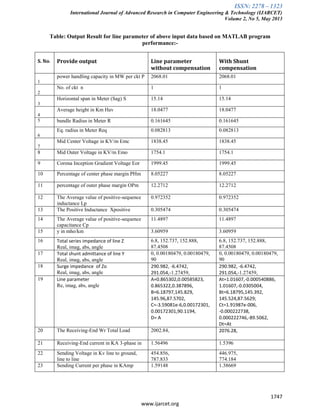
Table: Output Result for line parameter of above input data based on MATLAB program
performance:-
S. No. Provide output Line parameter
without compensation
With Shunt
compensation
1
power handling capacity in MW per ckt P 2068.01 2068.01
2
No. of ckt n 1 1
3
Horizontal span in Meter (Sag) S 15.14 15.14
4
Average height in Km Hav 18.0477 18.0477
5 bundle Radius in Meter R 0.161645 0.161645
6
Eq. radius in Meter Req 0.082813 0.082813
7
Mid Center Voltage in KV/m Emc 1838.45 1838.45
8 Mid Outer Voltage in KV/m Emo 1754.1 1754.1
9 Corona Inception Gradient Voltage Eor 1999.45 1999.45
10 Percentage of center phase margin PHm 8.05227 8.05227
11 percentage of outer phase margin OPm 12.2712 12.2712
12 The Average value of positive-sequence
inductance Lp
0.972352 0.972352
13 The Positive Inductance Xpositive 0.305474 0.305474
14 The Average value of positive-sequence
capacitance Cp
11.4897 11.4897
15 y in mho/km 3.60959 3.60959
16 Total series impedance of line Z
Real, imag, abs, angle
6.8, 152.737, 152.888,
87.4508
6.8, 152.737, 152.888,
87.4508
17 Total shunt admittance of line Y
Real, imag, abs, angle
0, 0.00180479, 0.00180479,
90
0, 0.00180479, 0.00180479,
90
18 Surge impedance of Zo
Real, imag, abs, angle
290.982, -6.4742,
291.054,-1.27459,
290.982, -6.4742,
291.054,-1.27459,
19 Line parameter
Re, imag, abs, angle
A=0.865302,0.00585823,
0.865322,0.387896,
B=6.18797,145.829,
145.96,87.5702,
C=-3.59081e-6,0.00172301,
0.00172301,90.1194,
D= A
At=1.01607,-0.000540886,
1.01607,-0.0305004,
Bt=6.18795,145.392,
145.524,87.5629;
Ct=1.91987e-006,
-0.000222738,
0.000222746,-89.5062,
Dt=At
20 The Receiving-End Wr Total Load 2002.84, 2076.28,
21 Receiving-End current in KA 3-phase in 1.56496 1.5396
22 Sending Voltage in Kv line to ground,
line to line
454.856,
787.833
446.975,
774.184
23 Sending Current per phase in KAmp 1.59148 1.38669
ISSN: 2278 – 1323
International Journal of Advanced Research in Computer Engineering & Technology (IJARCET)
Volume 2, No 5, May 2013
1748
www.ijarcet.org
24 Sending-end power MW 2443.97 2081.83
25 Percentage of power line loss 18.1658% 3.93047%
26 Efficiency of transmission line 81.8342% 96.0695%
These results are obtained by MATLAB program and
shown above table. It is concluded that in the
considered transmission line, if the available
compensating device is 1.037*10^ (-3) Ohms shunt
reactor admittance. Than eff. Improve 14.8608%.
Conclusion
This paper focus on the parameter design of the
transmission line system and it line efficiency. The
results for the system are obtained by the MATLAB
program and output result shown that above table.
For compared and calculate the line parameter and
efficiency of two conditions with and without shunt
compensation of transmission line with admittance
reactor Bl. Output result table clearly shown that the
condition of with shunt compensation line efficiency
improve that condition of without compensation line
efficiency and it losses are reduced. Where it is
placed. It is not necessary that a device which is
transferring maximum power will also be minimizing
the reactive losses.
The results found in this work would be very
useful in selecting the best for shunt compensation
show that table. It is also discussed that the shunt
controllers, sag, average height, power handling
capacity per circuit, center phase, outer phase,
electrostatic field, average value of positive sequence
inductance and capacitance, line impedance,
admittance, surge impedance, line parameter and
receiving end power also calculate the line efficiency
and line losses with and without compensation of ac
transmission systems, providing multifunctional
flexibility required to solve many of the problems
facing the power delivery industry. These controllers
are able to control, simultaneously or selectively, all
the parameters affecting power flow in the
transmission line (i.e. voltage, impedance and phase
angle).
REFRENCES
1. Rakosh Das Begamudre, “Extra High Voltage
AC Transmission Engg”, New Age
International (P) Limited, Publishers
2. P.Kundur, ―Power System Stability and
Control‖, New York: Mc Graw Hill 1992.
3. M.H.Haque, ―Optimal location of shunt
FACTS devices in long Transmission
Lines‖. © IEE,2000
4. C.Palanichamy, N.Sundar Babu, ―A Visual
Package for Educating Preparatory
Transmission Line Compensation‖. 0018-
9359/$20.00 © 2005 IEEE
5. Overview of Transmission line Above
700kv,‖Inaugural IEEE PES 2005
Conference and Exposition in Africa
Durban, South Africa, 11-15 July 2005‖ 0-
7803-9327-9/05/$20.00©2005 IEEE

1743 1748

  • 1.
    ISSN: 2278 –1323 International Journal of Advanced Research in Computer Engineering & Technology (IJARCET) Volume 2, No 5, May 2013 1743 www.ijarcet.org 750kv Transmission Line parameter and line Efficiency calculation and the performance of High Voltage alternating current Transmission system using MATLAB program Alka Szeerin Mansoori M.E. Student of Electrical Engineering Department, Jabalpur Engineering College, Jabalpur Under guidance of Associate Professor. Mrs. Ranjana Nigam Singh. Professor Electrical Engg. Department, Jabalpur Engineering College, Jabalpur ______________________________________________________________________________ Abstract— This paper presents the electrical system for 750kv transmission line and also that have been built throughout the world to operate above 700kv.This paper is provides information of system planning, design and programming of the transmission line. In this paper discussed by the over head high voltage 3-phase transmission line problem. The problem is that: 750kv transmission line, it distance 500km, and it handling capacitive load is 2000MW calculate and discussed . These papers also consider that important that the design and operation of transmission line parameter and efficiency determination. The Line losses and the efficiency of transmission are depends on line parameter. These values are greatly influenced by the line constant R, L and C of transmission line. For instant of voltage drop in the line depend upon the above value of line parameter. The system performance is tested under steady-state condition. The line parameters and performance have been calculated by using several MATLAB functions, With MATLAB programs of transmission line analyzes the behavior and parameter of transmission line under the shunt compensation condition to a long transmission line and performance sending end and receiving end. The results after simulation help in designing of extra high voltage long transmission line model. This paper also show that two condition of transmission line: with and without shunt compensation. The intent of this paper is to provide information power handling capacity per circuit, number of circuits sag, average height, L, C, line parameter ABCD, receiving end current, sending end voltage, current, and power, line losses, and line efficiency. Keywords: Over head high voltage transmission line, Shunt compensation, MATLAB programming. Introduction: Once High voltage AC power transmission become feasible in this century. The use of increasingly higher voltages for transmitting power efficiency over long distance. Higher voltage transmission lines were also essential for the development of large interconnected power networks. This paper is considered that the capacity of transmission lines is becoming the main bottleneck of electricity transmission in the unregulated power industry [1]. The competition of electricity may aggravate load ability of some transmission lines. To meet the load demands in a power system and to satisfy the stability and reliability criteria, the transmission lines must be utilized more efficiently. The purpose of the transmission network is to pool power plants and load centers in order to supply the load at a required reliability and maximum efficiency at a lower cost a technically attractive solution to above problems is to use some efficient controls with the help of general MATLAB program. The transmission line parameters have been obtained and efficiency has been calculated on that transmission line. This paper also discussed with and without shunt compensation condition as the same high voltage transmission line problem at same distance and for same power frequency [2]. The results reveal that: Power transfer capability and voltage profile of transmission line is improved with compensating device. Moreover the software package developed using MATLAB is found to be quite useful as its working is independent of transmission line length and impedance of with and without shunt compensation device. The results demonstrate the performance of transmission line when the location of compensating device is varied [3]. Performance Analysis of Compensated Transmission Line Consider that the transmission line parameters are uniformly distributed and the line can be modeled by a two-port, four-terminal network. Electrical power transmission lines have three main parameters, namely, resistance, inductance, and capacitance. These parameters are uniformly distributed along the entire length of the transmission lines. The inductive
  • 2.
    ISSN: 2278 –1323 International Journal of Advanced Research in Computer Engineering & Technology (IJARCET) Volume 2, No 5, May 2013 1744 www.ijarcet.org reactance of a transmission line, which is directly proportional to the line inductance and the system frequency, is by far the most important line parameter because for normal line design, the power transfer capability is highly affected by its magnitude. Hence, the inductive reactance of transmission lines becomes a problem of increasing importance when transmission line length continues to increase [1, 2]. A decrease in the line inductive reactance increases the power transfer capability. Paralleling two or more similar lines is very effective in reducing the line inductive reactance since the inductive reactance decreases in inverse proportion to the number of lines. However, this method is not well practiced because of economic considerations [3, 4]. Shunt Controllers: The shunt controllers may be variable impedance, variable source, or a combination of these. In principle, all shunt Controllers inject current into the system at the point of connection. As long as the injected current is in phase quadrature with the line voltage, the shunt Controller only supplies or consumes variable reactive power. For handling real power other phase relationships are required. E.g. of shunt controllers[3,4] Series Controllers: The series Controller could be variable impedance, such as capacitor, reactor, etc., or power electronics based variable source of main frequency, sub synchronous and harmonic frequencies to serve the desired need. In principle, all series controllers inject voltage in series with the line. As long as the voltage is in phase quadrature with the line current, the series controller only supplies or consumes variable reactive power. Any other phase relationship will involve handling of real power as well. e.g. of series controllers[3,4] Design factor under steady state: Design can be considered as synthesis of analytical procedures that are available and an enumerations of the limits and constraints under which line designs have to be carried out. The steady- state considerations are following: 1. Maximum allowable bus voltage and across equipment for a given voltage level. 2. Bundling, energy for these factor s are important for fixing the conductor diameter and number of conductors in the bundle and have been discussed. 3. Electrostatic field under the line at 50Hz covered. 4. Compensation requirements for voltage control as described. MATLAB Module:- An equations and constraints can be given here: a. Number of circuit: The power handling capacity of single circuit P=0.5𝑉2 / (Lx) MW/circuit Where: V =voltage in kV line-line; L =line length in km; x =total series reactance per km per phase. r =line resistance per km per phase %power loss is p=50 r/x; b. Line clearance and phase spacing: NESC recommends a minimum clearance of 29 feet= 8.84meters for first 33kv and 0.52 meter extra for each 33kv. Average height H = Hmin+S/3; Where; Hmin=minimum clearance height, S=sag c. Conductor Size and Number in bundle: Using formula; For the centre phase Emc; Emc=Vm[1+(N-1)r/R]/[Nrln{2HS/req√(4𝐻2 + 𝑆2 )}] For the outer phases Emo; Emo=Vm/(Nr)[1+(N-1)r/R]/[ln(2H/req)- 0.5ln{√(4𝐻2 + 𝑆2 )(𝐻2 + 𝑆2 )/ 𝑆2 }] Where; Vm=maximum operating voltage, N =number of conductors in the bundle, R =bundle radius, r =radius of each conductor, B = bundle spacing, R=B/2 sin (𝜋/N) req= √𝑟𝐵 𝑁 d. Electrostatic field: The potential coefficient matrix elements; Pii= ln (2H/req)
  • 3.
    ISSN: 2278 –1323 International Journal of Advanced Research in Computer Engineering & Technology (IJARCET) Volume 2, No 5, May 2013 1745 www.ijarcet.org Poc= ln ((2𝐻/𝑆)2 + 1) Poo= ln ((𝐻/𝑆)2 + 1) e. Line compensation Requirements: From the [P] matrices, the average values of positive- sequence inductance and capacitance are calculated: Ls=0.2 Pii3 𝑖=1 mH/km Lm=0.2(2Poc+Poo) mH/km L+=Ls-Lm; mH/km X+= 2𝜋f L+ ohm/km Cs= 2𝜋eo Mii3 𝑖=1 nF/km Cm= 2𝜋eo (2Moc+Moo) nF/km So, C+=Cs-Cm; nF/km y=2𝜋f C+ mho/km Line Impedance: Z = (R+jX+) L Line Admittance: Y =jyL Surge Impedance: Zo = √(𝑍/𝑌) Voltage Control at power frequency: I. For line only: line parameter ABCD formula is mentioned below- A= cosh (√𝑍𝑌) B= Zo sinh (√𝑍𝑌) C= sinh (√𝑍𝑌)/Zo D=A; Receiving - End Power –Circle:- Centre of x-axis and y-axis: xc= - 𝑉2 A/B cos (𝜃𝑎-𝜃𝑏) yc= - 𝑉2 A/B sin (𝜃𝑎-𝜃𝑏) Radius = 𝐸𝑟 𝐸𝑠/𝐵 Where Er = V; Receiving end voltage, The compensation required is:- (𝑅𝑎𝑑𝑖𝑢𝑠)2 = (𝑃/𝑛 + xc )2 + ( 𝑦𝑐 − 𝑄𝑟) 2 Where, n = no. of per circuit The sending end voltage and current are calculated. The load at the receiving end is: Wr = P/n+jQr; MVA Receiving end current is:- Ir = Wr/√3 V; k Amp per phase Equations for (Es, Is) in term of (Er, Ir) are given below:- 𝐸𝑠 𝐼𝑠 = 𝐴, 𝐵 𝐶, 𝐷 𝐸𝑟/√3 𝐼𝑟 The Sending – End Power is:- Ws = √3 Es Is; MVA Therefore the line loss is:- Pl = Re (Ws) – P/n; MW, 3-phase The % line loss is =100 Pl/Re (Ws) And the efficiency of transmission line is:- Eff = 100 (P/n)/Re (Ws) II. Shunt Reactor Compensation:- The shunt compensate line parameter At, Bt, Ct, Dt calculate with the help of line parameter ABCD and use analytical equation shown below and
  • 4.
    ISSN: 2278 –1323 International Journal of Advanced Research in Computer Engineering & Technology (IJARCET) Volume 2, No 5, May 2013 1746 www.ijarcet.org also show that Relation equation shunt compensate line parameter sending end voltage and current in term of receiving end voltage and current. Same procedures for calculation line loss and transmission line efficiency with shunt compensate. 𝐴𝑡 𝐵𝑡 𝐶𝑡 𝐷𝑡 = 𝐴, 𝐵 𝐶, 𝐷 − 𝑗𝐵𝑙 𝐵 0 2𝐴 − 𝑗𝐵𝑙 𝐵 𝐵 Where, Reactor admittance = Bl = 1/Xsh; When a shunt compensating device is placed at a distance of x km from the sending end, the resultant generalized circuit constants of the compensated transmission line, with reactance Xsh of the shunt element respectively. The value of compensating device depends up on the following constraints such as: • Market Availability: By compensation studies, if one needs a value of capacitor for a specific transmission line for a how much degree of compensation, that value may not be available in the market. Hence, whatever value is available; one has to make use of that. In that case, the degree of compensation would be different from the determined value. • Available Location for the Capacitor Placement: By compensation method, one might have arrived at an optimum location for the placement of the compensation scheme. At that location, there might not be a sub-station to place the compensation method. If so, then formation of a new sub-station exclusively for this purpose becomes an expensive affair. Instead, if there does a sub-station exist closer to the study-based optimum location, then that existing sub-station would be preferred for locating the compensation scheme. For such a situation, the degree of compensation as decided might be some different [3]. • Expected Increase in Power Transfer: Before deciding the degree of compensation, all the parameters should be considered to ascertain whether the existing line can cope with the increased amount of power because of compensation. • Transmission Efficiency: With increased compensation at heavier loadings, the transmission losses increase steeply. The transmission efficiency is low. The compensation corresponding to maximum received power cannot be adopted. Hence, to improve efficiency of power transmission, though series compensation is considered, a small amount of shunt reactive volt– ampere is required at the receiving end. The power handling capacity can be increased; series capacitor compensation results in certain harmful properties in the system like increased short-circuit current and sub-harmonic or sub-synchronous resonance conditions during load changes and short circuits[3,4,5]. Case Study The following transmission line parameters are obtained from HVAC transmission system. These data described below table are obtained by using MATLAB program for with and without shunt compensation. The following results are obtained: Transmitted to the power in receiving end in MW Pl= 2000 Voltage in KV V=750 Line length in Km =500 Total series reactance per Km per phase X=.272 Minimum Clearance height in Meter Hmin=13 The max Operating voltage in KV Vmax=765/√3 The No. of conductor in the bundle N=4 The bundle spacing in Meter Bs=.4572 Bundle sub-conductor radius in Meter r=.015 Distance from the outer phase at the ground in meter Do=15 The line resistance per Km per phase Rl=.0136 The value of shunt reactor admittance=1.037*10^(-3) Frequency in Hz=50
  • 5.
    ISSN: 2278 –1323 International Journal of Advanced Research in Computer Engineering & Technology (IJARCET) Volume 2, No 5, May 2013 1747 www.ijarcet.org Table: Output Result for line parameter of above input data based on MATLAB program performance:- S. No. Provide output Line parameter without compensation With Shunt compensation 1 power handling capacity in MW per ckt P 2068.01 2068.01 2 No. of ckt n 1 1 3 Horizontal span in Meter (Sag) S 15.14 15.14 4 Average height in Km Hav 18.0477 18.0477 5 bundle Radius in Meter R 0.161645 0.161645 6 Eq. radius in Meter Req 0.082813 0.082813 7 Mid Center Voltage in KV/m Emc 1838.45 1838.45 8 Mid Outer Voltage in KV/m Emo 1754.1 1754.1 9 Corona Inception Gradient Voltage Eor 1999.45 1999.45 10 Percentage of center phase margin PHm 8.05227 8.05227 11 percentage of outer phase margin OPm 12.2712 12.2712 12 The Average value of positive-sequence inductance Lp 0.972352 0.972352 13 The Positive Inductance Xpositive 0.305474 0.305474 14 The Average value of positive-sequence capacitance Cp 11.4897 11.4897 15 y in mho/km 3.60959 3.60959 16 Total series impedance of line Z Real, imag, abs, angle 6.8, 152.737, 152.888, 87.4508 6.8, 152.737, 152.888, 87.4508 17 Total shunt admittance of line Y Real, imag, abs, angle 0, 0.00180479, 0.00180479, 90 0, 0.00180479, 0.00180479, 90 18 Surge impedance of Zo Real, imag, abs, angle 290.982, -6.4742, 291.054,-1.27459, 290.982, -6.4742, 291.054,-1.27459, 19 Line parameter Re, imag, abs, angle A=0.865302,0.00585823, 0.865322,0.387896, B=6.18797,145.829, 145.96,87.5702, C=-3.59081e-6,0.00172301, 0.00172301,90.1194, D= A At=1.01607,-0.000540886, 1.01607,-0.0305004, Bt=6.18795,145.392, 145.524,87.5629; Ct=1.91987e-006, -0.000222738, 0.000222746,-89.5062, Dt=At 20 The Receiving-End Wr Total Load 2002.84, 2076.28, 21 Receiving-End current in KA 3-phase in 1.56496 1.5396 22 Sending Voltage in Kv line to ground, line to line 454.856, 787.833 446.975, 774.184 23 Sending Current per phase in KAmp 1.59148 1.38669
  • 6.
    ISSN: 2278 –1323 International Journal of Advanced Research in Computer Engineering & Technology (IJARCET) Volume 2, No 5, May 2013 1748 www.ijarcet.org 24 Sending-end power MW 2443.97 2081.83 25 Percentage of power line loss 18.1658% 3.93047% 26 Efficiency of transmission line 81.8342% 96.0695% These results are obtained by MATLAB program and shown above table. It is concluded that in the considered transmission line, if the available compensating device is 1.037*10^ (-3) Ohms shunt reactor admittance. Than eff. Improve 14.8608%. Conclusion This paper focus on the parameter design of the transmission line system and it line efficiency. The results for the system are obtained by the MATLAB program and output result shown that above table. For compared and calculate the line parameter and efficiency of two conditions with and without shunt compensation of transmission line with admittance reactor Bl. Output result table clearly shown that the condition of with shunt compensation line efficiency improve that condition of without compensation line efficiency and it losses are reduced. Where it is placed. It is not necessary that a device which is transferring maximum power will also be minimizing the reactive losses. The results found in this work would be very useful in selecting the best for shunt compensation show that table. It is also discussed that the shunt controllers, sag, average height, power handling capacity per circuit, center phase, outer phase, electrostatic field, average value of positive sequence inductance and capacitance, line impedance, admittance, surge impedance, line parameter and receiving end power also calculate the line efficiency and line losses with and without compensation of ac transmission systems, providing multifunctional flexibility required to solve many of the problems facing the power delivery industry. These controllers are able to control, simultaneously or selectively, all the parameters affecting power flow in the transmission line (i.e. voltage, impedance and phase angle). REFRENCES 1. Rakosh Das Begamudre, “Extra High Voltage AC Transmission Engg”, New Age International (P) Limited, Publishers 2. P.Kundur, ―Power System Stability and Control‖, New York: Mc Graw Hill 1992. 3. M.H.Haque, ―Optimal location of shunt FACTS devices in long Transmission Lines‖. © IEE,2000 4. C.Palanichamy, N.Sundar Babu, ―A Visual Package for Educating Preparatory Transmission Line Compensation‖. 0018- 9359/$20.00 © 2005 IEEE 5. Overview of Transmission line Above 700kv,‖Inaugural IEEE PES 2005 Conference and Exposition in Africa Durban, South Africa, 11-15 July 2005‖ 0- 7803-9327-9/05/$20.00©2005 IEEE