TheOntarioPublicLibrary
NarrativeToolkit
Presented by
FOPL, SOLS, OLS-NORTH and OLA MARKETING
A new story with a new
perspective on Ontario
Public Libraries.
In October of 2015 FOPL, SOLS, OLS-North and OLA
Marketing kicked off a three-year marketing effort to
drive new relevance with the general public. Core to
that effort was the development of a new marketing
tagline “A Visit Will Get You Thinking.”. This is a
hard-working line that acts as a call to action and
when placed in the right storylines, activates the
public’s imagination.
This narrative toolkit is designed to help you create
those storylines. It gives you everything from strategic
thought, to messaging structure and key sound bites.
It is a resource for you to return to over and over as
you bring the tagline, and your own Library’s brand
to life with new relevance.
DiscoverOur
Narrative
How is a narrative different from
a brand or a mission statement?
Your library likely has mission and vision statements, values
and guidelines for a logo. These thoughts and tools make up
your“brand”and drive consistency in your messaging. But the
library story is also made up of a structure that is flexible and
designed to invite people to emotionally participate with their
imagination. That structure is referred to as the“narrative”.
This toolkit is designed to help you understand and use that
narrative to creatively engage your target audiences.
The Power of a Narrative
There are a number of benefits to using a narrative
structure when it comes to talking about Ontario libraries:
1.	Stories are how humans communicate, persuade and rally 		
	 together. Culture is a collection of stories that unify people.
2.	People share stories and make them their own. They find
	 a space within stories for their beliefs. When that happens 		
	 they become advocates of a point of view.
Narrative Components
Good marketing narratives are made up of several
key storytelling components:
•	 Social point of view
•	 A strong why statement
•	 A description of how we uniquely do what we do
•	 A defined promise of consistent value
•	A hero and, of course, an antagonist
Social Point Of View
A social point of view is a perspective or belief that an
organization has which is larger than its immediate
activities, yet provides background for why it does what
it does. The social point of view becomes the foundation
for developing common purpose with large audiences.
For example, Patagonia, an outdoor clothing manufacturer
and retailer, has the following social point of view …
“The environment is a very special gift. We should enjoy
it. We should protect it.” Not only does this influence their
products, it also creates common purpose with advocates,
their customers and prospective customers.
OUR CAMPAIGN’S SOCIAL POINT OF VIEW IS:
Through personal growth we discover our uniqueness
and learn about our similarities—and because of both
we strengthen our communities.”
This point of view allows our marketing efforts to develop
a common purpose with a broad external audience who
may not find immediate relevance with a message about
library programs.
The Campaign“Why”
Every marketing narrative needs a strong why. Why do
modern public libraries exist and why do we come to work
everyday? A well articulated why helps people understand
our motives and creates context for all the facts that follow.
OUR WHY CAN BE EXPRESSED AS:
Communities must ensure everyone has the
opportunity and support for personal growth.
This also ensures community growth.”
The Public Library“How”
Within our story there needs to be an explanation of what
we uniquely do beyond descriptions of services.
OUR HOW STATEMENT IS:
Public libraries are a community’s physical and virtual
home for expanding people’s horizons through work-
shops, maker programs, discussion groups, speaking
engagements, accessing technology or finding those
special words that will inspire people for years to come.”
The Promise
Our social point of view, plus our why and how statements
allows us to make a relevant and very believable promise to
the public and ourselves.
OUR PROMISE IS:
When you visit a public library you will be pleasantly
surprised! You will be welcomed and supported in
your journey of personal growth.”
The Hero and Antagonists
It may sound silly to think of heroes and villains when
promoting an organization, but those concepts help frame
a story. They create drama that gets people to rally together.
Heroes and antagonists don’t always need to be people.
They can be issues or events as well.
IN OUR NARRATIVE, THE ANTAGONIST IS:
That personal feeling of being in a rut and not experiencing
the liberating excitement of personal growth.
THE HERO IS:
The individual who takes up our invitation to visit, and
become a member of a public library. It may seem like
a small act, but by doing so our heroes begin a journey
of personal growth through acquiring, and sharing,
knowledge and experience. They overcome stagnation
and grow with the community.
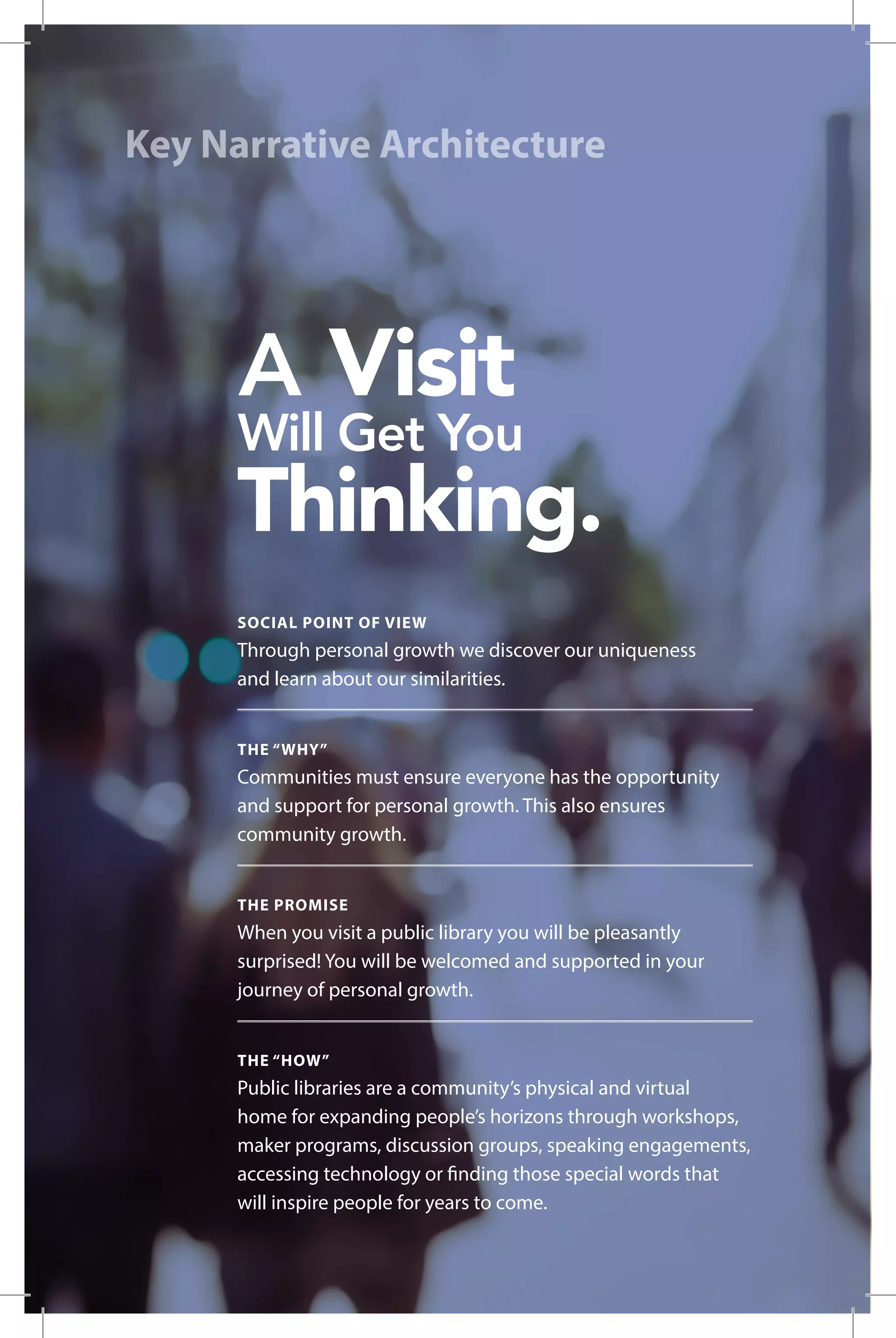
Key Narrative Architecture
SOCIAL POINT OF VIEW
Through personal growth we discover our uniqueness
and learn about our similarities.
THE “WHY”
Communities must ensure everyone has the opportunity
and support for personal growth. This also ensures
community growth.
THE PROMISE
When you visit a public library you will be pleasantly
surprised! You will be welcomed and supported in your
journey of personal growth.
THE “HOW”
Public libraries are a community’s physical and virtual
home for expanding people’s horizons through workshops,
maker programs, discussion groups, speaking engagements,
accessing technology or finding those special words that
will inspire people for years to come.
Products and Services
Within any marketing effort tangible products, programs and
offerings are clearly important. The elements of our narrative
create a compelling context for those facts. This narrative
strategy was created in an open fashion so it is easy for you to
insert your own brand and product offering. Use the narrative
to get people’s attention. Then proudly show them your stuff!
Tone and Personality
Our narrative has energy. It is positive and engaging.
It has this tonality for a reason. Libraries are the gateway
to expanding horizons and a connection to a feeling of
community. Libraries give people permission to move
beyond stagnation towards expansive growth.
This tonality also provides some of the intrigue within the
narrative. It is not what the audience currently associates
with libraries. It is a key part of the invitation to visit a public
library and change perspectives.
Storytelling Language
The marketing campaign will be targeting people in the
18-40 age group—both active library patrons and non-
library cardholders. This audience feels that the Internet has
overtaken the library. When they want to“learn”something
or get“information”, they believe the Internet is superior.
We don’t want to crash into pre existing beliefs. Beliefs
rarely change in the face of facts. However, if we replace
this language with terms such as “personal growth” and
“knowledge”—more action oriented activities—we can
offer people a new context and gain their initial interest
of our message.
Putting the components together
and creating stories.
There are many ways to use the narrative structure and there
are countless ways you can organize the story depending
on the need. You can literally cut and paste the narrative
components into a presentation as a way of explaining
why public libraries are relevant today and worth a second
consideration. Or, you can use your own creative language.
Regardless of the language you use, there are some core
structures that work most of the time:
•	Start with our social point of view. It builds a bridge to our audience
and creates a common belief or purpose. In social media it allows you
to enter existing conversations that, while not on the topic of public
libraries, do share a common purpose.
•	In shorter storylines you can lead off with the social point of view and
then jump directly to a version of our how and promise. Example:
	“Our community is not just where we live. It’s where we grow. It’s where we
discover our uniqueness and learn about our similarities. The public library
is that place were we can grow—as artists, musicians, speakers, writers,
dancers, makers, experts, parents, educators … together.
	Your public library helps you grow and you help the community grow.
A Visit Will Get You Thinking.“
•	The ultimate short story is a provocative introduction to a plot—
and since our goal is to get people to stop and reconsider their
public library, a provocative introduction may be all that is sometimes
needed. Here is an example where we use the hero and antagonist
roles to create curiosity:
	“When you think about your public library do you think about yourself?
Do you imagine yourself being energized, supported and doing new things?
(Yes, we said doing.) Do you imagine yourself growing, improving and
expanding your life within your community? A Visit Will Get You Thinking.”
•	 When developing a long story, where you need to give everyone
the complete picture, the following structure is recommended:
 Briefly set the stage with the villain and hero scenario.
	State our social point of view to build a common purpose
	 with your audience.
	Explain how that point of view uniquely manifests itself in
	 the context of your library. Tell your why.
	It is now time to tell people what you can do for them, but always
use the filter of our how. Show how the uniqueness of each program is
a result of the thoughts embedded in our how statement.
	 	Finally bring it home with the promise that “When you visit a public
library you will be pleasantly surprised! You will be welcomed and
supported in your journey of personal growth.”
•	 Example: “Does your today feel a lot like yesterday? Avoiding a tomorrow
that feels far too familiar starts with taking steps towards your own personal
growth. When we learn about our own uniqueness we also learn about what
we have in common with others. And, this makes our communities and us far
more interesting.
	Your public library is that place where you can start that journey. It is your
community’s home to workshops, maker programs, discussion groups,
speaking engagements, technology and those special words that will
inspire you for years to come.
	Your public library will surprise you … support you. It is where, together, we
can turn today into a very special someday. A Visit Will Get You Thinking.“
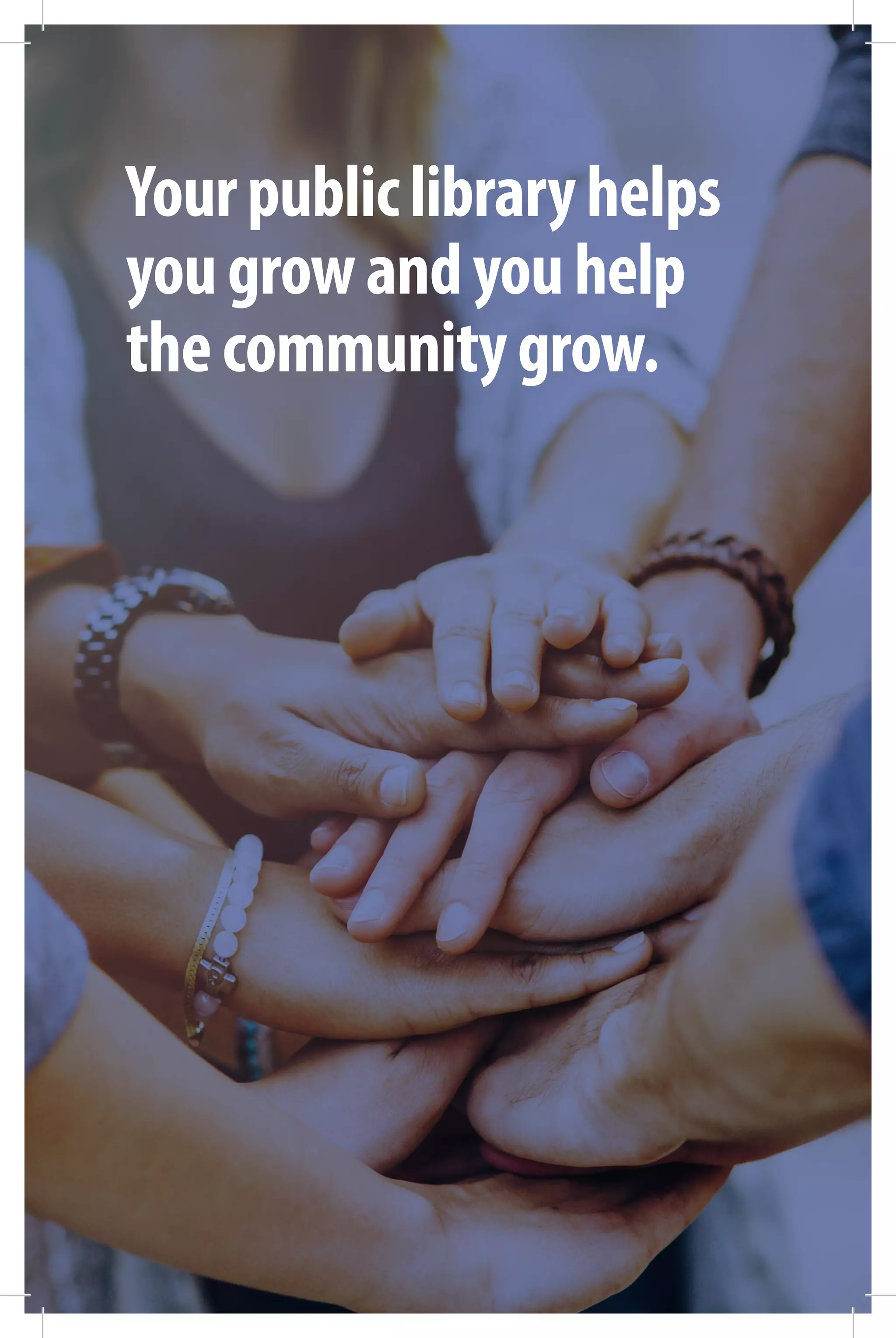
Yourpubliclibraryhelps
yougrowandyouhelp
thecommunitygrow.
Creative Content
The following content is an additional resource for you
to use within communication material, or perhaps it will
inspire you to write your own messages:
Story Lines
A narrative is meant to be flexible and inspiring. Small paragraphs can
say a lot when you inject narrative components. Here are some examples
for you to use:
“We all have a responsibility to use our brain and grow as individuals. It is
a responsibility that comes with being born. When we grow we learn
about our uniqueness and our similarities—and both help build better
communities. When we don’t grow we get smaller. Our lives get smaller.
So where do you go to grow, do things and connect with others like you?
Try your public library. A Visit Will Get You Thinking.”
Sound Bites
Even a single sentence can be a story. Here are some small“sound bites”
that can be used on posters, brochures or even in your emails. They help
weave our story.
“Where do you go to grow? Try your public library!
A Visit Will Get You Thinking.”
“Let’s discover our uniqueness and learn about our similarities.”
The public library is a place were we can grow—as artists, musicians,
speakers, writers, dancers, makers, experts, parents, educators … together.
Ultimately, a variation to our new tagline is the best sound bite of all.
A friendly challenge to everyone to reconsider their relationship with
their public library.
“A visit to your public library will get you thinking.
And that is a good thing.”
Public Service Announcement 1
“What is the growth engine of our community? Surprise! ... it’s you … and me.
Our community grows when we grow as individuals. Luckily we have
a tool to make growing easy. It is called the public library. It’s where we
can discover our uniqueness and learn about our similarities.
It’s that place were we can grow—as artists, musicians, speakers, writers,
dancers, makers, experts, parents, debaters, chefs, and even business titans
of the future, … together.
Your public library helps you grow. And, as we all become artistic, dancing,
business-writing titans of the future we help the community grow.
(Optional insert: “This month at your public library …”)
A Visit Will Get You Thinking.”
Public Service Announcement 2
“Someday you are going to learn flamenco dancing.
Someday you will build your own furniture, fearlessly give a speech in front
of a large crowd.
Someday you will meet people who like Italian cooking as much as you do.
You will learn about social media, join a debating club, create art, learn the
names of all the constellations, sing in a choir and take a lesson in welding.
Someday you will be supported when you talk about your dreams.
What if today was someday? Your public library is ready.
(Optional insert: “This month at your public library …”)
A Visit Will Get You Thinking.”
Where To Use Our Narrative
Our campaign narrative describes our contemporary
relevance in a very human and motivating way. You can
use it to expand your ability to engage external audiences.
The campaign social point of view can be used to allow
you to enter any number of discussions that are focused
on personal growth or building healthy communities.
This is because we believe“Through personal growth we
discover our uniqueness and learn about our similarities
—and because of both we strengthen our communities.”
•	 Join social media and use the social point of view
to comment on current events
•	 Engage with new groups who also want an improved 		
	 community and tell them our belief and what we do
•	 Use this broad common ground to reach new audiences 		
	 who think libraries are just for borrowing books
Looking for more
information?
Visit fopl.ca
Email sabram@fopl.ca
Call 416 669 4855

17 fpl001 narrativetoolkit_vf1_print

  • 1.
  • 2.
    A new storywith a new perspective on Ontario Public Libraries. In October of 2015 FOPL, SOLS, OLS-North and OLA Marketing kicked off a three-year marketing effort to drive new relevance with the general public. Core to that effort was the development of a new marketing tagline “A Visit Will Get You Thinking.”. This is a hard-working line that acts as a call to action and when placed in the right storylines, activates the public’s imagination. This narrative toolkit is designed to help you create those storylines. It gives you everything from strategic thought, to messaging structure and key sound bites. It is a resource for you to return to over and over as you bring the tagline, and your own Library’s brand to life with new relevance.
  • 3.
  • 4.
    How is anarrative different from a brand or a mission statement? Your library likely has mission and vision statements, values and guidelines for a logo. These thoughts and tools make up your“brand”and drive consistency in your messaging. But the library story is also made up of a structure that is flexible and designed to invite people to emotionally participate with their imagination. That structure is referred to as the“narrative”. This toolkit is designed to help you understand and use that narrative to creatively engage your target audiences. The Power of a Narrative There are a number of benefits to using a narrative structure when it comes to talking about Ontario libraries: 1. Stories are how humans communicate, persuade and rally together. Culture is a collection of stories that unify people. 2. People share stories and make them their own. They find a space within stories for their beliefs. When that happens they become advocates of a point of view. Narrative Components Good marketing narratives are made up of several key storytelling components: • Social point of view • A strong why statement • A description of how we uniquely do what we do • A defined promise of consistent value • A hero and, of course, an antagonist
  • 5.
    Social Point OfView A social point of view is a perspective or belief that an organization has which is larger than its immediate activities, yet provides background for why it does what it does. The social point of view becomes the foundation for developing common purpose with large audiences. For example, Patagonia, an outdoor clothing manufacturer and retailer, has the following social point of view … “The environment is a very special gift. We should enjoy it. We should protect it.” Not only does this influence their products, it also creates common purpose with advocates, their customers and prospective customers. OUR CAMPAIGN’S SOCIAL POINT OF VIEW IS: Through personal growth we discover our uniqueness and learn about our similarities—and because of both we strengthen our communities.” This point of view allows our marketing efforts to develop a common purpose with a broad external audience who may not find immediate relevance with a message about library programs.
  • 6.
    The Campaign“Why” Every marketingnarrative needs a strong why. Why do modern public libraries exist and why do we come to work everyday? A well articulated why helps people understand our motives and creates context for all the facts that follow. OUR WHY CAN BE EXPRESSED AS: Communities must ensure everyone has the opportunity and support for personal growth. This also ensures community growth.” The Public Library“How” Within our story there needs to be an explanation of what we uniquely do beyond descriptions of services. OUR HOW STATEMENT IS: Public libraries are a community’s physical and virtual home for expanding people’s horizons through work- shops, maker programs, discussion groups, speaking engagements, accessing technology or finding those special words that will inspire people for years to come.”
  • 7.
    The Promise Our socialpoint of view, plus our why and how statements allows us to make a relevant and very believable promise to the public and ourselves. OUR PROMISE IS: When you visit a public library you will be pleasantly surprised! You will be welcomed and supported in your journey of personal growth.” The Hero and Antagonists It may sound silly to think of heroes and villains when promoting an organization, but those concepts help frame a story. They create drama that gets people to rally together. Heroes and antagonists don’t always need to be people. They can be issues or events as well. IN OUR NARRATIVE, THE ANTAGONIST IS: That personal feeling of being in a rut and not experiencing the liberating excitement of personal growth. THE HERO IS: The individual who takes up our invitation to visit, and become a member of a public library. It may seem like a small act, but by doing so our heroes begin a journey of personal growth through acquiring, and sharing, knowledge and experience. They overcome stagnation and grow with the community.
  • 8.
    Key Narrative Architecture SOCIALPOINT OF VIEW Through personal growth we discover our uniqueness and learn about our similarities. THE “WHY” Communities must ensure everyone has the opportunity and support for personal growth. This also ensures community growth. THE PROMISE When you visit a public library you will be pleasantly surprised! You will be welcomed and supported in your journey of personal growth. THE “HOW” Public libraries are a community’s physical and virtual home for expanding people’s horizons through workshops, maker programs, discussion groups, speaking engagements, accessing technology or finding those special words that will inspire people for years to come.
  • 9.
    Products and Services Withinany marketing effort tangible products, programs and offerings are clearly important. The elements of our narrative create a compelling context for those facts. This narrative strategy was created in an open fashion so it is easy for you to insert your own brand and product offering. Use the narrative to get people’s attention. Then proudly show them your stuff! Tone and Personality Our narrative has energy. It is positive and engaging. It has this tonality for a reason. Libraries are the gateway to expanding horizons and a connection to a feeling of community. Libraries give people permission to move beyond stagnation towards expansive growth. This tonality also provides some of the intrigue within the narrative. It is not what the audience currently associates with libraries. It is a key part of the invitation to visit a public library and change perspectives. Storytelling Language The marketing campaign will be targeting people in the 18-40 age group—both active library patrons and non- library cardholders. This audience feels that the Internet has overtaken the library. When they want to“learn”something or get“information”, they believe the Internet is superior. We don’t want to crash into pre existing beliefs. Beliefs rarely change in the face of facts. However, if we replace this language with terms such as “personal growth” and “knowledge”—more action oriented activities—we can offer people a new context and gain their initial interest of our message.
  • 10.
    Putting the componentstogether and creating stories. There are many ways to use the narrative structure and there are countless ways you can organize the story depending on the need. You can literally cut and paste the narrative components into a presentation as a way of explaining why public libraries are relevant today and worth a second consideration. Or, you can use your own creative language. Regardless of the language you use, there are some core structures that work most of the time: • Start with our social point of view. It builds a bridge to our audience and creates a common belief or purpose. In social media it allows you to enter existing conversations that, while not on the topic of public libraries, do share a common purpose. • In shorter storylines you can lead off with the social point of view and then jump directly to a version of our how and promise. Example: “Our community is not just where we live. It’s where we grow. It’s where we discover our uniqueness and learn about our similarities. The public library is that place were we can grow—as artists, musicians, speakers, writers, dancers, makers, experts, parents, educators … together. Your public library helps you grow and you help the community grow. A Visit Will Get You Thinking.“ • The ultimate short story is a provocative introduction to a plot— and since our goal is to get people to stop and reconsider their public library, a provocative introduction may be all that is sometimes needed. Here is an example where we use the hero and antagonist roles to create curiosity: “When you think about your public library do you think about yourself? Do you imagine yourself being energized, supported and doing new things? (Yes, we said doing.) Do you imagine yourself growing, improving and expanding your life within your community? A Visit Will Get You Thinking.”
  • 11.
    • When developinga long story, where you need to give everyone the complete picture, the following structure is recommended: Briefly set the stage with the villain and hero scenario. State our social point of view to build a common purpose with your audience. Explain how that point of view uniquely manifests itself in the context of your library. Tell your why. It is now time to tell people what you can do for them, but always use the filter of our how. Show how the uniqueness of each program is a result of the thoughts embedded in our how statement. Finally bring it home with the promise that “When you visit a public library you will be pleasantly surprised! You will be welcomed and supported in your journey of personal growth.” • Example: “Does your today feel a lot like yesterday? Avoiding a tomorrow that feels far too familiar starts with taking steps towards your own personal growth. When we learn about our own uniqueness we also learn about what we have in common with others. And, this makes our communities and us far more interesting. Your public library is that place where you can start that journey. It is your community’s home to workshops, maker programs, discussion groups, speaking engagements, technology and those special words that will inspire you for years to come. Your public library will surprise you … support you. It is where, together, we can turn today into a very special someday. A Visit Will Get You Thinking.“
  • 12.
  • 13.
    Creative Content The followingcontent is an additional resource for you to use within communication material, or perhaps it will inspire you to write your own messages: Story Lines A narrative is meant to be flexible and inspiring. Small paragraphs can say a lot when you inject narrative components. Here are some examples for you to use: “We all have a responsibility to use our brain and grow as individuals. It is a responsibility that comes with being born. When we grow we learn about our uniqueness and our similarities—and both help build better communities. When we don’t grow we get smaller. Our lives get smaller. So where do you go to grow, do things and connect with others like you? Try your public library. A Visit Will Get You Thinking.” Sound Bites Even a single sentence can be a story. Here are some small“sound bites” that can be used on posters, brochures or even in your emails. They help weave our story. “Where do you go to grow? Try your public library! A Visit Will Get You Thinking.” “Let’s discover our uniqueness and learn about our similarities.” The public library is a place were we can grow—as artists, musicians, speakers, writers, dancers, makers, experts, parents, educators … together. Ultimately, a variation to our new tagline is the best sound bite of all. A friendly challenge to everyone to reconsider their relationship with their public library. “A visit to your public library will get you thinking. And that is a good thing.”
  • 14.
    Public Service Announcement1 “What is the growth engine of our community? Surprise! ... it’s you … and me. Our community grows when we grow as individuals. Luckily we have a tool to make growing easy. It is called the public library. It’s where we can discover our uniqueness and learn about our similarities. It’s that place were we can grow—as artists, musicians, speakers, writers, dancers, makers, experts, parents, debaters, chefs, and even business titans of the future, … together. Your public library helps you grow. And, as we all become artistic, dancing, business-writing titans of the future we help the community grow. (Optional insert: “This month at your public library …”) A Visit Will Get You Thinking.” Public Service Announcement 2 “Someday you are going to learn flamenco dancing. Someday you will build your own furniture, fearlessly give a speech in front of a large crowd. Someday you will meet people who like Italian cooking as much as you do. You will learn about social media, join a debating club, create art, learn the names of all the constellations, sing in a choir and take a lesson in welding. Someday you will be supported when you talk about your dreams. What if today was someday? Your public library is ready. (Optional insert: “This month at your public library …”) A Visit Will Get You Thinking.”
  • 15.
    Where To UseOur Narrative Our campaign narrative describes our contemporary relevance in a very human and motivating way. You can use it to expand your ability to engage external audiences. The campaign social point of view can be used to allow you to enter any number of discussions that are focused on personal growth or building healthy communities. This is because we believe“Through personal growth we discover our uniqueness and learn about our similarities —and because of both we strengthen our communities.” • Join social media and use the social point of view to comment on current events • Engage with new groups who also want an improved community and tell them our belief and what we do • Use this broad common ground to reach new audiences who think libraries are just for borrowing books
  • 16.
    Looking for more information? Visitfopl.ca Email sabram@fopl.ca Call 416 669 4855