Changing Stakeholder
Perceptions About Library Value
Presented by
Bill Irwin, PhD
Assistant Professor, Huron University
&
Kimberly Silk, MLS
Sr. Planning & Development Officer, Hamilton Public Library
OLA Super Conference 2019
Today’s Presentation
• Introductions
• Your Current State of Practice
• Metrics and the Monster We’ve Created
• The Unintended Consequences of Evaluation
• The Importance of Meaningful Metrics
• The Critical Role of Stakeholder Engagement
• Q & A
Introductions
Evaluation in your workplace:
the good, the bad and the ugly
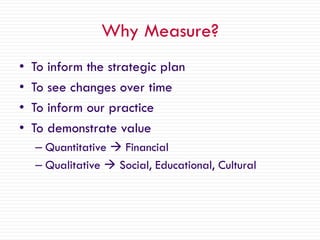
Why Measure?
• To inform the strategic plan
• To see changes over time
• To inform our practice
• To demonstrate value
– Quantitative à Financial
– Qualitative à Social, Educational, Cultural
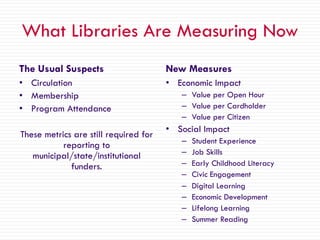
What Libraries Are Measuring Now
The Usual Suspects
• Circulation
• Membership
• Program Attendance
These metrics are still required for
reporting to
municipal/state/institutional
funders.
New Measures
• Economic Impact
– Value per Open Hour
– Value per Cardholder
– Value per Citizen
• Social Impact
– Student Experience
– Job Skills
– Early Childhood Literacy
– Civic Engagement
– Digital Learning
– Economic Development
– Lifelong Learning
– Summer Reading
The Monster We Created
• We deliver “traditional” metrics to
stakeholders:
– Membership, Circulation, Program Attendance
• These metrics lack context (chasing the metrics)
• These metrics do not reflect the evolution of
library success
ROI is Not the Whole Story
• ROI studies only look at proxies of economic
value
• Not all proxies are appropriate for all
communities
• Yes, we punch above our weight: So What?
• Social Impact is our real value, and where we
need to put our efforts
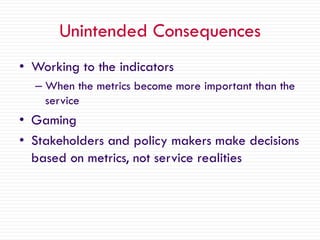
Unintended Consequences
• Working to the indicators
– When the metrics become more important than the
service
• Gaming
• Stakeholders and policy makers make decisions
based on metrics, not service realities
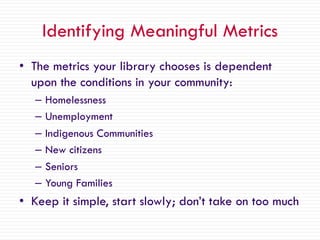
Identifying Meaningful Metrics
• The metrics your library chooses is dependent
upon the conditions in your community:
– Homelessness
– Unemployment
– Indigenous Communities
– New citizens
– Seniors
– Young Families
• Keep it simple, start slowly; don’t take on too much
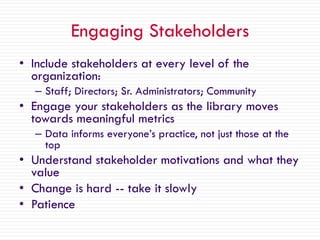
Engaging Stakeholders
• Include stakeholders at every level of the
organization:
– Staff; Directors; Sr. Administrators; Community
• Engage your stakeholders as the library moves
towards meaningful metrics
– Data informs everyone’s practice, not just those at the
top
• Understand stakeholder motivations and what they
value
• Change is hard -- take it slowly
• Patience
Q & A
Your turn:
Thank you for Listening
Bill Irwin - birwin6@uwo.ca
Kimberly Silk – ksilk@hpl.ca

OLA Super Conference 2019: Changing Stakeholder Perceptions About Library Value

  • 1.
    Changing Stakeholder Perceptions AboutLibrary Value Presented by Bill Irwin, PhD Assistant Professor, Huron University & Kimberly Silk, MLS Sr. Planning & Development Officer, Hamilton Public Library OLA Super Conference 2019
  • 2.
    Today’s Presentation • Introductions •Your Current State of Practice • Metrics and the Monster We’ve Created • The Unintended Consequences of Evaluation • The Importance of Meaningful Metrics • The Critical Role of Stakeholder Engagement • Q & A
  • 3.
    Introductions Evaluation in yourworkplace: the good, the bad and the ugly
  • 4.
    Why Measure? • Toinform the strategic plan • To see changes over time • To inform our practice • To demonstrate value – Quantitative à Financial – Qualitative à Social, Educational, Cultural
  • 5.
    What Libraries AreMeasuring Now The Usual Suspects • Circulation • Membership • Program Attendance These metrics are still required for reporting to municipal/state/institutional funders. New Measures • Economic Impact – Value per Open Hour – Value per Cardholder – Value per Citizen • Social Impact – Student Experience – Job Skills – Early Childhood Literacy – Civic Engagement – Digital Learning – Economic Development – Lifelong Learning – Summer Reading
  • 6.
    The Monster WeCreated • We deliver “traditional” metrics to stakeholders: – Membership, Circulation, Program Attendance • These metrics lack context (chasing the metrics) • These metrics do not reflect the evolution of library success
  • 7.
    ROI is Notthe Whole Story • ROI studies only look at proxies of economic value • Not all proxies are appropriate for all communities • Yes, we punch above our weight: So What? • Social Impact is our real value, and where we need to put our efforts
  • 8.
    Unintended Consequences • Workingto the indicators – When the metrics become more important than the service • Gaming • Stakeholders and policy makers make decisions based on metrics, not service realities
  • 9.
    Identifying Meaningful Metrics •The metrics your library chooses is dependent upon the conditions in your community: – Homelessness – Unemployment – Indigenous Communities – New citizens – Seniors – Young Families • Keep it simple, start slowly; don’t take on too much
  • 10.
    Engaging Stakeholders • Includestakeholders at every level of the organization: – Staff; Directors; Sr. Administrators; Community • Engage your stakeholders as the library moves towards meaningful metrics – Data informs everyone’s practice, not just those at the top • Understand stakeholder motivations and what they value • Change is hard -- take it slowly • Patience
  • 11.
  • 12.
    Thank you forListening Bill Irwin - birwin6@uwo.ca Kimberly Silk – ksilk@hpl.ca