UNIT I : Introduction to Design Thinking
By
Dr.K.Lalitha
Asso. Professor / IT
Kongu Engineering College
Perundurai, Erode, Tamilnadu, India
Thanks to and Resource from : Jeanne Liedtka and Tim Ogilvie, "Designing for Growth: A Design Thinking Tool Kit for Managers", NA Edition, Columbia University
Press, NA, 2011 & Lee Chong Hwa, "Design Thinking The Guidebook", NA Edition, Design Thinking Master Trainers of Bhutan, NA, 2017.
18GEO03 – Design Thinking for Engineers
Unit I : Contents
1. Introduction
2. Need for design thinking
3. Design and Business
4. The Design Process
5. Design Brief
6. Visualization
7. Four Questions & Ten Tools
4/11/2022 2
1.7 _ Explore - STEEP Analysis
8. Explore
9. STEEP Analysis
10. Strategic Priorities
11. Activity System
12. Stakeholder Mapping
13. Opportunity Framing
Design Thinking Stages/Phases
• 5 Stages/Phases and 17 Tools of Design Thinking
are proposed by
– the Design Thinking Master Trainers of Bhutan and
– facilitated by experts from Singapore Polytechnic
– (2nd Text Book)
4/11/2022 1.7 _ Explore - STEEP Analysis 3
Purpose/objective of this Guide Book
• Equip the DT practitioners
– to work on real projects by designing needs and solutions
with communities (users/citizen),
– to deeply understand the people they’re looking to serve,
– to dream up scores of ideas, and
– to create innovative new solutions rooted in people’s
actual needs
• DT practitioners can attain by using Design Thinking
through step by step guide with samples and ready to
use templates.
• This guidebook offers a comprehensive set of Methods
& Tools and activities that will take you from framing
up your design challenge to getting it to the decision
makers for implementation and users.
4/11/2022 1.7 _ Explore - STEEP Analysis 4
Some of the Key Principles and
Mindset
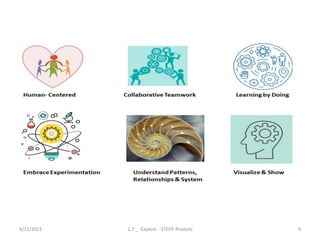
• Design Thinking human-centered problem
solving approach is based on a few easy-to-
understand principles:
– Human-centered
– Collaborative teamwork
– Learning by Doing
– Embrace Experimentation
– Understand patterns, relationships & systems
– Visualize and Show
4/11/2022 1.7 _ Explore - STEEP Analysis 5
4/11/2022 1.7 _ Explore - STEEP Analysis 6
Heart-on Hands-on Head-On Approach
4/11/2022 1.7 _ Explore - STEEP Analysis 7
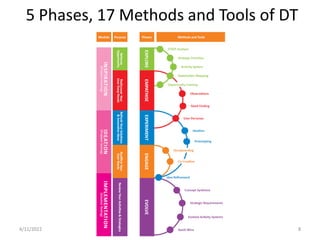
5 Phases, 17 Methods and Tools of DT
4/11/2022 1.7 _ Explore - STEEP Analysis 8
Introduction
• Design Thinking is not a perfectly linear process, and
each project invariably has its own contours and
character.
• Generally, you will move through three main modules:
– Inspiration,
– Ideation, and
– Implementation
• It includes 5 phases.
• When you move through the 5 phases,
– you will move from divergent thinking (create choices) to
convergent thinking (make choices).
4/11/2022 1.7 _ Explore - STEEP Analysis 9
Thinking Process
4/11/2022 1.7 _ Explore - STEEP Analysis 10
Scoping of design challenge
• When you want to work on real project using
Design Thinking, begin the process with a specific
and purposeful situation or problem to solve
called Design Challenge.
• The Design Challenge should be doable, clear,
actionable and hopefully inspiring.
• Your problem statement should be an outcome
and not a solution.
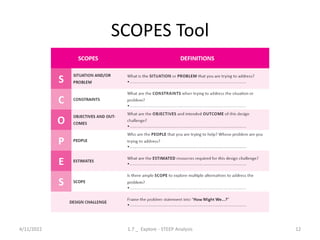
• You can use SCOPES as a tool to brainstorm and
frame your problem.
4/11/2022 1.7 _ Explore - STEEP Analysis 11
4/11/2022 1.7 _ Explore - STEEP Analysis 12
SCOPES Tool
Phase 1 - Explore
• After scoping the design challenge, the
explore phase focuses on reframing the
design challenge topic into design
opportunity from multiple perspectives.
4/11/2022 1.7 _ Explore - STEEP Analysis 13
Activities of Explore Phase
• Synthesis the STEEP trends analysis to gain insights on the
implications and context of your design challenge.
• Foster multiple perspectives to explore your design
challenge.
• Map the organization’s activity system/ecosystem as the
foundation model to leverage for your new idea delivery.
• Map key stakeholders to appreciate the key people who
determine the success of your design challenge
• Frame project (design challenge) into design opportunity
• Identify, select and invite your target stakeholders for the
interview
• Plan your design challenge project management.
4/11/2022 1.7 _ Explore - STEEP Analysis 14
Explore Phase
4/11/2022 1.7 _ Explore - STEEP Analysis 15
Explore Phase – Methods and Tools
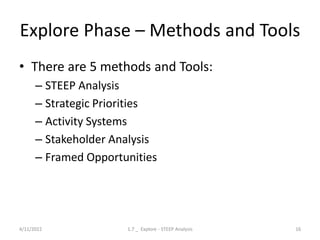
• There are 5 methods and Tools:
– STEEP Analysis
– Strategic Priorities
– Activity Systems
– Stakeholder Analysis
– Framed Opportunities
4/11/2022 1.7 _ Explore - STEEP Analysis 16
STEEP Analysis
4/11/2022 1.7 _ Explore - STEEP Analysis 17
What is STTEP Analysis?
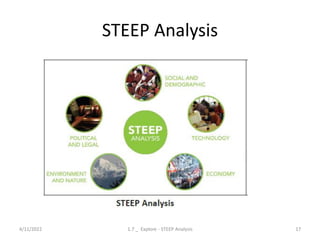
• STEEP Analysis is a tool to explore and determine the
impact of macro-environmental trends in the context of
the project topic (design challenge) as you should not limit
your thinking just to the people you are designing for.
• You may need to consider governments, international
partner and other stakeholders.
• STEEP Analysis is used:
– To understand the future opportunities and challenges.
– To keep an eye on the future while focusing on the possibilities
of the current as new services, processes, administration and
public policies may have to be developed in response to these
trends.
– To cultivate thinking which leads to future implications of the
present changes?
4/11/2022 1.7 _ Explore - STEEP Analysis 18
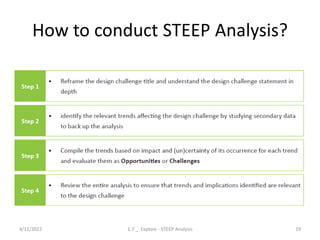
How to conduct STEEP Analysis?
4/11/2022 1.7 _ Explore - STEEP Analysis 19
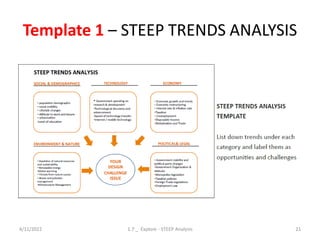
Templates to be used for the conduct
of STEEP analysis
4/11/2022 1.7 _ Explore - STEEP Analysis 20
Template 1 – STEEP TRENDS ANALYSIS
4/11/2022 1.7 _ Explore - STEEP Analysis 21
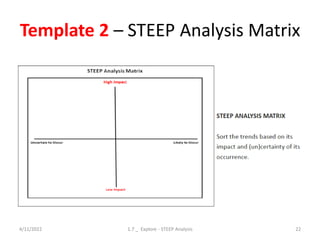
Template 2 – STEEP Analysis Matrix
4/11/2022 1.7 _ Explore - STEEP Analysis 22
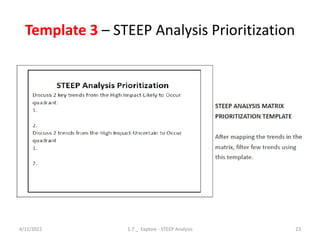
Template 3 – STEEP Analysis Prioritization
4/11/2022 1.7 _ Explore - STEEP Analysis 23
Thank you
4/11/2022 1.7 _ Explore - STEEP Analysis 24

1.7 _ Explore _ STEEP Analysis.pdf

  • 1.
    UNIT I :Introduction to Design Thinking By Dr.K.Lalitha Asso. Professor / IT Kongu Engineering College Perundurai, Erode, Tamilnadu, India Thanks to and Resource from : Jeanne Liedtka and Tim Ogilvie, "Designing for Growth: A Design Thinking Tool Kit for Managers", NA Edition, Columbia University Press, NA, 2011 & Lee Chong Hwa, "Design Thinking The Guidebook", NA Edition, Design Thinking Master Trainers of Bhutan, NA, 2017. 18GEO03 – Design Thinking for Engineers
  • 2.
    Unit I :Contents 1. Introduction 2. Need for design thinking 3. Design and Business 4. The Design Process 5. Design Brief 6. Visualization 7. Four Questions & Ten Tools 4/11/2022 2 1.7 _ Explore - STEEP Analysis 8. Explore 9. STEEP Analysis 10. Strategic Priorities 11. Activity System 12. Stakeholder Mapping 13. Opportunity Framing
  • 3.
    Design Thinking Stages/Phases •5 Stages/Phases and 17 Tools of Design Thinking are proposed by – the Design Thinking Master Trainers of Bhutan and – facilitated by experts from Singapore Polytechnic – (2nd Text Book) 4/11/2022 1.7 _ Explore - STEEP Analysis 3
  • 4.
    Purpose/objective of thisGuide Book • Equip the DT practitioners – to work on real projects by designing needs and solutions with communities (users/citizen), – to deeply understand the people they’re looking to serve, – to dream up scores of ideas, and – to create innovative new solutions rooted in people’s actual needs • DT practitioners can attain by using Design Thinking through step by step guide with samples and ready to use templates. • This guidebook offers a comprehensive set of Methods & Tools and activities that will take you from framing up your design challenge to getting it to the decision makers for implementation and users. 4/11/2022 1.7 _ Explore - STEEP Analysis 4
  • 5.
    Some of theKey Principles and Mindset • Design Thinking human-centered problem solving approach is based on a few easy-to- understand principles: – Human-centered – Collaborative teamwork – Learning by Doing – Embrace Experimentation – Understand patterns, relationships & systems – Visualize and Show 4/11/2022 1.7 _ Explore - STEEP Analysis 5
  • 6.
    4/11/2022 1.7 _Explore - STEEP Analysis 6
  • 7.
    Heart-on Hands-on Head-OnApproach 4/11/2022 1.7 _ Explore - STEEP Analysis 7
  • 8.
    5 Phases, 17Methods and Tools of DT 4/11/2022 1.7 _ Explore - STEEP Analysis 8
  • 9.
    Introduction • Design Thinkingis not a perfectly linear process, and each project invariably has its own contours and character. • Generally, you will move through three main modules: – Inspiration, – Ideation, and – Implementation • It includes 5 phases. • When you move through the 5 phases, – you will move from divergent thinking (create choices) to convergent thinking (make choices). 4/11/2022 1.7 _ Explore - STEEP Analysis 9
  • 10.
    Thinking Process 4/11/2022 1.7_ Explore - STEEP Analysis 10
  • 11.
    Scoping of designchallenge • When you want to work on real project using Design Thinking, begin the process with a specific and purposeful situation or problem to solve called Design Challenge. • The Design Challenge should be doable, clear, actionable and hopefully inspiring. • Your problem statement should be an outcome and not a solution. • You can use SCOPES as a tool to brainstorm and frame your problem. 4/11/2022 1.7 _ Explore - STEEP Analysis 11
  • 12.
    4/11/2022 1.7 _Explore - STEEP Analysis 12 SCOPES Tool
  • 13.
    Phase 1 -Explore • After scoping the design challenge, the explore phase focuses on reframing the design challenge topic into design opportunity from multiple perspectives. 4/11/2022 1.7 _ Explore - STEEP Analysis 13
  • 14.
    Activities of ExplorePhase • Synthesis the STEEP trends analysis to gain insights on the implications and context of your design challenge. • Foster multiple perspectives to explore your design challenge. • Map the organization’s activity system/ecosystem as the foundation model to leverage for your new idea delivery. • Map key stakeholders to appreciate the key people who determine the success of your design challenge • Frame project (design challenge) into design opportunity • Identify, select and invite your target stakeholders for the interview • Plan your design challenge project management. 4/11/2022 1.7 _ Explore - STEEP Analysis 14
  • 15.
    Explore Phase 4/11/2022 1.7_ Explore - STEEP Analysis 15
  • 16.
    Explore Phase –Methods and Tools • There are 5 methods and Tools: – STEEP Analysis – Strategic Priorities – Activity Systems – Stakeholder Analysis – Framed Opportunities 4/11/2022 1.7 _ Explore - STEEP Analysis 16
  • 17.
    STEEP Analysis 4/11/2022 1.7_ Explore - STEEP Analysis 17
  • 18.
    What is STTEPAnalysis? • STEEP Analysis is a tool to explore and determine the impact of macro-environmental trends in the context of the project topic (design challenge) as you should not limit your thinking just to the people you are designing for. • You may need to consider governments, international partner and other stakeholders. • STEEP Analysis is used: – To understand the future opportunities and challenges. – To keep an eye on the future while focusing on the possibilities of the current as new services, processes, administration and public policies may have to be developed in response to these trends. – To cultivate thinking which leads to future implications of the present changes? 4/11/2022 1.7 _ Explore - STEEP Analysis 18
  • 19.
    How to conductSTEEP Analysis? 4/11/2022 1.7 _ Explore - STEEP Analysis 19
  • 20.
    Templates to beused for the conduct of STEEP analysis 4/11/2022 1.7 _ Explore - STEEP Analysis 20
  • 21.
    Template 1 –STEEP TRENDS ANALYSIS 4/11/2022 1.7 _ Explore - STEEP Analysis 21
  • 22.
    Template 2 –STEEP Analysis Matrix 4/11/2022 1.7 _ Explore - STEEP Analysis 22
  • 23.
    Template 3 –STEEP Analysis Prioritization 4/11/2022 1.7 _ Explore - STEEP Analysis 23
  • 24.
    Thank you 4/11/2022 1.7_ Explore - STEEP Analysis 24