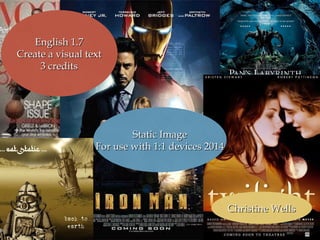
English 1.7
Create a visual text
3 credits

Static Image
For use with 1:1 devices 2014

Christine Wells
Discover
1. Identify & describe visual/verbal
features.
2. Select effective features to include
in a visual text.
Learning Intentions

3. Identify an important theme to
portray.
4. Explain why the visual and verbal
features are effective in
portraying the theme.
2
Discover: Your Mission…
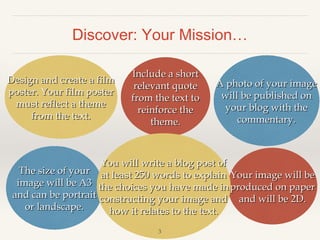
Design and create a film
poster. Your film poster
must reflect a theme
from the text.

Include a short
relevant quote
from the text to
reinforce the
theme.

A photo of your image
will be published on
your blog with the
commentary.

You will write a blog post of
The size of your at least 250 words to explain Your image will be
image will be A3 the choices you have made in produced on paper
and can be portrait constructing your image and and will be 2D.
or landscape.
how it relates to the text.
3
Discover: Features of a Static Image
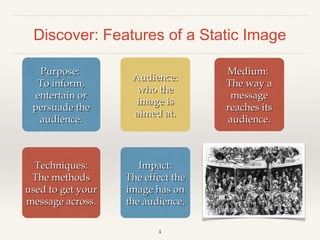
Purpose:
To inform,
entertain or
persuade the
audience.

Audience:
who the
image is
aimed at.

Techniques:
The methods
used to get your
message across.

Impact:
The effect the
image has on
the audience.
4

Medium:
The way a
message
reaches its
audience.
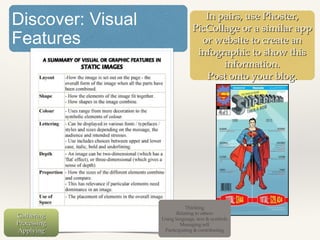
Discover: Visual
Features

Gathering
Processing
Applying

In pairs, use Phoster,
PicCollage or a similar app
or website to create an
infographic to show this
information.
Post onto your blog.

Thinking
Relating to others
Using language, text & symbols
Managing self
5 Participating & contributing
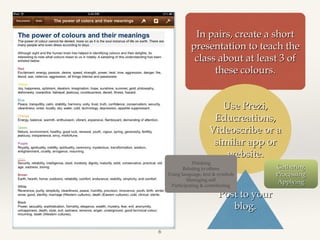
In pairs, create a short
presentation to teach the
class about at least 3 of
these colours.
Use Prezi,
Educreations,
Videoscribe or a
similar app or
website.

Thinking
Relating to others
Using language, text & symbols
Managing self
Participating & contributing

Post to your
blog.

6

Gathering
Processing
Applying
Discover: The Rule of
3rds
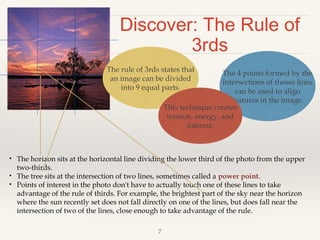
The rule of 3rds states that
an image can be divided
into 9 equal parts.

The 4 points formed by the
intersections of theses lines
can be used to align
features in the image.
This technique creates
tension, energy, and
interest.

•
•
•

The horizon sits at the horizontal line dividing the lower third of the photo from the upper
two-thirds.
The tree sits at the intersection of two lines, sometimes called a power point.
Points of interest in the photo don't have to actually touch one of these lines to take
advantage of the rule of thirds. For example, the brightest part of the sky near the horizon
where the sun recently set does not fall directly on one of the lines, but does fall near the
intersection of two of the lines, close enough to take advantage of the rule.
7
Thinking
Relating to others
Using language, text & symbols
Managing self
Participating & contributing

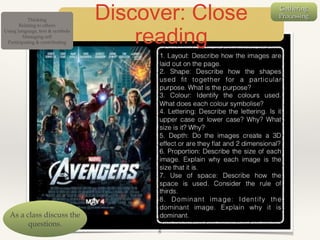
As a class discuss the
questions.

Discover: Close
reading

8

Gathering
Processing
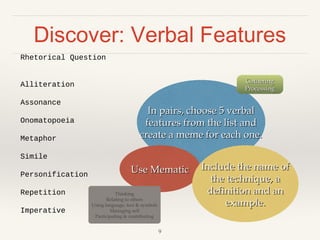
Discover: Verbal Features
Rhetorical Question
Gathering
Processing

Alliteration
Assonance
Onomatopoeia
Metaphor

In pairs, choose 5 verbal
features from the list and
create a meme for each one.

Simile
Personification
Repetition
Imperative

Use Mematic
Thinking
Relating to others
Using language, text & symbols
Managing self
Participating & contributing

9

Include the name of
the technique, a
definition and an
example.
Gathering
Processing

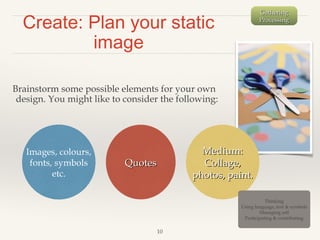
Create: Plan your static
image
 
Brainstorm some possible elements for your own
design. You might like to consider the following:
 
Images, colours,
fonts, symbols
etc.

Quotes

Medium:
Collage,
photos, paint.
Thinking
Using language, text & symbols
Managing self
Participating & contributing

10
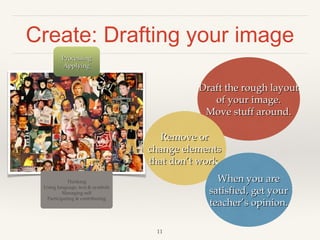
Create: Drafting your image
Processing
Applying

Draft the rough layout
of your image.
Move stuff around.
Remove or
change elements
that don’t work.
When you are
satisfied, get your
teacher’s opinion.

Thinking
Using language, text & symbols
Managing self
Participating & contributing

11
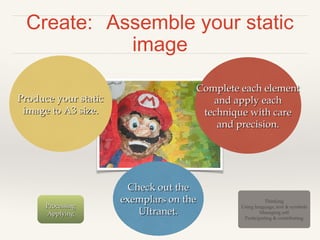
Create: Assemble your static
image
Complete each element
and apply each
technique with care
and precision.

Produce your static
image to A3 size.

Processing
Applying

Check out the
exemplars on the
Ultranet.
12

Thinking
Using language, text & symbols
Managing self
Participating & contributing
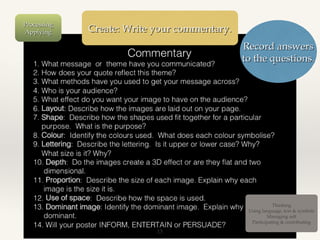
Processing
Applying

Create: Write your commentary.
Record answers
to the questions.

Thinking
Using language, text & symbols
Managing self
Participating & contributing

13
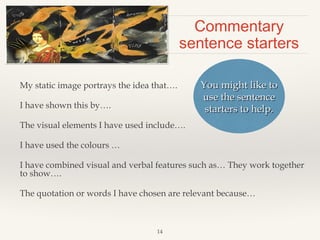
Commentary
sentence starters


My static image portrays the idea that….
I have shown this by….

You might like to
use the sentence
starters to help.

The visual elements I have used include….
I have used the colours …
I have combined visual and verbal features such as… They work together
to show….
The quotation or words I have chosen are relevant because…

14
Processing
Applying

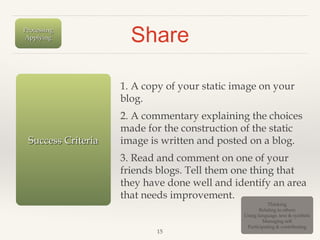
Share
1. A copy of your static image on your
blog.

Success Criteria

2. A commentary explaining the choices
made for the construction of the static
image is written and posted on a blog.
3. Read and comment on one of your
friends blogs. Tell them one thing that
they have done well and identify an area
that needs improvement.

15

Thinking
Relating to others
Using language, text & symbols
Managing self
Participating & contributing
Processing
Applying

Answer the
following
questions.

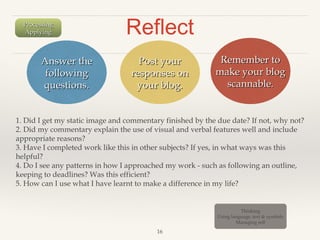
Reflect
Post your
responses on
your blog.

Remember to
make your blog
scannable.

1. Did I get my static image and commentary finished by the due date? If not, why not?
2. Did my commentary explain the use of visual and verbal features well and include
appropriate reasons?
3. Have I completed work like this in other subjects? If yes, in what ways was this
helpful?
4. Do I see any patterns in how I approached my work - such as following an outline,
keeping to deadlines? Was this efficient?
5. How can I use what I have learnt to make a difference in my life?

Thinking
Using language, text & symbols
Managing self

16
Bibliography

Adapted from NZQA task

http://www.slideshare.net/Kazmania/stati

1.7 Create a visual text

  • 1.
    English 1.7 Create avisual text 3 credits Static Image For use with 1:1 devices 2014 Christine Wells
  • 2.
    Discover 1. Identify &describe visual/verbal features. 2. Select effective features to include in a visual text. Learning Intentions 3. Identify an important theme to portray. 4. Explain why the visual and verbal features are effective in portraying the theme. 2
  • 3.
    Discover: Your Mission… Designand create a film poster. Your film poster must reflect a theme from the text. Include a short relevant quote from the text to reinforce the theme. A photo of your image will be published on your blog with the commentary. You will write a blog post of The size of your at least 250 words to explain Your image will be image will be A3 the choices you have made in produced on paper and can be portrait constructing your image and and will be 2D. or landscape. how it relates to the text. 3
  • 4.
    Discover: Features ofa Static Image Purpose: To inform, entertain or persuade the audience. Audience: who the image is aimed at. Techniques: The methods used to get your message across. Impact: The effect the image has on the audience. 4 Medium: The way a message reaches its audience.
  • 5.
    Discover: Visual Features Gathering Processing Applying In pairs,use Phoster, PicCollage or a similar app or website to create an infographic to show this information. Post onto your blog. Thinking Relating to others Using language, text & symbols Managing self 5 Participating & contributing
  • 6.
    In pairs, createa short presentation to teach the class about at least 3 of these colours. Use Prezi, Educreations, Videoscribe or a similar app or website. Thinking Relating to others Using language, text & symbols Managing self Participating & contributing Post to your blog. 6 Gathering Processing Applying
  • 7.
    Discover: The Ruleof 3rds The rule of 3rds states that an image can be divided into 9 equal parts. The 4 points formed by the intersections of theses lines can be used to align features in the image. This technique creates tension, energy, and interest. • • • The horizon sits at the horizontal line dividing the lower third of the photo from the upper two-thirds. The tree sits at the intersection of two lines, sometimes called a power point. Points of interest in the photo don't have to actually touch one of these lines to take advantage of the rule of thirds. For example, the brightest part of the sky near the horizon where the sun recently set does not fall directly on one of the lines, but does fall near the intersection of two of the lines, close enough to take advantage of the rule. 7
  • 8.
    Thinking Relating to others Usinglanguage, text & symbols Managing self Participating & contributing As a class discuss the questions. Discover: Close reading 8 Gathering Processing
  • 9.
    Discover: Verbal Features RhetoricalQuestion Gathering Processing Alliteration Assonance Onomatopoeia Metaphor In pairs, choose 5 verbal features from the list and create a meme for each one. Simile Personification Repetition Imperative Use Mematic Thinking Relating to others Using language, text & symbols Managing self Participating & contributing 9 Include the name of the technique, a definition and an example.
  • 10.
    Gathering Processing Create: Plan yourstatic image   Brainstorm some possible elements for your own design. You might like to consider the following:   Images, colours, fonts, symbols etc. Quotes Medium: Collage, photos, paint. Thinking Using language, text & symbols Managing self Participating & contributing 10
  • 11.
    Create: Drafting yourimage Processing Applying Draft the rough layout of your image. Move stuff around. Remove or change elements that don’t work. When you are satisfied, get your teacher’s opinion. Thinking Using language, text & symbols Managing self Participating & contributing 11
  • 12.
    Create: Assemble yourstatic image Complete each element and apply each technique with care and precision. Produce your static image to A3 size. Processing Applying Check out the exemplars on the Ultranet. 12 Thinking Using language, text & symbols Managing self Participating & contributing
  • 13.
    Processing Applying Create: Write yourcommentary. Record answers to the questions. Thinking Using language, text & symbols Managing self Participating & contributing 13
  • 14.
    Commentary sentence starters           My staticimage portrays the idea that…. I have shown this by…. You might like to use the sentence starters to help. The visual elements I have used include…. I have used the colours … I have combined visual and verbal features such as… They work together to show…. The quotation or words I have chosen are relevant because… 14
  • 15.
    Processing Applying Share 1. A copyof your static image on your blog. Success Criteria 2. A commentary explaining the choices made for the construction of the static image is written and posted on a blog. 3. Read and comment on one of your friends blogs. Tell them one thing that they have done well and identify an area that needs improvement. 15 Thinking Relating to others Using language, text & symbols Managing self Participating & contributing
  • 16.
    Processing Applying Answer the following questions. Reflect Post your responseson your blog. Remember to make your blog scannable. 1. Did I get my static image and commentary finished by the due date? If not, why not? 2. Did my commentary explain the use of visual and verbal features well and include appropriate reasons? 3. Have I completed work like this in other subjects? If yes, in what ways was this helpful? 4. Do I see any patterns in how I approached my work - such as following an outline, keeping to deadlines? Was this efficient? 5. How can I use what I have learnt to make a difference in my life? Thinking Using language, text & symbols Managing self 16
  • 17.
    Bibliography Adapted from NZQAtask http://www.slideshare.net/Kazmania/stati