Page Design
Fundamentals
  Ronnie R. Sunggay
What is Page Design or Newspaper
Makeup?

   According to Ceciliano-Jose
    Cruz, page design is the
    arrangement of illustrations and
    types on a page or spreadsheet
    which is to be reproduced
    graphically. Makeup is a happy
    marriage of aesthetics and
    mechanics.
   Makeup maybe defined as the
    arrangement of the display elements
    on a printed page, including
    headlines, body text, illustrations,
    photos, white spaces and rule or
    columns lines. Makeup refers to the
    page design of a newspaper, while
    layout is that of a magazine or
    advertisements.
                   By: Alito Mendoza
                        Journalism for Filipinos
 Newspapers  like people
 have their own
 personalities. The
 personality of a newspaper
 emerges in part through the
 nature and quality of its
 makeup.
          -Dewitt C. Rederick
Effective Makeup may be
planned using two procedures:

1.   By headline and text
     arrangement

2.   By way of text and
     photo combinations
BASIC QUESTIONS


• What size of newspaper format am I
going to plan? Tabloid size?
Newsletter/magazine size?
• For what type of readers am I
laying out the newspaper?

Keep in mind your answers to the above
questions when you lay out the newspaper.
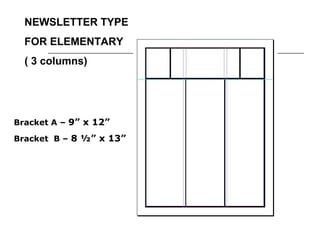
NEWSLETTER TYPE
  FOR ELEMENTARY
  ( 3 columns)


Bracket A – 9” x 12”

Bracket B – 8 ½” x 13”
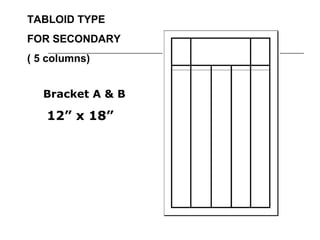
TABLOID TYPE
FOR SECONDARY
( 5 columns)


   Bracket A & B

   12” x 18”
Front Page Make up
     by Headline
and Text arrangement
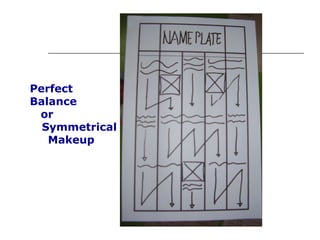
1.Perfect Balance
  or Symmetrical
   Makeup
Ex. A large headline placed
 in the upper first two
 columns of front page is
 balanced with a
 corresponding large
 headline in the 4th and
 fifth upper columns. Other
 headlines are similarly
 arranged.
A one column-cut at the
upper 2nd column is
balanced with another one
column cut at column 4. This
kind of makeup gives static
monotonous appearance to
the paper. It should not be
made from issue to issue.
Perfect
Balance
 or
  Symmetrical
   Makeup
2. Brace or Focus
 Makeup
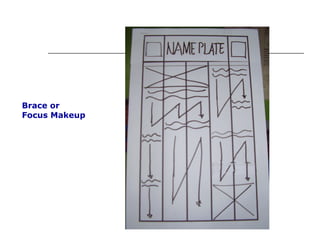
   Headlines are diagonally
    arranged from the upper left to
    the lower right hand corner or
    vice-versa just like a brace
    supporting a house. Balance is
    obtained by various devices
    such as two column heads,
    boxes , and cuts which are used
    to offset the weight
    concentrated in the upper right
    of upper left hand corner.
 This kind of makeup is
 desirable when one story is
 more important than any
 other because the readers
 attention is directed to the
 upper right hand corner or
 occasionally to the upper
 left.
Brace or
Focus Makeup
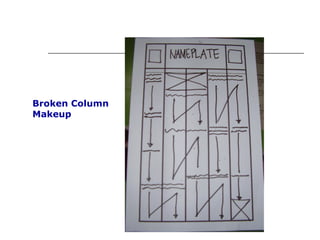
3. Broken Column
 Makeup
   The page is broken into several
    units to give space to many
    stories. Symmetry is obtained
    by carefully arranging the
    contents so as not to cancel
    each other by their nearness.
    Large heads and cuts are placed
    where they give the page a
    pleasing pattern.
   This kind of makeup is
    developed primarily to be able
    to print as many short stories
    on page one as possible.
Broken Column
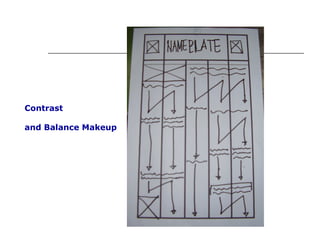
Makeup
4. Contrast and
 Balance Makeup
   This type groups are arranged
    at varying distances from the
    center like two boys on a see-
    saw. It is sometimes called
    occult or hidden balance
    because the type groups with its
    headline may be balanced with
    a picture, an illustration, or a
    box., or instead of a type group.
   No attempt is made to achieve
    perfect balance. This is one of
    the most popular kinds of front
    page makeup since it permits
    great variety from issue to
    issue.
Contrast

and Balance Makeup
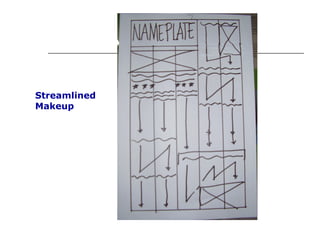
5. Streamlined
 Makeup
   The format is similar with that
    of the contrast and balance
    makeup. However, the
    nameplate is usually floated,
    headlines are flushed up in cap
    or lower case, and large body
    types are often used. Many
    closely cropped pictures are
    also used. Instead of boxing
    stories in full, the three quarter
    boxes are resorted to.
   Often bullets, asterisks, and jim
    dashes are employed to
    introduce lead stories. This kind
    of makeup is commonly used by
    high school papers than by the
    national dailies.
Streamlined
Makeup
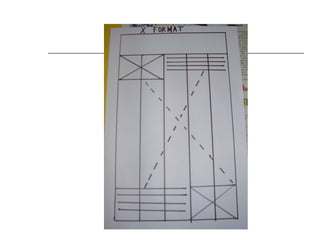
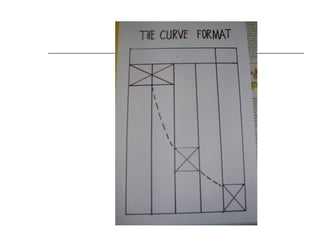
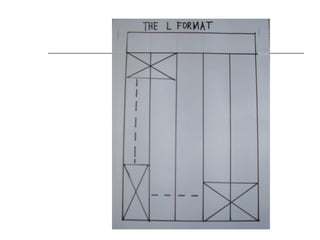
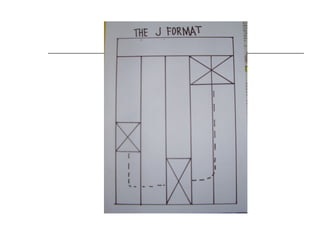
Makeup by way of Text
and Photo Combination Layout
for Front page:
   The   X Format
   The   Curve Format
   The   L Format
   The   J Format
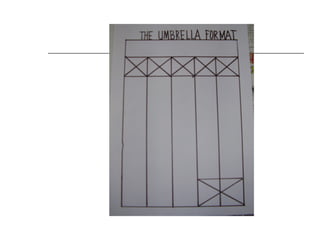
   The   Umbrella Format
Makeup of Inside Pages:
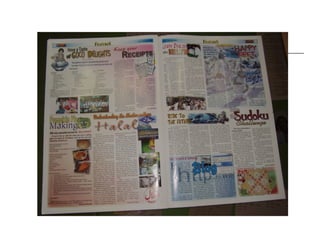
   While it is true that the front
    page of the newspaper is its
    show window, attractive
    makeup should not be confined
    to this page alone. The inside
    and back pages should be given
    the same tender care, treatment
    and attention by the layout
    artist.
For   Inside News pages
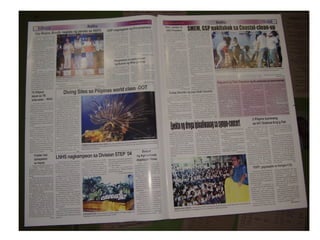
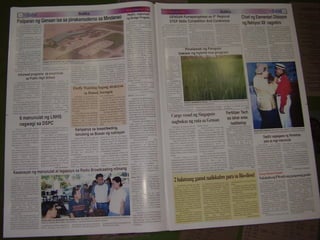
    Inside news pages should
     be laid out as facing page
     units rather than as single
     pages. The principles for
     contrast and balance used
     for front page makeup
     should also be considered.
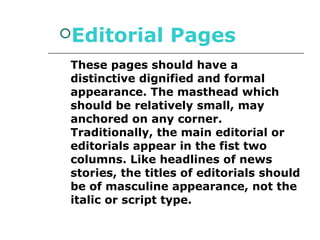
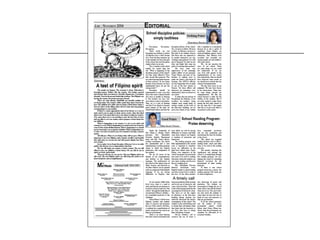
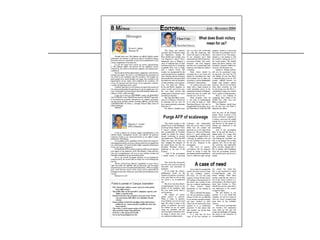
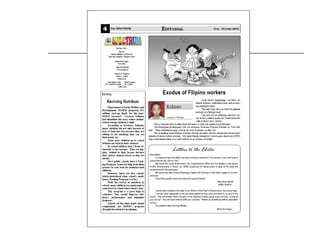
Editorial        Pages
 These pages should have a
 distinctive dignified and formal
 appearance. The masthead which
 should be relatively small, may
 anchored on any corner.
 Traditionally, the main editorial or
 editorials appear in the fist two
 columns. Like headlines of news
 stories, the titles of editorials should
 be of masculine appearance, not the
 italic or script type.
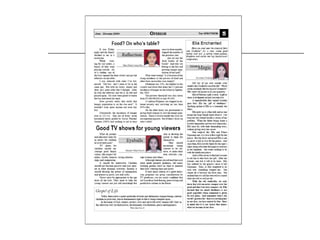
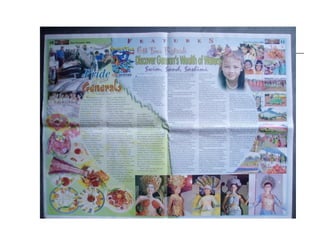
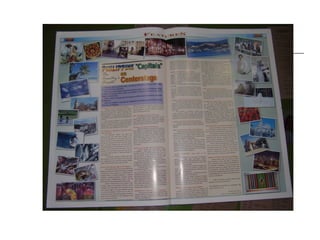
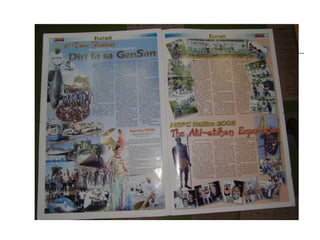
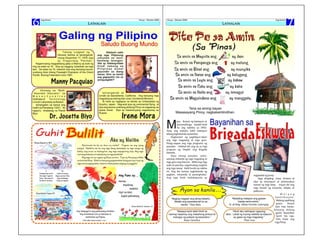
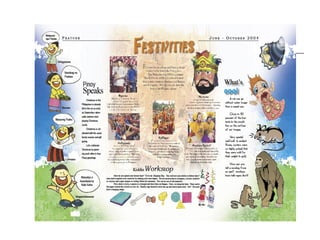
Feature     / Literary Pages
   These pages must have a
    feminine appearance. The
    columns are often wider.
    Roman and italic types are
    used for text. Feminine types
    like the coronet, mandate and
    liberty families may be used.
These pages have bolder but
livelier appearance than the
others. Their makeup should
suggest action, speed and
color. Large bold heads are
used.
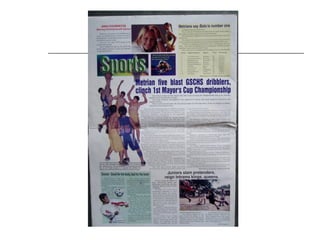
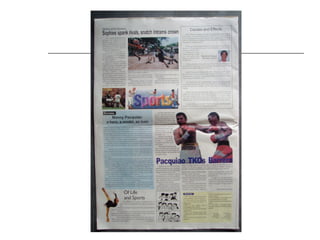
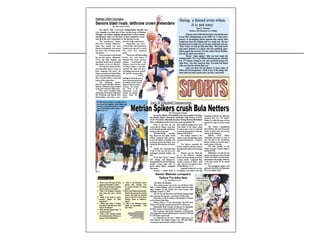
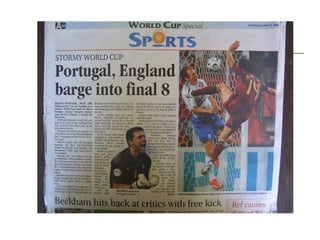
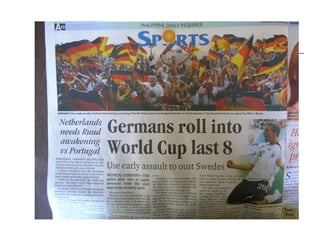
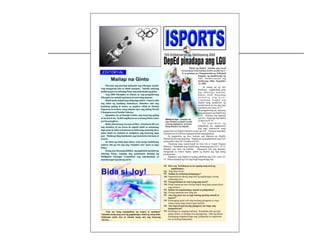
Sports       Pages
   These pages have bolder but
    livelier appearance than the
    others. Their makeup should
    suggest action, speed and
    color. Large bold heads are
    used.
PRINCIPLES OF
LAYOUT / PAGE
   MAKEUP
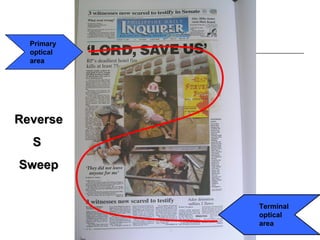
Primary
  optical
  area


Reverse
  S
Sweep


            Terminal
            optical
            area
Principle #1

Rank your stories. You must know what
the stories are about and evaluate their
news value. Don't be lazy; read them. Once
you have ranked them, generally
place them in descending order on
the   page   according  to   their
importance. Story placement is a
nonverbal    cue    that   indicates their
importance to readers. Don’t sacrifice
accuracy in favor of aesthetics.
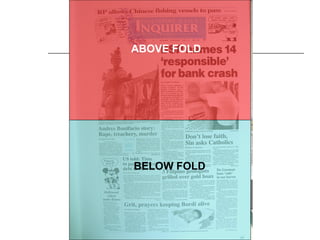
ABOVE FOLD


BELOW FOLD
Principle #2


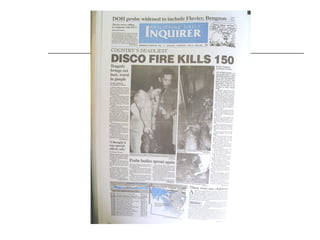
When you design, start with the art and
build your page around it. Pages are
built around photographs and graphics.
Your design options often will become
clear once you place photographs and
graphics, especially if they go with stories.
Principle #3

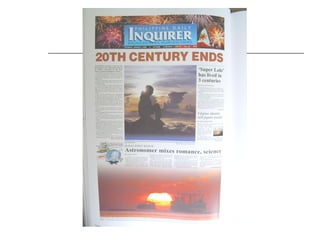
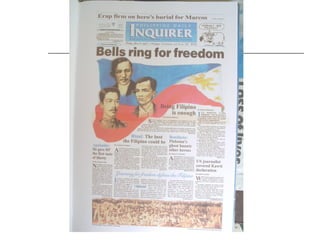
Have one dominant element (Center of
Visual Impact), usually a photo with a
story. You must give the reader a reason to
stop and look at the page. Often the
dominant element is a story with a photo, but
it can have more photos, quotes and
graphics to provide the reader with more
points of entry onto the page. Your central
package must dominate the page so that the
reader's eye is drawn to it.
Principle #4

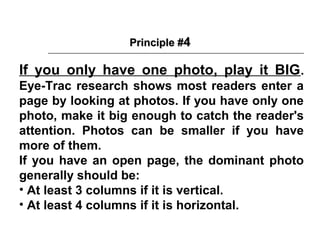
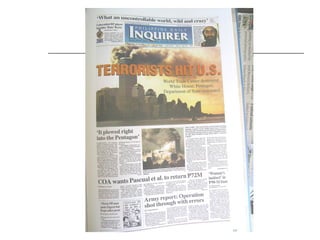
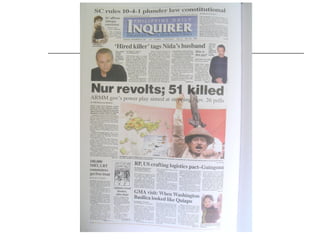
If you only have one photo, play it BIG .
Eye-Trac research shows most readers enter a
page by looking at photos. If you have only one
photo, make it big enough to catch the reader's
attention. Photos can be smaller if you have
more of them.
If you have an open page, the dominant photo
generally should be:
• At least 3 columns if it is vertical.
• At least 4 columns if it is horizontal.
Principle #5

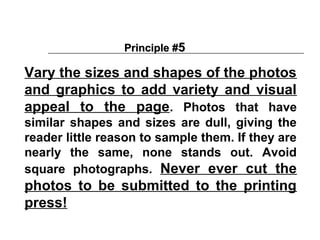
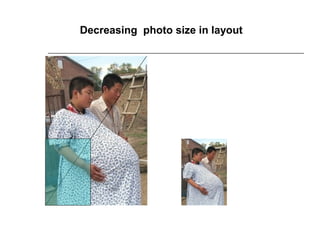
Vary the sizes and shapes of the photos
and graphics to add variety and visual
appeal to the page. Photos that have
similar shapes and sizes are dull, giving the
reader little reason to sample them. If they are
nearly the same, none stands out. Avoid
square photographs. Never ever cut the
photos to be submitted to the printing
press!
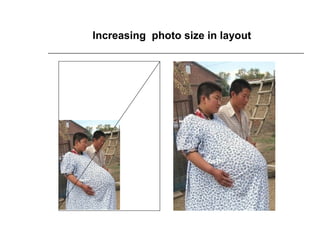
Increasing photo size in layout
Decreasing photo size in layout
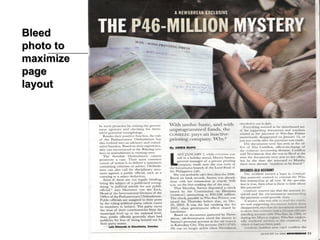
Bleed
photo to
maximize
page
layout
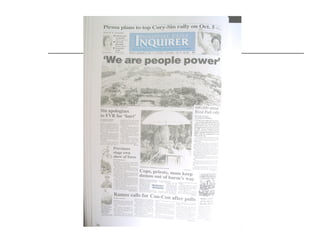
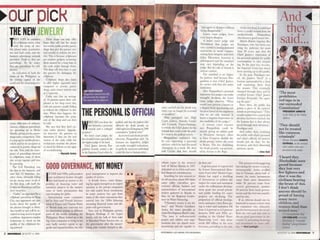
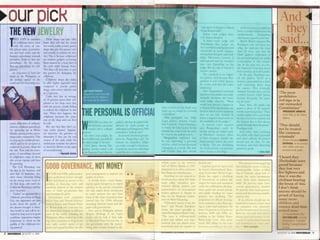
Principle #6


Use a mixture of vertical and
horizontal elements to add variety to
the page and to move the reader's
eyes around it. Cross the page at least
once with type. Don't leave vertical gutters
that run all the way down the page and
divide it visually. Avoid stacking, or
pancaking, stories on top of one other. None
of them will stand out.
`
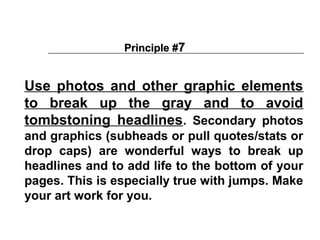
Principle #7


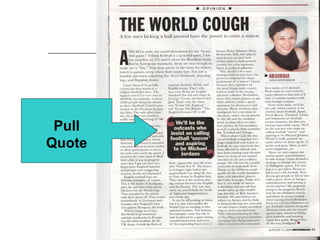
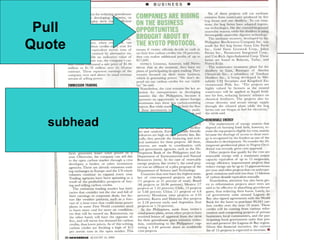
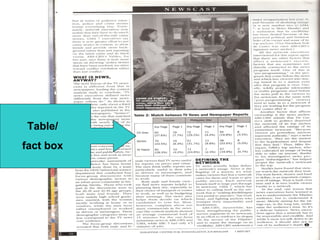
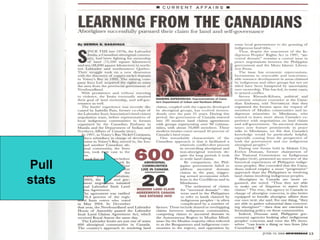
Use photos and other graphic elements
to break up the gray and to avoid
tombstoning headlines. Secondary photos
and graphics (subheads or pull quotes/stats or
drop caps) are wonderful ways to break up
headlines and to add life to the bottom of your
pages. This is especially true with jumps. Make
your art work for you.
Pull
Quote
Pull
Quote


  subhead
Table/
fact box
Pull
stats
Principle #8


Honor the hierarchy of type. Generally,
headlines should decrease in size as
you go down the page because the
stories are less important. Use three-line
headlines above two-line headlines.
Principle #9

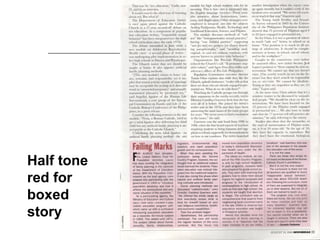
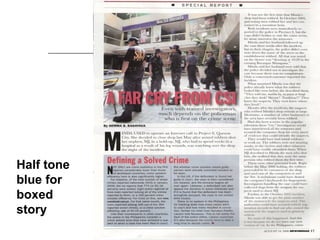
Color is more effective when used
sparingly. Use half-tones for boxed
stories.

No color in your school paper? No problem.
You have black, white and 10-15 distinctive
shades of gray.
Half tone
red for
boxed
story
Half tone
blue for
boxed
story
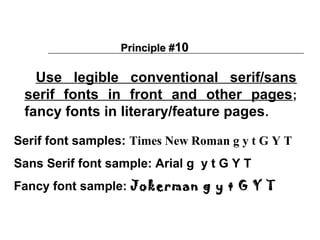
Principle #10

   Use legible conventional serif/sans
 serif fonts in front and other pages ;
 fancy fonts in literary/feature pages .

Serif font samples: Times New Roman g y t G Y T
Sans Serif font sample: Arial g y t G Y T
Fancy font sample: Jokerman g y t G Y T
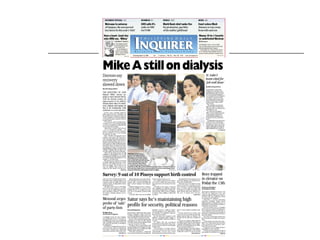
Principle #11


White space can be your most
powerful design element. The eye is
drawn to it, and then to the elements
around it. White space should be
adjacent to the outside edges of the
page, not trapped in the middle and
surrounded by photos and type.
Do’s and Don’ts in Page Makeup
   Avoid tombstoning-
     Placing two or more headlines
    on approximately the same level
    in adjacent columns especially if
    they are of the same point or
    types.
   Avoid bad breaks
    Do not break cut stories to the
    top of columns. The top of the
    column should have a headline
    or a cut.
   Avoid separating related stories and
    pictures.

   Avoid gray areas (sea of gray) Break
    this up with used of subheads, pull
    quotes or half tones.

   Keep long columns of 6 points type
    and tabular material to a minimum
    especially on front page.
   Avoid using a banner headline
    unless the story deserves it.
    Screaming headlines should also
    not be used. Screaming headline
    is one that is too big for a short
    or unimportant story.
THANK YOU!

Page layout final

  • 1.
    Page Design Fundamentals Ronnie R. Sunggay
  • 2.
    What is PageDesign or Newspaper Makeup?  According to Ceciliano-Jose Cruz, page design is the arrangement of illustrations and types on a page or spreadsheet which is to be reproduced graphically. Makeup is a happy marriage of aesthetics and mechanics.
  • 3.
    Makeup maybe defined as the arrangement of the display elements on a printed page, including headlines, body text, illustrations, photos, white spaces and rule or columns lines. Makeup refers to the page design of a newspaper, while layout is that of a magazine or advertisements. By: Alito Mendoza Journalism for Filipinos
  • 4.
     Newspapers like people have their own personalities. The personality of a newspaper emerges in part through the nature and quality of its makeup. -Dewitt C. Rederick
  • 5.
    Effective Makeup maybe planned using two procedures: 1. By headline and text arrangement 2. By way of text and photo combinations
  • 6.
    BASIC QUESTIONS • Whatsize of newspaper format am I going to plan? Tabloid size? Newsletter/magazine size? • For what type of readers am I laying out the newspaper? Keep in mind your answers to the above questions when you lay out the newspaper.
  • 7.
    NEWSLETTER TYPE FOR ELEMENTARY ( 3 columns) Bracket A – 9” x 12” Bracket B – 8 ½” x 13”
  • 8.
    TABLOID TYPE FOR SECONDARY (5 columns) Bracket A & B 12” x 18”
  • 9.
    Front Page Makeup by Headline and Text arrangement
  • 10.
    1.Perfect Balance or Symmetrical Makeup
  • 11.
    Ex. A largeheadline placed in the upper first two columns of front page is balanced with a corresponding large headline in the 4th and fifth upper columns. Other headlines are similarly arranged.
  • 12.
    A one column-cutat the upper 2nd column is balanced with another one column cut at column 4. This kind of makeup gives static monotonous appearance to the paper. It should not be made from issue to issue.
  • 13.
    Perfect Balance or Symmetrical Makeup
  • 14.
    2. Brace orFocus Makeup
  • 15.
    Headlines are diagonally arranged from the upper left to the lower right hand corner or vice-versa just like a brace supporting a house. Balance is obtained by various devices such as two column heads, boxes , and cuts which are used to offset the weight concentrated in the upper right of upper left hand corner.
  • 16.
     This kindof makeup is desirable when one story is more important than any other because the readers attention is directed to the upper right hand corner or occasionally to the upper left.
  • 17.
  • 18.
  • 19.
    The page is broken into several units to give space to many stories. Symmetry is obtained by carefully arranging the contents so as not to cancel each other by their nearness. Large heads and cuts are placed where they give the page a pleasing pattern.
  • 20.
    This kind of makeup is developed primarily to be able to print as many short stories on page one as possible.
  • 21.
  • 22.
    4. Contrast and Balance Makeup
  • 23.
    This type groups are arranged at varying distances from the center like two boys on a see- saw. It is sometimes called occult or hidden balance because the type groups with its headline may be balanced with a picture, an illustration, or a box., or instead of a type group.
  • 24.
    No attempt is made to achieve perfect balance. This is one of the most popular kinds of front page makeup since it permits great variety from issue to issue.
  • 25.
  • 26.
  • 27.
    The format is similar with that of the contrast and balance makeup. However, the nameplate is usually floated, headlines are flushed up in cap or lower case, and large body types are often used. Many closely cropped pictures are also used. Instead of boxing stories in full, the three quarter boxes are resorted to.
  • 28.
    Often bullets, asterisks, and jim dashes are employed to introduce lead stories. This kind of makeup is commonly used by high school papers than by the national dailies.
  • 29.
  • 30.
    Makeup by wayof Text and Photo Combination Layout for Front page:  The X Format  The Curve Format  The L Format  The J Format  The Umbrella Format
  • 36.
    Makeup of InsidePages:  While it is true that the front page of the newspaper is its show window, attractive makeup should not be confined to this page alone. The inside and back pages should be given the same tender care, treatment and attention by the layout artist.
  • 37.
    For Inside News pages  Inside news pages should be laid out as facing page units rather than as single pages. The principles for contrast and balance used for front page makeup should also be considered.
  • 42.
    Editorial Pages These pages should have a distinctive dignified and formal appearance. The masthead which should be relatively small, may anchored on any corner. Traditionally, the main editorial or editorials appear in the fist two columns. Like headlines of news stories, the titles of editorials should be of masculine appearance, not the italic or script type.
  • 47.
    Feature / Literary Pages  These pages must have a feminine appearance. The columns are often wider. Roman and italic types are used for text. Feminine types like the coronet, mandate and liberty families may be used.
  • 48.
    These pages havebolder but livelier appearance than the others. Their makeup should suggest action, speed and color. Large bold heads are used.
  • 55.
    Sports Pages  These pages have bolder but livelier appearance than the others. Their makeup should suggest action, speed and color. Large bold heads are used.
  • 62.
  • 63.
    Primary optical area Reverse S Sweep Terminal optical area
  • 64.
    Principle #1 Rank yourstories. You must know what the stories are about and evaluate their news value. Don't be lazy; read them. Once you have ranked them, generally place them in descending order on the page according to their importance. Story placement is a nonverbal cue that indicates their importance to readers. Don’t sacrifice accuracy in favor of aesthetics.
  • 65.
  • 66.
    Principle #2 When youdesign, start with the art and build your page around it. Pages are built around photographs and graphics. Your design options often will become clear once you place photographs and graphics, especially if they go with stories.
  • 68.
    Principle #3 Have onedominant element (Center of Visual Impact), usually a photo with a story. You must give the reader a reason to stop and look at the page. Often the dominant element is a story with a photo, but it can have more photos, quotes and graphics to provide the reader with more points of entry onto the page. Your central package must dominate the page so that the reader's eye is drawn to it.
  • 70.
    Principle #4 If youonly have one photo, play it BIG . Eye-Trac research shows most readers enter a page by looking at photos. If you have only one photo, make it big enough to catch the reader's attention. Photos can be smaller if you have more of them. If you have an open page, the dominant photo generally should be: • At least 3 columns if it is vertical. • At least 4 columns if it is horizontal.
  • 72.
    Principle #5 Vary thesizes and shapes of the photos and graphics to add variety and visual appeal to the page. Photos that have similar shapes and sizes are dull, giving the reader little reason to sample them. If they are nearly the same, none stands out. Avoid square photographs. Never ever cut the photos to be submitted to the printing press!
  • 73.
  • 74.
  • 75.
  • 78.
    Principle #6 Use amixture of vertical and horizontal elements to add variety to the page and to move the reader's eyes around it. Cross the page at least once with type. Don't leave vertical gutters that run all the way down the page and divide it visually. Avoid stacking, or pancaking, stories on top of one other. None of them will stand out.
  • 81.
  • 82.
    Principle #7 Use photosand other graphic elements to break up the gray and to avoid tombstoning headlines. Secondary photos and graphics (subheads or pull quotes/stats or drop caps) are wonderful ways to break up headlines and to add life to the bottom of your pages. This is especially true with jumps. Make your art work for you.
  • 83.
  • 84.
  • 85.
  • 86.
  • 87.
    Principle #8 Honor thehierarchy of type. Generally, headlines should decrease in size as you go down the page because the stories are less important. Use three-line headlines above two-line headlines.
  • 88.
    Principle #9 Color ismore effective when used sparingly. Use half-tones for boxed stories. No color in your school paper? No problem. You have black, white and 10-15 distinctive shades of gray.
  • 89.
  • 90.
  • 91.
    Principle #10 Use legible conventional serif/sans serif fonts in front and other pages ; fancy fonts in literary/feature pages . Serif font samples: Times New Roman g y t G Y T Sans Serif font sample: Arial g y t G Y T Fancy font sample: Jokerman g y t G Y T
  • 92.
    Principle #11 White spacecan be your most powerful design element. The eye is drawn to it, and then to the elements around it. White space should be adjacent to the outside edges of the page, not trapped in the middle and surrounded by photos and type.

  • 95.
    Do’s and Don’tsin Page Makeup  Avoid tombstoning- Placing two or more headlines on approximately the same level in adjacent columns especially if they are of the same point or types.
  • 96.
    Avoid bad breaks Do not break cut stories to the top of columns. The top of the column should have a headline or a cut.
  • 97.
    Avoid separating related stories and pictures.  Avoid gray areas (sea of gray) Break this up with used of subheads, pull quotes or half tones.  Keep long columns of 6 points type and tabular material to a minimum especially on front page.
  • 98.
    Avoid using a banner headline unless the story deserves it. Screaming headlines should also not be used. Screaming headline is one that is too big for a short or unimportant story.
  • 99.