Developer Tests 
Things to Know 
Vaidas Pilkauskas 2014 
Vilnius JUG 
vaidas.pilkauskas@gmail.com
me 
My hobbies 
● developer at Wix.com 
● main language - Scala 
● main professional interest - developer communities 
If there is time left after my hobbies 
● mountain bicycle rider, snowboarder 
● consumer of rock music, contemporary art, etc
me - how to contact me 
connect with me on LinkedIn http://lt.linkedin. 
com/pub/vaidas-pilkauskas/8/77/863/ 
add me on G+ https://www.google.com/+VaidasPilkauskas 
follow on Twitter @liucijus
“We couldn’t understand why people without technical 
knowledge had to tell programmers “what” to do and, 
furthermore, they had to supervise “how” 
programmers did it.” 
Cristian Rennella 
http://qz.com/260846/why-our-startup-has-no-bosses-no-office-and-a-four-day-work-week/
What this talk is about 
● Things we argue about during code reviews 
● Things that took me time to understand and 
prove that they are actually good way to go 
● Small things we have no time to discuss 
during big talks
“Legacy Code is code without 
Tests” 
Michael Feathers 
Working Effectively with Legacy Code
So what is test? 
It is system’s exercise under predefined 
conditions and then verification of an 
expected outcome.
Thing #1 
Test structure
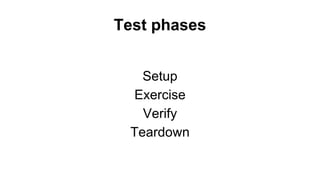
Test phases 
Setup 
Exercise 
Verify 
Teardown
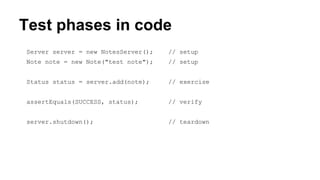
Test phases in code 
Server server = new NotesServer(); // setup 
Note note = new Note("test note"); // setup 
Status status = server.add(note); // exercise 
assertEquals(SUCCESS, status); // verify 
server.shutdown(); // teardown
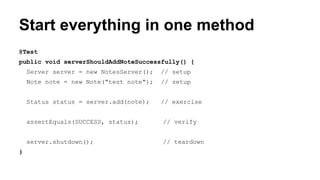
Start everything in one method 
@Test 
public void serverShouldAddNoteSuccessfully() { 
Server server = new NotesServer(); // setup 
Note note = new Note("test note"); // setup 
Status status = server.add(note); // exercise 
assertEquals(SUCCESS, status); // verify 
server.shutdown(); // teardown 
}
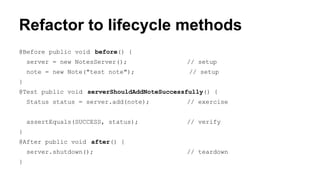
Refactor to lifecycle methods 
@Before public void before() { 
server = new NotesServer(); // setup 
note = new Note("test note"); // setup 
} 
@Test public void serverShouldAddNoteSuccessfully() { 
Status status = server.add(note); // exercise 
assertEquals(SUCCESS, status); // verify 
} 
@After public void after() { 
server.shutdown(); // teardown 
}
DON’Ts - #1 
Do not start from setup/teardown
DON’Ts - #2 
Do not mix setup code from different 
tests - shared code must be relevant to 
the tests that use it
DON’Ts - #3 
Setup and teardown are there to solve 
DRY problem and to help structure your 
test code
How many colors are there in the 
picture? 
Source: Josef Albers Interaction of Color
Context matters! 
Source: Josef Albers Interaction of Color
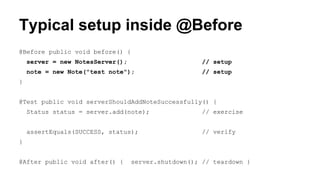
Typical setup inside @Before 
@Before public void before() { 
server = new NotesServer(); // setup 
note = new Note("test note"); // setup 
} 
@Test public void serverShouldAddNoteSuccessfully() { 
Status status = server.add(note); // exercise 
assertEquals(SUCCESS, status); // verify 
} 
@After public void after() { server.shutdown(); // teardown }
Setup pollution - #1 
● Every line in setup must be relevant to all tests.
Setup pollution - #2 
● It is tempting to add additional setup tuning just to 
fix/enhance one test.
Setup pollution - #3 
● Rich setup makes tests slow!
Setup pollution - #4 
● Setup is to bootstrap your SUT.
Setup pollution - #5 
● Setup hides details! Do not hide test preconditions.
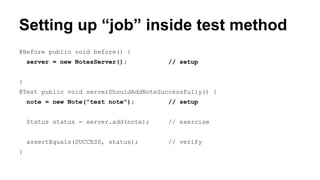
Setting up “job” inside test method 
@Before public void before() { 
server = new NotesServer(); // setup 
} 
@Test public void serverShouldAddNoteSuccessfully() { 
note = new Note("test note"); // setup 
Status status = server.add(note); // exercise 
assertEquals(SUCCESS, status); // verify 
}
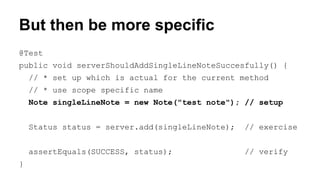
But then be more specific 
@Test 
public void serverShouldAddSingleLineNoteSuccesfully() { 
// * set up which is actual for the current method 
// * use scope specific name 
Note singleLineNote = new Note("test note"); // setup 
Status status = server.add(singleLineNote); // exercise 
assertEquals(SUCCESS, status); // verify 
}
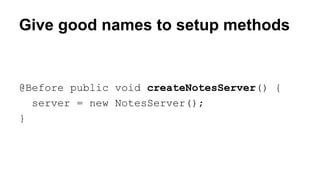
Give good names to setup methods 
@Before public void createNotesServer() { 
server = new NotesServer(); 
}
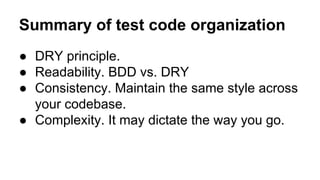
Summary of test code organization 
● DRY principle. 
● Readability. BDD vs. DRY 
● Consistency. Maintain the same style across 
your codebase. 
● Complexity. It may dictate the way you go.
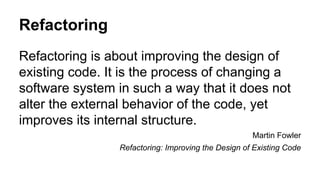
Refactoring 
Refactoring is about improving the design of 
existing code. It is the process of changing a 
software system in such a way that it does not 
alter the external behavior of the code, yet 
improves its internal structure. 
Martin Fowler 
Refactoring: Improving the Design of Existing Code
Thing #2 
What do we test?
Test behaviour not methods 
● Think of a contract
Test behaviour not methods 
● Think of a contract 
● And responsibilities
Test behaviour not methods 
● Think of a contract 
● And responsibilities 
● Specify requirements as tests
Test behaviour not methods 
● Think of a contract 
● And responsibilities 
● Specify requirements as tests 
● Happens naturally when done in test-first 
approach
Thing #3 
Matchers
Matchers 
● Enhance readability 
● Asserts on the right level of abstraction 
● Encapsulate testing logic 
● Reusable 
● Detailed match error messages (do not 
leave them out in your custom matchers!)
Matchers 
● Enhance readability 
● Asserts on the right level of abstraction 
● Encapsulate testing logic 
● Reusable 
● Detailed match error messages (do not 
leave them out in your custom matchers!)
Matcher libraries 
● Hamcrest - standard matcher lib for JUnit 
● AssertJ - fluent assertions (IDE friendly) 
● Provides common matchers 
● You can write your own custom matchers
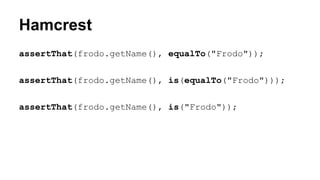
Hamcrest 
assertThat(frodo.getName(), equalTo("Frodo")); 
assertThat(frodo.getName(), is(equalTo("Frodo"))); 
assertThat(frodo.getName(), is("Frodo"));
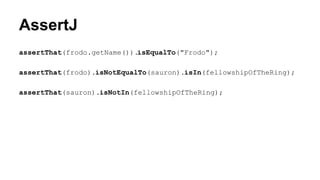
AssertJ 
assertThat(frodo.getName()).isEqualTo("Frodo"); 
assertThat(frodo).isNotEqualTo(sauron).isIn(fellowshipOfTheRing); 
assertThat(sauron).isNotIn(fellowshipOfTheRing);
Thing #4 
Custom matchers
Custom matchers 
Are matchers that we write specifically for our 
projects.
Custom matchers 
● Help communicate test intention 
● Abstract assertion logic in case standard 
matchers are not enough 
● Are reusable and save time in large projects 
● You may have a custom message to be 
more specific about test failure
Custom matchers 
● Help communicate test intention 
● Abstract assertion logic in case standard 
matchers are not enough 
● Are reusable and save time in large projects 
● You may have a custom message to be 
more specific about test failure
Custom matchers 
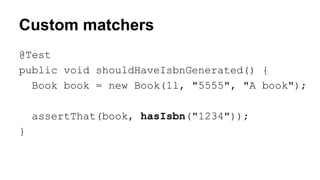
@Test 
public void shouldHaveIsbnGenerated() { 
Book book = new Book(1l, "5555", "A book"); 
assertThat(book, hasIsbn("1234")); 
}
Thing #5 
Failing a test
fail() 
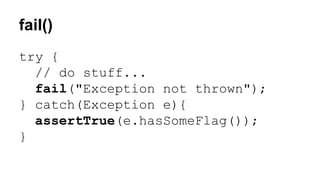
In some cases (e.g. testing exceptions) you 
may want to force test to fail if some expected 
situation does not happen
fail() 
try { 
// do stuff... 
fail("Exception not thrown"); 
} catch(Exception e){ 
assertTrue(e.hasSomeFlag()); 
}
fail() 
● Fundamentally not bad, but better use 
matchers for expected failure 
● Matchers help to clarify test intention 
● Don’t forget - expected behaviour is an 
opposite of a failing test
Thing #6 
Anti-pattern: The Ugly Mirror
Anti-pattern: The Ugly Mirror 
@Test 
public void personToStringShouldIncludeNameAndSurname() { 
Person person = new Person("Vilkas", "Pilkas"); 
String expected = 
"Person[" + person.getName() + " " + person.getSurname() + "]" 
assertEquals(expected, person.toString()); 
}
Anti-pattern: The Ugly Mirror 
@Test 
public void personToStringShouldIncludeNameAndSurname() { 
Person person = new Person("Vilkas", "Pilkas"); 
String expected = 
"Person[" + person.getName() + " " + person.getSurname() + "]" 
assertEquals(expected, person.toString()); 
}
Anti-pattern: The Ugly Mirror 
@Test 
public void personToStringShouldIncludeNameAndSurname() { 
Person person = new Person("Vilkas", "Pilkas"); 
assertEquals("Person[Vilkas Pilkas]", person.toString()); 
}
Thing #7 
How to turn off the test?
Why would you want to turn off the 
test?
Why would you want to turn off the 
test? 
Well, because it fails… :)
Ignoring tests 
● Always use ignore/pending API from your 
test library (JUnit @Ignore)
Ignoring tests 
● Always use ignore/pending API from your 
test library (JUnit @Ignore) 
● Do not comment out or false assert your test
Ignoring tests 
● Always use ignore/pending API from your 
test library (JUnit @Ignore) 
● Do not comment out or false assert your test 
● If you do not need a test - delete it
Thing #8 
What to do with exceptions?
Exceptions 
● If you can, use matchers instead of 
○ @Test(expected=?) 
○ try-catch approach
JUnit expected exception 
@Test(expected=IndexOutOfBoundsException.class) 
public void shouldThrowIndexOutOfBoundsException() { 
ArrayList emptyList = new ArrayList(); 
Object o = emptyList.get(0); 
} 
//matcher in Specs2 (Scala) 
server.process(None) must throwA[NothingToProccess]
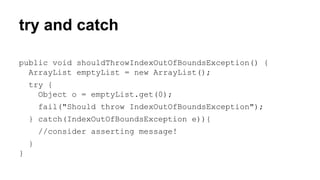
try and catch 
public void shouldThrowIndexOutOfBoundsException() { 
ArrayList emptyList = new ArrayList(); 
try { 
Object o = emptyList.get(0); 
fail("Should throw IndexOutOfBoundsException"); 
} catch(IndexOutOfBoundsException e)){ 
//consider asserting message! 
} 
}
Exceptions 
● catch-exception lib
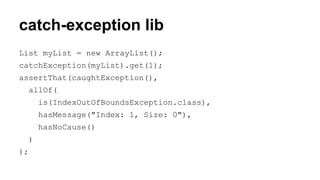
catch-exception lib 
List myList = new ArrayList(); 
catchException(myList).get(1); 
assertThat(caughtException(), 
allOf( 
is(IndexOutOfBoundsException.class), 
hasMessage("Index: 1, Size: 0"), 
hasNoCause() 
) 
);
Exceptions 
● What about ExpectedException Rule? 
○ My personal opinion - not that intuitive 
○ breaks arrange/act/assert flow
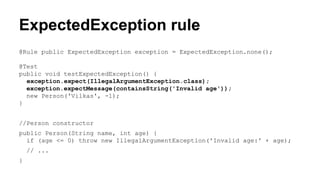
ExpectedException rule 
@Rule public ExpectedException exception = ExpectedException.none(); 
@Test 
public void testExpectedException() { 
exception.expect(IllegalArgumentException.class); 
exception.expectMessage(containsString('Invalid age')); 
new Person('Vilkas', -1); 
} 
//Person constructor 
public Person(String name, int age) { 
if (age <= 0) throw new IllegalArgumentException('Invalid age:' + age); 
// ... 
}
Thing #9 
Testing with time
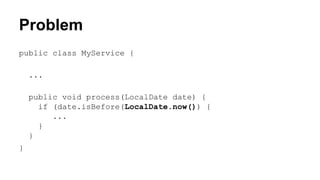
Problem 
public class MyService { 
... 
public void process(LocalDate date) { 
if (date.isBefore(LocalDate.now()) { 
... 
} 
} 
}
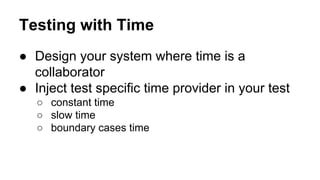
Testing with Time 
● Design your system where time is a 
collaborator 
● Inject test specific time provider in your test 
○ constant time 
○ slow time 
○ boundary cases time
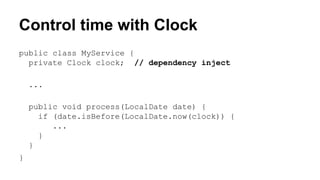
Control time with Clock 
public class MyService { 
private Clock clock; // dependency inject 
... 
public void process(LocalDate date) { 
if (date.isBefore(LocalDate.now(clock)) { 
... 
} 
} 
}
Thing #10 
Collections
Collections - multiple properties to 
assert 
● Is null? 
● Size 
● Order 
● Content
Collections 
● Most of the time you want to assert on collection content
Collections 
● Most of the time you want to assert on collection content 
● Prefer exact content matching
Collections 
● Most of the time you want to assert on collection content 
● Prefer exact content matching 
● Avoid incomplete assertions
Collections 
● Most of the time you want to assert on collection content 
● Prefer exact content matching 
● Avoid incomplete assertions 
● Do not sort just because it is easier to assert!
Collections 
● Most of the time you want to assert on collection content 
● Prefer exact content matching 
● Avoid incomplete assertions 
● Do not sort just because it is easier to assert! 
● Multiple assertions are worse than single content 
assertion
Collections 
● Most of the time you want to assert on collection content 
● Prefer exact content matching 
● Avoid incomplete assertions 
● Do not sort just because it is easier to assert! 
● Multiple assertions are worse than single content 
assertion 
● Unless you want to say something important in your test!
Collections 
● Most of the time you want to assert on collection content 
● Prefer exact content matching 
● Avoid incomplete assertions 
● Do not sort just because it is easier to assert! 
● Multiple assertions are worse than single content 
assertion 
● Unless you want to say something important in your test! 
● Use matchers!
Collections 
● Most of the time you want to assert on collection content 
● Prefer exact content matching 
● Avoid incomplete assertions 
● Do not sort just because it is easier to assert! 
● Multiple assertions are worse than single content 
assertion 
● Unless you want to say something important in your test! 
● Use matchers!
Thing #11 
Random values
Random values in tests 
● Most of the time you do not want it
Random values in tests 
● Most of the time you do not want it 
● Unless you depend on randomness a lot (eg. 
password generation*) 
*Thanks to Aleksandar Tomovski for a good example
Random values in tests 
● Most of the time you do not want it 
● Unless you depend on randomness a lot 
● Use property based testing (which is also 
hard)
Random values in tests 
● Most of the time you do not want it 
● Unless you depend on randomness a lot 
● Use property based testing (which is also 
hard) 
● Do not make dummy values random
What if we still need random cases?
Generate Multiple Test Cases 
● Quality over quantity
Generate Multiple Test Cases 
● Quality over quantity 
● Think of boundary cases, that you may want 
to detect with random test
Generate Multiple Test Cases 
● Quality over quantity 
● Think of boundary cases, that you may want 
to detect with random test 
● Use parameterized tests
Generate Multiple Test Cases 
● Quality over quantity 
● Think of boundary cases, that you may want 
to detect with random test 
● Use parameterized tests 
● Random is hard to repeat
Generate Multiple Test Cases 
● Quality over quantity 
● Think of boundary cases, that you may want 
to detect with random test 
● Use parameterized tests 
● Random is hard to repeat 
● Flickering tests
Thing #12 
How many assertions per test?
How many assertions per test? 
● Unit test - one assertion per test. Must be 
clear and readable 
● Proper test should fail for exactly one reason 
● End to end - best case one assertion per 
test, but more are allowed 
● Consider custom matchers
How many assertions per test? 
● Unit test - one assertion per test. Must be 
clear and readable 
● Proper test should fail for exactly one 
reason 
● End to end - best case one assertion per 
test, but more are allowed 
● Consider custom matchers
Thing #13 
Decoupling in End-to-end tests
What can be better in this test 
[pseudocode] 
@Test shouldRetrieveUserByLogin() { 
String userJson = "{"username": "vaidas"}"; 
HttpRequest post = new Post("https://localhost:8080/users", userJson); 
HttpResponse postResp = HttpClient().execute(post); 
assertThat(postResp.status, is(200)); 
HttpRequest get = new Get("https://localhost:8080/users/vaidas"); 
HttpResponse getResp = HttpClient().execute(get); 
User user = mapper.readValue(getResp, User.class); 
assertThat(username, is("vaidas")); 
}
Decoupling from low level details 
[pseudocode] 
@Test shouldRetrieveUserByUsername() { 
CreateUserResponse createResp = aCreateUserRequest().withUsername("vaidas").execute(); 
assertThat(createResp, hasStatus(OK)); 
GetUserResponse getResp = aGetUserRequest().withUsername("vaidas").execute(); 
assertThat(getResp, allOf(hasStatus(OK), hasUsername("vaidas"))); 
}
Thoughts on end-to-end testing 
● What is real e2e? REST vs. UI 
● Testing by using system itself 
● Vs. using low level DB driver to verify data 
persistence
Thing #14 
Comments
Comments in Test code 
● Fundamentally good option to explain 
complicated parts, but: 
● better use good method naming 
● custom matcher 
● do less, so that intention is clear 
● comments are not so bad in isolated well 
named methods
Summary 
● Context matters 
● Tests are controversial topic 
● And very opinionated
Thanks! 
Q & A

Developer Tests - Things to Know (Vilnius JUG)

  • 1.
    Developer Tests Thingsto Know Vaidas Pilkauskas 2014 Vilnius JUG vaidas.pilkauskas@gmail.com
  • 2.
    me My hobbies ● developer at Wix.com ● main language - Scala ● main professional interest - developer communities If there is time left after my hobbies ● mountain bicycle rider, snowboarder ● consumer of rock music, contemporary art, etc
  • 3.
    me - howto contact me connect with me on LinkedIn http://lt.linkedin. com/pub/vaidas-pilkauskas/8/77/863/ add me on G+ https://www.google.com/+VaidasPilkauskas follow on Twitter @liucijus
  • 4.
    “We couldn’t understandwhy people without technical knowledge had to tell programmers “what” to do and, furthermore, they had to supervise “how” programmers did it.” Cristian Rennella http://qz.com/260846/why-our-startup-has-no-bosses-no-office-and-a-four-day-work-week/
  • 5.
    What this talkis about ● Things we argue about during code reviews ● Things that took me time to understand and prove that they are actually good way to go ● Small things we have no time to discuss during big talks
  • 7.
    “Legacy Code iscode without Tests” Michael Feathers Working Effectively with Legacy Code
  • 8.
    So what istest? It is system’s exercise under predefined conditions and then verification of an expected outcome.
  • 9.
    Thing #1 Teststructure
  • 10.
    Test phases Setup Exercise Verify Teardown
  • 11.
    Test phases incode Server server = new NotesServer(); // setup Note note = new Note("test note"); // setup Status status = server.add(note); // exercise assertEquals(SUCCESS, status); // verify server.shutdown(); // teardown
  • 12.
    Start everything inone method @Test public void serverShouldAddNoteSuccessfully() { Server server = new NotesServer(); // setup Note note = new Note("test note"); // setup Status status = server.add(note); // exercise assertEquals(SUCCESS, status); // verify server.shutdown(); // teardown }
  • 13.
    Refactor to lifecyclemethods @Before public void before() { server = new NotesServer(); // setup note = new Note("test note"); // setup } @Test public void serverShouldAddNoteSuccessfully() { Status status = server.add(note); // exercise assertEquals(SUCCESS, status); // verify } @After public void after() { server.shutdown(); // teardown }
  • 14.
    DON’Ts - #1 Do not start from setup/teardown
  • 15.
    DON’Ts - #2 Do not mix setup code from different tests - shared code must be relevant to the tests that use it
  • 16.
    DON’Ts - #3 Setup and teardown are there to solve DRY problem and to help structure your test code
  • 17.
    How many colorsare there in the picture? Source: Josef Albers Interaction of Color
  • 18.
    Context matters! Source:Josef Albers Interaction of Color
  • 19.
    Typical setup inside@Before @Before public void before() { server = new NotesServer(); // setup note = new Note("test note"); // setup } @Test public void serverShouldAddNoteSuccessfully() { Status status = server.add(note); // exercise assertEquals(SUCCESS, status); // verify } @After public void after() { server.shutdown(); // teardown }
  • 20.
    Setup pollution -#1 ● Every line in setup must be relevant to all tests.
  • 21.
    Setup pollution -#2 ● It is tempting to add additional setup tuning just to fix/enhance one test.
  • 22.
    Setup pollution -#3 ● Rich setup makes tests slow!
  • 23.
    Setup pollution -#4 ● Setup is to bootstrap your SUT.
  • 24.
    Setup pollution -#5 ● Setup hides details! Do not hide test preconditions.
  • 25.
    Setting up “job”inside test method @Before public void before() { server = new NotesServer(); // setup } @Test public void serverShouldAddNoteSuccessfully() { note = new Note("test note"); // setup Status status = server.add(note); // exercise assertEquals(SUCCESS, status); // verify }
  • 26.
    But then bemore specific @Test public void serverShouldAddSingleLineNoteSuccesfully() { // * set up which is actual for the current method // * use scope specific name Note singleLineNote = new Note("test note"); // setup Status status = server.add(singleLineNote); // exercise assertEquals(SUCCESS, status); // verify }
  • 27.
    Give good namesto setup methods @Before public void createNotesServer() { server = new NotesServer(); }
  • 28.
    Summary of testcode organization ● DRY principle. ● Readability. BDD vs. DRY ● Consistency. Maintain the same style across your codebase. ● Complexity. It may dictate the way you go.
  • 29.
    Refactoring Refactoring isabout improving the design of existing code. It is the process of changing a software system in such a way that it does not alter the external behavior of the code, yet improves its internal structure. Martin Fowler Refactoring: Improving the Design of Existing Code
  • 30.
    Thing #2 Whatdo we test?
  • 31.
    Test behaviour notmethods ● Think of a contract
  • 32.
    Test behaviour notmethods ● Think of a contract ● And responsibilities
  • 33.
    Test behaviour notmethods ● Think of a contract ● And responsibilities ● Specify requirements as tests
  • 34.
    Test behaviour notmethods ● Think of a contract ● And responsibilities ● Specify requirements as tests ● Happens naturally when done in test-first approach
  • 35.
  • 36.
    Matchers ● Enhancereadability ● Asserts on the right level of abstraction ● Encapsulate testing logic ● Reusable ● Detailed match error messages (do not leave them out in your custom matchers!)
  • 37.
    Matchers ● Enhancereadability ● Asserts on the right level of abstraction ● Encapsulate testing logic ● Reusable ● Detailed match error messages (do not leave them out in your custom matchers!)
  • 38.
    Matcher libraries ●Hamcrest - standard matcher lib for JUnit ● AssertJ - fluent assertions (IDE friendly) ● Provides common matchers ● You can write your own custom matchers
  • 39.
    Hamcrest assertThat(frodo.getName(), equalTo("Frodo")); assertThat(frodo.getName(), is(equalTo("Frodo"))); assertThat(frodo.getName(), is("Frodo"));
  • 40.
  • 41.
  • 42.
    Custom matchers Arematchers that we write specifically for our projects.
  • 43.
    Custom matchers ●Help communicate test intention ● Abstract assertion logic in case standard matchers are not enough ● Are reusable and save time in large projects ● You may have a custom message to be more specific about test failure
  • 44.
    Custom matchers ●Help communicate test intention ● Abstract assertion logic in case standard matchers are not enough ● Are reusable and save time in large projects ● You may have a custom message to be more specific about test failure
  • 45.
    Custom matchers @Test public void shouldHaveIsbnGenerated() { Book book = new Book(1l, "5555", "A book"); assertThat(book, hasIsbn("1234")); }
  • 46.
  • 47.
    fail() In somecases (e.g. testing exceptions) you may want to force test to fail if some expected situation does not happen
  • 48.
    fail() try { // do stuff... fail("Exception not thrown"); } catch(Exception e){ assertTrue(e.hasSomeFlag()); }
  • 49.
    fail() ● Fundamentallynot bad, but better use matchers for expected failure ● Matchers help to clarify test intention ● Don’t forget - expected behaviour is an opposite of a failing test
  • 50.
    Thing #6 Anti-pattern:The Ugly Mirror
  • 51.
    Anti-pattern: The UglyMirror @Test public void personToStringShouldIncludeNameAndSurname() { Person person = new Person("Vilkas", "Pilkas"); String expected = "Person[" + person.getName() + " " + person.getSurname() + "]" assertEquals(expected, person.toString()); }
  • 52.
    Anti-pattern: The UglyMirror @Test public void personToStringShouldIncludeNameAndSurname() { Person person = new Person("Vilkas", "Pilkas"); String expected = "Person[" + person.getName() + " " + person.getSurname() + "]" assertEquals(expected, person.toString()); }
  • 53.
    Anti-pattern: The UglyMirror @Test public void personToStringShouldIncludeNameAndSurname() { Person person = new Person("Vilkas", "Pilkas"); assertEquals("Person[Vilkas Pilkas]", person.toString()); }
  • 54.
    Thing #7 Howto turn off the test?
  • 55.
    Why would youwant to turn off the test?
  • 56.
    Why would youwant to turn off the test? Well, because it fails… :)
  • 57.
    Ignoring tests ●Always use ignore/pending API from your test library (JUnit @Ignore)
  • 58.
    Ignoring tests ●Always use ignore/pending API from your test library (JUnit @Ignore) ● Do not comment out or false assert your test
  • 59.
    Ignoring tests ●Always use ignore/pending API from your test library (JUnit @Ignore) ● Do not comment out or false assert your test ● If you do not need a test - delete it
  • 60.
    Thing #8 Whatto do with exceptions?
  • 61.
    Exceptions ● Ifyou can, use matchers instead of ○ @Test(expected=?) ○ try-catch approach
  • 62.
    JUnit expected exception @Test(expected=IndexOutOfBoundsException.class) public void shouldThrowIndexOutOfBoundsException() { ArrayList emptyList = new ArrayList(); Object o = emptyList.get(0); } //matcher in Specs2 (Scala) server.process(None) must throwA[NothingToProccess]
  • 63.
    try and catch public void shouldThrowIndexOutOfBoundsException() { ArrayList emptyList = new ArrayList(); try { Object o = emptyList.get(0); fail("Should throw IndexOutOfBoundsException"); } catch(IndexOutOfBoundsException e)){ //consider asserting message! } }
  • 64.
  • 65.
    catch-exception lib ListmyList = new ArrayList(); catchException(myList).get(1); assertThat(caughtException(), allOf( is(IndexOutOfBoundsException.class), hasMessage("Index: 1, Size: 0"), hasNoCause() ) );
  • 66.
    Exceptions ● Whatabout ExpectedException Rule? ○ My personal opinion - not that intuitive ○ breaks arrange/act/assert flow
  • 67.
    ExpectedException rule @Rulepublic ExpectedException exception = ExpectedException.none(); @Test public void testExpectedException() { exception.expect(IllegalArgumentException.class); exception.expectMessage(containsString('Invalid age')); new Person('Vilkas', -1); } //Person constructor public Person(String name, int age) { if (age <= 0) throw new IllegalArgumentException('Invalid age:' + age); // ... }
  • 68.
  • 69.
    Problem public classMyService { ... public void process(LocalDate date) { if (date.isBefore(LocalDate.now()) { ... } } }
  • 70.
    Testing with Time ● Design your system where time is a collaborator ● Inject test specific time provider in your test ○ constant time ○ slow time ○ boundary cases time
  • 71.
    Control time withClock public class MyService { private Clock clock; // dependency inject ... public void process(LocalDate date) { if (date.isBefore(LocalDate.now(clock)) { ... } } }
  • 72.
  • 73.
    Collections - multipleproperties to assert ● Is null? ● Size ● Order ● Content
  • 74.
    Collections ● Mostof the time you want to assert on collection content
  • 75.
    Collections ● Mostof the time you want to assert on collection content ● Prefer exact content matching
  • 76.
    Collections ● Mostof the time you want to assert on collection content ● Prefer exact content matching ● Avoid incomplete assertions
  • 77.
    Collections ● Mostof the time you want to assert on collection content ● Prefer exact content matching ● Avoid incomplete assertions ● Do not sort just because it is easier to assert!
  • 78.
    Collections ● Mostof the time you want to assert on collection content ● Prefer exact content matching ● Avoid incomplete assertions ● Do not sort just because it is easier to assert! ● Multiple assertions are worse than single content assertion
  • 79.
    Collections ● Mostof the time you want to assert on collection content ● Prefer exact content matching ● Avoid incomplete assertions ● Do not sort just because it is easier to assert! ● Multiple assertions are worse than single content assertion ● Unless you want to say something important in your test!
  • 80.
    Collections ● Mostof the time you want to assert on collection content ● Prefer exact content matching ● Avoid incomplete assertions ● Do not sort just because it is easier to assert! ● Multiple assertions are worse than single content assertion ● Unless you want to say something important in your test! ● Use matchers!
  • 81.
    Collections ● Mostof the time you want to assert on collection content ● Prefer exact content matching ● Avoid incomplete assertions ● Do not sort just because it is easier to assert! ● Multiple assertions are worse than single content assertion ● Unless you want to say something important in your test! ● Use matchers!
  • 82.
  • 83.
    Random values intests ● Most of the time you do not want it
  • 84.
    Random values intests ● Most of the time you do not want it ● Unless you depend on randomness a lot (eg. password generation*) *Thanks to Aleksandar Tomovski for a good example
  • 85.
    Random values intests ● Most of the time you do not want it ● Unless you depend on randomness a lot ● Use property based testing (which is also hard)
  • 86.
    Random values intests ● Most of the time you do not want it ● Unless you depend on randomness a lot ● Use property based testing (which is also hard) ● Do not make dummy values random
  • 87.
    What if westill need random cases?
  • 88.
    Generate Multiple TestCases ● Quality over quantity
  • 89.
    Generate Multiple TestCases ● Quality over quantity ● Think of boundary cases, that you may want to detect with random test
  • 90.
    Generate Multiple TestCases ● Quality over quantity ● Think of boundary cases, that you may want to detect with random test ● Use parameterized tests
  • 91.
    Generate Multiple TestCases ● Quality over quantity ● Think of boundary cases, that you may want to detect with random test ● Use parameterized tests ● Random is hard to repeat
  • 92.
    Generate Multiple TestCases ● Quality over quantity ● Think of boundary cases, that you may want to detect with random test ● Use parameterized tests ● Random is hard to repeat ● Flickering tests
  • 93.
    Thing #12 Howmany assertions per test?
  • 94.
    How many assertionsper test? ● Unit test - one assertion per test. Must be clear and readable ● Proper test should fail for exactly one reason ● End to end - best case one assertion per test, but more are allowed ● Consider custom matchers
  • 95.
    How many assertionsper test? ● Unit test - one assertion per test. Must be clear and readable ● Proper test should fail for exactly one reason ● End to end - best case one assertion per test, but more are allowed ● Consider custom matchers
  • 96.
    Thing #13 Decouplingin End-to-end tests
  • 97.
    What can bebetter in this test [pseudocode] @Test shouldRetrieveUserByLogin() { String userJson = "{"username": "vaidas"}"; HttpRequest post = new Post("https://localhost:8080/users", userJson); HttpResponse postResp = HttpClient().execute(post); assertThat(postResp.status, is(200)); HttpRequest get = new Get("https://localhost:8080/users/vaidas"); HttpResponse getResp = HttpClient().execute(get); User user = mapper.readValue(getResp, User.class); assertThat(username, is("vaidas")); }
  • 98.
    Decoupling from lowlevel details [pseudocode] @Test shouldRetrieveUserByUsername() { CreateUserResponse createResp = aCreateUserRequest().withUsername("vaidas").execute(); assertThat(createResp, hasStatus(OK)); GetUserResponse getResp = aGetUserRequest().withUsername("vaidas").execute(); assertThat(getResp, allOf(hasStatus(OK), hasUsername("vaidas"))); }
  • 99.
    Thoughts on end-to-endtesting ● What is real e2e? REST vs. UI ● Testing by using system itself ● Vs. using low level DB driver to verify data persistence
  • 100.
  • 101.
    Comments in Testcode ● Fundamentally good option to explain complicated parts, but: ● better use good method naming ● custom matcher ● do less, so that intention is clear ● comments are not so bad in isolated well named methods
  • 102.
    Summary ● Contextmatters ● Tests are controversial topic ● And very opinionated
  • 103.