Introduzione al
Test Driven Development
Andrea Francia
http://www.andreafrancia.it
Contents
Concepts
Definition
Example1: Parser
Example2: Text To Speech
Concepts
Test First
Automate tests
What is a Automated
Test?
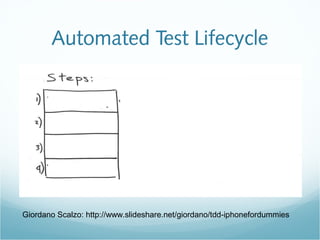
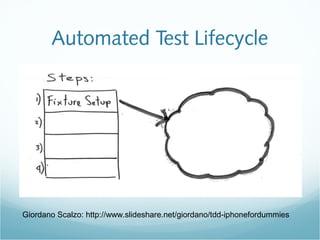
Automated Test Lifecycle
Giordano Scalzo: http://www.slideshare.net/giordano/tdd-iphonefordummies
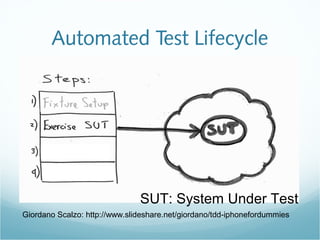
Automated Test Lifecycle
Giordano Scalzo: http://www.slideshare.net/giordano/tdd-iphonefordummies
Automated Test Lifecycle
SUT: System Under Test
Giordano Scalzo: http://www.slideshare.net/giordano/tdd-iphonefordummies
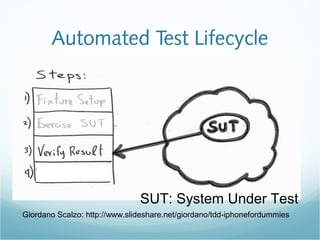
Automated Test Lifecycle
SUT: System Under Test
Giordano Scalzo: http://www.slideshare.net/giordano/tdd-iphonefordummies
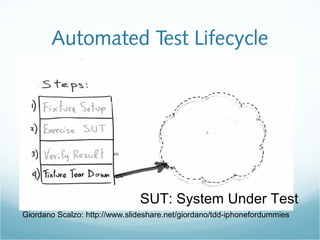
Automated Test Lifecycle
SUT: System Under Test
Giordano Scalzo: http://www.slideshare.net/giordano/tdd-iphonefordummies
Example of a Manual Test:
nextLine()
public static void main(String[] args) {
String text = "first linensecond line";
Scanner scanner = new Scanner(text);
System.out.println(scanner.nextLine()); // prints
"first line"
System.out.println(scanner.nextLine()); // prints
"second line”
}
Code:
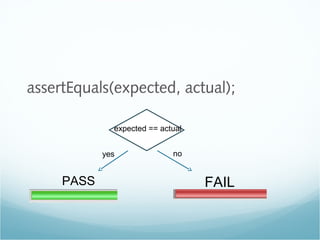
assertEquals(expected, actual);
PASS FAIL
expected == actual
yes no
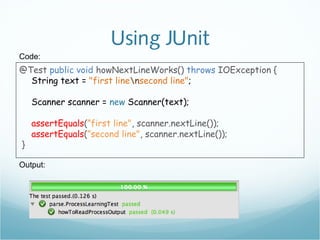
Using JUnit
@Test public void howNextLineWorks() throws IOException {
String text = "first linensecond line";
Scanner scanner = new Scanner(text);
assertEquals(”first line", scanner.nextLine());
assertEquals(”second line", scanner.nextLine());
}
Code:
Output:
What is Test Driven
Development?
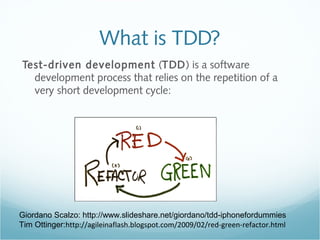
What is TDD?
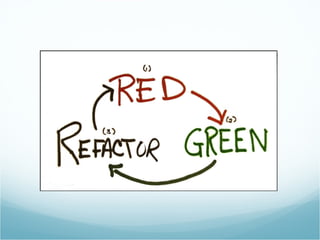
Test-driven development (TDD) is a software
development process that relies on the repetition of a
very short development cycle:
Giordano Scalzo: http://www.slideshare.net/giordano/tdd-iphonefordummies
Tim Ottinger:http://agileinaflash.blogspot.com/2009/02/red-green-refactor.html
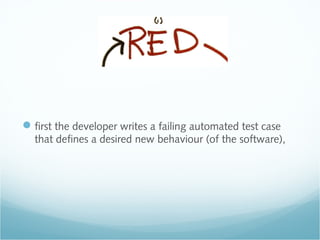
RED
first the developer writes a failing automated test case
that defines a desired new behaviour (of the software),
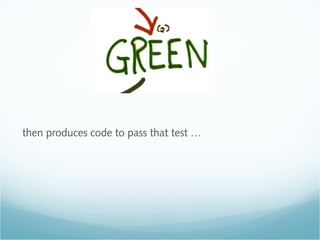
GREEN
then produces code to pass that test …
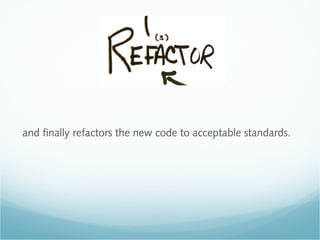
Refactor
and finally refactors the new code to acceptable standards.
Example:
Writing “df” Parser
The df output
[andreafrancia@deneb Dropbox]$ df
Filesystem 1K-blocks Used Available Use% Mounted on
/dev/disk0s2 243862672 135971832 107634840 56% /
/dev/disk0s1 243862672 135971832 107634840 56% /tmp
/dev/disk1s2 243862672 135971832 107634840 56% /opt
devfs 109 109 0 100% /dev
Mount Points
The problem
List all mount points
The Problem
Write a method that extract the list of the mount points
from the output of df.
First of all decompose
the problem!
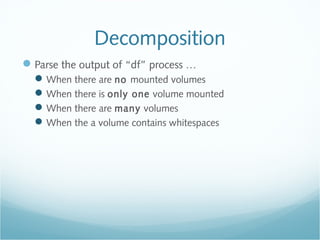
Decomposition
Parse the output of “df” process …
When there are no mounted volumes
When there is only one volume mounted
When there are many volumes
When the a volume contains whitespaces
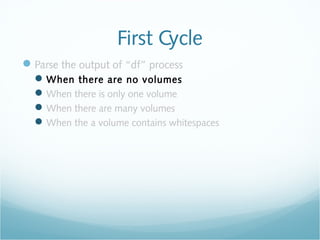
First Cycle
Parse the output of “df” process
When there are no volumes
When there is only one volume
When there are many volumes
When the a volume contains whitespaces
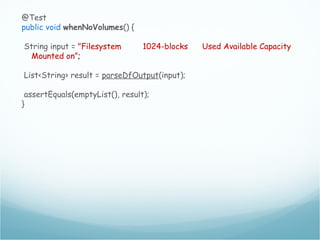
@Test
public void whenNoVolumes() {
String input = "Filesystem 1024-blocks Used Available Capacity
Mounted on”;
List<String> result = parseDfOutput(input);
assertEquals(emptyList(), result);
}
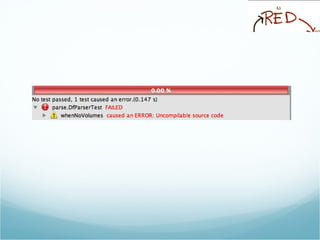
@Test
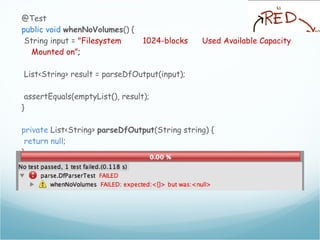
public void whenNoVolumes() {
String input = "Filesystem 1024-blocks Used Available Capacity
Mounted on”;
List<String> result = parseDfOutput(input);
assertEquals(emptyList(), result);
}
private List<String> parseDfOutput(String string) {
return null;
}
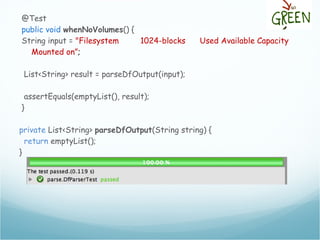
@Test
public void whenNoVolumes() {
String input = "Filesystem 1024-blocks Used Available Capacity
Mounted on”;
List<String> result = parseDfOutput(input);
assertEquals(emptyList(), result);
}
private List<String> parseDfOutput(String string) {
return emptyList();
}
No need for refactoring
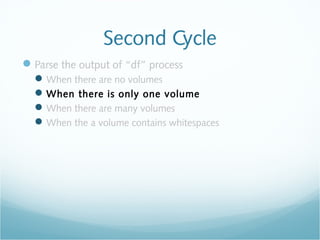
Second Cycle
Parse the output of “df” process
When there are no volumes
When there is only one volume
When there are many volumes
When the a volume contains whitespaces
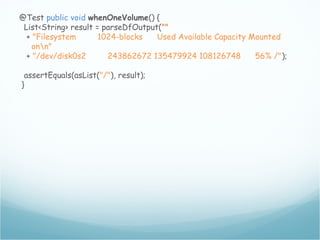
@Test public void whenOneVolume() {
List<String> result = parseDfOutput(""
+ "Filesystem 1024-blocks Used Available Capacity Mounted
onn"
+ "/dev/disk0s2 243862672 135479924 108126748 56% /");
assertEquals(asList("/"), result);
}
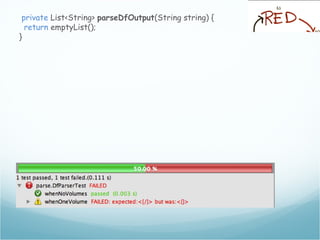
private List<String> parseDfOutput(String string) {
return emptyList();
}
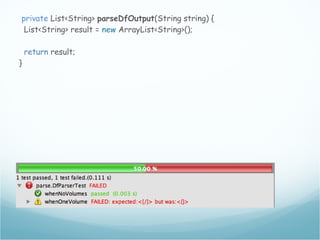
private List<String> parseDfOutput(String string) {
List<String> result = new ArrayList<String>();
return result;
}
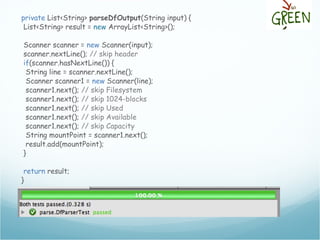
private List<String> parseDfOutput(String input) {
List<String> result = new ArrayList<String>();
Scanner scanner = new Scanner(input);
scanner.nextLine(); // skip header
if(scanner.hasNextLine()) {
String line = scanner.nextLine();
Scanner scanner1 = new Scanner(line);
scanner1.next(); // skip Filesystem
scanner1.next(); // skip 1024-blocks
scanner1.next(); // skip Used
scanner1.next(); // skip Available
scanner1.next(); // skip Capacity
String mountPoint = scanner1.next();
result.add(mountPoint);
}
return result;
}
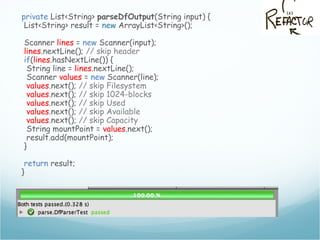
private List<String> parseDfOutput(String input) {
List<String> result = new ArrayList<String>();
Scanner lines = new Scanner(input);
lines.nextLine(); // skip header
if(lines.hasNextLine()) {
String line = lines.nextLine();
Scanner values = new Scanner(line);
values.next(); // skip Filesystem
values.next(); // skip 1024-blocks
values.next(); // skip Used
values.next(); // skip Available
values.next(); // skip Capacity
String mountPoint = values.next();
result.add(mountPoint);
}
return result;
}
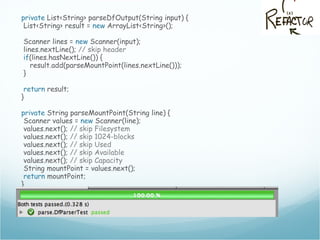
private List<String> parseDfOutput(String input) {
List<String> result = new ArrayList<String>();
Scanner lines = new Scanner(input);
lines.nextLine(); // skip header
if(lines.hasNextLine()) {
result.add(parseMountPoint(lines.nextLine()));
}
return result;
}
private String parseMountPoint(String line) {
Scanner values = new Scanner(line);
values.next(); // skip Filesystem
values.next(); // skip 1024-blocks
values.next(); // skip Used
values.next(); // skip Available
values.next(); // skip Capacity
String mountPoint = values.next();
return mountPoint;
}
Third Cycle
Parse the output of “df” process
When there are no volumes
When there is only one volume
When there are many volumes
When the a volume contains whitespaces
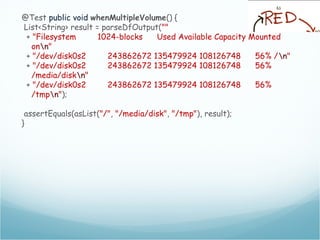
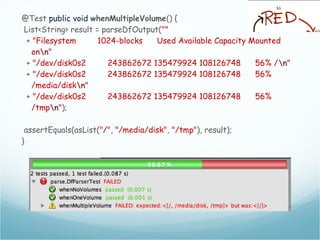
@Test public void whenMultipleVolume() {
List<String> result = parseDfOutput(""
+ "Filesystem 1024-blocks Used Available Capacity Mounted
onn"
+ "/dev/disk0s2 243862672 135479924 108126748 56% /n"
+ "/dev/disk0s2 243862672 135479924 108126748 56%
/media/diskn"
+ "/dev/disk0s2 243862672 135479924 108126748 56%
/tmpn");
assertEquals(asList("/", "/media/disk", "/tmp"), result);
}
@Test public void whenMultipleVolume() {
List<String> result = parseDfOutput(""
+ "Filesystem 1024-blocks Used Available Capacity Mounted
onn"
+ "/dev/disk0s2 243862672 135479924 108126748 56% /n"
+ "/dev/disk0s2 243862672 135479924 108126748 56%
/media/diskn"
+ "/dev/disk0s2 243862672 135479924 108126748 56%
/tmpn");
assertEquals(asList("/", "/media/disk", "/tmp"), result);
}
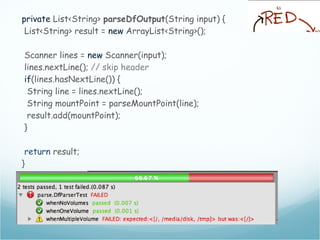
private List<String> parseDfOutput(String input) {
List<String> result = new ArrayList<String>();
Scanner lines = new Scanner(input);
lines.nextLine(); // skip header
if(lines.hasNextLine()) {
String line = lines.nextLine();
String mountPoint = parseMountPoint(line);
result.add(mountPoint);
}
return result;
}
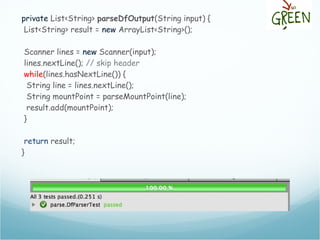
private List<String> parseDfOutput(String input) {
List<String> result = new ArrayList<String>();
Scanner lines = new Scanner(input);
lines.nextLine(); // skip header
while(lines.hasNextLine()) {
String line = lines.nextLine();
String mountPoint = parseMountPoint(line);
result.add(mountPoint);
}
return result;
}
TDD Rules
TDD Rules
Test First
Test for All Features
Remove all duplication
(always)
Some hints
Keep tests running and passing
Keeps test small
Don’t mix phases (Red, Green,
Refactor)
Don’t mix unit tests with integration
tests
Test only one feature per test
Examples from my last
work
Regole applicate
Ogni feature deve essere sviluppata secondo il
TDD
Partire dai test di accettazione
Ritardare le decisioni di design all’ultimo
momento responsabile
Applicare un principio di design solo dopo aver
avuto la prova che sia utile in quel specifico caso
Prima feature: produrre
testo pronunciabile
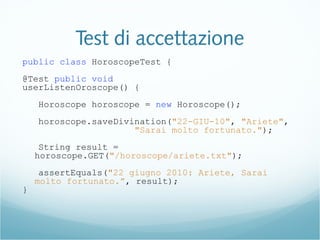
Test di accettazione
public class HoroscopeTest {
@Test public void
userListenOroscope() {
Horoscope horoscope = new Horoscope();
horoscope.saveDivination("22-GIU-10", "Ariete",
"Sarai molto fortunato.");
String result =
horoscope.GET("/horoscope/ariete.txt");
assertEquals("22 giugno 2010: Ariete, Sarai
molto fortunato.”, result);
}
No test  No code
Quando scrivo il codice di produzione scrivo il
minimo necessario a far passare il test
Se il minimo non mi convince (è troppo stupido),
vuol dire che manca una specifica funzionale 
cioè manca un test.
Prima di scrivere una qualsiasi riga di codice in
più aggiungo un test che la richieda.
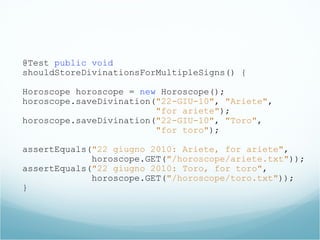
@Test public void
shouldStoreDivinationsForMultipleSigns() {
Horoscope horoscope = new Horoscope();
horoscope.saveDivination("22-GIU-10", "Ariete",
"for ariete");
horoscope.saveDivination("22-GIU-10", "Toro",
"for toro");
assertEquals("22 giugno 2010: Ariete, for ariete",
horoscope.GET("/horoscope/ariete.txt"));
assertEquals("22 giugno 2010: Toro, for toro",
horoscope.GET("/horoscope/toro.txt"));
}
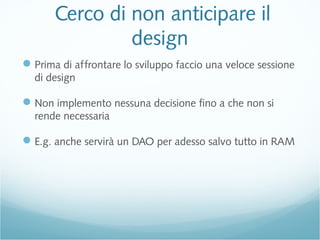
Cerco di non anticipare il
design
Prima di affrontare lo sviluppo faccio una veloce sessione
di design
Non implemento nessuna decisione fino a che non si
rende necessaria
E.g. anche servirà un DAO per adesso salvo tutto in RAM
Seconda Feature:
oroscopo ascoltabile
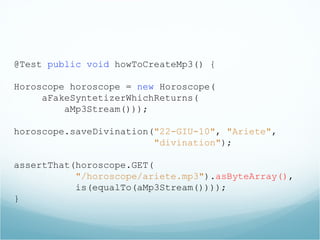
@Test public void howToCreateMp3() {
Horoscope horoscope = new Horoscope(
aFakeSyntetizerWhichReturns(
aMp3Stream()));
horoscope.saveDivination("22-GIU-10", "Ariete",
"divination");
assertThat(horoscope.GET(
"/horoscope/ariete.mp3").asByteArray(),
is(equalTo(aMp3Stream())));
}
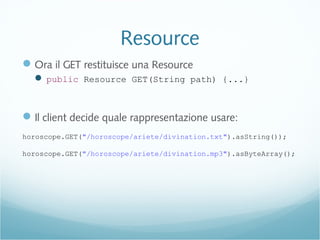
Resource
Ora il GET restituisce una Resource
 public Resource GET(String path) {...}
Il client decide quale rappresentazione usare:
horoscope.GET("/horoscope/ariete/divination.txt").asString());
horoscope.GET("/horoscope/ariete/divination.mp3").asByteArray();
Terza feature: la
persistenza
Stato delle cose
Al momento tutto viene persistito in memoria (in una
HashMap)
Non esiste ancora un oggetto DAO, tutto viene fatto
dall’unica class Horoscope
Estrazione del comportamento
public class MemoryDivinationRepo {
Divination lastDivinationForSign(String sign);
void saveDivinationFromPronounce(String sign,
String pronounce);
};
public interface Divination {
String asText();
byte[] asMp3();
};
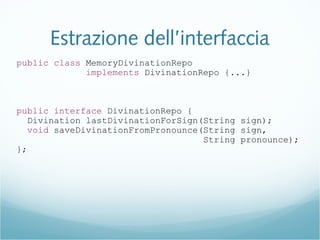
Estrazione dell’interfaccia
public class MemoryDivinationRepo
implements DivinationRepo {...}
public interface DivinationRepo {
Divination lastDivinationForSign(String sign);
void saveDivinationFromPronounce(String sign,
String pronounce);
};
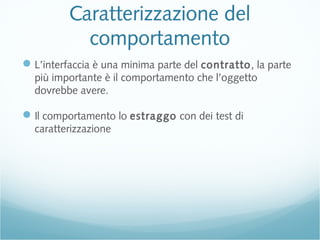
Caratterizzazione del
comportamento
L’interfaccia è una minima parte del contratto, la parte
più importante è il comportamento che l’oggetto
dovrebbe avere.
Il comportamento lo estraggo con dei test di
caratterizzazione
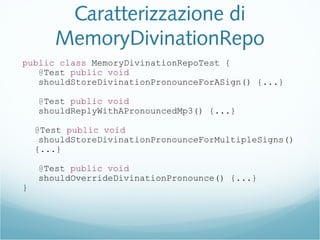
Caratterizzazione di
MemoryDivinationRepo
public class MemoryDivinationRepoTest {
@Test public void
shouldStoreDivinationPronounceForASign() {...}
@Test public void
shouldReplyWithAPronouncedMp3() {...}
@Test public void
shouldStoreDivinationPronounceForMultipleSigns()
{...}
@Test public void
shouldOverrideDivinationPronounce() {...}
}
Thanks
Andrea Francia
www.andreafrancia.it
blog.andreafrancia.it
andrea@andreafrancia.it
Extra slides
Example of an Automated Test
@Test public void shouldParsePath() {
String content =
"[Trash Info]n"
+ "Path=/home/andrea/foo.txtn"
+ "DeletionDate=2010-08-23T12:59:14n";
String path = Parser.parsePath(content);
assertEquals("/home/andrea/foo.txt”,
path);
}
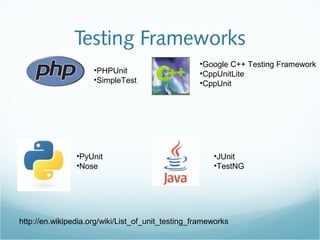
Testing Frameworks
http://en.wikipedia.org/wiki/List_of_unit_testing_frameworks
•PHPUnit
•SimpleTest
•Google C++ Testing Framework
•CppUnitLite
•CppUnit
•JUnit
•TestNG
•PyUnit
•Nose

Introduzione al TDD

  • 1.
    Introduzione al Test DrivenDevelopment Andrea Francia http://www.andreafrancia.it
  • 2.
  • 3.
  • 4.
    What is aAutomated Test?
  • 5.
    Automated Test Lifecycle GiordanoScalzo: http://www.slideshare.net/giordano/tdd-iphonefordummies
  • 6.
    Automated Test Lifecycle GiordanoScalzo: http://www.slideshare.net/giordano/tdd-iphonefordummies
  • 7.
    Automated Test Lifecycle SUT:System Under Test Giordano Scalzo: http://www.slideshare.net/giordano/tdd-iphonefordummies
  • 8.
    Automated Test Lifecycle SUT:System Under Test Giordano Scalzo: http://www.slideshare.net/giordano/tdd-iphonefordummies
  • 9.
    Automated Test Lifecycle SUT:System Under Test Giordano Scalzo: http://www.slideshare.net/giordano/tdd-iphonefordummies
  • 10.
    Example of aManual Test: nextLine() public static void main(String[] args) { String text = "first linensecond line"; Scanner scanner = new Scanner(text); System.out.println(scanner.nextLine()); // prints "first line" System.out.println(scanner.nextLine()); // prints "second line” } Code:
  • 11.
  • 12.
    Using JUnit @Test publicvoid howNextLineWorks() throws IOException { String text = "first linensecond line"; Scanner scanner = new Scanner(text); assertEquals(”first line", scanner.nextLine()); assertEquals(”second line", scanner.nextLine()); } Code: Output:
  • 13.
    What is TestDriven Development?
  • 14.
    What is TDD? Test-drivendevelopment (TDD) is a software development process that relies on the repetition of a very short development cycle: Giordano Scalzo: http://www.slideshare.net/giordano/tdd-iphonefordummies Tim Ottinger:http://agileinaflash.blogspot.com/2009/02/red-green-refactor.html
  • 15.
    RED first the developerwrites a failing automated test case that defines a desired new behaviour (of the software),
  • 16.
    GREEN then produces codeto pass that test …
  • 17.
    Refactor and finally refactorsthe new code to acceptable standards.
  • 19.
  • 20.
    The df output [andreafrancia@denebDropbox]$ df Filesystem 1K-blocks Used Available Use% Mounted on /dev/disk0s2 243862672 135971832 107634840 56% / /dev/disk0s1 243862672 135971832 107634840 56% /tmp /dev/disk1s2 243862672 135971832 107634840 56% /opt devfs 109 109 0 100% /dev Mount Points
  • 21.
  • 22.
    The Problem Write amethod that extract the list of the mount points from the output of df.
  • 23.
    First of alldecompose the problem!
  • 24.
    Decomposition Parse the outputof “df” process … When there are no mounted volumes When there is only one volume mounted When there are many volumes When the a volume contains whitespaces
  • 25.
    First Cycle Parse theoutput of “df” process When there are no volumes When there is only one volume When there are many volumes When the a volume contains whitespaces
  • 26.
    @Test public void whenNoVolumes(){ String input = "Filesystem 1024-blocks Used Available Capacity Mounted on”; List<String> result = parseDfOutput(input); assertEquals(emptyList(), result); }
  • 28.
    @Test public void whenNoVolumes(){ String input = "Filesystem 1024-blocks Used Available Capacity Mounted on”; List<String> result = parseDfOutput(input); assertEquals(emptyList(), result); } private List<String> parseDfOutput(String string) { return null; }
  • 29.
    @Test public void whenNoVolumes(){ String input = "Filesystem 1024-blocks Used Available Capacity Mounted on”; List<String> result = parseDfOutput(input); assertEquals(emptyList(), result); } private List<String> parseDfOutput(String string) { return emptyList(); }
  • 30.
    No need forrefactoring
  • 31.
    Second Cycle Parse theoutput of “df” process When there are no volumes When there is only one volume When there are many volumes When the a volume contains whitespaces
  • 32.
    @Test public voidwhenOneVolume() { List<String> result = parseDfOutput("" + "Filesystem 1024-blocks Used Available Capacity Mounted onn" + "/dev/disk0s2 243862672 135479924 108126748 56% /"); assertEquals(asList("/"), result); }
  • 33.
    private List<String> parseDfOutput(Stringstring) { return emptyList(); }
  • 34.
    private List<String> parseDfOutput(Stringstring) { List<String> result = new ArrayList<String>(); return result; }
  • 35.
    private List<String> parseDfOutput(Stringinput) { List<String> result = new ArrayList<String>(); Scanner scanner = new Scanner(input); scanner.nextLine(); // skip header if(scanner.hasNextLine()) { String line = scanner.nextLine(); Scanner scanner1 = new Scanner(line); scanner1.next(); // skip Filesystem scanner1.next(); // skip 1024-blocks scanner1.next(); // skip Used scanner1.next(); // skip Available scanner1.next(); // skip Capacity String mountPoint = scanner1.next(); result.add(mountPoint); } return result; }
  • 36.
    private List<String> parseDfOutput(Stringinput) { List<String> result = new ArrayList<String>(); Scanner lines = new Scanner(input); lines.nextLine(); // skip header if(lines.hasNextLine()) { String line = lines.nextLine(); Scanner values = new Scanner(line); values.next(); // skip Filesystem values.next(); // skip 1024-blocks values.next(); // skip Used values.next(); // skip Available values.next(); // skip Capacity String mountPoint = values.next(); result.add(mountPoint); } return result; }
  • 37.
    private List<String> parseDfOutput(Stringinput) { List<String> result = new ArrayList<String>(); Scanner lines = new Scanner(input); lines.nextLine(); // skip header if(lines.hasNextLine()) { result.add(parseMountPoint(lines.nextLine())); } return result; } private String parseMountPoint(String line) { Scanner values = new Scanner(line); values.next(); // skip Filesystem values.next(); // skip 1024-blocks values.next(); // skip Used values.next(); // skip Available values.next(); // skip Capacity String mountPoint = values.next(); return mountPoint; }
  • 38.
    Third Cycle Parse theoutput of “df” process When there are no volumes When there is only one volume When there are many volumes When the a volume contains whitespaces
  • 39.
    @Test public voidwhenMultipleVolume() { List<String> result = parseDfOutput("" + "Filesystem 1024-blocks Used Available Capacity Mounted onn" + "/dev/disk0s2 243862672 135479924 108126748 56% /n" + "/dev/disk0s2 243862672 135479924 108126748 56% /media/diskn" + "/dev/disk0s2 243862672 135479924 108126748 56% /tmpn"); assertEquals(asList("/", "/media/disk", "/tmp"), result); }
  • 40.
    @Test public voidwhenMultipleVolume() { List<String> result = parseDfOutput("" + "Filesystem 1024-blocks Used Available Capacity Mounted onn" + "/dev/disk0s2 243862672 135479924 108126748 56% /n" + "/dev/disk0s2 243862672 135479924 108126748 56% /media/diskn" + "/dev/disk0s2 243862672 135479924 108126748 56% /tmpn"); assertEquals(asList("/", "/media/disk", "/tmp"), result); }
  • 41.
    private List<String> parseDfOutput(Stringinput) { List<String> result = new ArrayList<String>(); Scanner lines = new Scanner(input); lines.nextLine(); // skip header if(lines.hasNextLine()) { String line = lines.nextLine(); String mountPoint = parseMountPoint(line); result.add(mountPoint); } return result; }
  • 42.
    private List<String> parseDfOutput(Stringinput) { List<String> result = new ArrayList<String>(); Scanner lines = new Scanner(input); lines.nextLine(); // skip header while(lines.hasNextLine()) { String line = lines.nextLine(); String mountPoint = parseMountPoint(line); result.add(mountPoint); } return result; }
  • 43.
  • 44.
    TDD Rules Test First Testfor All Features Remove all duplication (always)
  • 45.
    Some hints Keep testsrunning and passing Keeps test small Don’t mix phases (Red, Green, Refactor) Don’t mix unit tests with integration tests Test only one feature per test
  • 46.
  • 47.
    Regole applicate Ogni featuredeve essere sviluppata secondo il TDD Partire dai test di accettazione Ritardare le decisioni di design all’ultimo momento responsabile Applicare un principio di design solo dopo aver avuto la prova che sia utile in quel specifico caso
  • 48.
  • 49.
    Test di accettazione publicclass HoroscopeTest { @Test public void userListenOroscope() { Horoscope horoscope = new Horoscope(); horoscope.saveDivination("22-GIU-10", "Ariete", "Sarai molto fortunato."); String result = horoscope.GET("/horoscope/ariete.txt"); assertEquals("22 giugno 2010: Ariete, Sarai molto fortunato.”, result); }
  • 50.
    No test No code Quando scrivo il codice di produzione scrivo il minimo necessario a far passare il test Se il minimo non mi convince (è troppo stupido), vuol dire che manca una specifica funzionale  cioè manca un test. Prima di scrivere una qualsiasi riga di codice in più aggiungo un test che la richieda.
  • 51.
    @Test public void shouldStoreDivinationsForMultipleSigns(){ Horoscope horoscope = new Horoscope(); horoscope.saveDivination("22-GIU-10", "Ariete", "for ariete"); horoscope.saveDivination("22-GIU-10", "Toro", "for toro"); assertEquals("22 giugno 2010: Ariete, for ariete", horoscope.GET("/horoscope/ariete.txt")); assertEquals("22 giugno 2010: Toro, for toro", horoscope.GET("/horoscope/toro.txt")); }
  • 52.
    Cerco di nonanticipare il design Prima di affrontare lo sviluppo faccio una veloce sessione di design Non implemento nessuna decisione fino a che non si rende necessaria E.g. anche servirà un DAO per adesso salvo tutto in RAM
  • 53.
  • 54.
    @Test public voidhowToCreateMp3() { Horoscope horoscope = new Horoscope( aFakeSyntetizerWhichReturns( aMp3Stream())); horoscope.saveDivination("22-GIU-10", "Ariete", "divination"); assertThat(horoscope.GET( "/horoscope/ariete.mp3").asByteArray(), is(equalTo(aMp3Stream()))); }
  • 55.
    Resource Ora il GETrestituisce una Resource  public Resource GET(String path) {...} Il client decide quale rappresentazione usare: horoscope.GET("/horoscope/ariete/divination.txt").asString()); horoscope.GET("/horoscope/ariete/divination.mp3").asByteArray();
  • 56.
  • 57.
    Stato delle cose Almomento tutto viene persistito in memoria (in una HashMap) Non esiste ancora un oggetto DAO, tutto viene fatto dall’unica class Horoscope
  • 58.
    Estrazione del comportamento publicclass MemoryDivinationRepo { Divination lastDivinationForSign(String sign); void saveDivinationFromPronounce(String sign, String pronounce); }; public interface Divination { String asText(); byte[] asMp3(); };
  • 59.
    Estrazione dell’interfaccia public classMemoryDivinationRepo implements DivinationRepo {...} public interface DivinationRepo { Divination lastDivinationForSign(String sign); void saveDivinationFromPronounce(String sign, String pronounce); };
  • 60.
    Caratterizzazione del comportamento L’interfaccia èuna minima parte del contratto, la parte più importante è il comportamento che l’oggetto dovrebbe avere. Il comportamento lo estraggo con dei test di caratterizzazione
  • 61.
    Caratterizzazione di MemoryDivinationRepo public classMemoryDivinationRepoTest { @Test public void shouldStoreDivinationPronounceForASign() {...} @Test public void shouldReplyWithAPronouncedMp3() {...} @Test public void shouldStoreDivinationPronounceForMultipleSigns() {...} @Test public void shouldOverrideDivinationPronounce() {...} }
  • 62.
  • 63.
  • 64.
    Example of anAutomated Test @Test public void shouldParsePath() { String content = "[Trash Info]n" + "Path=/home/andrea/foo.txtn" + "DeletionDate=2010-08-23T12:59:14n"; String path = Parser.parsePath(content); assertEquals("/home/andrea/foo.txt”, path); }
  • 65.
    Testing Frameworks http://en.wikipedia.org/wiki/List_of_unit_testing_frameworks •PHPUnit •SimpleTest •Google C++Testing Framework •CppUnitLite •CppUnit •JUnit •TestNG •PyUnit •Nose

Editor's Notes

  • #2 Questa presentazione è una breve introduzione al Test Driven Development. Questa è una presentazione rivolta a chi: - ha sentito parlare della tecnica - che non l’ha ancora provata o ha appena iniziato - e che vorrebbe saperne qualcosa di più. Non c’è nessun argomento avanzato, solo un assaggio. Gli obiettivi della presentazione sono: spiegare di cosa si tratta fornirvi un idea di quello che permette di fare spiegare i vantaggi dell’approcio Non è una trattazione completa dell’argomento. Per riuscire ad usarla con profitto sarebbe necessario almeno leggere alcuni libri che eventualmente dopo indicherò oppure meglio ancora lavorare con qualcuno bravo che la usa.
  • #3 Questi sono I contenuti della presenazione. Partiremo dallo spiegare brevemente i concetti che sono dietro alla tecnica. Esporremo la meccanica alla base della del processo. Infine vedremo due esemp. Un esempio sullo sviluppo in TDD di un parser. Un esempio tratto dal un mio recente lavoro.
  • #4 Io ho individuato due concetti alla base del TDD. Test First Il primo è scrivere il test prima. Cioe’ scriverlo prima che il codice di produzione sia creato. Questo perche’ l’altra strategia, il test after, non funziona. O almeno funziona male. I problemi con il test after sono che: - alla fine il test non viene scritto - testare del codice che non e’ pensato per essere testato puo’ essere veramente molto difficile Invece con il test first si riesce a definire a priori sia l’interfaccia del codice da sviluppare sia il comportamento che il codice deve avere. Automate your tests L’altro aspetto fondamentale è che tutti i test vengono automatizzati. Il motivo è semplice testare a mano è noioso. Ricompilare, avviare il programma, inserire gli input necessari per attivare quel particolare pezzo di codice che stiamo scrivendo è lungo e tedioso. Scrivere test automatici richiede un certo tempo, ma dopo aver fatto un po’ di pratica con gli strumenti il tempo è di meno di quello necessario per scrivere il test automatico.
  • #55 L’interfaccia si evolve  La GET() non era adatta per gestire sia testo che gli mp3 Nasce il concetto di Resource L’interfaccia si evolve per supportare le nuove funzionalità senza rovinare il design
  • #56 Nota: refactoring anche dei test scritti precedentemente che saranno adattati alla nuova API.
  • #65 Nella slide è riportato un esempio di test. Questo esempio di test riguarda lo sviluppo di un applicazione che gestisce il cestino di Linux. Quando in buttiamo un file nel cestino il sistema si deve ricordare alcuni metadati come il path da cui il file e’ stato “rimosso” e la data in cui questa cosa e’ successa. In Linux queste informazioni sono memorizzate in un file di testo che ha una sintassi simile alla stringa content che vedete nelle slide. Questo è un test per il metodo parse() della classe TrashInfo e verifica che sia in grado di leggere il contenuto del file passato in input. La caratteristica importante di questi test è che il controllo dell’esito è automatico, in altre parole che non é necessaria l’ispezione o il controllo da parte dello sviluppatore. L’altro aspetto importante é l’esecuzione é molto veloce perché non ci sono operazioni di I/O. Questo tipo di test è chiamato test di unità.