Bad Tests, Good Tests

Tomek Kaczanowski


                        http://twitter.com/#!/devops_borat
Tomek Kaczanowski
• Developer
• Team lead
• Blogger
   • http://kaczanowscy.pl/tomek
• Book author
   • http://practicalunittesting.com

• Working at CodeWise (Krakow, Poland)
   • ...we are hiring, wanna join us?
                                         JUnit version
                                         coming soon!
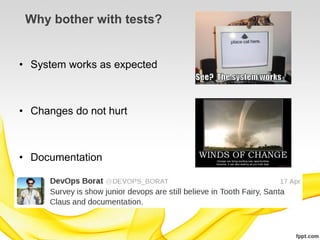
Why bother with tests?


• System works as expected


• Changes do not hurt


• Documentation
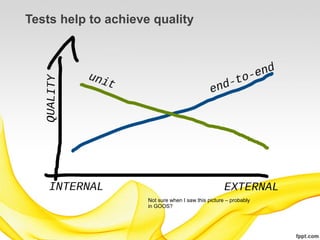
Tests help to achieve quality


                     Not sure when I saw this picture – probably
                     in GOOS?
What happens if we do it wrong?
• Angry clients
• Depressed developers


                         http://www.joshcanhelp.com
When I started out with unit tests, I was
enthralled with the promise of ease and
security that they would bring to my
projects. In practice, however, the
theory of sustainable software through
unit tests started to break down. This
difficulty continued to build up, until I
finally threw my head back in anger and
declared that "Unit Tests have become
more trouble than they are worth."
               Llewellyn Falco and Michael Kennedy, Develop Mentor August 09
http://chrispiascik.com/daily-drawings/express-yourself/
write the right test


write this test right
Before we begin

• All of the examples are real but were:
   • obfuscated
       • to protect the innocents :)
   • truncated
       • imagine much more complex domain objects
• Asking questions is allowed
   • ...but being smarter than me is not ;)
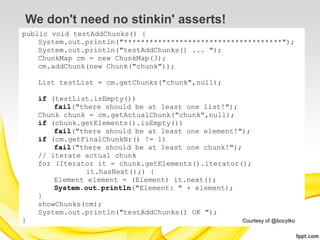
We don't need no stinkin' asserts!
public void testAddChunks() {
    System.out.println("*************************************");
    System.out.println("testAddChunks() ... ");
    ChunkMap cm = new ChunkMap(3);
    cm.addChunk(new Chunk("chunk"));

    List testList = cm.getChunks("chunk",null);

    if (testList.isEmpty())
        fail("there should be at least one list!");
    Chunk chunk = cm.getActualChunk("chunk",null);
    if (chunk.getElements().isEmpty())
        fail("there should be at least one element!");
    if (cm.getFinalChunkNr() != 1)
        fail("there should be at least one chunk!");
    // iterate actual chunk
    for (Iterator it = chunk.getElements().iterator();
               it.hasNext();) {
        Element element = (Element) it.next();
        System.out.println("Element: " + element);
    }
    showChunks(cm);
    System.out.println("testAddChunks() OK ");
}                                                  Courtesy of @bocytko
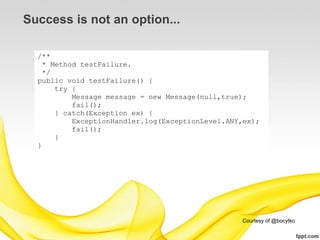
Success is not an option...

  /**
    * Method testFailure.
    */
  public void testFailure() {
       try {
           Message message = new Message(null,true);
           fail();
       } catch(Exception ex) {
           ExceptionHandler.log(ExceptionLevel.ANY,ex);
           fail();
       }
  }


                                                  Courtesy of @bocytko
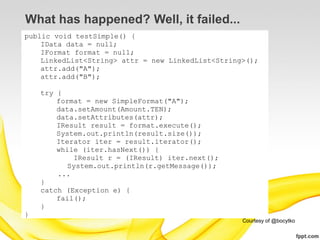
What has happened? Well, it failed...
public void testSimple() {
    IData data = null;
    IFormat format = null;
    LinkedList<String> attr = new LinkedList<String>();
    attr.add("A");
    attr.add("B");

    try {
        format = new SimpleFormat("A");
        data.setAmount(Amount.TEN);
        data.setAttributes(attr);
        IResult result = format.execute();
        System.out.println(result.size());
        Iterator iter = result.iterator();
        while (iter.hasNext()) {
            IResult r = (IResult) iter.next();
           System.out.println(r.getMessage());
        ...
    }
    catch (Exception e) {
        fail();
    }
}
                                                   Courtesy of @bocytko
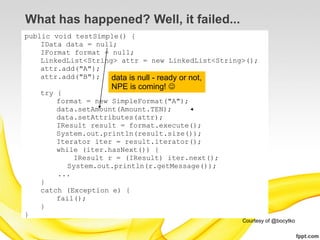
What has happened? Well, it failed...
public void testSimple() {
    IData data = null;
    IFormat format = null;
    LinkedList<String> attr = new LinkedList<String>();
    attr.add("A");
    attr.add("B");   data is null - ready or not,
                    NPE is coming! 
    try {
        format = new SimpleFormat("A");
        data.setAmount(Amount.TEN);
        data.setAttributes(attr);
        IResult result = format.execute();
        System.out.println(result.size());
        Iterator iter = result.iterator();
        while (iter.hasNext()) {
            IResult r = (IResult) iter.next();
           System.out.println(r.getMessage());
        ...
    }
    catch (Exception e) {
        fail();
    }
}
                                                   Courtesy of @bocytko
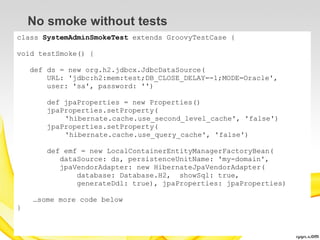
No smoke without tests
class SystemAdminSmokeTest extends GroovyTestCase {

void testSmoke() {

    def ds = new org.h2.jdbcx.JdbcDataSource(
        URL: 'jdbc:h2:mem:test;DB_CLOSE_DELAY=-1;MODE=Oracle',
        user: 'sa', password: '')

        def jpaProperties = new Properties()
        jpaProperties.setProperty(
            'hibernate.cache.use_second_level_cache', 'false')
        jpaProperties.setProperty(
            'hibernate.cache.use_query_cache', 'false')

        def emf = new LocalContainerEntityManagerFactoryBean(
           dataSource: ds, persistenceUnitName: 'my-domain',
           jpaVendorAdapter: new HibernateJpaVendorAdapter(
               database: Database.H2, showSql: true,
               generateDdl: true), jpaProperties: jpaProperties)

    …some more code below
}
No smoke without tests
class SystemAdminSmokeTest extends GroovyTestCase {

void testSmoke() {
// do not remove below code
// def ds = new org.h2.jdbcx.JdbcDataSource(
//     URL: 'jdbc:h2:mem:test;DB_CLOSE_DELAY=-1;MODE=Oracle',
//     user: 'sa', password: '')
//
//     def jpaProperties = new Properties()
//     jpaProperties.setProperty(
//         'hibernate.cache.use_second_level_cache', 'false')
//     jpaProperties.setProperty(
//         'hibernate.cache.use_query_cache', 'false')
//
//     def emf = new LocalContainerEntityManagerFactoryBean(
//        dataSource: ds, persistenceUnitName: 'my-domain',
//        jpaVendorAdapter: new HibernateJpaVendorAdapter(
//            database: Database.H2, showSql: true,
//            generateDdl: true), jpaProperties: jpaProperties)

    …some more code below, all commented out :(
}
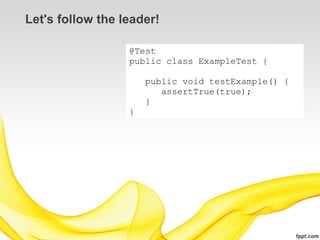
Let's follow the leader!

                  @Test
                  public class ExampleTest {

                      public void testExample() {
                         assertTrue(true);
                      }
                  }
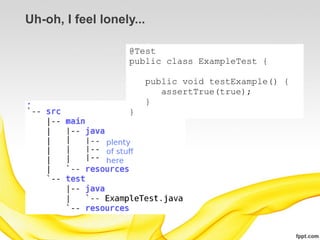
Uh-oh, I feel lonely...

                   @Test
                   public class ExampleTest {

                          public void testExample() {
                             assertTrue(true);
                          }
                   }
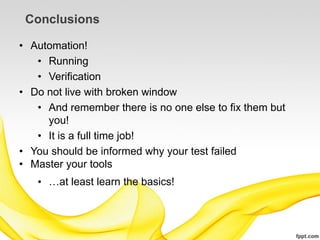
Conclusions

• Automation!
   • Running
   • Verification
• Do not live with broken window
   • And remember there is no one else to fix them but
     you!
   • It is a full time job!
• You should be informed why your test failed
• Master your tools
   • …at least learn the basics!
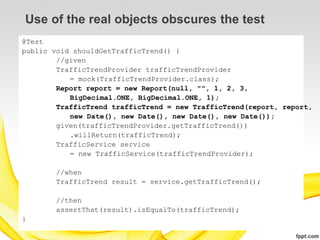
Use of the real objects obscures the test
@Test
public void shouldGetTrafficTrend() {
        //given
        TrafficTrendProvider trafficTrendProvider
           = mock(TrafficTrendProvider.class);
        Report report = new Report(null, "", 1, 2, 3,
           BigDecimal.ONE, BigDecimal.ONE, 1);
        TrafficTrend trafficTrend = new TrafficTrend(report, report,
           new Date(), new Date(), new Date(), new Date());
        given(trafficTrendProvider.getTrafficTrend())
           .willReturn(trafficTrend);
        TrafficService service
           = new TrafficService(trafficTrendProvider);

        //when
        TrafficTrend result = service.getTrafficTrend();

        //then
        assertThat(result).isEqualTo(trafficTrend);
}
Use of the real objects obscures the test
@Test
public void shouldGetTrafficTrend() {
        //given
        TrafficTrendProvider trafficTrendProvider
           = mock(TrafficTrendProvider.class);
        TrafficTrend trafficTrend = mock(TrafficTrend.class);
        given(trafficTrendProvider.getTrafficTrend())
           .willReturn(trafficTrend);


        TrafficService service
            = new TrafficService(trafficTrendProvider);

        //when
        TrafficTrend result = service.getTrafficTrend();

        //then
        assertThat(result).isEqualTo(trafficTrend);
}
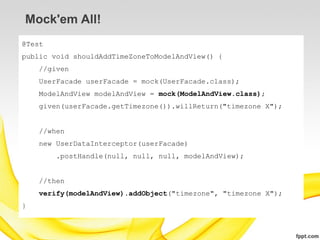
Mock'em All!
@Test
public void shouldAddTimeZoneToModelAndView() {
    //given
    UserFacade userFacade = mock(UserFacade.class);
    ModelAndView modelAndView = mock(ModelAndView.class);
    given(userFacade.getTimezone()).willReturn("timezone X");


    //when
    new UserDataInterceptor(userFacade)
        .postHandle(null, null, null, modelAndView);


    //then
    verify(modelAndView).addObject("timezone", "timezone X");
}
ModelAndView from
Mock'em All!                               SpringMVC – a mere
                                           container for data, without
@Test                                      any behaviour
public void shouldAddTimeZoneToModelAndView() {
    //given
    UserFacade userFacade = mock(UserFacade.class);
    ModelAndView modelAndView = mock(ModelAndView.class);
    given(userFacade.getTimezone()).willReturn("timezone X");


    //when
    new UserDataInterceptor(userFacade)
        .postHandle(null, null, null, modelAndView);


    //then
    verify(modelAndView).addObject("timezone", "timezone X");
}
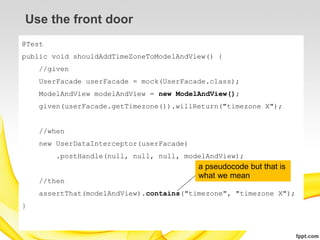
Use the front door
@Test
public void shouldAddTimeZoneToModelAndView() {
    //given
    UserFacade userFacade = mock(UserFacade.class);
    ModelAndView modelAndView = new ModelAndView();
    given(userFacade.getTimezone()).willReturn("timezone X");


    //when
    new UserDataInterceptor(userFacade)
        .postHandle(null, null, null, modelAndView);
                                          a pseudocode but that is
                                          what we mean
    //then
    assertThat(modelAndView).contains("timezone", "timezone X");
}
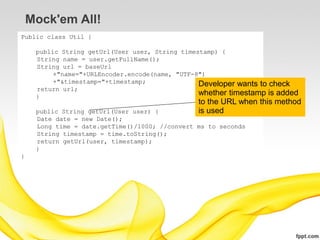
Mock'em All!
Public class Util {

     public String getUrl(User user, String timestamp) {
     String name = user.getFullName();
     String url = baseUrl
          +"name="+URLEncoder.encode(name, "UTF-8")
          +"&timestamp="+timestamp;              Developer wants to check
     return url;
     }
                                                 whether timestamp is added
                                                to the URL when this method
     public String getUrl(User user) {          is used
     Date date = new Date();
     Long time = date.getTime()/1000; //convert ms to seconds
     String timestamp = time.toString();
     return getUrl(user, timestamp);
     }
}
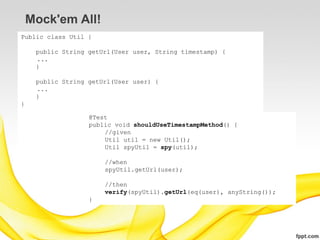
Mock'em All!
Public class Util {

     public String getUrl(User user, String timestamp) {
     ...
     }

     public String getUrl(User user) {
     ...
     }
}

                   @Test
                   public void shouldUseTimestampMethod() {
                       //given
                       Util util = new Util();
                       Util spyUtil = spy(util);

                       //when
                       spyUtil.getUrl(user);

                       //then
                       verify(spyUtil).getUrl(eq(user), anyString());
                   }
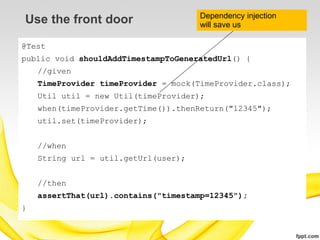
Dependency injection
Use the front door                    will save us

@Test
public void shouldAddTimestampToGeneratedUrl() {
    //given
    TimeProvider timeProvider = mock(TimeProvider.class);
    Util util = new Util(timeProvider);
    when(timeProvider.getTime()).thenReturn("12345");
    util.set(timeProvider);


    //when
    String url = util.getUrl(user);


    //then
    assertThat(url).contains("timestamp=12345");
}
Single Responsibility Principle


 A test should have one and only one reason to fail.
Testing two things at once
@DataProvider
public Object[][] data() {
    return new Object[][] { {"48", true}, {"+48", true},
         {"++48", true}, {"+48503", true}, {"+4", false},
         {"++4", false}, {"", false},
         {null, false}, {" ", false}, };
}

@Test(dataProvider = "data")
public void testQueryVerification(String query, boolean expected) {
    assertEquals(expected, FieldVerifier.isValidQuery(query));
}
Testing two things at once
@DataProvider
public Object[][] data() {
    return new Object[][] { {"48", true}, {"+48", true},
         {"++48", true}, {"+48503", true}, {"+4", false},
         {"++4", false}, {"", false},
         {null, false}, {" ", false}, };
}

@Test(dataProvider = "data")
public void testQueryVerification(String query, boolean expected) {
    assertEquals(expected, FieldVerifier.isValidQuery(query));
}

          testQueryVerification1() {
              assertEquals(true, FieldVerifier.isValidQuery(„48”));
          }
          testQueryVerification2() {
              assertEquals(true, FieldVerifier.isValidQuery(„+48”));
          }
          testQueryVerification3() {
              assertEquals(true, FieldVerifier.isValidQuery(„++48”));
          }
          testQueryVerification4() {
              assertEquals(true, FieldVerifier.isValidQuery(„+48503”));
          }
          ...
Concentrate on one feature
@DataProvider
public Object[][] validQueries() {
return new Object[][] { {"48"}, {"48123"},
         {"+48"}, {"++48"}, {"+48503"}};
}

@Test(dataProvider = "validQueries")
public void shouldRecognizeValidQueries(String validQuery) {
    assertTrue(FieldVerifier.isValidQuery(validQuery));
}


@DataProvider
public Object[][] invalidQueries() {
  return new Object[][] {
    {"+4"}, {"++4"}, {""}, {null}, {"   "} };
}

@Test(dataProvider = "invalidQueries")
public void shouldRejectInvalidQueries(String invalidQuery) {
    assertFalse(FieldVerifier.isValidQuery(invalidQuery));
}
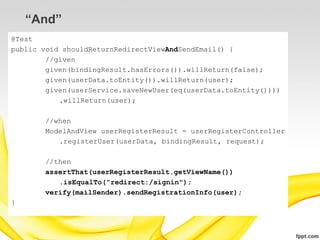
“And”
@Test
public void shouldReturnRedirectViewAndSendEmail() {
        //given
        given(bindingResult.hasErrors()).willReturn(false);
        given(userData.toEntity()).willReturn(user);
        given(userService.saveNewUser(eq(userData.toEntity())))
           .willReturn(user);

       //when
       ModelAndView userRegisterResult = userRegisterController
          .registerUser(userData, bindingResult, request);

       //then
       assertThat(userRegisterResult.getViewName())
          .isEqualTo("redirect:/signin");
       verify(mailSender).sendRegistrationInfo(user);
}
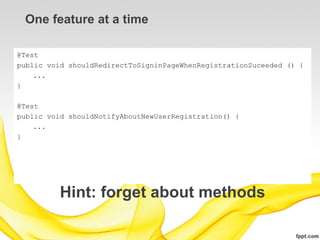
One feature at a time

@Test
public void shouldRedirectToSigninPageWhenRegistrationSuceeded () {
    ...
}

@Test
public void shouldNotifyAboutNewUserRegistration() {
    ...
}


          Hint: forget about methods
Readability is the king
Who the heck is “user_2” ?

@DataProvider
public static Object[][] usersPermissions() {
    return new Object[][]{
         {"user_1", Permission.READ},
         {"user_1", Permission.WRITE},
         {"user_1", Permission.REMOVE},
         {"user_2", Permission.WRITE},
         {"user_2", Permission.READ},
         {"user_3", Permission.READ}
    };
}
Ah, logged user can read and write...

@DataProvider
public static Object[][] usersPermissions() {
    return new Object[][]{
         {ADMIN, Permission.READ},
         {ADMIN, Permission.WRITE},
         {ADMIN, Permission.REMOVE},
         {LOGGED, Permission.WRITE},
         {LOGGED, Permission.READ},
         {GUEST, Permission.READ}
    };
}
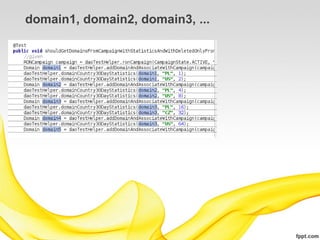
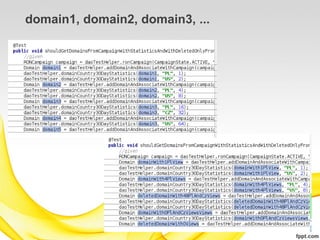
domain1, domain2, domain3, ...
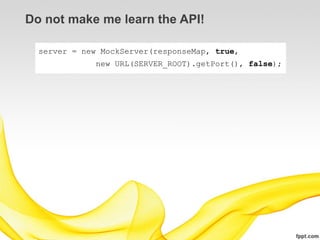
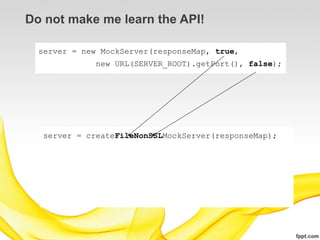
Do not make me learn the API!

  server = new MockServer(responseMap, true,
              new URL(SERVER_ROOT).getPort(), false);
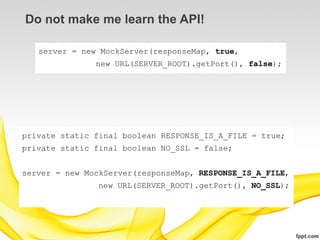
Do not make me learn the API!

   server = new MockServer(responseMap, true,
               new URL(SERVER_ROOT).getPort(), false);


private static final boolean RESPONSE_IS_A_FILE = true;
private static final boolean NO_SSL = false;


server = new MockServer(responseMap, RESPONSE_IS_A_FILE,
                new URL(SERVER_ROOT).getPort(), NO_SSL);
Do not make me learn the API!

  server = new MockServer(responseMap, true,
              new URL(SERVER_ROOT).getPort(), false);


  server = createFileNonSSLMockServer(responseMap);
Do not make me learn the API!

  server = new MockServer(responseMap, true,
              new URL(SERVER_ROOT).getPort(), false);


  server = new MockServerBuilder()
     .withResponse(responseMap)
     .withResponseType(FILE)
     .withUrl(SERVER_ROOT)
     .withoutSsl().create();


  server = MockServerBuilder
     .createFileNoSSLServer(responseMap, SERVER_ROOT);
Naming is really important
Test methods names are important

• When test fails
• Relation to focused tests
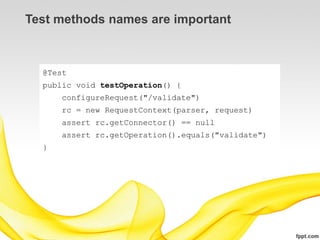
Test methods names are important


  @Test
  public void testOperation() {
      configureRequest("/validate")
      rc = new RequestContext(parser, request)
      assert rc.getConnector() == null
      assert rc.getOperation().equals("validate")
  }
“should” is better than “test”


•   testOperation()
•   testQuery()
•   testConstructor()
•   testFindUsersWithFilter()


•   shouldRejectInvalidRequests()
•   shouldSaveNewUserToDatabase()
•   constructorShouldFailWithNegativePrice()
•   shouldReturnOnlyUsersWithGivenName()
“should” is better than “test”

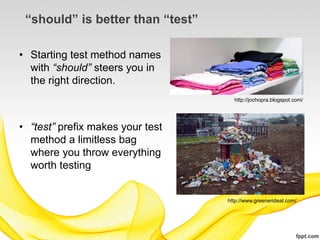
• Starting test method names
  with “should” steers you in
  the right direction.
                                    http://jochopra.blogspot.com/


• “test” prefix makes your test
  method a limitless bag
  where you throw everything
  worth testing


                                  http://www.greenerideal.com/
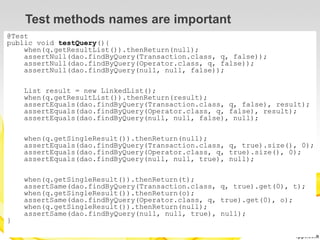
Test methods names are important
@Test
public void testQuery(){
    when(q.getResultList()).thenReturn(null);
    assertNull(dao.findByQuery(Transaction.class, q, false));
    assertNull(dao.findByQuery(Operator.class, q, false));
    assertNull(dao.findByQuery(null, null, false));

    List result = new LinkedList();
    when(q.getResultList()).thenReturn(result);
    assertEquals(dao.findByQuery(Transaction.class, q, false), result);
    assertEquals(dao.findByQuery(Operator.class, q, false), result);
    assertEquals(dao.findByQuery(null, null, false), null);

    when(q.getSingleResult()).thenReturn(null);
    assertEquals(dao.findByQuery(Transaction.class, q, true).size(), 0);
    assertEquals(dao.findByQuery(Operator.class, q, true).size(), 0);
    assertEquals(dao.findByQuery(null, null, true), null);

    when(q.getSingleResult()).thenReturn(t);
    assertSame(dao.findByQuery(Transaction.class, q, true).get(0), t);
    when(q.getSingleResult()).thenReturn(o);
    assertSame(dao.findByQuery(Operator.class, q, true).get(0), o);
    when(q.getSingleResult()).thenReturn(null);
    assertSame(dao.findByQuery(null, null, true), null);
}
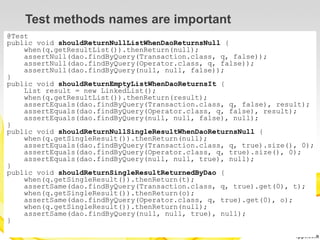
Test methods names are important
@Test
public void shouldReturnNullListWhenDaoReturnsNull {
    when(q.getResultList()).thenReturn(null);
    assertNull(dao.findByQuery(Transaction.class, q, false));
    assertNull(dao.findByQuery(Operator.class, q, false));
    assertNull(dao.findByQuery(null, null, false));
}
public void shouldReturnEmptyListWhenDaoReturnsIt {
    List result = new LinkedList();
    when(q.getResultList()).thenReturn(result);
    assertEquals(dao.findByQuery(Transaction.class, q, false), result);
    assertEquals(dao.findByQuery(Operator.class, q, false), result);
    assertEquals(dao.findByQuery(null, null, false), null);
}
public void shouldReturnNullSingleResultWhenDaoReturnsNull {
    when(q.getSingleResult()).thenReturn(null);
    assertEquals(dao.findByQuery(Transaction.class, q, true).size(), 0);
    assertEquals(dao.findByQuery(Operator.class, q, true).size(), 0);
    assertEquals(dao.findByQuery(null, null, true), null);
}
public void shouldReturnSingleResultReturnedByDao {
    when(q.getSingleResult()).thenReturn(t);
    assertSame(dao.findByQuery(Transaction.class, q, true).get(0), t);
    when(q.getSingleResult()).thenReturn(o);
    assertSame(dao.findByQuery(Operator.class, q, true).get(0), o);
    when(q.getSingleResult()).thenReturn(null);
    assertSame(dao.findByQuery(null, null, true), null);
}
Assertion part is freaking huge
public void shouldPreDeployApplication() {
     // given
     Artifact artifact = mock(Artifact.class);
     when(artifact.getFileName()).thenReturn("war-artifact-2.0.war");
     ServerConfiguration config
          = new ServerConfiguration(ADDRESS, USER, KEY_FILE, TOMCAT_PATH, TEMP_PATH);
     Tomcat tomcat = new Tomcat(HTTP_TOMCAT_URL, config);
     String destDir = new File(".").getCanonicalPath() + SLASH + "target" + SLASH;
     new File(destDir).mkdirs();

    // when
    tomcat.preDeploy(artifact, new FakeWar(WAR_FILE_LENGTH));

    //then
    JSch jsch = new JSch();
    jsch.addIdentity(KEY_FILE);
    Session session = jsch.getSession(USER, ADDRESS, 22);
    session.setConfig("StrictHostKeyChecking", "no");
    session.connect();

    Channel channel = session.openChannel("sftp");
    session.setServerAliveInterval(92000);
    channel.connect();
    ChannelSftp sftpChannel = (ChannelSftp) channel;

    sftpChannel.get(TEMP_PATH + SLASH + artifact.getFileName(), destDir);
    sftpChannel.exit();

    session.disconnect();

    File downloadedFile = new File(destDir, artifact.getFileName());

    assertThat(downloadedFile).exists().hasSize(WAR_FILE_LENGTH);
}
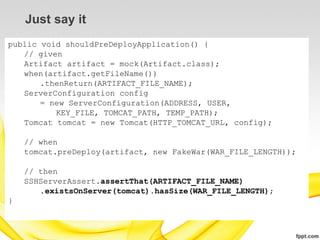
Just say it
public void shouldPreDeployApplication() {
   // given
   Artifact artifact = mock(Artifact.class);
   when(artifact.getFileName())
       .thenReturn(ARTIFACT_FILE_NAME);
   ServerConfiguration config
       = new ServerConfiguration(ADDRESS, USER,
          KEY_FILE, TOMCAT_PATH, TEMP_PATH);
   Tomcat tomcat = new Tomcat(HTTP_TOMCAT_URL, config);

    // when
    tomcat.preDeploy(artifact, new FakeWar(WAR_FILE_LENGTH));

    // then
    SSHServerAssert.assertThat(ARTIFACT_FILE_NAME)
       .existsOnServer(tomcat).hasSize(WAR_FILE_LENGTH);
}
Just say it
public void shouldPreDeployApplication() {
   // given
   Artifact artifact = mock(Artifact.class);
   when(artifact.getFileName())
       .thenReturn(ARTIFACT_FILE_NAME);
   ServerConfiguration config
       = new ServerConfiguration(ADDRESS, USER,
          KEY_FILE, TOMCAT_PATH, TEMP_PATH);
   Tomcat tomcat = new Tomcat(HTTP_TOMCAT_URL, config);

    // when   WHY NOT CREATE   WHY NOT USE
    tomcat.preDeploy(artifact, new FakeWar(WAR_FILE_LENGTH));
       A PRIVATE ASSERTION METHOD?
    // then
    assertThatFileIsOnServer(ARTIFACT_FILE_NAME,
            Tomcat, WAR_FILE_LENGTH);
}
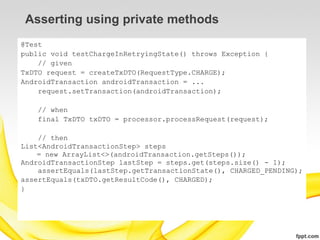
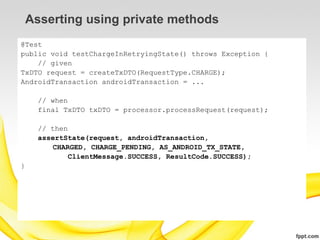
Asserting using private methods
@Test
public void testChargeInRetryingState() throws Exception {
    // given
TxDTO request = createTxDTO(RequestType.CHARGE);
AndroidTransaction androidTransaction = ...
    request.setTransaction(androidTransaction);

   // when
   final TxDTO txDTO = processor.processRequest(request);

    // then
List<AndroidTransactionStep> steps
    = new ArrayList<>(androidTransaction.getSteps());
AndroidTransactionStep lastStep = steps.get(steps.size() - 1);
    assertEquals(lastStep.getTransactionState(), CHARGED_PENDING);
assertEquals(txDTO.getResultCode(), CHARGED);
}
Asserting using private methods
@Test
public void testChargeInRetryingState() throws Exception {
    // given
TxDTO request = createTxDTO(RequestType.CHARGE);
AndroidTransaction androidTransaction = ...
    request.setTransaction(androidTransaction);

   // when WHY NOT CREATE
   final TxDTO txDTO = processor.processRequest(request);
    A PRIVATE ASSERTION METHOD?
    // then
List<AndroidTransactionStep> steps
    = new ArrayList<>(androidTransaction.getSteps());
AndroidTransactionStep lastStep = steps.get(steps.size() - 1);
    assertEquals(lastStep.getTransactionState(), CHARGED_PENDING);
assertEquals(txDTO.getResultCode(), CHARGED);
}
Asserting using private methods
@Test
public void testChargeInRetryingState() throws Exception {
    // given
TxDTO request = createTxDTO(RequestType.CHARGE);
AndroidTransaction androidTransaction = ...

      // when
      final TxDTO txDTO = processor.processRequest(request);

      // then
      assertState(request, androidTransaction,
         CHARGED, CHARGE_PENDING, AS_ANDROID_TX_STATE,
              ClientMessage.SUCCESS, ResultCode.SUCCESS);
}
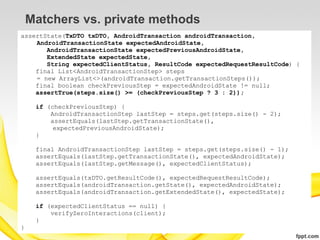
Matchers vs. private methods
assertState(TxDTO txDTO, AndroidTransaction androidTransaction,
    AndroidTransactionState expectedAndroidState,
       AndroidTransactionState expectedPreviousAndroidState,
       ExtendedState expectedState,
       String expectedClientStatus, ResultCode expectedRequestResultCode) {
    final List<AndroidTransactionStep> steps
    = new ArrayList<>(androidTransaction.getTransactionSteps());
    final boolean checkPreviousStep = expectedAndroidState != null;
    assertTrue(steps.size() >= (checkPreviousStep ? 3 : 2));

     if (checkPreviousStep) {
         AndroidTransactionStep lastStep = steps.get(steps.size() - 2);
         assertEquals(lastStep.getTransactionState(),
          expectedPreviousAndroidState);
     }

     final AndroidTransactionStep lastStep = steps.get(steps.size() - 1);
     assertEquals(lastStep.getTransactionState(), expectedAndroidState);
     assertEquals(lastStep.getMessage(), expectedClientStatus);

     assertEquals(txDTO.getResultCode(), expectedRequestResultCode);
     assertEquals(androidTransaction.getState(), expectedAndroidState);
     assertEquals(androidTransaction.getExtendedState(), expectedState);

     if (expectedClientStatus == null) {
         verifyZeroInteractions(client);
     }
}
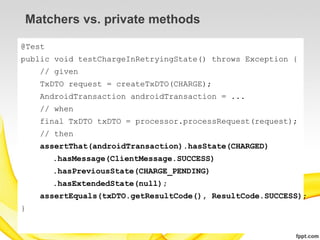
Matchers vs. private methods

@Test
public void testChargeInRetryingState() throws Exception {
    // given
    TxDTO request = createTxDTO(CHARGE);
    AndroidTransaction androidTransaction = ...
    // when
    final TxDTO txDTO = processor.processRequest(request);
    // then
    assertThat(androidTransaction).hasState(CHARGED)
        .hasMessage(ClientMessage.SUCCESS)
        .hasPreviousState(CHARGE_PENDING)
        .hasExtendedState(null);
    assertEquals(txDTO.getResultCode(), ResultCode.SUCCESS);
}
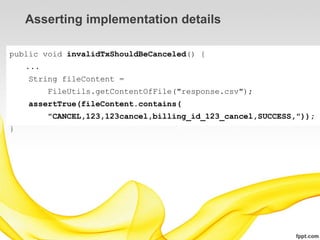
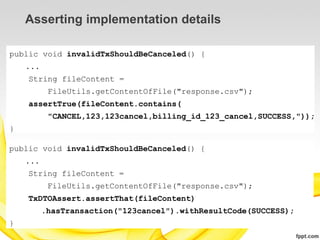
Asserting implementation details

public void invalidTxShouldBeCanceled() {
    ...
    String fileContent =
          FileUtils.getContentOfFile("response.csv");
    assertTrue(fileContent.contains(
          "CANCEL,123,123cancel,billing_id_123_cancel,SUCCESS,"));
}
Asserting implementation details

public void invalidTxShouldBeCanceled() {
    ...
    String fileContent =
           FileUtils.getContentOfFile("response.csv");
    assertTrue(fileContent.contains(
           "CANCEL,123,123cancel,billing_id_123_cancel,SUCCESS,"));
}

public void invalidTxShouldBeCanceled() {
    ...
    String fileContent =
           FileUtils.getContentOfFile("response.csv");
    TxDTOAssert.assertThat(fileContent)
          .hasTransaction("123cancel").withResultCode(SUCCESS);
}
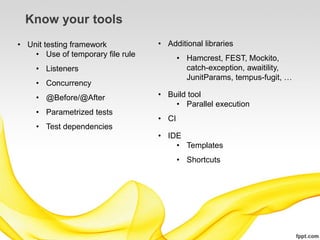
Know your tools
• Unit testing framework           • Additional libraries
    • Use of temporary file rule          • Hamcrest, FEST, Mockito,
     • Listeners                            catch-exception, awaitility,
                                            JunitParams, tempus-fugit, …
     • Concurrency
     • @Before/@After              • Build tool
                                       • Parallel execution
     • Parametrized tests
                                   • CI
     • Test dependencies
                                   • IDE
                                       • Templates
                                          • Shortcuts
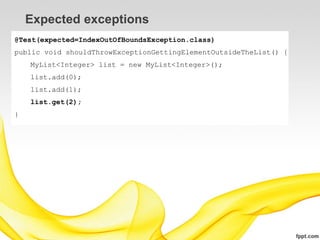
Expected exceptions
@Test(expected=IndexOutOfBoundsException.class)
public void shouldThrowExceptionGettingElementOutsideTheList() {
    MyList<Integer> list = new MyList<Integer>();
    list.add(0);
    list.add(1);
    list.get(2);
}
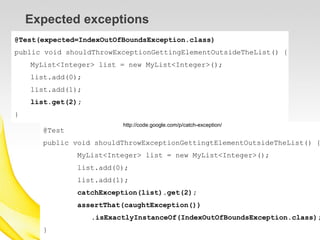
Expected exceptions
@Test(expected=IndexOutOfBoundsException.class)
public void shouldThrowExceptionGettingElementOutsideTheList() {
    MyList<Integer> list = new MyList<Integer>();
    list.add(0);
    list.add(1);
    list.get(2);
}
                          http://code.google.com/p/catch-exception/
      @Test
      public void shouldThrowExceptionGettingtElementOutsideTheList() {
              MyList<Integer> list = new MyList<Integer>();
              list.add(0);
              list.add(1);
              catchException(list).get(2);
              assertThat(caughtException())
                   .isExactlyInstanceOf(IndexOutOfBoundsException.class);
      }
Expected exceptions (with catch-exception)

@Test
public void shouldThrowException() throws SmsException {


    catchException(gutExtractor)
        .extractGut(„invalid gut”);


    then(caughtException())
         .isInstanceOf(SmsException.class)
         .hasMessage("Invalid gut")
         .hasNoCause();
}

                               http://code.google.com/p/catch-exception/
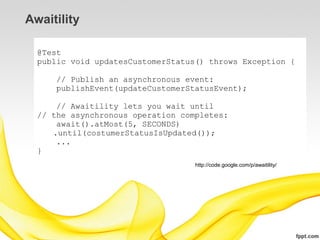
Awaitility

  @Test
  public void updatesCustomerStatus() throws Exception {

      // Publish an asynchronous event:
      publishEvent(updateCustomerStatusEvent);

      // Awaitility lets you wait until
  // the asynchronous operation completes:
      await().atMost(5, SECONDS)
     .until(costumerStatusIsUpdated());
      ...
  }
                                   http://code.google.com/p/awaitility/
What do you really want to test?

  @Test
  public void shouldAddAUser() {
      User user = new User();
      userService.save(user);
      assertEquals(dao.getNbOfUsers(), 1);
  }
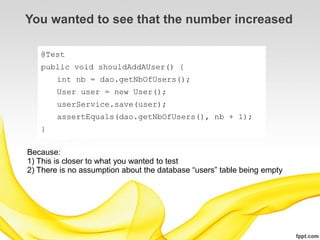
You wanted to see that the number increased

   @Test
   public void shouldAddAUser() {
        int nb = dao.getNbOfUsers();
        User user = new User();
        userService.save(user);
        assertEquals(dao.getNbOfUsers(), nb + 1);
   }

Because:
1) This is closer to what you wanted to test
2) There is no assumption about the database “users” table being empty
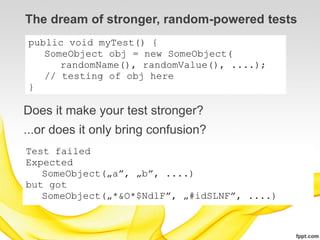
The dream of stronger, random-powered tests
public void myTest() {
   SomeObject obj = new SomeObject(
      randomName(), randomValue(), ....);
   // testing of obj here
}

Does it make your test stronger?
The dream of stronger, random-powered tests
public void myTest() {
   SomeObject obj = new SomeObject(
      randomName(), randomValue(), ....);
   // testing of obj here
}

Does it make your test stronger?
...or does it only bring confusion?
Test failed
Expected
   SomeObject(„a”, „b”, ....)
but got
   SomeObject(„*&O*$NdlF”, „#idSLNF”, ....)
Random done wrong
public void myTest() {
   SomeObject obj = new SomeObject(
           a, b, c, productCode());
      // testing of obj here
}

private String productCode(){
   String[] codes = {"Code A", "Code B",
                 "Code C", "Code D"};
   int index = rand.nextInt(codes.length);
   return codes[index];
}
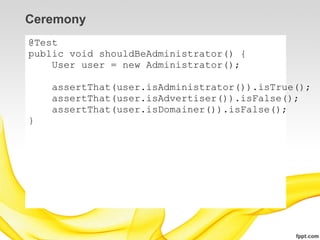
Ceremony
@Test
public void shouldBeAdministrator() {
    //given
    User user = new Administrator();

    //when
    boolean administrator = user.isAdministrator()
    boolean advertiser = user.isAdvertiser();
    boolean domainer = user.isDomainer();

    //then
    assertThat(administrator).isTrue();
    assertThat(advertiser).isFalse();
    assertThat(domainer).isFalse();
}
Ceremony
@Test
public void shouldBeAdministrator() {
    User user = new Administrator();

    assertThat(user.isAdministrator()).isTrue();
    assertThat(user.isAdvertiser()).isFalse();
    assertThat(user.isDomainer()).isFalse();
}
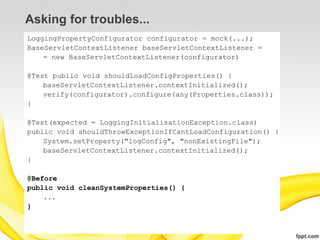
Asking for troubles...
LoggingPropertyConfigurator configurator = mock(...);
BaseServletContextListener baseServletContextListener =
= new BaseServletContextListener(configurator)


@Test public void shouldLoadConfigProperties() {          Should load some
    baseServletContextListener.contextInitialized();      default config
    verify(configurator).configure(any(Properties.class));
}


@Test(expected = LoggingInitialisationException.class)
public void shouldThrowExceptionIfCantLoadConfiguration() Should load this
                                                           {
                                                            specific file
    System.setProperty("logConfig", "nonExistingFile");
    baseServletContextListener.contextInitialized();
}
Asking for troubles...
LoggingPropertyConfigurator configurator = mock(...);
BaseServletContextListener baseServletContextListener =
    = new BaseServletContextListener(configurator)

@Test public void shouldLoadConfigProperties() {
    baseServletContextListener.contextInitialized();
    verify(configurator).configure(any(Properties.class));
}

@Test(expected = LoggingInitialisationException.class)
public void shouldThrowExceptionIfCantLoadConfiguration() {
    System.setProperty("logConfig", "nonExistingFile");
    baseServletContextListener.contextInitialized();
}

@Before
public void cleanSystemProperties() {
    ...
}
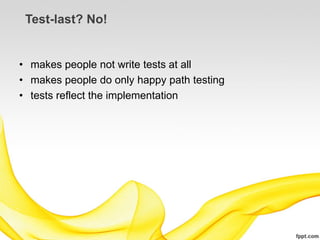
Test-last? No!


• makes people not write tests at all
• makes people do only happy path testing
• tests reflect the implementation
Always TDD?

For six or eight hours spread over the next few weeks I
struggled to get the first test written and running. Writing
tests for Eclipse plug-ins is not trivial, so it’s not
surprising I had some trouble. [...] In six or eight hours
of solid programming time, I can still make significant
progress. If I’d just written some stuff and verified it by
hand, I would probably have the final answer to whether
my idea is actually worth money by now. Instead, all I
have is a complicated test that doesn’t work, a pile
of frustration, eight fewer hours in my life, and the
motivation to write another essay.
                                           Kent Beck, Just Ship, Baby
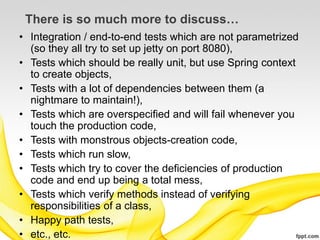
There is so much more to discuss…
• Integration / end-to-end tests which are not parametrized
  (so they all try to set up jetty on port 8080),
• Tests which should be really unit, but use Spring context
  to create objects,
• Tests with a lot of dependencies between them (a
  nightmare to maintain!),
• Tests which are overspecified and will fail whenever you
  touch the production code,
• Tests with monstrous objects-creation code,
• Tests which run slow,
• Tests which try to cover the deficiencies of production
  code and end up being a total mess,
• Tests which verify methods instead of verifying
  responsibilities of a class,
• Happy path tests,
• etc., etc.
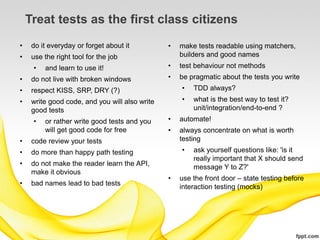
Treat tests as the first class citizens
•    do it everyday or forget about it          •   make tests readable using matchers,
•    use the right tool for the job                 builders and good names
     •   and learn to use it!                   •   test behaviour not methods
•    do not live with broken windows            •   be pragmatic about the tests you write
•    respect KISS, SRP, DRY (?)                     •   TDD always?
•    write good code, and you will also write       •   what is the best way to test it?
     good tests                                         unit/integration/end-to-end ?
     •   or rather write good tests and you     •   automate!
         will get good code for free            •   always concentrate on what is worth
•    code review your tests                         testing
•    do more than happy path testing                •   ask yourself questions like: 'is it
                                                        really important that X should send
•    do not make the reader learn the API,              message Y to Z?'
     make it obvious
                                                •   use the front door – state testing before
•    bad names lead to bad tests                    interaction testing (mocks)
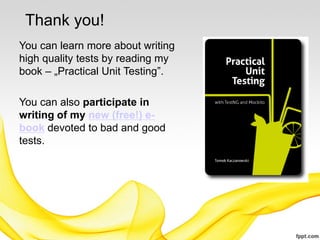
Thank you!
You can learn more about writing
high quality tests by reading my
book – „Practical Unit Testing”.

You can also participate in
writing of my new (free!) e-
book devoted to bad and good
tests.

33rd Degree 2013, Bad Tests, Good Tests

  • 1.
    Bad Tests, GoodTests Tomek Kaczanowski http://twitter.com/#!/devops_borat
  • 2.
    Tomek Kaczanowski • Developer •Team lead • Blogger • http://kaczanowscy.pl/tomek • Book author • http://practicalunittesting.com • Working at CodeWise (Krakow, Poland) • ...we are hiring, wanna join us? JUnit version coming soon!
  • 3.
    Why bother withtests? • System works as expected • Changes do not hurt • Documentation
  • 4.
    Tests help toachieve quality Not sure when I saw this picture – probably in GOOS?
  • 5.
    What happens ifwe do it wrong? • Angry clients • Depressed developers http://www.joshcanhelp.com
  • 6.
    When I startedout with unit tests, I was enthralled with the promise of ease and security that they would bring to my projects. In practice, however, the theory of sustainable software through unit tests started to break down. This difficulty continued to build up, until I finally threw my head back in anger and declared that "Unit Tests have become more trouble than they are worth." Llewellyn Falco and Michael Kennedy, Develop Mentor August 09
  • 7.
  • 8.
  • 9.
    write the righttest write this test right
  • 10.
    Before we begin •All of the examples are real but were: • obfuscated • to protect the innocents :) • truncated • imagine much more complex domain objects • Asking questions is allowed • ...but being smarter than me is not ;)
  • 11.
    We don't needno stinkin' asserts! public void testAddChunks() { System.out.println("*************************************"); System.out.println("testAddChunks() ... "); ChunkMap cm = new ChunkMap(3); cm.addChunk(new Chunk("chunk")); List testList = cm.getChunks("chunk",null); if (testList.isEmpty()) fail("there should be at least one list!"); Chunk chunk = cm.getActualChunk("chunk",null); if (chunk.getElements().isEmpty()) fail("there should be at least one element!"); if (cm.getFinalChunkNr() != 1) fail("there should be at least one chunk!"); // iterate actual chunk for (Iterator it = chunk.getElements().iterator(); it.hasNext();) { Element element = (Element) it.next(); System.out.println("Element: " + element); } showChunks(cm); System.out.println("testAddChunks() OK "); } Courtesy of @bocytko
  • 12.
    Success is notan option... /** * Method testFailure. */ public void testFailure() { try { Message message = new Message(null,true); fail(); } catch(Exception ex) { ExceptionHandler.log(ExceptionLevel.ANY,ex); fail(); } } Courtesy of @bocytko
  • 13.
    What has happened?Well, it failed... public void testSimple() { IData data = null; IFormat format = null; LinkedList<String> attr = new LinkedList<String>(); attr.add("A"); attr.add("B"); try { format = new SimpleFormat("A"); data.setAmount(Amount.TEN); data.setAttributes(attr); IResult result = format.execute(); System.out.println(result.size()); Iterator iter = result.iterator(); while (iter.hasNext()) { IResult r = (IResult) iter.next(); System.out.println(r.getMessage()); ... } catch (Exception e) { fail(); } } Courtesy of @bocytko
  • 14.
    What has happened?Well, it failed... public void testSimple() { IData data = null; IFormat format = null; LinkedList<String> attr = new LinkedList<String>(); attr.add("A"); attr.add("B"); data is null - ready or not, NPE is coming!  try { format = new SimpleFormat("A"); data.setAmount(Amount.TEN); data.setAttributes(attr); IResult result = format.execute(); System.out.println(result.size()); Iterator iter = result.iterator(); while (iter.hasNext()) { IResult r = (IResult) iter.next(); System.out.println(r.getMessage()); ... } catch (Exception e) { fail(); } } Courtesy of @bocytko
  • 15.
    No smoke withouttests class SystemAdminSmokeTest extends GroovyTestCase { void testSmoke() { def ds = new org.h2.jdbcx.JdbcDataSource( URL: 'jdbc:h2:mem:test;DB_CLOSE_DELAY=-1;MODE=Oracle', user: 'sa', password: '') def jpaProperties = new Properties() jpaProperties.setProperty( 'hibernate.cache.use_second_level_cache', 'false') jpaProperties.setProperty( 'hibernate.cache.use_query_cache', 'false') def emf = new LocalContainerEntityManagerFactoryBean( dataSource: ds, persistenceUnitName: 'my-domain', jpaVendorAdapter: new HibernateJpaVendorAdapter( database: Database.H2, showSql: true, generateDdl: true), jpaProperties: jpaProperties) …some more code below }
  • 16.
    No smoke withouttests class SystemAdminSmokeTest extends GroovyTestCase { void testSmoke() { // do not remove below code // def ds = new org.h2.jdbcx.JdbcDataSource( // URL: 'jdbc:h2:mem:test;DB_CLOSE_DELAY=-1;MODE=Oracle', // user: 'sa', password: '') // // def jpaProperties = new Properties() // jpaProperties.setProperty( // 'hibernate.cache.use_second_level_cache', 'false') // jpaProperties.setProperty( // 'hibernate.cache.use_query_cache', 'false') // // def emf = new LocalContainerEntityManagerFactoryBean( // dataSource: ds, persistenceUnitName: 'my-domain', // jpaVendorAdapter: new HibernateJpaVendorAdapter( // database: Database.H2, showSql: true, // generateDdl: true), jpaProperties: jpaProperties) …some more code below, all commented out :( }
  • 17.
    Let's follow theleader! @Test public class ExampleTest { public void testExample() { assertTrue(true); } }
  • 18.
    Uh-oh, I feellonely... @Test public class ExampleTest { public void testExample() { assertTrue(true); } }
  • 19.
    Conclusions • Automation! • Running • Verification • Do not live with broken window • And remember there is no one else to fix them but you! • It is a full time job! • You should be informed why your test failed • Master your tools • …at least learn the basics!
  • 20.
    Use of thereal objects obscures the test @Test public void shouldGetTrafficTrend() { //given TrafficTrendProvider trafficTrendProvider = mock(TrafficTrendProvider.class); Report report = new Report(null, "", 1, 2, 3, BigDecimal.ONE, BigDecimal.ONE, 1); TrafficTrend trafficTrend = new TrafficTrend(report, report, new Date(), new Date(), new Date(), new Date()); given(trafficTrendProvider.getTrafficTrend()) .willReturn(trafficTrend); TrafficService service = new TrafficService(trafficTrendProvider); //when TrafficTrend result = service.getTrafficTrend(); //then assertThat(result).isEqualTo(trafficTrend); }
  • 21.
    Use of thereal objects obscures the test @Test public void shouldGetTrafficTrend() { //given TrafficTrendProvider trafficTrendProvider = mock(TrafficTrendProvider.class); TrafficTrend trafficTrend = mock(TrafficTrend.class); given(trafficTrendProvider.getTrafficTrend()) .willReturn(trafficTrend); TrafficService service = new TrafficService(trafficTrendProvider); //when TrafficTrend result = service.getTrafficTrend(); //then assertThat(result).isEqualTo(trafficTrend); }
  • 22.
    Mock'em All! @Test public voidshouldAddTimeZoneToModelAndView() { //given UserFacade userFacade = mock(UserFacade.class); ModelAndView modelAndView = mock(ModelAndView.class); given(userFacade.getTimezone()).willReturn("timezone X"); //when new UserDataInterceptor(userFacade) .postHandle(null, null, null, modelAndView); //then verify(modelAndView).addObject("timezone", "timezone X"); }
  • 23.
    ModelAndView from Mock'em All! SpringMVC – a mere container for data, without @Test any behaviour public void shouldAddTimeZoneToModelAndView() { //given UserFacade userFacade = mock(UserFacade.class); ModelAndView modelAndView = mock(ModelAndView.class); given(userFacade.getTimezone()).willReturn("timezone X"); //when new UserDataInterceptor(userFacade) .postHandle(null, null, null, modelAndView); //then verify(modelAndView).addObject("timezone", "timezone X"); }
  • 24.
    Use the frontdoor @Test public void shouldAddTimeZoneToModelAndView() { //given UserFacade userFacade = mock(UserFacade.class); ModelAndView modelAndView = new ModelAndView(); given(userFacade.getTimezone()).willReturn("timezone X"); //when new UserDataInterceptor(userFacade) .postHandle(null, null, null, modelAndView); a pseudocode but that is what we mean //then assertThat(modelAndView).contains("timezone", "timezone X"); }
  • 25.
    Mock'em All! Public classUtil { public String getUrl(User user, String timestamp) { String name = user.getFullName(); String url = baseUrl +"name="+URLEncoder.encode(name, "UTF-8") +"&timestamp="+timestamp; Developer wants to check return url; } whether timestamp is added to the URL when this method public String getUrl(User user) { is used Date date = new Date(); Long time = date.getTime()/1000; //convert ms to seconds String timestamp = time.toString(); return getUrl(user, timestamp); } }
  • 26.
    Mock'em All! Public classUtil { public String getUrl(User user, String timestamp) { ... } public String getUrl(User user) { ... } } @Test public void shouldUseTimestampMethod() { //given Util util = new Util(); Util spyUtil = spy(util); //when spyUtil.getUrl(user); //then verify(spyUtil).getUrl(eq(user), anyString()); }
  • 27.
    Dependency injection Use thefront door will save us @Test public void shouldAddTimestampToGeneratedUrl() { //given TimeProvider timeProvider = mock(TimeProvider.class); Util util = new Util(timeProvider); when(timeProvider.getTime()).thenReturn("12345"); util.set(timeProvider); //when String url = util.getUrl(user); //then assertThat(url).contains("timestamp=12345"); }
  • 28.
    Single Responsibility Principle A test should have one and only one reason to fail.
  • 29.
    Testing two thingsat once @DataProvider public Object[][] data() { return new Object[][] { {"48", true}, {"+48", true}, {"++48", true}, {"+48503", true}, {"+4", false}, {"++4", false}, {"", false}, {null, false}, {" ", false}, }; } @Test(dataProvider = "data") public void testQueryVerification(String query, boolean expected) { assertEquals(expected, FieldVerifier.isValidQuery(query)); }
  • 30.
    Testing two thingsat once @DataProvider public Object[][] data() { return new Object[][] { {"48", true}, {"+48", true}, {"++48", true}, {"+48503", true}, {"+4", false}, {"++4", false}, {"", false}, {null, false}, {" ", false}, }; } @Test(dataProvider = "data") public void testQueryVerification(String query, boolean expected) { assertEquals(expected, FieldVerifier.isValidQuery(query)); } testQueryVerification1() { assertEquals(true, FieldVerifier.isValidQuery(„48”)); } testQueryVerification2() { assertEquals(true, FieldVerifier.isValidQuery(„+48”)); } testQueryVerification3() { assertEquals(true, FieldVerifier.isValidQuery(„++48”)); } testQueryVerification4() { assertEquals(true, FieldVerifier.isValidQuery(„+48503”)); } ...
  • 31.
    Concentrate on onefeature @DataProvider public Object[][] validQueries() { return new Object[][] { {"48"}, {"48123"}, {"+48"}, {"++48"}, {"+48503"}}; } @Test(dataProvider = "validQueries") public void shouldRecognizeValidQueries(String validQuery) { assertTrue(FieldVerifier.isValidQuery(validQuery)); } @DataProvider public Object[][] invalidQueries() { return new Object[][] { {"+4"}, {"++4"}, {""}, {null}, {" "} }; } @Test(dataProvider = "invalidQueries") public void shouldRejectInvalidQueries(String invalidQuery) { assertFalse(FieldVerifier.isValidQuery(invalidQuery)); }
  • 32.
    “And” @Test public void shouldReturnRedirectViewAndSendEmail(){ //given given(bindingResult.hasErrors()).willReturn(false); given(userData.toEntity()).willReturn(user); given(userService.saveNewUser(eq(userData.toEntity()))) .willReturn(user); //when ModelAndView userRegisterResult = userRegisterController .registerUser(userData, bindingResult, request); //then assertThat(userRegisterResult.getViewName()) .isEqualTo("redirect:/signin"); verify(mailSender).sendRegistrationInfo(user); }
  • 33.
    One feature ata time @Test public void shouldRedirectToSigninPageWhenRegistrationSuceeded () { ... } @Test public void shouldNotifyAboutNewUserRegistration() { ... } Hint: forget about methods
  • 34.
  • 35.
    Who the heckis “user_2” ? @DataProvider public static Object[][] usersPermissions() { return new Object[][]{ {"user_1", Permission.READ}, {"user_1", Permission.WRITE}, {"user_1", Permission.REMOVE}, {"user_2", Permission.WRITE}, {"user_2", Permission.READ}, {"user_3", Permission.READ} }; }
  • 36.
    Ah, logged usercan read and write... @DataProvider public static Object[][] usersPermissions() { return new Object[][]{ {ADMIN, Permission.READ}, {ADMIN, Permission.WRITE}, {ADMIN, Permission.REMOVE}, {LOGGED, Permission.WRITE}, {LOGGED, Permission.READ}, {GUEST, Permission.READ} }; }
  • 37.
  • 38.
  • 39.
  • 40.
    Do not makeme learn the API! server = new MockServer(responseMap, true, new URL(SERVER_ROOT).getPort(), false);
  • 41.
    Do not makeme learn the API! server = new MockServer(responseMap, true, new URL(SERVER_ROOT).getPort(), false); private static final boolean RESPONSE_IS_A_FILE = true; private static final boolean NO_SSL = false; server = new MockServer(responseMap, RESPONSE_IS_A_FILE, new URL(SERVER_ROOT).getPort(), NO_SSL);
  • 42.
    Do not makeme learn the API! server = new MockServer(responseMap, true, new URL(SERVER_ROOT).getPort(), false); server = createFileNonSSLMockServer(responseMap);
  • 43.
    Do not makeme learn the API! server = new MockServer(responseMap, true, new URL(SERVER_ROOT).getPort(), false); server = new MockServerBuilder() .withResponse(responseMap) .withResponseType(FILE) .withUrl(SERVER_ROOT) .withoutSsl().create(); server = MockServerBuilder .createFileNoSSLServer(responseMap, SERVER_ROOT);
  • 44.
  • 45.
    Test methods namesare important • When test fails • Relation to focused tests
  • 46.
    Test methods namesare important @Test public void testOperation() { configureRequest("/validate") rc = new RequestContext(parser, request) assert rc.getConnector() == null assert rc.getOperation().equals("validate") }
  • 47.
    “should” is betterthan “test” • testOperation() • testQuery() • testConstructor() • testFindUsersWithFilter() • shouldRejectInvalidRequests() • shouldSaveNewUserToDatabase() • constructorShouldFailWithNegativePrice() • shouldReturnOnlyUsersWithGivenName()
  • 48.
    “should” is betterthan “test” • Starting test method names with “should” steers you in the right direction. http://jochopra.blogspot.com/ • “test” prefix makes your test method a limitless bag where you throw everything worth testing http://www.greenerideal.com/
  • 49.
    Test methods namesare important @Test public void testQuery(){ when(q.getResultList()).thenReturn(null); assertNull(dao.findByQuery(Transaction.class, q, false)); assertNull(dao.findByQuery(Operator.class, q, false)); assertNull(dao.findByQuery(null, null, false)); List result = new LinkedList(); when(q.getResultList()).thenReturn(result); assertEquals(dao.findByQuery(Transaction.class, q, false), result); assertEquals(dao.findByQuery(Operator.class, q, false), result); assertEquals(dao.findByQuery(null, null, false), null); when(q.getSingleResult()).thenReturn(null); assertEquals(dao.findByQuery(Transaction.class, q, true).size(), 0); assertEquals(dao.findByQuery(Operator.class, q, true).size(), 0); assertEquals(dao.findByQuery(null, null, true), null); when(q.getSingleResult()).thenReturn(t); assertSame(dao.findByQuery(Transaction.class, q, true).get(0), t); when(q.getSingleResult()).thenReturn(o); assertSame(dao.findByQuery(Operator.class, q, true).get(0), o); when(q.getSingleResult()).thenReturn(null); assertSame(dao.findByQuery(null, null, true), null); }
  • 50.
    Test methods namesare important @Test public void shouldReturnNullListWhenDaoReturnsNull { when(q.getResultList()).thenReturn(null); assertNull(dao.findByQuery(Transaction.class, q, false)); assertNull(dao.findByQuery(Operator.class, q, false)); assertNull(dao.findByQuery(null, null, false)); } public void shouldReturnEmptyListWhenDaoReturnsIt { List result = new LinkedList(); when(q.getResultList()).thenReturn(result); assertEquals(dao.findByQuery(Transaction.class, q, false), result); assertEquals(dao.findByQuery(Operator.class, q, false), result); assertEquals(dao.findByQuery(null, null, false), null); } public void shouldReturnNullSingleResultWhenDaoReturnsNull { when(q.getSingleResult()).thenReturn(null); assertEquals(dao.findByQuery(Transaction.class, q, true).size(), 0); assertEquals(dao.findByQuery(Operator.class, q, true).size(), 0); assertEquals(dao.findByQuery(null, null, true), null); } public void shouldReturnSingleResultReturnedByDao { when(q.getSingleResult()).thenReturn(t); assertSame(dao.findByQuery(Transaction.class, q, true).get(0), t); when(q.getSingleResult()).thenReturn(o); assertSame(dao.findByQuery(Operator.class, q, true).get(0), o); when(q.getSingleResult()).thenReturn(null); assertSame(dao.findByQuery(null, null, true), null); }
  • 51.
    Assertion part isfreaking huge public void shouldPreDeployApplication() { // given Artifact artifact = mock(Artifact.class); when(artifact.getFileName()).thenReturn("war-artifact-2.0.war"); ServerConfiguration config = new ServerConfiguration(ADDRESS, USER, KEY_FILE, TOMCAT_PATH, TEMP_PATH); Tomcat tomcat = new Tomcat(HTTP_TOMCAT_URL, config); String destDir = new File(".").getCanonicalPath() + SLASH + "target" + SLASH; new File(destDir).mkdirs(); // when tomcat.preDeploy(artifact, new FakeWar(WAR_FILE_LENGTH)); //then JSch jsch = new JSch(); jsch.addIdentity(KEY_FILE); Session session = jsch.getSession(USER, ADDRESS, 22); session.setConfig("StrictHostKeyChecking", "no"); session.connect(); Channel channel = session.openChannel("sftp"); session.setServerAliveInterval(92000); channel.connect(); ChannelSftp sftpChannel = (ChannelSftp) channel; sftpChannel.get(TEMP_PATH + SLASH + artifact.getFileName(), destDir); sftpChannel.exit(); session.disconnect(); File downloadedFile = new File(destDir, artifact.getFileName()); assertThat(downloadedFile).exists().hasSize(WAR_FILE_LENGTH); }
  • 52.
    Just say it publicvoid shouldPreDeployApplication() { // given Artifact artifact = mock(Artifact.class); when(artifact.getFileName()) .thenReturn(ARTIFACT_FILE_NAME); ServerConfiguration config = new ServerConfiguration(ADDRESS, USER, KEY_FILE, TOMCAT_PATH, TEMP_PATH); Tomcat tomcat = new Tomcat(HTTP_TOMCAT_URL, config); // when tomcat.preDeploy(artifact, new FakeWar(WAR_FILE_LENGTH)); // then SSHServerAssert.assertThat(ARTIFACT_FILE_NAME) .existsOnServer(tomcat).hasSize(WAR_FILE_LENGTH); }
  • 53.
    Just say it publicvoid shouldPreDeployApplication() { // given Artifact artifact = mock(Artifact.class); when(artifact.getFileName()) .thenReturn(ARTIFACT_FILE_NAME); ServerConfiguration config = new ServerConfiguration(ADDRESS, USER, KEY_FILE, TOMCAT_PATH, TEMP_PATH); Tomcat tomcat = new Tomcat(HTTP_TOMCAT_URL, config); // when WHY NOT CREATE WHY NOT USE tomcat.preDeploy(artifact, new FakeWar(WAR_FILE_LENGTH)); A PRIVATE ASSERTION METHOD? // then assertThatFileIsOnServer(ARTIFACT_FILE_NAME, Tomcat, WAR_FILE_LENGTH); }
  • 54.
    Asserting using privatemethods @Test public void testChargeInRetryingState() throws Exception { // given TxDTO request = createTxDTO(RequestType.CHARGE); AndroidTransaction androidTransaction = ... request.setTransaction(androidTransaction); // when final TxDTO txDTO = processor.processRequest(request); // then List<AndroidTransactionStep> steps = new ArrayList<>(androidTransaction.getSteps()); AndroidTransactionStep lastStep = steps.get(steps.size() - 1); assertEquals(lastStep.getTransactionState(), CHARGED_PENDING); assertEquals(txDTO.getResultCode(), CHARGED); }
  • 55.
    Asserting using privatemethods @Test public void testChargeInRetryingState() throws Exception { // given TxDTO request = createTxDTO(RequestType.CHARGE); AndroidTransaction androidTransaction = ... request.setTransaction(androidTransaction); // when WHY NOT CREATE final TxDTO txDTO = processor.processRequest(request); A PRIVATE ASSERTION METHOD? // then List<AndroidTransactionStep> steps = new ArrayList<>(androidTransaction.getSteps()); AndroidTransactionStep lastStep = steps.get(steps.size() - 1); assertEquals(lastStep.getTransactionState(), CHARGED_PENDING); assertEquals(txDTO.getResultCode(), CHARGED); }
  • 56.
    Asserting using privatemethods @Test public void testChargeInRetryingState() throws Exception { // given TxDTO request = createTxDTO(RequestType.CHARGE); AndroidTransaction androidTransaction = ... // when final TxDTO txDTO = processor.processRequest(request); // then assertState(request, androidTransaction, CHARGED, CHARGE_PENDING, AS_ANDROID_TX_STATE, ClientMessage.SUCCESS, ResultCode.SUCCESS); }
  • 57.
    Matchers vs. privatemethods assertState(TxDTO txDTO, AndroidTransaction androidTransaction, AndroidTransactionState expectedAndroidState, AndroidTransactionState expectedPreviousAndroidState, ExtendedState expectedState, String expectedClientStatus, ResultCode expectedRequestResultCode) { final List<AndroidTransactionStep> steps = new ArrayList<>(androidTransaction.getTransactionSteps()); final boolean checkPreviousStep = expectedAndroidState != null; assertTrue(steps.size() >= (checkPreviousStep ? 3 : 2)); if (checkPreviousStep) { AndroidTransactionStep lastStep = steps.get(steps.size() - 2); assertEquals(lastStep.getTransactionState(), expectedPreviousAndroidState); } final AndroidTransactionStep lastStep = steps.get(steps.size() - 1); assertEquals(lastStep.getTransactionState(), expectedAndroidState); assertEquals(lastStep.getMessage(), expectedClientStatus); assertEquals(txDTO.getResultCode(), expectedRequestResultCode); assertEquals(androidTransaction.getState(), expectedAndroidState); assertEquals(androidTransaction.getExtendedState(), expectedState); if (expectedClientStatus == null) { verifyZeroInteractions(client); } }
  • 58.
    Matchers vs. privatemethods @Test public void testChargeInRetryingState() throws Exception { // given TxDTO request = createTxDTO(CHARGE); AndroidTransaction androidTransaction = ... // when final TxDTO txDTO = processor.processRequest(request); // then assertThat(androidTransaction).hasState(CHARGED) .hasMessage(ClientMessage.SUCCESS) .hasPreviousState(CHARGE_PENDING) .hasExtendedState(null); assertEquals(txDTO.getResultCode(), ResultCode.SUCCESS); }
  • 59.
    Asserting implementation details publicvoid invalidTxShouldBeCanceled() { ... String fileContent = FileUtils.getContentOfFile("response.csv"); assertTrue(fileContent.contains( "CANCEL,123,123cancel,billing_id_123_cancel,SUCCESS,")); }
  • 60.
    Asserting implementation details publicvoid invalidTxShouldBeCanceled() { ... String fileContent = FileUtils.getContentOfFile("response.csv"); assertTrue(fileContent.contains( "CANCEL,123,123cancel,billing_id_123_cancel,SUCCESS,")); } public void invalidTxShouldBeCanceled() { ... String fileContent = FileUtils.getContentOfFile("response.csv"); TxDTOAssert.assertThat(fileContent) .hasTransaction("123cancel").withResultCode(SUCCESS); }
  • 61.
    Know your tools •Unit testing framework • Additional libraries • Use of temporary file rule • Hamcrest, FEST, Mockito, • Listeners catch-exception, awaitility, JunitParams, tempus-fugit, … • Concurrency • @Before/@After • Build tool • Parallel execution • Parametrized tests • CI • Test dependencies • IDE • Templates • Shortcuts
  • 62.
    Expected exceptions @Test(expected=IndexOutOfBoundsException.class) public voidshouldThrowExceptionGettingElementOutsideTheList() { MyList<Integer> list = new MyList<Integer>(); list.add(0); list.add(1); list.get(2); }
  • 63.
    Expected exceptions @Test(expected=IndexOutOfBoundsException.class) public voidshouldThrowExceptionGettingElementOutsideTheList() { MyList<Integer> list = new MyList<Integer>(); list.add(0); list.add(1); list.get(2); } http://code.google.com/p/catch-exception/ @Test public void shouldThrowExceptionGettingtElementOutsideTheList() { MyList<Integer> list = new MyList<Integer>(); list.add(0); list.add(1); catchException(list).get(2); assertThat(caughtException()) .isExactlyInstanceOf(IndexOutOfBoundsException.class); }
  • 64.
    Expected exceptions (withcatch-exception) @Test public void shouldThrowException() throws SmsException { catchException(gutExtractor) .extractGut(„invalid gut”); then(caughtException()) .isInstanceOf(SmsException.class) .hasMessage("Invalid gut") .hasNoCause(); } http://code.google.com/p/catch-exception/
  • 65.
    Awaitility @Test public void updatesCustomerStatus() throws Exception { // Publish an asynchronous event: publishEvent(updateCustomerStatusEvent); // Awaitility lets you wait until // the asynchronous operation completes: await().atMost(5, SECONDS) .until(costumerStatusIsUpdated()); ... } http://code.google.com/p/awaitility/
  • 66.
    What do youreally want to test? @Test public void shouldAddAUser() { User user = new User(); userService.save(user); assertEquals(dao.getNbOfUsers(), 1); }
  • 67.
    You wanted tosee that the number increased @Test public void shouldAddAUser() { int nb = dao.getNbOfUsers(); User user = new User(); userService.save(user); assertEquals(dao.getNbOfUsers(), nb + 1); } Because: 1) This is closer to what you wanted to test 2) There is no assumption about the database “users” table being empty
  • 68.
    The dream ofstronger, random-powered tests public void myTest() { SomeObject obj = new SomeObject( randomName(), randomValue(), ....); // testing of obj here } Does it make your test stronger?
  • 69.
    The dream ofstronger, random-powered tests public void myTest() { SomeObject obj = new SomeObject( randomName(), randomValue(), ....); // testing of obj here } Does it make your test stronger? ...or does it only bring confusion? Test failed Expected SomeObject(„a”, „b”, ....) but got SomeObject(„*&O*$NdlF”, „#idSLNF”, ....)
  • 70.
    Random done wrong publicvoid myTest() { SomeObject obj = new SomeObject( a, b, c, productCode()); // testing of obj here } private String productCode(){ String[] codes = {"Code A", "Code B", "Code C", "Code D"}; int index = rand.nextInt(codes.length); return codes[index]; }
  • 71.
    Ceremony @Test public void shouldBeAdministrator(){ //given User user = new Administrator(); //when boolean administrator = user.isAdministrator() boolean advertiser = user.isAdvertiser(); boolean domainer = user.isDomainer(); //then assertThat(administrator).isTrue(); assertThat(advertiser).isFalse(); assertThat(domainer).isFalse(); }
  • 72.
    Ceremony @Test public void shouldBeAdministrator(){ User user = new Administrator(); assertThat(user.isAdministrator()).isTrue(); assertThat(user.isAdvertiser()).isFalse(); assertThat(user.isDomainer()).isFalse(); }
  • 73.
    Asking for troubles... LoggingPropertyConfiguratorconfigurator = mock(...); BaseServletContextListener baseServletContextListener = = new BaseServletContextListener(configurator) @Test public void shouldLoadConfigProperties() { Should load some baseServletContextListener.contextInitialized(); default config verify(configurator).configure(any(Properties.class)); } @Test(expected = LoggingInitialisationException.class) public void shouldThrowExceptionIfCantLoadConfiguration() Should load this { specific file System.setProperty("logConfig", "nonExistingFile"); baseServletContextListener.contextInitialized(); }
  • 74.
    Asking for troubles... LoggingPropertyConfiguratorconfigurator = mock(...); BaseServletContextListener baseServletContextListener = = new BaseServletContextListener(configurator) @Test public void shouldLoadConfigProperties() { baseServletContextListener.contextInitialized(); verify(configurator).configure(any(Properties.class)); } @Test(expected = LoggingInitialisationException.class) public void shouldThrowExceptionIfCantLoadConfiguration() { System.setProperty("logConfig", "nonExistingFile"); baseServletContextListener.contextInitialized(); } @Before public void cleanSystemProperties() { ... }
  • 75.
    Test-last? No! • makespeople not write tests at all • makes people do only happy path testing • tests reflect the implementation
  • 76.
    Always TDD? For sixor eight hours spread over the next few weeks I struggled to get the first test written and running. Writing tests for Eclipse plug-ins is not trivial, so it’s not surprising I had some trouble. [...] In six or eight hours of solid programming time, I can still make significant progress. If I’d just written some stuff and verified it by hand, I would probably have the final answer to whether my idea is actually worth money by now. Instead, all I have is a complicated test that doesn’t work, a pile of frustration, eight fewer hours in my life, and the motivation to write another essay. Kent Beck, Just Ship, Baby
  • 77.
    There is somuch more to discuss… • Integration / end-to-end tests which are not parametrized (so they all try to set up jetty on port 8080), • Tests which should be really unit, but use Spring context to create objects, • Tests with a lot of dependencies between them (a nightmare to maintain!), • Tests which are overspecified and will fail whenever you touch the production code, • Tests with monstrous objects-creation code, • Tests which run slow, • Tests which try to cover the deficiencies of production code and end up being a total mess, • Tests which verify methods instead of verifying responsibilities of a class, • Happy path tests, • etc., etc.
  • 78.
    Treat tests asthe first class citizens • do it everyday or forget about it • make tests readable using matchers, • use the right tool for the job builders and good names • and learn to use it! • test behaviour not methods • do not live with broken windows • be pragmatic about the tests you write • respect KISS, SRP, DRY (?) • TDD always? • write good code, and you will also write • what is the best way to test it? good tests unit/integration/end-to-end ? • or rather write good tests and you • automate! will get good code for free • always concentrate on what is worth • code review your tests testing • do more than happy path testing • ask yourself questions like: 'is it really important that X should send • do not make the reader learn the API, message Y to Z?' make it obvious • use the front door – state testing before • bad names lead to bad tests interaction testing (mocks)
  • 79.
    Thank you! You canlearn more about writing high quality tests by reading my book – „Practical Unit Testing”. You can also participate in writing of my new (free!) e- book devoted to bad and good tests.