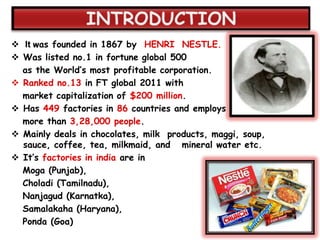
 It was founded in 1867 by HENRI NESTLE.
 Was listed no.1 in fortune global 500
  as the World‟s most profitable corporation.
 Ranked no.13 in FT global 2011 with
  market capitalization of $200 million.
 Has 449 factories in 86 countries and employs
  more than 3,28,000 people.
 Mainly deals in chocolates, milk products, maggi, soup,
  sauce, coffee, tea, milkmaid, and mineral water etc.
 It‟s factories in india are in
  Moga (Punjab),
  Choladi (Tamilnadu),
  Nanjagud (Karnatka),
  Samalakaha (Haryana),
  Ponda (Goa)
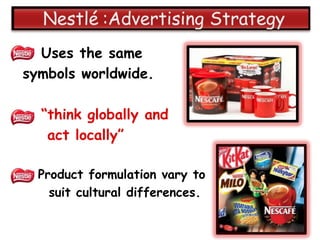
Uses the same
symbols worldwide.

  “think globally and
   act locally”

  Product formulation vary to
    suit cultural differences.
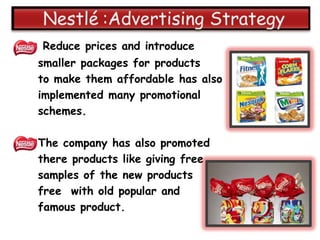
Reduce prices and introduce
smaller packages for products
to make them affordable has also
implemented many promotional
schemes.

The company has also promoted
there products like giving free
samples of the new products
free with old popular and
famous product.
It also came up with products
which will target the children like
fruitips, milky bar choo,
nestle Chinese maggi noodles.

In the spirit of catering to Indian
tastes magi introduced magi
pickles in five variants
 benchmarked to give her
 “ghar ka swad”.
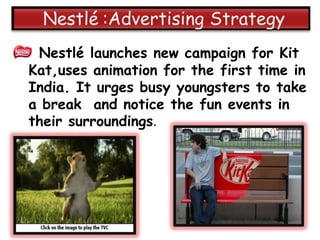
Nestlé launches new campaign for Kit
Kat,uses animation for the first time in
India. It urges busy youngsters to take
a break and notice the fun events in
their surroundings.
• In 2006, Nestlé became the first organisation
  to adopt creating share value approach
       .


• Nestlé has focused its Creating Shared Value
  efforts and investments on three areas –
   nutrition, water and rural development – as
  these are core to our business activities and
  vital for our value chain.

• CSV builds on a strong base of performance
  in environmental sustainability and compliance
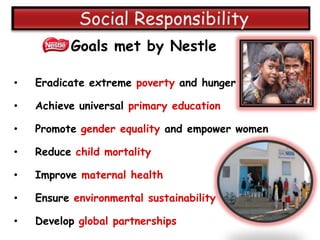
Goals met by Nestle

•   Eradicate extreme poverty and hunger

•   Achieve universal primary education

•   Promote gender equality and empower women

•   Reduce child mortality

•   Improve maternal health

•   Ensure environmental sustainability

•   Develop global partnerships
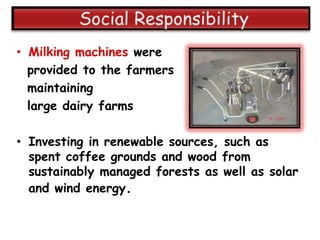
• Milking machines were
  provided to the farmers
  maintaining
  large dairy farms

• Investing in renewable sources, such as
  spent coffee grounds and wood from
  sustainably managed forests as well as solar
  and wind energy.
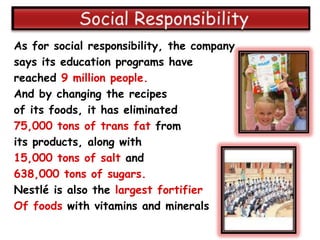
As for social responsibility, the company
says its education programs have
reached 9 million people.
And by changing the recipes
of its foods, it has eliminated
75,000 tons of trans fat from
its products, along with
15,000 tons of salt and
638,000 tons of sugars.
Nestlé is also the largest fortifier
Of foods with vitamins and minerals
• Veterinary services are provided free,
  and medicines provided at wholesale cost
• Nestlé India supports local schools,
  helps in the maintenance of public parks
  and green belts, facilitates blood
  donation camps and health awareness
  programs
• Reducing greenhouse gas (GHG) emissions
  from our operations by improving energy
  efficiency, switching to cleaner fuels
  The Nestlé Group is one of the first
  companies achieving the Certification of
  Clean Industry for all of its factories
FORMS OF CSR ASPECTS:
               EMPLOYEE SAFELY:
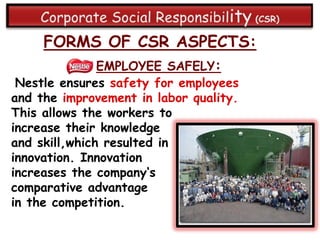
 Nestle ensures safety for employees
and the improvement in labor quality.
This allows the workers to
increase their knowledge
and skill,which resulted in
innovation. Innovation
increases the company„s
comparative advantage
in the competition.
ENVIRONMENT:
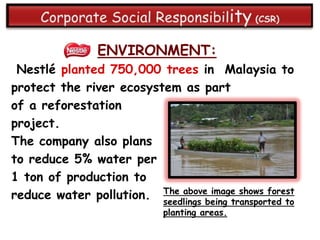
 Nestlé planted 750,000 trees in Malaysia to
protect the river ecosystem as part
of a reforestation
project.
The company also plans
to reduce 5% water per
1 ton of production to
reduce water pollution. The abovebeing transported to
                         seedlings
                                   image shows forest

                            planting areas.
SOCIETY:
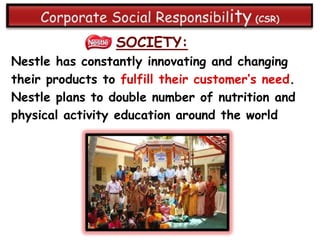
Nestle has constantly innovating and changing
their products to fulfill their customer‟s need.
Nestle plans to double number of nutrition and
physical activity education around the world
Topic               Commitment                            Key short-term goal
Water               Improve our water management          To reduce water consumption
                    further and continue to use water     and water discharges on a
                    sustainably.                          comparable basis by a further
                                                          10% by 2015.

Climate change      Target the reduction of greenhouse    To reduce GHG emissions on a
mitigation          gas (GHG) emissions from our direct   comparable basis by 5% by
                    operations, with an emphasis on       2015.
                    energy efficiency, cleaner fuel and
                    renewable energy. Expand the roll-
                    out of natural refrigerants.

Energy efficiency   Pursue our energy efficiency          To achieve energy efficiency
                    programmes across our operations.     improvements of at least 5% by 2015.


Biodiversity        Develop and extend our systematic     To source palm oil only from
                    methodology, launched in 2011, for    sustainable sources by 2015 and
                    the assessment of biodiversity        to help achieve zero net
                    sensitivity around our operations.    deforestation by 2020.

Waste and           Achieve zero waste and the full       To reduce waste for disposal on
recovery            recovery of unavoidable by-products   a comparable basis by 5% by
                                                          2015
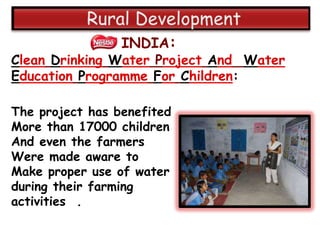
INDIA:
Clean Drinking Water Project And Water
Education Programme For Children:

The project has benefited
More than 17000 children
And even the farmers
Were made aware to
Make proper use of water
during their farming
activities .
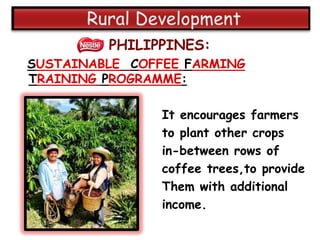
PHILIPPINES:
SUSTAINABLE COFFEE FARMING
TRAINING PROGRAMME:

                It encourages farmers
                to plant other crops
                in-between rows of
                coffee trees,to provide
                Them with additional
                income.
MALAYSIA:
Contract Chilli Farming Project:
Nestlé provides the rural farmers with technical
Support in the field of Chilli
processing. 80% of the chillies
produced,are purchased by
Nestlé which are been
used in
                                A proud farmer from
MAGGIE CHILLI SAUSE.            Kelantan, Malaysia
                                Whose chillies are
                                used In
                                Maggie Chilli sause.
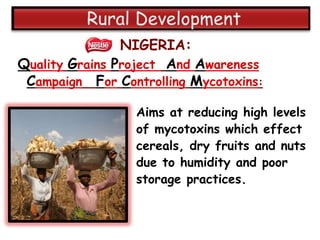
NIGERIA:
Quality Grains Project And Awareness
 Campaign For Controlling Mycotoxins:

                 Aims at reducing high levels
                 of mycotoxins which effect
                 cereals, dry fruits and nuts
                 due to humidity and poor
                 storage practices.
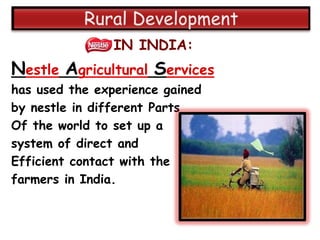
IN INDIA:
Nestle Agricultural Services
has used the experience gained
by nestle in different Parts
Of the world to set up a
system of direct and
Efficient contact with the
farmers in India.
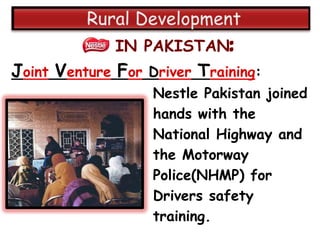
IN PAKISTAN:
Joint Venture For Driver Training:
                   Nestle Pakistan joined
                   hands with the
                   National Highway and
                   the Motorway
                   Police(NHMP) for
                   Drivers safety
                   training.
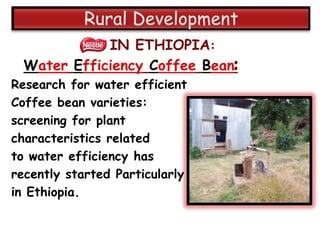
IN ETHIOPIA:
  Water Efficiency Coffee Bean:
Research for water efficient
Coffee bean varieties:
screening for plant
characteristics related
to water efficiency has
recently started Particularly
in Ethiopia.
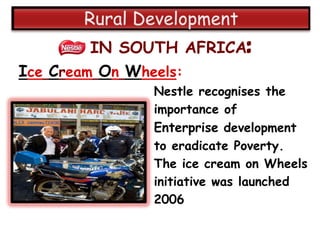
IN SOUTH AFRICA:
Ice Cream On Wheels:
              Nestle recognises the
              importance of
              Enterprise development
              to eradicate Poverty.
              The ice cream on Wheels
              initiative was launched
              2006
1495681 634799425164497500

1495681 634799425164497500

  • 3.
     It wasfounded in 1867 by HENRI NESTLE.  Was listed no.1 in fortune global 500 as the World‟s most profitable corporation.  Ranked no.13 in FT global 2011 with market capitalization of $200 million.  Has 449 factories in 86 countries and employs more than 3,28,000 people.  Mainly deals in chocolates, milk products, maggi, soup, sauce, coffee, tea, milkmaid, and mineral water etc.  It‟s factories in india are in Moga (Punjab), Choladi (Tamilnadu), Nanjagud (Karnatka), Samalakaha (Haryana), Ponda (Goa)
  • 4.
    Uses the same symbolsworldwide. “think globally and act locally” Product formulation vary to suit cultural differences.
  • 5.
    Reduce prices andintroduce smaller packages for products to make them affordable has also implemented many promotional schemes. The company has also promoted there products like giving free samples of the new products free with old popular and famous product.
  • 6.
    It also cameup with products which will target the children like fruitips, milky bar choo, nestle Chinese maggi noodles. In the spirit of catering to Indian tastes magi introduced magi pickles in five variants benchmarked to give her “ghar ka swad”.
  • 7.
    Nestlé launches newcampaign for Kit Kat,uses animation for the first time in India. It urges busy youngsters to take a break and notice the fun events in their surroundings.
  • 11.
    • In 2006,Nestlé became the first organisation to adopt creating share value approach . • Nestlé has focused its Creating Shared Value efforts and investments on three areas – nutrition, water and rural development – as these are core to our business activities and vital for our value chain. • CSV builds on a strong base of performance in environmental sustainability and compliance
  • 12.
    Goals met byNestle • Eradicate extreme poverty and hunger • Achieve universal primary education • Promote gender equality and empower women • Reduce child mortality • Improve maternal health • Ensure environmental sustainability • Develop global partnerships
  • 13.
    • Milking machineswere provided to the farmers maintaining large dairy farms • Investing in renewable sources, such as spent coffee grounds and wood from sustainably managed forests as well as solar and wind energy.
  • 14.
    As for socialresponsibility, the company says its education programs have reached 9 million people. And by changing the recipes of its foods, it has eliminated 75,000 tons of trans fat from its products, along with 15,000 tons of salt and 638,000 tons of sugars. Nestlé is also the largest fortifier Of foods with vitamins and minerals
  • 15.
    • Veterinary servicesare provided free, and medicines provided at wholesale cost • Nestlé India supports local schools, helps in the maintenance of public parks and green belts, facilitates blood donation camps and health awareness programs • Reducing greenhouse gas (GHG) emissions from our operations by improving energy efficiency, switching to cleaner fuels The Nestlé Group is one of the first companies achieving the Certification of Clean Industry for all of its factories
  • 16.
    FORMS OF CSRASPECTS: EMPLOYEE SAFELY: Nestle ensures safety for employees and the improvement in labor quality. This allows the workers to increase their knowledge and skill,which resulted in innovation. Innovation increases the company„s comparative advantage in the competition.
  • 17.
    ENVIRONMENT: Nestlé planted750,000 trees in Malaysia to protect the river ecosystem as part of a reforestation project. The company also plans to reduce 5% water per 1 ton of production to reduce water pollution. The abovebeing transported to seedlings image shows forest planting areas.
  • 18.
    SOCIETY: Nestle has constantlyinnovating and changing their products to fulfill their customer‟s need. Nestle plans to double number of nutrition and physical activity education around the world
  • 19.
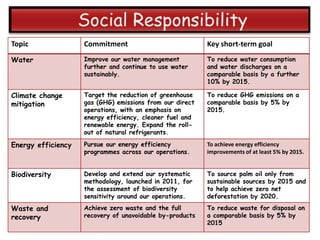
    Topic Commitment Key short-term goal Water Improve our water management To reduce water consumption further and continue to use water and water discharges on a sustainably. comparable basis by a further 10% by 2015. Climate change Target the reduction of greenhouse To reduce GHG emissions on a mitigation gas (GHG) emissions from our direct comparable basis by 5% by operations, with an emphasis on 2015. energy efficiency, cleaner fuel and renewable energy. Expand the roll- out of natural refrigerants. Energy efficiency Pursue our energy efficiency To achieve energy efficiency programmes across our operations. improvements of at least 5% by 2015. Biodiversity Develop and extend our systematic To source palm oil only from methodology, launched in 2011, for sustainable sources by 2015 and the assessment of biodiversity to help achieve zero net sensitivity around our operations. deforestation by 2020. Waste and Achieve zero waste and the full To reduce waste for disposal on recovery recovery of unavoidable by-products a comparable basis by 5% by 2015
  • 21.
    INDIA: Clean Drinking WaterProject And Water Education Programme For Children: The project has benefited More than 17000 children And even the farmers Were made aware to Make proper use of water during their farming activities .
  • 22.
    PHILIPPINES: SUSTAINABLE COFFEE FARMING TRAININGPROGRAMME: It encourages farmers to plant other crops in-between rows of coffee trees,to provide Them with additional income.
  • 23.
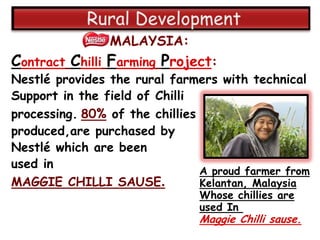
    MALAYSIA: Contract Chilli FarmingProject: Nestlé provides the rural farmers with technical Support in the field of Chilli processing. 80% of the chillies produced,are purchased by Nestlé which are been used in A proud farmer from MAGGIE CHILLI SAUSE. Kelantan, Malaysia Whose chillies are used In Maggie Chilli sause.
  • 24.
    NIGERIA: Quality Grains ProjectAnd Awareness Campaign For Controlling Mycotoxins: Aims at reducing high levels of mycotoxins which effect cereals, dry fruits and nuts due to humidity and poor storage practices.
  • 25.
    IN INDIA: Nestle AgriculturalServices has used the experience gained by nestle in different Parts Of the world to set up a system of direct and Efficient contact with the farmers in India.
  • 26.
    IN PAKISTAN: Joint VentureFor Driver Training: Nestle Pakistan joined hands with the National Highway and the Motorway Police(NHMP) for Drivers safety training.
  • 27.
    IN ETHIOPIA: Water Efficiency Coffee Bean: Research for water efficient Coffee bean varieties: screening for plant characteristics related to water efficiency has recently started Particularly in Ethiopia.
  • 28.
    IN SOUTH AFRICA: IceCream On Wheels: Nestle recognises the importance of Enterprise development to eradicate Poverty. The ice cream on Wheels initiative was launched 2006