Future Internet Architecture (FIArch)
Rationale and Methodology
Dimitri Papadimitriou
Alcatel-Lucent Bell
Approach
Methodology: 4 Steps
Step 1: Motivations and design objectives
Step 2: Common architectural principles
Step 3: Architectural components
Step 4: Putting components into common model
Step 1: Motivations and design
objectives
Goals:
 Understanding actual motivations and
rationalization: identification and
characterization of presumed architectural
"limitations" (with quantitative and
qualitative arguments)
 Setting design objectives (and associated
metrics) starting from current architecture
objectives of the Internet, recognizing
thus its potential
Architecture – What does we mean ?
Architecture
 Formal grouping of a function space, a state space
and objects/information, as well as their respective
distribution that characterizes its domain of
applicability
 Specification of the associated functional, object/
informational and state models leads to a set of
architectural components (i.e. procedures, data
structures, state machines, etc.) together with the
characterization of their interactions (i.e.
messages, calls, events, etc.) and their
distribution
Note:
Principles (often) drive the design of these models
and their associated components
What is an Architectural Limitation ?
 Limitation refers to functional, structural or
performance restriction or constraint that
 cannot be resolved with current or clearly foreseen
paradigms as far as our understanding/knowledge goes
→ Fundamental limitation (of Internet architecture)
 could be resolved (as far as our understanding/knowledge
goes) by replacing and/or adding/removing a component of
the architecture that would in turn change its global
properties
→ Challenging limitation
Example: to overcome IP address overload : loc/id split
>< Re-engineering: technique/method for overcoming
limitation by replacement of an instance of an
existing architectural component that would not
change its global properties
Examples: replacement of IPv4 by IPv6 (no change to
"IP") – over-dimensioning/over-provisioning
Fundamental Questions
 Question 1: might the architecture itself (and its
properties) become the limiting factor of Internet
growth and deployment of new applications ?
 Question 2: Internet architecture incrementally and
reactively extended but up to which limit? vs impact
of Internet architecture limits but up to which
extend?
 Studies on research results impact have shown that
better performance or functionality define
necessary but not sufficient conditions for
change in the Internet architecture (and/or its
components)
=> Demonstrate architectural limits and
characterize them is a MUST
What's different ...
 ... from EU FP7 (FIA, EIFFEL), US (NewArch,
FIND, GENI, etc.), Asia (AKARI, etc.), etc.
 That's not the actual question: here trial
to consolidate material to define a common
problem statement with shared design
objectives
 Note: it's easy to specialize (e.g. IoT vs
Core of the Internet) ... the real exercise
is to identify the commonly shared
baseline
This being said
Is the Internet architecture under pressure ?
... Think of
 Emergence of new needs at both functional and
performance level (scaling, reliability,
availability)
 Increasing cost and complexity, as well as
performance decrease resulting from Internet
growth
 Existing and foreseen (functional and performance)
limitations resulting from the Internet
architectural principles, model, and components...
 Increasing heterogeneity of running conditions as
well as the increasing occurrence of unattended
and unexpected events
 Real time systems, etc.
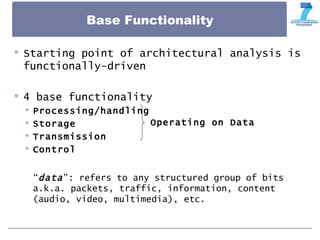
Base Functionality
 Starting point of architectural analysis is
functionally-driven
 4 base functionality
 Processing/handling
 Storage
 Transmission
 Control
“data”: refers to any structured group of bits
a.k.a. packets, traffic, information, content
(audio, video, multimedia), etc.
Operating on Data
Base Functionality
 Processing/handling of “data”
 Refers to forwarders (e.g. routers, etc.),
computers (e.g., terminals, servers, etc.), CPUs,
etc. and handlers (software programs/routines/web
services) that generate and treat data
 Storage of “data”
 Refers to memory, buffers, caches, disks, etc. and
associated structures (words, pages, files, etc.)
 Transmission of “data”
 Refers to physical and logical transferring and
exchange of data
Base Functionality
 Control of processing, storage, transmission
 refers to action of observation (input), analysis,
and decision (output) whose execution affects the
running conditions of these functions
Note
 Communication function ≡ combination of
processing, storage, transmission, and control
functions
 Data communication ≡ combination of processing,
storage, transmission (and their control) applied
to data
=> Communication (function) and "network" are not
equivalent terms
Step 1 In a nutshell...
 Characterize
 What are Internet architecture fundamental
limitations wrt base functionality ?
 -as much as we can- with currently available
qualitative and quantitative data how the current
architecture performs wrt base functionality ?
 Derive design objective
 Identify those that could possibly be met using
current architecture and those that appear to
demand a new or extended architectural foundation
 design objectives = functional and performance
properties as well as structural and quality
criteria that architecture is expected to meet
Step 2: Common Architectural
Principles
 Internet architecture driven by design
principles
 Suggest rules on how a designer/an architect can
best structure the various architectural
components
 Describe the fundamental and time invariant laws
underlying execution of engineered artifacts
 Goal: Identify common design principles
for architecture involving (distributed and
dynamic) data processing, storage, transmission,
and control functions
 Determine additional / improvement of current
architecture principles (implies also
identification of hidden relationships)
Step 3: Architectural Components
 Architectural components (i.e. procedures, data
structures, state machines, etc.) together with the
characterization of their interactions (i.e.
messages, events, etc.) and their distribution
 Approach by decomposition to decrease complexity of
the global problem space -> Which decomposition ?
 For each of these components there is a-priori no
unique instantiation or realization possible !!!
 Distinction between time invariant components
(performance over time metrics) vs. evolvable/adaptable
components (lifetime over performance metrics)
 Performance and functionality criteria and utility
to be evaluated by means of measurable metrics and
results compared to their resulting cost &
complexity
Step 4: Design model
 Combine designed components into common
model baseline following common design
principles
... the BIGGEST challenge !

Dimitri Papadimitriou (Alcatel-Lucent Bell) - Future Internet Architecture (FIArch) Rationale and Methodology

  • 1.
    Future Internet Architecture(FIArch) Rationale and Methodology Dimitri Papadimitriou Alcatel-Lucent Bell
  • 2.
    Approach Methodology: 4 Steps Step1: Motivations and design objectives Step 2: Common architectural principles Step 3: Architectural components Step 4: Putting components into common model
  • 3.
    Step 1: Motivationsand design objectives Goals:  Understanding actual motivations and rationalization: identification and characterization of presumed architectural "limitations" (with quantitative and qualitative arguments)  Setting design objectives (and associated metrics) starting from current architecture objectives of the Internet, recognizing thus its potential
  • 4.
    Architecture – Whatdoes we mean ? Architecture  Formal grouping of a function space, a state space and objects/information, as well as their respective distribution that characterizes its domain of applicability  Specification of the associated functional, object/ informational and state models leads to a set of architectural components (i.e. procedures, data structures, state machines, etc.) together with the characterization of their interactions (i.e. messages, calls, events, etc.) and their distribution Note: Principles (often) drive the design of these models and their associated components
  • 5.
    What is anArchitectural Limitation ?  Limitation refers to functional, structural or performance restriction or constraint that  cannot be resolved with current or clearly foreseen paradigms as far as our understanding/knowledge goes → Fundamental limitation (of Internet architecture)  could be resolved (as far as our understanding/knowledge goes) by replacing and/or adding/removing a component of the architecture that would in turn change its global properties → Challenging limitation Example: to overcome IP address overload : loc/id split >< Re-engineering: technique/method for overcoming limitation by replacement of an instance of an existing architectural component that would not change its global properties Examples: replacement of IPv4 by IPv6 (no change to "IP") – over-dimensioning/over-provisioning
  • 6.
    Fundamental Questions  Question1: might the architecture itself (and its properties) become the limiting factor of Internet growth and deployment of new applications ?  Question 2: Internet architecture incrementally and reactively extended but up to which limit? vs impact of Internet architecture limits but up to which extend?  Studies on research results impact have shown that better performance or functionality define necessary but not sufficient conditions for change in the Internet architecture (and/or its components) => Demonstrate architectural limits and characterize them is a MUST
  • 7.
    What's different ... ... from EU FP7 (FIA, EIFFEL), US (NewArch, FIND, GENI, etc.), Asia (AKARI, etc.), etc.  That's not the actual question: here trial to consolidate material to define a common problem statement with shared design objectives  Note: it's easy to specialize (e.g. IoT vs Core of the Internet) ... the real exercise is to identify the commonly shared baseline
  • 8.
    This being said Isthe Internet architecture under pressure ? ... Think of  Emergence of new needs at both functional and performance level (scaling, reliability, availability)  Increasing cost and complexity, as well as performance decrease resulting from Internet growth  Existing and foreseen (functional and performance) limitations resulting from the Internet architectural principles, model, and components...  Increasing heterogeneity of running conditions as well as the increasing occurrence of unattended and unexpected events  Real time systems, etc.
  • 9.
    Base Functionality  Startingpoint of architectural analysis is functionally-driven  4 base functionality  Processing/handling  Storage  Transmission  Control “data”: refers to any structured group of bits a.k.a. packets, traffic, information, content (audio, video, multimedia), etc. Operating on Data
  • 10.
    Base Functionality  Processing/handlingof “data”  Refers to forwarders (e.g. routers, etc.), computers (e.g., terminals, servers, etc.), CPUs, etc. and handlers (software programs/routines/web services) that generate and treat data  Storage of “data”  Refers to memory, buffers, caches, disks, etc. and associated structures (words, pages, files, etc.)  Transmission of “data”  Refers to physical and logical transferring and exchange of data
  • 11.
    Base Functionality  Controlof processing, storage, transmission  refers to action of observation (input), analysis, and decision (output) whose execution affects the running conditions of these functions Note  Communication function ≡ combination of processing, storage, transmission, and control functions  Data communication ≡ combination of processing, storage, transmission (and their control) applied to data => Communication (function) and "network" are not equivalent terms
  • 12.
    Step 1 Ina nutshell...  Characterize  What are Internet architecture fundamental limitations wrt base functionality ?  -as much as we can- with currently available qualitative and quantitative data how the current architecture performs wrt base functionality ?  Derive design objective  Identify those that could possibly be met using current architecture and those that appear to demand a new or extended architectural foundation  design objectives = functional and performance properties as well as structural and quality criteria that architecture is expected to meet
  • 13.
    Step 2: CommonArchitectural Principles  Internet architecture driven by design principles  Suggest rules on how a designer/an architect can best structure the various architectural components  Describe the fundamental and time invariant laws underlying execution of engineered artifacts  Goal: Identify common design principles for architecture involving (distributed and dynamic) data processing, storage, transmission, and control functions  Determine additional / improvement of current architecture principles (implies also identification of hidden relationships)
  • 14.
    Step 3: ArchitecturalComponents  Architectural components (i.e. procedures, data structures, state machines, etc.) together with the characterization of their interactions (i.e. messages, events, etc.) and their distribution  Approach by decomposition to decrease complexity of the global problem space -> Which decomposition ?  For each of these components there is a-priori no unique instantiation or realization possible !!!  Distinction between time invariant components (performance over time metrics) vs. evolvable/adaptable components (lifetime over performance metrics)  Performance and functionality criteria and utility to be evaluated by means of measurable metrics and results compared to their resulting cost & complexity
  • 15.
    Step 4: Designmodel  Combine designed components into common model baseline following common design principles ... the BIGGEST challenge !