Information as an economic good in the future internetJonathan CaveRAND Europe and Warwick UniversityFIA event, Ghent, 16-17 December 2010
OutlineIntroductionWhat makes information an economic good?What kind of good is it?How does this relate to the future internet
IntroductionInformation is both a good in its own right (given suitable property rights) and a complement to economic activity (production, innovation, search)Information is intangibleThe ‘economic’ (scarce, value-creating) aspects derive from creation, sharing, storage, access, utilisation, etc. Contrast with ‘normal’ cycle of production/exchange/consumptionIts hedonic qualities (accuracy, completeness, objectivity, timeliness, etc.) may be hard to verify, unstable and subjective.It need not be true to be valuable.Levine and Boldrin note that the enormous difference between the ‘fixation’ of information in IPR and other property rights makes little senseGames of incomplete information show the distinctive role played in strategic interactionsThe enormous amount of communication that involves no new information shows that it ‘works’ as a form of social contact rather than ‘mere content’
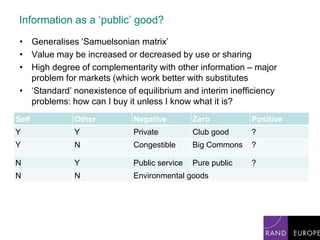
Information as a ‘public’ good?Generalises ‘Samuelsonian matrix’Value may be increased or decreased by use or sharingHigh degree of complementarity with other information – major problem for markets (which work better with substitutes‘Standard’ nonexistence of equilibrium and interim inefficiency problems: how can I buy it unless I know what it is?
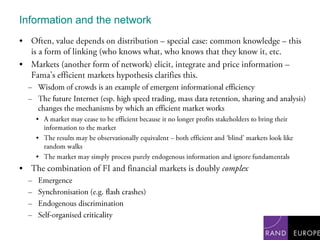
Information and the networkOften, value depends on distribution – special case: common knowledge – this is a form of linking (who knows what, who knows that they know it, etc.Markets (another form of network) elicit, integrate and price information – Fama’s efficient markets hypothesis clarifies this.Wisdom of crowds is an example of emergent informational efficiencyThe future Internet (esp. high speed trading, mass data retention, sharing and analysis) changes the mechanisms by which an efficient market worksA market may cease to be efficient because it no longer profits stakeholders to bring their information to the marketThe results may be observationally equivalent – both efficient and ‘blind’ markets look like random walksThe market may simply process purely endogenous information and ignore fundamentalsThe combination of FI and financial markets is doubly complexEmergenceSynchronisation (e.g. flash crashes)Endogenous discriminationSelf-organised criticality
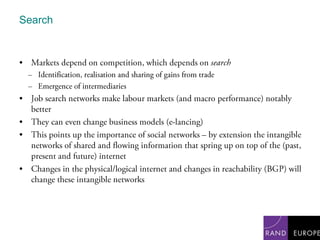
SearchMarkets depend on competition, which depends on searchIdentification, realisation and sharing of gains from tradeEmergence of intermediariesJob search networks make labour markets (and macro performance) notably betterThey can even change business models (e-lancing) This points up the importance of social networks – by extension the intangible networks of shared and flowing information that spring up on top of the (past, present and future) internetChanges in the physical/logical internet and changes in reachability (BGP) will change these intangible networks
FI3PStudy in support of a Future Internet Public-Private Partnership (FI3P)Ongoing study to identify in quantitative and qualitative terms the potential economic and societal longer-term impacts of the application driven public-private partnership on Future InternetCore institutions:  IC Focus, IDC, ISMB, RAND Europe , WIK Consult[Operational definitions of FI]Assessment of current European Internet industry, sector, economyAnalysis of near-term and post-2013 FI PPP policy options Rendition in modelsDevelopment of scenariosImpact AssessmentNext slide: brief introduction to last two items
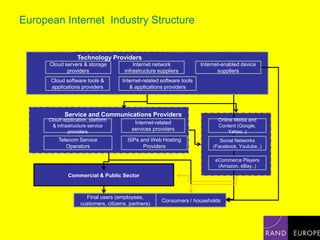
European Internet  Industry StructureTechnology ProvidersInternet network infrastructure suppliersCloud servers & storage providersInternet-enabled device suppliersInternet-related software tools & applications providersCloud software tools & applications providersService and Communications ProvidersCloud application, platform & infrastructure service providersInternet-related services providersOnline Media and Content (Google, Yahoo..)Telecom Service OperatorsISPs and Web Hosting ProvidersSocial Networks (Facebook, Youtube..)eCommerce Players (Amazon, eBay..)Large Companies (> 250 empl.)Small & Medium Companies (< 250 empl.)Commercial & Public SectorFinal users (employees, customers, citizens, partners)Consumers / households
Current European Internet industry (EII)2009 Internet technology and service revenues were €121.9 B; 60% from (Internet-related) telecom services spending, but Internet IT and Networks will grow faster (and also drive other parts of IT budgets)This is 23% of ICT market but will grow to 31% by 2014.EII Top 100 had combined  revenues of €110.7 B in 2009 from Internet-related activities in the EU alone. However, this covers considerable asymmetry : the largest company generated more than €12 B; 100th generated only €22 M. This indicates strong fragmentation in the industry and considerable market power. Also asymmetric as to country of establishment  (Fr, UK, Nordic), segment (telecom = 44%, software = 20%, service providers = 13%) and reach (55 global, 25 local)Continuing business model evolution
Implications for the futureContribution to ICT impacts on productivity, sustainable growth, equity and economic efficiency is hard to separate.Need better tools, models and data to handle dynamics of the Internet economyICTs are traditional source of economic growth and recovery, but hard to ‘embed’ – this is probably more true of the FI as a “glocal” commons than of ICTs per se.EU firms dominate EU telecom and IT services, but US/global firms dominate the innovation-friendly elementsStruggle for dominance between technology, application, service providers likely to be criticalThe provision, maintenance and regulation of the Internet itself is likely to remain a subject of acrimonious debate, e.g.As recession erodes public and political support for large infrastructure projects, public funding may drop; private parties will continue to provide infrastructures, but attempt to assert control at all layers (e.g. aspects of NGNs, Walled Gardens)As economic value-creation and innovation move into the service and application layers, profitability will drop for infrastructure providers and the sector as a whole; this may limit or distort FI development
Regulatory challengesWhile core technologies are developing rapidlyImplementation (esp. in Europe) is laggingComplementary technologies are yet to take offOther problems of privacy, security, liabilities, etc. remain unsolvedSmall innovations (esp. in the EU) face steep and increasing hurdles in scaling up and spreading out without takeover or relocationThe EU telecommunications regulatory framework has led the worldIt may not generalise to the InternetThe regulatory approaches from affected domains are inconsistentThe scope and implications of e.g. technological, content, service, network ‘neutrality’) remain unclear – see latest EU survey on NNStakeholders have proposed regulatory  holidays and support for collaboration, standardisation, exploitation, community building & outreach, research on regulatory issues, but these may have ‘rebounds’Temporarily tip playing field in traditional markets and business models in favour of incumbents, and encourage them to rest on their laurels. Reinforced by natural reluctance of hard-pressed EU governments to put any strain on their ‘national champions’

J. Cave - Information as an economic good in the future internet

  • 1.
    Information as aneconomic good in the future internetJonathan CaveRAND Europe and Warwick UniversityFIA event, Ghent, 16-17 December 2010
  • 2.
    OutlineIntroductionWhat makes informationan economic good?What kind of good is it?How does this relate to the future internet
  • 3.
    IntroductionInformation is botha good in its own right (given suitable property rights) and a complement to economic activity (production, innovation, search)Information is intangibleThe ‘economic’ (scarce, value-creating) aspects derive from creation, sharing, storage, access, utilisation, etc. Contrast with ‘normal’ cycle of production/exchange/consumptionIts hedonic qualities (accuracy, completeness, objectivity, timeliness, etc.) may be hard to verify, unstable and subjective.It need not be true to be valuable.Levine and Boldrin note that the enormous difference between the ‘fixation’ of information in IPR and other property rights makes little senseGames of incomplete information show the distinctive role played in strategic interactionsThe enormous amount of communication that involves no new information shows that it ‘works’ as a form of social contact rather than ‘mere content’
  • 4.
    Information as a‘public’ good?Generalises ‘Samuelsonian matrix’Value may be increased or decreased by use or sharingHigh degree of complementarity with other information – major problem for markets (which work better with substitutes‘Standard’ nonexistence of equilibrium and interim inefficiency problems: how can I buy it unless I know what it is?
  • 5.
    Information and thenetworkOften, value depends on distribution – special case: common knowledge – this is a form of linking (who knows what, who knows that they know it, etc.Markets (another form of network) elicit, integrate and price information – Fama’s efficient markets hypothesis clarifies this.Wisdom of crowds is an example of emergent informational efficiencyThe future Internet (esp. high speed trading, mass data retention, sharing and analysis) changes the mechanisms by which an efficient market worksA market may cease to be efficient because it no longer profits stakeholders to bring their information to the marketThe results may be observationally equivalent – both efficient and ‘blind’ markets look like random walksThe market may simply process purely endogenous information and ignore fundamentalsThe combination of FI and financial markets is doubly complexEmergenceSynchronisation (e.g. flash crashes)Endogenous discriminationSelf-organised criticality
  • 6.
    SearchMarkets depend oncompetition, which depends on searchIdentification, realisation and sharing of gains from tradeEmergence of intermediariesJob search networks make labour markets (and macro performance) notably betterThey can even change business models (e-lancing) This points up the importance of social networks – by extension the intangible networks of shared and flowing information that spring up on top of the (past, present and future) internetChanges in the physical/logical internet and changes in reachability (BGP) will change these intangible networks
  • 7.
    FI3PStudy in supportof a Future Internet Public-Private Partnership (FI3P)Ongoing study to identify in quantitative and qualitative terms the potential economic and societal longer-term impacts of the application driven public-private partnership on Future InternetCore institutions: IC Focus, IDC, ISMB, RAND Europe , WIK Consult[Operational definitions of FI]Assessment of current European Internet industry, sector, economyAnalysis of near-term and post-2013 FI PPP policy options Rendition in modelsDevelopment of scenariosImpact AssessmentNext slide: brief introduction to last two items
  • 8.
    European Internet Industry StructureTechnology ProvidersInternet network infrastructure suppliersCloud servers & storage providersInternet-enabled device suppliersInternet-related software tools & applications providersCloud software tools & applications providersService and Communications ProvidersCloud application, platform & infrastructure service providersInternet-related services providersOnline Media and Content (Google, Yahoo..)Telecom Service OperatorsISPs and Web Hosting ProvidersSocial Networks (Facebook, Youtube..)eCommerce Players (Amazon, eBay..)Large Companies (> 250 empl.)Small & Medium Companies (< 250 empl.)Commercial & Public SectorFinal users (employees, customers, citizens, partners)Consumers / households
  • 9.
    Current European Internetindustry (EII)2009 Internet technology and service revenues were €121.9 B; 60% from (Internet-related) telecom services spending, but Internet IT and Networks will grow faster (and also drive other parts of IT budgets)This is 23% of ICT market but will grow to 31% by 2014.EII Top 100 had combined revenues of €110.7 B in 2009 from Internet-related activities in the EU alone. However, this covers considerable asymmetry : the largest company generated more than €12 B; 100th generated only €22 M. This indicates strong fragmentation in the industry and considerable market power. Also asymmetric as to country of establishment (Fr, UK, Nordic), segment (telecom = 44%, software = 20%, service providers = 13%) and reach (55 global, 25 local)Continuing business model evolution
  • 10.
    Implications for thefutureContribution to ICT impacts on productivity, sustainable growth, equity and economic efficiency is hard to separate.Need better tools, models and data to handle dynamics of the Internet economyICTs are traditional source of economic growth and recovery, but hard to ‘embed’ – this is probably more true of the FI as a “glocal” commons than of ICTs per se.EU firms dominate EU telecom and IT services, but US/global firms dominate the innovation-friendly elementsStruggle for dominance between technology, application, service providers likely to be criticalThe provision, maintenance and regulation of the Internet itself is likely to remain a subject of acrimonious debate, e.g.As recession erodes public and political support for large infrastructure projects, public funding may drop; private parties will continue to provide infrastructures, but attempt to assert control at all layers (e.g. aspects of NGNs, Walled Gardens)As economic value-creation and innovation move into the service and application layers, profitability will drop for infrastructure providers and the sector as a whole; this may limit or distort FI development
  • 11.
    Regulatory challengesWhile coretechnologies are developing rapidlyImplementation (esp. in Europe) is laggingComplementary technologies are yet to take offOther problems of privacy, security, liabilities, etc. remain unsolvedSmall innovations (esp. in the EU) face steep and increasing hurdles in scaling up and spreading out without takeover or relocationThe EU telecommunications regulatory framework has led the worldIt may not generalise to the InternetThe regulatory approaches from affected domains are inconsistentThe scope and implications of e.g. technological, content, service, network ‘neutrality’) remain unclear – see latest EU survey on NNStakeholders have proposed regulatory holidays and support for collaboration, standardisation, exploitation, community building & outreach, research on regulatory issues, but these may have ‘rebounds’Temporarily tip playing field in traditional markets and business models in favour of incumbents, and encourage them to rest on their laurels. Reinforced by natural reluctance of hard-pressed EU governments to put any strain on their ‘national champions’