ii,..
, .+;
Max. tvtafsil00
,, ''"
lii illrr:i}" 'ir
I
IOMAT3l
(07 Marks)
(07 Marks)
(06 Marks)
USN
Third Semester B.E. Degree Examination, June/July 2015
Engineering Mathematics - Ill
Note: Answer FIVE full questions, selecting
at least TWO quesfions from each parl
Time: 3 hrs.
PART - A
1 a. Expand (x) : x sin x as a Fourier series in the interval (-n, n), Hence dedube the following:
(07 Marks)
c. Find the constant term and the first twb harmonics in the Fourier series
(06 Marks)
for f(x) given by the
followins tabl
.n 2 2 2
Lt
-=l-r-
-r-
' 2 1.3 3.5 s.l
n-2 1 1 1 ",* "l;,,,,i;|
ii):- =- +_-+ {;;;.,-.-lit,
' 4 1.3 3.5 5.7 ro r.",
b. Find the half-range Fourier cosine series for the fung,Sgl
[u, o <*</, ,.,,,,. -.ffit''ftx)-l / z
- .-/
lr.rl - *1. !/. < x < .t ,.,.,.i
t "//. .,,'
Where k is a non-integer positive constant.
:tio
o
nn
ct
IC
n(
th
fo
refu
s oft
<a
)4
rans
f0rm
trans
IX,
)
rier si
n
0
IT
0.
ul
0
of
rans
iine
Jsin
lrFour
d
.9
o
lr
U)
(!
€o
C6
C)
EPa0-(l=
O'=
yi
(ll ./
.o .,'
-^ll
Hoo
.= (..r
(g$
H AI)
HC)
otr
-c !l
o>
EE
BS
bU
ctO
OE
boc((lcl
}E(€-
-O6
->B
Es
io)
HB
5.8o -.:
atO
PH
e€
LO)
t=> qr
oo-coo
()=
E.E
tr>
^u'l
O-r'rl
- >)i,, iLFI!1..A qJ
lJ<
-.i",f^i
c)
z
E
Cd
.F
og
t
of th n (x) - xe-alxl
Ozu
-
subject to condition u(0,t) :0, u (,t ,t) : 0,
dt'
(06 Marks)
subject to condition u (0, y) - u( !-,y):0, u (x, 0) :0,
(07 Marks)
one dimensional wave equation + = C' * by
A' Ax' J
(07 Marks)
rtr
rS
=
el
a
ier
ier
r)=
tne
rrie
(x)
/ers
-act
Find the Fou
Find the Fou
Functions f(
Find the inv
,,I
F- (u) = le-
',,.. cx,
solution of
od.
au r:2
-v
0t
,ta
Find various possible
separable variab le meth
Obtain solution of heat
u (x, 0) : f(x).
Solve Laplace equation
. /m*
u (x, a): srn[f]
forms
0<x
x
2a.
b. ne
(.S1,
OU
>(
c. ine T
equation
8,.i'
^) ^)d'u d'u.-*-=0
ax' fu'
b.
ollowm e.
x: 0 nl3 2n13 TE tuff|?: 5n13 2n
F(x) : 1.0 t.4 1.9 t.T u.5 1.2 1.0
(07 Marks)
I of3
c.
1OMAT3l
ofa gas
to the fo
4a. The pressure P and volume V are related by the equation PV' : K, where r and K
Fit this equatiare constants. Fr rs equatron to o
P: 0.5 1.0 1.5 2.0 2.5 3.0
V: t.62 1.00 0.7 5 0.62 0.s2 0.46
llowing set of observations (in appropriate units)
b.
c.
Solve the following LPP by using the Graphical method
Maximize Z=3X, +4x,
Under the constraints 4x, + 2x, < 80
Zxr+5x, <180
X1, X2 ) Q'
Solve the following using simplex method
Maximize : Z = 2x + 4y, subject to the
Constraint : 3x *y 122, 2x+3y <24, x ) 0, y 2 0.
PART - B
a. Using the Regular - Falsi method, find a real root (correct to three decimal
equation cos x : 3x - I that lies between 0.5 and 1 (Here, x is in radians).
Using the
function dnc on oescn e
x 0 I 2 3 4
f(x) a
J 6 11 l8 27
Hence find f (0.5) and f (3.1).
I
c. Evaluate
l#axby using Simpson't (%^
0
Hence find an approximate value of logrD.
L5grange's formula, find the interpolating polynomial
,{i'otr
ri s,q
(07 M&$r
i;
ti
tr
riil
o,iiit,.
(06 Marks)
(07 Marks)
places) of the
(07 Marks)
(07 Marks)
(07 Marks)
that approximates to the
(06 Marks)
Rule, dividing the interval into 3 equal parts.
(07 Marks)
initial conditions
(07 Marks)
b.
c.
By relaxation method *.
r+',** ,
Solve:-x* 6y+272:85, 54x+y+z:1*141, + 15y + 6z:72. (06Marks)
Using the power method, find the largest eiffi value and corresponding eigen vectors of the
lo -z 21 n4"
matrix A-l-2 3 -11 t,-=,u-*
lz -1 3.1 ' ,
taking [1, 1, 1]r as the initialdgen vectors. Perform 5 iterations.
irri r1i -iiii:lr:f
6 a. From the,data given,inffifrltoyine f
1!te
;{ind the,number of students who obtained
(i) Less than 45 ii) between 40 and 45 marks.
Marks l3o +o 40-50 s0-60 60-70 70 80
No. of Studenfe, 31 42 51 35 31
b.
ibed b the following table:
^7 ^')
7 a. Solve the one - dimensional wave equation += +Ox- dt-
Subject to the boundary conditions u (0, t):0, u (1, t): 0, t > 0 and the
u(x,o):sinnx, *(*,0)=0, o<x'< 1.
' At'
2of3
b. ^2 ^
Consider the heat equation 2+ -
y under the
i) u(0, 1):u (4,t):^0, ,, O'*'
At
ii) u (x, 0) : x (4 - x), 0 < x < 4.
Employ the Bendre - Schmidt method with h : 1
0 < t < 1.
1OMAT31
to find the solution of the equation forr,*
(06iMark0
(07 Marks)
(07 Marks)
(06 Marks)
a)a)i
c. Solve the two - dimensional Laplace equation + =+ =0 at the interior pivotdl pbints of
Ax' Ay' ^ ,,,.; '
the square region shown in the following figure. The values ofu at the pivotal points on the
boundary are also shown in the figure.
I ooo
looo looo
I ooo
z ooo 9Oo
I Ooo
9oo
Fig. Q7 (c)
ve the recurrence relation of Z - Transformation hence find Zt (np) and
(r-2)' @- a)
.r)]
z' - 2oz
,ro
nrr
2
i_
Ir,
p
t
-,1
and
osh
Z;
8 a. State
t-
Z",l c
L
.i! rii
b. Ffi&
L:T
c.' Solve the difference equation
yn+u - 2y n*t - 3y, - 3" + 2n
Given yo : yr : 0.rli L
t€ :t * *. :l€
3 of3
(07 Marks)
3'd5** P-tc
USN
Time: 3 hrs.
Note: Answer any FIVE full questions.
a. Express the complex number
(5 - 3i)(2 + i) in rhe form x + iy.
4+2i
b. Find the modulus and the amplitude of 1 + cos0 + i sinO.
c. Find the cube roots of I + i. ,,':::, .
Find the n'h derivative of eu^ cos(bx + c).
Find the nth derivative of
(x+l)(2x+3)
c. If x=tan(1og y)provethat (1 +x2)yn+r* (2nx- l) y"+n(n- 1) yn-r =0.
a. Find the angle of intersection of the curves rn = an cosnO, rn = bn sinnO.
b. Find the Pedal equation of the curve .i"= a (1 - cos 0).
c. Using Maclcaurin's series expand log(1 + x) upto the term containing x4.
0(u, v, w)
o(x, y,z)
a. Obtain the reduction formula for where n is a positive integer.
Third Semester B.E. Degree Examinatior, June/July 2Al5
Advanced Mathematics - I
Max. Marks:100
G)
a
()
cg
O.
c,
u)
E()
()
L
*c,
;B
63 q,
=[n-* ll
cco
'; J-
,= a-l
c€+
:r a0
Yq)
(utr
€gtr'EoB
EZ
bU
OE
10E
vo
BE(g-t
E(€
-ba'8s
48.tro.Xd
(Jj
grE
ueA|E
t-. C)
6.v>.k
bo-trboI
o= :
:" 9r,. .
A,i- q' :
u"4f i
o<
-.; 6i
0)
Z
ir
o
2a.
b.
(06 Marks)
(07 Marks)
(07 Marks)
(06 Marks)
(07 Marks)
(07 Marks)
(06 Marks)
(07 Marks)
(07 Marks)
(06 Marks)
(07 Marks)
(07 Marks)
(06 Marks)
(07 Marks)
(07 Marks)
(06 Marks)
(07 Marks)
(07 Marks)
b.
c.
b.
ri
c.
^')
s')
If u = f(x + ct) + -q(x -ct) show that
#=r:-#;.
If u - {t I.Zl prove rhat xux + yuv + ztt,=e.
[v, x)'
If u = x * !; v = y + z,w = z + x find the value of
Jcos'xdx
a. Define b.,i,?yma functions and prove that I(n + 1) = nl(n).
b. Show that f
."*,e oe x
{ #-
d0 = n.
c. Prove rhar B(m. n) -
r(m)'r(n)
.I 
I-(m+n)
I of 2
b.
c.
Solve
Solve
Solve
a. Solve
b. Solve
c. Solve
dvr = cos(x
dx
(r'- y2) d*
dv
' + vcotx1J
dx
+y+1).
- xYdY = Q.
= xcosec x
MATDIP3Ol
(06 Marks)
(07 Marks)
(07 Mrtu)
(06 Marks)
(07 Marks)
(07 Marks)
(D'-6D2+1lD-6)y=0.
(D'+ 2D+!)=x2 +e**.
(D'+D+ l)y=sin2x.
,<****
2 of 2
USN
Time: 3 hrs.
1a.
b.
c.
Third Semester B.E. Degree Exarnination, June/July 2Ol5
Analog Electrottic Gircuits
C)
(J
Q
!
(g
U)
cl
()
c)
th A
(-)x
oo-
EC
=ta-^ll
C'@
.=N(Br+
gd
od
€gtr'tro>
Ez
-'E
3E
bU
do
o€00ccq(€
!x>P
ir€(t!
-
E(g
ia'Eo
O!
ECO
d.3
ts'E
56oj
u) l)
9H
a€
:- O)
5,:> +r
boo
ca0
c)=
E.E
F a 'rri.l
A 9
vL+".
v L:! ':..
i.6r, +*
li.t{,+b ,4*/ $
H**<r-* '*'
-ftr.i
(.)
z
g
Max. Marks:1O,0
Note: Answer any FIVE full questions, selecting
atleast TWO qwestions from each part.
.' ::
: r
j ,,'a'
PART_A
J
State and explain the various resistance le.rels of the semiconductor diode. (06 Marks)
Explain the working of a full wave centre tapped rectifier. Also determine ripple factor,
Design a suitable circuit represented by the box shown below, which has the input and
output waveforms as indicated. '
Vi
,,.I
f 0
Va
'..'.' Fig.Ql(c)
t't
,.
'
a. Name different biasing methods of transistor. With circuit diagram analyze the
circuit, with effect of variation in Ie, R. and Vcc on Q.point ofthe load line.
b. Explain the circuit of a transistor switch being used as an inverter.
c. In a voltage divider bias circuit of B.IT. Vcc : 20 V, Rg : 10 kO, RE
Rr : 40 ke), Rz : 4 kf) Assume siliccn transistor with F
: 150. Find Is, V6s and
exact analysis.
3 a. Define h:$arameters and hence derive h - oarameters model of CE - BIT.
fixed bias
(10 Marks)
(04 Marks)
: 1.5 kf),
Ic(ruq using
(06 Marks)
(06 Marks)
b. Explain'with a neat circuit diagram of emifier follower configuration. Justiff how voltage
gain-is nearly equal to one. (06 Marks)
c. ,Forthe circuit shown below detemrine Vcc, if Av: -160 and ro: 100 kf). Take B: 100.
(08 Marks)
4tfca
3'3K
j-
t>{*
'rUl,tl
tl$n 11
fi &,,de
ll,Ev
Fig. Q3(c)
'*;1,
l of 2
4 a. Draw the singie stage RC coupled BJT
response) : i) lnput capacitance C:. ii)
capacitance C. on frequency response.
b. Prove that miller effect of input u;:acttance C1a; : (i
crrao =[,-*).'
c. It is desired that the voltage gaur of ar li.C - coupleC
by more than rc% from its mid bond vaiue. Calculate
i) the lower 3 dB frequency
ii) the required C if R : 2000 O.
10ES32
amplifier and discuss the effect of (low frequency
output capacitance Cc and iii) Emitter by pass
(05 Marks)
A") Cf and ouput capacitance
(lo vrarils)
.,'*
tn;1
amplifier at 60 Hz should not.delitdase
(05 Marks)
(07 Marks)
(06 Marks)
(07 Marks)
Derive Zr, Zs and
(10 Marks)
(03 Marks)
}. raPf-s V o
PART _ B
a. Derive expressions for Z; ar,d Ai for ir Darlington ernitter followet'eirdtrit. (10 Marks)
b. Mention the types of feedback connuc;ions. Draw their blockA@a*s indicating input and
output signal. (06 Marks)
c. List the generai characteristics of a ncga.tive feedback anrplifier and write its advantages.
", (04 Marks)
a. With a neat circuit diagram, expiain the operation of a transformer coupled class A power
amplifier. (07 Marks)
b. Explain the operation of a class B p,ish-pull alnplifier and derive its conversion efficiency.
(08 Marks)
c. The following distortion readmg are :-.r ailable for a power amplifier :
Dz: A.2,D3 : 0.02,D+ : 0.06, wi{h li = 3.3A an<l Rc : 4 A.Calculate :
i) the THD ii) the fundamental powe.'component iii) the total power. (05 Marks)
7a.
b.
c.
Explain the working of Wien,bridge tsciilator.
With a neat circuit diagrarn, explain the operation of BJT Colpitts oscillator.
crystal.
a. Draw the' T common drain contig',rration (source - follower) circuit.
A, using'Small signal model. Write its characteristics.
C-omP JFET and MOSFET.
A crystal has the foll.owing pararneter L :0.334 H, Crul: 1 pF, C :0.065 and R: 5.5 k().
Calculate the series''tesonant frequency, parallel resonant frequency and find Q of the
b.
c. .E*iathe JFET common drain con'frgu,ration shown below. Given Idss: 10 mA, Vp : -5V,
;i :40 kf), Vcse : -2.85 V i) Calculate ZiandZ0ll) Calculate Au iii) find Vo ifVi:20 mV
(p - p). (07 Marks)
0,1 uP
JItVi
lt
+
Fig. Q8(c)
,(*{<*{<
Vou - D+v
o,I L{ tr
USN
'[ime: 3 lrrs.
Third Semester B.E. Degree Examination, June/July 2015
Log ic Desig n
o)
()
ld
n
tr
"J)
t)
,"
*))a.) *
(t !,
-; v'.
5J) "
t: c/j
.= (n
CJ I?:
7i 'A
ij 'o
.u r'
olt I
(J7,
3.ii
5.3
AU
).Y
o (i-
Li C)
.5 .:
, q-
bo .o
C OII
O=
=p
5!
(r'<
z
a.
b.
Max. Marks:IO0
Note: Answer any FIVE .full questions, selecting
atleast TWO questions from each part.
PART _ A
Express the following Boolean function in canonical min term form :
Express the foliowing Boolean function in canonical max term f m :
F(A,B,C,D) = ag + CD. :
Sirnplify the following Boolean function
expression using NAND gates.
F(A, B. C, D) = Im(1,5,6,7,11,12, 13,
using four varjable 'k' map.
15). , i (08lVlarks)
technique.
(10 Marks)
Simplify the following Boolean function uSing Quine - Moclusky's minimization
F(A, B, C, D) = Im(6, J,9,10, 13) + d(l ,4.5,11, 15).
Consider the following Booiean equarion :
F(A, B, C, D) = Im( 1,3,,7 ,11, 15) + Id(o.2, 5),
Simpl.ify the firnction F using a 3 variable MEV k - map. Assign the variable D to be the
MEV. (I0}Iarks)
Implement the Boolean functions :
E(^" y.z) =Xl +YZ
D(x,y,z) = nm(0,3,5)
Usinga,3 - 8 line decoder IC 74138 with active low outputs. (08 IVIarks)
Inrcniate a 10 key keypad to a digital system using a I-C 74147 which is a 10 line to BCD
pr,iority encoder. Draw the logic diagram and explain the operation with the truth table.
(12 Marks)
Implement the Boolean function :
F(A, B, C, D) = Im(0, I,2,4,5,7,8,9)
Using a 8 to 1 multiplexer. Draw the logic diagram and explain the operation. Aclditional
gates can be used if required. (0g Marks)
Explain the operation of a full subtractor with the help of a truth table and Boolean
expressions for the outputs. Implement the full subtractclr using two numbers of
i) 4tolmultiplexers
ii) 2to I multiplexers.
Additional gates if required can be used.
Design a one bit binary comparator.
(04 Marks)
(08 Marks)
Realize the simplified
(08 Marks)
(04 Marks)
a.
b.
a.
b.
a.
b.
c.
I of 2
108s33
PART _ B
a. Explain the operation of a gated SR latch with a logic diagram and a truth table. (06 Marks)
b. Explain the operation of a positive edge trigged 'D' flip-flop with the help of a logic
diagram and truth table. Also draw the relevant waveforms. (04 Marks)
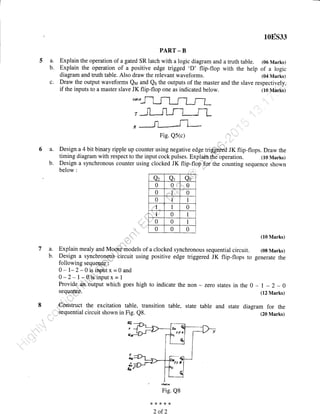
c. Draw the output waveforms Qy and Q5 the outputs of the master and the slave respectively,
if the inputs to a master slave JK flip-flop one as indicated below. (10 Marks)
n l-1
*_._)i ,,.1 L-,
Fie. Q5(c)
1
;a.,a1
Design a bitbinary ripple up counter using negative edge tri$[e?ed JK flip-flops.6a.
b.
timing diagram with respect to the input cock pulses. Explain the operation.
Design a synchronous counter using clocked JK flip-flop'for the counting
below :
Draw the
(10 Marks)
sequence shown
a. Explain mealy and MootC odels of a clocked
b. Design a synchronousraircuit using positive
following sequea#-
0 - 1- 2 - 0is ihptit x = 0 and
O-2-1- rputx=l
Provide-,,ffi'output which goes high
sequenee.
(10 Marks)
synchronous sequential circuit. (0g Marks)
edge triggered JK flip-flops to generate the
to indicate the non - zero states in the 0 - t - 2 - O
(12 Marks)
C.onstruct the excitation table, transition table, state table and state diagram for the
sequential circuit shown in Fig. Q8. (20 Marks)
d,A,x
Fig. Q8
*:F{<x8
2 of 2
Qz Qr Qb
0 0 0
0 I 0
0 I 1
1 1 0
I 0 1
0 0 1
0 0 0
x
gt
,x
{i
f#'
hUSN
Third Semester B.E. Degree ,--.;amination,
N e t 1.{/ C.!,1,. .i- -.!
a ly S iS
Time: 3 hrs.
P{RT_A
a. Derir e errrression for
i r Sur :,: deiia ransformation ii) Delta rr !,- transib.mation
b. Fr-rr lhe er,i'ork shou,n finc the .i:Ce .'L - --.-r-.: ',',J :-tJ -c Fie. Q No. 1
ES}I
Max. Marks:100
t
,'*r F
..r.r
-"'= v
"i.r'rr*rilorr#1?
;-1
l-- *J
"
k (10 Marks)
Gj.'' i (10 Marks)
 t.,"tats+-
e' . ..=i
f!
,_a '
b.
ila
i
g
=
='a
?-
x-
(!v
-.oll
trcc
.= (l .r,rva
xbo
a)AEq
3e
AH
q=
bd
(gO
ootr(!(u
-cGCEi
5:
1()Lr< o,
a.,
u) li
9E 2
t 3 -,cn'C,
l-r 0)
6.:h(+i
trbo
: .F +-
U-
=
!) -" **.'. 1l
U+.*.
X - Jr*&,.'+rivunh
- " Fr $r, i'{.!--:i.ds qd't:
^i'
l'f . -: -rrj
41d<**'*
:-r,.
<".,i.1
;
z
a
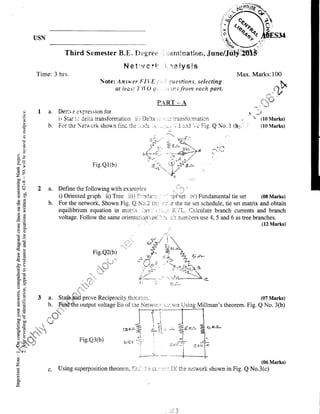
Fie.Q1(b)
Define the following with examolCIs
i) Oriented graph ii) Tree iii) Frnda:::r,
For the network, Shown FiS. Q i-o.2 (b)
equilibrium equation in metri>: ;'Jrr : ,
voltage. Follow the sarne orienterticr{"i :i1i
' ''.r .:utrset jr,,) Fundamental tie set (08 Marks)
',i'i:,.fl'the tie set schedule, tie set matrix and obtain
:,,-;,r X{'i,/I . Calculate branch currents and branch
':::? c: rulribers use 4,5 and 6 as tree branches.
(12 Marks)
.r1'..
+/ /'i
{a'si -' 
5- F; lc-r
Jr 4 L
{ :i,3^ 7" }--su.- ;V t'T.^' 4 r -
' /' i r.. { r- L4
il:' .::r''tti
.i:rl a
. 'da"
;li' 
a. Stapffi prove Reciprocity tkreorerr.
b. Hiffi e output voltage Eo of t,re ietwor*' r,,,irirx,rn Using Millman's
(07 Marks)
theorem. Fig. Q No. 3(b)
ah
Fig.Q3(b)
c. Using superposition theorern, fir-rlr :ir CLr:,'r;r:1, IX tl:,e network shown in Fig. q N".#;Marks)
-: a
i
s.
j ,
'.,/
^q.,,' i -.f e. 5r'I -' a.
'i'r'':;" '',{-"
| .-7
tt i
,t I
,/; 
t-rre;r1 h, S.f*- -. r, u{r*_ ,
10ES34
Fq"...r(07 Marks)
Fig.Q3(c)
State Norton's theorern. Show thrii
equalent circuit.
Obtain the current Ix by usitig fi r"'
In the circuit shown, switch K is r.r,
Vc = 80V. Then the switch I{ is .
agaifi, Vc = 90V after h.aif secoi?d,
. *lu,**,
-;r'nevenin's
equivalent circuit is..f.tfqdial of Norton's
aa,
,.,s*i",,,.
r (06 Marks)
i ir'I'sr Lheorem for the network $hown in Fig Q No.a@)
'
ttti
. J-.,i^ I J[- . ' tt
,..i-
-
b.
Fie.Qa(b)
ii, ':
'':": (08 Marks)
c. State maximum power transfer thetrern. Pfbve thatZt-- Zo* for Ac circuits. (06 Marks)
5 a. Show that fo = di,f, fr,: s;ri.:s i: , ,r;{..) c,:..:c;.,i:^ (06Marks)
b. A voltage of 100 sin rrffi"*irc, i.. il a-n ..iLC series circuit at resonant frequency. The
voltage across a capac.it was io.. ,, t,e 4Ci:)'. Tne bandwidth ts75Hz. The impedence at
resonance is 100Q"ffin4 the rescna - '*quenc./ and, constants of the circuit. (06 Marks)
c. Derive an expr for the resonai-ii fi:equency of a resonant frequency of a resonant circuit
consisting of.Ril in parallel rvitn R, C. Draw the frequency response curve of the above
circuit. d;t.,;
(08 Marks)
J:!,, ag ,.
rn aa
thd,*&itcuit
i,3Jt-
Fig.Q6(a)
6a.
b. )1. ;rer] -icli:ery loilg time, on closing K, after 10ms,
:,rrri, closc,J sor a lcng time. When the switch is opened
," ,:.uLate veiluss of R. and C. Fig. Q No.6 (b)
2of3
t'' ,,
) it_4
L6{-r+ /^.
liJu'_r
". - - *.-^*.**$-S'f,ALn
I
I r,H gdY $
* 4v
,. ##
..! li
.!.,.. " , :ri
+ '6 iry.+
6.
'i1
ati! g
dcs- w
,;fi,"'".# (10 Marks)
Fig.Q6(b) toui@
I
pr;:5
,
{
i_
T
i
7 a. State and prove i) Initial ';aiue theor: r, ::) Final value tlr.or*cffipHed to Laplace
. transforrn. What are the limi:iiti.or. s or ; it .-' : . ,: :.creryl. ,g{ffi (L0 Marks)
b. In the circuit shown, in Fig.Q SIc,"7 {a) si,i'ri.;h is iniriaily c1o;i# After steady the switch is
opened, Determine the nodal vr;::;,-!ei:
'!,r. . : ii;; Vo (t) using:lSplacetransfonn method.
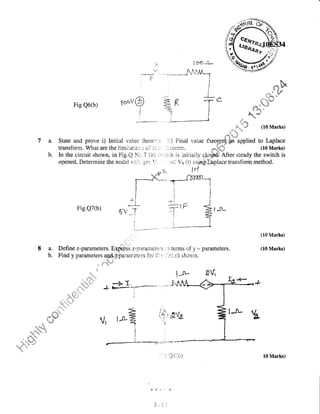
F-ig.Q7(b, ,o
8 a. Define z-parumeters. Exptess z-frardfft€;tr.r"r: r r terrns of y - paranneters.
b. Find y parameters
1pd',/lpararneters
for i1::: -'.t.r,:;.it shcr;in.
' t"
t".''"'
(10 Marks)
(10 Marks)
fiVr
t )i': >-' : *
1 ('
iii.l
5,a
Vr ts-a
I
i
I
I
10 Marks)
USN
Time: 3 hrs.
a. Define the following with example:
i) Accuracy ii) Precision iii) Resolution
b. With a schematrc, explain a true rms voltmeter.
c. Calculate the value of the multiplier resistor
shown in Fig.Q.1(c).
Third Semester B.E. Degree Examination, June/July 2015
Electronics I nstrumentation
qi
(J
o(g
Lr
a(€
.o
()
63
0)
3<
EEoo#
X=
;B
(B (-,
5a
oo ll
coo
.g c
d$
Hoo
(DC
_c(u
q'tr
R.h
.hX
(-) o
GtO
OE
o0c
.s 6i
o>P
-(sss=
'O crJ
-hts
5sAa
o. 6.
tro-
0();
0.)=
g()
(atE
l-0)
=+A,=
>t ({-
ooo
too
0)5
L1- s?
=c)5:7'r
L'<
-
C'l
(.)
Z
(n
!
o
O.
Note: Answer any FIVE full questions, selecting
utleast TWO questions from each part.
PART _ A
iv) S ignificBnt-fi gures.
,, -_r ,
for a j_ftV rms ac range
Max. Marksi t 00
on the
(08 Marks)
(06 Marks)
voltmeter as
(06 Marks)
(12 Marks)
(08 Marks)
(10 Marks)
(10 Marks)
(10 Marks)
(10 Marks)
2a.
b.
q?r-t Fig.e.I(c)
Give the working principle of following:
i) V - F type DY ' it) Successive approximation.
Explain the principle, construction and working of a digital frequency meter.
3 a. Draw the"bhSic block diagram of an oscilloscope and explain the functions of each block and
menfioflthe advantages of negative HV supply.
b. Exphin dual trace oscilloscope with a neat block diagram.
d''qh.
4 a-. Explain the need for a delayed time base oscilloscope. Dnaw the block diagram of a delayed
time base, and explain how it operates.
b. With block diagram, explain the operation of an analog storage oscilloscope.
PART _ B
a. Explain the operation of conventional standard signal
diagram.
b. Write a brief note on function generator.
c. Explain the operation of a sweep frequency generator
diagram. Mention its applications.
generator with the
with the help of a
help of block
(06 Marks)
(04 Marks)
suitable block
(10 Marks)
I of 2
7a.
b.
10IT3s
Explain the operation of the Maxwell's bridge, with a neat circuit diagram. Derive an
expression for unknown values of resistance and inductance. What are the limitations of
Maxwell's bridge? (10 Marks)
b. Explain the operation of the capacitance comparison bridge, with a neat circuit diagram and
derive the necessary equations. (06 Mark)
c. A capacitance comparison bridge is used to measure a capacitive impedance at a frequency
of ZkHz. The bridge constants at balance are Cl - 100pF, Rr - 10Ke), Rz +'50KO,
R:: 100K0. Find the equivalent series circuit of the unknown impedance. (04 Marks)
Listat1eastfiveadvantagesofelectricaltransducer.
Explain the method of measuring displacement using LVDT with a suftab'tb diagram. State
the advantages and disadvantages of LVDT.
c. Write a note on differential output transducers.
(10 Marks)
(05 Marks)
a. Write a note on photo transistor. f
'
(05 Marks)
b. List at least five classifications of digital displays. , ; , (05 Marks)
c. Explain the operation of the measurement of power by,means of bolometer bridge, with the
suitable circuit. (10 Marks)
{<**"**
2 of 2
USN
Third Semester B.E. Degree
Field
Time: 3 hrs.
Examination, June/July 2015
Theory
Max. Marks:100
Note: Answer FIVE full questions, selecfing
at least TWO questions from each parl
PART_A ".. *
a. State and prove Gauss law. ,,
* ,""'104'Marks)
b. Find the volume charge density at (4m,45",60"). If the electric flux denffi given by,
--)nnA.ds'+
D - (r &r * sirr 0 ae + sin 0 cos $ aq) Clmz. .il-x;.',# (06 Marks)
,du P't/'
c. Given B =ry1. in cylindrical co-ordinates, evaluate both sp66uof the divergence theorem
4 *.1n.*1
for the volume enclosed by the cylinder with r:2 m, z:4fl3-fl0 rn. (10 Marks)
l'qJ
#*,a' With usual notations, prove point form of continuity bffiliAtion, V.J =
U!-'
. (05 Marks)
b. Find the amount of energy required to mov. * ?-orrlomb of point.fr#g. from the origin to
p(3, t,-1)minthefield i-12*i.-3y';rtr;;) v/matongthestraighrtinepath, x:-32,
Y
: x* 2z u** * ' (05 Marks)
c. A parallel plate capacitor is filled wifh a dielectric of 0.03 power factor and r, =10. The
plates have ar: areaof 250 mm'&d distance between them is 10 mm. If 5000 V (rms) at
1 MHz is applied to the capa*tQJ n'irA the power dissipated as heat. (10 Marks)
,1"i:.f,
a' Find V and the volumq",{#;; density in free space, if v -
2 cos 0 at p(0.5, 45o, 60o).- --,;,,, v-o- '
f
(07 Marks)
b. Find the electrt#ur rt, ,7,2) for the field of two radial conducting planes V: 50 V at
0 : 10" and-ff;bh. V at $ - 30o ' (08 Marks)
c. State an{p#-q-t}€ uniqueness theorem. (0s Marks)
%-*.C*ds" fs
!Iri,
a. Statg# prove Ampere's law. (04 Marks)
b. @h"fp*ftate the magnetic field intensity at point P due to 10 A current flowing in the
,,-.1;5,'t*ti.lockwise
direction in the metallic block shown in Fig. Q4 (b). (06 Marks)
1S^
-?*

Soan

+
o)
o
o
6l.
(n
a
(g
(.)
=0)
B9Do-
.i;>
de
-o
-^ll
c- oo
,= o.l
d$
nOD
i:()
oEl
-c q)
oB
*,a
caX
bU
do
OIJ -
ro=
-ag(€r
EsU)-
^X
=i*
oj
at)
9i6,c)tU:
=ij
li C)
?'o
>r qi
bo-
trbo
=-o
o-
(r<
e)
z
ir
F 3rn
Fig. Qa
Verify stokes theorem for a
cylindrical surface defined by p
(b)
- 2p' (r + 1)sin g lq for the portion of a
1 < t < 1.5 and for its perimeter.
field having fr
:2.Lsd<1-' 4-Y- 2'
qi
*
il
(10 Marks)
PART - E
a. What is Lorentz force equation?
b. A square loop carrying 2 mA current is placed
current of 15 A as shown in Fig. Q5 (b). Find the
in the field of an infinite
force exerted on the loop.
108S35
(02 Marks)
element carrying
(08 Marks)
c. Two homogeneous, linear, isofropic material have interface ffi: 0, in which there is a
",h" .#i
surface current K - 200 i,N^.In region 2 forx > 0, fi$**t);.i{; ii) le,l iii) lBrla 'u *,""
iv) cr1 v) crz. If Hr = (1501.-+ool y+zsli")oim1
*#
(10 Marks)
i,.s:ij
6a.
b.
c.
State Maxwell's equations for a good conductor*'ahd.for perfect dielectrics.
Define phase velocity, wavelength and prop.pgatffi constant.
unA uniform plane wave traveling in*z 4jreotion in air has H =20arNmthe frequency of the
1l,t
signal is a x 10e Hz. Find 1,, T and.E:"il==
i (06 Marks)
n .ji' :::
(08 Marks)
(06 Marks)
(06 Marks)
(05 Marks)
: I iVIHz.
(09 Marks)
(08 Marks)
(12 Marks)
7 a. Derive the expression for cr, p, y and V for low loss dielectric.
b. For a uniform plane waver E, = 1 0.4e(-.ip-+2nxr0e')v / .n . Find
i) The direction of propagation.
ii) Phase constant B
iii) Expression miH.
c. A materiale'$:,charactenzed by t, =2.5, p, = 1 and o : 4xI0{ U/m at f
Determisib"ffi value of the loss tangent, attenuation constant and phase constant.
- ;i't*'*
h L/'g
8 -Wff"ffi explanatory notes on:
a. .*,.S,t di"g wave ratio.
,{fT,i':P "
Yn tine ve cto r'
*{.rf*rf
2 of 2

3rd Semester Electronic and Communication Engineering (June/July-2015) Question Papers

  • 1.
    ii,.. , .+; Max. tvtafsil00 ,,''" lii illrr:i}" 'ir I IOMAT3l (07 Marks) (07 Marks) (06 Marks) USN Third Semester B.E. Degree Examination, June/July 2015 Engineering Mathematics - Ill Note: Answer FIVE full questions, selecting at least TWO quesfions from each parl Time: 3 hrs. PART - A 1 a. Expand (x) : x sin x as a Fourier series in the interval (-n, n), Hence dedube the following: (07 Marks) c. Find the constant term and the first twb harmonics in the Fourier series (06 Marks) for f(x) given by the followins tabl .n 2 2 2 Lt -=l-r- -r- ' 2 1.3 3.5 s.l n-2 1 1 1 ",* "l;,,,,i;| ii):- =- +_-+ {;;;.,-.-lit, ' 4 1.3 3.5 5.7 ro r.", b. Find the half-range Fourier cosine series for the fung,Sgl [u, o <*</, ,.,,,,. -.ffit''ftx)-l / z - .-/ lr.rl - *1. !/. < x < .t ,.,.,.i t "//. .,,' Where k is a non-integer positive constant. :tio o nn ct IC n( th fo refu s oft <a )4 rans f0rm trans IX, ) rier si n 0 IT 0. ul 0 of rans iine Jsin lrFour d .9 o lr U) (! €o C6 C) EPa0-(l= O'= yi (ll ./ .o .,' -^ll Hoo .= (..r (g$ H AI) HC) otr -c !l o> EE BS bU ctO OE boc((lcl }E(€- -O6 ->B Es io) HB 5.8o -.: atO PH e€ LO) t=> qr oo-coo ()= E.E tr> ^u'l O-r'rl - >)i,, iLFI!1..A qJ lJ< -.i",f^i c) z E Cd .F og t of th n (x) - xe-alxl Ozu - subject to condition u(0,t) :0, u (,t ,t) : 0, dt' (06 Marks) subject to condition u (0, y) - u( !-,y):0, u (x, 0) :0, (07 Marks) one dimensional wave equation + = C' * by A' Ax' J (07 Marks) rtr rS = el a ier ier r)= tne rrie (x) /ers -act Find the Fou Find the Fou Functions f( Find the inv ,,I F- (u) = le- ',,.. cx, solution of od. au r:2 -v 0t ,ta Find various possible separable variab le meth Obtain solution of heat u (x, 0) : f(x). Solve Laplace equation . /m* u (x, a): srn[f] forms 0<x x 2a. b. ne (.S1, OU >( c. ine T equation 8,.i' ^) ^)d'u d'u.-*-=0 ax' fu' b. ollowm e. x: 0 nl3 2n13 TE tuff|?: 5n13 2n F(x) : 1.0 t.4 1.9 t.T u.5 1.2 1.0 (07 Marks) I of3 c.
  • 2.
    1OMAT3l ofa gas to thefo 4a. The pressure P and volume V are related by the equation PV' : K, where r and K Fit this equatiare constants. Fr rs equatron to o P: 0.5 1.0 1.5 2.0 2.5 3.0 V: t.62 1.00 0.7 5 0.62 0.s2 0.46 llowing set of observations (in appropriate units) b. c. Solve the following LPP by using the Graphical method Maximize Z=3X, +4x, Under the constraints 4x, + 2x, < 80 Zxr+5x, <180 X1, X2 ) Q' Solve the following using simplex method Maximize : Z = 2x + 4y, subject to the Constraint : 3x *y 122, 2x+3y <24, x ) 0, y 2 0. PART - B a. Using the Regular - Falsi method, find a real root (correct to three decimal equation cos x : 3x - I that lies between 0.5 and 1 (Here, x is in radians). Using the function dnc on oescn e x 0 I 2 3 4 f(x) a J 6 11 l8 27 Hence find f (0.5) and f (3.1). I c. Evaluate l#axby using Simpson't (%^ 0 Hence find an approximate value of logrD. L5grange's formula, find the interpolating polynomial ,{i'otr ri s,q (07 M&$r i; ti tr riil o,iiit,. (06 Marks) (07 Marks) places) of the (07 Marks) (07 Marks) (07 Marks) that approximates to the (06 Marks) Rule, dividing the interval into 3 equal parts. (07 Marks) initial conditions (07 Marks) b. c. By relaxation method *. r+',** , Solve:-x* 6y+272:85, 54x+y+z:1*141, + 15y + 6z:72. (06Marks) Using the power method, find the largest eiffi value and corresponding eigen vectors of the lo -z 21 n4" matrix A-l-2 3 -11 t,-=,u-* lz -1 3.1 ' , taking [1, 1, 1]r as the initialdgen vectors. Perform 5 iterations. irri r1i -iiii:lr:f 6 a. From the,data given,inffifrltoyine f 1!te ;{ind the,number of students who obtained (i) Less than 45 ii) between 40 and 45 marks. Marks l3o +o 40-50 s0-60 60-70 70 80 No. of Studenfe, 31 42 51 35 31 b. ibed b the following table: ^7 ^') 7 a. Solve the one - dimensional wave equation += +Ox- dt- Subject to the boundary conditions u (0, t):0, u (1, t): 0, t > 0 and the u(x,o):sinnx, *(*,0)=0, o<x'< 1. ' At' 2of3
  • 3.
    b. ^2 ^ Considerthe heat equation 2+ - y under the i) u(0, 1):u (4,t):^0, ,, O'*' At ii) u (x, 0) : x (4 - x), 0 < x < 4. Employ the Bendre - Schmidt method with h : 1 0 < t < 1. 1OMAT31 to find the solution of the equation forr,* (06iMark0 (07 Marks) (07 Marks) (06 Marks) a)a)i c. Solve the two - dimensional Laplace equation + =+ =0 at the interior pivotdl pbints of Ax' Ay' ^ ,,,.; ' the square region shown in the following figure. The values ofu at the pivotal points on the boundary are also shown in the figure. I ooo looo looo I ooo z ooo 9Oo I Ooo 9oo Fig. Q7 (c) ve the recurrence relation of Z - Transformation hence find Zt (np) and (r-2)' @- a) .r)] z' - 2oz ,ro nrr 2 i_ Ir, p t -,1 and osh Z; 8 a. State t- Z",l c L .i! rii b. Ffi& L:T c.' Solve the difference equation yn+u - 2y n*t - 3y, - 3" + 2n Given yo : yr : 0.rli L t€ :t * *. :l€ 3 of3 (07 Marks)
  • 4.
    3'd5** P-tc USN Time: 3hrs. Note: Answer any FIVE full questions. a. Express the complex number (5 - 3i)(2 + i) in rhe form x + iy. 4+2i b. Find the modulus and the amplitude of 1 + cos0 + i sinO. c. Find the cube roots of I + i. ,,':::, . Find the n'h derivative of eu^ cos(bx + c). Find the nth derivative of (x+l)(2x+3) c. If x=tan(1og y)provethat (1 +x2)yn+r* (2nx- l) y"+n(n- 1) yn-r =0. a. Find the angle of intersection of the curves rn = an cosnO, rn = bn sinnO. b. Find the Pedal equation of the curve .i"= a (1 - cos 0). c. Using Maclcaurin's series expand log(1 + x) upto the term containing x4. 0(u, v, w) o(x, y,z) a. Obtain the reduction formula for where n is a positive integer. Third Semester B.E. Degree Examinatior, June/July 2Al5 Advanced Mathematics - I Max. Marks:100 G) a () cg O. c, u) E() () L *c, ;B 63 q, =[n-* ll cco '; J- ,= a-l c€+ :r a0 Yq) (utr €gtr'EoB EZ bU OE 10E vo BE(g-t E(€ -ba'8s 48.tro.Xd (Jj grE ueA|E t-. C) 6.v>.k bo-trboI o= : :" 9r,. . A,i- q' : u"4f i o< -.; 6i 0) Z ir o 2a. b. (06 Marks) (07 Marks) (07 Marks) (06 Marks) (07 Marks) (07 Marks) (06 Marks) (07 Marks) (07 Marks) (06 Marks) (07 Marks) (07 Marks) (06 Marks) (07 Marks) (07 Marks) (06 Marks) (07 Marks) (07 Marks) b. c. b. ri c. ^') s') If u = f(x + ct) + -q(x -ct) show that #=r:-#;. If u - {t I.Zl prove rhat xux + yuv + ztt,=e. [v, x)' If u = x * !; v = y + z,w = z + x find the value of Jcos'xdx a. Define b.,i,?yma functions and prove that I(n + 1) = nl(n). b. Show that f ."*,e oe x { #- d0 = n. c. Prove rhar B(m. n) - r(m)'r(n) .I I-(m+n) I of 2
  • 5.
    b. c. Solve Solve Solve a. Solve b. Solve c.Solve dvr = cos(x dx (r'- y2) d* dv ' + vcotx1J dx +y+1). - xYdY = Q. = xcosec x MATDIP3Ol (06 Marks) (07 Marks) (07 Mrtu) (06 Marks) (07 Marks) (07 Marks) (D'-6D2+1lD-6)y=0. (D'+ 2D+!)=x2 +e**. (D'+D+ l)y=sin2x. ,<**** 2 of 2
  • 6.
    USN Time: 3 hrs. 1a. b. c. ThirdSemester B.E. Degree Exarnination, June/July 2Ol5 Analog Electrottic Gircuits C) (J Q ! (g U) cl () c) th A (-)x oo- EC =ta-^ll C'@ .=N(Br+ gd od €gtr'tro> Ez -'E 3E bU do o€00ccq(€ !x>P ir€(t! - E(g ia'Eo O! ECO d.3 ts'E 56oj u) l) 9H a€ :- O) 5,:> +r boo ca0 c)= E.E F a 'rri.l A 9 vL+". v L:! ':.. i.6r, +* li.t{,+b ,4*/ $ H**<r-* '*' -ftr.i (.) z g Max. Marks:1O,0 Note: Answer any FIVE full questions, selecting atleast TWO qwestions from each part. .' :: : r j ,,'a' PART_A J State and explain the various resistance le.rels of the semiconductor diode. (06 Marks) Explain the working of a full wave centre tapped rectifier. Also determine ripple factor, Design a suitable circuit represented by the box shown below, which has the input and output waveforms as indicated. ' Vi ,,.I f 0 Va '..'.' Fig.Ql(c) t't ,. ' a. Name different biasing methods of transistor. With circuit diagram analyze the circuit, with effect of variation in Ie, R. and Vcc on Q.point ofthe load line. b. Explain the circuit of a transistor switch being used as an inverter. c. In a voltage divider bias circuit of B.IT. Vcc : 20 V, Rg : 10 kO, RE Rr : 40 ke), Rz : 4 kf) Assume siliccn transistor with F : 150. Find Is, V6s and exact analysis. 3 a. Define h:$arameters and hence derive h - oarameters model of CE - BIT. fixed bias (10 Marks) (04 Marks) : 1.5 kf), Ic(ruq using (06 Marks) (06 Marks) b. Explain'with a neat circuit diagram of emifier follower configuration. Justiff how voltage gain-is nearly equal to one. (06 Marks) c. ,Forthe circuit shown below detemrine Vcc, if Av: -160 and ro: 100 kf). Take B: 100. (08 Marks) 4tfca 3'3K j- t>{* 'rUl,tl tl$n 11 fi &,,de ll,Ev Fig. Q3(c) '*;1, l of 2
  • 7.
    4 a. Drawthe singie stage RC coupled BJT response) : i) lnput capacitance C:. ii) capacitance C. on frequency response. b. Prove that miller effect of input u;:acttance C1a; : (i crrao =[,-*).' c. It is desired that the voltage gaur of ar li.C - coupleC by more than rc% from its mid bond vaiue. Calculate i) the lower 3 dB frequency ii) the required C if R : 2000 O. 10ES32 amplifier and discuss the effect of (low frequency output capacitance Cc and iii) Emitter by pass (05 Marks) A") Cf and ouput capacitance (lo vrarils) .,'* tn;1 amplifier at 60 Hz should not.delitdase (05 Marks) (07 Marks) (06 Marks) (07 Marks) Derive Zr, Zs and (10 Marks) (03 Marks) }. raPf-s V o PART _ B a. Derive expressions for Z; ar,d Ai for ir Darlington ernitter followet'eirdtrit. (10 Marks) b. Mention the types of feedback connuc;ions. Draw their blockA@a*s indicating input and output signal. (06 Marks) c. List the generai characteristics of a ncga.tive feedback anrplifier and write its advantages. ", (04 Marks) a. With a neat circuit diagram, expiain the operation of a transformer coupled class A power amplifier. (07 Marks) b. Explain the operation of a class B p,ish-pull alnplifier and derive its conversion efficiency. (08 Marks) c. The following distortion readmg are :-.r ailable for a power amplifier : Dz: A.2,D3 : 0.02,D+ : 0.06, wi{h li = 3.3A an<l Rc : 4 A.Calculate : i) the THD ii) the fundamental powe.'component iii) the total power. (05 Marks) 7a. b. c. Explain the working of Wien,bridge tsciilator. With a neat circuit diagrarn, explain the operation of BJT Colpitts oscillator. crystal. a. Draw the' T common drain contig',rration (source - follower) circuit. A, using'Small signal model. Write its characteristics. C-omP JFET and MOSFET. A crystal has the foll.owing pararneter L :0.334 H, Crul: 1 pF, C :0.065 and R: 5.5 k(). Calculate the series''tesonant frequency, parallel resonant frequency and find Q of the b. c. .E*iathe JFET common drain con'frgu,ration shown below. Given Idss: 10 mA, Vp : -5V, ;i :40 kf), Vcse : -2.85 V i) Calculate ZiandZ0ll) Calculate Au iii) find Vo ifVi:20 mV (p - p). (07 Marks) 0,1 uP JItVi lt + Fig. Q8(c) ,(*{<*{< Vou - D+v o,I L{ tr
  • 8.
    USN '[ime: 3 lrrs. ThirdSemester B.E. Degree Examination, June/July 2015 Log ic Desig n o) () ld n tr "J) t) ," *))a.) * (t !, -; v'. 5J) " t: c/j .= (n CJ I?: 7i 'A ij 'o .u r' olt I (J7, 3.ii 5.3 AU ).Y o (i- Li C) .5 .: , q- bo .o C OII O= =p 5! (r'< z a. b. Max. Marks:IO0 Note: Answer any FIVE .full questions, selecting atleast TWO questions from each part. PART _ A Express the following Boolean function in canonical min term form : Express the foliowing Boolean function in canonical max term f m : F(A,B,C,D) = ag + CD. : Sirnplify the following Boolean function expression using NAND gates. F(A, B. C, D) = Im(1,5,6,7,11,12, 13, using four varjable 'k' map. 15). , i (08lVlarks) technique. (10 Marks) Simplify the following Boolean function uSing Quine - Moclusky's minimization F(A, B, C, D) = Im(6, J,9,10, 13) + d(l ,4.5,11, 15). Consider the following Booiean equarion : F(A, B, C, D) = Im( 1,3,,7 ,11, 15) + Id(o.2, 5), Simpl.ify the firnction F using a 3 variable MEV k - map. Assign the variable D to be the MEV. (I0}Iarks) Implement the Boolean functions : E(^" y.z) =Xl +YZ D(x,y,z) = nm(0,3,5) Usinga,3 - 8 line decoder IC 74138 with active low outputs. (08 IVIarks) Inrcniate a 10 key keypad to a digital system using a I-C 74147 which is a 10 line to BCD pr,iority encoder. Draw the logic diagram and explain the operation with the truth table. (12 Marks) Implement the Boolean function : F(A, B, C, D) = Im(0, I,2,4,5,7,8,9) Using a 8 to 1 multiplexer. Draw the logic diagram and explain the operation. Aclditional gates can be used if required. (0g Marks) Explain the operation of a full subtractor with the help of a truth table and Boolean expressions for the outputs. Implement the full subtractclr using two numbers of i) 4tolmultiplexers ii) 2to I multiplexers. Additional gates if required can be used. Design a one bit binary comparator. (04 Marks) (08 Marks) Realize the simplified (08 Marks) (04 Marks) a. b. a. b. a. b. c. I of 2
  • 9.
    108s33 PART _ B a.Explain the operation of a gated SR latch with a logic diagram and a truth table. (06 Marks) b. Explain the operation of a positive edge trigged 'D' flip-flop with the help of a logic diagram and truth table. Also draw the relevant waveforms. (04 Marks) c. Draw the output waveforms Qy and Q5 the outputs of the master and the slave respectively, if the inputs to a master slave JK flip-flop one as indicated below. (10 Marks) n l-1 *_._)i ,,.1 L-, Fie. Q5(c) 1 ;a.,a1 Design a bitbinary ripple up counter using negative edge tri$[e?ed JK flip-flops.6a. b. timing diagram with respect to the input cock pulses. Explain the operation. Design a synchronous counter using clocked JK flip-flop'for the counting below : Draw the (10 Marks) sequence shown a. Explain mealy and MootC odels of a clocked b. Design a synchronousraircuit using positive following sequea#- 0 - 1- 2 - 0is ihptit x = 0 and O-2-1- rputx=l Provide-,,ffi'output which goes high sequenee. (10 Marks) synchronous sequential circuit. (0g Marks) edge triggered JK flip-flops to generate the to indicate the non - zero states in the 0 - t - 2 - O (12 Marks) C.onstruct the excitation table, transition table, state table and state diagram for the sequential circuit shown in Fig. Q8. (20 Marks) d,A,x Fig. Q8 *:F{<x8 2 of 2 Qz Qr Qb 0 0 0 0 I 0 0 I 1 1 1 0 I 0 1 0 0 1 0 0 0 x gt ,x {i f#'
  • 10.
    hUSN Third Semester B.E.Degree ,--.;amination, N e t 1.{/ C.!,1,. .i- -.! a ly S iS Time: 3 hrs. P{RT_A a. Derir e errrression for i r Sur :,: deiia ransformation ii) Delta rr !,- transib.mation b. Fr-rr lhe er,i'ork shou,n finc the .i:Ce .'L - --.-r-.: ',',J :-tJ -c Fie. Q No. 1 ES}I Max. Marks:100 t ,'*r F ..r.r -"'= v "i.r'rr*rilorr#1? ;-1 l-- *J " k (10 Marks) Gj.'' i (10 Marks) t.,"tats+- e' . ..=i f! ,_a ' b. ila i g = ='a ?- x- (!v -.oll trcc .= (l .r,rva xbo a)AEq 3e AH q= bd (gO ootr(!(u -cGCEi 5: 1()Lr< o, a., u) li 9E 2 t 3 -,cn'C, l-r 0) 6.:h(+i trbo : .F +- U- = !) -" **.'. 1l U+.*. X - Jr*&,.'+rivunh - " Fr $r, i'{.!--:i.ds qd't: ^i' l'f . -: -rrj 41d<**'* :-r,. <".,i.1 ; z a Fie.Q1(b) Define the following with examolCIs i) Oriented graph ii) Tree iii) Frnda:::r, For the network, Shown FiS. Q i-o.2 (b) equilibrium equation in metri>: ;'Jrr : , voltage. Follow the sarne orienterticr{"i :i1i ' ''.r .:utrset jr,,) Fundamental tie set (08 Marks) ',i'i:,.fl'the tie set schedule, tie set matrix and obtain :,,-;,r X{'i,/I . Calculate branch currents and branch ':::? c: rulribers use 4,5 and 6 as tree branches. (12 Marks) .r1'.. +/ /'i {a'si -' 5- F; lc-r Jr 4 L { :i,3^ 7" }--su.- ;V t'T.^' 4 r - ' /' i r.. { r- L4 il:' .::r''tti .i:rl a . 'da" ;li' a. Stapffi prove Reciprocity tkreorerr. b. Hiffi e output voltage Eo of t,re ietwor*' r,,,irirx,rn Using Millman's (07 Marks) theorem. Fig. Q No. 3(b) ah Fig.Q3(b) c. Using superposition theorern, fir-rlr :ir CLr:,'r;r:1, IX tl:,e network shown in Fig. q N".#;Marks) -: a i
  • 11.
    s. j , '.,/ ^q.,,' i-.f e. 5r'I -' a. 'i'r'':;" '',{-" | .-7 tt i ,t I ,/; t-rre;r1 h, S.f*- -. r, u{r*_ , 10ES34 Fq"...r(07 Marks) Fig.Q3(c) State Norton's theorern. Show thrii equalent circuit. Obtain the current Ix by usitig fi r"' In the circuit shown, switch K is r.r, Vc = 80V. Then the switch I{ is . agaifi, Vc = 90V after h.aif secoi?d, . *lu,**, -;r'nevenin's equivalent circuit is..f.tfqdial of Norton's aa, ,.,s*i",,,. r (06 Marks) i ir'I'sr Lheorem for the network $hown in Fig Q No.a@) ' ttti . J-.,i^ I J[- . ' tt ,..i- - b. Fie.Qa(b) ii, ': '':": (08 Marks) c. State maximum power transfer thetrern. Pfbve thatZt-- Zo* for Ac circuits. (06 Marks) 5 a. Show that fo = di,f, fr,: s;ri.:s i: , ,r;{..) c,:..:c;.,i:^ (06Marks) b. A voltage of 100 sin rrffi"*irc, i.. il a-n ..iLC series circuit at resonant frequency. The voltage across a capac.it was io.. ,, t,e 4Ci:)'. Tne bandwidth ts75Hz. The impedence at resonance is 100Q"ffin4 the rescna - '*quenc./ and, constants of the circuit. (06 Marks) c. Derive an expr for the resonai-ii fi:equency of a resonant frequency of a resonant circuit consisting of.Ril in parallel rvitn R, C. Draw the frequency response curve of the above circuit. d;t.,; (08 Marks) J:!,, ag ,. rn aa thd,*&itcuit i,3Jt- Fig.Q6(a) 6a. b. )1. ;rer] -icli:ery loilg time, on closing K, after 10ms, :,rrri, closc,J sor a lcng time. When the switch is opened ," ,:.uLate veiluss of R. and C. Fig. Q No.6 (b) 2of3
  • 12.
    t'' ,, ) it_4 L6{-r+/^. liJu'_r ". - - *.-^*.**$-S'f,ALn I I r,H gdY $ * 4v ,. ## ..! li .!.,.. " , :ri + '6 iry.+ 6. 'i1 ati! g dcs- w ,;fi,"'".# (10 Marks) Fig.Q6(b) toui@ I pr;:5 , { i_ T i 7 a. State and prove i) Initial ';aiue theor: r, ::) Final value tlr.or*cffipHed to Laplace . transforrn. What are the limi:iiti.or. s or ; it .-' : . ,: :.creryl. ,g{ffi (L0 Marks) b. In the circuit shown, in Fig.Q SIc,"7 {a) si,i'ri.;h is iniriaily c1o;i# After steady the switch is opened, Determine the nodal vr;::;,-!ei: '!,r. . : ii;; Vo (t) using:lSplacetransfonn method. F-ig.Q7(b, ,o 8 a. Define z-parumeters. Exptess z-frardfft€;tr.r"r: r r terrns of y - paranneters. b. Find y parameters 1pd',/lpararneters for i1::: -'.t.r,:;.it shcr;in. ' t" t".''"' (10 Marks) (10 Marks) fiVr t )i': >-' : * 1 (' iii.l 5,a Vr ts-a I i I I 10 Marks)
  • 13.
    USN Time: 3 hrs. a.Define the following with example: i) Accuracy ii) Precision iii) Resolution b. With a schematrc, explain a true rms voltmeter. c. Calculate the value of the multiplier resistor shown in Fig.Q.1(c). Third Semester B.E. Degree Examination, June/July 2015 Electronics I nstrumentation qi (J o(g Lr a(€ .o () 63 0) 3< EEoo# X= ;B (B (-, 5a oo ll coo .g c d$ Hoo (DC _c(u q'tr R.h .hX (-) o GtO OE o0c .s 6i o>P -(sss= 'O crJ -hts 5sAa o. 6. tro- 0(); 0.)= g() (atE l-0) =+A,= >t ({- ooo too 0)5 L1- s? =c)5:7'r L'< - C'l (.) Z (n ! o O. Note: Answer any FIVE full questions, selecting utleast TWO questions from each part. PART _ A iv) S ignificBnt-fi gures. ,, -_r , for a j_ftV rms ac range Max. Marksi t 00 on the (08 Marks) (06 Marks) voltmeter as (06 Marks) (12 Marks) (08 Marks) (10 Marks) (10 Marks) (10 Marks) (10 Marks) 2a. b. q?r-t Fig.e.I(c) Give the working principle of following: i) V - F type DY ' it) Successive approximation. Explain the principle, construction and working of a digital frequency meter. 3 a. Draw the"bhSic block diagram of an oscilloscope and explain the functions of each block and menfioflthe advantages of negative HV supply. b. Exphin dual trace oscilloscope with a neat block diagram. d''qh. 4 a-. Explain the need for a delayed time base oscilloscope. Dnaw the block diagram of a delayed time base, and explain how it operates. b. With block diagram, explain the operation of an analog storage oscilloscope. PART _ B a. Explain the operation of conventional standard signal diagram. b. Write a brief note on function generator. c. Explain the operation of a sweep frequency generator diagram. Mention its applications. generator with the with the help of a help of block (06 Marks) (04 Marks) suitable block (10 Marks) I of 2
  • 14.
    7a. b. 10IT3s Explain the operationof the Maxwell's bridge, with a neat circuit diagram. Derive an expression for unknown values of resistance and inductance. What are the limitations of Maxwell's bridge? (10 Marks) b. Explain the operation of the capacitance comparison bridge, with a neat circuit diagram and derive the necessary equations. (06 Mark) c. A capacitance comparison bridge is used to measure a capacitive impedance at a frequency of ZkHz. The bridge constants at balance are Cl - 100pF, Rr - 10Ke), Rz +'50KO, R:: 100K0. Find the equivalent series circuit of the unknown impedance. (04 Marks) Listat1eastfiveadvantagesofelectricaltransducer. Explain the method of measuring displacement using LVDT with a suftab'tb diagram. State the advantages and disadvantages of LVDT. c. Write a note on differential output transducers. (10 Marks) (05 Marks) a. Write a note on photo transistor. f ' (05 Marks) b. List at least five classifications of digital displays. , ; , (05 Marks) c. Explain the operation of the measurement of power by,means of bolometer bridge, with the suitable circuit. (10 Marks) {<**"** 2 of 2
  • 15.
    USN Third Semester B.E.Degree Field Time: 3 hrs. Examination, June/July 2015 Theory Max. Marks:100 Note: Answer FIVE full questions, selecfing at least TWO questions from each parl PART_A ".. * a. State and prove Gauss law. ,, * ,""'104'Marks) b. Find the volume charge density at (4m,45",60"). If the electric flux denffi given by, --)nnA.ds'+ D - (r &r * sirr 0 ae + sin 0 cos $ aq) Clmz. .il-x;.',# (06 Marks) ,du P't/' c. Given B =ry1. in cylindrical co-ordinates, evaluate both sp66uof the divergence theorem 4 *.1n.*1 for the volume enclosed by the cylinder with r:2 m, z:4fl3-fl0 rn. (10 Marks) l'qJ #*,a' With usual notations, prove point form of continuity bffiliAtion, V.J = U!-' . (05 Marks) b. Find the amount of energy required to mov. * ?-orrlomb of point.fr#g. from the origin to p(3, t,-1)minthefield i-12*i.-3y';rtr;;) v/matongthestraighrtinepath, x:-32, Y : x* 2z u** * ' (05 Marks) c. A parallel plate capacitor is filled wifh a dielectric of 0.03 power factor and r, =10. The plates have ar: areaof 250 mm'&d distance between them is 10 mm. If 5000 V (rms) at 1 MHz is applied to the capa*tQJ n'irA the power dissipated as heat. (10 Marks) ,1"i:.f, a' Find V and the volumq",{#;; density in free space, if v - 2 cos 0 at p(0.5, 45o, 60o).- --,;,,, v-o- ' f (07 Marks) b. Find the electrt#ur rt, ,7,2) for the field of two radial conducting planes V: 50 V at 0 : 10" and-ff;bh. V at $ - 30o ' (08 Marks) c. State an{p#-q-t}€ uniqueness theorem. (0s Marks) %-*.C*ds" fs !Iri, a. Statg# prove Ampere's law. (04 Marks) b. @h"fp*ftate the magnetic field intensity at point P due to 10 A current flowing in the ,,-.1;5,'t*ti.lockwise direction in the metallic block shown in Fig. Q4 (b). (06 Marks) 1S^ -?* Soan + o) o o 6l. (n a (g (.) =0) B9Do- .i;> de -o -^ll c- oo ,= o.l d$ nOD i:() oEl -c q) oB *,a caX bU do OIJ - ro= -ag(€r EsU)- ^X =i* oj at) 9i6,c)tU: =ij li C) ?'o >r qi bo- trbo =-o o- (r< e) z ir F 3rn Fig. Qa Verify stokes theorem for a cylindrical surface defined by p (b) - 2p' (r + 1)sin g lq for the portion of a 1 < t < 1.5 and for its perimeter. field having fr :2.Lsd<1-' 4-Y- 2' qi * il (10 Marks)
  • 16.
    PART - E a.What is Lorentz force equation? b. A square loop carrying 2 mA current is placed current of 15 A as shown in Fig. Q5 (b). Find the in the field of an infinite force exerted on the loop. 108S35 (02 Marks) element carrying (08 Marks) c. Two homogeneous, linear, isofropic material have interface ffi: 0, in which there is a ",h" .#i surface current K - 200 i,N^.In region 2 forx > 0, fi$**t);.i{; ii) le,l iii) lBrla 'u *,"" iv) cr1 v) crz. If Hr = (1501.-+ool y+zsli")oim1 *# (10 Marks) i,.s:ij 6a. b. c. State Maxwell's equations for a good conductor*'ahd.for perfect dielectrics. Define phase velocity, wavelength and prop.pgatffi constant. unA uniform plane wave traveling in*z 4jreotion in air has H =20arNmthe frequency of the 1l,t signal is a x 10e Hz. Find 1,, T and.E:"il== i (06 Marks) n .ji' ::: (08 Marks) (06 Marks) (06 Marks) (05 Marks) : I iVIHz. (09 Marks) (08 Marks) (12 Marks) 7 a. Derive the expression for cr, p, y and V for low loss dielectric. b. For a uniform plane waver E, = 1 0.4e(-.ip-+2nxr0e')v / .n . Find i) The direction of propagation. ii) Phase constant B iii) Expression miH. c. A materiale'$:,charactenzed by t, =2.5, p, = 1 and o : 4xI0{ U/m at f Determisib"ffi value of the loss tangent, attenuation constant and phase constant. - ;i't*'* h L/'g 8 -Wff"ffi explanatory notes on: a. .*,.S,t di"g wave ratio. ,{fT,i':P " Yn tine ve cto r' *{.rf*rf 2 of 2