WEL COME
PRAVEEN M JIGAJINNI
PGT (Computer Science)
MCA, MSc[IT], MTech[IT],MPhil (Comp.Sci), PGDCA, ADCA,
Dc. Sc. & Engg.
Reference Book
CLASS XI
By
Sumita Arora
CHAPTER 13
STRUCTURE
S
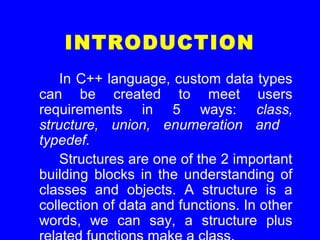
INTRODUCTION
In C++ language, custom data types
can be created to meet users
requirements in 5 ways: class,
structure, union, enumeration and
typedef.
Structures are one of the 2 important
building blocks in the understanding of
classes and objects. A structure is a
collection of data and functions. In other
words, we can say, a structure plus
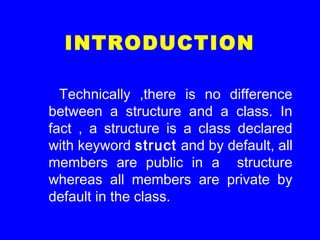
INTRODUCTION
Technically ,there is no difference
between a structure and a class. In
fact , a structure is a class declared
with keyword struct and by default, all
members are public in a structure
whereas all members are private by
default in the class.
STRUCTURES
• Sometimes, some logically related elements need
to be treated under one unit. For instance, the
elements storing a student’s information (e.g., roll
no , name, class, marks, grade) need t be
processed together under one roof. Similarly,
elements keeping a date’s information (e.g., day,
month, and year) need to be processed together.
To handle and serve to such situation, C++ offers
structures.
• Thus it can be said that ,
• A C style structures is a collection of variables
referenced under one name.
STRUCTURES
• To handle and serve to such situation,
C++ offers structures.
• Thus it can be said that ,
• A C style structures is a collection of
variables referenced under one name.
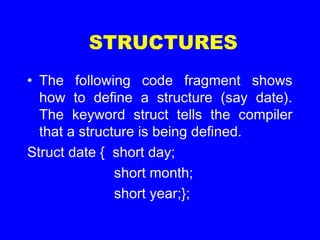
STRUCTURES
• The following code fragment shows
how to define a structure (say date).
The keyword struct tells the compiler
that a structure is being defined.
Struct date { short day;
short month;
short year;};
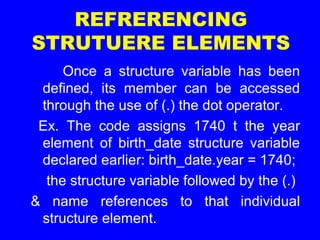
REFRERENCING
STRUTUERE ELEMENTS
Once a structure variable has been
defined, its member can be accessed
through the use of (.) the dot operator.
Ex. The code assigns 1740 t the year
element of birth_date structure variable
declared earlier: birth_date.year = 1740;
the structure variable followed by the (.)
& name references to that individual
structure element.
REFRERENCING
STRUTUERE ELEMENTS
The structure members are just treated
like other variables. Therefore to print
year of birth_date we can write
cout<<birth_date.year;
Initializing Structure
Elements
Structure can be initialized separately
or jointly . Member of structure
senior_student
can be initialized as separately:
senior_student.rolln=01;
senior_student.class=12;
senior_student.marks=50;
senior_student.grade=A
Initializing Structure
Elements
Or jointly as:
Stutype senior_student = { 01 ,12 ,50 ,A };
Joint structure can not be used befour the
variables are defined.
Structure
Assignment
Objects of the same structure can be
assign
or passed as a function .
Ex. The members of senior_student can
be assign to junior_student.
Structure Assignment
Two structure types are different ven they
have same members.
Struct one { int a ;
};
Struct two{int a;
};
one s1 ;
two s2;
cin >> s1.a; //read s1
s2=s1 //error :type
mismatch
The code will produce an error because both are of different type.
NESTED STRUCTURE
A structure element may be either
complex or simple .the simple elements
are int, char, float double .
Element of structure may contain
structure in itself known as complex
structure.
ACCESSING NESTED
STRUCTURE MEMBER
The member of structure can be accessed
by using dot operator . To access the city
member of address which is the element
of other structure worker, we shall write:
Worker.address.city
STRUCTURE AND
ARRAYS
Structure and arrays are both
derived types. Arrays are the collection
of analogous elements,
structures assemble dissimilar
elements under one roof. Both can be
combined to form compels data objects.
ARRAYS OF STRUCTURE
An array can contain similar elements,the
combination having structures within an array is
an array of structure .To declare an structure tou
must define a structure and then declare an
array variable of that type.
To declare a 100 element array of structure of type
addr men_addr [100] ;
To access a specific structure ex . to print houseno of structure 8
write
cout << mem_add [7].houseno ;
Passing structure to
function
Passing a local structure to a function can
be done in two ways:
1.By passing individual structure element
2. By passing the entire structure.
Passing structure
elements to function
When an element of structure is passed
to a function, actually a value of that
element to that function is passing . It is
just like passing the simple variable.
Passing entire structure makes sense
when structure is relatively compact.
The entire function can be passed by
value or by reference.
Returning structure
from function
Just like other types , function can
return structure also. Then the type of
the function is the same as that of
structure returned.
User defined data type
• C++ allows you to define new type of
data types name by using keyword
typedef
• Typedef does not create new data
class rather it define new name for
an existing type.
• Ex typedef float amount
#Define Pre-Processor
Directive
Pre-processor commands are called
DIRECTIVES and begins with a pound
symbol.(#). Many things that can be
done during pre-processor phase
include:
Inclusion of other files through #include
directive.
Definition of symbolic constants and
macros through #define directive.
#Define Pre-Processor
Directive
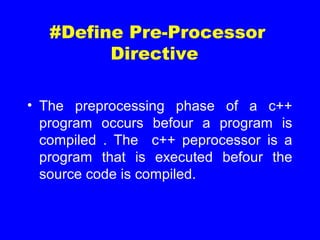
• The preprocessing phase of a c++
program occurs befour a program is
compiled . The c++ peprocessor is a
program that is executed befour the
source code is compiled.
#Define Pre-Processor
Directive
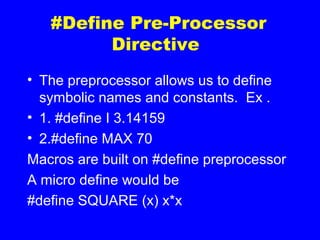
• The preprocessor allows us to define
symbolic names and constants. Ex .
• 1. #define I 3.14159
• 2.#define MAX 70
Macros are built on #define preprocessor
A micro define would be
#define SQUARE (x) x*x
#Define Pre-Processor
Directive
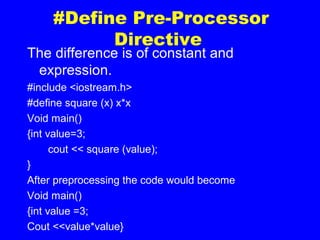
The difference is of constant and
expression.
#include <iostream.h>
#define square (x) x*x
Void main()
{int value=3;
cout << square (value);
}
After preprocessing the code would become
Void main()
{int value =3;
Cout <<value*value}
#Define Pre-Processor
Directive
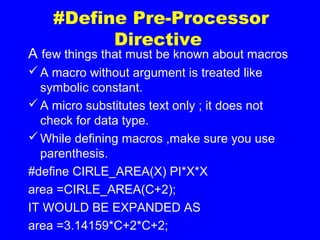
A few things that must be known about macros
A macro without argument is treated like
symbolic constant.
A micro substitutes text only ; it does not
check for data type.
While defining macros ,make sure you use
parenthesis.
#define CIRLE_AREA(X) PI*X*X
area =CIRLE_AREA(C+2);
IT WOULD BE EXPANDED AS
area =3.14159*C+2*C+2;
THANK
YOU

Structures

  • 1.
    WEL COME PRAVEEN MJIGAJINNI PGT (Computer Science) MCA, MSc[IT], MTech[IT],MPhil (Comp.Sci), PGDCA, ADCA, Dc. Sc. & Engg.
  • 2.
  • 3.
  • 4.
    INTRODUCTION In C++ language,custom data types can be created to meet users requirements in 5 ways: class, structure, union, enumeration and typedef. Structures are one of the 2 important building blocks in the understanding of classes and objects. A structure is a collection of data and functions. In other words, we can say, a structure plus
  • 5.
    INTRODUCTION Technically ,there isno difference between a structure and a class. In fact , a structure is a class declared with keyword struct and by default, all members are public in a structure whereas all members are private by default in the class.
  • 6.
    STRUCTURES • Sometimes, somelogically related elements need to be treated under one unit. For instance, the elements storing a student’s information (e.g., roll no , name, class, marks, grade) need t be processed together under one roof. Similarly, elements keeping a date’s information (e.g., day, month, and year) need to be processed together. To handle and serve to such situation, C++ offers structures. • Thus it can be said that , • A C style structures is a collection of variables referenced under one name.
  • 7.
    STRUCTURES • To handleand serve to such situation, C++ offers structures. • Thus it can be said that , • A C style structures is a collection of variables referenced under one name.
  • 8.
    STRUCTURES • The followingcode fragment shows how to define a structure (say date). The keyword struct tells the compiler that a structure is being defined. Struct date { short day; short month; short year;};
  • 9.
    REFRERENCING STRUTUERE ELEMENTS Once astructure variable has been defined, its member can be accessed through the use of (.) the dot operator. Ex. The code assigns 1740 t the year element of birth_date structure variable declared earlier: birth_date.year = 1740; the structure variable followed by the (.) & name references to that individual structure element.
  • 10.
    REFRERENCING STRUTUERE ELEMENTS The structuremembers are just treated like other variables. Therefore to print year of birth_date we can write cout<<birth_date.year;
  • 11.
    Initializing Structure Elements Structure canbe initialized separately or jointly . Member of structure senior_student can be initialized as separately: senior_student.rolln=01; senior_student.class=12; senior_student.marks=50; senior_student.grade=A
  • 12.
    Initializing Structure Elements Or jointlyas: Stutype senior_student = { 01 ,12 ,50 ,A }; Joint structure can not be used befour the variables are defined.
  • 13.
    Structure Assignment Objects of thesame structure can be assign or passed as a function . Ex. The members of senior_student can be assign to junior_student.
  • 14.
    Structure Assignment Two structuretypes are different ven they have same members. Struct one { int a ; }; Struct two{int a; }; one s1 ; two s2; cin >> s1.a; //read s1 s2=s1 //error :type mismatch The code will produce an error because both are of different type.
  • 15.
    NESTED STRUCTURE A structureelement may be either complex or simple .the simple elements are int, char, float double . Element of structure may contain structure in itself known as complex structure.
  • 16.
    ACCESSING NESTED STRUCTURE MEMBER Themember of structure can be accessed by using dot operator . To access the city member of address which is the element of other structure worker, we shall write: Worker.address.city
  • 17.
    STRUCTURE AND ARRAYS Structure andarrays are both derived types. Arrays are the collection of analogous elements, structures assemble dissimilar elements under one roof. Both can be combined to form compels data objects.
  • 18.
    ARRAYS OF STRUCTURE Anarray can contain similar elements,the combination having structures within an array is an array of structure .To declare an structure tou must define a structure and then declare an array variable of that type. To declare a 100 element array of structure of type addr men_addr [100] ; To access a specific structure ex . to print houseno of structure 8 write cout << mem_add [7].houseno ;
  • 19.
    Passing structure to function Passinga local structure to a function can be done in two ways: 1.By passing individual structure element 2. By passing the entire structure.
  • 20.
    Passing structure elements tofunction When an element of structure is passed to a function, actually a value of that element to that function is passing . It is just like passing the simple variable. Passing entire structure makes sense when structure is relatively compact. The entire function can be passed by value or by reference.
  • 21.
    Returning structure from function Justlike other types , function can return structure also. Then the type of the function is the same as that of structure returned.
  • 22.
    User defined datatype • C++ allows you to define new type of data types name by using keyword typedef • Typedef does not create new data class rather it define new name for an existing type. • Ex typedef float amount
  • 23.
    #Define Pre-Processor Directive Pre-processor commandsare called DIRECTIVES and begins with a pound symbol.(#). Many things that can be done during pre-processor phase include: Inclusion of other files through #include directive. Definition of symbolic constants and macros through #define directive.
  • 24.
    #Define Pre-Processor Directive • Thepreprocessing phase of a c++ program occurs befour a program is compiled . The c++ peprocessor is a program that is executed befour the source code is compiled.
  • 25.
    #Define Pre-Processor Directive • Thepreprocessor allows us to define symbolic names and constants. Ex . • 1. #define I 3.14159 • 2.#define MAX 70 Macros are built on #define preprocessor A micro define would be #define SQUARE (x) x*x
  • 26.
    #Define Pre-Processor Directive The differenceis of constant and expression. #include <iostream.h> #define square (x) x*x Void main() {int value=3; cout << square (value); } After preprocessing the code would become Void main() {int value =3; Cout <<value*value}
  • 27.
    #Define Pre-Processor Directive A fewthings that must be known about macros A macro without argument is treated like symbolic constant. A micro substitutes text only ; it does not check for data type. While defining macros ,make sure you use parenthesis. #define CIRLE_AREA(X) PI*X*X area =CIRLE_AREA(C+2); IT WOULD BE EXPANDED AS area =3.14159*C+2*C+2;
  • 28.