1
Presented By: Shubham Naudiyal
MSc. Physics
1st
Semester
Semiconductors
2
Semiconductors are materials that have
electrical conductivity between that of a
conductor (like metals) and an insulator
(like glass).
This unique property makes them
essential for modern electronic devices.
Semiconductors can conduct electricity
under certain conditions, making them
ideal for controlling electrical currents.
What are Semiconductors?
3
Silicon (Si): The most widely used semiconductor material, because of its
abundance and stable properties.
Germanium (Ge): Used in early transistors and some specialized applications.
Gallium arsenide (GaAs): Known for high-speed and optoelectronic
applications.
Other materials: Include indium phosphide (InP), silicon carbide (SiC), and
organic semiconductors.
Common Semiconductor Materials:
4
 Intermediate Electrical Conductivity :
Semiconductors have electrical conductivity between
conductors (like metals) and insulators (like glass).
Their conductivity can be modified through
doping or external factors like temperature &light.
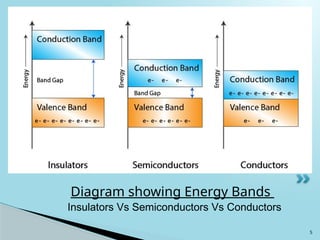
 Energy Band Structure :
Semiconductors have a small energy gap (band gap)
between the valence band and the conduction band.
Electrons need sufficient energy to jump from the
valence
band to the conduction band, enabling electrical
conduction.
Properties of Semiconductors
5
Insulators Vs Semiconductors Vs Conductors
Diagram showing Energy Bands
6
 Doping and Controlled Conductivity :
The addition of small amounts of impurities (doping)
changes their electrical properties:
◦ n-type doping: Adds extra electrons, increasing
conductivity.
◦ p-type doping: Creates "holes" (absence of
electrons) that act as positive charge carriers.
 Temperature Dependency:
Conductivity increases with temperature as
more electrons gain energy to cross the band
gap (opposite to conductors, whose resistance
increases with temperature).
7
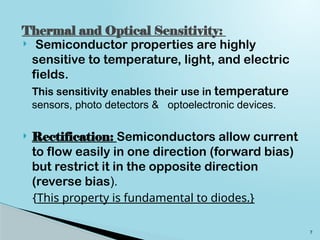
 Semiconductor properties are highly
sensitive to temperature, light, and electric
fields.
This sensitivity enables their use in temperature
sensors, photo detectors & optoelectronic devices.
 Rectification: Semiconductors allow current
to flow easily in one direction (forward bias)
but restrict it in the opposite direction
(reverse bias).
{This property is fundamental to diodes.}
Thermal and Optical Sensitivity:
8
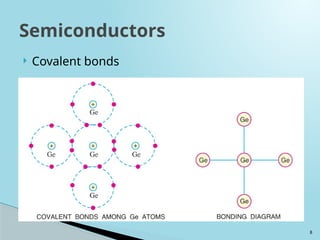
 Covalent bonds
Semiconductors
9
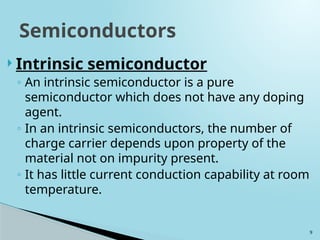
 Intrinsic semiconductor
◦ An intrinsic semiconductor is a pure
semiconductor which does not have any doping
agent.
◦ In an intrinsic semiconductors, the number of
charge carrier depends upon property of the
material not on impurity present.
◦ It has little current conduction capability at room
temperature.
Semiconductors
10
 Extrinsic Semiconductors
◦ An extrinsic semiconductor is a semiconductor
whose electrical conductivity can be increased
by adding impurities in the material.
◦ There are two types of impurities added to Ge
and Si Crystal.
 Pentavalent material - It is made up of
atoms which have five valence electrons.
Examples of Pentavalent impurities are
Arsenic and Antimony.
 Trivalent material – It is materials has three
valence electrons.
Semiconductors
11
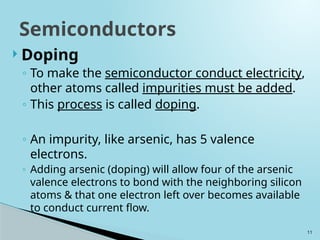
 Doping
◦ To make the semiconductor conduct electricity,
other atoms called impurities must be added.
◦ This process is called doping.
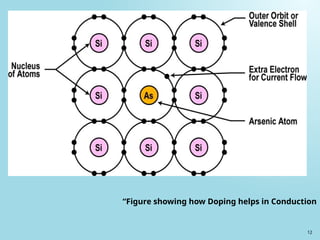
◦ An impurity, like arsenic, has 5 valence
electrons.
◦ Adding arsenic (doping) will allow four of the arsenic
valence electrons to bond with the neighboring silicon
atoms & that one electron left over becomes available
to conduct current flow.
Semiconductors
12
“Figure showing how Doping helps in Conduction
13
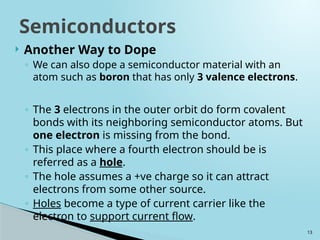
 Another Way to Dope
◦ We can also dope a semiconductor material with an
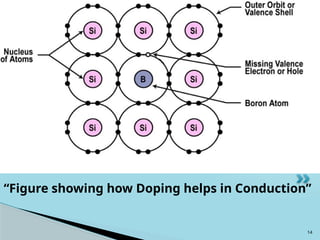
atom such as boron that has only 3 valence electrons.
◦ The 3 electrons in the outer orbit do form covalent
bonds with its neighboring semiconductor atoms. But
one electron is missing from the bond.
◦ This place where a fourth electron should be is
referred as a hole.
◦ The hole assumes a +ve charge so it can attract
electrons from some other source.
◦ Holes become a type of current carrier like the
electron to support current flow.
Semiconductors
14
Click icon to add picture
“Figure showing how Doping helps in Conduction”
15
Types of Semiconductor Materials
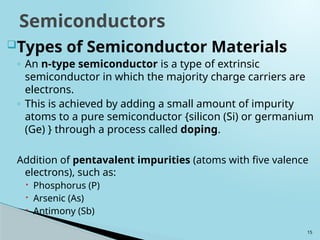
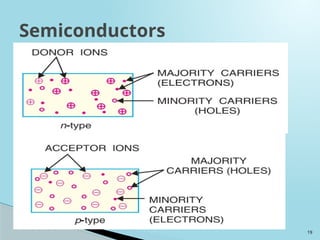
◦ An n-type semiconductor is a type of extrinsic
semiconductor in which the majority charge carriers are
electrons.
◦ This is achieved by adding a small amount of impurity
atoms to a pure semiconductor {silicon (Si) or germanium
(Ge) } through a process called doping.
Addition of pentavalent impurities (atoms with five valence
electrons), such as:
 Phosphorus (P)
 Arsenic (As)
 Antimony (Sb)
Semiconductors
16
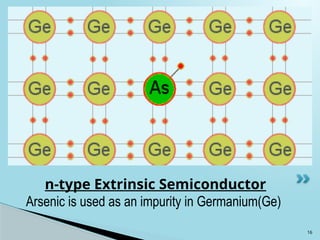
Arsenic is used as an impurity in Germanium(Ge)
n-type Extrinsic Semiconductor
17
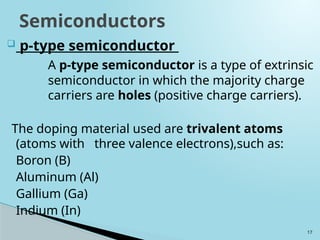
 p-type semiconductor
A p-type semiconductor is a type of extrinsic
semiconductor in which the majority charge
carriers are holes (positive charge carriers).
The doping material used are trivalent atoms
(atoms with three valence electrons),such as:
Boron (B)
Aluminum (Al)
Gallium (Ga)
Indium (In)
Semiconductors
18
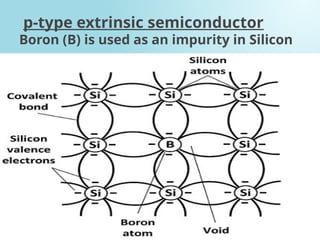
p-type extrinsic semiconductor
Boron (B) is used as an impurity in Silicon
19
Semiconductors
20
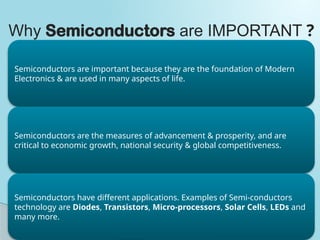
Semiconductors are important because they are the foundation of Modern
Electronics & are used in many aspects of life.
Semiconductors are the measures of advancement & prosperity, and are
critical to economic growth, national security & global competitiveness.
Semiconductors have different applications. Examples of Semi-conductors
technology are Diodes, Transistors, Micro-processors, Solar Cells, LEDs and
many more.
Why Semiconductors are IMPORTANT ?
21

Semi-Conductors, Physics, Science PPT.pptx

  • 1.
    1 Presented By: ShubhamNaudiyal MSc. Physics 1st Semester Semiconductors
  • 2.
    2 Semiconductors are materialsthat have electrical conductivity between that of a conductor (like metals) and an insulator (like glass). This unique property makes them essential for modern electronic devices. Semiconductors can conduct electricity under certain conditions, making them ideal for controlling electrical currents. What are Semiconductors?
  • 3.
    3 Silicon (Si): Themost widely used semiconductor material, because of its abundance and stable properties. Germanium (Ge): Used in early transistors and some specialized applications. Gallium arsenide (GaAs): Known for high-speed and optoelectronic applications. Other materials: Include indium phosphide (InP), silicon carbide (SiC), and organic semiconductors. Common Semiconductor Materials:
  • 4.
    4  Intermediate ElectricalConductivity : Semiconductors have electrical conductivity between conductors (like metals) and insulators (like glass). Their conductivity can be modified through doping or external factors like temperature &light.  Energy Band Structure : Semiconductors have a small energy gap (band gap) between the valence band and the conduction band. Electrons need sufficient energy to jump from the valence band to the conduction band, enabling electrical conduction. Properties of Semiconductors
  • 5.
    5 Insulators Vs SemiconductorsVs Conductors Diagram showing Energy Bands
  • 6.
    6  Doping andControlled Conductivity : The addition of small amounts of impurities (doping) changes their electrical properties: ◦ n-type doping: Adds extra electrons, increasing conductivity. ◦ p-type doping: Creates "holes" (absence of electrons) that act as positive charge carriers.  Temperature Dependency: Conductivity increases with temperature as more electrons gain energy to cross the band gap (opposite to conductors, whose resistance increases with temperature).
  • 7.
    7  Semiconductor propertiesare highly sensitive to temperature, light, and electric fields. This sensitivity enables their use in temperature sensors, photo detectors & optoelectronic devices.  Rectification: Semiconductors allow current to flow easily in one direction (forward bias) but restrict it in the opposite direction (reverse bias). {This property is fundamental to diodes.} Thermal and Optical Sensitivity:
  • 8.
  • 9.
    9  Intrinsic semiconductor ◦An intrinsic semiconductor is a pure semiconductor which does not have any doping agent. ◦ In an intrinsic semiconductors, the number of charge carrier depends upon property of the material not on impurity present. ◦ It has little current conduction capability at room temperature. Semiconductors
  • 10.
    10  Extrinsic Semiconductors ◦An extrinsic semiconductor is a semiconductor whose electrical conductivity can be increased by adding impurities in the material. ◦ There are two types of impurities added to Ge and Si Crystal.  Pentavalent material - It is made up of atoms which have five valence electrons. Examples of Pentavalent impurities are Arsenic and Antimony.  Trivalent material – It is materials has three valence electrons. Semiconductors
  • 11.
    11  Doping ◦ Tomake the semiconductor conduct electricity, other atoms called impurities must be added. ◦ This process is called doping. ◦ An impurity, like arsenic, has 5 valence electrons. ◦ Adding arsenic (doping) will allow four of the arsenic valence electrons to bond with the neighboring silicon atoms & that one electron left over becomes available to conduct current flow. Semiconductors
  • 12.
    12 “Figure showing howDoping helps in Conduction
  • 13.
    13  Another Wayto Dope ◦ We can also dope a semiconductor material with an atom such as boron that has only 3 valence electrons. ◦ The 3 electrons in the outer orbit do form covalent bonds with its neighboring semiconductor atoms. But one electron is missing from the bond. ◦ This place where a fourth electron should be is referred as a hole. ◦ The hole assumes a +ve charge so it can attract electrons from some other source. ◦ Holes become a type of current carrier like the electron to support current flow. Semiconductors
  • 14.
    14 Click icon toadd picture “Figure showing how Doping helps in Conduction”
  • 15.
    15 Types of SemiconductorMaterials ◦ An n-type semiconductor is a type of extrinsic semiconductor in which the majority charge carriers are electrons. ◦ This is achieved by adding a small amount of impurity atoms to a pure semiconductor {silicon (Si) or germanium (Ge) } through a process called doping. Addition of pentavalent impurities (atoms with five valence electrons), such as:  Phosphorus (P)  Arsenic (As)  Antimony (Sb) Semiconductors
  • 16.
    16 Arsenic is usedas an impurity in Germanium(Ge) n-type Extrinsic Semiconductor
  • 17.
    17  p-type semiconductor Ap-type semiconductor is a type of extrinsic semiconductor in which the majority charge carriers are holes (positive charge carriers). The doping material used are trivalent atoms (atoms with three valence electrons),such as: Boron (B) Aluminum (Al) Gallium (Ga) Indium (In) Semiconductors
  • 18.
    18 p-type extrinsic semiconductor Boron(B) is used as an impurity in Silicon
  • 19.
  • 20.
    20 Semiconductors are importantbecause they are the foundation of Modern Electronics & are used in many aspects of life. Semiconductors are the measures of advancement & prosperity, and are critical to economic growth, national security & global competitiveness. Semiconductors have different applications. Examples of Semi-conductors technology are Diodes, Transistors, Micro-processors, Solar Cells, LEDs and many more. Why Semiconductors are IMPORTANT ?
  • 21.