Visual Imagination

Part 1
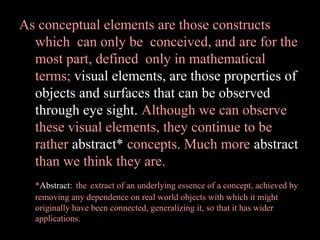
As conceptual elements are those constructs
which can only be conceived, and are for the
most part, defined only in mathematical
terms; visual elements, are those properties of
objects and surfaces that can be observed
through eye sight. Although we can observe
these visual elements, they continue to be
rather abstract* concepts. Much more abstract
than we think they are.
*Abstract: the extract of an underlying essence of a concept, achieved by
removing any dependence on real world objects with which it might
originally have been connected, generalizing it, so that it has wider
applications.
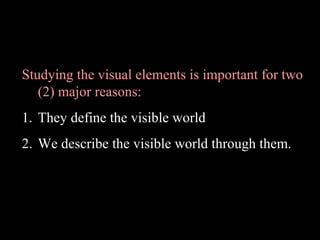
Studying the visual elements is important for two
(2) major reasons:
1. They define the visible world
2. We describe the visible world through them.
There are six (6) principal visual elements:
1. Point*
2. Line
3. Shape
4. Volume*
5. Color
6. Texture
•

Point and Volume will not be given significant attention in this class.
We have already, to a degree, considered
four of them in the discussion concerning
conceptual elements, namely: Point, Line,
Plane and Volume.
In visual terms, point becomes a dot and is
primarily, although, not exclusively, used to
pinpoint the position of a shape or object in two
dimensional and three dimensional space.
THE CHARACTERISTICS OF LINE AS A
VISUAL ELEMENT
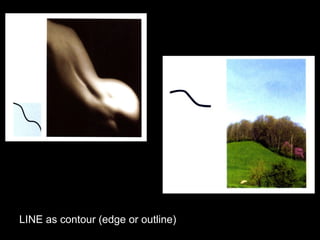
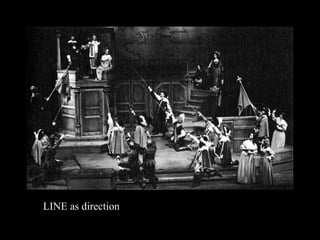
1. In visual terms, line is sometimes thought of
as an edge, a contour (outline), a path, or a
directional signal . It directs our vision to
various points of interest in a composition. Line
is a graphic device. It does not exist in nature in
the same sense that we interpret it in drawing.
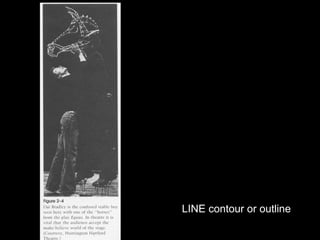
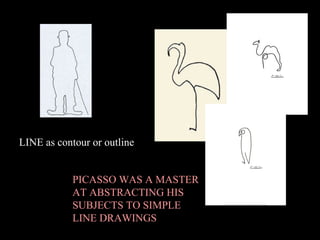
LINE as contour (edge or outline)
LINE contour or outline
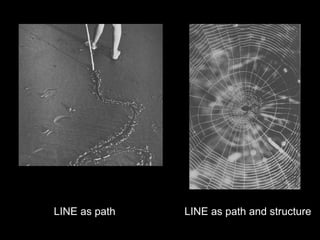
LINE as path

LINE as path and structure
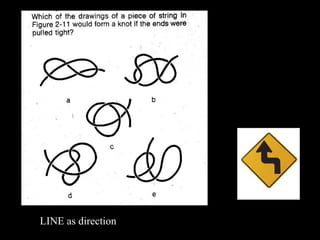
LINE as direction
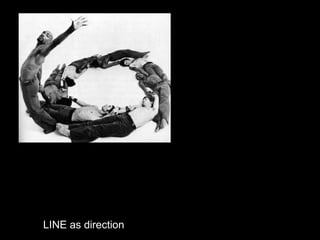
LINE as direction
LINE as direction
LINE as contour or outline
PICASSO WAS A MASTER
AT ABSTRACTING HIS
SUBJECTS TO SIMPLE
LINE DRAWINGS
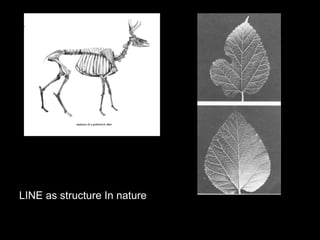
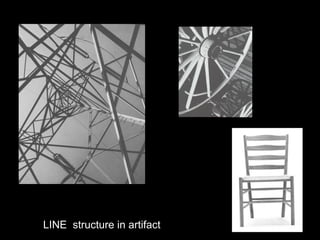
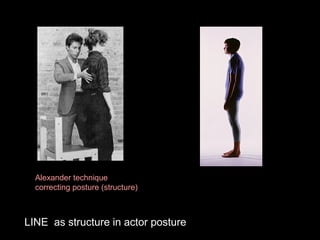
2. In nature we interpret line as providing
structure or underpinning to an entity.
LINE as structure In nature
LINE structure in artifact
Alexander technique
correcting posture (structure)

LINE as structure in actor posture
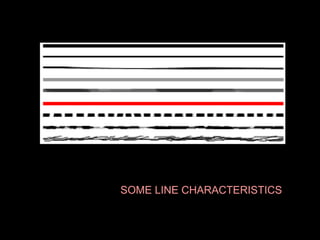
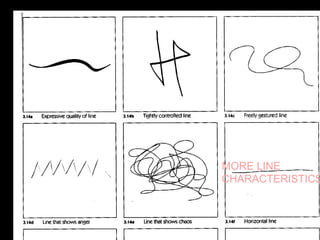
3. Lines have surface characteristics.They can
be straight, curved, thick, thin, solid, broken,
rough, smooth, light, dark pigmented or nonpigmented. Or any combinations of the above .
SOME LINE CHARACTERISTICS
MORE LINE
CHARACTERISTICS
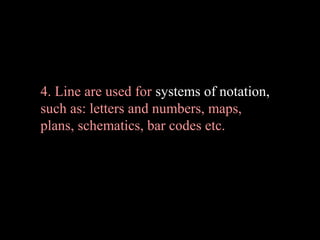
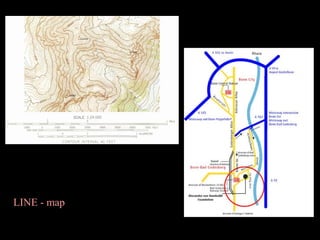
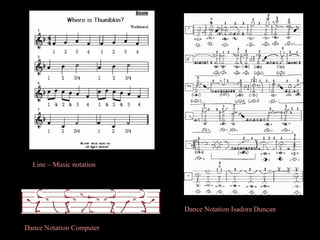
4. Line are used for systems of notation,
such as: letters and numbers, maps,
plans, schematics, bar codes etc.
LINE - map
Line – Music notation

Dance Notation Isadora Duncan
Dance Notation Computer
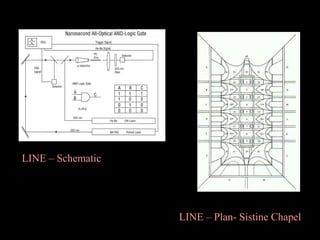
LINE – Schematic

LINE – Plan- Sistine Chapel
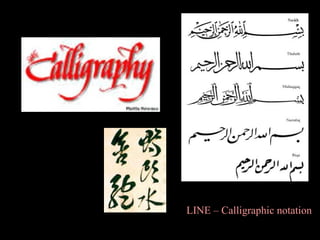
LINE – Calligraphic notation
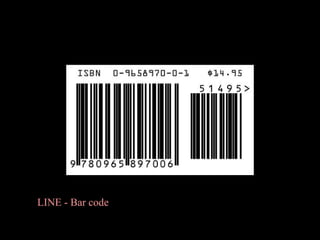
LINE - Bar code
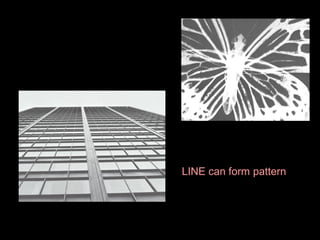
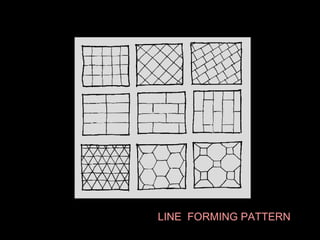
5. Line can be used in forming patterns.
LINE can form pattern
LINE FORMING PATTERN
12a   the visual elements -line -1

12a the visual elements -line -1

  • 1.
  • 2.
    As conceptual elementsare those constructs which can only be conceived, and are for the most part, defined only in mathematical terms; visual elements, are those properties of objects and surfaces that can be observed through eye sight. Although we can observe these visual elements, they continue to be rather abstract* concepts. Much more abstract than we think they are. *Abstract: the extract of an underlying essence of a concept, achieved by removing any dependence on real world objects with which it might originally have been connected, generalizing it, so that it has wider applications.
  • 3.
    Studying the visualelements is important for two (2) major reasons: 1. They define the visible world 2. We describe the visible world through them.
  • 4.
    There are six(6) principal visual elements: 1. Point* 2. Line 3. Shape 4. Volume* 5. Color 6. Texture • Point and Volume will not be given significant attention in this class.
  • 5.
    We have already,to a degree, considered four of them in the discussion concerning conceptual elements, namely: Point, Line, Plane and Volume. In visual terms, point becomes a dot and is primarily, although, not exclusively, used to pinpoint the position of a shape or object in two dimensional and three dimensional space.
  • 6.
    THE CHARACTERISTICS OFLINE AS A VISUAL ELEMENT 1. In visual terms, line is sometimes thought of as an edge, a contour (outline), a path, or a directional signal . It directs our vision to various points of interest in a composition. Line is a graphic device. It does not exist in nature in the same sense that we interpret it in drawing.
  • 7.
    LINE as contour(edge or outline)
  • 8.
  • 9.
    LINE as path LINEas path and structure
  • 10.
  • 11.
  • 12.
  • 13.
    LINE as contouror outline PICASSO WAS A MASTER AT ABSTRACTING HIS SUBJECTS TO SIMPLE LINE DRAWINGS
  • 14.
    2. In naturewe interpret line as providing structure or underpinning to an entity.
  • 15.
  • 16.
  • 17.
    Alexander technique correcting posture(structure) LINE as structure in actor posture
  • 18.
    3. Lines havesurface characteristics.They can be straight, curved, thick, thin, solid, broken, rough, smooth, light, dark pigmented or nonpigmented. Or any combinations of the above .
  • 19.
  • 20.
  • 21.
    4. Line areused for systems of notation, such as: letters and numbers, maps, plans, schematics, bar codes etc.
  • 22.
  • 23.
    Line – Musicnotation Dance Notation Isadora Duncan Dance Notation Computer
  • 24.
    LINE – Schematic LINE– Plan- Sistine Chapel
  • 25.
  • 26.
  • 27.
    5. Line canbe used in forming patterns.
  • 28.
  • 29.