Mark Scheme (Results)
November 2012
GCSE Mathematics (2MB01) Higher
5MB3H (Calculator) Paper 01
Edexcel and BTEC Qualifications
Edexcel and BTEC qualifications come from Pearson, the world’s leading learning
company. We provide a wide range of qualifications including academic, vocational,
occupational and specific programmes for employers. For further information visit our
qualifications websites at www.edexcel.com or www.btec.co.uk for our BTEC
qualifications.
Alternatively, you can get in touch with us using the details on our contact us page at
www.edexcel.com/contactus.
If you have any subject specific questions about this specification that require the help
of a subject specialist, you can speak directly to the subject team at Pearson.
Their contact details can be found on this link: www.edexcel.com/teachingservices.
You can also use our online Ask the Expert service at www.edexcel.com/ask. You will
need an Edexcel username and password to access this service.
Pearson: helping people progress, everywhere
Our aim is to help everyone progress in their lives through education. We believe in
every kind of learning, for all kinds of people, wherever they are in the world. We’ve
been involved in education for over 150 years, and by working across 70 countries, in
100 languages, we have built an international reputation for our commitment to high
standards and raising achievement through innovation in education. Find out more
about how we can help you and your students at: www.pearson.com/uk
November 2012
Publications Code UG033858
All the material in this publication is copyright
© Pearson Education Ltd 2012
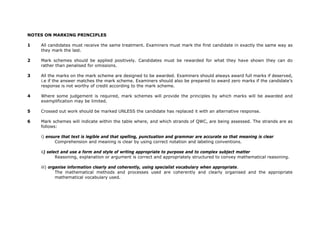
NOTES ON MARKING PRINCIPLES
1 All candidates must receive the same treatment. Examiners must mark the first candidate in exactly the same way as
they mark the last.
2 Mark schemes should be applied positively. Candidates must be rewarded for what they have shown they can do
rather than penalised for omissions.
3 All the marks on the mark scheme are designed to be awarded. Examiners should always award full marks if deserved,
i.e if the answer matches the mark scheme. Examiners should also be prepared to award zero marks if the candidate’s
response is not worthy of credit according to the mark scheme.
4 Where some judgement is required, mark schemes will provide the principles by which marks will be awarded and
exemplification may be limited.
5 Crossed out work should be marked UNLESS the candidate has replaced it with an alternative response.
6 Mark schemes will indicate within the table where, and which strands of QWC, are being assessed. The strands are as
follows:
i) ensure that text is legible and that spelling, punctuation and grammar are accurate so that meaning is clear
Comprehension and meaning is clear by using correct notation and labeling conventions.
ii) select and use a form and style of writing appropriate to purpose and to complex subject matter
Reasoning, explanation or argument is correct and appropriately structured to convey mathematical reasoning.
iii) organise information clearly and coherently, using specialist vocabulary when appropriate.
The mathematical methods and processes used are coherently and clearly organised and the appropriate
mathematical vocabulary used.
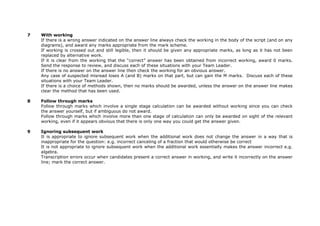
7 With working
If there is a wrong answer indicated on the answer line always check the working in the body of the script (and on any
diagrams), and award any marks appropriate from the mark scheme.
If working is crossed out and still legible, then it should be given any appropriate marks, as long as it has not been
replaced by alternative work.
If it is clear from the working that the “correct” answer has been obtained from incorrect working, award 0 marks.
Send the response to review, and discuss each of these situations with your Team Leader.
If there is no answer on the answer line then check the working for an obvious answer.
Any case of suspected misread loses A (and B) marks on that part, but can gain the M marks. Discuss each of these
situations with your Team Leader.
If there is a choice of methods shown, then no marks should be awarded, unless the answer on the answer line makes
clear the method that has been used.
8 Follow through marks
Follow through marks which involve a single stage calculation can be awarded without working since you can check
the answer yourself, but if ambiguous do not award.
Follow through marks which involve more than one stage of calculation can only be awarded on sight of the relevant
working, even if it appears obvious that there is only one way you could get the answer given.
9 Ignoring subsequent work
It is appropriate to ignore subsequent work when the additional work does not change the answer in a way that is
inappropriate for the question: e.g. incorrect canceling of a fraction that would otherwise be correct
It is not appropriate to ignore subsequent work when the additional work essentially makes the answer incorrect e.g.
algebra.
Transcription errors occur when candidates present a correct answer in working, and write it incorrectly on the answer
line; mark the correct answer.
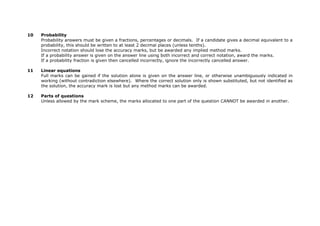
10 Probability
Probability answers must be given a fractions, percentages or decimals. If a candidate gives a decimal equivalent to a
probability, this should be written to at least 2 decimal places (unless tenths).
Incorrect notation should lose the accuracy marks, but be awarded any implied method marks.
If a probability answer is given on the answer line using both incorrect and correct notation, award the marks.
If a probability fraction is given then cancelled incorrectly, ignore the incorrectly cancelled answer.
11 Linear equations
Full marks can be gained if the solution alone is given on the answer line, or otherwise unambiguously indicated in
working (without contradiction elsewhere). Where the correct solution only is shown substituted, but not identified as
the solution, the accuracy mark is lost but any method marks can be awarded.
12 Parts of questions
Unless allowed by the mark scheme, the marks allocated to one part of the question CANNOT be awarded in another.
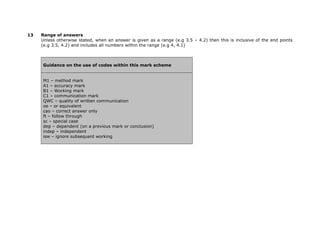
13 Range of answers
Unless otherwise stated, when an answer is given as a range (e.g 3.5 – 4.2) then this is inclusive of the end points
(e.g 3.5, 4.2) and includes all numbers within the range (e.g 4, 4.1)
Guidance on the use of codes within this mark scheme
M1 – method mark
A1 – accuracy mark
B1 – Working mark
C1 – communication mark
QWC – quality of written communication
oe – or equivalent
cao – correct answer only
ft – follow through
sc – special case
dep – dependent (on a previous mark or conclusion)
indep – independent
isw – ignore subsequent working
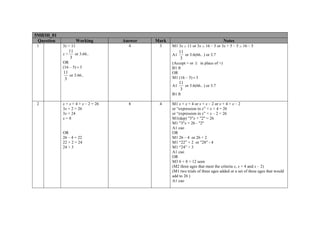
5MB3H_01
Question Working Answer Mark Notes
1 3x > 11
x >
11
3
or 3.66..
OR
(16 – 5) ÷3
11
3
or 3.66..
4 3 M1 3x > 11 or 3x > 16 – 5 or 3x + 5 – 5 > 16 – 5
A1
11
3
or 3.6(66.. ) or 3.7
(Accept = or ≥ in place of >)
B1 ft
OR
M1 (16 – 5) ÷3
A1
11
3
or 3.6(66.. ) or 3.7
B1 ft
2 x + x + 4 + x – 2 = 26
3x + 2 = 26
3x = 24
x = 8
OR
26 – 4 = 22
22 + 2 = 24
24 ÷ 3
8 4 M1 x + x + 4 or x + x – 2 or x + 4 + x – 2
or “expression in x” + x + 4 = 26
or “expression in x” + x – 2 = 26
M1(dep) "3"x + "2" = 26
M1 "3"x = 26 - "2"
A1 cao
OR
M1 26 – 4 or 26 + 2
M1 “22” + 2 or "28" - 4
M1 “24” ÷ 3
A1 cao
OR
M3 6 + 8 + 12 seen
(M2 three ages that meet the criteria x, x + 4 and x – 2)
(M1 two trials of three ages added or a set of three ages that would
add to 26 )
A1 cao
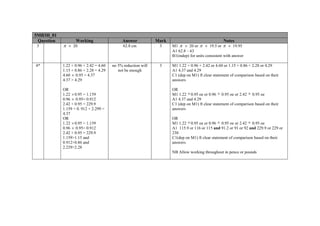
5MB3H_01
Question Working Answer Mark Notes
3 π × 20 62.8 cm 3 M1 π × 20 or π × 19.5 or π × 19.95
A1 62.8 – 63
B1(indep) for units consistent with answer
4* 1.22 + 0.96 + 2.42 = 4.60
1.15 + 0.86 + 2.28 = 4.29
4.60 × 0.95 = 4.37
4.37 > 4.29
OR
1.22 ×0.95 = 1.159
0.96 × 0.95= 0.912
2.42 × 0.95 = 229.9
1.159 + 0. 912 + 2.299 =
4.37
OR
1.22 ×0.95 = 1.159
0.96 × 0.95= 0.912
2.42 × 0.95 = 229.9
1.159>1.15 and
0.912>0.86 and
2.229>2.28
no 5% reduction will
not be enough
3 M1 1.22 + 0.96 + 2.42 or 4.60 or 1.15 + 0.86 + 2.28 or 4.29
A1 4.37 and 4.29
C1 (dep on M1) ft clear statement of comparison based on their
answers
OR
M1 1.22 ×0.95 oe or 0.96 × 0.95 oe or 2.42 × 0.95 oe
A1 4.37 and 4.29
C1 (dep on M1) ft clear statement of comparison based on their
answers
OR
M1 1.22 ×0.95 oe or 0.96 × 0.95 oe or 2.42 × 0.95 oe
A1 115.9 or 116 or 115 and 91.2 or 91 or 92 and 229.9 or 229 or
230
C1(dep on M1) ft clear statement of comparison based on their
answers
NB Allow working throughout in pence or pounds
5MB3H_01
Question Working Answer Mark Notes
5 64 ÷ 10 = 6.4
arc of radius 6.4cm
drawn with cross at 70o
OR
64 ÷ 10 = 6.4
line drawn at 70o
with
cross at 6.4cm
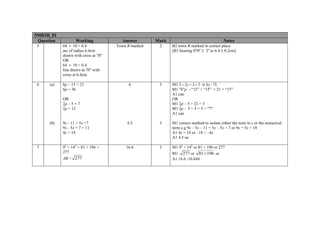
Town B marked 2 B2 town B marked in correct place
(B1 bearing 070o
± 2o
or 6.4 ± 0.2cm)
6 (a) 6p – 15 = 21
6p = 36
OR
2p – 5 = 7
2p = 12
6 3 M1 3 × 2p – 3 × 5 or 6p - 15
M1 "6"p - “15” + “15” = 21 + “15”
A1 cao
OR
M1 2p – 5 = 21 ÷ 3
M1 2p - 5 + 5 = 5 + "7"
A1 cao
(b) 9x - 11 = 5x +7
9x - 5x = 7 + 11
4x = 18
4.5 3 M1 correct method to isolate either the term in x or the numerical
term e.g 9x – 5x – 11 = 5x – 5x + 7 or 9x = 5x + 18
A1 4x = 18 or –18 = –4x
A1 4.5 oe
7 92
+ 142
= 81 + 196 =
277
AB = 277
16.6 3 M1 92
+ 142
or 81 + 196 or 277
M1 277 or 19681+ or
A1 16.6 -16.644
5MB3H_01
Question Working Answer Mark Notes
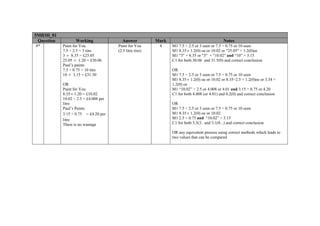
8* Paint for You
7.5 ÷ 2.5 = 3 tins
3 × 8.35 = £25.05
25.05 × 1.20 = £30.06
Paul’s paints
7.5 ÷ 0.75 = 10 tins
10 × 3.15 = £31.50
OR
Paint for You
8.35× 1.20 = £10.02
10.02 ÷ 2.5 = £4.008 per
litre
Paul’s Paints
3.15 ÷ 0.75 = £4.20 per
litre
There is no wastage
Paint for You
(2.5 litre tins)
4 M1 7.5 ÷ 2.5 or 3 seen or 7.5 ÷ 0.75 or 10 seen
M1 8.35× 1.2(0) oe or 10.02 or "25.05" × 1.2(0)oe
M1 "3" × 8.35 or "3" × "10.02" and “10” × 3.15
C1 for both 30.06 and 31.5(0) and correct conclusion
OR
M1 7.5 ÷ 2.5 or 3 seen or 7.5 ÷ 0.75 or 10 seen
M1 8.35× 1.2(0) oe or 10.02 or 8.35÷2.5 × 1.2(0)oe or 3.34 ×
1.2(0) oe
M1 “10.02” ÷ 2.5 or 4.008 or 4.01 and 3.15 ÷ 0.75 or 4.20
C1 for both 4.008 (or 4.01) and 4.2(0) and correct conclusion
OR
M1 7.5 ÷ 2.5 or 3 seen or 7.5 ÷ 0.75 or 10 seen
M1 8.35× 1.2(0) oe or 10.02
M1 2.5 ÷ 0.75 and “10.02” ÷ 3.15
C1 for both 3.3(3.. and 3.1(8...) and correct conclusion
OR any equivalent process using correct methods which leads to
two values that can be compared
5MB3H_01
Question Working Answer Mark Notes
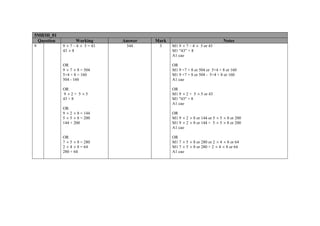
9 9 × 7 – 4 × 5 = 43
43 × 8
OR
9 × 7 × 8 = 504
5×4 × 8 = 160
504 - 160
OR
9 × 2 + 5 × 5
43 × 8
OR
9 × 2 × 8 = 144
5 × 5 × 8 = 200
144 + 200
OR
7 × 5 × 8 = 280
2 × 4 × 8 = 64
280 + 64
344 3 M1 9 × 7 – 4 × 5 or 43
M1 “43” × 8
A1 cao
OR
M1 9 ×7 × 8 or 504 or 5×4 × 8 or 160
M1 9 ×7 × 8 or 504 - 5×4 × 8 or 160
A1 cao
OR
M1 9 × 2 + 5 × 5 or 43
M1 "43" × 8
A1 cao
OR
M1 9 × 2 × 8 or 144 or 5 × 5 × 8 or 200
M1 9 × 2 × 8 or 144 + 5 × 5 × 8 or 200
A1 cao
OR
M1 7 × 5 × 8 or 280 or 2 × 4 × 8 or 64
M1 7 × 5 × 8 or 280 + 2 × 4 × 8 or 64
A1 cao
5MB3H_01
Question Working Answer Mark Notes
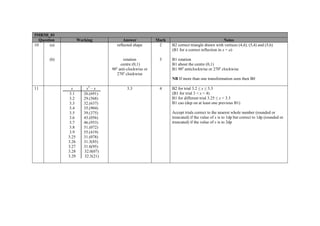
10 (a) reflected shape 2 B2 correct triangle drawn with vertices (4,4), (5,4) and (5,6)
(B1 for a correct reflection in x = a)
(b) rotation
centre (0,1)
90o
anti-clockwise or
270o
clockwise
3 B1 rotation
B1 about the centre (0,1)
B1 90o
anticlockwise or 270o
clockwise
NB If more than one transformation seen then B0
11 x x3
– x
3.1 26.(691)
3.2 29.(568)
3.3 32.(637)
3.4 35.(904)
3.5 39.(375)
3.6 43.(056)
3.7 46.(953)
3.8 51.(072)
3.9 55.(419)
3.25 31.(078)
3.26 31.3(85)
3.27 31.6(95)
3.28 32.0(07)
3.29 32.3(21)
3.3 4 B2 for trial 3.2 ≤ x ≤ 3.3
(B1 for trial 3 < x < 4)
B1 for different trial 3.25 ≤ x < 3.3
B1 cao (dep on at least one previous B1)
Accept trials correct to the nearest whole number (rounded or
truncated) if the value of x is to 1dp but correct to 1dp (rounded or
truncated) if the value of x is to 2dp
5MB3H_01
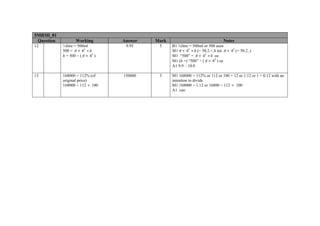
Question Working Answer Mark Notes
12 ½litre = 500ml
500 = ×π 42
×h
h = 500 ÷ ( ×π 42
)
9.95 5 B1 ½litre = 500ml or 500 seen
M1 ×π 42
×h (= 50.2.×.h )or ×π 42
(= 50.2..)
M1 “500” = ×π 42
×h oe
M1 (h =) “500” ÷ ( ×π 42
) oe
A1 9.9 – 10.0
13 168000 = 112% (of
original price)
168000 ÷ 112 × 100
150000 3 M1 168000 = 112% or 112 or 100 + 12 or 1.12 or 1 + 0.12 with an
intention to divide
M1 168000 ÷ 1.12 or 16800 ÷ 112 × 100
A1 cao
5MB3H_01
Question Working Answer Mark Notes
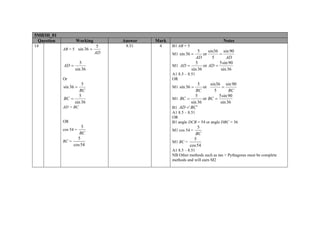
14
AB = 5
AD
5
36sin =
36sin
5
=AD
Or
BC
5
36sin =
36sin
5
=BC
AD = BC
OR
cos 54 =
5
BC
BC =
5
cos54
8.51 4 B1 AB = 5
M1
ADAD
90sin
5
sin36
or
5
36sin ==
M1
36sin
90sin5
or
36sin
5
== ADAD
A1 8.5 – 8.51
OR
M1
BCBC
90sin
5
sin36
or
5
36sin ==
M1
36sin
90sin5
or
36sin
5
== BCBC
B1 ''BCAD =
A1 8.5 – 8.51
OR
B1 angle DCB = 54 or angle DBC = 36
M1 cos 54 =
5
BC
M1 BC =
5
cos54
A1 8.5 – 8.51
NB Other methods such as tan + Pythagoras must be complete
methods and will earn M2
5MB3H_01
Question Working Answer Mark Notes
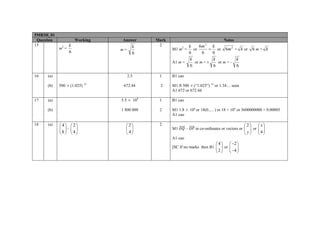
15
m2
=
6
k
m =
6
k 2
M1 m2
=
6
k
or
66
6 2
km
= or 2
6m = k or 6 m = k
A1 m =
6
k
or m = ±
6
k
or m = –
6
k
16 (a) 2.5 1 B1 cao
(b) 500 × (1.025) 12
672.44 2 M1 ft 500 × (“1.025”) 12
or 1.34… seen
A1 672 or 672.44
17 (a) 5.5 × 10⁴
1 B1 cao
(b) 1 800 000 2 M1 1.8 × 10n
or 18(0..... ) or 18 × 10n
or 3600000000 × 0.00005
A1 cao
18 (a) 4
8
⎛ ⎞
⎜ ⎟
⎝ ⎠
–
2
4
⎛ ⎞
⎜ ⎟
⎝ ⎠
2
4
⎛ ⎞
⎜ ⎟
⎝ ⎠
2
M1 – in co-ordinates or vectors or
2
y
⎛ ⎞
⎜ ⎟
⎝ ⎠
or
4
x⎛ ⎞
⎜ ⎟
⎝ ⎠
A1 cao
[SC If no marks then B1
4
2
⎛ ⎞
⎜ ⎟
⎝ ⎠
or
2
4
−⎛ ⎞
⎜ ⎟
−⎝ ⎠
5MB3H_01
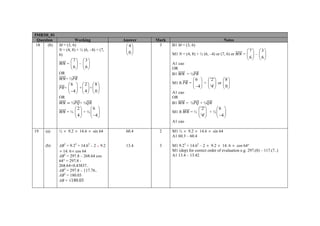
Question Working Answer Mark Notes
18 (b) M = (3, 6)
N = (4, 8) + ½ (6, –4) = (7,
6)
=
7
6
⎛ ⎞
⎜ ⎟
⎝ ⎠
–
3
6
⎛ ⎞
⎜ ⎟
⎝ ⎠
OR
= ½
=
6
4
⎛ ⎞
⎜ ⎟
−⎝ ⎠
+
2
4
⎛ ⎞
⎜ ⎟
⎝ ⎠
=
8
0
⎛ ⎞
⎜ ⎟
⎝ ⎠
OR
½ + ½
= ½
2
4
⎛ ⎞
⎜ ⎟
⎝ ⎠
+ ½
6
4
⎛ ⎞
⎜ ⎟
−⎝ ⎠
4
0
⎛ ⎞
⎜ ⎟
⎝ ⎠
3 B1 M = (3, 6)
M1 N = (4, 8) + ½ (6, –4) or (7, 6) or =
7
6
⎛ ⎞
⎜ ⎟
⎝ ⎠
–
3
6
⎛ ⎞
⎜ ⎟
⎝ ⎠
A1 cao
OR
B1 = ½
M1 ft =
6
4
⎛ ⎞
⎜ ⎟
−⎝ ⎠
+ ⎟⎟
⎠
⎞
⎜⎜
⎝
⎛
'4'
'2'
or
8
0
⎛ ⎞
⎜ ⎟
⎝ ⎠
A1 cao
OR
B1 = ½ + ½
M1 ft = ½ ⎟⎟
⎠
⎞
⎜⎜
⎝
⎛
'4'
'2'
+ ½
6
4
⎛ ⎞
⎜ ⎟
−⎝ ⎠
A1 cao
19 (a) ½ × 9.2 × 14.6 × sin 64 60.4 2 M1 ½ × 9.2 × 14.6 × sin 64
A1 60.3 – 60.4
(b) AB2
= 9.22
+ 14.62
– 2 × 9.2
× 14. 6× cos 64
AB2
= 297.8 – 268.64 cos
64° = 297.8 -
268.64×0.43837..
AB2
= 297.8 – 117.76..
AB2
= 180.03
AB = √180.03
13.4 3 M1 9.22
+ 14.62
– 2 × 9.2 × 14. 6 × cos 64°
M1 (dep) for correct order of evaluation e.g. 297.(8) – 117.(7..)
A1 13.4 – 13.42
5MB3H_01
Question Working Answer Mark Notes
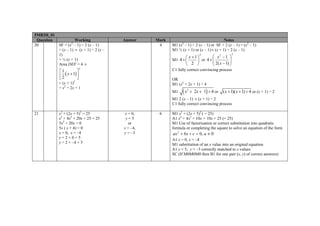
20 SF = (x2
– 1) ÷ 2 (x – 1)
= (x – 1) × (x + 1) ÷ 2 (x –
1)
= ½ (x + 1)
Area DEF = 4 ×
( )
2
1
1
2
x
⎡ ⎤
+⎢ ⎥⎣ ⎦
= (x + 1)2
= x2
+ 2x + 1
4 M1 (x2
– 1) ÷ 2 (x – 1) or SF × 2 (x – 1) = (x2
– 1)
M1 ½ (x + 1) or (x – 1)× (x + 1) ÷ 2 (x – 1)
M1
2
2
1
4 ⎟
⎠
⎞
⎜
⎝
⎛ +
×
x
or
22
)1(2
1
4 ⎟⎟
⎠
⎞
⎜⎜
⎝
⎛
−
−
×
x
x
C1 fully correct convincing process
OR
M1 (x2
+ 2x + 1) ÷ 4
M1 ( )2
2 1 4x x+ + ÷ or ( 1)( 1) 4x x+ + ÷ or (x + 1) ÷ 2
M1 2 (x – 1) × (x + 1) ÷ 2
C1 fully correct convincing process
21 x2
+ (2x + 5)2
= 25
x2
+ 4x2
+ 20x + 25 = 25
5x2
+ 20x = 0
5x ( x + 4) = 0
x = 0, x = –4
y = 2 × 0 + 5
y = 2 × –4 + 5
x = 0,
y = 5
or
x = –4,
y = –3
6 M1 x2
+ (2x + 5)2
( = 25)
A1 x2
+ 4x2
+ 10x + 10x + 25 (= 25)
M1 Use of factorisation or correct substitution into quadratic
formula or completing the square to solve an equation of the form
0,02
≠=++ acbxax
A1 x = 0, x = –4
M1 substitution of an x value into an original equation
A1 y = 5, y = –3 correctly matched to x values
SC (If M0M0M0 then B1 for one pair (x, y) of correct answers)
Further copies of this publication are available from
Edexcel Publications, Adamsway, Mansfield, Notts, NG18 4FN
Telephone 01623 467467
Fax 01623 450481
Email publication.orders@edexcel.com
Order Code UG033858 November 2012
For more information on Edexcel qualifications, please visit our website
www.edexcel.com
Pearson Education Limited. Registered company number 872828
with its registered office at Edinburgh Gate, Harlow, Essex CM20 2JE

12a 5 mb3h_-_november_2012_mark_scheme

  • 1.
    Mark Scheme (Results) November2012 GCSE Mathematics (2MB01) Higher 5MB3H (Calculator) Paper 01
  • 2.
    Edexcel and BTECQualifications Edexcel and BTEC qualifications come from Pearson, the world’s leading learning company. We provide a wide range of qualifications including academic, vocational, occupational and specific programmes for employers. For further information visit our qualifications websites at www.edexcel.com or www.btec.co.uk for our BTEC qualifications. Alternatively, you can get in touch with us using the details on our contact us page at www.edexcel.com/contactus. If you have any subject specific questions about this specification that require the help of a subject specialist, you can speak directly to the subject team at Pearson. Their contact details can be found on this link: www.edexcel.com/teachingservices. You can also use our online Ask the Expert service at www.edexcel.com/ask. You will need an Edexcel username and password to access this service. Pearson: helping people progress, everywhere Our aim is to help everyone progress in their lives through education. We believe in every kind of learning, for all kinds of people, wherever they are in the world. We’ve been involved in education for over 150 years, and by working across 70 countries, in 100 languages, we have built an international reputation for our commitment to high standards and raising achievement through innovation in education. Find out more about how we can help you and your students at: www.pearson.com/uk November 2012 Publications Code UG033858 All the material in this publication is copyright © Pearson Education Ltd 2012
  • 3.
    NOTES ON MARKINGPRINCIPLES 1 All candidates must receive the same treatment. Examiners must mark the first candidate in exactly the same way as they mark the last. 2 Mark schemes should be applied positively. Candidates must be rewarded for what they have shown they can do rather than penalised for omissions. 3 All the marks on the mark scheme are designed to be awarded. Examiners should always award full marks if deserved, i.e if the answer matches the mark scheme. Examiners should also be prepared to award zero marks if the candidate’s response is not worthy of credit according to the mark scheme. 4 Where some judgement is required, mark schemes will provide the principles by which marks will be awarded and exemplification may be limited. 5 Crossed out work should be marked UNLESS the candidate has replaced it with an alternative response. 6 Mark schemes will indicate within the table where, and which strands of QWC, are being assessed. The strands are as follows: i) ensure that text is legible and that spelling, punctuation and grammar are accurate so that meaning is clear Comprehension and meaning is clear by using correct notation and labeling conventions. ii) select and use a form and style of writing appropriate to purpose and to complex subject matter Reasoning, explanation or argument is correct and appropriately structured to convey mathematical reasoning. iii) organise information clearly and coherently, using specialist vocabulary when appropriate. The mathematical methods and processes used are coherently and clearly organised and the appropriate mathematical vocabulary used.
  • 4.
    7 With working Ifthere is a wrong answer indicated on the answer line always check the working in the body of the script (and on any diagrams), and award any marks appropriate from the mark scheme. If working is crossed out and still legible, then it should be given any appropriate marks, as long as it has not been replaced by alternative work. If it is clear from the working that the “correct” answer has been obtained from incorrect working, award 0 marks. Send the response to review, and discuss each of these situations with your Team Leader. If there is no answer on the answer line then check the working for an obvious answer. Any case of suspected misread loses A (and B) marks on that part, but can gain the M marks. Discuss each of these situations with your Team Leader. If there is a choice of methods shown, then no marks should be awarded, unless the answer on the answer line makes clear the method that has been used. 8 Follow through marks Follow through marks which involve a single stage calculation can be awarded without working since you can check the answer yourself, but if ambiguous do not award. Follow through marks which involve more than one stage of calculation can only be awarded on sight of the relevant working, even if it appears obvious that there is only one way you could get the answer given. 9 Ignoring subsequent work It is appropriate to ignore subsequent work when the additional work does not change the answer in a way that is inappropriate for the question: e.g. incorrect canceling of a fraction that would otherwise be correct It is not appropriate to ignore subsequent work when the additional work essentially makes the answer incorrect e.g. algebra. Transcription errors occur when candidates present a correct answer in working, and write it incorrectly on the answer line; mark the correct answer.
  • 5.
    10 Probability Probability answersmust be given a fractions, percentages or decimals. If a candidate gives a decimal equivalent to a probability, this should be written to at least 2 decimal places (unless tenths). Incorrect notation should lose the accuracy marks, but be awarded any implied method marks. If a probability answer is given on the answer line using both incorrect and correct notation, award the marks. If a probability fraction is given then cancelled incorrectly, ignore the incorrectly cancelled answer. 11 Linear equations Full marks can be gained if the solution alone is given on the answer line, or otherwise unambiguously indicated in working (without contradiction elsewhere). Where the correct solution only is shown substituted, but not identified as the solution, the accuracy mark is lost but any method marks can be awarded. 12 Parts of questions Unless allowed by the mark scheme, the marks allocated to one part of the question CANNOT be awarded in another.
  • 6.
    13 Range ofanswers Unless otherwise stated, when an answer is given as a range (e.g 3.5 – 4.2) then this is inclusive of the end points (e.g 3.5, 4.2) and includes all numbers within the range (e.g 4, 4.1) Guidance on the use of codes within this mark scheme M1 – method mark A1 – accuracy mark B1 – Working mark C1 – communication mark QWC – quality of written communication oe – or equivalent cao – correct answer only ft – follow through sc – special case dep – dependent (on a previous mark or conclusion) indep – independent isw – ignore subsequent working
  • 7.
    5MB3H_01 Question Working AnswerMark Notes 1 3x > 11 x > 11 3 or 3.66.. OR (16 – 5) ÷3 11 3 or 3.66.. 4 3 M1 3x > 11 or 3x > 16 – 5 or 3x + 5 – 5 > 16 – 5 A1 11 3 or 3.6(66.. ) or 3.7 (Accept = or ≥ in place of >) B1 ft OR M1 (16 – 5) ÷3 A1 11 3 or 3.6(66.. ) or 3.7 B1 ft 2 x + x + 4 + x – 2 = 26 3x + 2 = 26 3x = 24 x = 8 OR 26 – 4 = 22 22 + 2 = 24 24 ÷ 3 8 4 M1 x + x + 4 or x + x – 2 or x + 4 + x – 2 or “expression in x” + x + 4 = 26 or “expression in x” + x – 2 = 26 M1(dep) "3"x + "2" = 26 M1 "3"x = 26 - "2" A1 cao OR M1 26 – 4 or 26 + 2 M1 “22” + 2 or "28" - 4 M1 “24” ÷ 3 A1 cao OR M3 6 + 8 + 12 seen (M2 three ages that meet the criteria x, x + 4 and x – 2) (M1 two trials of three ages added or a set of three ages that would add to 26 ) A1 cao
  • 8.
    5MB3H_01 Question Working AnswerMark Notes 3 π × 20 62.8 cm 3 M1 π × 20 or π × 19.5 or π × 19.95 A1 62.8 – 63 B1(indep) for units consistent with answer 4* 1.22 + 0.96 + 2.42 = 4.60 1.15 + 0.86 + 2.28 = 4.29 4.60 × 0.95 = 4.37 4.37 > 4.29 OR 1.22 ×0.95 = 1.159 0.96 × 0.95= 0.912 2.42 × 0.95 = 229.9 1.159 + 0. 912 + 2.299 = 4.37 OR 1.22 ×0.95 = 1.159 0.96 × 0.95= 0.912 2.42 × 0.95 = 229.9 1.159>1.15 and 0.912>0.86 and 2.229>2.28 no 5% reduction will not be enough 3 M1 1.22 + 0.96 + 2.42 or 4.60 or 1.15 + 0.86 + 2.28 or 4.29 A1 4.37 and 4.29 C1 (dep on M1) ft clear statement of comparison based on their answers OR M1 1.22 ×0.95 oe or 0.96 × 0.95 oe or 2.42 × 0.95 oe A1 4.37 and 4.29 C1 (dep on M1) ft clear statement of comparison based on their answers OR M1 1.22 ×0.95 oe or 0.96 × 0.95 oe or 2.42 × 0.95 oe A1 115.9 or 116 or 115 and 91.2 or 91 or 92 and 229.9 or 229 or 230 C1(dep on M1) ft clear statement of comparison based on their answers NB Allow working throughout in pence or pounds
  • 9.
    5MB3H_01 Question Working AnswerMark Notes 5 64 ÷ 10 = 6.4 arc of radius 6.4cm drawn with cross at 70o OR 64 ÷ 10 = 6.4 line drawn at 70o with cross at 6.4cm Town B marked 2 B2 town B marked in correct place (B1 bearing 070o ± 2o or 6.4 ± 0.2cm) 6 (a) 6p – 15 = 21 6p = 36 OR 2p – 5 = 7 2p = 12 6 3 M1 3 × 2p – 3 × 5 or 6p - 15 M1 "6"p - “15” + “15” = 21 + “15” A1 cao OR M1 2p – 5 = 21 ÷ 3 M1 2p - 5 + 5 = 5 + "7" A1 cao (b) 9x - 11 = 5x +7 9x - 5x = 7 + 11 4x = 18 4.5 3 M1 correct method to isolate either the term in x or the numerical term e.g 9x – 5x – 11 = 5x – 5x + 7 or 9x = 5x + 18 A1 4x = 18 or –18 = –4x A1 4.5 oe 7 92 + 142 = 81 + 196 = 277 AB = 277 16.6 3 M1 92 + 142 or 81 + 196 or 277 M1 277 or 19681+ or A1 16.6 -16.644
  • 10.
    5MB3H_01 Question Working AnswerMark Notes 8* Paint for You 7.5 ÷ 2.5 = 3 tins 3 × 8.35 = £25.05 25.05 × 1.20 = £30.06 Paul’s paints 7.5 ÷ 0.75 = 10 tins 10 × 3.15 = £31.50 OR Paint for You 8.35× 1.20 = £10.02 10.02 ÷ 2.5 = £4.008 per litre Paul’s Paints 3.15 ÷ 0.75 = £4.20 per litre There is no wastage Paint for You (2.5 litre tins) 4 M1 7.5 ÷ 2.5 or 3 seen or 7.5 ÷ 0.75 or 10 seen M1 8.35× 1.2(0) oe or 10.02 or "25.05" × 1.2(0)oe M1 "3" × 8.35 or "3" × "10.02" and “10” × 3.15 C1 for both 30.06 and 31.5(0) and correct conclusion OR M1 7.5 ÷ 2.5 or 3 seen or 7.5 ÷ 0.75 or 10 seen M1 8.35× 1.2(0) oe or 10.02 or 8.35÷2.5 × 1.2(0)oe or 3.34 × 1.2(0) oe M1 “10.02” ÷ 2.5 or 4.008 or 4.01 and 3.15 ÷ 0.75 or 4.20 C1 for both 4.008 (or 4.01) and 4.2(0) and correct conclusion OR M1 7.5 ÷ 2.5 or 3 seen or 7.5 ÷ 0.75 or 10 seen M1 8.35× 1.2(0) oe or 10.02 M1 2.5 ÷ 0.75 and “10.02” ÷ 3.15 C1 for both 3.3(3.. and 3.1(8...) and correct conclusion OR any equivalent process using correct methods which leads to two values that can be compared
  • 11.
    5MB3H_01 Question Working AnswerMark Notes 9 9 × 7 – 4 × 5 = 43 43 × 8 OR 9 × 7 × 8 = 504 5×4 × 8 = 160 504 - 160 OR 9 × 2 + 5 × 5 43 × 8 OR 9 × 2 × 8 = 144 5 × 5 × 8 = 200 144 + 200 OR 7 × 5 × 8 = 280 2 × 4 × 8 = 64 280 + 64 344 3 M1 9 × 7 – 4 × 5 or 43 M1 “43” × 8 A1 cao OR M1 9 ×7 × 8 or 504 or 5×4 × 8 or 160 M1 9 ×7 × 8 or 504 - 5×4 × 8 or 160 A1 cao OR M1 9 × 2 + 5 × 5 or 43 M1 "43" × 8 A1 cao OR M1 9 × 2 × 8 or 144 or 5 × 5 × 8 or 200 M1 9 × 2 × 8 or 144 + 5 × 5 × 8 or 200 A1 cao OR M1 7 × 5 × 8 or 280 or 2 × 4 × 8 or 64 M1 7 × 5 × 8 or 280 + 2 × 4 × 8 or 64 A1 cao
  • 12.
    5MB3H_01 Question Working AnswerMark Notes 10 (a) reflected shape 2 B2 correct triangle drawn with vertices (4,4), (5,4) and (5,6) (B1 for a correct reflection in x = a) (b) rotation centre (0,1) 90o anti-clockwise or 270o clockwise 3 B1 rotation B1 about the centre (0,1) B1 90o anticlockwise or 270o clockwise NB If more than one transformation seen then B0 11 x x3 – x 3.1 26.(691) 3.2 29.(568) 3.3 32.(637) 3.4 35.(904) 3.5 39.(375) 3.6 43.(056) 3.7 46.(953) 3.8 51.(072) 3.9 55.(419) 3.25 31.(078) 3.26 31.3(85) 3.27 31.6(95) 3.28 32.0(07) 3.29 32.3(21) 3.3 4 B2 for trial 3.2 ≤ x ≤ 3.3 (B1 for trial 3 < x < 4) B1 for different trial 3.25 ≤ x < 3.3 B1 cao (dep on at least one previous B1) Accept trials correct to the nearest whole number (rounded or truncated) if the value of x is to 1dp but correct to 1dp (rounded or truncated) if the value of x is to 2dp
  • 13.
    5MB3H_01 Question Working AnswerMark Notes 12 ½litre = 500ml 500 = ×π 42 ×h h = 500 ÷ ( ×π 42 ) 9.95 5 B1 ½litre = 500ml or 500 seen M1 ×π 42 ×h (= 50.2.×.h )or ×π 42 (= 50.2..) M1 “500” = ×π 42 ×h oe M1 (h =) “500” ÷ ( ×π 42 ) oe A1 9.9 – 10.0 13 168000 = 112% (of original price) 168000 ÷ 112 × 100 150000 3 M1 168000 = 112% or 112 or 100 + 12 or 1.12 or 1 + 0.12 with an intention to divide M1 168000 ÷ 1.12 or 16800 ÷ 112 × 100 A1 cao
  • 14.
    5MB3H_01 Question Working AnswerMark Notes 14 AB = 5 AD 5 36sin = 36sin 5 =AD Or BC 5 36sin = 36sin 5 =BC AD = BC OR cos 54 = 5 BC BC = 5 cos54 8.51 4 B1 AB = 5 M1 ADAD 90sin 5 sin36 or 5 36sin == M1 36sin 90sin5 or 36sin 5 == ADAD A1 8.5 – 8.51 OR M1 BCBC 90sin 5 sin36 or 5 36sin == M1 36sin 90sin5 or 36sin 5 == BCBC B1 ''BCAD = A1 8.5 – 8.51 OR B1 angle DCB = 54 or angle DBC = 36 M1 cos 54 = 5 BC M1 BC = 5 cos54 A1 8.5 – 8.51 NB Other methods such as tan + Pythagoras must be complete methods and will earn M2
  • 15.
    5MB3H_01 Question Working AnswerMark Notes 15 m2 = 6 k m = 6 k 2 M1 m2 = 6 k or 66 6 2 km = or 2 6m = k or 6 m = k A1 m = 6 k or m = ± 6 k or m = – 6 k 16 (a) 2.5 1 B1 cao (b) 500 × (1.025) 12 672.44 2 M1 ft 500 × (“1.025”) 12 or 1.34… seen A1 672 or 672.44 17 (a) 5.5 × 10⁴ 1 B1 cao (b) 1 800 000 2 M1 1.8 × 10n or 18(0..... ) or 18 × 10n or 3600000000 × 0.00005 A1 cao 18 (a) 4 8 ⎛ ⎞ ⎜ ⎟ ⎝ ⎠ – 2 4 ⎛ ⎞ ⎜ ⎟ ⎝ ⎠ 2 4 ⎛ ⎞ ⎜ ⎟ ⎝ ⎠ 2 M1 – in co-ordinates or vectors or 2 y ⎛ ⎞ ⎜ ⎟ ⎝ ⎠ or 4 x⎛ ⎞ ⎜ ⎟ ⎝ ⎠ A1 cao [SC If no marks then B1 4 2 ⎛ ⎞ ⎜ ⎟ ⎝ ⎠ or 2 4 −⎛ ⎞ ⎜ ⎟ −⎝ ⎠
  • 16.
    5MB3H_01 Question Working AnswerMark Notes 18 (b) M = (3, 6) N = (4, 8) + ½ (6, –4) = (7, 6) = 7 6 ⎛ ⎞ ⎜ ⎟ ⎝ ⎠ – 3 6 ⎛ ⎞ ⎜ ⎟ ⎝ ⎠ OR = ½ = 6 4 ⎛ ⎞ ⎜ ⎟ −⎝ ⎠ + 2 4 ⎛ ⎞ ⎜ ⎟ ⎝ ⎠ = 8 0 ⎛ ⎞ ⎜ ⎟ ⎝ ⎠ OR ½ + ½ = ½ 2 4 ⎛ ⎞ ⎜ ⎟ ⎝ ⎠ + ½ 6 4 ⎛ ⎞ ⎜ ⎟ −⎝ ⎠ 4 0 ⎛ ⎞ ⎜ ⎟ ⎝ ⎠ 3 B1 M = (3, 6) M1 N = (4, 8) + ½ (6, –4) or (7, 6) or = 7 6 ⎛ ⎞ ⎜ ⎟ ⎝ ⎠ – 3 6 ⎛ ⎞ ⎜ ⎟ ⎝ ⎠ A1 cao OR B1 = ½ M1 ft = 6 4 ⎛ ⎞ ⎜ ⎟ −⎝ ⎠ + ⎟⎟ ⎠ ⎞ ⎜⎜ ⎝ ⎛ '4' '2' or 8 0 ⎛ ⎞ ⎜ ⎟ ⎝ ⎠ A1 cao OR B1 = ½ + ½ M1 ft = ½ ⎟⎟ ⎠ ⎞ ⎜⎜ ⎝ ⎛ '4' '2' + ½ 6 4 ⎛ ⎞ ⎜ ⎟ −⎝ ⎠ A1 cao 19 (a) ½ × 9.2 × 14.6 × sin 64 60.4 2 M1 ½ × 9.2 × 14.6 × sin 64 A1 60.3 – 60.4 (b) AB2 = 9.22 + 14.62 – 2 × 9.2 × 14. 6× cos 64 AB2 = 297.8 – 268.64 cos 64° = 297.8 - 268.64×0.43837.. AB2 = 297.8 – 117.76.. AB2 = 180.03 AB = √180.03 13.4 3 M1 9.22 + 14.62 – 2 × 9.2 × 14. 6 × cos 64° M1 (dep) for correct order of evaluation e.g. 297.(8) – 117.(7..) A1 13.4 – 13.42
  • 17.
    5MB3H_01 Question Working AnswerMark Notes 20 SF = (x2 – 1) ÷ 2 (x – 1) = (x – 1) × (x + 1) ÷ 2 (x – 1) = ½ (x + 1) Area DEF = 4 × ( ) 2 1 1 2 x ⎡ ⎤ +⎢ ⎥⎣ ⎦ = (x + 1)2 = x2 + 2x + 1 4 M1 (x2 – 1) ÷ 2 (x – 1) or SF × 2 (x – 1) = (x2 – 1) M1 ½ (x + 1) or (x – 1)× (x + 1) ÷ 2 (x – 1) M1 2 2 1 4 ⎟ ⎠ ⎞ ⎜ ⎝ ⎛ + × x or 22 )1(2 1 4 ⎟⎟ ⎠ ⎞ ⎜⎜ ⎝ ⎛ − − × x x C1 fully correct convincing process OR M1 (x2 + 2x + 1) ÷ 4 M1 ( )2 2 1 4x x+ + ÷ or ( 1)( 1) 4x x+ + ÷ or (x + 1) ÷ 2 M1 2 (x – 1) × (x + 1) ÷ 2 C1 fully correct convincing process 21 x2 + (2x + 5)2 = 25 x2 + 4x2 + 20x + 25 = 25 5x2 + 20x = 0 5x ( x + 4) = 0 x = 0, x = –4 y = 2 × 0 + 5 y = 2 × –4 + 5 x = 0, y = 5 or x = –4, y = –3 6 M1 x2 + (2x + 5)2 ( = 25) A1 x2 + 4x2 + 10x + 10x + 25 (= 25) M1 Use of factorisation or correct substitution into quadratic formula or completing the square to solve an equation of the form 0,02 ≠=++ acbxax A1 x = 0, x = –4 M1 substitution of an x value into an original equation A1 y = 5, y = –3 correctly matched to x values SC (If M0M0M0 then B1 for one pair (x, y) of correct answers)
  • 20.
    Further copies ofthis publication are available from Edexcel Publications, Adamsway, Mansfield, Notts, NG18 4FN Telephone 01623 467467 Fax 01623 450481 Email publication.orders@edexcel.com Order Code UG033858 November 2012 For more information on Edexcel qualifications, please visit our website www.edexcel.com Pearson Education Limited. Registered company number 872828 with its registered office at Edinburgh Gate, Harlow, Essex CM20 2JE