Mark Scheme (Results)
January 2015
Pearson Edexcel International GCSE
Mathematics A (4MA0)
Paper 4HR
Edexcel and BTEC Qualifications
Edexcel and BTEC qualifications come from Pearson, the world’s
leading learning company. We provide a wide range of qualifications
including academic, vocational, occupational and specific
programmes for employers. For further information, please visit our
website at www.edexcel.com.
Our website subject pages hold useful resources, support material
and live feeds from our subject advisors giving you access to a
portal of information. If you have any subject specific questions
about this specification that require the help of a subject specialist,
you may find our Ask The Expert email service helpful.
www.edexcel.com/contactus
Pearson: helping people progress, everywhere
Our aim is to help everyone progress in their lives through education. We
believe in every kind of learning, for all kinds of people, wherever they are
in the world. We’ve been involved in education for over 150 years, and by
working across 70 countries, in 100 languages, we have built an
international reputation for our commitment to high standards and raising
achievement through innovation in education. Find out more about how
we can help you and your students at: www.pearson.com/uk
January 2015
Publications Code UG040601
All the material in this publication is copyright
© Pearson Education Ltd 2015
General Marking Guidance
 All candidates must receive the same treatment. Examiners
must mark the first candidate in exactly the same way as they
mark the last.
 Mark schemes should be applied positively. Candidates must
be rewarded for what they have shown they can do rather
than penalised for omissions.
 Examiners should mark according to the mark scheme not
according to their perception of where the grade boundaries
may lie.
 There is no ceiling on achievement. All marks on the mark
scheme should be used appropriately.
 All the marks on the mark scheme are designed to be
awarded. Examiners should always award full marks if
deserved, i.e. if the answer matches the mark scheme.
Examiners should also be prepared to award zero marks if the
candidate’s response is not worthy of credit according to the
mark scheme.
 Where some judgement is required, mark schemes will
provide the principles by which marks will be awarded and
exemplification may be limited.
 When examiners are in doubt regarding the application of the
mark scheme to a candidate’s response, the team leader must
be consulted.
 Crossed out work should be marked UNLESS the candidate
has replaced it with an alternative response.
 Types of mark
o M marks: method marks
o A marks: accuracy marks
o B marks: unconditional accuracy marks (independent of
M marks)
 Abbreviations
o cao – correct answer only
o ft – follow through
o isw – ignore subsequent working
o SC - special case
o oe – or equivalent (and appropriate)
o dep – dependent
o indep – independent
o eeoo – each error or omission
o awrt –answer which rounds to
 No working
If no working is shown then correct answers normally score full
marks
If no working is shown then incorrect (even though nearly correct)
answers score no marks.
 With working
If there is a wrong answer indicated on the answer line always check
the working in the body of the script (and on any diagrams), and
award any marks appropriate from the mark scheme.
If it is clear from the working that the “correct” answer has been
obtained from incorrect working, award 0 marks.
Any case of suspected misread loses A (and B) marks on that part,
but can gain the M marks.
If working is crossed out and still legible, then it should be given any
appropriate marks, as long as it has not been replaced by
alternative work.
If there is a choice of methods shown, then no marks should be
awarded, unless the answer on the answer line makes clear the
method that has been used.
If there is no answer on the answer line then check the working for
an obvious answer.
 Ignoring subsequent work
It is appropriate to ignore subsequent work when the additional
work does not change the answer in a way that is inappropriate for
the question: eg. Incorrect cancelling of a fraction that would
otherwise be correct.
It is not appropriate to ignore subsequent work when the additional
work essentially makes the answer incorrect eg algebra.
Transcription errors occur when candidates present a correct answer
in working, and write it incorrectly on the answer line; mark the
correct answer.
 Parts of questions
Unless allowed by the mark scheme, the marks allocated to one part
of the question CANNOT be awarded in another
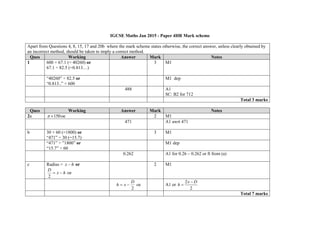
IGCSE Maths Jan 2015 - Paper 4HR Mark scheme
Apart from Questions 4, 8, 15, 17 and 20b where the mark scheme states otherwise, the correct answer, unless clearly obtained by
an incorrect method, should be taken to imply a correct method.
Ques Working Answer Mark Notes
1 600 × 67.1 (= 40260) or
67.1 ÷ 82.5 (=0.813…)
3 M1
“40260” ÷ 82.5 or
“0.813..” × 600
M1 dep
488 A1
SC: B2 for 712
Total 3 marks
Ques Working Answer Mark Notes
2a 150 oe 2 M1
471 A1 awrt 471
b 30 × 60 (=1800) or
“471” ÷ 30 (=15.7)
3 M1
“471” ÷ ”1800” or
“15.7” ÷ 60
M1 dep
0.262 A1 for 0.26 – 0.262 or ft from (a)
c Radius = hx  or
hx
D

2
oe
2 M1
2
D
xh  oe A1 or
2
2
x D
h


Total 7 marks
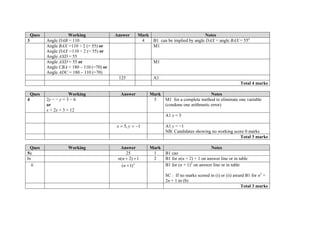
Ques Working Answer Mark Notes
3 Angle DAB = 110 4 B1 can be implied by angle DAX = angle BAX = 55o
Angle BAX =110 ÷ 2 (= 55) or
Angle DAX =110 ÷ 2 (= 55) or
Angle AXD = 55
M1
Angle AXD = 55 or
Angle CBA = 180 – 110 (=70) or
Angle ADC = 180 – 110 (=70)
M1
125 A1
Total 4 marks
Ques Working Answer Mark Notes
4 2y − − y = 3 − 6
or
x + 2x = 3 + 12
3 M1 for a complete method to eliminate one variable
(condone one arithmetic error)
A1 x = 5
1,5  yx A1 y = −1
NB: Candidates showing no working score 0 marks
Total 3 marks
Ques Working Answer Mark Notes
5a 25 1 B1 cao
bi 1)2( nn 2 B1 for n(n + 2) + 1 on answer line or in table
ii 2
)1( n B1 for (n + 1)2
on answer line or in table
SC : If no marks scored in (i) or (ii) award B1 for n2
+
2n + 1 in (b)
Total 3 marks
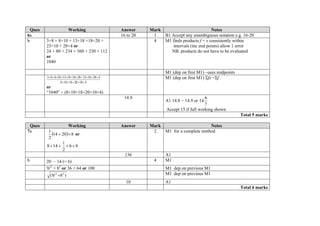
Ques Working Answer Mark Notes
6a 16 to 20 1 B1 Accept any unambiguous notation e.g. 16-20
b 3×8 + 8×10 + 13×18 +18×20 +
23×10 + 28×4 or
24 + 80 + 234 + 360 + 230 + 112
or
1040
4 M1 finds products f × x consistently within
intervals (inc end points) allow 1 error
NB. products do not have to be evaluated
M1 (dep on first M1) –uses midpoints
3 8 8 10 13 18 18 20 23 10 28 4
8 10 18 20 10 4
          
    
or
“1040” ÷ (8+10+18+20+10+4)
M1 (dep on first M1) Σfx ÷Σf
14.9
A1 14.8 − 14.9 or
6
14
7
Accept 15 if full working shown
Total 5 marks
Ques Working Answer Mark Notes
7a
  82014
2
1
 or
86
2
1
148 
2 M1 for a complete method
136 A1
b 20  14 (= 6) 4 M1
'6'2
+ 82
or 36 + 64 or 100 M1 dep on previous M1
)8'6(' 22
 M1 dep on previous M1
10 A1
Total 6 marks
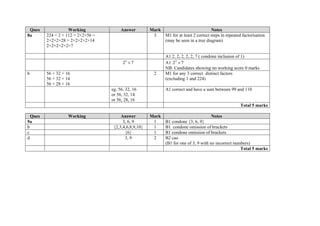
Ques Working Answer Mark Notes
8a 224 = 2 × 112 = 2×2×56 =
2×2×2×28 = 2×2×2×2×14
2×2×2×2×2×7
3 M1 for at least 2 correct steps in repeated factorisation
(may be seen in a tree diagram)
A1 2, 2, 2, 2, 2, 7 ( condone inclusion of 1)
725
 A1 725

NB: Candidates showing no working score 0 marks
b 56 + 32 + 16
56 + 32 + 14
56 + 28 + 16
2 M1 for any 3 correct distinct factors
(excluding 1 and 224)
eg. 56, 32, 16
or 56, 32, 14
or 56, 28, 16
A1 correct and have a sum between 99 and 110
Total 5 marks
Ques Working Answer Mark Notes
9a 3, 6, 9 1 B1 condone {3, 6, 9}
b {2,3,4,6,8,9,10} 1 B1 condone omission of brackets
c {6} 1 B1 condone omission of brackets
d 3, 9 2 B2 cao
(B1 for one of 3, 9 with no incorrect numbers)
Total 5 marks
Ques Working Answer Mark Notes
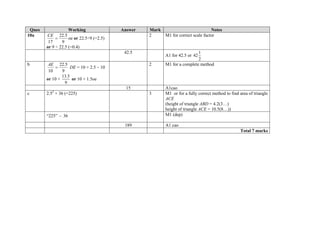
10a
9
5.22
17

CE
oe or 22.5÷9 (=2.5)
or 9 ÷ 22.5 (=0.4)
2 M1 for correct scale factor
42.5
A1 for 42.5 or
1
42
2
b
9
5.22
10

AE
DE = 10 × 2.5 – 10
or 10 ×
13.5
9
or 10 × 1.5oe
2 M1 for a complete method
15 A1cao
c 2.52
× 36 (=225) 3 M1 or for a fully correct method to find area of triangle
ACE
(height of triangle ABD = 4.2(3…)
height of triangle ACE = 10.5(8…))
“225”  36 M1 (dep)
189 A1 cao
Total 7 marks
Ques Working Answer Mark Notes
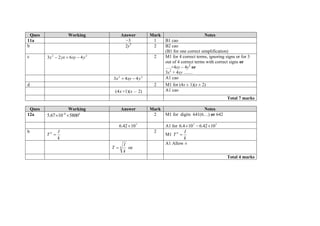
11a −3 1 B1 cao
b 2y3
2 B2 cao
(B1 for one correct simplification)
c 22
4623 yxyyxx  2 M1 for 4 correct terms, ignoring signs or for 3
out of 4 correct terms with correct signs or
….+4xy – 4y2
or
3x2
+ 4xy ……
22
443 yxyx  A1 cao
d 2 M1 for (4x ± 1)(x ± 2)
x4( +1)(x  2) A1 cao
Total 7 marks
Ques Working Answer Mark Notes
12a 8 4
5.67 10 5800
  2 M1 for digits 641(6…) or 642
7
1042.6  A1 for 77
1042.6104.6 
b
k
I
T 4 2
M1
k
I
T 4
4
k
I
T  oe
A1 Allow ±
Total 4 marks
Ques Working Answer Mark Notes
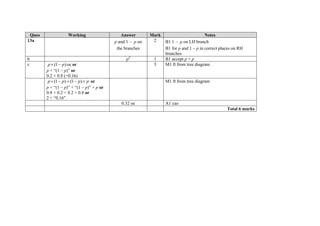
13a p and 1  p on
the branches
2 B1 1  p on LH branch
B1 for p and 1 – p in correct places on RH
branches
b p2
1 B1 accept p × p
c )1( pp  oe or
p × “(1 – p)” or
0.2 × 0.8 (=0.16)
3 M1 ft from tree diagram
pppp  )1()1( or
p × “(1 – p)” + “(1 – p)” × p or
0.8 × 0.2 + 0.2 × 0.8 or
2 × “0.16”
M1 ft from tree diagram
0.32 oe A1 cao
Total 6 marks
Ques Working Answer Mark Notes
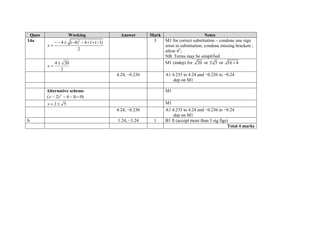
14a 2
4 ( 4) 4 1 ( 1)
2
x
       

3 M1 for correct substitution – condone one sign
error in substitution; condone missing brackets ;
allow 42
;
NB. Terms may be simplified
2
204 
x
M1 (indep) for 20 or 2 5 or 16 4
4.24, −0.236 A1 4.235 to 4.24 and −0.236 to −0.24
dep on M1
Alternative scheme
)0(14)2( 2
x
M1
52 x M1
4.24, −0.236 A1 4.235 to 4.24 and −0.236 to −0.24
dep on M1
b 1.24, −3.24 1 B1 ft (accept more than 3 sig figs)
Total 4 marks
Ques Working Answer Mark Notes
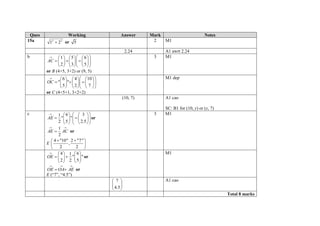
15a 22
21  or 5 2 M1
2.24 A1 awrt 2.24
b 1 5 6
2 3 5
AC
       
        
      
or B (4+5, 3+2) or (9, 5)
3 M1
6 4 10
" "
5 2 7
OC
       
        
      
or C (4+5+1, 3+2+2)
M1 dep
(10, 7) A1 cao
SC: B1 for (10, y) or (x, 7)
c 6 31
" "
5 2.52
AE
     
     
    
or

 ACAE
2
1
or
E
4 "10" 2 "7"
,
2 2
  
 
 
3 M1
4 61
" "
2 52
OE
    
    
   
or

 AEOAOE or
E (“7”, “4.5”)
M1






5.4
7 A1 cao
Total 8 marks
Ques Working Answer Mark Notes
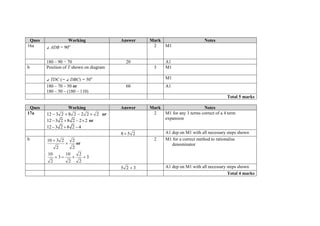
16a ∠ ADB = 90o 2 M1
180 – 90 − 70 20 A1
b Position of T shown on diagram 3 M1
∠ TDC (= ∠ DBC) = 50o M1
180 – 70 – 50 or
180 – 50 – (180 – 110)
60 A1
Total 5 marks
Ques Working Answer Mark Notes
17a 222282312  or
12 3 2 8 2 2 2    or
12 3 2 8 2 4  
2 M1 for any 3 terms correct of a 4 term
expansion
258  A1 dep on M1 with all necessary steps shown
b
2
2
2
2310


or
3
2
2
2
10
3
2
10

2 M1 for a correct method to rationalise
denominator
325  A1 dep on M1 with all necessary steps shown
Total 4 marks
Ques Working Answer Mark Notes
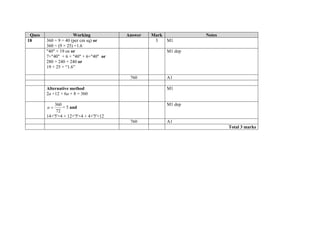
18 360 ÷ 9 = 40 (per cm sq) or
360 ÷ (9 × 25) =1.6
3 M1
"40" × 19 oe or
7×"40" + 6 × "40" + 6×"40" or
280 + 240 + 240 or
19 × 25 × “1.6”
M1 dep
760 A1
Alternative method
2a ×12 + 6a × 8 = 360
M1
72
360
a = 5 and
14×'5'×4 + 12×'5'×4 + 4×'5'×12
M1 dep
760 A1
Total 3 marks
Ques Working Answer Mark Notes
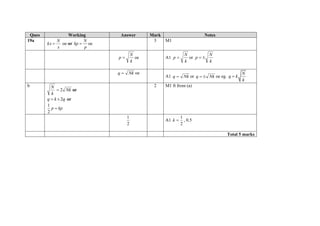
19a
x
N
kx  oe or
N
kp
p
 oe
3 M1
k
N
p  oe A1
k
N
p  or
k
N
p 
Nkq  oe
A1 Nkq  or Nkq  oe eg.
N
q k
k

b
Nk
k
N
2 or
2q k q  or
1
2
p kp
2 M1 ft from (a)
2
1
A1
2
1
k , 0.5
Total 5 marks
Ques Working Answer Mark Notes
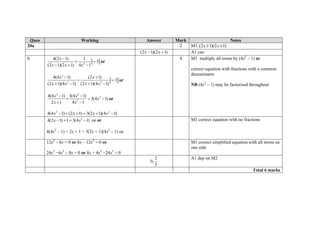
20a 2 M1 (2 1)(2 1)x x 
)12)(12(  xx A1 cao
b
 2
4(2 1) 1
3
(2 1)(2 1) 4 1
x
x x x

 
  
or
 
2
2 2
4(4 1) (2 1)
3
(2 1)(4 1) (2 1)(4 1)
x x
x x x x
 
 
   
or
2 2
2
2
4(4 1) 1(4 1)
3(4 1)
2 1 4 1
x x
x
x x
 
  
 
or
2 2
4(4 1) (2 1) 3(2 1)(4 1)x x x x     
4 M1 multiply all terms by (4x2
– 1) or
correct equation with fractions with a common
denominator
NB (4x2
– 1) may be factorised throughout
2
4(2 1) 1 3(4 1)x x    oe or
4(4x2
– 1) + 2x + 1 = 3(2x + 1)(4x2
– 1) oe
M1 correct equation with no fractions
12x2
– 8x = 0 or 8x – 12x2
= 0 or
24x3
−4x2
– 8x = 0 or 8x + 4x2
−24x3
= 0
M1 correct simplified equation with all terms on
one side
3
2
,0
A1 dep on M2
Total 6 marks
Pearson Education Limited. Registered company number 872828
with its registered office at Edinburgh Gate, Harlow, Essex CM20 2JE

EOY MATHS

  • 1.
    Mark Scheme (Results) January2015 Pearson Edexcel International GCSE Mathematics A (4MA0) Paper 4HR
  • 2.
    Edexcel and BTECQualifications Edexcel and BTEC qualifications come from Pearson, the world’s leading learning company. We provide a wide range of qualifications including academic, vocational, occupational and specific programmes for employers. For further information, please visit our website at www.edexcel.com. Our website subject pages hold useful resources, support material and live feeds from our subject advisors giving you access to a portal of information. If you have any subject specific questions about this specification that require the help of a subject specialist, you may find our Ask The Expert email service helpful. www.edexcel.com/contactus Pearson: helping people progress, everywhere Our aim is to help everyone progress in their lives through education. We believe in every kind of learning, for all kinds of people, wherever they are in the world. We’ve been involved in education for over 150 years, and by working across 70 countries, in 100 languages, we have built an international reputation for our commitment to high standards and raising achievement through innovation in education. Find out more about how we can help you and your students at: www.pearson.com/uk January 2015 Publications Code UG040601 All the material in this publication is copyright © Pearson Education Ltd 2015
  • 3.
    General Marking Guidance All candidates must receive the same treatment. Examiners must mark the first candidate in exactly the same way as they mark the last.  Mark schemes should be applied positively. Candidates must be rewarded for what they have shown they can do rather than penalised for omissions.  Examiners should mark according to the mark scheme not according to their perception of where the grade boundaries may lie.  There is no ceiling on achievement. All marks on the mark scheme should be used appropriately.  All the marks on the mark scheme are designed to be awarded. Examiners should always award full marks if deserved, i.e. if the answer matches the mark scheme. Examiners should also be prepared to award zero marks if the candidate’s response is not worthy of credit according to the mark scheme.  Where some judgement is required, mark schemes will provide the principles by which marks will be awarded and exemplification may be limited.  When examiners are in doubt regarding the application of the mark scheme to a candidate’s response, the team leader must be consulted.  Crossed out work should be marked UNLESS the candidate has replaced it with an alternative response.  Types of mark o M marks: method marks o A marks: accuracy marks o B marks: unconditional accuracy marks (independent of M marks)  Abbreviations o cao – correct answer only o ft – follow through o isw – ignore subsequent working o SC - special case o oe – or equivalent (and appropriate) o dep – dependent o indep – independent o eeoo – each error or omission o awrt –answer which rounds to
  • 4.
     No working Ifno working is shown then correct answers normally score full marks If no working is shown then incorrect (even though nearly correct) answers score no marks.  With working If there is a wrong answer indicated on the answer line always check the working in the body of the script (and on any diagrams), and award any marks appropriate from the mark scheme. If it is clear from the working that the “correct” answer has been obtained from incorrect working, award 0 marks. Any case of suspected misread loses A (and B) marks on that part, but can gain the M marks. If working is crossed out and still legible, then it should be given any appropriate marks, as long as it has not been replaced by alternative work. If there is a choice of methods shown, then no marks should be awarded, unless the answer on the answer line makes clear the method that has been used. If there is no answer on the answer line then check the working for an obvious answer.  Ignoring subsequent work It is appropriate to ignore subsequent work when the additional work does not change the answer in a way that is inappropriate for the question: eg. Incorrect cancelling of a fraction that would otherwise be correct. It is not appropriate to ignore subsequent work when the additional work essentially makes the answer incorrect eg algebra. Transcription errors occur when candidates present a correct answer in working, and write it incorrectly on the answer line; mark the correct answer.  Parts of questions Unless allowed by the mark scheme, the marks allocated to one part of the question CANNOT be awarded in another
  • 5.
    IGCSE Maths Jan2015 - Paper 4HR Mark scheme Apart from Questions 4, 8, 15, 17 and 20b where the mark scheme states otherwise, the correct answer, unless clearly obtained by an incorrect method, should be taken to imply a correct method. Ques Working Answer Mark Notes 1 600 × 67.1 (= 40260) or 67.1 ÷ 82.5 (=0.813…) 3 M1 “40260” ÷ 82.5 or “0.813..” × 600 M1 dep 488 A1 SC: B2 for 712 Total 3 marks Ques Working Answer Mark Notes 2a 150 oe 2 M1 471 A1 awrt 471 b 30 × 60 (=1800) or “471” ÷ 30 (=15.7) 3 M1 “471” ÷ ”1800” or “15.7” ÷ 60 M1 dep 0.262 A1 for 0.26 – 0.262 or ft from (a) c Radius = hx  or hx D  2 oe 2 M1 2 D xh  oe A1 or 2 2 x D h   Total 7 marks
  • 6.
    Ques Working AnswerMark Notes 3 Angle DAB = 110 4 B1 can be implied by angle DAX = angle BAX = 55o Angle BAX =110 ÷ 2 (= 55) or Angle DAX =110 ÷ 2 (= 55) or Angle AXD = 55 M1 Angle AXD = 55 or Angle CBA = 180 – 110 (=70) or Angle ADC = 180 – 110 (=70) M1 125 A1 Total 4 marks Ques Working Answer Mark Notes 4 2y − − y = 3 − 6 or x + 2x = 3 + 12 3 M1 for a complete method to eliminate one variable (condone one arithmetic error) A1 x = 5 1,5  yx A1 y = −1 NB: Candidates showing no working score 0 marks Total 3 marks Ques Working Answer Mark Notes 5a 25 1 B1 cao bi 1)2( nn 2 B1 for n(n + 2) + 1 on answer line or in table ii 2 )1( n B1 for (n + 1)2 on answer line or in table SC : If no marks scored in (i) or (ii) award B1 for n2 + 2n + 1 in (b) Total 3 marks
  • 7.
    Ques Working AnswerMark Notes 6a 16 to 20 1 B1 Accept any unambiguous notation e.g. 16-20 b 3×8 + 8×10 + 13×18 +18×20 + 23×10 + 28×4 or 24 + 80 + 234 + 360 + 230 + 112 or 1040 4 M1 finds products f × x consistently within intervals (inc end points) allow 1 error NB. products do not have to be evaluated M1 (dep on first M1) –uses midpoints 3 8 8 10 13 18 18 20 23 10 28 4 8 10 18 20 10 4                 or “1040” ÷ (8+10+18+20+10+4) M1 (dep on first M1) Σfx ÷Σf 14.9 A1 14.8 − 14.9 or 6 14 7 Accept 15 if full working shown Total 5 marks Ques Working Answer Mark Notes 7a   82014 2 1  or 86 2 1 148  2 M1 for a complete method 136 A1 b 20  14 (= 6) 4 M1 '6'2 + 82 or 36 + 64 or 100 M1 dep on previous M1 )8'6(' 22  M1 dep on previous M1 10 A1 Total 6 marks
  • 8.
    Ques Working AnswerMark Notes 8a 224 = 2 × 112 = 2×2×56 = 2×2×2×28 = 2×2×2×2×14 2×2×2×2×2×7 3 M1 for at least 2 correct steps in repeated factorisation (may be seen in a tree diagram) A1 2, 2, 2, 2, 2, 7 ( condone inclusion of 1) 725  A1 725  NB: Candidates showing no working score 0 marks b 56 + 32 + 16 56 + 32 + 14 56 + 28 + 16 2 M1 for any 3 correct distinct factors (excluding 1 and 224) eg. 56, 32, 16 or 56, 32, 14 or 56, 28, 16 A1 correct and have a sum between 99 and 110 Total 5 marks Ques Working Answer Mark Notes 9a 3, 6, 9 1 B1 condone {3, 6, 9} b {2,3,4,6,8,9,10} 1 B1 condone omission of brackets c {6} 1 B1 condone omission of brackets d 3, 9 2 B2 cao (B1 for one of 3, 9 with no incorrect numbers) Total 5 marks
  • 9.
    Ques Working AnswerMark Notes 10a 9 5.22 17  CE oe or 22.5÷9 (=2.5) or 9 ÷ 22.5 (=0.4) 2 M1 for correct scale factor 42.5 A1 for 42.5 or 1 42 2 b 9 5.22 10  AE DE = 10 × 2.5 – 10 or 10 × 13.5 9 or 10 × 1.5oe 2 M1 for a complete method 15 A1cao c 2.52 × 36 (=225) 3 M1 or for a fully correct method to find area of triangle ACE (height of triangle ABD = 4.2(3…) height of triangle ACE = 10.5(8…)) “225”  36 M1 (dep) 189 A1 cao Total 7 marks
  • 10.
    Ques Working AnswerMark Notes 11a −3 1 B1 cao b 2y3 2 B2 cao (B1 for one correct simplification) c 22 4623 yxyyxx  2 M1 for 4 correct terms, ignoring signs or for 3 out of 4 correct terms with correct signs or ….+4xy – 4y2 or 3x2 + 4xy …… 22 443 yxyx  A1 cao d 2 M1 for (4x ± 1)(x ± 2) x4( +1)(x  2) A1 cao Total 7 marks Ques Working Answer Mark Notes 12a 8 4 5.67 10 5800   2 M1 for digits 641(6…) or 642 7 1042.6  A1 for 77 1042.6104.6  b k I T 4 2 M1 k I T 4 4 k I T  oe A1 Allow ± Total 4 marks
  • 11.
    Ques Working AnswerMark Notes 13a p and 1  p on the branches 2 B1 1  p on LH branch B1 for p and 1 – p in correct places on RH branches b p2 1 B1 accept p × p c )1( pp  oe or p × “(1 – p)” or 0.2 × 0.8 (=0.16) 3 M1 ft from tree diagram pppp  )1()1( or p × “(1 – p)” + “(1 – p)” × p or 0.8 × 0.2 + 0.2 × 0.8 or 2 × “0.16” M1 ft from tree diagram 0.32 oe A1 cao Total 6 marks
  • 12.
    Ques Working AnswerMark Notes 14a 2 4 ( 4) 4 1 ( 1) 2 x          3 M1 for correct substitution – condone one sign error in substitution; condone missing brackets ; allow 42 ; NB. Terms may be simplified 2 204  x M1 (indep) for 20 or 2 5 or 16 4 4.24, −0.236 A1 4.235 to 4.24 and −0.236 to −0.24 dep on M1 Alternative scheme )0(14)2( 2 x M1 52 x M1 4.24, −0.236 A1 4.235 to 4.24 and −0.236 to −0.24 dep on M1 b 1.24, −3.24 1 B1 ft (accept more than 3 sig figs) Total 4 marks
  • 13.
    Ques Working AnswerMark Notes 15a 22 21  or 5 2 M1 2.24 A1 awrt 2.24 b 1 5 6 2 3 5 AC                         or B (4+5, 3+2) or (9, 5) 3 M1 6 4 10 " " 5 2 7 OC                         or C (4+5+1, 3+2+2) M1 dep (10, 7) A1 cao SC: B1 for (10, y) or (x, 7) c 6 31 " " 5 2.52 AE                  or   ACAE 2 1 or E 4 "10" 2 "7" , 2 2        3 M1 4 61 " " 2 52 OE               or   AEOAOE or E (“7”, “4.5”) M1       5.4 7 A1 cao Total 8 marks
  • 14.
    Ques Working AnswerMark Notes 16a ∠ ADB = 90o 2 M1 180 – 90 − 70 20 A1 b Position of T shown on diagram 3 M1 ∠ TDC (= ∠ DBC) = 50o M1 180 – 70 – 50 or 180 – 50 – (180 – 110) 60 A1 Total 5 marks Ques Working Answer Mark Notes 17a 222282312  or 12 3 2 8 2 2 2    or 12 3 2 8 2 4   2 M1 for any 3 terms correct of a 4 term expansion 258  A1 dep on M1 with all necessary steps shown b 2 2 2 2310   or 3 2 2 2 10 3 2 10  2 M1 for a correct method to rationalise denominator 325  A1 dep on M1 with all necessary steps shown Total 4 marks
  • 15.
    Ques Working AnswerMark Notes 18 360 ÷ 9 = 40 (per cm sq) or 360 ÷ (9 × 25) =1.6 3 M1 "40" × 19 oe or 7×"40" + 6 × "40" + 6×"40" or 280 + 240 + 240 or 19 × 25 × “1.6” M1 dep 760 A1 Alternative method 2a ×12 + 6a × 8 = 360 M1 72 360 a = 5 and 14×'5'×4 + 12×'5'×4 + 4×'5'×12 M1 dep 760 A1 Total 3 marks
  • 16.
    Ques Working AnswerMark Notes 19a x N kx  oe or N kp p  oe 3 M1 k N p  oe A1 k N p  or k N p  Nkq  oe A1 Nkq  or Nkq  oe eg. N q k k  b Nk k N 2 or 2q k q  or 1 2 p kp 2 M1 ft from (a) 2 1 A1 2 1 k , 0.5 Total 5 marks
  • 17.
    Ques Working AnswerMark Notes 20a 2 M1 (2 1)(2 1)x x  )12)(12(  xx A1 cao b  2 4(2 1) 1 3 (2 1)(2 1) 4 1 x x x x       or   2 2 2 4(4 1) (2 1) 3 (2 1)(4 1) (2 1)(4 1) x x x x x x         or 2 2 2 2 4(4 1) 1(4 1) 3(4 1) 2 1 4 1 x x x x x        or 2 2 4(4 1) (2 1) 3(2 1)(4 1)x x x x      4 M1 multiply all terms by (4x2 – 1) or correct equation with fractions with a common denominator NB (4x2 – 1) may be factorised throughout 2 4(2 1) 1 3(4 1)x x    oe or 4(4x2 – 1) + 2x + 1 = 3(2x + 1)(4x2 – 1) oe M1 correct equation with no fractions 12x2 – 8x = 0 or 8x – 12x2 = 0 or 24x3 −4x2 – 8x = 0 or 8x + 4x2 −24x3 = 0 M1 correct simplified equation with all terms on one side 3 2 ,0 A1 dep on M2 Total 6 marks
  • 18.
    Pearson Education Limited.Registered company number 872828 with its registered office at Edinburgh Gate, Harlow, Essex CM20 2JE