Section II – Free Response Questions This section of the exam consists of 6 questions in 90 minutes Part A of the free response section (2 questions in 30 minutes) contains some problems or part of problems for which a graphing calculator is required  Part B of the free response section (4 questions in 60 minutes) does not allow the use of a calculator During the second portion of the free-response section (Part B), students are permitted to continue work on Part A, but are not permitted to use a calculator during this time All problems are given equal weight, but the parts of a particular problem are not necessarily equal weight
Calculator Use On Part A, you are permitted to use your calculator to solve an equation, find the derivative of a function at a point, or calculate the value of a definite integral However, you must clearly indicate the setup of your problem, namely the equation, function, or integral that you are using If you use other built-in features or programs, you must show the mathematical steps necessary to produce your results
Section II Strategies Read all directions carefully before starting the problem You should write all work for each part of each problem in the space provided.  Write clearly and legibly If you make an error, you may save time by crossing out rather than erasing.  Erased and crossed-out work  will not  be graded Show all your work.  You will be graded on correctness and completeness of your methods, as well as the accuracy of your final answers.  Correct answers without supporting work will not receive credit Justifications require that you must give a mathematical (non-calculator) reason and that you clearly label functions, graphs, tables, or other objects you use
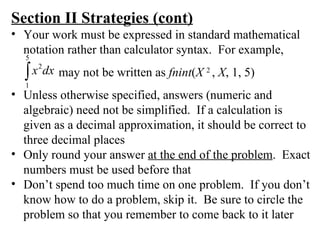
Section II Strategies (cont) Your work must be expressed in standard mathematical notation rather than calculator syntax.  For example,   may not be written as  fnint ( X  2  ,  X , 1, 5) Unless otherwise specified, answers (numeric and algebraic) need not be simplified.  If a calculation is given as a decimal approximation, it should be correct to three decimal places Only round your answer  at the end of the problem .  Exact numbers must be used before that Don’t spend too much time on one problem.  If you don’t know how to do a problem, skip it.  Be sure to circle the problem so that you remember to come back to it later
Things to Remember There is no need to simplify arithmetic.  It won’t make the answer any more correct (even long Riemann sums) Don’t cross out your work unless you  know  you can do better Be sure to label your answers and use correct units If you are worried that your result in part a) is incorrect, use it anyway to finish the problem If you use your calculator, describe it clearly in mathematical terms, not in calculator speak
More Things to Remember Don’t use bad math (“slope of the derivative” or  “6.2368 = 6.237” or “-17.213 = 17.213” Remember, three decimals (more is OK) Don’t write  f  ( x ) = 2(1.5) + 3 when you mean  f  (1.5) = 2(1.5) + 3 Every pronoun needs an antecedent.  Don’t write “it”, “the graph”, “the slope”, or “the derivative”.  Instead of “the slope is…”, write “the slope of  g  is…” When asked to write an integral, start with the limits and any constants of multiplication.  Then you can figure out the integrand Know the difference between increasing and positive.  f  is  increasing  when  f     is  positive
Still More Things to Remember Calculator work will be limited to the four required functionalities: graph a function, solve an equation, derivative at a point, and definite integral.  You won’t be required to do anything else with your calculator and no question will be asked where an additional feature would give an advantage Know the difference between local and absolute extrema Know the difference between the extreme value ( y -coordinate) and the location of the extreme value ( x - and  y -coordinates)
Next class, you will be taking a Derivative Quiz. Now you’re going to get a chance to work on your first sample free response test

Calculus review fr intro

  • 1.
    Section II –Free Response Questions This section of the exam consists of 6 questions in 90 minutes Part A of the free response section (2 questions in 30 minutes) contains some problems or part of problems for which a graphing calculator is required Part B of the free response section (4 questions in 60 minutes) does not allow the use of a calculator During the second portion of the free-response section (Part B), students are permitted to continue work on Part A, but are not permitted to use a calculator during this time All problems are given equal weight, but the parts of a particular problem are not necessarily equal weight
  • 2.
    Calculator Use OnPart A, you are permitted to use your calculator to solve an equation, find the derivative of a function at a point, or calculate the value of a definite integral However, you must clearly indicate the setup of your problem, namely the equation, function, or integral that you are using If you use other built-in features or programs, you must show the mathematical steps necessary to produce your results
  • 3.
    Section II StrategiesRead all directions carefully before starting the problem You should write all work for each part of each problem in the space provided. Write clearly and legibly If you make an error, you may save time by crossing out rather than erasing. Erased and crossed-out work will not be graded Show all your work. You will be graded on correctness and completeness of your methods, as well as the accuracy of your final answers. Correct answers without supporting work will not receive credit Justifications require that you must give a mathematical (non-calculator) reason and that you clearly label functions, graphs, tables, or other objects you use
  • 4.
    Section II Strategies(cont) Your work must be expressed in standard mathematical notation rather than calculator syntax. For example, may not be written as fnint ( X 2 , X , 1, 5) Unless otherwise specified, answers (numeric and algebraic) need not be simplified. If a calculation is given as a decimal approximation, it should be correct to three decimal places Only round your answer at the end of the problem . Exact numbers must be used before that Don’t spend too much time on one problem. If you don’t know how to do a problem, skip it. Be sure to circle the problem so that you remember to come back to it later
  • 5.
    Things to RememberThere is no need to simplify arithmetic. It won’t make the answer any more correct (even long Riemann sums) Don’t cross out your work unless you know you can do better Be sure to label your answers and use correct units If you are worried that your result in part a) is incorrect, use it anyway to finish the problem If you use your calculator, describe it clearly in mathematical terms, not in calculator speak
  • 6.
    More Things toRemember Don’t use bad math (“slope of the derivative” or “6.2368 = 6.237” or “-17.213 = 17.213” Remember, three decimals (more is OK) Don’t write f ( x ) = 2(1.5) + 3 when you mean f (1.5) = 2(1.5) + 3 Every pronoun needs an antecedent. Don’t write “it”, “the graph”, “the slope”, or “the derivative”. Instead of “the slope is…”, write “the slope of g is…” When asked to write an integral, start with the limits and any constants of multiplication. Then you can figure out the integrand Know the difference between increasing and positive. f is increasing when f  is positive
  • 7.
    Still More Thingsto Remember Calculator work will be limited to the four required functionalities: graph a function, solve an equation, derivative at a point, and definite integral. You won’t be required to do anything else with your calculator and no question will be asked where an additional feature would give an advantage Know the difference between local and absolute extrema Know the difference between the extreme value ( y -coordinate) and the location of the extreme value ( x - and y -coordinates)
  • 8.
    Next class, youwill be taking a Derivative Quiz. Now you’re going to get a chance to work on your first sample free response test