Mark Scheme (Results)

January 2012


International GCSE Mathematics
(4MB0) Paper 01
Edexcel and BTEC Qualifications
Edexcel and BTEC qualifications come from Pearson, the world’s leading learning
company. We provide a wide range of qualifications including academic,
vocational, occupational and specific programmes for employers. For further
information, please call our GCE line on 0844 576 0025, our GCSE team on 0844
576 0027, or visit our qualifications website at www.edexcel.com. For information
about our BTEC qualifications, please call 0844 576 0026, or visit our website at
www.btec.co.uk.

If you have any subject specific questions about this specification that require the
help of a subject specialist, you may find our Ask The Expert email service
helpful.

Ask The Expert can be accessed online at the following link:

http://www.edexcel.com/Aboutus/contact-us/


Pearson: helping people progress, everywhere
Our aim is to help everyone progress in their lives through education. We believe in
every kind of learning, for all kinds of people, wherever they are in the world. We’ve
been involved in education for over 150 years, and by working across 70 countries, in
100 languages, we have built an international reputation for raising achievement
through innovation in education. Find out more about how we can help you and your
students at: www.pearson.com/uk


January 2012
Publications Code UG030753
All the material in this publication is copyright
© Pearson Education Ltd 2012
General Marking Guidance
  •   All candidates must receive the same treatment. Examiners must mark the first
      candidate in exactly the same way as they mark the last.
  •   Mark schemes should be applied positively. Candidates must be rewarded for
      what they have shown they can do rather than penalised for omissions.
  •   Examiners should mark according to the mark scheme not according to their
      perception of where the grade boundaries may lie.
  •   There is no ceiling on achievement. All marks on the mark scheme should be
      used appropriately.
  •   All the marks on the mark scheme are designed to be awarded. Examiners
      should always award full marks if deserved, i.e. if the answer matches the mark
      scheme.
      Examiners should also be prepared to award zero marks if the candidate’s
      response is not worthy of credit according to the mark scheme.
  •   Where some judgement is required, mark schemes will provide the principles by
      which marks will be awarded and exemplification may be limited.
  •   When examiners are in doubt regarding the application of the mark scheme to a
      candidate’s response, the team leader must be consulted.
  •   Crossed out work should be marked UNLESS the candidate has replaced it with
      an alternative response.
  •   Types of mark
         o   M marks: method marks
         o   A marks: accuracy marks
         o   B marks: unconditional accuracy marks (independent of M marks)
  •   Abbreviations
         o   cao – correct answer only
         o   ft – follow through
         o   isw – ignore subsequent working
         o   SC - special case
         o   oe – or equivalent (and appropriate)
         o   dep – dependent
         o   indep – independent
         o   eeoo – each error or omission
  •   No working
      If no working is shown then correct answers normally score full marks
      If no working is shown then incorrect (even though nearly correct)   answers
      score no marks.
  •   With working
      If there is a wrong answer indicated on the answer line always check the
      working in the body of the script (and on any diagrams), and award any marks
      appropriate from the mark scheme.
      If it is clear from the working that the “correct” answer has been obtained from
      incorrect working, award 0 marks.
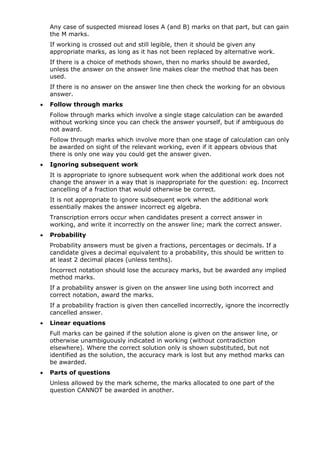
Any case of suspected misread loses A (and B) marks on that part, but can gain
    the M marks.
    If working is crossed out and still legible, then it should be given any
    appropriate marks, as long as it has not been replaced by alternative work.
    If there is a choice of methods shown, then no marks should be awarded,
    unless the answer on the answer line makes clear the method that has been
    used.
    If there is no answer on the answer line then check the working for an obvious
    answer.
•   Follow through marks
    Follow through marks which involve a single stage calculation can be awarded
    without working since you can check the answer yourself, but if ambiguous do
    not award.
    Follow through marks which involve more than one stage of calculation can only
    be awarded on sight of the relevant working, even if it appears obvious that
    there is only one way you could get the answer given.
•   Ignoring subsequent work
    It is appropriate to ignore subsequent work when the additional work does not
    change the answer in a way that is inappropriate for the question: eg. Incorrect
    cancelling of a fraction that would otherwise be correct.
    It is not appropriate to ignore subsequent work when the additional work
    essentially makes the answer incorrect eg algebra.
    Transcription errors occur when candidates present a correct answer in
    working, and write it incorrectly on the answer line; mark the correct answer.
•   Probability
    Probability answers must be given a fractions, percentages or decimals. If a
    candidate gives a decimal equivalent to a probability, this should be written to
    at least 2 decimal places (unless tenths).
    Incorrect notation should lose the accuracy marks, but be awarded any implied
    method marks.
    If a probability answer is given on the answer line using both incorrect and
    correct notation, award the marks.
    If a probability fraction is given then cancelled incorrectly, ignore the incorrectly
    cancelled answer.
•   Linear equations
    Full marks can be gained if the solution alone is given on the answer line, or
    otherwise unambiguously indicated in working (without contradiction
    elsewhere). Where the correct solution only is shown substituted, but not
    identified as the solution, the accuracy mark is lost but any method marks can
    be awarded.
•   Parts of questions
    Unless allowed by the mark scheme, the marks allocated to one part of the
    question CANNOT be awarded in another.
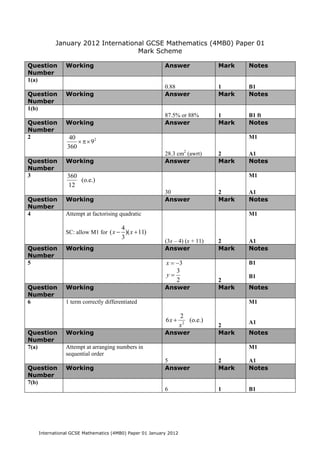
January 2012 International GCSE Mathematics (4MB0) Paper 01
                                 Mark Scheme

Question     Working                                   Answer               Mark   Notes
Number
1(a)
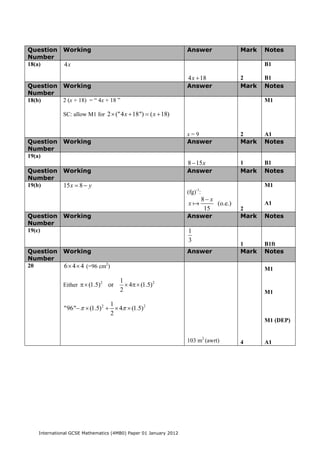
                                                       0.88                 1      B1
Question     Working                                   Answer               Mark   Notes
Number
1(b)
                                                       87.5% or 88%         1      B1 ft
Question     Working                                   Answer               Mark   Notes
Number
2              40                                                                  M1
                  × π× 92
              360
                                                       28.3 cm2 (awrt)      2      A1
Question     Working                                   Answer               Mark   Notes
Number
3             360                                                                  M1
                  (o.e.)
              12
                                                       30                   2      A1
Question     Working                                   Answer               Mark   Notes
Number
4            Attempt at factorising quadratic                                      M1

                                     4
             SC: allow M1 for ( x − )( x + 11)
                                     3
                                                       (3x – 4) (x + 11)    2      A1
Question     Working                                   Answer               Mark   Notes
Number
5                                                      x = −3                      B1
                                                           3
                                                       y=                          B1
                                                           2                2
Question     Working                                   Answer               Mark   Notes
Number
6            1 term correctly differentiated                                       M1

                                                                2
                                                       6x +        (o.e.)          A1
                                                                x2          2
Question     Working                                   Answer               Mark   Notes
Number
7(a)         Attempt at arranging numbers in                                       M1
             sequential order
                                                       5                    2      A1
Question     Working                                   Answer               Mark   Notes
Number
7(b)
                                                       6                    1      B1


  International GCSE Mathematics (4MB0) Paper 01 January 2012
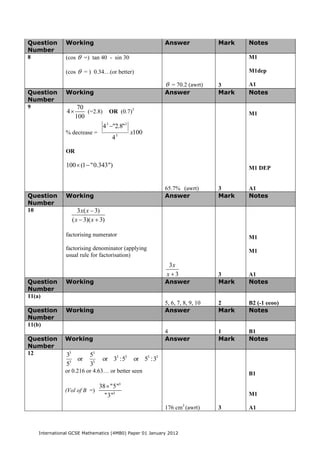
Question     Working                                       Answer              Mark   Notes
Number
8            (cos θ =) tan 40 - sin 30                                                M1

             (cos θ = ) 0.34…(or better)                                              M1dep

                                                           θ = 70.2 (awrt)     3      A1
Question     Working                                       Answer              Mark   Notes
Number
9                  70
             4×       (=2.8)       OR (0.7)3                                          M1
                  100
                               4 3 −"2.8"3
             % decrease =                    x100
                                    43

             OR

             100 × (1 − "0.343")                                                      M1 DEP


                                                           65.7% (awrt)        3      A1
Question     Working                                       Answer              Mark   Notes
Number
10                 3 x( x − 3)
                ( x − 3)( x + 3)

             factorising numerator                                                    M1
             factorising denominator (applying                                        M1
             usual rule for factorisation)
                                                            3x
                                                           x+3                 3      A1
Question     Working                                       Answer              Mark   Notes
Number
11(a)
                                                           5, 6, 7, 8, 9, 10   2      B2 (-1 eeoo)
Question     Working                                       Answer              Mark   Notes
Number
11(b)
                                                           4                   1      B1
Question     Working                                       Answer              Mark   Notes
Number
12           33         53
                or             or 33 : 53     or 53 : 33
             53         33
             or 0.216 or 4.63… or better seen                                         B1

                             38 × "5"3
             (Vol of B =)
                               "3"3                                                   M1

                                                           176 cm3 (awrt)      3      A1


  International GCSE Mathematics (4MB0) Paper 01 January 2012
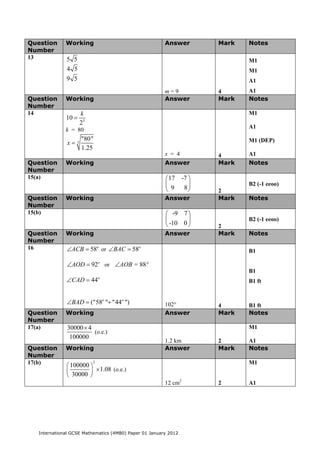
Question     Working                                   Answer          Mark   Notes
Number
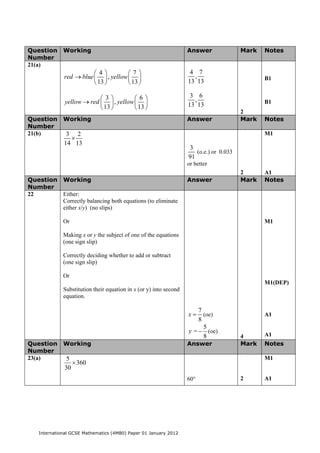
13           5 5                                                              M1
             4 5                                                              M1
             9 5                                                              A1
                                                       m=9             4      A1
Question     Working                                   Answer          Mark   Notes
Number
14                     k                                                      M1
             10 =
                       23
                                                                              A1
             k = 80
                       "80"                                                   M1 (DEP)
              x=   3
                       1.25
                                                       x = 4           4      A1
Question     Working                                   Answer          Mark   Notes
Number
15(a)                                                  ⎛17      -7 ⎞
                                                       ⎜           ⎟          B2 (-1 eeoo)
                                                       ⎝ 9       8⎠    2
Question     Working                                   Answer          Mark   Notes
Number
15(b)                                                  ⎛ -9 7 ⎞
                                                       ⎜       ⎟              B2 (-1 eeoo)
                                                       ⎝ -10 0 ⎠       2
Question     Working                                   Answer          Mark   Notes
Number
16           ∠ACB = 58o or ∠BAC = 58o                                         B1

             ∠AOD = 92o or ∠AOB = 88 o
                                                                              B1
             ∠CAD = 44          o
                                                                              B1 ft


             ∠BAD = ("58o "+ "44o ")                   102°            4      B1 ft
Question     Working                                   Answer          Mark   Notes
Number
17(a)         30000 × 4                                                       M1
                        (o.e.)
               100000
                                                       1.2 km          2      A1
Question     Working                                   Answer          Mark   Notes
Number
17(b)                       2                                                 M1
             ⎛ 100000 ⎞
             ⎜        ⎟ ×1.08 (o.e.)
             ⎝ 30000 ⎠
                                                       12 cm2          2      A1


  International GCSE Mathematics (4MB0) Paper 01 January 2012
Question Working                                                 Answer                 Mark   Notes
Number
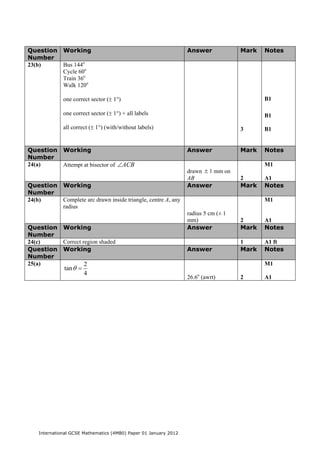
18(a)    4x                                                                                    B1

                                                                 4 x + 18               2      B1
Question Working                                                 Answer                 Mark   Notes
Number
18(b)    2 (x + 18) = “ 4x + 18 ”                                                              M1

             SC: allow M1 for 2 × ("4 x + 18") = ( x + 18)


                                                                 x=9                    2      A1
Question Working                                                 Answer                 Mark   Notes
Number
19(a)
                                                                 8 − 15x                1      B1
Question Working                                                 Answer                 Mark   Notes
Number
19(b)    15 x = 8 − y                                                                          M1
                                                                     -1
                                                                 (fg) :
                                                                          8− x
                                                                 x             (o.e.)          A1
                                                                           15           2
Question Working                                                 Answer                 Mark   Notes
Number
19(c)                                                            1
                                                                 3
                                                                                        1      B1ft
Question Working                                                 Answer                 Mark   Notes
Number
20       6 × 4 × 4 (=96 cm2)                                                                   M1

                                     1
             Either π× (1.5) 2 or      × 4π× (1.5) 2
                                     2                                                         M1

                                1
             "96"− π × (1.5) 2 + × 4π × (1.5) 2
                                2
                                                                                               M1 (DEP)


                                                                 103 m2 (awrt)          4      A1


   International GCSE Mathematics (4MB0) Paper 01 January 2012
Question Working                                                    Answer               Mark   Notes
Number
21(a)
                         ⎛4⎞          ⎛7⎞                            4 7
              red → blue ⎜ ⎟ , yellow ⎜ ⎟                             ,                         B1
                         ⎝ 13 ⎠       ⎝ 13 ⎠                        13 13

                            ⎛3⎞          ⎛6⎞                         3 6
               yellow → red ⎜ ⎟ , yellow ⎜ ⎟                          ,                         B1
                            ⎝ 13 ⎠       ⎝ 13 ⎠                     13 13
                                                                                         2
Question Working                                                    Answer               Mark   Notes
Number
21(b)    3 2                                                                                    M1
                   ×
              14 13
                                                                    3
                                                                       (o.e.) or 0.033
                                                                    91
                                                                    or better
                                                                                         2      A1
Question Working                                                    Answer               Mark   Notes
Number
22       Either:
         Correctly balancing both equations (to eliminate
         either x/y) (no slips)

              Or                                                                                M1

              Making x or y the subject of one of the equations
              (one sign slip)

              Correctly deciding whether to add or subtract
              (one sign slip)

              Or
                                                                                                M1(DEP)
              Substitution their equation in x (or y) into second
              equation.

                                                                        7
                                                                    x=    (oe)                  A1
                                                                        8
                                                                          5
                                                                    y = − (oe)
                                                                          8              4      A1
Question Working                                                    Answer               Mark   Notes
Number
23(a)    5                                                                                      M1
                   × 360
              30
                                                                    60°                  2      A1


    International GCSE Mathematics (4MB0) Paper 01 January 2012
Question Working                                                  Answer             Mark   Notes
Number
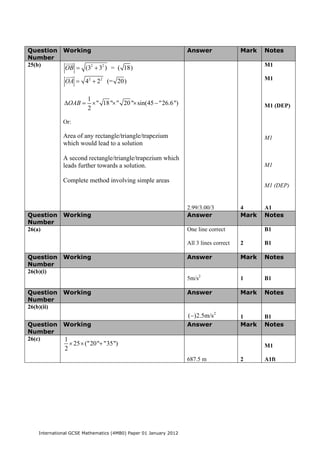
23(b)    Bus 144o
         Cycle 60o
         Train 36o
         Walk 120o

              one correct sector (± 1°)                                                     B1

              one correct sector (± 1°) + all labels                                        B1
              all correct (± 1°) (with/without labels)                               3      B1


Question Working                                                  Answer             Mark   Notes
Number
24(a)    Attempt at bisector of ∠ACB                                                        M1
                                                                  drawn ± 1 mm on
                                                                  AB                 2      A1
Question Working                                                  Answer             Mark   Notes
Number
24(b)    Complete arc drawn inside triangle, centre A, any                                  M1
         radius
                                                                  radius 5 cm (± 1
                                                                  mm)                2      A1
Question Working                                                  Answer             Mark   Notes
Number
24(c)    Correct region shaded                                                       1      A1 ft
Question Working                                                  Answer             Mark   Notes
Number
25(a)             2                                                                         M1
              tan θ =
                        4
                                                                  26.6o (awrt)       2      A1


    International GCSE Mathematics (4MB0) Paper 01 January 2012
Question Working                                                Answer                Mark   Notes
Number
25(b)                                                                                        M1
             OB = (3 + 32 ) = ( 18)
                2


             OA = 42 + 22 (= 20)                                                             M1


                  1
            ∆OAB = × " 18 "× " 20 "× sin(45 − "26.6")                                        M1 (DEP)
                  2

            Or:

            Area of any rectangle/triangle/trapezium                                         M1
            which would lead to a solution

            A second rectangle/triangle/trapezium which
            leads further towards a solution.                                                M1

            Complete method involving simple areas
                                                                                             M1 (DEP)


                                                                2.99/3.00/3           4      A1
Question Working                                                Answer                Mark   Notes
Number
26(a)                                                           One line correct             B1

                                                                All 3 lines correct   2      B1

Question Working                                                Answer                Mark   Notes
Number
26(b)(i)
                                                                5m/s2                 1      B1

Question Working                                                Answer                Mark   Notes
Number
26(b)(ii)
                                                                (−)2.5m/s 2           1      B1
Question Working                                                Answer                Mark   Notes
Number
26(c)    1
                × 25 × ("20"+ "35")                                                          M1
            2
                                                                687.5 m               2      A1ft


  International GCSE Mathematics (4MB0) Paper 01 January 2012
Question Working                                                  Answer             Mark   Notes
Number
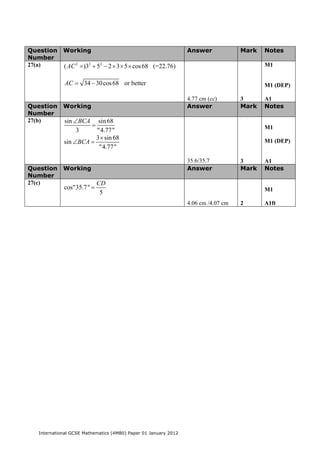
27(a)    ( AC 2 =)32 + 52 − 2 × 3 × 5 × cos 68 (=22.76)                                     M1


              AC = 34 − 30 cos 68 or better                                                 M1 (DEP)

                                                                  4.77 cm (cc)       3      A1
Question Working                                                  Answer             Mark   Notes
Number
27(b)    sin ∠BCA         sin 68
                          =                                                                 M1
                   3     "4.77"
                         3 × sin 68
              sin ∠BCA =                                                                    M1 (DEP)
                          "4.77"

                                                                  35.6/35.7          3      A1
Question Working                                                  Answer             Mark   Notes
Number
27(c)            CD
              cos"35.7" =                                                                   M1
                              5
                                                                  4.06 cm /4.07 cm   2      A1ft


    International GCSE Mathematics (4MB0) Paper 01 January 2012
Further copies of this publication are available from
Edexcel Publications, Adamsway, Mansfield, Notts, NG18 4FN


Telephone 01623 467467
Fax 01623 450481
Email publication.orders@edexcel.com
Order Code xxxxxxxx June 2011


For more information on Edexcel qualifications, please visit
www.edexcel.com/quals


Pearson Education Limited. Registered company number 872828
with its registered office at Edinburgh Gate, Harlow, Essex CM20 2JE

Igcse1.jan12 ms maths b

  • 1.
    Mark Scheme (Results) January2012 International GCSE Mathematics (4MB0) Paper 01
  • 2.
    Edexcel and BTECQualifications Edexcel and BTEC qualifications come from Pearson, the world’s leading learning company. We provide a wide range of qualifications including academic, vocational, occupational and specific programmes for employers. For further information, please call our GCE line on 0844 576 0025, our GCSE team on 0844 576 0027, or visit our qualifications website at www.edexcel.com. For information about our BTEC qualifications, please call 0844 576 0026, or visit our website at www.btec.co.uk. If you have any subject specific questions about this specification that require the help of a subject specialist, you may find our Ask The Expert email service helpful. Ask The Expert can be accessed online at the following link: http://www.edexcel.com/Aboutus/contact-us/ Pearson: helping people progress, everywhere Our aim is to help everyone progress in their lives through education. We believe in every kind of learning, for all kinds of people, wherever they are in the world. We’ve been involved in education for over 150 years, and by working across 70 countries, in 100 languages, we have built an international reputation for raising achievement through innovation in education. Find out more about how we can help you and your students at: www.pearson.com/uk January 2012 Publications Code UG030753 All the material in this publication is copyright © Pearson Education Ltd 2012
  • 3.
    General Marking Guidance • All candidates must receive the same treatment. Examiners must mark the first candidate in exactly the same way as they mark the last. • Mark schemes should be applied positively. Candidates must be rewarded for what they have shown they can do rather than penalised for omissions. • Examiners should mark according to the mark scheme not according to their perception of where the grade boundaries may lie. • There is no ceiling on achievement. All marks on the mark scheme should be used appropriately. • All the marks on the mark scheme are designed to be awarded. Examiners should always award full marks if deserved, i.e. if the answer matches the mark scheme. Examiners should also be prepared to award zero marks if the candidate’s response is not worthy of credit according to the mark scheme. • Where some judgement is required, mark schemes will provide the principles by which marks will be awarded and exemplification may be limited. • When examiners are in doubt regarding the application of the mark scheme to a candidate’s response, the team leader must be consulted. • Crossed out work should be marked UNLESS the candidate has replaced it with an alternative response. • Types of mark o M marks: method marks o A marks: accuracy marks o B marks: unconditional accuracy marks (independent of M marks) • Abbreviations o cao – correct answer only o ft – follow through o isw – ignore subsequent working o SC - special case o oe – or equivalent (and appropriate) o dep – dependent o indep – independent o eeoo – each error or omission • No working If no working is shown then correct answers normally score full marks If no working is shown then incorrect (even though nearly correct) answers score no marks. • With working If there is a wrong answer indicated on the answer line always check the working in the body of the script (and on any diagrams), and award any marks appropriate from the mark scheme. If it is clear from the working that the “correct” answer has been obtained from incorrect working, award 0 marks.
  • 4.
    Any case ofsuspected misread loses A (and B) marks on that part, but can gain the M marks. If working is crossed out and still legible, then it should be given any appropriate marks, as long as it has not been replaced by alternative work. If there is a choice of methods shown, then no marks should be awarded, unless the answer on the answer line makes clear the method that has been used. If there is no answer on the answer line then check the working for an obvious answer. • Follow through marks Follow through marks which involve a single stage calculation can be awarded without working since you can check the answer yourself, but if ambiguous do not award. Follow through marks which involve more than one stage of calculation can only be awarded on sight of the relevant working, even if it appears obvious that there is only one way you could get the answer given. • Ignoring subsequent work It is appropriate to ignore subsequent work when the additional work does not change the answer in a way that is inappropriate for the question: eg. Incorrect cancelling of a fraction that would otherwise be correct. It is not appropriate to ignore subsequent work when the additional work essentially makes the answer incorrect eg algebra. Transcription errors occur when candidates present a correct answer in working, and write it incorrectly on the answer line; mark the correct answer. • Probability Probability answers must be given a fractions, percentages or decimals. If a candidate gives a decimal equivalent to a probability, this should be written to at least 2 decimal places (unless tenths). Incorrect notation should lose the accuracy marks, but be awarded any implied method marks. If a probability answer is given on the answer line using both incorrect and correct notation, award the marks. If a probability fraction is given then cancelled incorrectly, ignore the incorrectly cancelled answer. • Linear equations Full marks can be gained if the solution alone is given on the answer line, or otherwise unambiguously indicated in working (without contradiction elsewhere). Where the correct solution only is shown substituted, but not identified as the solution, the accuracy mark is lost but any method marks can be awarded. • Parts of questions Unless allowed by the mark scheme, the marks allocated to one part of the question CANNOT be awarded in another.
  • 5.
    January 2012 InternationalGCSE Mathematics (4MB0) Paper 01 Mark Scheme Question Working Answer Mark Notes Number 1(a) 0.88 1 B1 Question Working Answer Mark Notes Number 1(b) 87.5% or 88% 1 B1 ft Question Working Answer Mark Notes Number 2 40 M1 × π× 92 360 28.3 cm2 (awrt) 2 A1 Question Working Answer Mark Notes Number 3 360 M1 (o.e.) 12 30 2 A1 Question Working Answer Mark Notes Number 4 Attempt at factorising quadratic M1 4 SC: allow M1 for ( x − )( x + 11) 3 (3x – 4) (x + 11) 2 A1 Question Working Answer Mark Notes Number 5 x = −3 B1 3 y= B1 2 2 Question Working Answer Mark Notes Number 6 1 term correctly differentiated M1 2 6x + (o.e.) A1 x2 2 Question Working Answer Mark Notes Number 7(a) Attempt at arranging numbers in M1 sequential order 5 2 A1 Question Working Answer Mark Notes Number 7(b) 6 1 B1 International GCSE Mathematics (4MB0) Paper 01 January 2012
  • 6.
    Question Working Answer Mark Notes Number 8 (cos θ =) tan 40 - sin 30 M1 (cos θ = ) 0.34…(or better) M1dep θ = 70.2 (awrt) 3 A1 Question Working Answer Mark Notes Number 9 70 4× (=2.8) OR (0.7)3 M1 100 4 3 −"2.8"3 % decrease = x100 43 OR 100 × (1 − "0.343") M1 DEP 65.7% (awrt) 3 A1 Question Working Answer Mark Notes Number 10 3 x( x − 3) ( x − 3)( x + 3) factorising numerator M1 factorising denominator (applying M1 usual rule for factorisation) 3x x+3 3 A1 Question Working Answer Mark Notes Number 11(a) 5, 6, 7, 8, 9, 10 2 B2 (-1 eeoo) Question Working Answer Mark Notes Number 11(b) 4 1 B1 Question Working Answer Mark Notes Number 12 33 53 or or 33 : 53 or 53 : 33 53 33 or 0.216 or 4.63… or better seen B1 38 × "5"3 (Vol of B =) "3"3 M1 176 cm3 (awrt) 3 A1 International GCSE Mathematics (4MB0) Paper 01 January 2012
  • 7.
    Question Working Answer Mark Notes Number 13 5 5 M1 4 5 M1 9 5 A1 m=9 4 A1 Question Working Answer Mark Notes Number 14 k M1 10 = 23 A1 k = 80 "80" M1 (DEP) x= 3 1.25 x = 4 4 A1 Question Working Answer Mark Notes Number 15(a) ⎛17 -7 ⎞ ⎜ ⎟ B2 (-1 eeoo) ⎝ 9 8⎠ 2 Question Working Answer Mark Notes Number 15(b) ⎛ -9 7 ⎞ ⎜ ⎟ B2 (-1 eeoo) ⎝ -10 0 ⎠ 2 Question Working Answer Mark Notes Number 16 ∠ACB = 58o or ∠BAC = 58o B1 ∠AOD = 92o or ∠AOB = 88 o B1 ∠CAD = 44 o B1 ft ∠BAD = ("58o "+ "44o ") 102° 4 B1 ft Question Working Answer Mark Notes Number 17(a) 30000 × 4 M1 (o.e.) 100000 1.2 km 2 A1 Question Working Answer Mark Notes Number 17(b) 2 M1 ⎛ 100000 ⎞ ⎜ ⎟ ×1.08 (o.e.) ⎝ 30000 ⎠ 12 cm2 2 A1 International GCSE Mathematics (4MB0) Paper 01 January 2012
  • 8.
    Question Working Answer Mark Notes Number 18(a) 4x B1 4 x + 18 2 B1 Question Working Answer Mark Notes Number 18(b) 2 (x + 18) = “ 4x + 18 ” M1 SC: allow M1 for 2 × ("4 x + 18") = ( x + 18) x=9 2 A1 Question Working Answer Mark Notes Number 19(a) 8 − 15x 1 B1 Question Working Answer Mark Notes Number 19(b) 15 x = 8 − y M1 -1 (fg) : 8− x x (o.e.) A1 15 2 Question Working Answer Mark Notes Number 19(c) 1 3 1 B1ft Question Working Answer Mark Notes Number 20 6 × 4 × 4 (=96 cm2) M1 1 Either π× (1.5) 2 or × 4π× (1.5) 2 2 M1 1 "96"− π × (1.5) 2 + × 4π × (1.5) 2 2 M1 (DEP) 103 m2 (awrt) 4 A1 International GCSE Mathematics (4MB0) Paper 01 January 2012
  • 9.
    Question Working Answer Mark Notes Number 21(a) ⎛4⎞ ⎛7⎞ 4 7 red → blue ⎜ ⎟ , yellow ⎜ ⎟ , B1 ⎝ 13 ⎠ ⎝ 13 ⎠ 13 13 ⎛3⎞ ⎛6⎞ 3 6 yellow → red ⎜ ⎟ , yellow ⎜ ⎟ , B1 ⎝ 13 ⎠ ⎝ 13 ⎠ 13 13 2 Question Working Answer Mark Notes Number 21(b) 3 2 M1 × 14 13 3 (o.e.) or 0.033 91 or better 2 A1 Question Working Answer Mark Notes Number 22 Either: Correctly balancing both equations (to eliminate either x/y) (no slips) Or M1 Making x or y the subject of one of the equations (one sign slip) Correctly deciding whether to add or subtract (one sign slip) Or M1(DEP) Substitution their equation in x (or y) into second equation. 7 x= (oe) A1 8 5 y = − (oe) 8 4 A1 Question Working Answer Mark Notes Number 23(a) 5 M1 × 360 30 60° 2 A1 International GCSE Mathematics (4MB0) Paper 01 January 2012
  • 10.
    Question Working Answer Mark Notes Number 23(b) Bus 144o Cycle 60o Train 36o Walk 120o one correct sector (± 1°) B1 one correct sector (± 1°) + all labels B1 all correct (± 1°) (with/without labels) 3 B1 Question Working Answer Mark Notes Number 24(a) Attempt at bisector of ∠ACB M1 drawn ± 1 mm on AB 2 A1 Question Working Answer Mark Notes Number 24(b) Complete arc drawn inside triangle, centre A, any M1 radius radius 5 cm (± 1 mm) 2 A1 Question Working Answer Mark Notes Number 24(c) Correct region shaded 1 A1 ft Question Working Answer Mark Notes Number 25(a) 2 M1 tan θ = 4 26.6o (awrt) 2 A1 International GCSE Mathematics (4MB0) Paper 01 January 2012
  • 11.
    Question Working Answer Mark Notes Number 25(b) M1 OB = (3 + 32 ) = ( 18) 2 OA = 42 + 22 (= 20) M1 1 ∆OAB = × " 18 "× " 20 "× sin(45 − "26.6") M1 (DEP) 2 Or: Area of any rectangle/triangle/trapezium M1 which would lead to a solution A second rectangle/triangle/trapezium which leads further towards a solution. M1 Complete method involving simple areas M1 (DEP) 2.99/3.00/3 4 A1 Question Working Answer Mark Notes Number 26(a) One line correct B1 All 3 lines correct 2 B1 Question Working Answer Mark Notes Number 26(b)(i) 5m/s2 1 B1 Question Working Answer Mark Notes Number 26(b)(ii) (−)2.5m/s 2 1 B1 Question Working Answer Mark Notes Number 26(c) 1 × 25 × ("20"+ "35") M1 2 687.5 m 2 A1ft International GCSE Mathematics (4MB0) Paper 01 January 2012
  • 12.
    Question Working Answer Mark Notes Number 27(a) ( AC 2 =)32 + 52 − 2 × 3 × 5 × cos 68 (=22.76) M1 AC = 34 − 30 cos 68 or better M1 (DEP) 4.77 cm (cc) 3 A1 Question Working Answer Mark Notes Number 27(b) sin ∠BCA sin 68 = M1 3 "4.77" 3 × sin 68 sin ∠BCA = M1 (DEP) "4.77" 35.6/35.7 3 A1 Question Working Answer Mark Notes Number 27(c) CD cos"35.7" = M1 5 4.06 cm /4.07 cm 2 A1ft International GCSE Mathematics (4MB0) Paper 01 January 2012
  • 13.
    Further copies ofthis publication are available from Edexcel Publications, Adamsway, Mansfield, Notts, NG18 4FN Telephone 01623 467467 Fax 01623 450481 Email publication.orders@edexcel.com Order Code xxxxxxxx June 2011 For more information on Edexcel qualifications, please visit www.edexcel.com/quals Pearson Education Limited. Registered company number 872828 with its registered office at Edinburgh Gate, Harlow, Essex CM20 2JE