The HEARTH Act  Norm Suchar July 2010
HEARTH Act Enacted May 20, 2009 Changes HUD’s McKinney-Vento Homeless Assistance programs First significant reauthorization since 1992
Major Changes More Administrative Funding Emphasizes Prevention Rapid Re-Housing Permanent Supportive Housing Focus on Outcomes
Timeline Most changes take effect in the NOFA released in Spring/Summer 2011 Some changes implemented over several years Regulations in mid-2010 Public comment period! Plan to Comment!
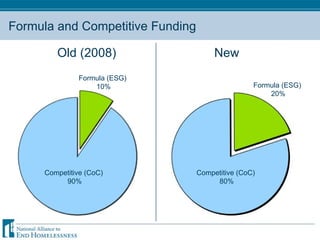
Formula and Competitive Funding Formula (ESG)  10% Competitive (CoC)  90% Competitive (CoC)  80% Formula (ESG)  20% Old (2008) New
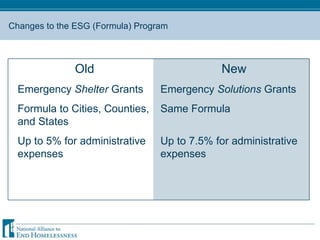
Changes to the ESG (Formula) Program Old Emergency  Shelter  Grants Formula to Cities, Counties, and States Up to 5% for administrative expenses  New Emergency  Solutions  Grants Same Formula Up to 7.5% for administrative expenses
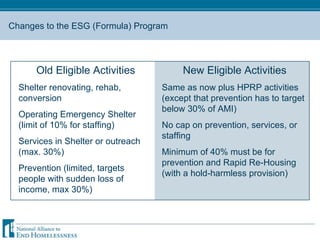
Changes to the ESG (Formula) Program Old Eligible Activities Shelter renovating, rehab, conversion Operating Emergency Shelter (limit of 10% for staffing) Services in Shelter or outreach (max. 30%) Prevention (limited, targets people with sudden loss of income, max 30%) New Eligible Activities Same as now plus HPRP activities (except that prevention has to target below 30% of AMI) No cap on prevention, services, or staffing Minimum of 40% must be for prevention and Rapid Re-Housing (with a hold-harmless provision)
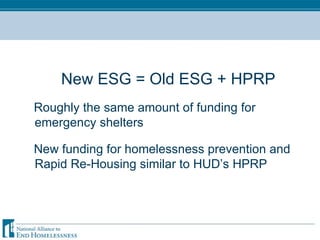
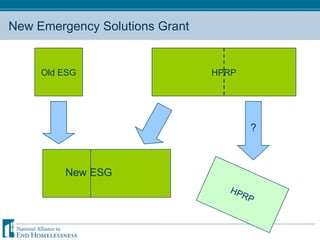
New ESG = Old ESG + HPRP Roughly the same amount of funding for emergency shelters New funding for homelessness prevention and Rapid Re-Housing similar to HUD’s HPRP
New Emergency Solutions Grant New ESG Old ESG HPRP HPRP ?
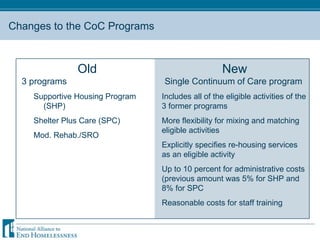
Changes to the CoC Programs Old 3 programs Supportive Housing Program (SHP) Shelter Plus Care (SPC) Mod. Rehab./SRO New Single Continuum of Care program  Includes all of the eligible activities of the 3 former programs More flexibility for mixing and matching eligible activities Explicitly specifies re-housing services as an eligible activity Up to 10 percent for administrative costs (previous amount was 5% for SHP and 8% for SPC Reasonable costs for staff training
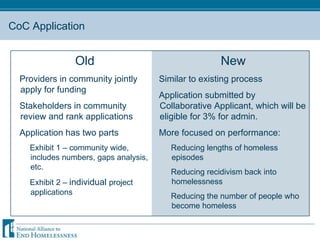
CoC Application Old Providers in community jointly apply for funding Stakeholders in community review and rank applications Application has two parts Exhibit 1  –  community wide, includes numbers, gaps analysis, etc.  Exhibit 2  –   individual  project applications New Similar to existing process Application submitted by Collaborative Applicant, which will be eligible for 3% for admin. More focused on performance: Reducing lengths of homeless episodes Reducing recidivism back into homelessness Reducing the number of people who become homeless
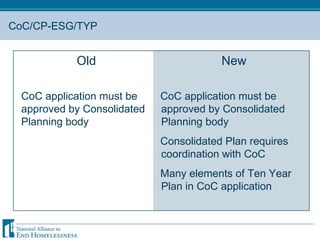
CoC/CP-ESG/TYP Old CoC application must be approved by Consolidated Planning body New CoC application must be approved by Consolidated Planning body Consolidated Plan requires coordination with CoC Many elements of Ten Year Plan in CoC application
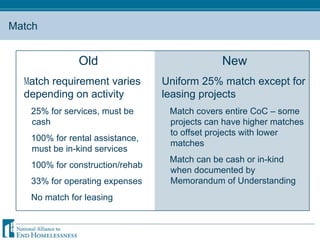
Match Old M atch requirement varies depending on activity 25% for services, must be cash 100% for rental assistance, must be in-kind services 100% for construction/rehab 33% for operating expenses No match for leasing New Uniform 25% match except for leasing projects Match covers entire CoC  –  some projects can have higher matches to offset projects with lower matches Match can be cash or in-kind when documented by Memorandum of Understanding
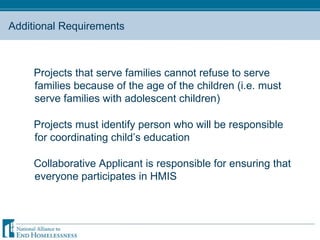
Additional Requirements Projects that serve families cannot refuse to serve families because of the age of the children (i.e. must serve families with adolescent children) Projects must identify person who will be responsible for coordinating child’s education Collaborative Applicant is responsible for ensuring that everyone participates in HMIS
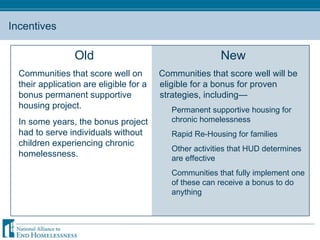
Incentives Old Communities that score well on their application are eligible for a bonus permanent supportive housing project.  In some years, the bonus project had to serve individuals without children experiencing chronic homelessness.  New Communities that score well will be eligible for a bonus for proven strategies, including— Permanent supportive housing for chronic homelessness  Rapid Re-Housing for families Other activities that HUD determines are effective  Communities that fully implement one of these can receive a bonus to do anything
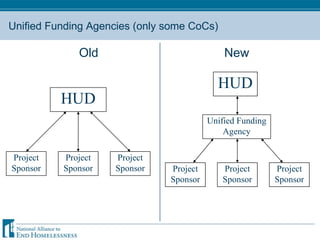
Unified Funding Agencies (only some CoCs) Old New Project Sponsor Project Sponsor Project Sponsor HUD Project Sponsor Project Sponsor Project Sponsor HUD Unified Funding Agency
Unified Funding Agencies Collaborative Applicant could apply to become a UFA or HUD could designate Collaborative Applicant as a UFA UFA responsible for audits and fiscal controls UFA could get up to 3% of a communities award for administrative expenses (on top of the 3% that a collaborative applicant could receive)
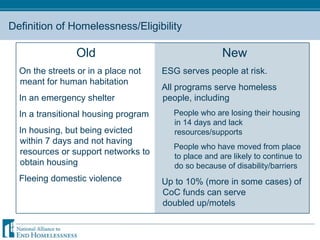
Definition of Homelessness/Eligibility Old On the streets or in a place not meant for human habitation In an emergency shelter In a transitional housing program In housing, but being evicted within 7 days and not having resources or support networks to obtain housing Fleeing domestic violence New ESG serves people at risk.  All programs serve homeless people, including People who are losing their housing in 14 days and lack resources/supports People who have moved from place to place and are likely to continue to do so because of disability/barriers Up to 10% (more in some cases) of CoC funds can serve  doubled up/motels
Other Changes Bigger capital grants Non-competitive renewals for PSH 15-year contracts subject to funding for project-based PSH All permanent housing activities are adjusted for inflation at renewal
Implications More focus on preventing homelessness and reducing lengths of stay in homelessness.  New funding will focus on homelessness prevention, permanent supportive housing, and Rapid Re-Housing.  Bigger role for Collaborative Applicants Need More Funding!
Get Ready! Who will be the Collaborative Applicant? Will the Collaborative Applicant also be the Unified Funding Agency? What systems and program changes are needed to ensure achievement of performance standards?  Now that there are new tools and evidence, what is the right mix of programs in the system?
Get Ready! Who isn’t at the table that should be? How will we integrate Ten Year Plan, Consolidated Plan, CoC Plan? Which HPRP funded programs will continue? Are we ready to take advantage of the bonus?
Contact Info: Norm Suchar National Alliance to End Homelessness [email_address] www.endhomelessness.org

1.2 The HEARTH Act 101 (PPT)

  • 1.
    The HEARTH Act Norm Suchar July 2010
  • 2.
    HEARTH Act EnactedMay 20, 2009 Changes HUD’s McKinney-Vento Homeless Assistance programs First significant reauthorization since 1992
  • 3.
    Major Changes MoreAdministrative Funding Emphasizes Prevention Rapid Re-Housing Permanent Supportive Housing Focus on Outcomes
  • 4.
    Timeline Most changestake effect in the NOFA released in Spring/Summer 2011 Some changes implemented over several years Regulations in mid-2010 Public comment period! Plan to Comment!
  • 5.
    Formula and CompetitiveFunding Formula (ESG) 10% Competitive (CoC) 90% Competitive (CoC) 80% Formula (ESG) 20% Old (2008) New
  • 6.
    Changes to theESG (Formula) Program Old Emergency Shelter Grants Formula to Cities, Counties, and States Up to 5% for administrative expenses New Emergency Solutions Grants Same Formula Up to 7.5% for administrative expenses
  • 7.
    Changes to theESG (Formula) Program Old Eligible Activities Shelter renovating, rehab, conversion Operating Emergency Shelter (limit of 10% for staffing) Services in Shelter or outreach (max. 30%) Prevention (limited, targets people with sudden loss of income, max 30%) New Eligible Activities Same as now plus HPRP activities (except that prevention has to target below 30% of AMI) No cap on prevention, services, or staffing Minimum of 40% must be for prevention and Rapid Re-Housing (with a hold-harmless provision)
  • 8.
    New ESG =Old ESG + HPRP Roughly the same amount of funding for emergency shelters New funding for homelessness prevention and Rapid Re-Housing similar to HUD’s HPRP
  • 9.
    New Emergency SolutionsGrant New ESG Old ESG HPRP HPRP ?
  • 10.
    Changes to theCoC Programs Old 3 programs Supportive Housing Program (SHP) Shelter Plus Care (SPC) Mod. Rehab./SRO New Single Continuum of Care program Includes all of the eligible activities of the 3 former programs More flexibility for mixing and matching eligible activities Explicitly specifies re-housing services as an eligible activity Up to 10 percent for administrative costs (previous amount was 5% for SHP and 8% for SPC Reasonable costs for staff training
  • 11.
    CoC Application OldProviders in community jointly apply for funding Stakeholders in community review and rank applications Application has two parts Exhibit 1 – community wide, includes numbers, gaps analysis, etc. Exhibit 2 – individual project applications New Similar to existing process Application submitted by Collaborative Applicant, which will be eligible for 3% for admin. More focused on performance: Reducing lengths of homeless episodes Reducing recidivism back into homelessness Reducing the number of people who become homeless
  • 12.
    CoC/CP-ESG/TYP Old CoCapplication must be approved by Consolidated Planning body New CoC application must be approved by Consolidated Planning body Consolidated Plan requires coordination with CoC Many elements of Ten Year Plan in CoC application
  • 13.
    Match Old Match requirement varies depending on activity 25% for services, must be cash 100% for rental assistance, must be in-kind services 100% for construction/rehab 33% for operating expenses No match for leasing New Uniform 25% match except for leasing projects Match covers entire CoC – some projects can have higher matches to offset projects with lower matches Match can be cash or in-kind when documented by Memorandum of Understanding
  • 14.
    Additional Requirements Projectsthat serve families cannot refuse to serve families because of the age of the children (i.e. must serve families with adolescent children) Projects must identify person who will be responsible for coordinating child’s education Collaborative Applicant is responsible for ensuring that everyone participates in HMIS
  • 15.
    Incentives Old Communitiesthat score well on their application are eligible for a bonus permanent supportive housing project. In some years, the bonus project had to serve individuals without children experiencing chronic homelessness. New Communities that score well will be eligible for a bonus for proven strategies, including— Permanent supportive housing for chronic homelessness Rapid Re-Housing for families Other activities that HUD determines are effective Communities that fully implement one of these can receive a bonus to do anything
  • 16.
    Unified Funding Agencies(only some CoCs) Old New Project Sponsor Project Sponsor Project Sponsor HUD Project Sponsor Project Sponsor Project Sponsor HUD Unified Funding Agency
  • 17.
    Unified Funding AgenciesCollaborative Applicant could apply to become a UFA or HUD could designate Collaborative Applicant as a UFA UFA responsible for audits and fiscal controls UFA could get up to 3% of a communities award for administrative expenses (on top of the 3% that a collaborative applicant could receive)
  • 18.
    Definition of Homelessness/EligibilityOld On the streets or in a place not meant for human habitation In an emergency shelter In a transitional housing program In housing, but being evicted within 7 days and not having resources or support networks to obtain housing Fleeing domestic violence New ESG serves people at risk. All programs serve homeless people, including People who are losing their housing in 14 days and lack resources/supports People who have moved from place to place and are likely to continue to do so because of disability/barriers Up to 10% (more in some cases) of CoC funds can serve doubled up/motels
  • 19.
    Other Changes Biggercapital grants Non-competitive renewals for PSH 15-year contracts subject to funding for project-based PSH All permanent housing activities are adjusted for inflation at renewal
  • 20.
    Implications More focuson preventing homelessness and reducing lengths of stay in homelessness. New funding will focus on homelessness prevention, permanent supportive housing, and Rapid Re-Housing. Bigger role for Collaborative Applicants Need More Funding!
  • 21.
    Get Ready! Whowill be the Collaborative Applicant? Will the Collaborative Applicant also be the Unified Funding Agency? What systems and program changes are needed to ensure achievement of performance standards? Now that there are new tools and evidence, what is the right mix of programs in the system?
  • 22.
    Get Ready! Whoisn’t at the table that should be? How will we integrate Ten Year Plan, Consolidated Plan, CoC Plan? Which HPRP funded programs will continue? Are we ready to take advantage of the bonus?
  • 23.
    Contact Info: NormSuchar National Alliance to End Homelessness [email_address] www.endhomelessness.org