Paul Howarth
Policy in Practice Welfare reforms and reducing
rent arrears
Westminster Briefing
21 November 2019
Agenda
1. Introduction
2. What is the benefit system for?
3. The cost of welfare
4. The manifestos
5. Universal Credit latest
6. Universal Credit and rent arrears
7. What needs fixing?
8. What of the future?
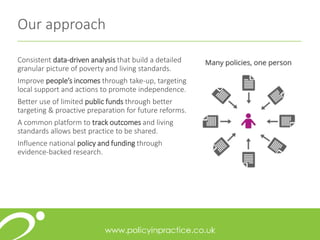
Consistent data-driven analysis that build a detailed
granular picture of poverty and living standards.
Improve people’s incomes through take-up, targeting
local support and actions to promote independence.
Better use of limited public funds through better
targeting & proactive preparation for future reforms.
A common platform to track outcomes and living
standards allows best practice to be shared.
Influence national policy and funding through
evidence-backed research.
Our approach
What is the benefit system for?
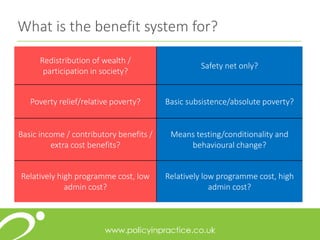
Redistribution of wealth /
participation in society?
Safety net only?
Poverty relief/relative poverty? Basic subsistence/absolute poverty?
Basic income / contributory benefits /
extra cost benefits?
Means testing/conditionality and
behavioural change?
Relatively high programme cost, low
admin cost?
Relatively low programme cost, high
admin cost?
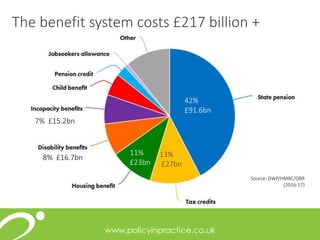
The benefit system costs £217 billion +
42%
£91.6bn
13%
£27bn
11%
£23bn
8% £16.7bn
7% £15.2bn
Source: DWP/HMRC/OBR
(2016-17)
Some cost projections for the future
State Pension
• Spending likely to fall in the short-term reflecting the rising state pension age to 66
– offsets the comparatively generous ‘triple lock’ (the higher of wage growth,
inflation and 2.5%)
• In longer-term spending increases reflect an ageing population
Disability benefits
• expenditure likely to increase - the caseload across DLA/PiP/AA is expected to rise
by 9.7% between 2017-18 and 2023-24
Other welfare benefits
• Spending projected to be relatively flat as a share of GDP over the long term
• But depends on economic cycles and impact of policy decisions
Election manifesto clues
Manifesto not published yet. Not likely to see much change in welfare policies. Will
make much of low taxes and increase in The National Living Wage (£10.50 by 2024, link
to two-thirds of median earnings in 5 years)
Manifesto not published yet. Likely to advocate scrapping Universal Credit and possibly
trialling Universal Basic Income. Will abolish two-child limit and benefit cap. Also
increase National Living Wage (£10 for all aged 16 and over in 2020)
Manifesto published yesterday. Reform Universal Credit (5 week wait to 5 days) scrap
two-child limit, benefit cap and bedroom tax, reform sanctions and work capability
tests, reverse ESA cuts, set a ‘genuine Living Wage’, end fuel poverty by 2025
Most radical policy – Universal Basic Income of £89 a week, £178 a week for
pensioners, unconditional, allowances for children on top (tapered out for those on
high incomes). HB and Carers Allowance paid on top, costed at £82 billion
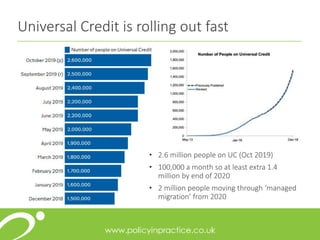
• 2.6 million people on UC (Oct 2019)
• 100,000 a month so at least extra 1.4
million by end of 2020
• 2 million people moving through ‘managed
migration’ from 2020
Universal Credit is rolling out fast
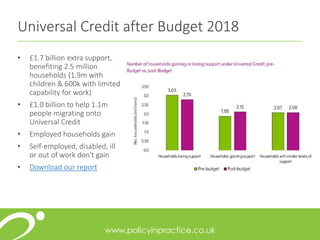
• £1.7 billion extra support,
benefiting 2.5 million
households (1.9m with
children & 600k with limited
capability for work)
• £1.0 billion to help 1.1m
people migrating onto
Universal Credit
• Employed households gain
• Self-employed, disabled, ill
or out of work don't gain
• Download our report
Universal Credit after Budget 2018
Universal Credit and rent arrears
• Most recent studies (e.g. Citizens Advice, NHF) show some link between Universal
Credit and rent arrears, mainly as a result of the five-week wait.
• Smith Institute study (in Croydon and Southwark) shows UC claimants with more
arrears than HB claimants but stabilises over time. Problems re-emerge if there are
repeat claims to UC.
• In June 2019, the then DWP Minister, Alok Sharma, stated that DWP were
investigating the link between Universal Credit and rent arrears, and quoted
research which shows that many claimants (75%) were already in arrears before
their UC claim.
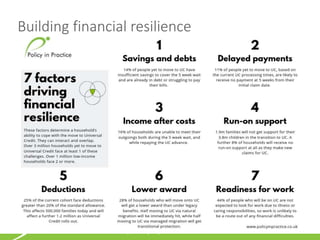
Building financial resilience
What needs fixing?
• 5 week wait – run-ons at the start could have avoided the problem
• Two-child limit – increases child poverty by 10% (266,000) over this year, reduces
financial resilience for those affected
• LHA freeze – current study indicates marked impact on homelessness
• More flexible processes in Universal Credit
• End benefit freeze – announcement now made
What of the future?
• Difficult to predict outcome of the Election
• Universal Credit roll-out likely to continue – very difficult to pause it (though
could pause the managed migration)
• 1.7% uprating (working-age benefits) from April 2020
• Implications of Brexit on individual households
• Pressure to reduce expenditure likely to continue
• But also pressure to end austerity and increase living standards
• Meanwhile, need to concentrate on identifying people who need most help
and preventing them falling into crisis
www.policyinpractice.co.uk
Contact us
Paul Howarth
paul@policyinpractice.co.uk
07854 773164
Jade Alsop
jade@policyinpractice.co.uk
07551 165172
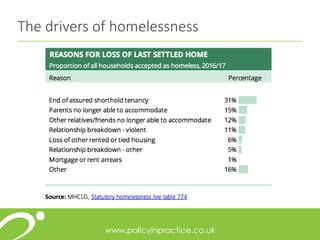
The drivers of homelessness
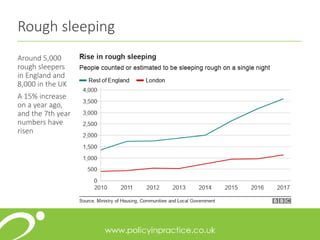
Around 5,000
rough sleepers
in England and
8,000 in the UK
A 15% increase
on a year ago,
and the 7th year
numbers have
risen
Rough sleeping
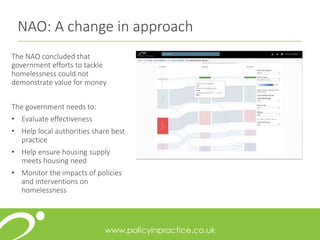
The NAO concluded that
government efforts to tackle
homelessness could not
demonstrate value for money
The government needs to:
• Evaluate effectiveness
• Help local authorities share best
practice
• Help ensure housing supply
meets housing need
• Monitor the impacts of policies
and interventions on
homelessness
NAO: A change in approach

Welfare reforms and reducing rent arrears

  • 1.
    Paul Howarth Policy inPractice Welfare reforms and reducing rent arrears Westminster Briefing 21 November 2019
  • 2.
    Agenda 1. Introduction 2. Whatis the benefit system for? 3. The cost of welfare 4. The manifestos 5. Universal Credit latest 6. Universal Credit and rent arrears 7. What needs fixing? 8. What of the future?
  • 3.
    Consistent data-driven analysisthat build a detailed granular picture of poverty and living standards. Improve people’s incomes through take-up, targeting local support and actions to promote independence. Better use of limited public funds through better targeting & proactive preparation for future reforms. A common platform to track outcomes and living standards allows best practice to be shared. Influence national policy and funding through evidence-backed research. Our approach
  • 4.
    What is thebenefit system for? Redistribution of wealth / participation in society? Safety net only? Poverty relief/relative poverty? Basic subsistence/absolute poverty? Basic income / contributory benefits / extra cost benefits? Means testing/conditionality and behavioural change? Relatively high programme cost, low admin cost? Relatively low programme cost, high admin cost?
  • 5.
    The benefit systemcosts £217 billion + 42% £91.6bn 13% £27bn 11% £23bn 8% £16.7bn 7% £15.2bn Source: DWP/HMRC/OBR (2016-17)
  • 6.
    Some cost projectionsfor the future State Pension • Spending likely to fall in the short-term reflecting the rising state pension age to 66 – offsets the comparatively generous ‘triple lock’ (the higher of wage growth, inflation and 2.5%) • In longer-term spending increases reflect an ageing population Disability benefits • expenditure likely to increase - the caseload across DLA/PiP/AA is expected to rise by 9.7% between 2017-18 and 2023-24 Other welfare benefits • Spending projected to be relatively flat as a share of GDP over the long term • But depends on economic cycles and impact of policy decisions
  • 7.
    Election manifesto clues Manifestonot published yet. Not likely to see much change in welfare policies. Will make much of low taxes and increase in The National Living Wage (£10.50 by 2024, link to two-thirds of median earnings in 5 years) Manifesto not published yet. Likely to advocate scrapping Universal Credit and possibly trialling Universal Basic Income. Will abolish two-child limit and benefit cap. Also increase National Living Wage (£10 for all aged 16 and over in 2020) Manifesto published yesterday. Reform Universal Credit (5 week wait to 5 days) scrap two-child limit, benefit cap and bedroom tax, reform sanctions and work capability tests, reverse ESA cuts, set a ‘genuine Living Wage’, end fuel poverty by 2025 Most radical policy – Universal Basic Income of £89 a week, £178 a week for pensioners, unconditional, allowances for children on top (tapered out for those on high incomes). HB and Carers Allowance paid on top, costed at £82 billion
  • 8.
    • 2.6 millionpeople on UC (Oct 2019) • 100,000 a month so at least extra 1.4 million by end of 2020 • 2 million people moving through ‘managed migration’ from 2020 Universal Credit is rolling out fast
  • 9.
    • £1.7 billionextra support, benefiting 2.5 million households (1.9m with children & 600k with limited capability for work) • £1.0 billion to help 1.1m people migrating onto Universal Credit • Employed households gain • Self-employed, disabled, ill or out of work don't gain • Download our report Universal Credit after Budget 2018
  • 11.
    Universal Credit andrent arrears • Most recent studies (e.g. Citizens Advice, NHF) show some link between Universal Credit and rent arrears, mainly as a result of the five-week wait. • Smith Institute study (in Croydon and Southwark) shows UC claimants with more arrears than HB claimants but stabilises over time. Problems re-emerge if there are repeat claims to UC. • In June 2019, the then DWP Minister, Alok Sharma, stated that DWP were investigating the link between Universal Credit and rent arrears, and quoted research which shows that many claimants (75%) were already in arrears before their UC claim.
  • 12.
  • 13.
    What needs fixing? •5 week wait – run-ons at the start could have avoided the problem • Two-child limit – increases child poverty by 10% (266,000) over this year, reduces financial resilience for those affected • LHA freeze – current study indicates marked impact on homelessness • More flexible processes in Universal Credit • End benefit freeze – announcement now made
  • 14.
    What of thefuture? • Difficult to predict outcome of the Election • Universal Credit roll-out likely to continue – very difficult to pause it (though could pause the managed migration) • 1.7% uprating (working-age benefits) from April 2020 • Implications of Brexit on individual households • Pressure to reduce expenditure likely to continue • But also pressure to end austerity and increase living standards • Meanwhile, need to concentrate on identifying people who need most help and preventing them falling into crisis
  • 15.
    www.policyinpractice.co.uk Contact us Paul Howarth paul@policyinpractice.co.uk 07854773164 Jade Alsop jade@policyinpractice.co.uk 07551 165172
  • 16.
    The drivers ofhomelessness
  • 17.
    Around 5,000 rough sleepers inEngland and 8,000 in the UK A 15% increase on a year ago, and the 7th year numbers have risen Rough sleeping
  • 18.
    The NAO concludedthat government efforts to tackle homelessness could not demonstrate value for money The government needs to: • Evaluate effectiveness • Help local authorities share best practice • Help ensure housing supply meets housing need • Monitor the impacts of policies and interventions on homelessness NAO: A change in approach

Editor's Notes

  • #13 We did a piece of work that outlined the 7 key factors driving financial resilience But actually
  • #19 PREVENTION BETTER THAN CURE- and the way in which we have supported councils with this is through a data led approach BACKED UP BY NAO NATIONAL AUDIT OFFICE = PREVENTION BETTER THAN CURE- PREDICTIVE ANALYTICS