NAEH CONFERENCE SUZANNE WAGNER HOUSING INNOVATIONS Data and Performance Measures
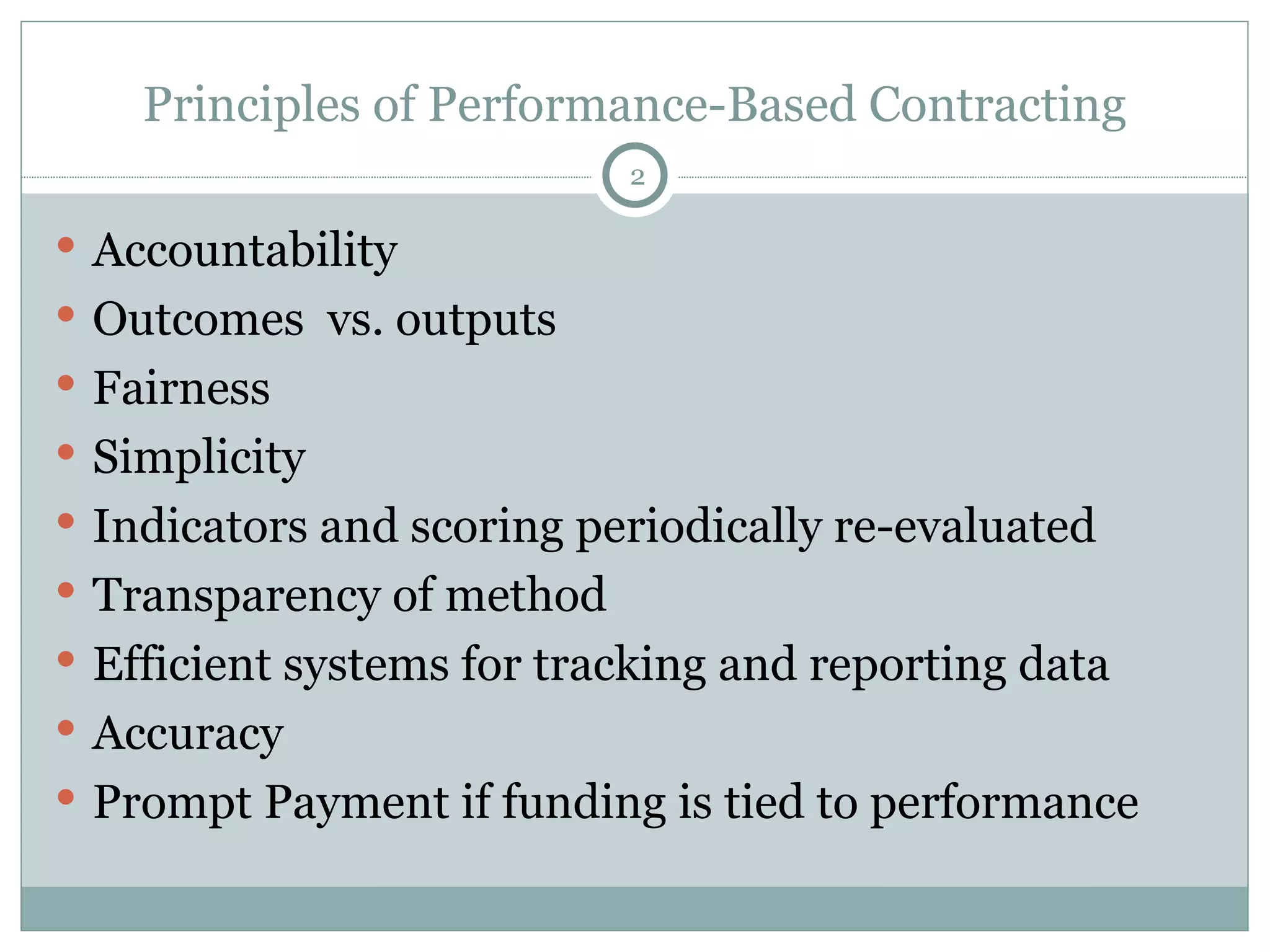
Principles of Performance-Based Contracting Accountability  Outcomes  vs. outputs Fairness  Simplicity  Indicators and scoring periodically re-evaluated Transparency of method Efficient systems for tracking and reporting data Accuracy Prompt Payment if funding is tied to performance
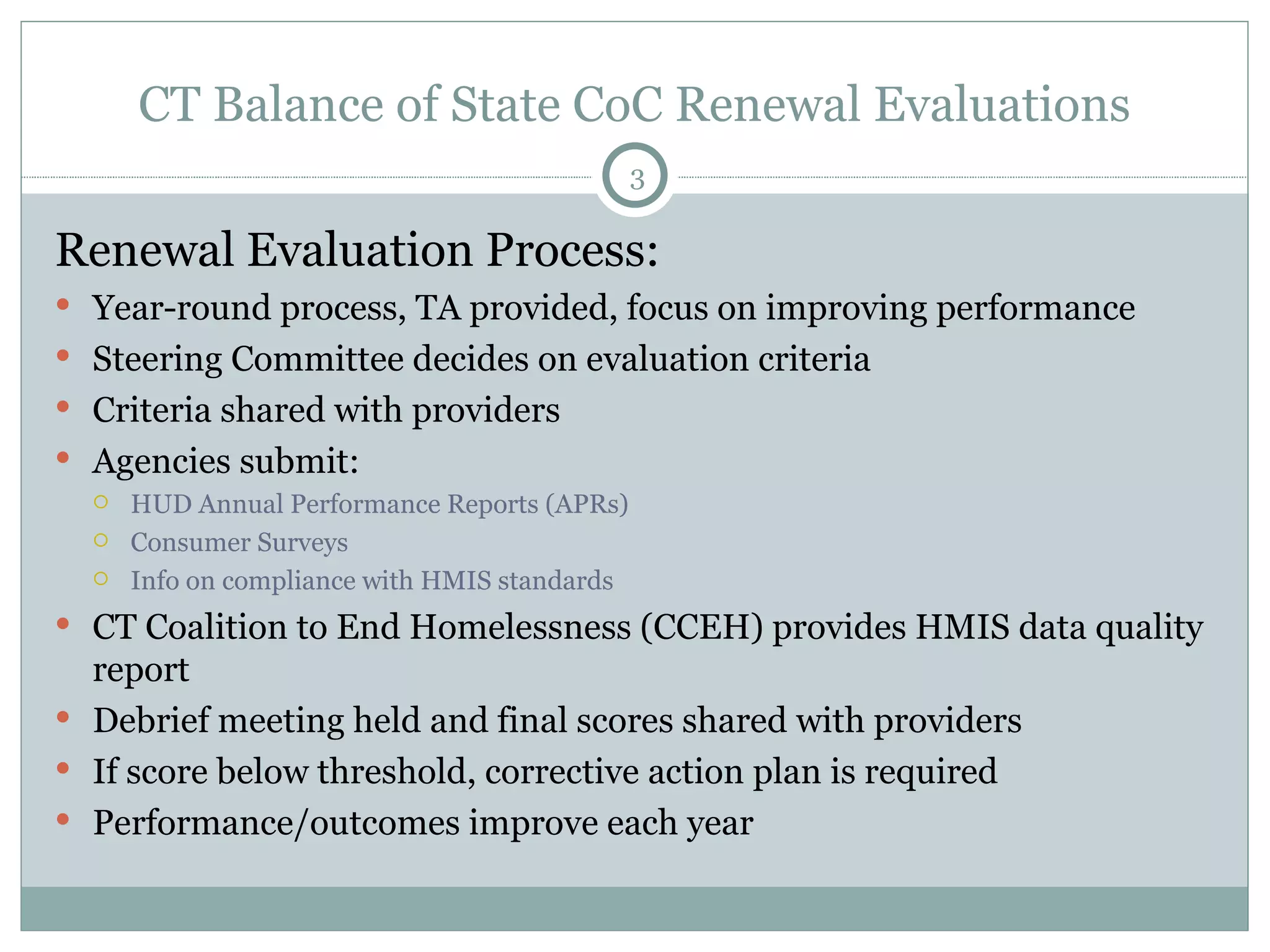
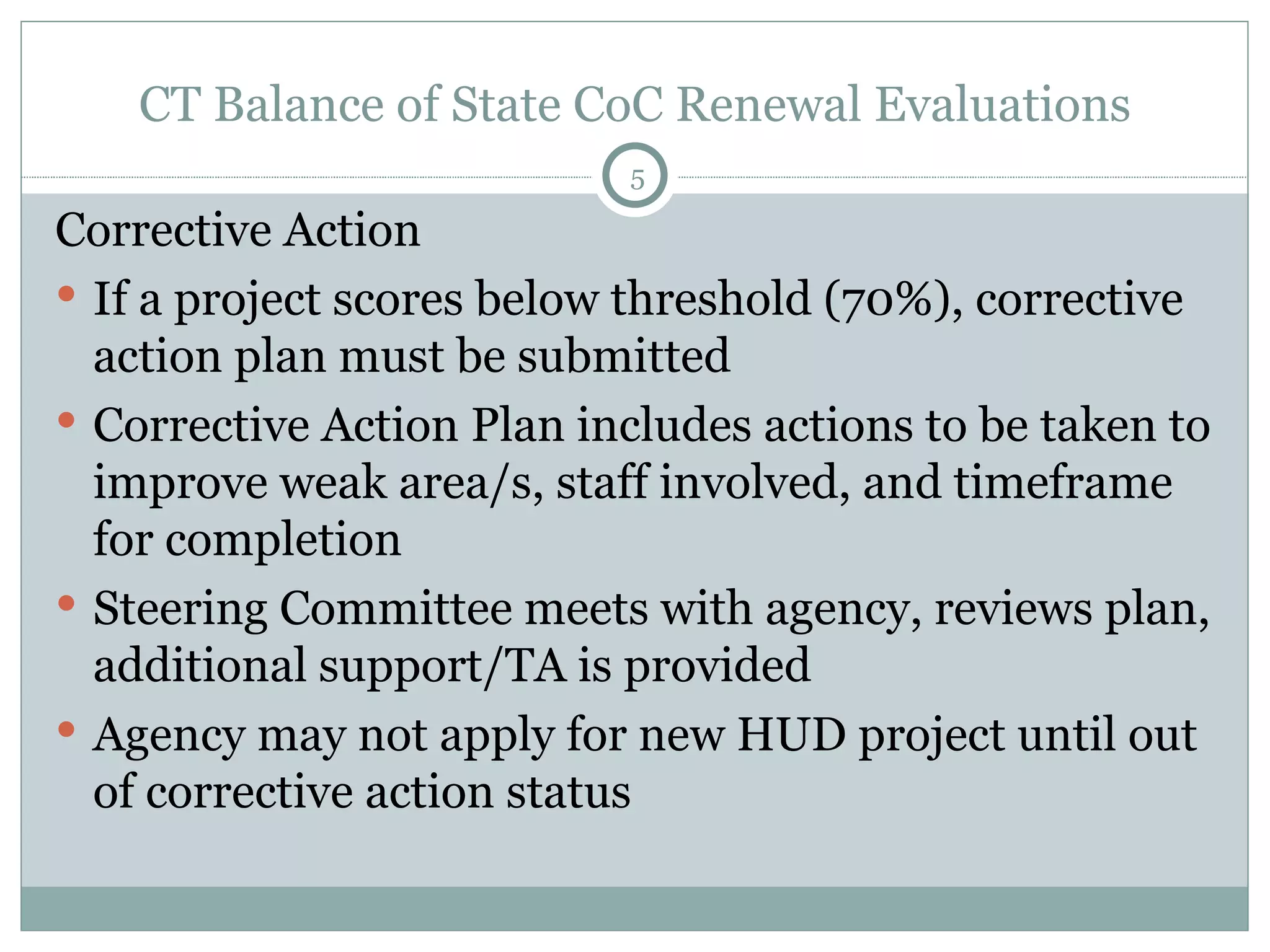
CT Balance of State CoC Renewal Evaluations Renewal Evaluation Process: Year-round process, TA provided, focus on improving performance Steering Committee decides on evaluation criteria Criteria shared with providers Agencies submit: HUD Annual Performance Reports (APRs) Consumer Surveys Info on compliance with HMIS standards CT Coalition to End Homelessness (CCEH) provides HMIS data quality report Debrief meeting held and final scores shared with providers  If score below threshold, corrective action plan is required Performance/outcomes improve each year
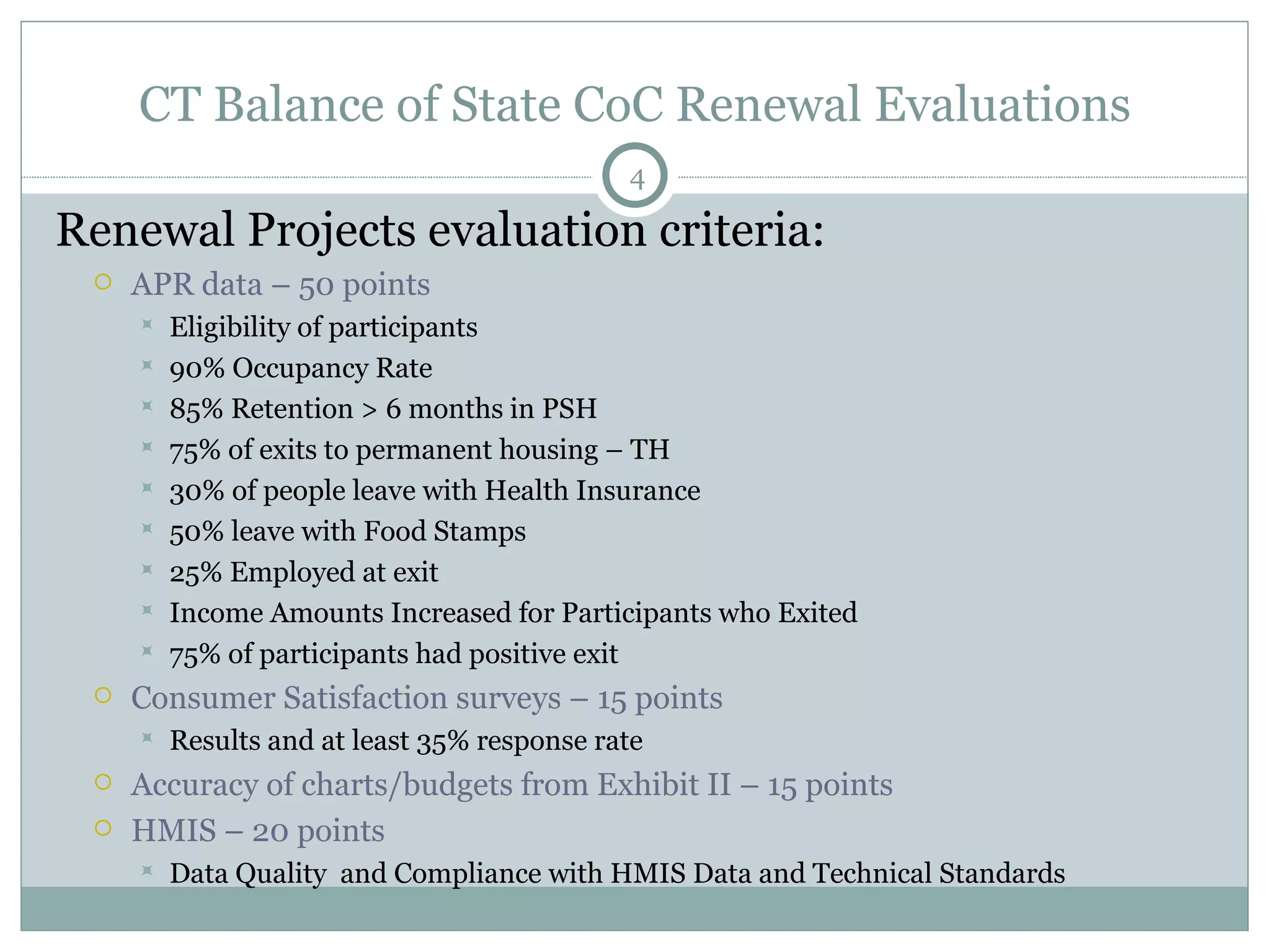
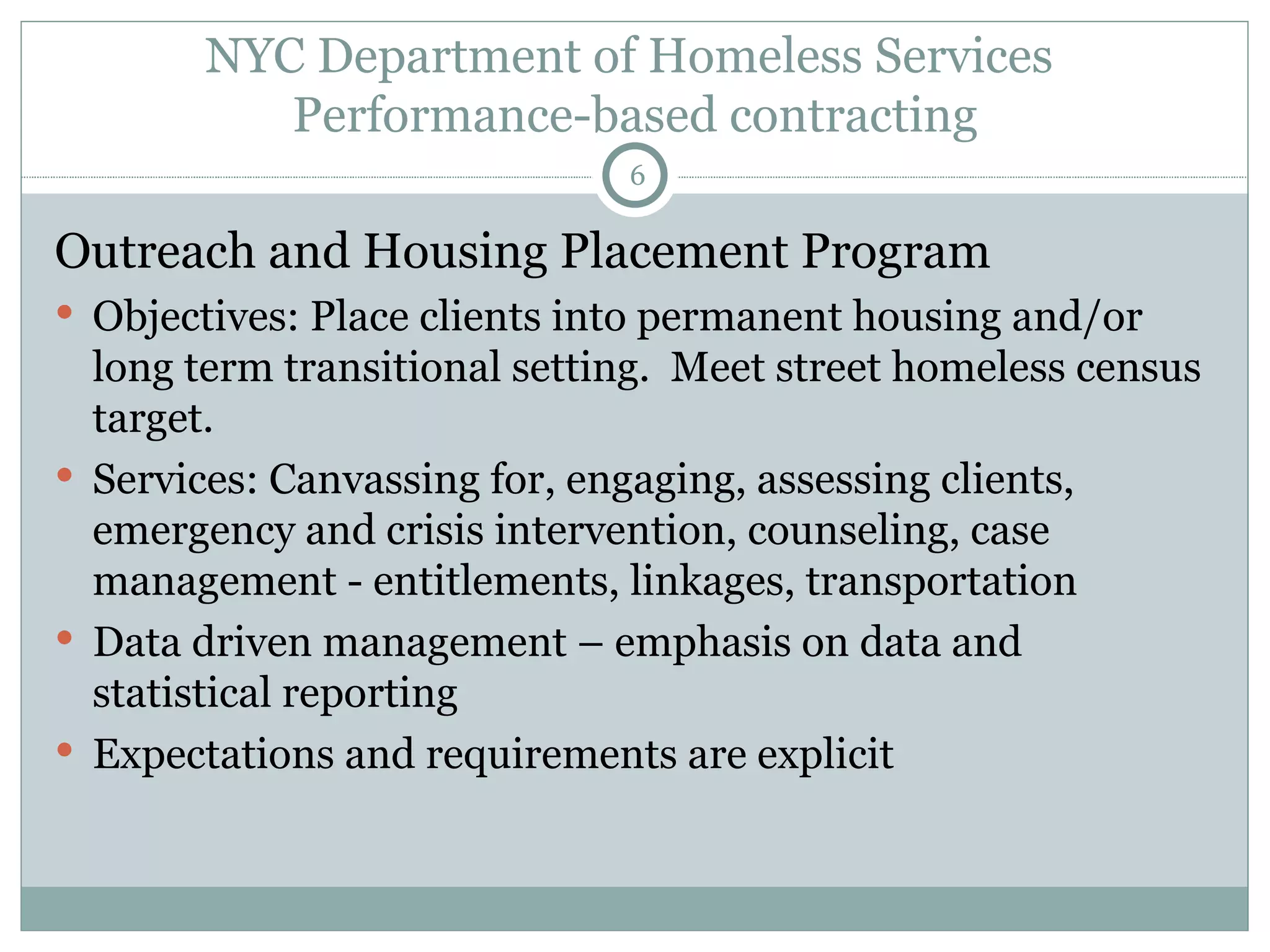
CT Balance of State CoC Renewal Evaluations Renewal Projects evaluation criteria: APR data – 50 points Eligibility of participants 90% Occupancy Rate 85% Retention > 6 months in PSH 75% of exits to permanent housing – TH 30% of people leave with Health Insurance 50% leave with Food Stamps 25% Employed at exit Income Amounts Increased for Participants who Exited 75% of participants had positive exit  Consumer Satisfaction surveys – 15 points Results and at least 35% response rate Accuracy of charts/budgets from Exhibit II – 15 points HMIS – 20 points Data Quality  and Compliance with HMIS Data and Technical Standards
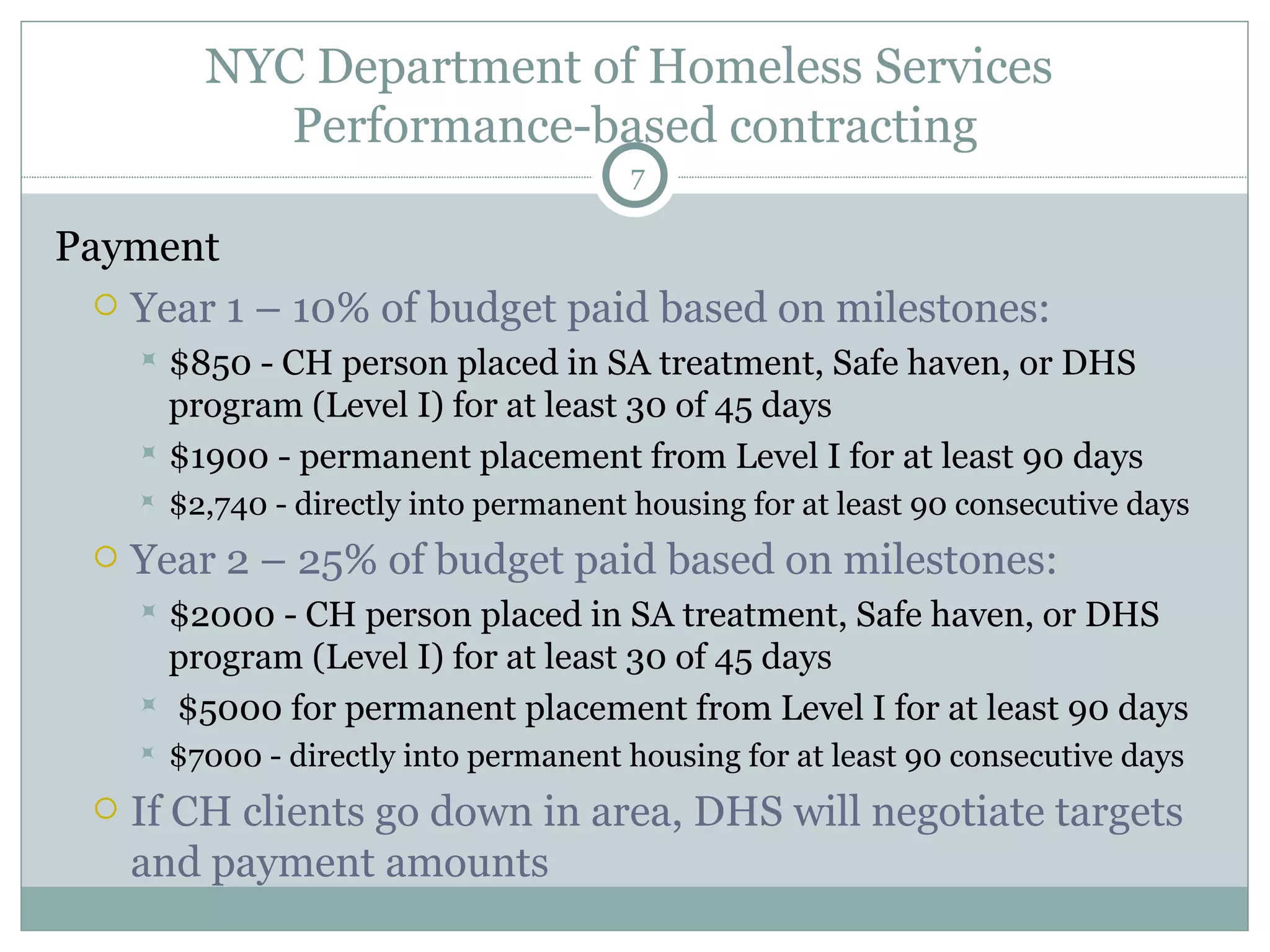
CT Balance of State CoC Renewal Evaluations Corrective Action If a project scores below threshold (70%), corrective action plan must be submitted Corrective Action Plan includes actions to be taken to improve weak area/s, staff involved, and timeframe for completion  Steering Committee meets with agency, reviews plan, additional support/TA is provided  Agency may not apply for new HUD project until out of corrective action status
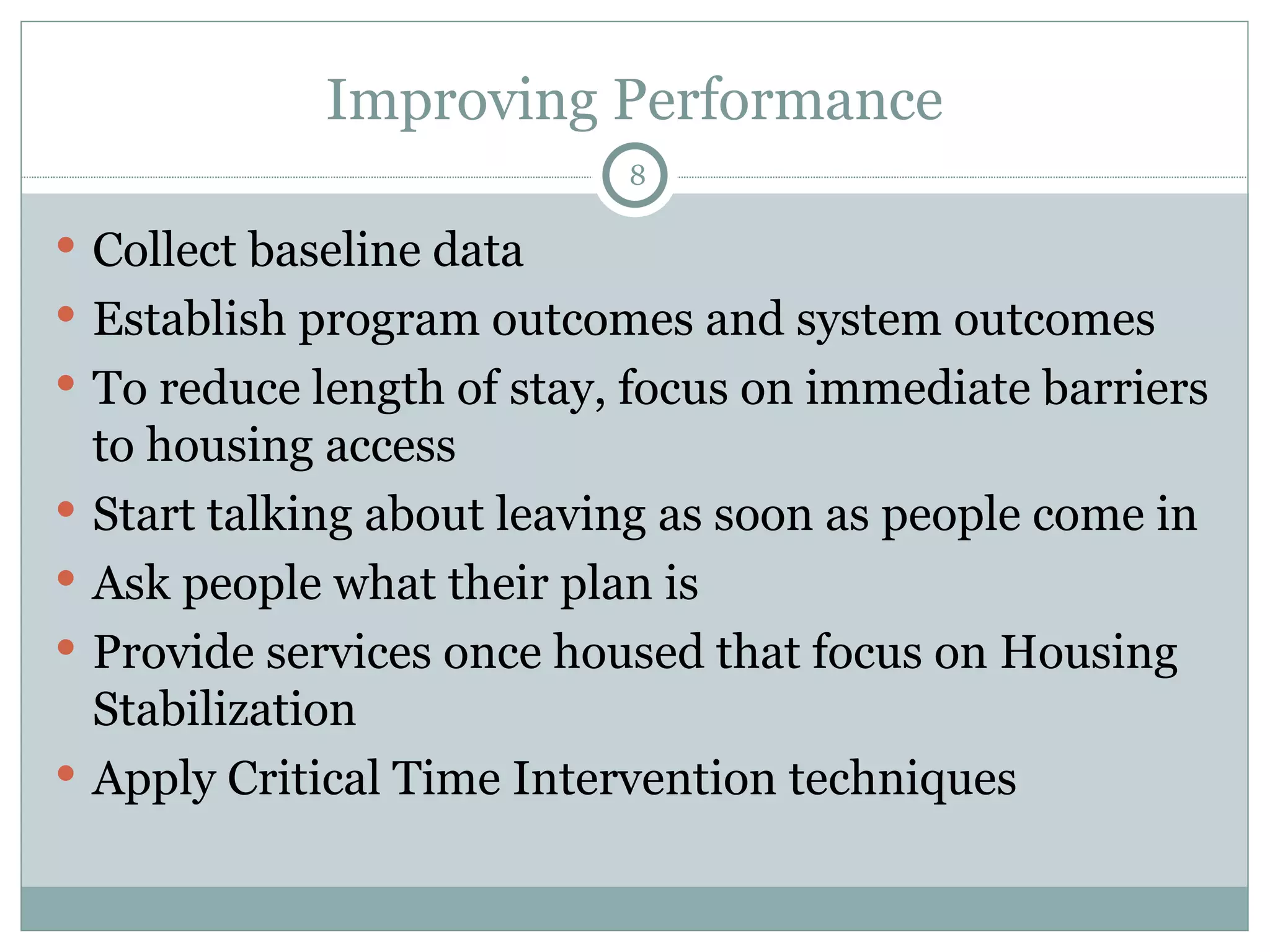
NYC Department of Homeless Services  Performance-based contracting Outreach and Housing Placement Program Objectives: Place clients into permanent housing and/or long term transitional setting.  Meet street homeless census target. Services: Canvassing for, engaging, assessing clients, emergency and crisis intervention, counseling, case management - entitlements, linkages, transportation Data driven management – emphasis on data and statistical reporting  Expectations and requirements are explicit
NYC Department of Homeless Services  Performance-based contracting Payment Year 1 – 10% of budget paid based on milestones: $850 - CH person placed in SA treatment, Safe haven, or DHS program (Level I) for at least 30 of 45 days $1900 - permanent placement from Level I for at least 90 days $2,740 - directly into permanent housing for at least 90 consecutive days Year 2 – 25% of budget paid based on milestones: $2000 - CH person placed in SA treatment, Safe haven, or DHS program (Level I) for at least 30 of 45 days $5000 for permanent placement from Level I for at least 90 days $7000 - directly into permanent housing for at least 90 consecutive days If CH clients go down in area, DHS will negotiate targets and payment amounts
Improving Performance Collect baseline data Establish program outcomes and system outcomes To reduce length of stay, focus on immediate barriers to housing access Start talking about leaving as soon as people come in Ask people what their plan is Provide services once housed that focus on Housing Stabilization Apply Critical Time Intervention techniques
Questions? Housing Innovations Suzanne Wagner [email_address] Tel: (917)612-5469

4.1 HEARTH: Data and Performance Measures (PPT)

  • 1.
    NAEH CONFERENCE SUZANNEWAGNER HOUSING INNOVATIONS Data and Performance Measures
  • 2.
    Principles of Performance-BasedContracting Accountability Outcomes vs. outputs Fairness Simplicity Indicators and scoring periodically re-evaluated Transparency of method Efficient systems for tracking and reporting data Accuracy Prompt Payment if funding is tied to performance
  • 3.
    CT Balance ofState CoC Renewal Evaluations Renewal Evaluation Process: Year-round process, TA provided, focus on improving performance Steering Committee decides on evaluation criteria Criteria shared with providers Agencies submit: HUD Annual Performance Reports (APRs) Consumer Surveys Info on compliance with HMIS standards CT Coalition to End Homelessness (CCEH) provides HMIS data quality report Debrief meeting held and final scores shared with providers If score below threshold, corrective action plan is required Performance/outcomes improve each year
  • 4.
    CT Balance ofState CoC Renewal Evaluations Renewal Projects evaluation criteria: APR data – 50 points Eligibility of participants 90% Occupancy Rate 85% Retention > 6 months in PSH 75% of exits to permanent housing – TH 30% of people leave with Health Insurance 50% leave with Food Stamps 25% Employed at exit Income Amounts Increased for Participants who Exited 75% of participants had positive exit Consumer Satisfaction surveys – 15 points Results and at least 35% response rate Accuracy of charts/budgets from Exhibit II – 15 points HMIS – 20 points Data Quality and Compliance with HMIS Data and Technical Standards
  • 5.
    CT Balance ofState CoC Renewal Evaluations Corrective Action If a project scores below threshold (70%), corrective action plan must be submitted Corrective Action Plan includes actions to be taken to improve weak area/s, staff involved, and timeframe for completion Steering Committee meets with agency, reviews plan, additional support/TA is provided Agency may not apply for new HUD project until out of corrective action status
  • 6.
    NYC Department ofHomeless Services Performance-based contracting Outreach and Housing Placement Program Objectives: Place clients into permanent housing and/or long term transitional setting. Meet street homeless census target. Services: Canvassing for, engaging, assessing clients, emergency and crisis intervention, counseling, case management - entitlements, linkages, transportation Data driven management – emphasis on data and statistical reporting Expectations and requirements are explicit
  • 7.
    NYC Department ofHomeless Services Performance-based contracting Payment Year 1 – 10% of budget paid based on milestones: $850 - CH person placed in SA treatment, Safe haven, or DHS program (Level I) for at least 30 of 45 days $1900 - permanent placement from Level I for at least 90 days $2,740 - directly into permanent housing for at least 90 consecutive days Year 2 – 25% of budget paid based on milestones: $2000 - CH person placed in SA treatment, Safe haven, or DHS program (Level I) for at least 30 of 45 days $5000 for permanent placement from Level I for at least 90 days $7000 - directly into permanent housing for at least 90 consecutive days If CH clients go down in area, DHS will negotiate targets and payment amounts
  • 8.
    Improving Performance Collectbaseline data Establish program outcomes and system outcomes To reduce length of stay, focus on immediate barriers to housing access Start talking about leaving as soon as people come in Ask people what their plan is Provide services once housed that focus on Housing Stabilization Apply Critical Time Intervention techniques
  • 9.
    Questions? Housing InnovationsSuzanne Wagner [email_address] Tel: (917)612-5469

Editor's Notes

  • #3 Accountability – Providers should be accountable for efficient use of contract resources to deliver the highest quality services possible.  Outcomes ‐ The performance‐based contracting initiative should be weighted towards measurable client outcomes (e.g. housing targets) rather than process indicators (e.g. number of service contacts or bed utilization).  Fairness – Targets should be reasonable given resources available. The process should afford adequate time for providers to understand and communicate to staff the areas in which they will be evaluated prior to the start of the evaluation period. Performance data should be compiled monthly and available to staff promptly so that they understand how actual performance compares to desired performance and can make programmatic adjustments as necessary. Indicators and scoring mechanisms should be periodically re‐evaluated to ensure fairness and effectiveness at achieving desired system outcomes.  Partnership ‐ To ensure the broadest possible ownership of goals and ultimate success, the initiative should be developed through a collaborative process that includes a pilot of adequate length to resolve design issues and implement programmatic changes prior to impact on program budgets.  Simplicity ‐ To ensure that performance‐based contracting is an effective tool to motivate and manage program staff, the design should be simple enough to be readily understood.  Efficiency – The system for tracking and reporting data should be automated and streamlined to avoid diverting program resources from service delivery.  Transparency ‐ The methodology for measuring performance should be clear and transparent to all program staff.  Accuracy ‐ To ensure confidence in the accuracy of data upon which performance will be judged, there should be a process through which providers can periodically review and reconcile data.  Prompt Payment ‐ To maximize the utility of performance‐based contracting as a management tool, the associated rewards should closely follow performance.