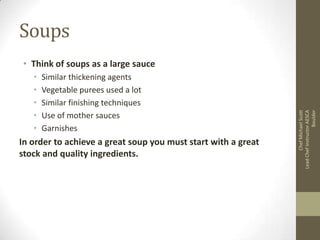
Soups
•
•
•
•
•

Similar thickening agents
Vegetable purees used a lot
Similar finishing techniques
Use of mother sauces
Garnishes

In order to achieve a great soup you must start with a great
stock and quality ingredients.

Chef Michael Scott
Lead Chef Instructor AESCA
Boulder

• Think of soups as a large sauce
• The garnish should be attractive
• The meats and vegetables used should be neatly cut into an
appropriate and uniform shape and size
• The garnish texture and flavor should complement the soup
• Starches and vegetables used as garnishes should be cooked
separately
• Garnishes should be cooked just until done; meat and poultry
should be tender but not falling apart

Chef Michael Scott
Lead Chef Instructor AESCA
Boulder

Garnishing Soup
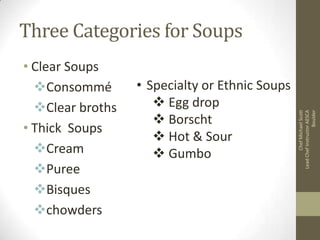
• Clear Soups
Consommé
Clear broths
• Thick Soups
Cream
Puree
Bisques
chowders

• Specialty or Ethnic Soups
 Egg drop
 Borscht
 Hot & Sour
 Gumbo

Chef Michael Scott
Lead Chef Instructor AESCA
Boulder

Three Categories for Soups
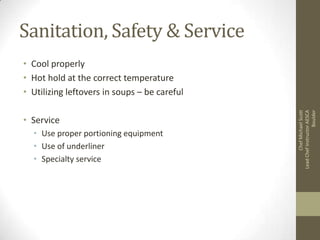
Sanitation, Safety & Service

• Service
• Use proper portioning equipment
• Use of underliner
• Specialty service

Chef Michael Scott
Lead Chef Instructor AESCA
Boulder

• Cool properly
• Hot hold at the correct temperature
• Utilizing leftovers in soups – be careful
• Clear soups, which are always “clear consommés with a slight garnish in keeping
with the nature of the consommé”.
• Purees, which are made from starchy vegetables and are thickened with
rice, potato or soft bread crumbs.
• Cullises, which use poultry, game or fish for a base and are thickened with
rice, lentils, espagnole sauce or bread soaked in boiling salted water.
• Bisques, which use shellfish cooked with a mirepoix as a base and are thickened
with rice.
• Veloutés, which use velouté sauce as a base and are finished with a liaison or
egg yolks and cream.
• Cream soups, which use béchamel sauce as a base and are finished with heavy
cream.
• Special soups, which are those that do not follow the procedures for veloutés or
creams.
• Vegetable soups, which are usually paysanne or peasant-type and “do not
demand very great precision in the apportionment of the vegetables of which
they are composed, but they need great care and attention, notwithstanding”.
• Foreign soups, “which have a foreign origin whose use, although it may not be
general is yet sufficiently common.”

Chef Michael Scott
Lead Chef Instructor AESCA
Boulder

Escoffier definitions for soup
Consommé

• Start from cold
• Stir often until raft forms
• Do not break raft
• Baste
• Onion brulee

• Strain through fine chinoise & cheesecloth
• Garnish and serve

Chef Michael Scott
Lead Chef Instructor AESCA
Boulder

• High quality flavorful and colorful stock
• Clear meat

11 soups

  • 1.
    Soups • • • • • Similar thickening agents Vegetablepurees used a lot Similar finishing techniques Use of mother sauces Garnishes In order to achieve a great soup you must start with a great stock and quality ingredients. Chef Michael Scott Lead Chef Instructor AESCA Boulder • Think of soups as a large sauce
  • 2.
    • The garnishshould be attractive • The meats and vegetables used should be neatly cut into an appropriate and uniform shape and size • The garnish texture and flavor should complement the soup • Starches and vegetables used as garnishes should be cooked separately • Garnishes should be cooked just until done; meat and poultry should be tender but not falling apart Chef Michael Scott Lead Chef Instructor AESCA Boulder Garnishing Soup
  • 3.
    • Clear Soups Consommé Clearbroths • Thick Soups Cream Puree Bisques chowders • Specialty or Ethnic Soups  Egg drop  Borscht  Hot & Sour  Gumbo Chef Michael Scott Lead Chef Instructor AESCA Boulder Three Categories for Soups
  • 4.
    Sanitation, Safety &Service • Service • Use proper portioning equipment • Use of underliner • Specialty service Chef Michael Scott Lead Chef Instructor AESCA Boulder • Cool properly • Hot hold at the correct temperature • Utilizing leftovers in soups – be careful
  • 5.
    • Clear soups,which are always “clear consommés with a slight garnish in keeping with the nature of the consommé”. • Purees, which are made from starchy vegetables and are thickened with rice, potato or soft bread crumbs. • Cullises, which use poultry, game or fish for a base and are thickened with rice, lentils, espagnole sauce or bread soaked in boiling salted water. • Bisques, which use shellfish cooked with a mirepoix as a base and are thickened with rice. • Veloutés, which use velouté sauce as a base and are finished with a liaison or egg yolks and cream. • Cream soups, which use béchamel sauce as a base and are finished with heavy cream. • Special soups, which are those that do not follow the procedures for veloutés or creams. • Vegetable soups, which are usually paysanne or peasant-type and “do not demand very great precision in the apportionment of the vegetables of which they are composed, but they need great care and attention, notwithstanding”. • Foreign soups, “which have a foreign origin whose use, although it may not be general is yet sufficiently common.” Chef Michael Scott Lead Chef Instructor AESCA Boulder Escoffier definitions for soup
  • 6.
    Consommé • Start fromcold • Stir often until raft forms • Do not break raft • Baste • Onion brulee • Strain through fine chinoise & cheesecloth • Garnish and serve Chef Michael Scott Lead Chef Instructor AESCA Boulder • High quality flavorful and colorful stock • Clear meat