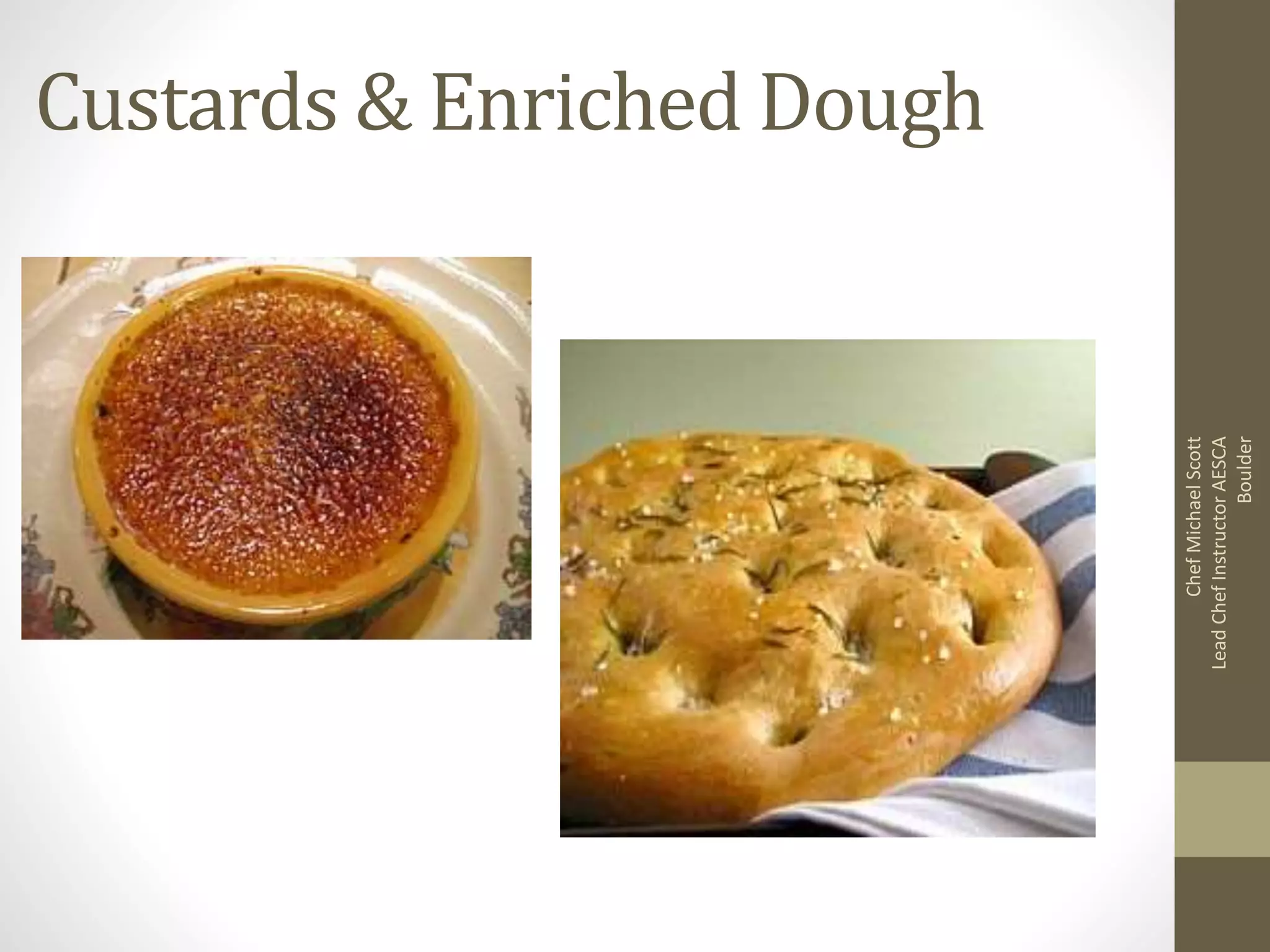
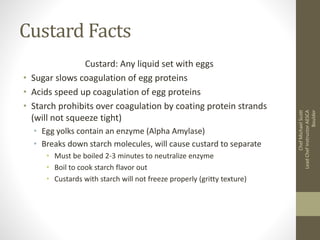
Custards & Enriched Dough
ChefMichaelScott
LeadChefInstructorAESCA
Boulder
Custard Facts
Custard: Any liquid set with eggs
• Sugar slows coagulation of egg proteins
• Acids speed up coagulation of egg proteins
• Starch prohibits over coagulation by coating protein strands
(will not squeeze tight)
• Egg yolks contain an enzyme (Alpha Amylase)
• Breaks down starch molecules, will cause custard to separate
• Must be boiled 2-3 minutes to neutralize enzyme
• Boil to cook starch flavor out
• Custards with starch will not freeze properly (gritty texture)
ChefMichaelScott
LeadChefInstructorAESCA
Boulder
Baking methods
• Custards
• Stovetop: temper hot liquid into egg/sugar mixture, strain back
into pan and carefully heat until nappé on the stove, (cool down
quickly).
• Pastry cream, crème anglaise, lemon curd
• Baked custards: temper hot liquid into egg/sugar mixture strain,
pour into dish and bake on a low temperature, usually in a water
bath.
• Crème brûlée, crème caramel, quiche, pot du creme
ChefMichaelScott
LeadChefInstructorAESCA
Boulder
Stirred or Stovetop Custards
Crème Anglaise, Lemon curd, Pastry cream
• Heat liquid
• Infusing flavors
• Temper into eggs
• Stir continually until nappe (coats the back of a spoon)
• Strain
• Chill immediately to stop cooking
ChefMichaelScott
LeadChefInstructorAESCA
Boulder
Baked Custards
Crème Brûlée, Crème Caramel, Flan, Pot de Crème
• Heat liquid
• Temper into eggs
• Strain
• Pour into dish
• Bake in a water bath (covered vs. uncovered)
• Cool completely
ChefMichaelScott
LeadChefInstructorAESCA
Boulder
Custards – Troubleshooting
• Tempering – always temper
• Synerisis – heat too high – cooked too long
• Air bubbles in baked custards
• Curdling in stirred custards
• Undesirable Skin – dry heat
• Cracking – heat too high, souffle action that falls when chilled
• Browning – heat too high
• Cratering – whisking too much creating foam on top
ChefMichaelScott
LeadChefInstructorAESCA
Boulder
Enriched Dough
A dough with a higher percentage of fat, milk, eggs or sweeteners
• Brioche: tender, rich dough with eggs and butter
• Uses a sponge to start
• Classical shapes; à têt, braids, loaves, cylinders
• Focaccia: Italian style yeasted flat bread
• Various flavorings (toppings)
• Lots of olive oil
ChefMichaelScott
LeadChefInstructorAESCA
Boulder

Day 36 custards & laminated dough

  • 1.
    Custards & EnrichedDough ChefMichaelScott LeadChefInstructorAESCA Boulder
  • 2.
    Custard Facts Custard: Anyliquid set with eggs • Sugar slows coagulation of egg proteins • Acids speed up coagulation of egg proteins • Starch prohibits over coagulation by coating protein strands (will not squeeze tight) • Egg yolks contain an enzyme (Alpha Amylase) • Breaks down starch molecules, will cause custard to separate • Must be boiled 2-3 minutes to neutralize enzyme • Boil to cook starch flavor out • Custards with starch will not freeze properly (gritty texture) ChefMichaelScott LeadChefInstructorAESCA Boulder
  • 3.
    Baking methods • Custards •Stovetop: temper hot liquid into egg/sugar mixture, strain back into pan and carefully heat until nappé on the stove, (cool down quickly). • Pastry cream, crème anglaise, lemon curd • Baked custards: temper hot liquid into egg/sugar mixture strain, pour into dish and bake on a low temperature, usually in a water bath. • Crème brûlée, crème caramel, quiche, pot du creme ChefMichaelScott LeadChefInstructorAESCA Boulder
  • 4.
    Stirred or StovetopCustards Crème Anglaise, Lemon curd, Pastry cream • Heat liquid • Infusing flavors • Temper into eggs • Stir continually until nappe (coats the back of a spoon) • Strain • Chill immediately to stop cooking ChefMichaelScott LeadChefInstructorAESCA Boulder
  • 5.
    Baked Custards Crème Brûlée,Crème Caramel, Flan, Pot de Crème • Heat liquid • Temper into eggs • Strain • Pour into dish • Bake in a water bath (covered vs. uncovered) • Cool completely ChefMichaelScott LeadChefInstructorAESCA Boulder
  • 6.
    Custards – Troubleshooting •Tempering – always temper • Synerisis – heat too high – cooked too long • Air bubbles in baked custards • Curdling in stirred custards • Undesirable Skin – dry heat • Cracking – heat too high, souffle action that falls when chilled • Browning – heat too high • Cratering – whisking too much creating foam on top ChefMichaelScott LeadChefInstructorAESCA Boulder
  • 7.
    Enriched Dough A doughwith a higher percentage of fat, milk, eggs or sweeteners • Brioche: tender, rich dough with eggs and butter • Uses a sponge to start • Classical shapes; à têt, braids, loaves, cylinders • Focaccia: Italian style yeasted flat bread • Various flavorings (toppings) • Lots of olive oil ChefMichaelScott LeadChefInstructorAESCA Boulder