Future Trends in
Social Media
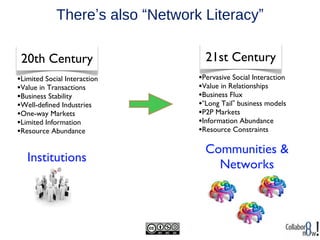
There’s also “Network Literacy”
21st Century
•Pervasive Social Interaction
•Value in Relationships
•Business Flux
•“Long Tail” business models
•P2P Markets
•Information Abundance
•Resource Constraints
Communities &
Networks
20th Century
•Limited Social Interaction
•Value in Transactions
•Business Stability
•Well-defined Industries
•One-way Markets
•Limited Information
•Resource Abundance
Institutions
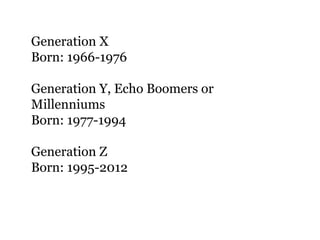
Generation X
Born: 1966-1976
Generation Y, Echo Boomers or
Millenniums
Born: 1977-1994
Generation Z
Born: 1995-2012
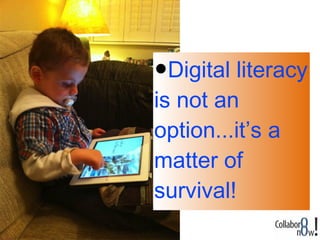
•Digital literacy
is not an
option...it’s a
matter of
survival!
17
What is
“digital
curation”?
18
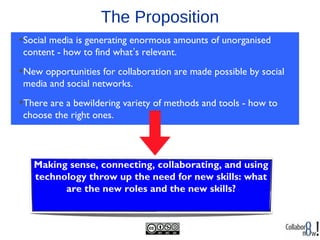
The Proposition
•Social media is generating enormous amounts of unorganised
content - how to find what’s relevant.
•New opportunities for collaboration are made possible by social
media and social networks.
•There are a bewildering variety of methods and tools - how to
choose the right ones.
Making sense, connecting, collaborating, and using
technology throw up the need for new skills: what
are the new roles and the new skills?
20
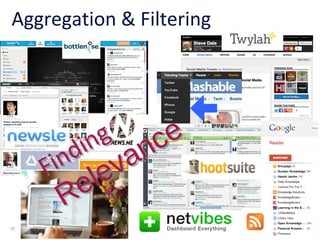
Aggregation & Filtering
Finding
Relevance
Finding
Relevance
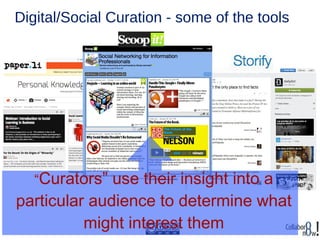
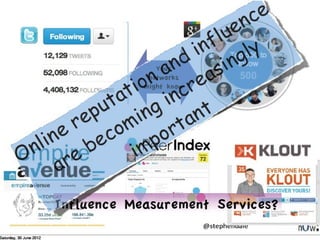
Digital/Social Curation - some of the tools
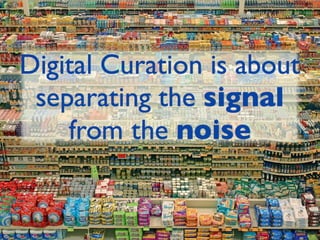
“Curators” use their insight into a
particular audience to determine what
might interest them
What is Content Curation?
Content Curation basically means that – out of all
the content you find on the social web – you pass
on the most valuable stuff to your network.
A Content Curator is someone who continually
finds, groups, organizes and shares the best and
most relevant content on a specific issue online.
The benefit for your network, is that your friends,
connections and followers don’t have to plough
through masses of tweets, blog posts, news feeds and
search results to find quality content. You have
already done that for them!
This establishes you as ‘the one who knows!’. It
brands you as an expert. A Trusted source. It builds
your reputation and gets you kudos i.e. ‘social
capital’.
So what doesn’t content curation do?
Different to content marketing, content curation
doesn’t drive people through their decision making
process about your products and services. For this,
you would need to create tailor-made content that
answers specific questions people have about
specific aspects of your products or services.
2828
29
30
31
32
33
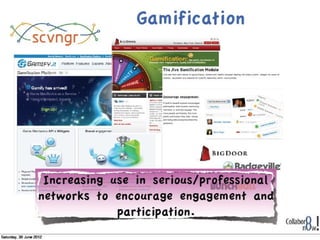
What is Gamification?
Gamification is the use of game thinking and game
mechanics in non-game contexts to engage users in
solving problems
Gamification has been studied and applied in several
domains, such as to improve user engagement,
physical exercise, return on investment, data quality,
timeliness, and learning. A review of research on
gamification shows that most studies on gamification
find positive effects from gamification.
34
35
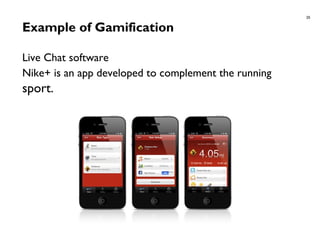
Example of Gamification
Live Chat software
Nike+ is an app developed to complement the running
sport.
36
37
38
39
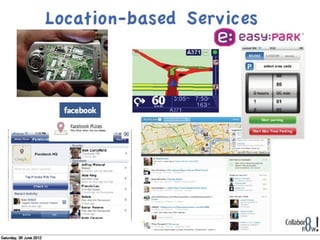
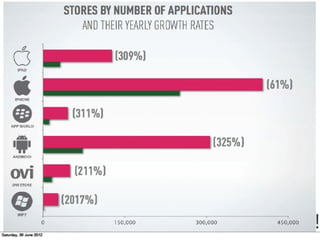
What is Appifying?
Appifying the web refers to the growing trend of web sites to
create native (mobile) applications which access internet
services instead of or in addition to a (mobile-optimized) web
site.
There are several different mobile platforms out there: iOS,
Android, Windows Phone, webOS, Symbian, Blackberry – just
to name a few, and more platforms showing up every other
year. To be able to cater for the needs of all potential users
when building a native mobile application, it is necessary to
build native mobile apps for several different platforms. It is
not difficult to see how this can be a daunting task.
40
41
42
43
Take-aways
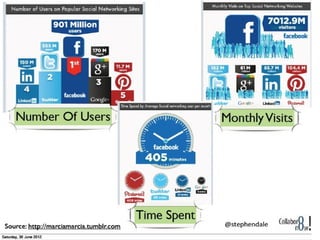
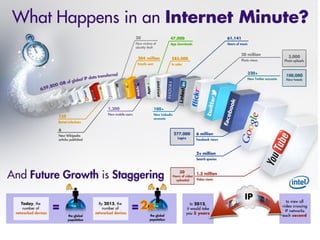
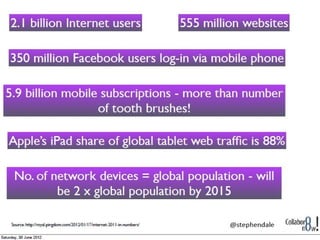
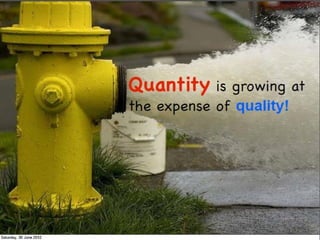
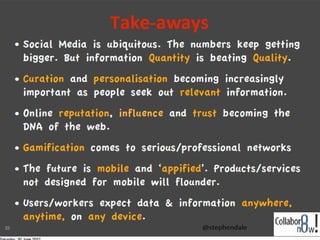
• Social Media is ubiquitous. The numbers keep getting
bigger. But we’ve sacrificed quality for quantity and
accuracy for timeliness
• Routine tasks are being outsourced. Repetitive tasks are
being done by machines/robots.
• Community Management and Digital Curation roles are
emergent: relying on skills that can’t easily be automated
• The most important skills for a 21st century knowledge
worker are the ability to network and socialise.
44
45
46

11 future-social-media chapter 11

  • 1.
  • 4.
    There’s also “NetworkLiteracy” 21st Century •Pervasive Social Interaction •Value in Relationships •Business Flux •“Long Tail” business models •P2P Markets •Information Abundance •Resource Constraints Communities & Networks 20th Century •Limited Social Interaction •Value in Transactions •Business Stability •Well-defined Industries •One-way Markets •Limited Information •Resource Abundance Institutions
  • 11.
    Generation X Born: 1966-1976 GenerationY, Echo Boomers or Millenniums Born: 1977-1994 Generation Z Born: 1995-2012
  • 13.
    •Digital literacy is notan option...it’s a matter of survival!
  • 17.
  • 18.
  • 19.
    The Proposition •Social mediais generating enormous amounts of unorganised content - how to find what’s relevant. •New opportunities for collaboration are made possible by social media and social networks. •There are a bewildering variety of methods and tools - how to choose the right ones. Making sense, connecting, collaborating, and using technology throw up the need for new skills: what are the new roles and the new skills?
  • 20.
  • 22.
    Digital/Social Curation -some of the tools “Curators” use their insight into a particular audience to determine what might interest them
  • 23.
    What is ContentCuration? Content Curation basically means that – out of all the content you find on the social web – you pass on the most valuable stuff to your network. A Content Curator is someone who continually finds, groups, organizes and shares the best and most relevant content on a specific issue online.
  • 24.
    The benefit foryour network, is that your friends, connections and followers don’t have to plough through masses of tweets, blog posts, news feeds and search results to find quality content. You have already done that for them! This establishes you as ‘the one who knows!’. It brands you as an expert. A Trusted source. It builds your reputation and gets you kudos i.e. ‘social capital’.
  • 25.
    So what doesn’tcontent curation do? Different to content marketing, content curation doesn’t drive people through their decision making process about your products and services. For this, you would need to create tailor-made content that answers specific questions people have about specific aspects of your products or services.
  • 28.
  • 29.
  • 30.
  • 31.
  • 32.
  • 33.
    33 What is Gamification? Gamificationis the use of game thinking and game mechanics in non-game contexts to engage users in solving problems Gamification has been studied and applied in several domains, such as to improve user engagement, physical exercise, return on investment, data quality, timeliness, and learning. A review of research on gamification shows that most studies on gamification find positive effects from gamification.
  • 34.
  • 35.
    35 Example of Gamification LiveChat software Nike+ is an app developed to complement the running sport.
  • 36.
  • 37.
  • 38.
  • 39.
    39 What is Appifying? Appifyingthe web refers to the growing trend of web sites to create native (mobile) applications which access internet services instead of or in addition to a (mobile-optimized) web site. There are several different mobile platforms out there: iOS, Android, Windows Phone, webOS, Symbian, Blackberry – just to name a few, and more platforms showing up every other year. To be able to cater for the needs of all potential users when building a native mobile application, it is necessary to build native mobile apps for several different platforms. It is not difficult to see how this can be a daunting task.
  • 40.
  • 41.
  • 42.
  • 43.
    43 Take-aways • Social Mediais ubiquitous. The numbers keep getting bigger. But we’ve sacrificed quality for quantity and accuracy for timeliness • Routine tasks are being outsourced. Repetitive tasks are being done by machines/robots. • Community Management and Digital Curation roles are emergent: relying on skills that can’t easily be automated • The most important skills for a 21st century knowledge worker are the ability to network and socialise.
  • 44.
  • 45.
  • 46.

Editor's Notes

  • #5 The skills required to survive and thrive in the 21st century are quite different to those of the 21st century. In particular (1) finding what is relevant in an Information-rich, time-poor environment, (2) making sense of the information we find, and (3) familiarity with social networks and social learning.
  • #19 More doesn’t mean better
  • #20 To be discussed in two parts - first, let’s set the scene....
  • #21 A small selection of the many information aggregation services, including: Bottlenose Twylah News.me Newsle Mashable Netvibes Hootesuite Google Reader/RSS
  • #23 Content curation is the organising, filtering and “making sense of” information on the web and sharing the very best with your network. A great curator: Optimises titles so it is relevant for that audience Edits the content to add further relevance of the message Formats the material so it is easy for the audience to read and apply to their situation Adds good images and other visual material that complements and reinforces the content Excerpts selected text so the reader can quickly and easily grasp the most important elements Adds his or her own voice in an intro to the piece, adding context and relevance for the reader Tags all content with relevant words and phrases so it is easily found by that audience Supplies links to expand the scope of the piece and give access to added resources about the subject Personalizes each piece for the relevant audience when posting to social sites, when appropriate Ensures all curated content is correct and from a reliable source Always gives attribution and links to sources Filters content vigorously and does not publish anything and everything Has a network of experts and curators in their sphere that they can tap into for personal insights Suggests stories and items to other curators Searches for additional material that can add depth and value or context to an item Constantly scouts for interesting new sources Sets up searches, filters and feeds to get a constant flow of relevant information Makes the focus of the curated content perfectly clear and easy to see right upfront Recommends other newsmasters and curators with great content Crowd sources tips and suggestions from readers and always acknowledges their contributions
  • #44 But define what a routine job is. Ref the video - can a lawyer be replaced by technology?