Contents
Introduction
• Working
•Steps of
creating
Block diagram
• Different
methods
• Applications
Advantages
• Disadvantages
• Conclusion
Micro Controller(Arduino Mega 2560)
Motor Driver(L293D)
Stepper Motor
Extruder
Printing Material
• ABS(Acrylonitrile Butadiene Styrene)
• PLA(Poly Lactic Acid)
BLOCK DIAGRAM
Arduino Mega 2560
 54 digital input/output pins (15 are used as PWM outputs)
 16 analog inputs, 4 UARTs (hardware serial ports)
 16MHz crystal oscillator, a USB connection, a power jack, an
ICSP header, and a reset button.
 Can be connected to a computer with USB Cable/power with
AC-DC Adapter or battery to get started.
Power
• Via USB Connection/External Power Supply
• External power is an AC-DC adapter(Wall-wart) or battery
• Operate at 6-20V
Power Pins
• VIN:Input voltage to the Arduino board when using external power source.
• 5V:Outputs a regulated 5V from the regulator on board
• 3V3:A 3.3V supply generated by on board regulator.Max current draw is 50mA
• GND:Ground pins
• IOREF:Provides voltage reference with which micro controller works
Memory
• 256kB Falsh memory(8kb for boot loader)
• 8kb of SRAM & 4kb of EEPROM
Input & Output
• 54 digital pins on the Mega can be used as an i/p / o/p, using pinmode(), digitalWrite() &
digitalRead() functions
• They operate at 5V.Each pin provide/receive a maximum of 40mA & pull-up resistor of 20-
50kohms
Communication
• ATMega provides 4 Hardware UARTS for TTL(5V) serial communication
• A software serial library allows for serial communication
• Also supports TWI & SPI communications
• Includes a wire library to simplify use of the TWI bus
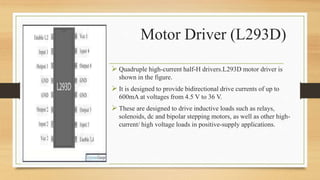
 Quadruple high-current half-H drivers.L293D motor driver is
shown in the figure.
 It is designed to provide bidirectional drive currents of up to
600mA at voltages from 4.5 V to 36 V.
 These are designed to drive inductive loads such as relays,
solenoids, dc and bipolar stepping motors, as well as other high-
current/ high voltage loads in positive-supply applications.
Motor Driver (L293D)
 Electromechanical devices which generates discrete displacement
(motion) in response to DC-Electrical signals.
UniPolar Stepper Motor
• Contains 2 windings per phase.
• Direction is controlled by changing the direction of current flow.
• Easy to shift direction of rotation by switching the teriminals.
Bipolar Stepper Motor
• Contains single winding per phase
• Current flow through the windings is reversed dynamically for
reversing motor rotation.
• Requires complex circuit
EXTRUDER
 Responsible for raw material melting & forming it into a continuous
profile.
 Works on the same principle of Injection molding machines.
 Extrusion is a simple concept,but the design & application is a
complex field.
 A dedicated extrusion machine must mix,homogenize & melt the
material.
 Higher back pressures will be generated
PRINTING MATERIALS
ABS(Acrylonitrile Butadiene Styrene)
• Cheapest material,very durable,strong,flexible & resistant to heat.
• Temperature:210-250C
• ABS Glue. Easily dissolved in acetane.
• Available in white,black,red,blue,yellow & green colors
PLA(Poly Lactic Acid)
• Biodegradable thermoplastic.
• Tough, little brittle
• 160-220C (Cant stand too much heat).
• Quite slow to cool.
• CNC based tooling language
• Each line conveys one type of machine
movement
• Describe movements that will make a part
• Including dimensions such as extrusion
width, speed etc.,
G-Code
Selective Laser Sintering(SLS)
• Uses high power laser (e.g. Carbon dioxide
Laser)
• Fuses small particles of plastic,
metal(DMLS),ceramic/glass powder
Stereo
Lithography
(STL)
• Use a vat of liquid Resin
• UV-Laser to build parts a layer at a time
• CAD is used to create STL files
• STL file format-Uses many little triangles to make a 3D plot of objects
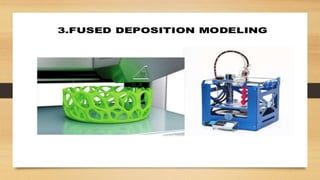
Fused Deposition Modelling (FDM)
• Commonly used for modelling,
prototyping & production
applications
☺ RAPID PROTOTYPING: 3-D design gives the designers ability to quickly turn concepts into 3D
models/prototypes.
☺ Clean Process: Wastage of material is negligible.
☺ Complex Shape can be produced.
☺ EASY TO USE: No skilled person is needed.
☺ REDUCE DESIGN COMPLEXITY.
☺ CHEAP Cheaper process than any other process.
☺ People in remote locations can fabricate objects that would otherwise be inaccessible to them.
advantages
disadvantages
☹ Process is slow.
☹ Components do not have enough strength.
☹ COST OF RAW MATERIALS.
☹ 3-D Printers are still expensive.
☹ Misuse of technology
☹ Although 3D printers have the potential of creating many jobs and opportunities,
they might also put certain jobs at risk.
☯ With todays 3D printers, if you loose your TV remote’s battery cover you can create a
replacement battery cover. With tomorrow’s if you loos your remote you will be able to
create a new remote.
☯ 3D printers are always getting cheaper & better.
☯ There is currently research going on to create 3D printers that could print out organs for
people in need of a transplant.
☯ Within a decade,3D printers will become common place in house.
The benefits of such Technology are endless
COnclusion
3D Design(Printing) Technology

3D Design(Printing) Technology

  • 2.
    Contents Introduction • Working •Steps of creating Blockdiagram • Different methods • Applications Advantages • Disadvantages • Conclusion
  • 11.
    Micro Controller(Arduino Mega2560) Motor Driver(L293D) Stepper Motor Extruder Printing Material • ABS(Acrylonitrile Butadiene Styrene) • PLA(Poly Lactic Acid) BLOCK DIAGRAM
  • 12.
    Arduino Mega 2560 54 digital input/output pins (15 are used as PWM outputs)  16 analog inputs, 4 UARTs (hardware serial ports)  16MHz crystal oscillator, a USB connection, a power jack, an ICSP header, and a reset button.  Can be connected to a computer with USB Cable/power with AC-DC Adapter or battery to get started.
  • 13.
    Power • Via USBConnection/External Power Supply • External power is an AC-DC adapter(Wall-wart) or battery • Operate at 6-20V Power Pins • VIN:Input voltage to the Arduino board when using external power source. • 5V:Outputs a regulated 5V from the regulator on board • 3V3:A 3.3V supply generated by on board regulator.Max current draw is 50mA • GND:Ground pins • IOREF:Provides voltage reference with which micro controller works Memory • 256kB Falsh memory(8kb for boot loader) • 8kb of SRAM & 4kb of EEPROM
  • 14.
    Input & Output •54 digital pins on the Mega can be used as an i/p / o/p, using pinmode(), digitalWrite() & digitalRead() functions • They operate at 5V.Each pin provide/receive a maximum of 40mA & pull-up resistor of 20- 50kohms Communication • ATMega provides 4 Hardware UARTS for TTL(5V) serial communication • A software serial library allows for serial communication • Also supports TWI & SPI communications • Includes a wire library to simplify use of the TWI bus
  • 15.
     Quadruple high-currenthalf-H drivers.L293D motor driver is shown in the figure.  It is designed to provide bidirectional drive currents of up to 600mA at voltages from 4.5 V to 36 V.  These are designed to drive inductive loads such as relays, solenoids, dc and bipolar stepping motors, as well as other high- current/ high voltage loads in positive-supply applications. Motor Driver (L293D)
  • 16.
     Electromechanical deviceswhich generates discrete displacement (motion) in response to DC-Electrical signals. UniPolar Stepper Motor • Contains 2 windings per phase. • Direction is controlled by changing the direction of current flow. • Easy to shift direction of rotation by switching the teriminals. Bipolar Stepper Motor • Contains single winding per phase • Current flow through the windings is reversed dynamically for reversing motor rotation. • Requires complex circuit
  • 17.
    EXTRUDER  Responsible forraw material melting & forming it into a continuous profile.  Works on the same principle of Injection molding machines.  Extrusion is a simple concept,but the design & application is a complex field.  A dedicated extrusion machine must mix,homogenize & melt the material.  Higher back pressures will be generated
  • 18.
    PRINTING MATERIALS ABS(Acrylonitrile ButadieneStyrene) • Cheapest material,very durable,strong,flexible & resistant to heat. • Temperature:210-250C • ABS Glue. Easily dissolved in acetane. • Available in white,black,red,blue,yellow & green colors PLA(Poly Lactic Acid) • Biodegradable thermoplastic. • Tough, little brittle • 160-220C (Cant stand too much heat). • Quite slow to cool.
  • 19.
    • CNC basedtooling language • Each line conveys one type of machine movement • Describe movements that will make a part • Including dimensions such as extrusion width, speed etc., G-Code
  • 21.
    Selective Laser Sintering(SLS) •Uses high power laser (e.g. Carbon dioxide Laser) • Fuses small particles of plastic, metal(DMLS),ceramic/glass powder
  • 22.
    Stereo Lithography (STL) • Use avat of liquid Resin • UV-Laser to build parts a layer at a time • CAD is used to create STL files • STL file format-Uses many little triangles to make a 3D plot of objects
  • 23.
    Fused Deposition Modelling(FDM) • Commonly used for modelling, prototyping & production applications
  • 27.
    ☺ RAPID PROTOTYPING:3-D design gives the designers ability to quickly turn concepts into 3D models/prototypes. ☺ Clean Process: Wastage of material is negligible. ☺ Complex Shape can be produced. ☺ EASY TO USE: No skilled person is needed. ☺ REDUCE DESIGN COMPLEXITY. ☺ CHEAP Cheaper process than any other process. ☺ People in remote locations can fabricate objects that would otherwise be inaccessible to them. advantages
  • 28.
    disadvantages ☹ Process isslow. ☹ Components do not have enough strength. ☹ COST OF RAW MATERIALS. ☹ 3-D Printers are still expensive. ☹ Misuse of technology ☹ Although 3D printers have the potential of creating many jobs and opportunities, they might also put certain jobs at risk.
  • 29.
    ☯ With todays3D printers, if you loose your TV remote’s battery cover you can create a replacement battery cover. With tomorrow’s if you loos your remote you will be able to create a new remote. ☯ 3D printers are always getting cheaper & better. ☯ There is currently research going on to create 3D printers that could print out organs for people in need of a transplant. ☯ Within a decade,3D printers will become common place in house. The benefits of such Technology are endless COnclusion