Marketing Management, 12/e A South Asian Perspective 11  Crafting the Brand  Positioning Kotler   Koshy Keller   Jha
Chapter Questions How can a firm choose and communicate an effective positioning in the market? How are brands differentiated? What marketing strategies are appropriate at each stage of the product life cycle? What are the implications of market evolution for marketing strategies?
Marketing Strategy Segmentation Targeting Positioning
Positioning Act of designing the company’s offering and image to occupy a distinctive place in the mind of the target market.
Value Propositions Scorpio, Mahindra & Mahindra Luxury of a Car and thrill of an SUV Domino’s A good hot pizza, delivered to your door within 30 minutes of ordering, at a moderate price
Writing a Positioning Statement Mountain Dew: To young, active soft-drink consumers who have little time for sleep, Mountain Dew is the soft drink that gives you more energy than any other brand because it has the  highest level of caffeine.
Defining Associations Points-of-difference (PODs) Attributes or benefits consumers strongly associate with a brand, positively evaluate, and believe they could not find to the same extent with a competitive brand Points-of-parity (POPs) Associations that are not necessarily unique to the brand but may be shared with other brands
Conveying Category Membership Announcing category benefits Comparing to exemplars Relying on the product descriptor
Consumer Desirability Criteria for PODs Relevance Distinctiveness Believability
Deliverability Criteria for PODs Feasibility Communicability Sustainability
Examples of Negatively Correlated Attributes and Benefits Low-price vs. High quality Taste vs. Low calories Nutritious vs. Good tasting Efficacious vs. Mild Powerful vs. Safe Strong vs. Refined Ubiquitous vs. Exclusive Varied vs. Simple
Addressing Negatively Correlated PODs and POPs Present separately Leverage equity of another entity Redefine the relationship
Differentiation Strategies Product Personnel Channel Image
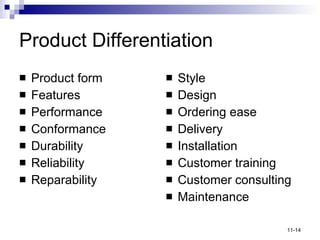
Product Differentiation Product form Features Performance Conformance Durability Reliability Reparability Style Design Ordering ease Delivery Installation Customer training Customer consulting Maintenance
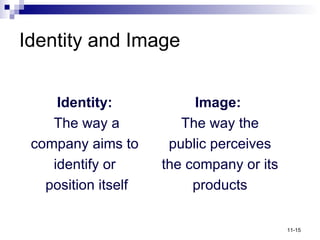
Identity and Image Identity:   The way a company aims to  identify or  position itself Image:  The way the public perceives the company or its products
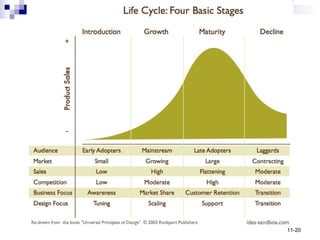
Product Life Cycle Introduction Growth Maturity Decline
Facts about Life Cycles Products have a limited life. Product sales pass through distinct stages. Profits rise and fall at different stages. Products require different marketing, financial, manufacturing, purchasing, and human resource strategies in each stage.
Marketing Program Modifications Prices Distribution Advertising Sales promotion Services
Market Evolution Stages Emergence Growth Maturity Decline
 
Product Life Cycle Style  Fashion FAD (as in short term trends)
Emerging Markets Latent Single-niche Multiple-niche Mass-market

11

  • 1.
    Marketing Management, 12/eA South Asian Perspective 11 Crafting the Brand Positioning Kotler Koshy Keller Jha
  • 2.
    Chapter Questions Howcan a firm choose and communicate an effective positioning in the market? How are brands differentiated? What marketing strategies are appropriate at each stage of the product life cycle? What are the implications of market evolution for marketing strategies?
  • 3.
    Marketing Strategy SegmentationTargeting Positioning
  • 4.
    Positioning Act ofdesigning the company’s offering and image to occupy a distinctive place in the mind of the target market.
  • 5.
    Value Propositions Scorpio,Mahindra & Mahindra Luxury of a Car and thrill of an SUV Domino’s A good hot pizza, delivered to your door within 30 minutes of ordering, at a moderate price
  • 6.
    Writing a PositioningStatement Mountain Dew: To young, active soft-drink consumers who have little time for sleep, Mountain Dew is the soft drink that gives you more energy than any other brand because it has the highest level of caffeine.
  • 7.
    Defining Associations Points-of-difference(PODs) Attributes or benefits consumers strongly associate with a brand, positively evaluate, and believe they could not find to the same extent with a competitive brand Points-of-parity (POPs) Associations that are not necessarily unique to the brand but may be shared with other brands
  • 8.
    Conveying Category MembershipAnnouncing category benefits Comparing to exemplars Relying on the product descriptor
  • 9.
    Consumer Desirability Criteriafor PODs Relevance Distinctiveness Believability
  • 10.
    Deliverability Criteria forPODs Feasibility Communicability Sustainability
  • 11.
    Examples of NegativelyCorrelated Attributes and Benefits Low-price vs. High quality Taste vs. Low calories Nutritious vs. Good tasting Efficacious vs. Mild Powerful vs. Safe Strong vs. Refined Ubiquitous vs. Exclusive Varied vs. Simple
  • 12.
    Addressing Negatively CorrelatedPODs and POPs Present separately Leverage equity of another entity Redefine the relationship
  • 13.
    Differentiation Strategies ProductPersonnel Channel Image
  • 14.
    Product Differentiation Productform Features Performance Conformance Durability Reliability Reparability Style Design Ordering ease Delivery Installation Customer training Customer consulting Maintenance
  • 15.
    Identity and ImageIdentity: The way a company aims to identify or position itself Image: The way the public perceives the company or its products
  • 16.
    Product Life CycleIntroduction Growth Maturity Decline
  • 17.
    Facts about LifeCycles Products have a limited life. Product sales pass through distinct stages. Profits rise and fall at different stages. Products require different marketing, financial, manufacturing, purchasing, and human resource strategies in each stage.
  • 18.
    Marketing Program ModificationsPrices Distribution Advertising Sales promotion Services
  • 19.
    Market Evolution StagesEmergence Growth Maturity Decline
  • 20.
  • 21.
    Product Life CycleStyle Fashion FAD (as in short term trends)
  • 22.
    Emerging Markets LatentSingle-niche Multiple-niche Mass-market