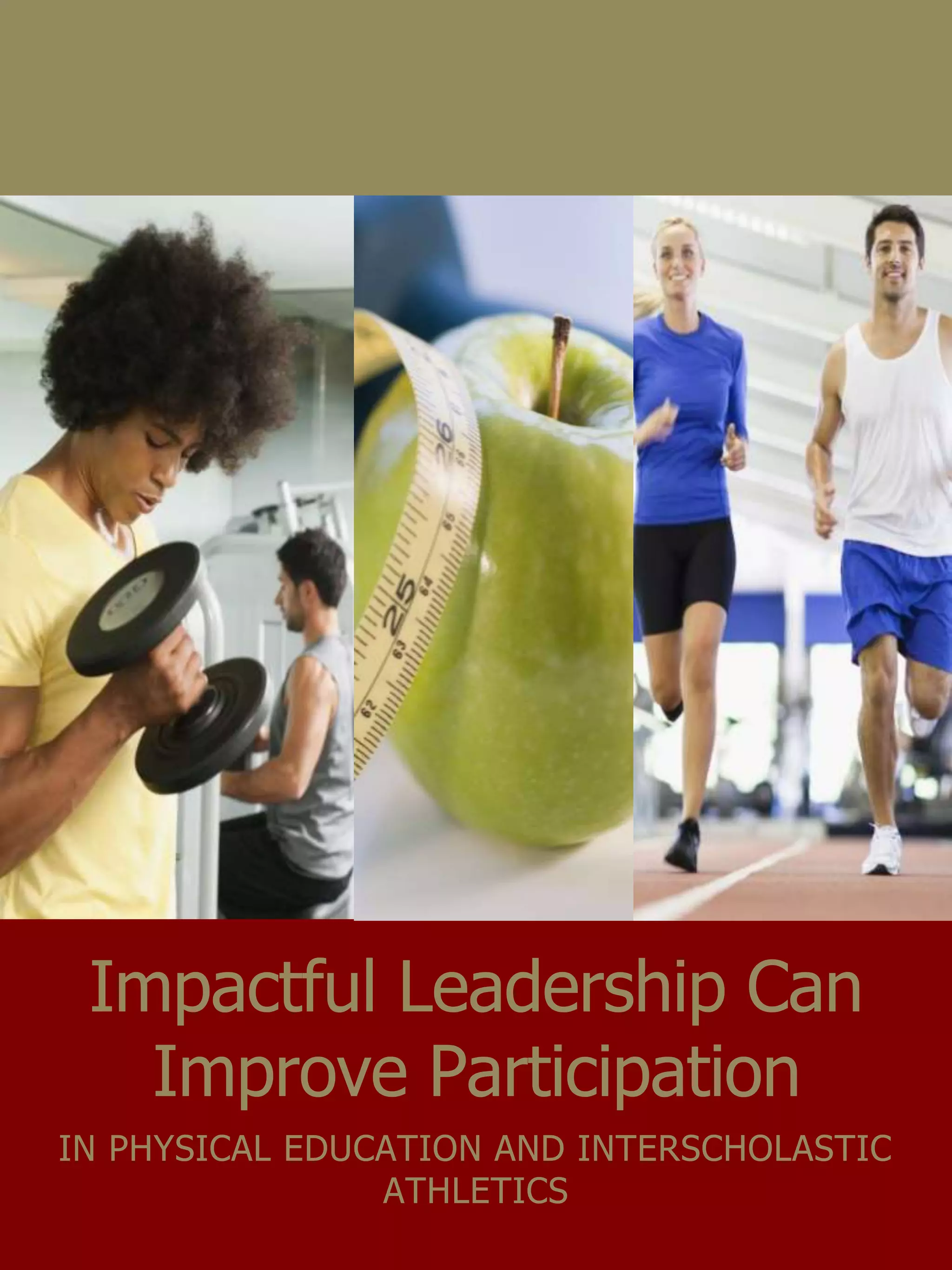
Impactful Leadership Can 
Improve Participation 
IN PHYSICAL EDUCATION AND INTERSCHOLASTIC 
ATHLETICS
A Story on the Power of 
Reading & Learning to 
foster Growth 
• Honored to be asked, 
but surprised… 
• I had just started 
working on a project 
as the MAC 
president... 
• As a leader focused 
on participation to 
prevent dropouts… 
• Being a learner, I 
read… 
• Staunchly believe in 
the value of 
scientifically based, 
research proven 
strategies to improve 
learning…
The Research is 
Clear 
 Movement is linked to 
improved learning 
 Movement combined with 
music is linked to even greater 
learning improvement 
 Planned, intentional movement 
with carefully chosen music, 
combined with cognitive 
learning targets can lead to 
significantly improved learning
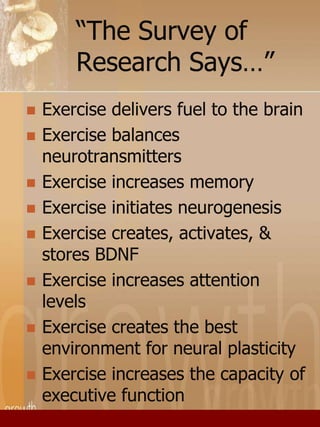
“The Survey of 
Research Says…” 
 Exercise delivers fuel to the brain 
 Exercise balances 
neurotransmitters 
 Exercise increases memory 
 Exercise initiates neurogenesis 
 Exercise creates, activates, & 
stores BDNF 
 Exercise increases attention 
levels 
 Exercise creates the best 
environment for neural plasticity 
 Exercise increases the capacity of 
executive function
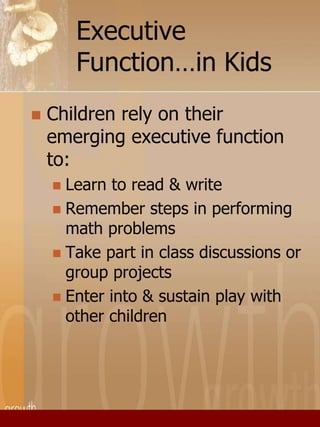
Executive 
Function…in Kids 
 Children rely on their 
emerging executive function 
to: 
 Learn to read & write 
 Remember steps in performing 
math problems 
 Take part in class discussions or 
group projects 
 Enter into & sustain play with 
other children
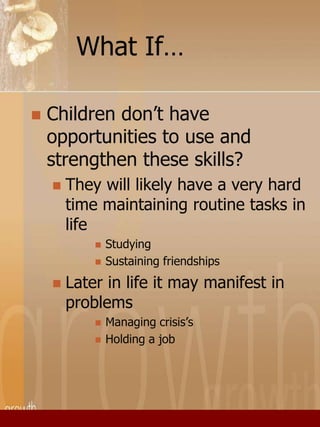
What If… 
 Children don’t have 
opportunities to use and 
strengthen these skills? 
 They will likely have a very hard 
time maintaining routine tasks in 
life 
 Studying 
 Sustaining friendships 
 Later in life it may manifest in 
problems 
 Managing crisis’s 
 Holding a job
“Through CREATIVE PLAY, 
GAMES, and schoolwork, 
children practice integrating 
their attention, working 
memory, and self-control to 
support planning, flexible 
problem-solving, and 
sustained engagement. “ 
Center on the Developing Child, 
Harvard University
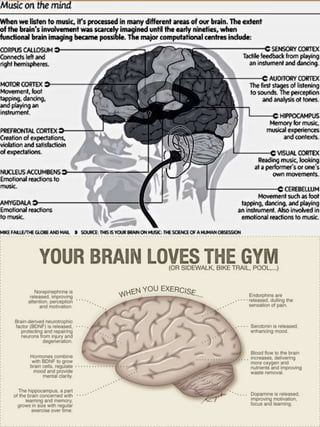
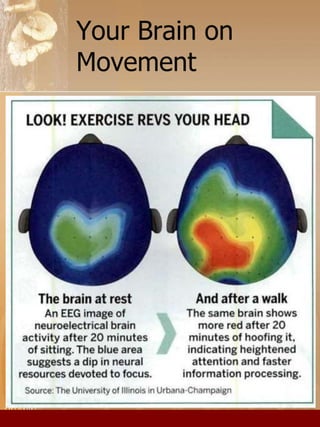
Your Brain on 
Movement
Realities we Face 
 Most UPK programs don’t 
include PE 
 Most PE programs don’t 
include learning targets for 
young children that create 
intentional movements to 
develop and strengthen 
executive function 
 As students age, participation 
in PE and sports tends to wane 
 Most classroom teachers don’t 
know what “intentional 
movement” is or integrate it
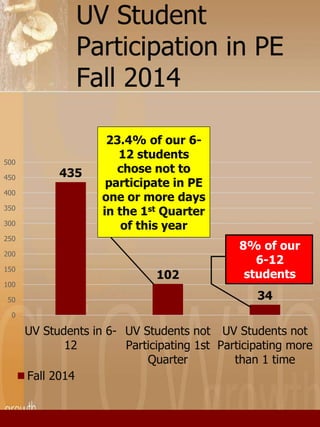
UV Student 
Participation in PE 
Fall 2014 
435 
102 
34 
500 
450 
400 
350 
300 
250 
200 
150 
100 
50 
0 
UV Students in 6- 
12 
UV Students not 
Participating 1st 
Quarter 
UV Students not 
Participating more 
than 1 time 
Fall 2014 
8% of our 
6-12 
students 
23.4% of our 6- 
12 students 
chose not to 
participate in PE 
one or more days 
in the 1st Quarter 
of this year
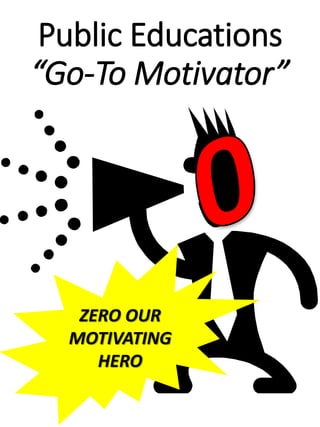
Public Educations 
“Go-To Motivator” 
ZERO OUR 
MOTIVATING 
HERO
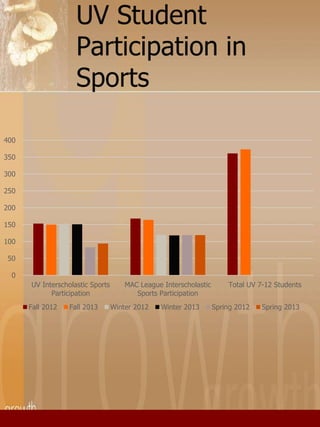
UV Student 
Participation in 
Sports 
400 
350 
300 
250 
200 
150 
100 
50 
0 
UV Interscholastic Sports 
Participation 
MAC League Interscholastic 
Sports Participation 
Total UV 7-12 Students 
Fall 2012 Fall 2013 Winter 2012 Winter 2013 Spring 2012 Spring 2013
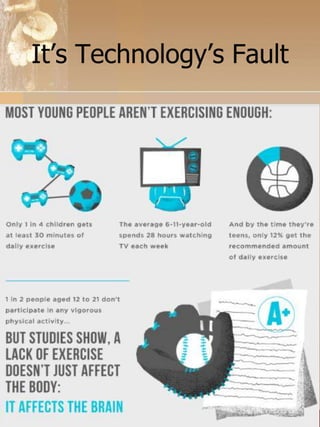
It’s Technology’s Fault
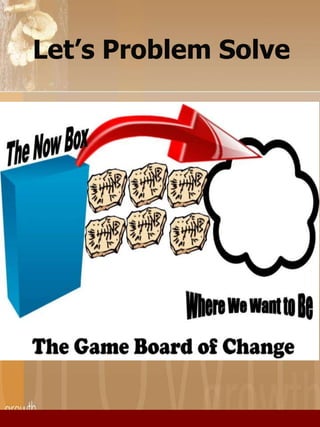
Let’s Problem Solve
Enough Blame to 
go Around 
 Not enough knowledge of the 
new research 
 Not a priority of the BOE or 
Administration 
 No time to plan with 
elementary teachers 
 Lack of professional 
development around 
movement to improve learning 
 Lack of resources like “Tools of 
the Mind”, Action Based 
Learning LAB, Body Brain 
Adventure, etc.
At UV 
 Formed a Professional Learning 
Community 
 PE & Health Team addresses the 
four questions of a PLC 
 What’s essential for all students 
to learn? 
 How do we know they’re 
learning? 
 How do we respond when they 
aren’t learning? 
 How do we respond when they 
are learning?
At UV con’t 
 Include PE, Music, Occupational 
Therapy (OT), and Library time in 
UPK 
 Integrating OT in primary 
classrooms to strengthen fine 
motor skills 
 Integrating Physical Therapy in 
primary PE classes to strengthen 
gross motor skills 
 6-12 grade students have 2-4 
choices of physical activities in PE 
 Implemented athletic program 
improvement plan in 2013-14
We’re Okay Where 
We Are, 
 Need to embed PD on intentional 
movement in PLC meetings 
 Need to update learning targets to 
integrate brain research 
 Need to continue to increase student 
participation in PE & sports 
Step 3 
Increased 
Participation 
Step 2 
C, I, & 
A 
Step 1 
PD 
But, 
We’re 
Okay 
Staying 
Where 
We Are.
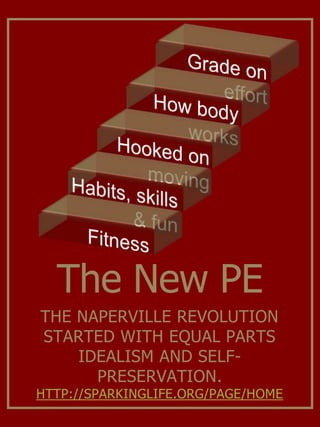
The New PE 
THE NAPERVILLE REVOLUTION 
STARTED WITH EQUAL PARTS 
IDEALISM AND SELF-PRESERVATION. 
HTTP://SPARKINGLIFE.ORG/PAGE/HOME
Executive Function 
“A set of processing skills 
developed in the brain that 
help us focus on multiple 
streams of information at 
the same time, monitor 
errors, make decisions in 
light of available 
information, revise plans as 
necessary, and resist the 
urge to let frustration lead 
to hasty actions.” 
Center on the Developing Child, 
Harvard University

Impactful Leadership Can Improve Physical Education Participation

  • 1.
    Impactful Leadership Can Improve Participation IN PHYSICAL EDUCATION AND INTERSCHOLASTIC ATHLETICS
  • 2.
    A Story onthe Power of Reading & Learning to foster Growth • Honored to be asked, but surprised… • I had just started working on a project as the MAC president... • As a leader focused on participation to prevent dropouts… • Being a learner, I read… • Staunchly believe in the value of scientifically based, research proven strategies to improve learning…
  • 3.
    The Research is Clear  Movement is linked to improved learning  Movement combined with music is linked to even greater learning improvement  Planned, intentional movement with carefully chosen music, combined with cognitive learning targets can lead to significantly improved learning
  • 6.
    “The Survey of Research Says…”  Exercise delivers fuel to the brain  Exercise balances neurotransmitters  Exercise increases memory  Exercise initiates neurogenesis  Exercise creates, activates, & stores BDNF  Exercise increases attention levels  Exercise creates the best environment for neural plasticity  Exercise increases the capacity of executive function
  • 7.
    Executive Function…in Kids  Children rely on their emerging executive function to:  Learn to read & write  Remember steps in performing math problems  Take part in class discussions or group projects  Enter into & sustain play with other children
  • 8.
    What If… Children don’t have opportunities to use and strengthen these skills?  They will likely have a very hard time maintaining routine tasks in life  Studying  Sustaining friendships  Later in life it may manifest in problems  Managing crisis’s  Holding a job
  • 9.
    “Through CREATIVE PLAY, GAMES, and schoolwork, children practice integrating their attention, working memory, and self-control to support planning, flexible problem-solving, and sustained engagement. “ Center on the Developing Child, Harvard University
  • 10.
    Your Brain on Movement
  • 11.
    Realities we Face  Most UPK programs don’t include PE  Most PE programs don’t include learning targets for young children that create intentional movements to develop and strengthen executive function  As students age, participation in PE and sports tends to wane  Most classroom teachers don’t know what “intentional movement” is or integrate it
  • 12.
    UV Student Participationin PE Fall 2014 435 102 34 500 450 400 350 300 250 200 150 100 50 0 UV Students in 6- 12 UV Students not Participating 1st Quarter UV Students not Participating more than 1 time Fall 2014 8% of our 6-12 students 23.4% of our 6- 12 students chose not to participate in PE one or more days in the 1st Quarter of this year
  • 13.
    Public Educations “Go-ToMotivator” ZERO OUR MOTIVATING HERO
  • 14.
    UV Student Participationin Sports 400 350 300 250 200 150 100 50 0 UV Interscholastic Sports Participation MAC League Interscholastic Sports Participation Total UV 7-12 Students Fall 2012 Fall 2013 Winter 2012 Winter 2013 Spring 2012 Spring 2013
  • 15.
  • 16.
  • 17.
    Enough Blame to go Around  Not enough knowledge of the new research  Not a priority of the BOE or Administration  No time to plan with elementary teachers  Lack of professional development around movement to improve learning  Lack of resources like “Tools of the Mind”, Action Based Learning LAB, Body Brain Adventure, etc.
  • 18.
    At UV Formed a Professional Learning Community  PE & Health Team addresses the four questions of a PLC  What’s essential for all students to learn?  How do we know they’re learning?  How do we respond when they aren’t learning?  How do we respond when they are learning?
  • 19.
    At UV con’t  Include PE, Music, Occupational Therapy (OT), and Library time in UPK  Integrating OT in primary classrooms to strengthen fine motor skills  Integrating Physical Therapy in primary PE classes to strengthen gross motor skills  6-12 grade students have 2-4 choices of physical activities in PE  Implemented athletic program improvement plan in 2013-14
  • 20.
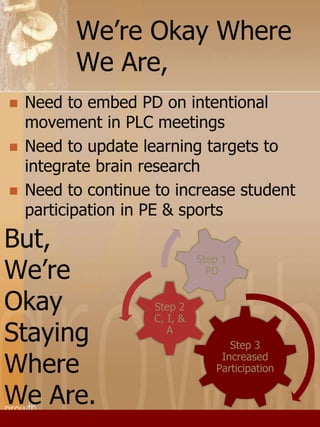
    We’re Okay Where We Are,  Need to embed PD on intentional movement in PLC meetings  Need to update learning targets to integrate brain research  Need to continue to increase student participation in PE & sports Step 3 Increased Participation Step 2 C, I, & A Step 1 PD But, We’re Okay Staying Where We Are.
  • 21.
    The New PE THE NAPERVILLE REVOLUTION STARTED WITH EQUAL PARTS IDEALISM AND SELF-PRESERVATION. HTTP://SPARKINGLIFE.ORG/PAGE/HOME
  • 22.
    Executive Function “Aset of processing skills developed in the brain that help us focus on multiple streams of information at the same time, monitor errors, make decisions in light of available information, revise plans as necessary, and resist the urge to let frustration lead to hasty actions.” Center on the Developing Child, Harvard University

Editor's Notes

  • #3 Just an average social studies teacher and one of those CCSS loving superintendents! Asking questions of our AD’s like what are the mission, vision, and beliefs of our athletic conference? Trying to close the white space to 100% graduation rate, realizing the importance participation in athletics and clubs plays in keeping kids in school Knowing that wasn’t going to be enough to prepare me for this presentation, I searched and read articles about brain research and movement You know when you have one of those “A-HA” moments, I had that as I read Advocate for changing professional practice in education (PLC and the research behind it) Advocate for the power of the “Other 60” in APPR to change teacher and principal focus Advocate of the Inquiry Approach to learning embodied in the CCSS (not to mention my favorite social studies textbooks published in 1968) Advocate for family based early childhood literacy and learning programs Advocate for preventative services like OT, PT, and Speech among others SO, WHY DID I NEVER REVIEW THE RESEARCH ON MOVEMENT AND LEARNING? WHY DIDN’T THAT COMEUP IN MY ADMINISTRATIVE COURSEWORK? THIS COULD BE A KEY PART OF CLOSING THE WHITE SPACE TO A 100% GRADUATION RATE!!!
  • #4 Who am I kidding? My wife has been a PE and Health teacher since 1989 and our secondary principal is a 20+ year veteran PE teacher prior to his move to administration and both have reviewed this and listened to me go on and on about this research. I could sense they were thinking “if you had asked I could have told you that.” They were patient with my “kid in a candy store” findings, as I hope you will be since it is my guess you already know all of this stuff too!
  • #5 Listening to music causes nearly every part of your brain to light up, combine that with movement and your brain scan will be bright enough the Dr. might need shades! Kata’s in Karate!
  • #6 Of course, there is always an anomaly to every research supported concept. College kids on spring break combine music and movement and Dr.’s need artificial light to be brought in to read their brain scans that week!
  • #7 Fuel like glucose and oxygen Neurotransmitters are chemicals in the brain that regulate body and mind functions as well as our behaviors By strengthening dendritic branching responsible for memory retention and retrieval The growth of new brain cells BDNF is brain derived neurotropic factor or growth factor, essential for brain growth By aiding in the development of the cerebellum Creating an environment where the brain can change “A set of processing skills developed in the brain that help us focus on multiple streams of information at the same time, monitor errors, make decisions in light of available information, revise plans as necessary, and resist the urge to let frustration lead to hasty actions.” Center on the Developing Child, Harvard University
  • #8 Maybe it isn’t a reading problem, or a math problem, or a dropout problem, maybe it’s an executive function problem.
  • #9 If we don’t address this problem, there are repercussions that may cost schools and society a lot of money and other resources.
  • #10 Play, with intentional movement or purpose, can improve learning!
  • #11 Once teachers learn this, who wouldn’t want PE first thing in the morning, every morning?
  • #13 The 1st Quarter for 6-8 was 10 weeks long and 35 total students chose not to participate one or more days in PE. The 1st Quarter for 9-12 was 5 weeks long and 67 total students chose not to participate one or more days in PE. 34 students in grades 6-12 didn’t change and didn’t participate in PE class more than 1 time in the 1st Quarter.
  • #14 So after all our rationalizations fail to improve participation, we turn to the age old teacher of responsibility in public school’s, “Zero the Hero!”
  • #15 While we may be similar to the MAC League, the average % of participation in our school is 41% for Fall and Winter sports and 24% for Spring sports.
  • #16 The decrease in participation is attributed to the family, cell phones, computers, video games, and TV. I WOULD ASK, DO WE AS EDUCATORS HAVE THE ABILITY CONTROL THIS? In the 2010 study titled “Television Viewing and Mortality”, they found that our sedentary lifestyle has a negative impact on increased risks of death connected to watching TV more than 4 hours per day. 40% increased risk of death from all causes and 80% increased risk of death from CVD.
  • #17 This is a process I use with administrators, teachers, support staff, students, and parents to create common visions, strategic plans, and/or problem solve. In this sample I started with the “Now Box” which assesses our current state. Then moved you to the “Where We Want to Be” area which identifies our preferred state. Normally you’d reverse this process if done with a white board, however I have done it live with groups either way depending on the issue. Lastly, you build key steps to move from your “now Box” to your vision of “Where you Want to Be.” Disney’s “Storyboarding” with sticky notes is a great way to identify key steps to take to begin moving toward your vision. The sample steps include: Updating training for PE and Health teachers around the research connecting exercise with brain growth and improved learning. Providing “turnkey” training for PE and Health teachers in strengthening executive function and intentional movement in the classroom Providing time for the PE and Health teachers to review and redesign the district PK-12 PE & Health Curriculum to incorporate learning targets and activities to develop and/or strengthen executive function and grow the brain as students move from early childhood through adolescence Have PE and Health teachers provide training for PK-12 grade teachers around designing and facilitating intentional movement into the classroom PE and Health teachers redesign their grading system to reward activity as a means to promote a growth mindset among students when it comes to physical activity (and retire “Zero the Hero”) PE and Health teachers regularly assess student growth at all levels and teach students to self assess at a very young age. Also, they need to at least annually assess the new program to determine if it is meeting the desired outcome…improved student learning through growth in physical activity.
  • #18 Not sure I need this slide?
  • #19 I believe we have implemented a lot to improve our PE programs, but the learning this preparation has taught me is that we can do even better!
  • #20 I believe we have implemented a lot to improve our PE programs, but the learning this preparation has taught me is that we can do even better!
  • #21 I believe we have implemented a lot to improve our PE programs, but the learning this preparation has taught me is that we can do even better!
  • #22 The essence of physical education in Naperville 203 is teaching fitness instead of sports. What’s being taught is a lifestyle. The students are developing healthy habits, skills, and a sense of fun, along with knowledge of how their bodies work. They’re getting kids hooked on moving instead of sitting in front of the television. Despite groans from students, complaints from parents, and notes from doctors he was undeterred - although he quickly recognized that the grading scale discouraged the slowest runners. To offer nonathletes a shot at good marks, the department bought a couple of stationary bikes and allowed students to earn extra credit. This evolved into personal bests and what he dubbed the New PE: Students would be assessed on effort rather than skill. Soon heart rate monitors were incorporated, and Naperville’s gym students were graded on how much time they spent in their target heart rate zones during any given activity.
  • #23 This is in my notes earlier, however does it have a place as a slide?