Disrupting Poverty
…A Rural Imperative
Presented at the Colton-Pierrepont Central School District
January 13, 2017
Robert Mackey, Superintendent, Unadilla Valley CSD
Steve Bliss, CIO, Unadilla Valley CSD
Education is the great equalizer. Horace Mann
If you work hard, do well in school, and follow the rules,
you can be anything you want to be. My Dad (maybe yours too!)
Education is the key to unlock the golden door of freedom.
George Washington Carver
Education is the most powerful weapon which you can use
to change the world. Nelson Mandela
I simply cannot understand the experiences of
economically disadvantaged students and their families, or
how they relate to school, or how best to engage them, if I
do not consider what it means to be poor in contemporary
society and its schools. Paul Gorski
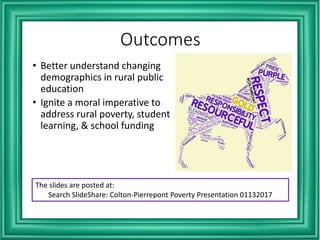
Outcomes
• Better understand changing
demographics in rural public
education
• Ignite a moral imperative to
address rural poverty, student
learning, & school funding
The slides are posted at:
Search SlideShare: Colton-Pierrepont Poverty Presentation 01132017
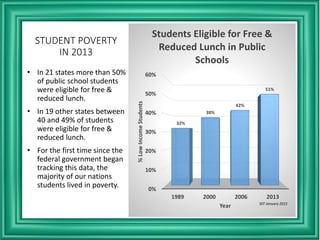
STUDENT POVERTY
IN 2013
• In 21 states more than 50%
of public school students
were eligible for free &
reduced lunch.
• In 19 other states between
40 and 49% of students
were eligible for free &
reduced lunch.
• For the first time since the
federal government began
tracking this data, the
majority of our nations
students lived in poverty. 0%
10%
20%
30%
40%
50%
60%
1989 2000 2006 2013
32%
38%
42%
51%
%LowIncomeStudents
Year
Students Eligible for Free &
Reduced Lunch in Public
Schools
SEF January 2015
How do we define Poverty?
• Poverty is a state of deprivation, lacking the usual
or socially acceptable amount of money or material
possessions. (Merriam-Webster)
• The most common measure of poverty in the U.S.
is the "poverty threshold" set by the U.S.
government. This measure recognizes poverty as a
lack of those goods and services commonly taken
for granted by members of mainstream society.
The official threshold is adjusted for inflation using
the consumer price index. (U.S. Census Bureau)
Jensen’s definition of
Poverty
Poverty is a chronic experience
resulting from an aggregate of
adverse social and economic risk
factors. (Poor Students, Rich
Learning 2016)
“Human and social capital helps
families improve their earnings
potential and accumulate assets,
gain access to safe neighborhoods
and high quality services (such as
medical care, schooling), and expand
their networks and social
connections.”
-National Center for Children in Poverty, May 2008
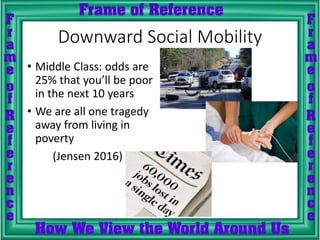
Downward Social Mobility
• Middle Class: odds are
25% that you’ll be poor
in the next 10 years
• We are all one tragedy
away from living in
poverty
(Jensen 2016)
Risk Factors Associated
with Poverty and Learning
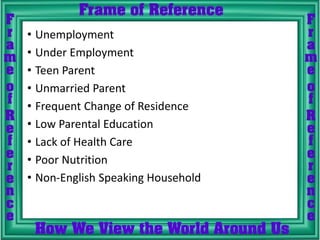
• Unemployment
• Under Employment
• Teen Parent
• Unmarried Parent
• Frequent Change of Residence
• Low Parental Education
• Lack of Health Care
• Poor Nutrition
• Non-English Speaking Household
How These Risk Factors Effect Kids
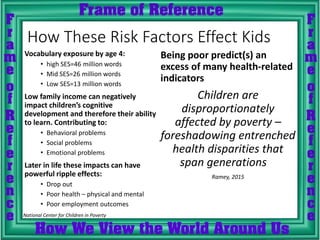
Vocabulary exposure by age 4:
• high SES=46 million words
• Mid SES=26 million words
• Low SES=13 million words
Low family income can negatively
impact children’s cognitive
development and therefore their ability
to learn. Contributing to:
• Behavioral problems
• Social problems
• Emotional problems
Later in life these impacts can have
powerful ripple effects:
• Drop out
• Poor health – physical and mental
• Poor employment outcomes
Being poor predict(s) an
excess of many health-related
indicators
Children are
disproportionately
affected by poverty –
foreshadowing entrenched
health disparities that
span generations
Ramey, 2015
National Center for Children in Poverty
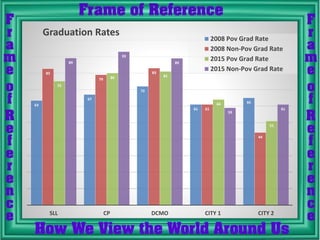
63
67
72
61
65
83
79
83
61
44
75
80 81
64
51
89
93
89
59
61
SLL CP DCMO CITY 1 CITY 2
Graduation Rates
2008 Pov Grad Rate
2008 Non-Pov Grad Rate
2015 Pov Grad Rate
2015 Non-Pov Grad Rate
0%
10%
20%
30%
40%
50%
60%
70%
80%
1 2 3 4
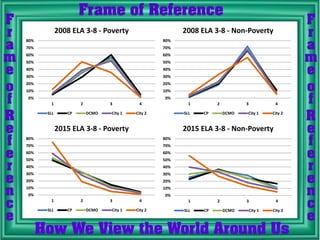
2008 ELA 3-8 - Poverty
SLL CP DCMO City 1 City 2
0%
10%
20%
30%
40%
50%
60%
70%
80%
1 2 3 4
2015 ELA 3-8 - Poverty
SLL CP DCMO City 1 City 2
0%
10%
20%
30%
40%
50%
60%
70%
80%
1 2 3 4
2008 ELA 3-8 - Non-Poverty
SLL CP DCMO City 1 City 2
0%
10%
20%
30%
40%
50%
60%
70%
80%
1 2 3 4
2015 ELA 3-8 - Non-Poverty
SLL CP DCMO City 1 City 2
0%
10%
20%
30%
40%
50%
60%
70%
80%
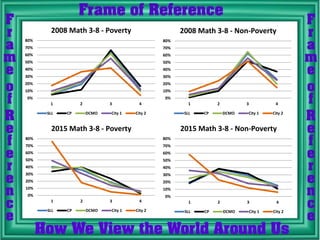
1 2 3 4
2008 Math 3-8 - Poverty
SLL CP DCMO City 1 City 2
0%
10%
20%
30%
40%
50%
60%
70%
80%
1 2 3 4
2015 Math 3-8 - Poverty
SLL CP DCMO City 1 City 2
0%
10%
20%
30%
40%
50%
60%
70%
80%
1 2 3 4
2008 Math 3-8 - Non-Poverty
SLL CP DCMO City 1 City 2
0%
10%
20%
30%
40%
50%
60%
70%
80%
1 2 3 4
2015 Math 3-8 - Non-Poverty
SLL CP DCMO City 1 City 2
0%
10%
20%
30%
40%
50%
60%
70%
80%
90%
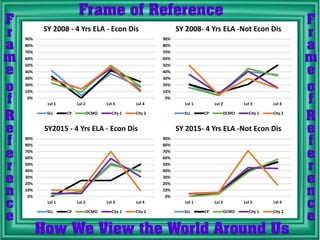
Lvl 1 Lvl 2 Lvl 3 Lvl 4
SY 2008 - 4 Yrs ELA - Econ Dis
SLL CP DCMO City 1 City 2
0%
10%
20%
30%
40%
50%
60%
70%
80%
90%
Lvl 1 Lvl 2 Lvl 3 Lvl 4
SY 2008- 4 Yrs ELA -Not Econ Dis
SLL CP DCMO City 1 City 2
0%
10%
20%
30%
40%
50%
60%
70%
80%
90%
Lvl 1 Lvl 2 Lvl 3 Lvl 4
SY2015 - 4 Yrs ELA - Econ Dis
SLL CP DCMO City 1 City 2
0%
10%
20%
30%
40%
50%
60%
70%
80%
90%
Lvl 1 Lvl 2 Lvl 3 Lvl 4
SY 2015- 4 Yrs ELA -Not Econ Dis
SLL CP DCMO City 1 City 2
0%
10%
20%
30%
40%
50%
60%
70%
80%
90%
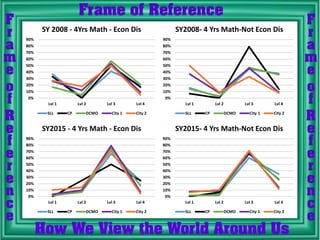
Lvl 1 Lvl 2 Lvl 3 Lvl 4
SY 2008 - 4Yrs Math - Econ Dis
SLL CP DCMO City 1 City 2
0%
10%
20%
30%
40%
50%
60%
70%
80%
90%
Lvl 1 Lvl 2 Lvl 3 Lvl 4
SY2008- 4 Yrs Math-Not Econ Dis
SLL CP DCMO City 1 City 2
0%
10%
20%
30%
40%
50%
60%
70%
80%
90%
Lvl 1 Lvl 2 Lvl 3 Lvl 4
SY2015 - 4 Yrs Math - Econ Dis
SLL CP DCMO City 1 City 2
0%
10%
20%
30%
40%
50%
60%
70%
80%
90%
Lvl 1 Lvl 2 Lvl 3 Lvl 4
SY2015- 4 Yrs Math-Not Econ Dis
SLL CP DCMO City 1 City 2
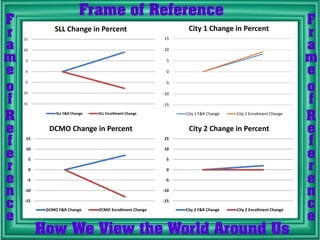
-15
-10
-5
0
5
10
15
SLL Change in Percent
SLL F&R Change SLL Enrollment Change
-15
-10
-5
0
5
10
15
DCMO Change in Percent
DCMO F&R Change DCMO Enrollment Change
-15
-10
-5
0
5
10
15
City 2 Change in Percent
City 2 F&R Change City 2 Enrollment Change
-15
-10
-5
0
5
10
15
City 1 Change in Percent
City 1 F&R Change City 1 Enrollment Change
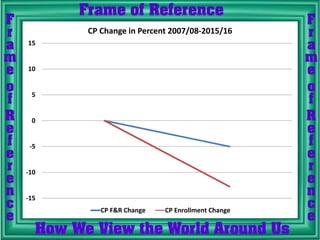
-15
-10
-5
0
5
10
15
CP Change in Percent 2007/08-2015/16
CP F&R Change CP Enrollment Change
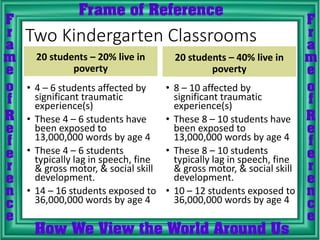
Two Kindergarten Classrooms
20 students – 20% live in
poverty
• 4 – 6 students affected by
significant traumatic
experience(s)
• These 4 – 6 students have
been exposed to
13,000,000 words by age 4
• These 4 – 6 students
typically lag in speech, fine
& gross motor, & social skill
development.
• 14 – 16 students exposed to
36,000,000 words by age 4
20 students – 40% live in
poverty
• 8 – 10 affected by
significant traumatic
experience(s)
• These 8 – 10 students have
been exposed to
13,000,000 words by age 4
• These 8 – 10 students
typically lag in speech, fine
& gross motor, & social skill
development.
• 10 – 12 students exposed to
36,000,000 words by age 4
What supports will each teacher
need to guarantee at least grade-
level proficiency for 100% of their
students this year?
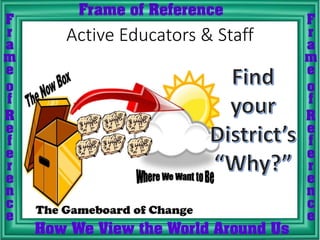
Active Educators & Staff
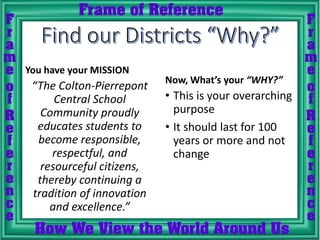
You have your MISSION
Now, What’s your “WHY?”
• This is your overarching
purpose
• It should last for 100
years or more and not
change
“The Colton-Pierrepont
Central School
Community proudly
educates students to
become responsible,
respectful, and
resourceful citizens,
thereby continuing a
tradition of innovation
and excellence.”
INTERVENTION
DISRUPTION
&
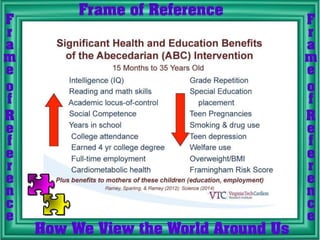
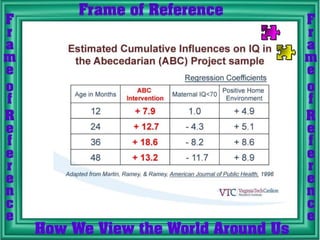
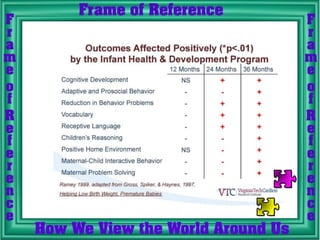
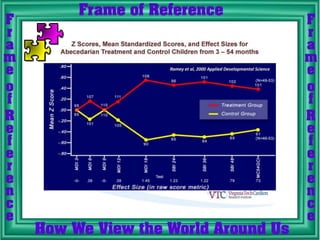
Ramey & Ramey, 2000
A Commitment to
Improving
K-12 Educational
Achievement
Begins in the First 5
Years of Life
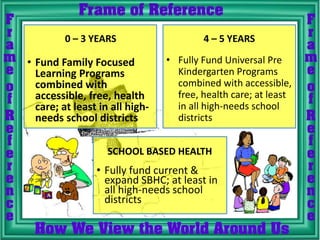
• Fund Family Focused
Learning Programs
combined with
accessible, free, health
care; at least in all high-
needs school districts
0 – 3 YEARS
• Fully fund current &
expand SBHC; at least in
all high-needs school
districts
SCHOOL BASED HEALTH
• Fully Fund Universal Pre
Kindergarten Programs
combined with accessible,
free, health care; at least
in all high-needs school
districts
4 – 5 YEARS
McLaughlin & Talbert, 2006
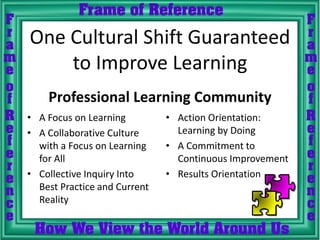
One Cultural Shift Guaranteed
to Improve Learning
Professional Learning Community
• A Focus on Learning
• A Collaborative Culture
with a Focus on Learning
for All
• Collective Inquiry Into
Best Practice and Current
Reality
• Action Orientation:
Learning by Doing
• A Commitment to
Continuous Improvement
• Results Orientation
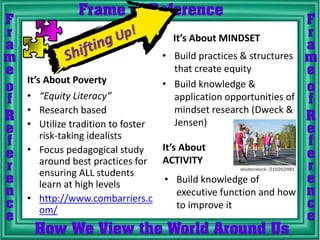
It’s About Poverty
• “Equity Literacy”
• Research based
• Utilize tradition to foster
risk-taking idealists
• Focus pedagogical study
around best practices for
ensuring ALL students
learn at high levels
• http://www.combarriers.c
om/
• Build practices & structures
that create equity
• Build knowledge &
application opportunities of
mindset research (Dweck &
Jensen)
It’s About
ACTIVITY
• Build knowledge of
executive function and how
to improve it
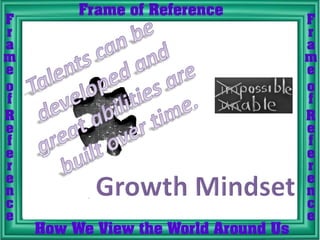
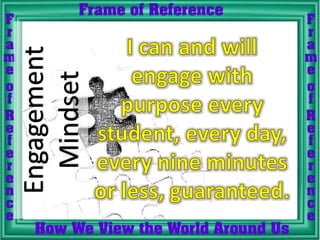
It’s About MINDSET
Achievement
Mindset
Rich Classroom
Mindset
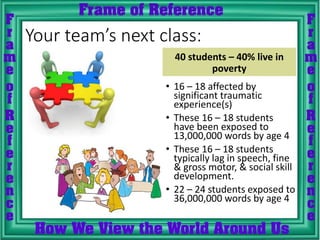
Your team’s next class:
40 students – 40% live in
poverty
• 16 – 18 affected by
significant traumatic
experience(s)
• These 16 – 18 students
have been exposed to
13,000,000 words by age 4
• These 16 – 18 students
typically lag in speech, fine
& gross motor, & social skill
development.
• 22 – 24 students exposed to
36,000,000 words by age 4
I’m from the government
and I’m here to help.
The potential changes on the horizon for defining
poverty in NYS
CPRL
Center for Public Research and Leadership
James S. Liebman, Director
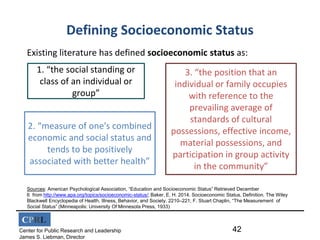
Defining Socioeconomic Status
42
1. “the social standing or
class of an individual or
group”
3. “the position that an
individual or family occupies
with reference to the
prevailing average of
standards of cultural
possessions, effective income,
material possessions, and
participation in group activity
in the community”
2. “measure of one's combined
economic and social status and
tends to be positively
associated with better health”
Existing literature has defined socioeconomic status as:
Sources: American Psychological Association, “Education and Socioeconomic Status” Retrieved December
6 from http://www.apa.org/topics/socioeconomic-status/; Baker, E. H. 2014. Socioeconomic Status, Definition. The Wiley
Blackwell Encyclopedia of Health, Illness, Behavior, and Society. 2210–221; F. Stuart Chaplin, “The Measurement of
Social Status” (Minneapolis: University Of Minnesota Press, 1933)
CPRL
Center for Public Research and Leadership
James S. Liebman, Director
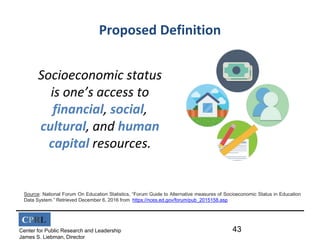
Proposed Definition
43
Socioeconomic status
is one’s access to
financial, social,
cultural, and human
capital resources.
Source: National Forum On Education Statistics, “Forum Guide to Alternative measures of Socioeconomic Status in Education
Data System.” Retrieved December 6, 2016 from https://nces.ed.gov/forum/pub_2015158.asp
CPRL
Center for Public Research and Leadership
James S. Liebman, Director
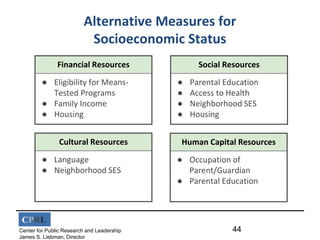
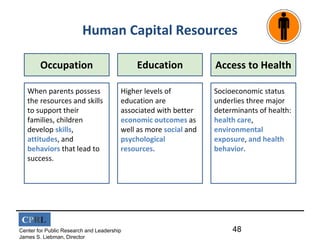
Human Capital Resources
● Occupation of
Parent/Guardian
● Parental Education
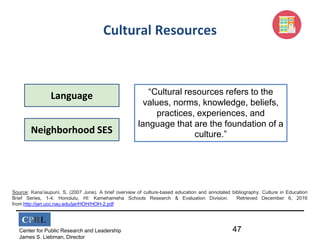
Cultural Resources
● Language
● Neighborhood SES
Financial Resources
● Eligibility for Means-
Tested Programs
● Family Income
● Housing
Alternative Measures for
Socioeconomic Status
44
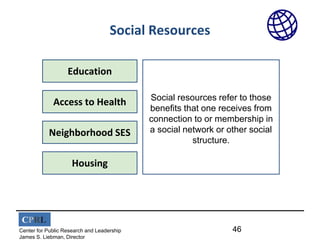
Social Resources
● Parental Education
● Access to Health
● Neighborhood SES
● Housing
CPRL
Center for Public Research and Leadership
James S. Liebman, Director
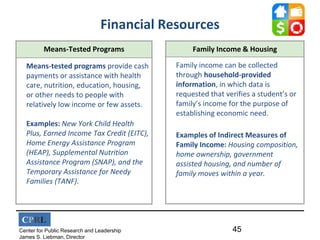
Financial Resources
45
Means-Tested Programs
Means-tested programs provide cash
payments or assistance with health
care, nutrition, education, housing,
or other needs to people with
relatively low income or few assets.
Examples: New York Child Health
Plus, Earned Income Tax Credit (EITC),
Home Energy Assistance Program
(HEAP), Supplemental Nutrition
Assistance Program (SNAP), and the
Temporary Assistance for Needy
Families (TANF).
Family Income & Housing
Family income can be collected
through household-provided
information, in which data is
requested that verifies a student’s or
family’s income for the purpose of
establishing economic need.
Examples of Indirect Measures of
Family Income: Housing composition,
home ownership, government
assisted housing, and number of
family moves within a year.
CPRL
Center for Public Research and Leadership
James S. Liebman, Director
Social Resources
46
Education
Access to Health
Housing
Neighborhood SES
Social resources refer to those
benefits that one receives from
connection to or membership in
a social network or other social
structure.
CPRL
Center for Public Research and Leadership
James S. Liebman, Director
Cultural Resources
47
Language
Neighborhood SES
“Cultural resources refers to the
values, norms, knowledge, beliefs,
practices, experiences, and
language that are the foundation of a
culture.”
Source: Kana’iaupuni, S. (2007 June). A brief overview of culture-based education and annotated bibliography. Culture in Education
Brief Series, 1-4. Honolulu, HI: Kamehameha Schools Research & Evaluation Division. Retrieved December 6, 2016
from http://jan.ucc.nau.edu/jar/HOH/HOH-2.pdf
CPRL
Center for Public Research and Leadership
James S. Liebman, Director
Human Capital Resources
48
Occupation Education Access to Health
When parents possess
the resources and skills
to support their
families, children
develop skills,
attitudes, and
behaviors that lead to
success.
Higher levels of
education are
associated with better
economic outcomes as
well as more social and
psychological
resources.
Socioeconomic status
underlies three major
determinants of health:
health care,
environmental
exposure, and health
behavior.
CPRL
Center for Public Research and Leadership
James S. Liebman, Director
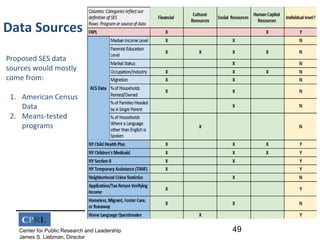
Proposed SES data
sources would mostly
come from:
1. American Census
Data
2. Means-tested
programs
49
Data Sources
CREATE A CULTURE OF EQUITY &
LEARNING FOR EVERYONE
Take the road less traveled and work collaboratively so it
makes all the difference!
Contact and Copy of Presentation
Unadilla Valley Central School District
4238 State Rte 8
New Berlin, NY 13411
P:(607)847-7500
F:(607)847-6924
Web Page: www.uvstorm.org
Facebook:
https://www.facebook.com/pages/U
nadilla-Valley-Central-School-
District/340853612739318?ref=book
marks
Email: rmackey@uvstorm.org
• Presentation link:
Search SlideShare:
Colton-Pierrepont
Poverty
Presentation
01132017
References• Dr. Craig Ramey – http://research.vtc.vt.edu/people/craig-ramey/ and Abecedarian Project as of October 2015.
• Communication Across Barriers – http://www.combarriers.com/ &
https://www2.ed.gov/programs/slcp/2012thematicmtg/studentpovty.pdf
• National Center for Children in Poverty –
• Jensen, Eric (2016). Poor Students, Rich Teaching: Mindsets for Change. Bloomington, IN: Solution Tree Press.
• Jensen, Eric (2013). How Poverty Affects Classroom Engagement. Educational Leadership, volume 70, pages24-
30.
• National Center for Education Statistics – https://nces.ed.gov/
• U.S. Census Bureau – http://www.census.gov/did/www/saipe/methods/schools/data/20102014.html
• The New York Center for Rural Schools – http://www.nyruralschools.org/w/data-tools/#.V36HC7fmrcs
• Social Security Office of Retirement and Disability Policy, Annual Statistical Supplement, 2014 –
https://www.ssa.gov/policy/docs/statcomps/supplement/2014/3e.html
• The Brookings Institution, Losing Ground: Income and Poverty in Upstate New York, 1980-2000 –
http://www.brookings.edu/~/media/research/files/reports/2004/9/demographics-
pendall/20040914_pendall.pdf
• U.S. Department of Health and Human Services, Poverty Guidelines – https://aspe.hhs.gov/2015-poverty-
guidelines
• Center for Public Education – http://www.centerforpubliceducation.org/You-May-Also-Be-Interested-In-landing-
page-level/Organizing-a-School-YMABI/The-United-States-of-education-The-changing-demographics-of-the-
United-States-and-their-schools.html
• Southern Education Foundation (2015). A New Majority: Low Income Students Now a Majority In the Nation’s
Public Schools. http://www.southerneducation.org/getattachment/4ac62e27-5260-47a5-9d02-
14896ec3a531/A-New-Majority-2015-Update-Low-Income-Students-Now.aspx
• Gorski, Paul C (May, 2016). Re-examining Beliefs About Students in Poverty. School Administrator, pages 17-20.
• Tine, Michele T. (March 2106). Different Worlds: Rural and Urban Poverty. School Administrator, pages 38-40.

Colton-Pierrepont Poverty Presentation 01132017

  • 1.
    Disrupting Poverty …A RuralImperative Presented at the Colton-Pierrepont Central School District January 13, 2017 Robert Mackey, Superintendent, Unadilla Valley CSD Steve Bliss, CIO, Unadilla Valley CSD
  • 2.
    Education is thegreat equalizer. Horace Mann If you work hard, do well in school, and follow the rules, you can be anything you want to be. My Dad (maybe yours too!) Education is the key to unlock the golden door of freedom. George Washington Carver Education is the most powerful weapon which you can use to change the world. Nelson Mandela I simply cannot understand the experiences of economically disadvantaged students and their families, or how they relate to school, or how best to engage them, if I do not consider what it means to be poor in contemporary society and its schools. Paul Gorski
  • 3.
    Outcomes • Better understandchanging demographics in rural public education • Ignite a moral imperative to address rural poverty, student learning, & school funding The slides are posted at: Search SlideShare: Colton-Pierrepont Poverty Presentation 01132017
  • 4.
    STUDENT POVERTY IN 2013 •In 21 states more than 50% of public school students were eligible for free & reduced lunch. • In 19 other states between 40 and 49% of students were eligible for free & reduced lunch. • For the first time since the federal government began tracking this data, the majority of our nations students lived in poverty. 0% 10% 20% 30% 40% 50% 60% 1989 2000 2006 2013 32% 38% 42% 51% %LowIncomeStudents Year Students Eligible for Free & Reduced Lunch in Public Schools SEF January 2015
  • 5.
    How do wedefine Poverty? • Poverty is a state of deprivation, lacking the usual or socially acceptable amount of money or material possessions. (Merriam-Webster) • The most common measure of poverty in the U.S. is the "poverty threshold" set by the U.S. government. This measure recognizes poverty as a lack of those goods and services commonly taken for granted by members of mainstream society. The official threshold is adjusted for inflation using the consumer price index. (U.S. Census Bureau)
  • 6.
    Jensen’s definition of Poverty Povertyis a chronic experience resulting from an aggregate of adverse social and economic risk factors. (Poor Students, Rich Learning 2016)
  • 7.
    “Human and socialcapital helps families improve their earnings potential and accumulate assets, gain access to safe neighborhoods and high quality services (such as medical care, schooling), and expand their networks and social connections.” -National Center for Children in Poverty, May 2008
  • 8.
    Downward Social Mobility •Middle Class: odds are 25% that you’ll be poor in the next 10 years • We are all one tragedy away from living in poverty (Jensen 2016)
  • 9.
    Risk Factors Associated withPoverty and Learning
  • 10.
    • Unemployment • UnderEmployment • Teen Parent • Unmarried Parent • Frequent Change of Residence • Low Parental Education • Lack of Health Care • Poor Nutrition • Non-English Speaking Household
  • 11.
    How These RiskFactors Effect Kids Vocabulary exposure by age 4: • high SES=46 million words • Mid SES=26 million words • Low SES=13 million words Low family income can negatively impact children’s cognitive development and therefore their ability to learn. Contributing to: • Behavioral problems • Social problems • Emotional problems Later in life these impacts can have powerful ripple effects: • Drop out • Poor health – physical and mental • Poor employment outcomes Being poor predict(s) an excess of many health-related indicators Children are disproportionately affected by poverty – foreshadowing entrenched health disparities that span generations Ramey, 2015 National Center for Children in Poverty
  • 12.
    63 67 72 61 65 83 79 83 61 44 75 80 81 64 51 89 93 89 59 61 SLL CPDCMO CITY 1 CITY 2 Graduation Rates 2008 Pov Grad Rate 2008 Non-Pov Grad Rate 2015 Pov Grad Rate 2015 Non-Pov Grad Rate
  • 13.
    0% 10% 20% 30% 40% 50% 60% 70% 80% 1 2 34 2008 ELA 3-8 - Poverty SLL CP DCMO City 1 City 2 0% 10% 20% 30% 40% 50% 60% 70% 80% 1 2 3 4 2015 ELA 3-8 - Poverty SLL CP DCMO City 1 City 2 0% 10% 20% 30% 40% 50% 60% 70% 80% 1 2 3 4 2008 ELA 3-8 - Non-Poverty SLL CP DCMO City 1 City 2 0% 10% 20% 30% 40% 50% 60% 70% 80% 1 2 3 4 2015 ELA 3-8 - Non-Poverty SLL CP DCMO City 1 City 2
  • 14.
    0% 10% 20% 30% 40% 50% 60% 70% 80% 1 2 34 2008 Math 3-8 - Poverty SLL CP DCMO City 1 City 2 0% 10% 20% 30% 40% 50% 60% 70% 80% 1 2 3 4 2015 Math 3-8 - Poverty SLL CP DCMO City 1 City 2 0% 10% 20% 30% 40% 50% 60% 70% 80% 1 2 3 4 2008 Math 3-8 - Non-Poverty SLL CP DCMO City 1 City 2 0% 10% 20% 30% 40% 50% 60% 70% 80% 1 2 3 4 2015 Math 3-8 - Non-Poverty SLL CP DCMO City 1 City 2
  • 15.
    0% 10% 20% 30% 40% 50% 60% 70% 80% 90% Lvl 1 Lvl2 Lvl 3 Lvl 4 SY 2008 - 4 Yrs ELA - Econ Dis SLL CP DCMO City 1 City 2 0% 10% 20% 30% 40% 50% 60% 70% 80% 90% Lvl 1 Lvl 2 Lvl 3 Lvl 4 SY 2008- 4 Yrs ELA -Not Econ Dis SLL CP DCMO City 1 City 2 0% 10% 20% 30% 40% 50% 60% 70% 80% 90% Lvl 1 Lvl 2 Lvl 3 Lvl 4 SY2015 - 4 Yrs ELA - Econ Dis SLL CP DCMO City 1 City 2 0% 10% 20% 30% 40% 50% 60% 70% 80% 90% Lvl 1 Lvl 2 Lvl 3 Lvl 4 SY 2015- 4 Yrs ELA -Not Econ Dis SLL CP DCMO City 1 City 2
  • 16.
    0% 10% 20% 30% 40% 50% 60% 70% 80% 90% Lvl 1 Lvl2 Lvl 3 Lvl 4 SY 2008 - 4Yrs Math - Econ Dis SLL CP DCMO City 1 City 2 0% 10% 20% 30% 40% 50% 60% 70% 80% 90% Lvl 1 Lvl 2 Lvl 3 Lvl 4 SY2008- 4 Yrs Math-Not Econ Dis SLL CP DCMO City 1 City 2 0% 10% 20% 30% 40% 50% 60% 70% 80% 90% Lvl 1 Lvl 2 Lvl 3 Lvl 4 SY2015 - 4 Yrs Math - Econ Dis SLL CP DCMO City 1 City 2 0% 10% 20% 30% 40% 50% 60% 70% 80% 90% Lvl 1 Lvl 2 Lvl 3 Lvl 4 SY2015- 4 Yrs Math-Not Econ Dis SLL CP DCMO City 1 City 2
  • 17.
    -15 -10 -5 0 5 10 15 SLL Change inPercent SLL F&R Change SLL Enrollment Change -15 -10 -5 0 5 10 15 DCMO Change in Percent DCMO F&R Change DCMO Enrollment Change -15 -10 -5 0 5 10 15 City 2 Change in Percent City 2 F&R Change City 2 Enrollment Change -15 -10 -5 0 5 10 15 City 1 Change in Percent City 1 F&R Change City 1 Enrollment Change
  • 18.
    -15 -10 -5 0 5 10 15 CP Change inPercent 2007/08-2015/16 CP F&R Change CP Enrollment Change
  • 19.
    Two Kindergarten Classrooms 20students – 20% live in poverty • 4 – 6 students affected by significant traumatic experience(s) • These 4 – 6 students have been exposed to 13,000,000 words by age 4 • These 4 – 6 students typically lag in speech, fine & gross motor, & social skill development. • 14 – 16 students exposed to 36,000,000 words by age 4 20 students – 40% live in poverty • 8 – 10 affected by significant traumatic experience(s) • These 8 – 10 students have been exposed to 13,000,000 words by age 4 • These 8 – 10 students typically lag in speech, fine & gross motor, & social skill development. • 10 – 12 students exposed to 36,000,000 words by age 4
  • 20.
    What supports willeach teacher need to guarantee at least grade- level proficiency for 100% of their students this year?
  • 21.
  • 22.
    You have yourMISSION Now, What’s your “WHY?” • This is your overarching purpose • It should last for 100 years or more and not change “The Colton-Pierrepont Central School Community proudly educates students to become responsible, respectful, and resourceful citizens, thereby continuing a tradition of innovation and excellence.”
  • 24.
  • 25.
    Ramey & Ramey,2000 A Commitment to Improving K-12 Educational Achievement Begins in the First 5 Years of Life
  • 31.
    • Fund FamilyFocused Learning Programs combined with accessible, free, health care; at least in all high- needs school districts 0 – 3 YEARS • Fully fund current & expand SBHC; at least in all high-needs school districts SCHOOL BASED HEALTH • Fully Fund Universal Pre Kindergarten Programs combined with accessible, free, health care; at least in all high-needs school districts 4 – 5 YEARS
  • 32.
  • 33.
    One Cultural ShiftGuaranteed to Improve Learning Professional Learning Community • A Focus on Learning • A Collaborative Culture with a Focus on Learning for All • Collective Inquiry Into Best Practice and Current Reality • Action Orientation: Learning by Doing • A Commitment to Continuous Improvement • Results Orientation
  • 34.
    It’s About Poverty •“Equity Literacy” • Research based • Utilize tradition to foster risk-taking idealists • Focus pedagogical study around best practices for ensuring ALL students learn at high levels • http://www.combarriers.c om/ • Build practices & structures that create equity • Build knowledge & application opportunities of mindset research (Dweck & Jensen) It’s About ACTIVITY • Build knowledge of executive function and how to improve it It’s About MINDSET
  • 37.
  • 38.
  • 40.
    Your team’s nextclass: 40 students – 40% live in poverty • 16 – 18 affected by significant traumatic experience(s) • These 16 – 18 students have been exposed to 13,000,000 words by age 4 • These 16 – 18 students typically lag in speech, fine & gross motor, & social skill development. • 22 – 24 students exposed to 36,000,000 words by age 4
  • 41.
    I’m from thegovernment and I’m here to help. The potential changes on the horizon for defining poverty in NYS
  • 42.
    CPRL Center for PublicResearch and Leadership James S. Liebman, Director Defining Socioeconomic Status 42 1. “the social standing or class of an individual or group” 3. “the position that an individual or family occupies with reference to the prevailing average of standards of cultural possessions, effective income, material possessions, and participation in group activity in the community” 2. “measure of one's combined economic and social status and tends to be positively associated with better health” Existing literature has defined socioeconomic status as: Sources: American Psychological Association, “Education and Socioeconomic Status” Retrieved December 6 from http://www.apa.org/topics/socioeconomic-status/; Baker, E. H. 2014. Socioeconomic Status, Definition. The Wiley Blackwell Encyclopedia of Health, Illness, Behavior, and Society. 2210–221; F. Stuart Chaplin, “The Measurement of Social Status” (Minneapolis: University Of Minnesota Press, 1933)
  • 43.
    CPRL Center for PublicResearch and Leadership James S. Liebman, Director Proposed Definition 43 Socioeconomic status is one’s access to financial, social, cultural, and human capital resources. Source: National Forum On Education Statistics, “Forum Guide to Alternative measures of Socioeconomic Status in Education Data System.” Retrieved December 6, 2016 from https://nces.ed.gov/forum/pub_2015158.asp
  • 44.
    CPRL Center for PublicResearch and Leadership James S. Liebman, Director Human Capital Resources ● Occupation of Parent/Guardian ● Parental Education Cultural Resources ● Language ● Neighborhood SES Financial Resources ● Eligibility for Means- Tested Programs ● Family Income ● Housing Alternative Measures for Socioeconomic Status 44 Social Resources ● Parental Education ● Access to Health ● Neighborhood SES ● Housing
  • 45.
    CPRL Center for PublicResearch and Leadership James S. Liebman, Director Financial Resources 45 Means-Tested Programs Means-tested programs provide cash payments or assistance with health care, nutrition, education, housing, or other needs to people with relatively low income or few assets. Examples: New York Child Health Plus, Earned Income Tax Credit (EITC), Home Energy Assistance Program (HEAP), Supplemental Nutrition Assistance Program (SNAP), and the Temporary Assistance for Needy Families (TANF). Family Income & Housing Family income can be collected through household-provided information, in which data is requested that verifies a student’s or family’s income for the purpose of establishing economic need. Examples of Indirect Measures of Family Income: Housing composition, home ownership, government assisted housing, and number of family moves within a year.
  • 46.
    CPRL Center for PublicResearch and Leadership James S. Liebman, Director Social Resources 46 Education Access to Health Housing Neighborhood SES Social resources refer to those benefits that one receives from connection to or membership in a social network or other social structure.
  • 47.
    CPRL Center for PublicResearch and Leadership James S. Liebman, Director Cultural Resources 47 Language Neighborhood SES “Cultural resources refers to the values, norms, knowledge, beliefs, practices, experiences, and language that are the foundation of a culture.” Source: Kana’iaupuni, S. (2007 June). A brief overview of culture-based education and annotated bibliography. Culture in Education Brief Series, 1-4. Honolulu, HI: Kamehameha Schools Research & Evaluation Division. Retrieved December 6, 2016 from http://jan.ucc.nau.edu/jar/HOH/HOH-2.pdf
  • 48.
    CPRL Center for PublicResearch and Leadership James S. Liebman, Director Human Capital Resources 48 Occupation Education Access to Health When parents possess the resources and skills to support their families, children develop skills, attitudes, and behaviors that lead to success. Higher levels of education are associated with better economic outcomes as well as more social and psychological resources. Socioeconomic status underlies three major determinants of health: health care, environmental exposure, and health behavior.
  • 49.
    CPRL Center for PublicResearch and Leadership James S. Liebman, Director Proposed SES data sources would mostly come from: 1. American Census Data 2. Means-tested programs 49 Data Sources
  • 50.
    CREATE A CULTUREOF EQUITY & LEARNING FOR EVERYONE
  • 51.
    Take the roadless traveled and work collaboratively so it makes all the difference!
  • 52.
    Contact and Copyof Presentation Unadilla Valley Central School District 4238 State Rte 8 New Berlin, NY 13411 P:(607)847-7500 F:(607)847-6924 Web Page: www.uvstorm.org Facebook: https://www.facebook.com/pages/U nadilla-Valley-Central-School- District/340853612739318?ref=book marks Email: rmackey@uvstorm.org • Presentation link: Search SlideShare: Colton-Pierrepont Poverty Presentation 01132017
  • 53.
    References• Dr. CraigRamey – http://research.vtc.vt.edu/people/craig-ramey/ and Abecedarian Project as of October 2015. • Communication Across Barriers – http://www.combarriers.com/ & https://www2.ed.gov/programs/slcp/2012thematicmtg/studentpovty.pdf • National Center for Children in Poverty – • Jensen, Eric (2016). Poor Students, Rich Teaching: Mindsets for Change. Bloomington, IN: Solution Tree Press. • Jensen, Eric (2013). How Poverty Affects Classroom Engagement. Educational Leadership, volume 70, pages24- 30. • National Center for Education Statistics – https://nces.ed.gov/ • U.S. Census Bureau – http://www.census.gov/did/www/saipe/methods/schools/data/20102014.html • The New York Center for Rural Schools – http://www.nyruralschools.org/w/data-tools/#.V36HC7fmrcs • Social Security Office of Retirement and Disability Policy, Annual Statistical Supplement, 2014 – https://www.ssa.gov/policy/docs/statcomps/supplement/2014/3e.html • The Brookings Institution, Losing Ground: Income and Poverty in Upstate New York, 1980-2000 – http://www.brookings.edu/~/media/research/files/reports/2004/9/demographics- pendall/20040914_pendall.pdf • U.S. Department of Health and Human Services, Poverty Guidelines – https://aspe.hhs.gov/2015-poverty- guidelines • Center for Public Education – http://www.centerforpubliceducation.org/You-May-Also-Be-Interested-In-landing- page-level/Organizing-a-School-YMABI/The-United-States-of-education-The-changing-demographics-of-the- United-States-and-their-schools.html • Southern Education Foundation (2015). A New Majority: Low Income Students Now a Majority In the Nation’s Public Schools. http://www.southerneducation.org/getattachment/4ac62e27-5260-47a5-9d02- 14896ec3a531/A-New-Majority-2015-Update-Low-Income-Students-Now.aspx • Gorski, Paul C (May, 2016). Re-examining Beliefs About Students in Poverty. School Administrator, pages 17-20. • Tine, Michele T. (March 2106). Different Worlds: Rural and Urban Poverty. School Administrator, pages 38-40.