11-
Copyright 2007 Prentice Hall 1
Organizational Theory,
Design, and Change
Fifth Edition
Gareth R. Jones
Chapter 11
Organizational
Transformations: Birth,
Growth, Decline,
and Death
11-
Copyright 2007 Prentice Hall 2
Learning Objectives
1. Appreciate the problems involved in
surviving the perils of organizational
birth and what founders can do to
help their new organizations to
survive
2. Describe the typical problems that
arise as an organization grows and
matures, and how an organization
must change if it is to survive and
prosper
11-
Copyright 2007 Prentice Hall 3
Learning Objectives (cont.)
3. Discuss why organizational decline
occurs, identify the stages of decline,
and how managers can change their
organizations to prevent failure and
eventual death or dissolution
11-
Copyright 2007 Prentice Hall 4
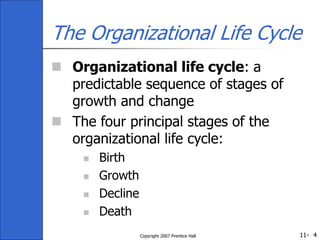
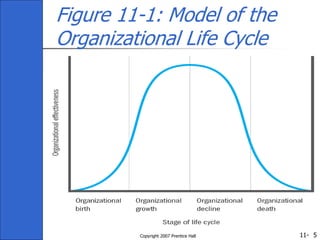
The Organizational Life Cycle
 Organizational life cycle: a
predictable sequence of stages of
growth and change
 The four principal stages of the
organizational life cycle:
 Birth
 Growth
 Decline
 Death
11-
Copyright 2007 Prentice Hall 5
Figure 11-1: Model of the
Organizational Life Cycle
11-
Copyright 2007 Prentice Hall 6
Organizational Birth
 Organizational birth: the founding of
an organization
 Occurs when entrepreneurs take advantage
of opportunities to use their skills and
competences to create value
 A dangerous life cycle stage associated
with the greatest chance of failure
 Liability of newness: the dangers associated
with being the first in a new environment
 New organization is fragile because it lacks a
formal structure
11-
Copyright 2007 Prentice Hall 7
Organizational Birth (cont.)
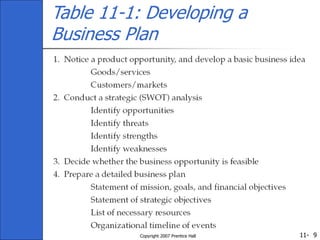
 Developing a plan for a new business
 Begins when an entrepreneur notices an
opportunity to develop a new or improved
product or service
 Tests the feasibility of the new product
idea
 SWOT analysis
 Examine the strengths and weaknesses of
the idea
 Decide whether the new product idea is
feasible
11-
Copyright 2007 Prentice Hall 8
Organizational Birth (cont.)
 Developing a plan for a new business
(cont.)
 Plan should include:
 Statement of the organization’s mission,
goals, and financial objectives
 Statement of the organization’s strategic
objectives
 List of all the functional and organizational
resources required to implement the idea
 Timeline that contains specific milestones
used to measure the progress of the venture
11-
Copyright 2007 Prentice Hall 9
Table 11-1: Developing a
Business Plan
11-
Copyright 2007 Prentice Hall 10
A Population Ecology Model of
Organizational Birth
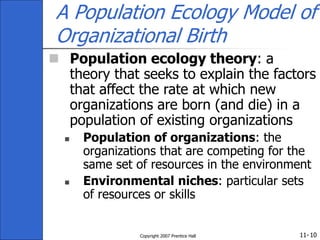
 Population ecology theory: a
theory that seeks to explain the factors
that affect the rate at which new
organizations are born (and die) in a
population of existing organizations
 Population of organizations: the
organizations that are competing for the
same set of resources in the environment
 Environmental niches: particular sets
of resources or skills
11-
Copyright 2007 Prentice Hall 11
Population Ecology Model
(cont.)
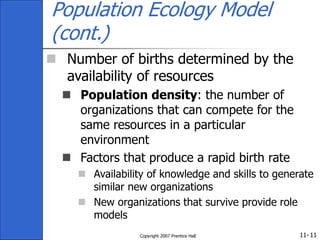
 Number of births determined by the
availability of resources
 Population density: the number of
organizations that can compete for the
same resources in a particular
environment
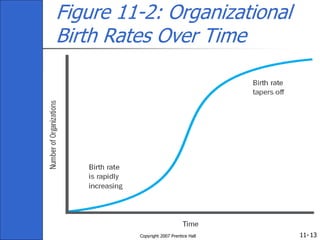
 Factors that produce a rapid birth rate
 Availability of knowledge and skills to generate
similar new organizations
 New organizations that survive provide role
models
11-
Copyright 2007 Prentice Hall 12
Population Ecology Model
(cont.)
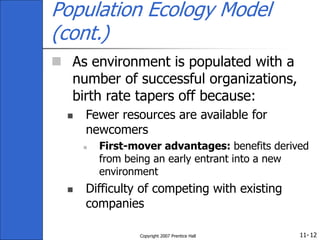
 As environment is populated with a
number of successful organizations,
birth rate tapers off because:
 Fewer resources are available for
newcomers
 First-mover advantages: benefits derived
from being an early entrant into a new
environment
 Difficulty of competing with existing
companies
11-
Copyright 2007 Prentice Hall 13
Figure 11-2: Organizational
Birth Rates Over Time
11-
Copyright 2007 Prentice Hall 14
Population Ecology Model
(cont.)
 Survival strategies
 Strategies that organizations can use to
gain access to resources and enhance
their chances of survival in the
environment
 r-strategy versus K-strategy
 r-strategy: a strategy of entering a new
environment early
 K-strategy: a strategy of entering an
environment late, after other organizations
have tested the environment
11-
Copyright 2007 Prentice Hall 15
Population Ecology Model
(cont.)
 Survival strategies (cont.)
 Specialists: organizations that
concentrate their skills to pursue a
narrow range of resources in a single
niche
 Generalists: organizations that spread
their skills thin to compete for a broad
range of resources in many niches
11-
Copyright 2007 Prentice Hall 16
Population Ecology Model
(cont.)
Process of natural selection
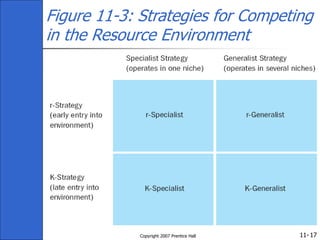
 Two sets of strategies result in: r-Specialist,
r-Generalist, K-Specialist, K-Generalist
 Early in an environment, new organizations are
likely to become r-Specialists
 Move quickly to focus on serving the needs of a
particular group
 As r-Specialists grow, they often become generalists
and compete in new niches
 K-Generalists often move into the market and
threaten the weaker r-Specialists
 Eventually, the market is dominated by the
strongest r-Specialists, r-Generalists, and K-
Generalists
11-
Copyright 2007 Prentice Hall 17
Figure 11-3: Strategies for Competing
in the Resource Environment
11-
Copyright 2007 Prentice Hall 18
Population Ecology Model
(cont.)
 Natural selection: the process that
ensures the survival of organizations
that have the skills and abilities that
best fit with the environment
 Over time, weaker organizations die
because they cannot adapt their
procedures to fit changes in the
environment
 Natural selection is a competitive
process
11-
Copyright 2007 Prentice Hall 19
The Institutional Theory of
Organizational Growth
 Organizational growth: the life-cycle
stage in which organizations develop
value-creation skills and competences
that allow them to acquire additional
resources
 Organizations can develop competitive
advantages by increasing division of labor
 Creates surplus resources that foster
greater growth
 Growth should not be an end-in-itself
11-
Copyright 2007 Prentice Hall 20
The Institutional Theory of
Organizational Growth (cont.)
 Institutional theory: a theory that
studies how organizations can
increase their ability to grow and
survive in a competitive environment
by becoming legitimate in the eyes of
their stakeholders
 Institutional environment: values
and norms in an environment that
govern the behavior of a population
of organizations
11-
Copyright 2007 Prentice Hall 21
The Institutional Theory of
Organizational Growth (cont.)
 Organizational isomorphism: the
similarity among organizations in a
population
 Three processes that explain why
organizations become similar are:
 Coercive isomorphism
 Mimetic isomorphism
 Normative isomorphism
11-
Copyright 2007 Prentice Hall 22
The Institutional Theory of
Organizational Growth (cont.)
 Coercive isomorphism: exists when
an organization adopts certain norms
because of pressures exerted by other
organizations and by society in general
 Increasing dependence of one
organization on another leads to greater
similarity
 Mimetic isomorphism: exists when
organizations intentionally imitate one
another to increase their legitimacy
 Environmental uncertainty increases the
likelihood of imitation
11-
Copyright 2007 Prentice Hall 23
The Institutional Theory of
Organizational Growth (cont.)
 Normative isomorphism: exists
when organizations indirectly adopt the
norms and values of other
organizations in the environment
 Organizations acquire norms and values
when:
 Employees move from one organization to
another and bring with them the norms and
values of their former employer
 They participate in the activities of industry,
trade, and professional associations
11-
Copyright 2007 Prentice Hall 24
The Institutional Theory of
Organizational Growth (cont.)
 Disadvantages of isomorphism
 Organizations may learn ways to behave
that have become outdated and no
longer lead to organizational
effectiveness
 Pressure to imitate may reduce the level
of innovation in the environment
11-
Copyright 2007 Prentice Hall 25
Greiner’s Model of
Organizational Growth
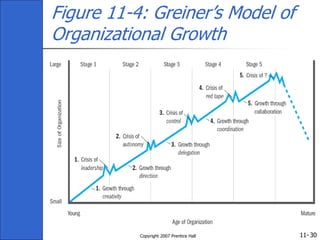
Greiner proposes five growth stages
 Each stage results in a crisis
 Advancement to the next stage requires
successfully resolving the crisis in the
previous stage
Stage 1: Growth through creativity
 Entrepreneurs develop the skills to create
and introduce new products
 Organizational learning occurs
 Crisis of leadership – entrepreneurs may
lack management skills
11-
Copyright 2007 Prentice Hall 26
Greiner’s Model of
Organizational Growth (cont.)
Stage 2: Growth through direction
 Crisis of leadership results in recruitment
of top-level managers who take
responsibility for the organization’s
strategy
 Often turns around an organization’s
fortunes
 Crisis of autonomy
 Creative people lose control over new product
development
 Professional managers run the show
11-
Copyright 2007 Prentice Hall 27
Greiner’s Model of
Organizational Growth (cont.)
Stage 3: Growth through delegation
 To solve the crisis of autonomy, managers
must delegate
 Strike a balance between the need for
professional management and the opportunity
for entrepreneurship
 Movement toward product team structure
 Crisis of control as power struggles over
resources emerge between top-level and
lower-level managers
11-
Copyright 2007 Prentice Hall 28
Greiner’s Model of
Organizational Growth (cont.)
Stage 4: Growth through coordination
 To resolve crisis of control, managers
must find right balance of centralized and
decentralized control
 Top management takes on role of
coordinating different divisions
 Attempt to inculcate a companywide
perspective
 Crisis of red tape
 Increasing reliance on rules and standard
procedures
 Organization becomes overly bureaucratic
11-
Copyright 2007 Prentice Hall 29
Greiner’s Model of
Organizational Growth (cont.)
Stage 5: Growth through collaboration
 Emphasizes greater spontaneity in
management action
 Greater use of product team and matrix
structures
 Changing from a mechanistic to an
organic structure as an organization
grows is a difficult task
11-
Copyright 2007 Prentice Hall 30
Figure 11-4: Greiner’s Model of
Organizational Growth
11-
Copyright 2007 Prentice Hall 31
Organizational Decline and
Death
Organizational decline: the life-
cycle stage that an organization enters
when it fails to anticipate, recognize,
avoid, neutralize, or adapt to external
or internal pressures that threaten its
long-term survival
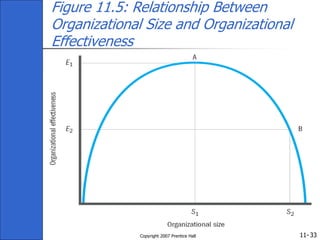
 May occur because organizations grow
too much
11-
Copyright 2007 Prentice Hall 32
Organizational Decline and
Death (cont.)
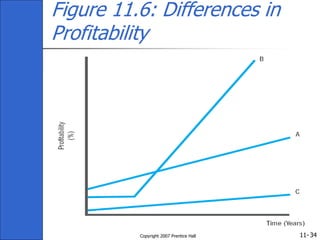
Effectiveness and profitability
 Assessing an organization’s effectiveness
involves comparing its profitability relative
to others
Profitability: measures how well a
company is making use of its resources
by investing them in ways to create
goods and services that generate profit
when sold
 Short term profits say little about how well
managers are using resources to generate
future profits
11-
Copyright 2007 Prentice Hall 33
Figure 11.5: Relationship Between
Organizational Size and Organizational
Effectiveness
11-
Copyright 2007 Prentice Hall 34
Figure 11.6: Differences in
Profitability
11-
Copyright 2007 Prentice Hall 35
Organizational Decline and
Death (cont.)
 Organizational inertia: the forces
inside an organization that make it
resistant to change
 Risk aversion: managers become
unwilling to bear the uncertainty of
change as organizations grow
 The desire to maximize rewards:
managers may increase the size of the
company to maximize their own rewards
even when this growth reduces
organizational effectiveness
11-
Copyright 2007 Prentice Hall 36
Organizational Decline and
Death (cont.)
 Organizational inertia (cont.)
 Overly bureaucratic culture: in large
organizations, property rights can
become so strong that managers spend
all their time protecting their specific
property rights instead of working to
advance the organization
11-
Copyright 2007 Prentice Hall 37
Organizational Decline and
Death (cont.)
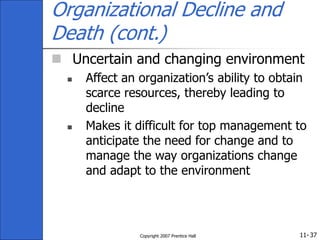
 Uncertain and changing environment
 Affect an organization’s ability to obtain
scarce resources, thereby leading to
decline
 Makes it difficult for top management to
anticipate the need for change and to
manage the way organizations change
and adapt to the environment
11-
Copyright 2007 Prentice Hall 38
Weitzel and Jonsson’s Model
of Organizational Decline
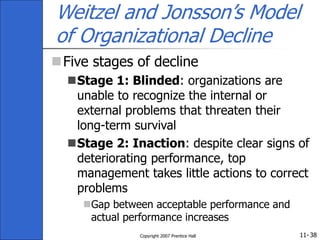
Five stages of decline
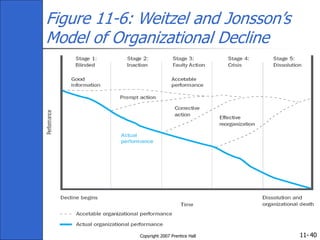
Stage 1: Blinded: organizations are
unable to recognize the internal or
external problems that threaten their
long-term survival
Stage 2: Inaction: despite clear signs of
deteriorating performance, top
management takes little actions to correct
problems
Gap between acceptable performance and
actual performance increases
11-
Copyright 2007 Prentice Hall 39
Weitzel and Jonsson’s Model
(cont.)
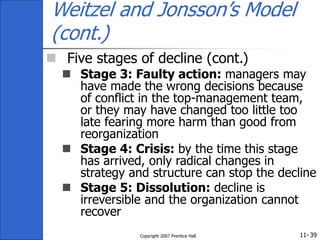
 Five stages of decline (cont.)
 Stage 3: Faulty action: managers may
have made the wrong decisions because
of conflict in the top-management team,
or they may have changed too little too
late fearing more harm than good from
reorganization
 Stage 4: Crisis: by the time this stage
has arrived, only radical changes in
strategy and structure can stop the decline
 Stage 5: Dissolution: decline is
irreversible and the organization cannot
recover
11-
Copyright 2007 Prentice Hall 40
Figure 11-6: Weitzel and Jonsson’s
Model of Organizational Decline

1041.ppt

  • 1.
    11- Copyright 2007 PrenticeHall 1 Organizational Theory, Design, and Change Fifth Edition Gareth R. Jones Chapter 11 Organizational Transformations: Birth, Growth, Decline, and Death
  • 2.
    11- Copyright 2007 PrenticeHall 2 Learning Objectives 1. Appreciate the problems involved in surviving the perils of organizational birth and what founders can do to help their new organizations to survive 2. Describe the typical problems that arise as an organization grows and matures, and how an organization must change if it is to survive and prosper
  • 3.
    11- Copyright 2007 PrenticeHall 3 Learning Objectives (cont.) 3. Discuss why organizational decline occurs, identify the stages of decline, and how managers can change their organizations to prevent failure and eventual death or dissolution
  • 4.
    11- Copyright 2007 PrenticeHall 4 The Organizational Life Cycle  Organizational life cycle: a predictable sequence of stages of growth and change  The four principal stages of the organizational life cycle:  Birth  Growth  Decline  Death
  • 5.
    11- Copyright 2007 PrenticeHall 5 Figure 11-1: Model of the Organizational Life Cycle
  • 6.
    11- Copyright 2007 PrenticeHall 6 Organizational Birth  Organizational birth: the founding of an organization  Occurs when entrepreneurs take advantage of opportunities to use their skills and competences to create value  A dangerous life cycle stage associated with the greatest chance of failure  Liability of newness: the dangers associated with being the first in a new environment  New organization is fragile because it lacks a formal structure
  • 7.
    11- Copyright 2007 PrenticeHall 7 Organizational Birth (cont.)  Developing a plan for a new business  Begins when an entrepreneur notices an opportunity to develop a new or improved product or service  Tests the feasibility of the new product idea  SWOT analysis  Examine the strengths and weaknesses of the idea  Decide whether the new product idea is feasible
  • 8.
    11- Copyright 2007 PrenticeHall 8 Organizational Birth (cont.)  Developing a plan for a new business (cont.)  Plan should include:  Statement of the organization’s mission, goals, and financial objectives  Statement of the organization’s strategic objectives  List of all the functional and organizational resources required to implement the idea  Timeline that contains specific milestones used to measure the progress of the venture
  • 9.
    11- Copyright 2007 PrenticeHall 9 Table 11-1: Developing a Business Plan
  • 10.
    11- Copyright 2007 PrenticeHall 10 A Population Ecology Model of Organizational Birth  Population ecology theory: a theory that seeks to explain the factors that affect the rate at which new organizations are born (and die) in a population of existing organizations  Population of organizations: the organizations that are competing for the same set of resources in the environment  Environmental niches: particular sets of resources or skills
  • 11.
    11- Copyright 2007 PrenticeHall 11 Population Ecology Model (cont.)  Number of births determined by the availability of resources  Population density: the number of organizations that can compete for the same resources in a particular environment  Factors that produce a rapid birth rate  Availability of knowledge and skills to generate similar new organizations  New organizations that survive provide role models
  • 12.
    11- Copyright 2007 PrenticeHall 12 Population Ecology Model (cont.)  As environment is populated with a number of successful organizations, birth rate tapers off because:  Fewer resources are available for newcomers  First-mover advantages: benefits derived from being an early entrant into a new environment  Difficulty of competing with existing companies
  • 13.
    11- Copyright 2007 PrenticeHall 13 Figure 11-2: Organizational Birth Rates Over Time
  • 14.
    11- Copyright 2007 PrenticeHall 14 Population Ecology Model (cont.)  Survival strategies  Strategies that organizations can use to gain access to resources and enhance their chances of survival in the environment  r-strategy versus K-strategy  r-strategy: a strategy of entering a new environment early  K-strategy: a strategy of entering an environment late, after other organizations have tested the environment
  • 15.
    11- Copyright 2007 PrenticeHall 15 Population Ecology Model (cont.)  Survival strategies (cont.)  Specialists: organizations that concentrate their skills to pursue a narrow range of resources in a single niche  Generalists: organizations that spread their skills thin to compete for a broad range of resources in many niches
  • 16.
    11- Copyright 2007 PrenticeHall 16 Population Ecology Model (cont.) Process of natural selection  Two sets of strategies result in: r-Specialist, r-Generalist, K-Specialist, K-Generalist  Early in an environment, new organizations are likely to become r-Specialists  Move quickly to focus on serving the needs of a particular group  As r-Specialists grow, they often become generalists and compete in new niches  K-Generalists often move into the market and threaten the weaker r-Specialists  Eventually, the market is dominated by the strongest r-Specialists, r-Generalists, and K- Generalists
  • 17.
    11- Copyright 2007 PrenticeHall 17 Figure 11-3: Strategies for Competing in the Resource Environment
  • 18.
    11- Copyright 2007 PrenticeHall 18 Population Ecology Model (cont.)  Natural selection: the process that ensures the survival of organizations that have the skills and abilities that best fit with the environment  Over time, weaker organizations die because they cannot adapt their procedures to fit changes in the environment  Natural selection is a competitive process
  • 19.
    11- Copyright 2007 PrenticeHall 19 The Institutional Theory of Organizational Growth  Organizational growth: the life-cycle stage in which organizations develop value-creation skills and competences that allow them to acquire additional resources  Organizations can develop competitive advantages by increasing division of labor  Creates surplus resources that foster greater growth  Growth should not be an end-in-itself
  • 20.
    11- Copyright 2007 PrenticeHall 20 The Institutional Theory of Organizational Growth (cont.)  Institutional theory: a theory that studies how organizations can increase their ability to grow and survive in a competitive environment by becoming legitimate in the eyes of their stakeholders  Institutional environment: values and norms in an environment that govern the behavior of a population of organizations
  • 21.
    11- Copyright 2007 PrenticeHall 21 The Institutional Theory of Organizational Growth (cont.)  Organizational isomorphism: the similarity among organizations in a population  Three processes that explain why organizations become similar are:  Coercive isomorphism  Mimetic isomorphism  Normative isomorphism
  • 22.
    11- Copyright 2007 PrenticeHall 22 The Institutional Theory of Organizational Growth (cont.)  Coercive isomorphism: exists when an organization adopts certain norms because of pressures exerted by other organizations and by society in general  Increasing dependence of one organization on another leads to greater similarity  Mimetic isomorphism: exists when organizations intentionally imitate one another to increase their legitimacy  Environmental uncertainty increases the likelihood of imitation
  • 23.
    11- Copyright 2007 PrenticeHall 23 The Institutional Theory of Organizational Growth (cont.)  Normative isomorphism: exists when organizations indirectly adopt the norms and values of other organizations in the environment  Organizations acquire norms and values when:  Employees move from one organization to another and bring with them the norms and values of their former employer  They participate in the activities of industry, trade, and professional associations
  • 24.
    11- Copyright 2007 PrenticeHall 24 The Institutional Theory of Organizational Growth (cont.)  Disadvantages of isomorphism  Organizations may learn ways to behave that have become outdated and no longer lead to organizational effectiveness  Pressure to imitate may reduce the level of innovation in the environment
  • 25.
    11- Copyright 2007 PrenticeHall 25 Greiner’s Model of Organizational Growth Greiner proposes five growth stages  Each stage results in a crisis  Advancement to the next stage requires successfully resolving the crisis in the previous stage Stage 1: Growth through creativity  Entrepreneurs develop the skills to create and introduce new products  Organizational learning occurs  Crisis of leadership – entrepreneurs may lack management skills
  • 26.
    11- Copyright 2007 PrenticeHall 26 Greiner’s Model of Organizational Growth (cont.) Stage 2: Growth through direction  Crisis of leadership results in recruitment of top-level managers who take responsibility for the organization’s strategy  Often turns around an organization’s fortunes  Crisis of autonomy  Creative people lose control over new product development  Professional managers run the show
  • 27.
    11- Copyright 2007 PrenticeHall 27 Greiner’s Model of Organizational Growth (cont.) Stage 3: Growth through delegation  To solve the crisis of autonomy, managers must delegate  Strike a balance between the need for professional management and the opportunity for entrepreneurship  Movement toward product team structure  Crisis of control as power struggles over resources emerge between top-level and lower-level managers
  • 28.
    11- Copyright 2007 PrenticeHall 28 Greiner’s Model of Organizational Growth (cont.) Stage 4: Growth through coordination  To resolve crisis of control, managers must find right balance of centralized and decentralized control  Top management takes on role of coordinating different divisions  Attempt to inculcate a companywide perspective  Crisis of red tape  Increasing reliance on rules and standard procedures  Organization becomes overly bureaucratic
  • 29.
    11- Copyright 2007 PrenticeHall 29 Greiner’s Model of Organizational Growth (cont.) Stage 5: Growth through collaboration  Emphasizes greater spontaneity in management action  Greater use of product team and matrix structures  Changing from a mechanistic to an organic structure as an organization grows is a difficult task
  • 30.
    11- Copyright 2007 PrenticeHall 30 Figure 11-4: Greiner’s Model of Organizational Growth
  • 31.
    11- Copyright 2007 PrenticeHall 31 Organizational Decline and Death Organizational decline: the life- cycle stage that an organization enters when it fails to anticipate, recognize, avoid, neutralize, or adapt to external or internal pressures that threaten its long-term survival  May occur because organizations grow too much
  • 32.
    11- Copyright 2007 PrenticeHall 32 Organizational Decline and Death (cont.) Effectiveness and profitability  Assessing an organization’s effectiveness involves comparing its profitability relative to others Profitability: measures how well a company is making use of its resources by investing them in ways to create goods and services that generate profit when sold  Short term profits say little about how well managers are using resources to generate future profits
  • 33.
    11- Copyright 2007 PrenticeHall 33 Figure 11.5: Relationship Between Organizational Size and Organizational Effectiveness
  • 34.
    11- Copyright 2007 PrenticeHall 34 Figure 11.6: Differences in Profitability
  • 35.
    11- Copyright 2007 PrenticeHall 35 Organizational Decline and Death (cont.)  Organizational inertia: the forces inside an organization that make it resistant to change  Risk aversion: managers become unwilling to bear the uncertainty of change as organizations grow  The desire to maximize rewards: managers may increase the size of the company to maximize their own rewards even when this growth reduces organizational effectiveness
  • 36.
    11- Copyright 2007 PrenticeHall 36 Organizational Decline and Death (cont.)  Organizational inertia (cont.)  Overly bureaucratic culture: in large organizations, property rights can become so strong that managers spend all their time protecting their specific property rights instead of working to advance the organization
  • 37.
    11- Copyright 2007 PrenticeHall 37 Organizational Decline and Death (cont.)  Uncertain and changing environment  Affect an organization’s ability to obtain scarce resources, thereby leading to decline  Makes it difficult for top management to anticipate the need for change and to manage the way organizations change and adapt to the environment
  • 38.
    11- Copyright 2007 PrenticeHall 38 Weitzel and Jonsson’s Model of Organizational Decline Five stages of decline Stage 1: Blinded: organizations are unable to recognize the internal or external problems that threaten their long-term survival Stage 2: Inaction: despite clear signs of deteriorating performance, top management takes little actions to correct problems Gap between acceptable performance and actual performance increases
  • 39.
    11- Copyright 2007 PrenticeHall 39 Weitzel and Jonsson’s Model (cont.)  Five stages of decline (cont.)  Stage 3: Faulty action: managers may have made the wrong decisions because of conflict in the top-management team, or they may have changed too little too late fearing more harm than good from reorganization  Stage 4: Crisis: by the time this stage has arrived, only radical changes in strategy and structure can stop the decline  Stage 5: Dissolution: decline is irreversible and the organization cannot recover
  • 40.
    11- Copyright 2007 PrenticeHall 40 Figure 11-6: Weitzel and Jonsson’s Model of Organizational Decline