©2001
South-Western College Publishing
Cincinnati, Ohio
Daft, Organizational Theory and Design, 7/e
8-1
8-2
Chapter Nine
Organization Size,
Life Cycle, and Decline
©2001
South-Western College Publishing
Cincinnati, Ohio
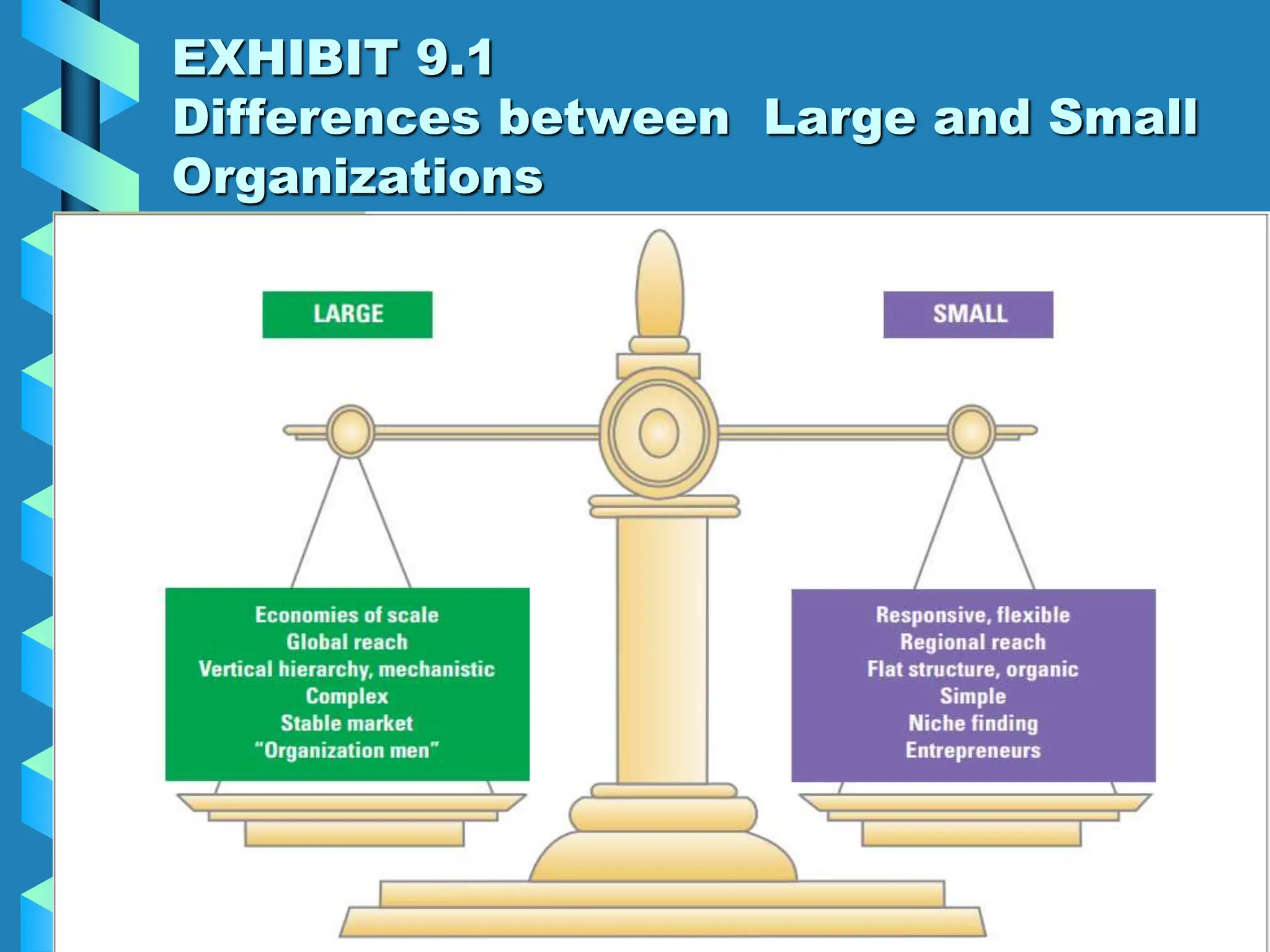
Daft, Organizational Theory and Design, 7/e
Purpose of This Chapter
• In this chapter, we explore the
question of large versus small
organizations and how size
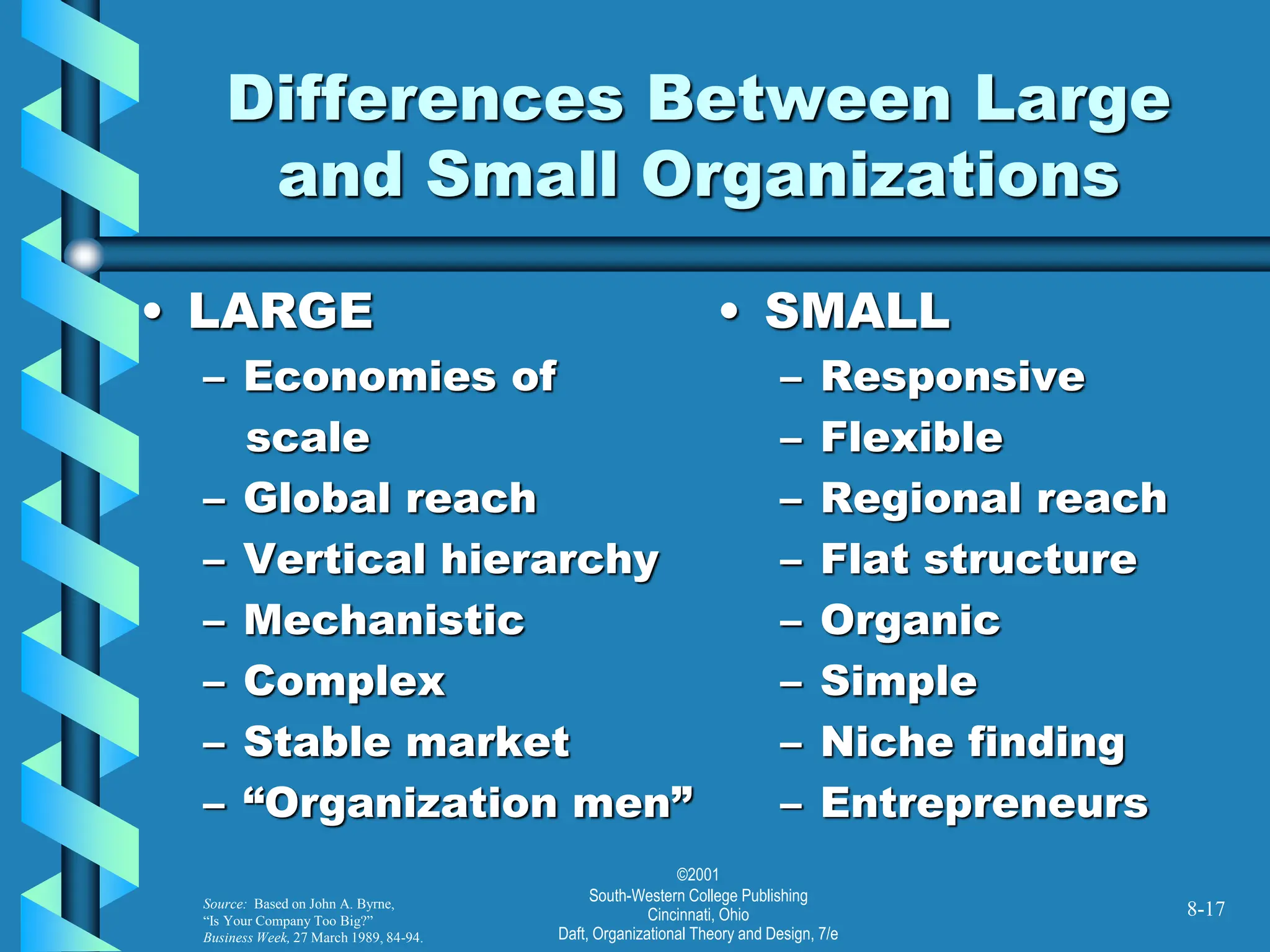
relates to structure and control.
Organization size is a contextual
variable that influences
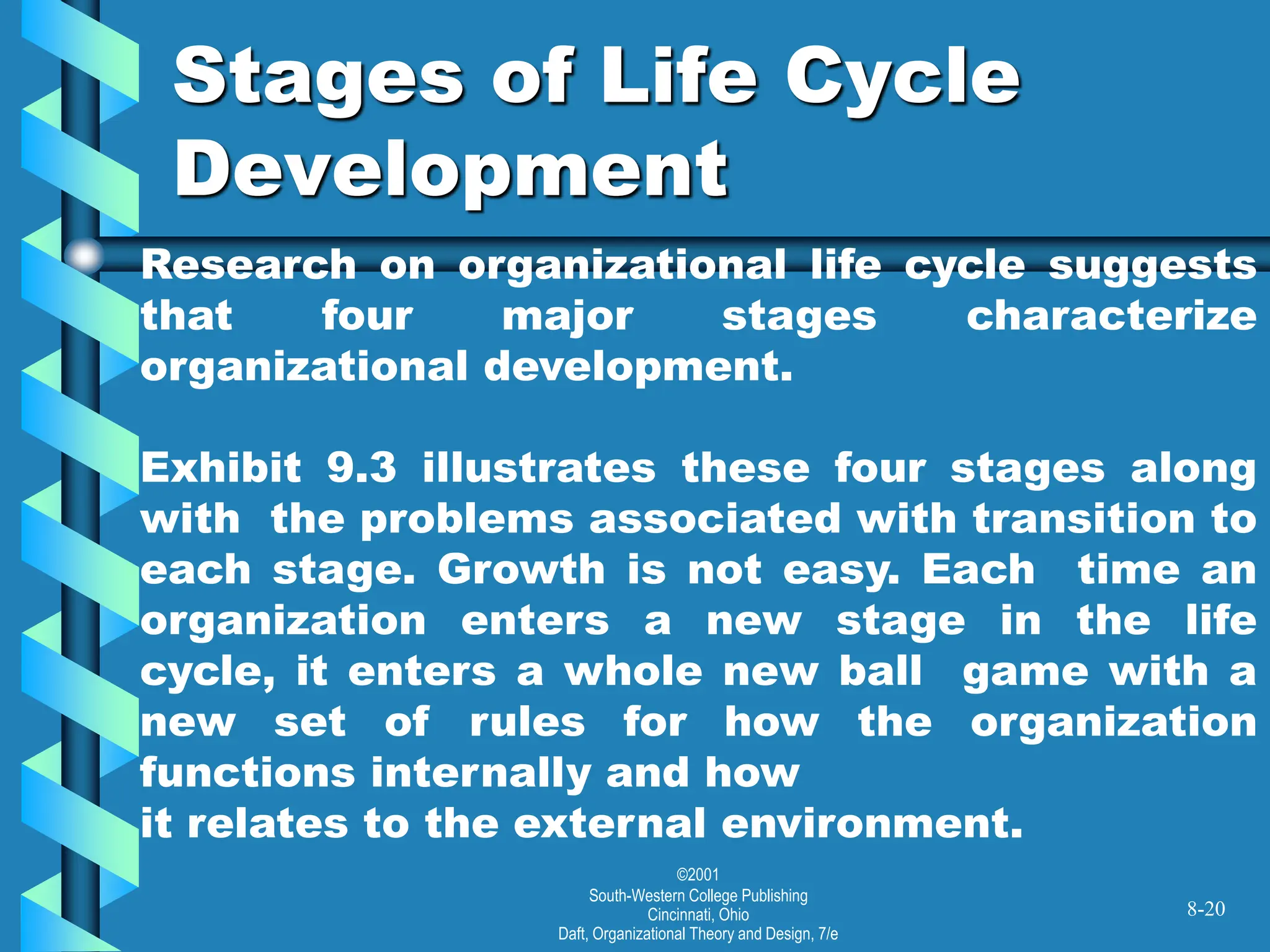
organization design and
functioning just as do the
contextual variables—
8-3
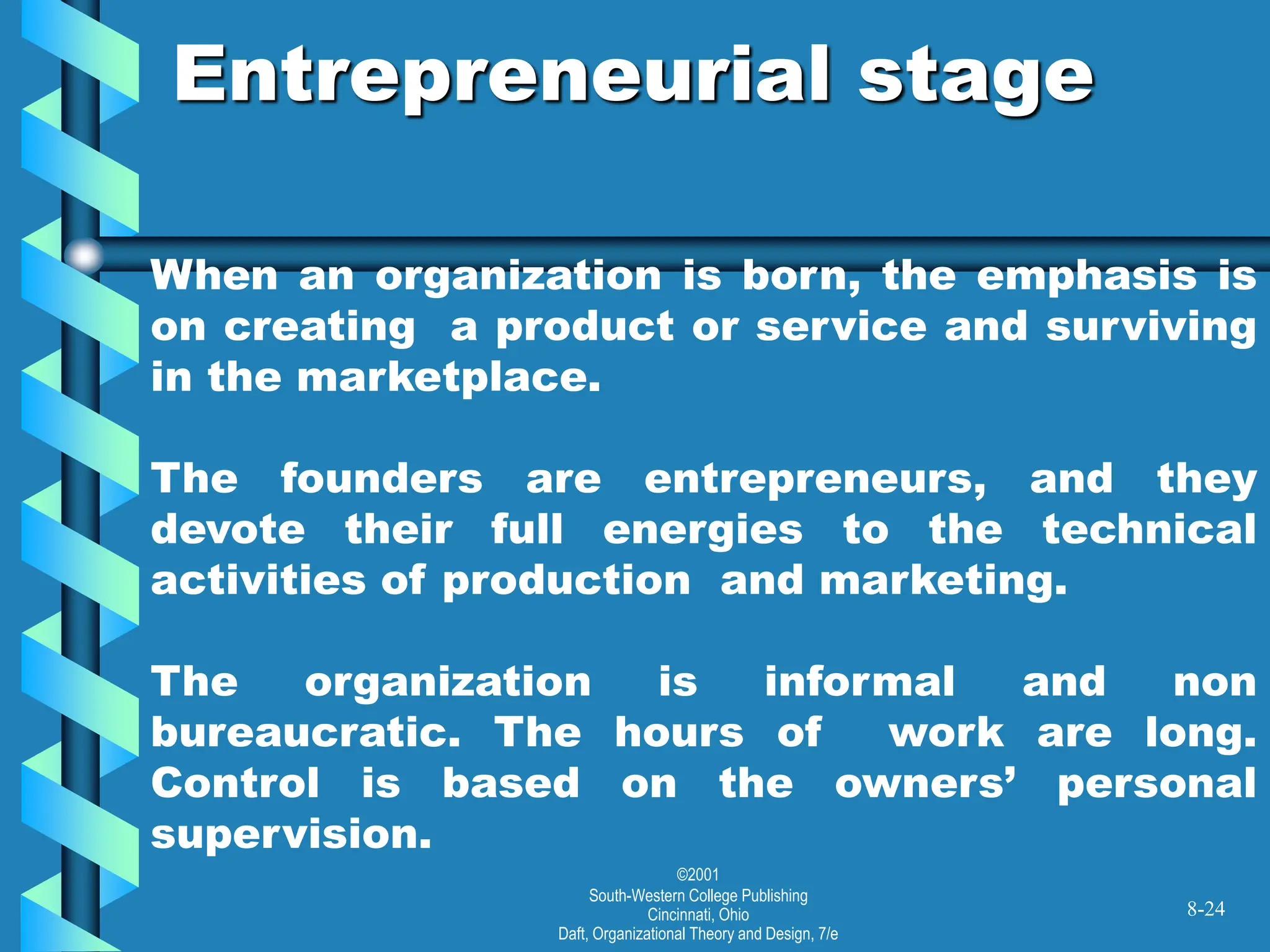
©2001
South-Western College Publishing
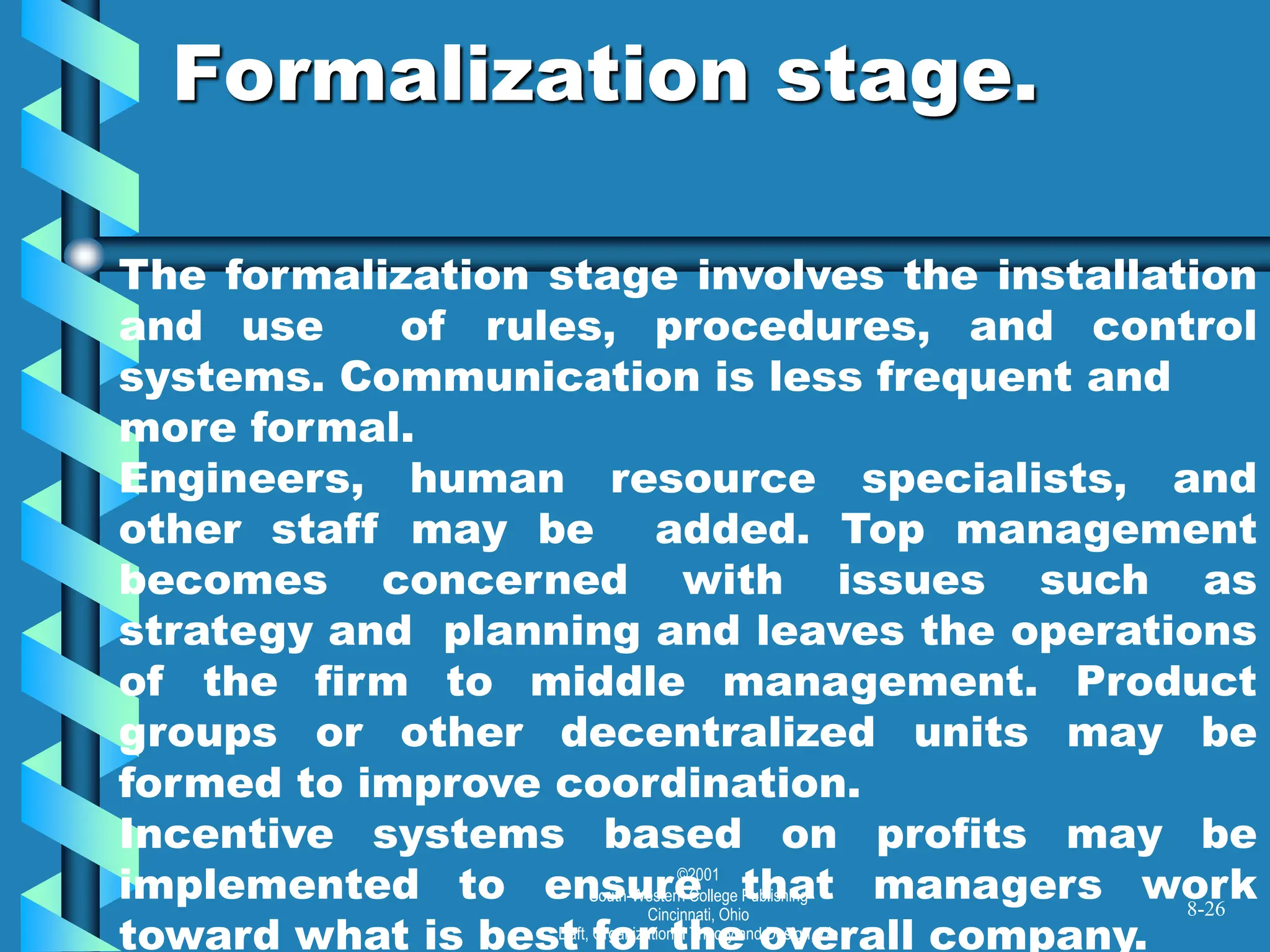
Cincinnati, Ohio
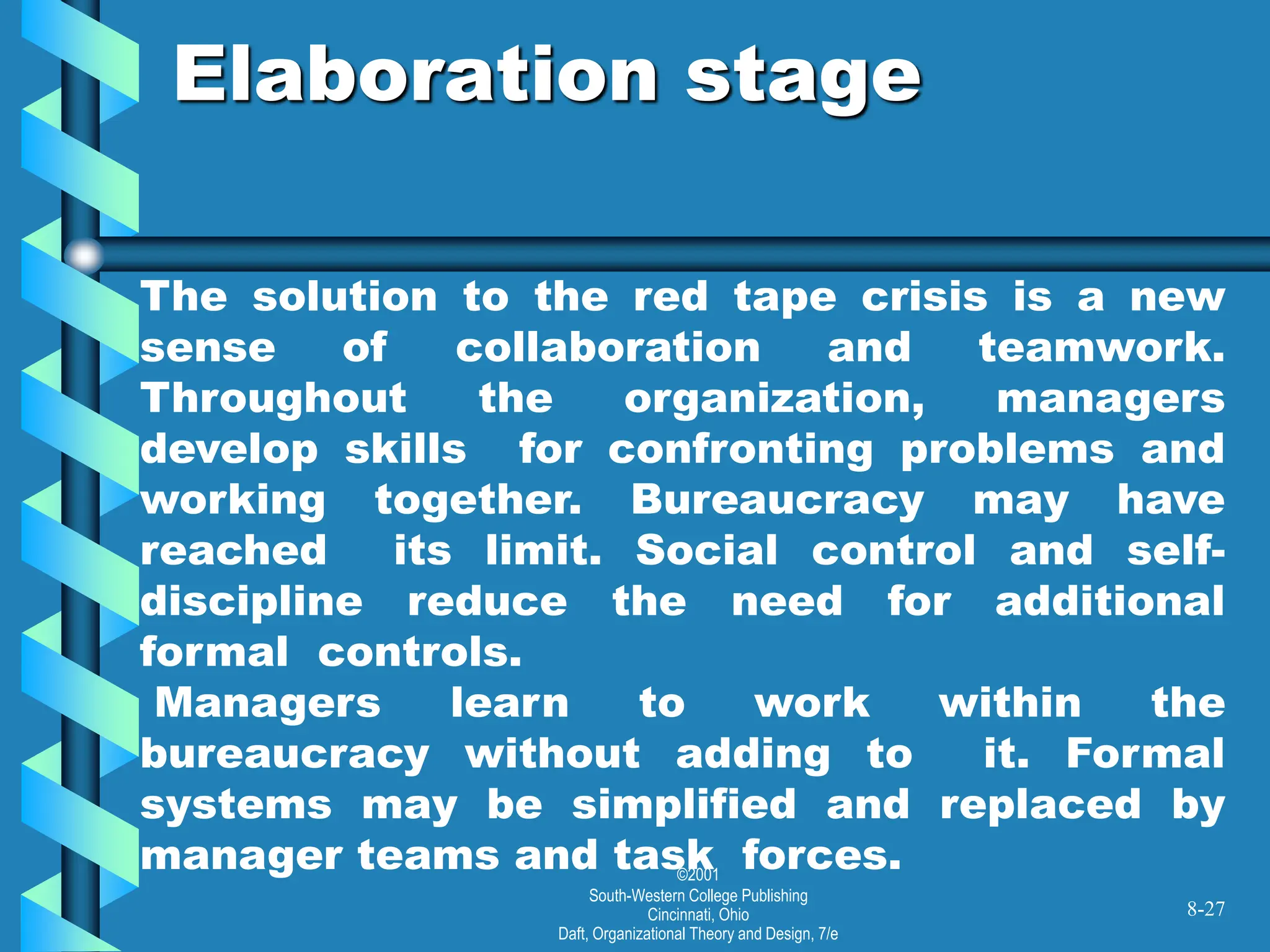
Daft, Organizational Theory and Design, 7/e
Purpose…… cont.,
• technology, environment, goals—
discussed in previous chapters.
• In the first section, we look at the
advantages of large versus small
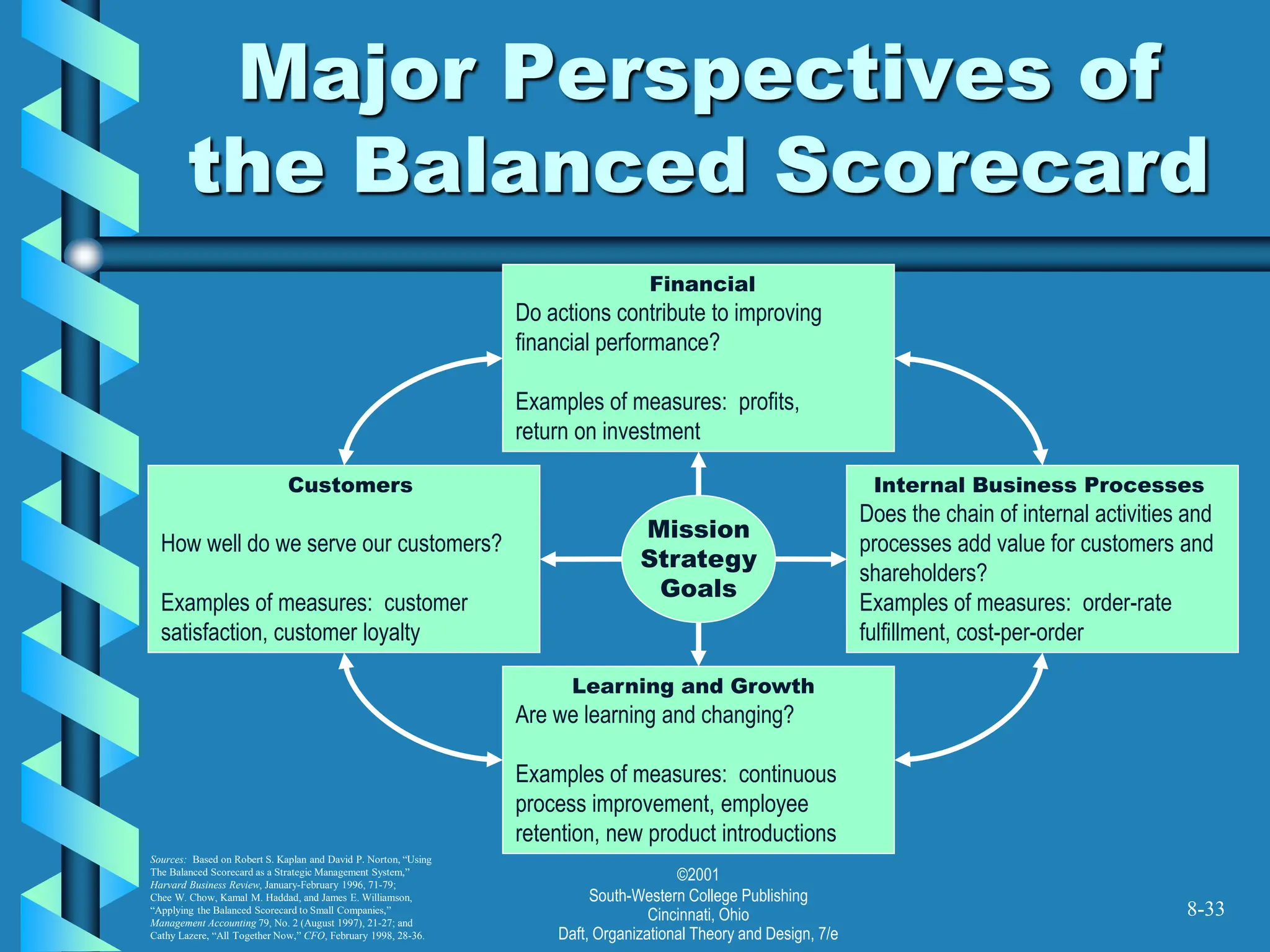
size.
• Then, we explore what is called
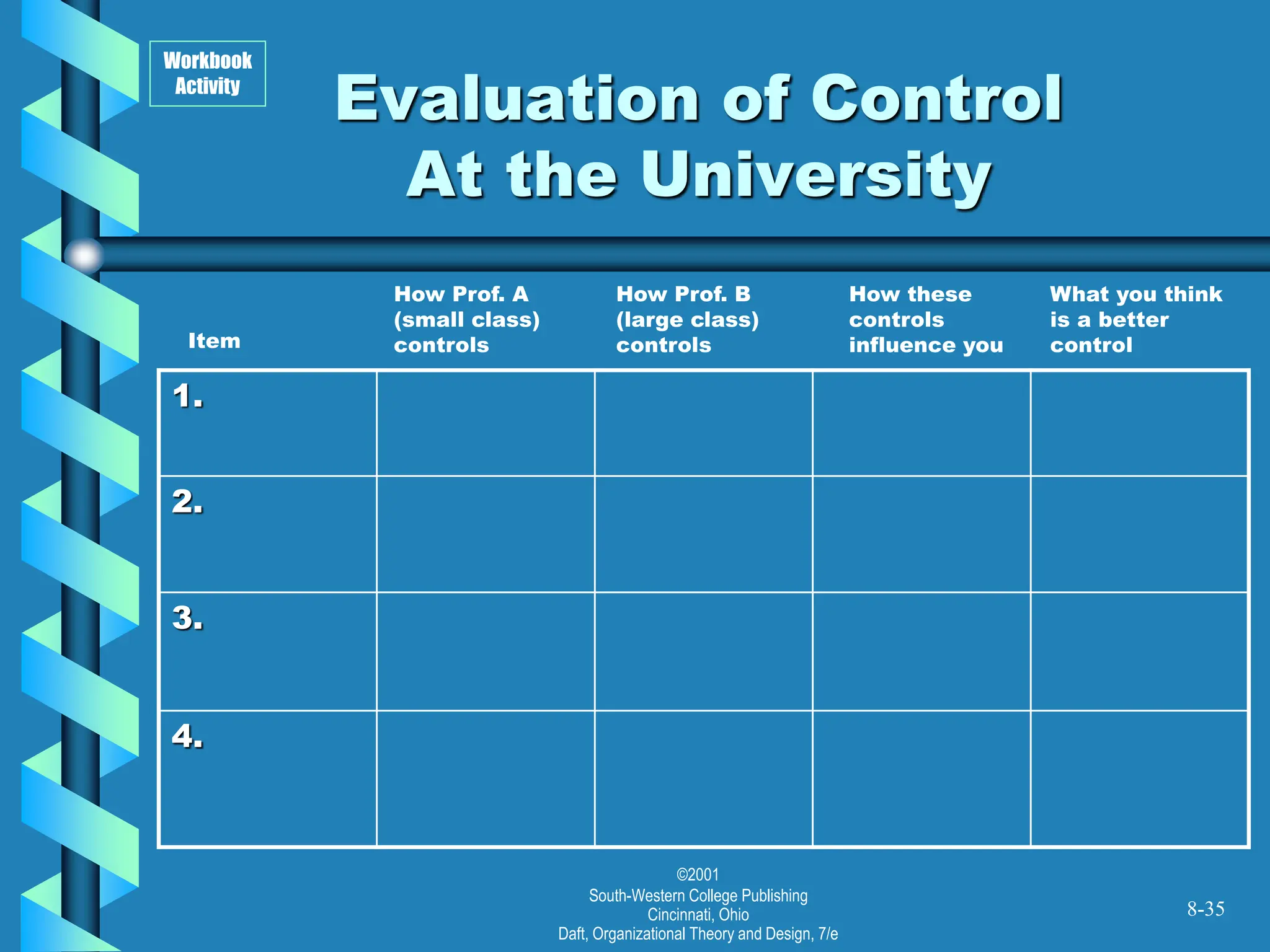
an organization’s life cycle and the
structural characteristics at each
stage. 8-4
©2001
South-Western College Publishing
Cincinnati, Ohio
Daft, Organizational Theory and Design, 7/e
• Next, we examine the historical
need for bureaucracy as a means
to control large organizations and
compare bureaucratic control to
various other control strategies.
Finally, the chapter looks at the
causes of organizational decline
and discusses some methods for
dealing with downsizing.
8-5
©2001
South-Western College Publishing
Cincinnati, Ohio
Daft, Organizational Theory and Design, 7/e
ORGANIZATION SIZE:
IS BIGGER BETTER?
• The question of big versus small
begins with the notion of growth
and the reasons so many
organizations feel the need to
grow large.
8-6
©2001
South-Western College Publishing
Cincinnati, Ohio
Daft, Organizational Theory and Design, 7/e
Pressures for Growth
• Do you ever dream of starting a small
company?
• Many people do, and entrepreneurial
start-ups are the lifeblood of the U.S.
economy. Yet the hope of practically
every entrepreneur is to have his or
her company grow fast and grow
• large, maybe even to eventually mak
the Fortune500 list. 8-7
©2001
South-Western College Publishing
Cincinnati, Ohio
Daft, Organizational Theory and Design, 7/e
• Sometimes this goal is more
urgent than to make the best
products or show the greatest
profits.
• Recent economic woes and
layoffs at many large firms have
spurred budding entrepreneurs to
take a chance on starting their
own company or going it alone in
a sole proprietorship. 8-8
©2001
South-Western College Publishing
Cincinnati, Ohio
Daft, Organizational Theory and Design, 7/e
• Yet despite the proliferation of new,
small organizations, the giants such
as Procter & Gamble, General
Electric, Toyota, and Wal-Mart have
continued to grow.
• For example, Wal-Mart’s employee
base is almost as big
• as the population of the city of
Houston, Texas.
8-9
©2001
South-Western College Publishing
Cincinnati, Ohio
Daft, Organizational Theory and Design, 7/e
• Companies in all industries, from
retail, to aerospace, to media,
strive for growth to acquire the
size and resources needed to
compete on a global scale, to
invest in new technology, and to
control distribution channels
and guarantee access to
markets.
8-10
©2001
South-Western College Publishing
Cincinnati, Ohio
Daft, Organizational Theory and Design, 7/e
• There are a number of other
pressures for organizations to grow.
Large size enables companies to
take risks that could ruin smaller
firms, and scale is crucial to
economic health in some industries.
For marketing-intensive companies
such as Coca-Cola, Procter &Gamble,
and Anheuser-Busch, greater size
provides power in the marketplace
and thus increased revenues. 8-11
©2001
South-Western College Publishing
Cincinnati, Ohio
Daft, Organizational Theory and Design, 7/e
Dilemmas of Large Size
• Organizations feel compelled to
grow, but how much and how
large?
• What size organization is better
poised to compete in a fast-
changing global environment?
The arguments are summarized
in Exhibit 9.1.
8-12
©2001
South-Western College Publishing
Cincinnati, Ohio
Daft, Organizational Theory and Design, 7/e
Large
8-13
Huge resources and economies of scale are
needed for many organizations to compete
globally. Only large organizations can build a
massive pipeline in Alaska.
Only a large corporation like General Electric
can afford to build ultra efficient $2 million
wind turbines that contain 8,000 different
parts.
9
Only a large Johnson & Johnson can invest
hundreds of millions in new products such as
bifocal contact lenses and a patch that delivers
contraceptives through the skin.
©2001
South-Western College Publishing
Cincinnati, Ohio
Daft, Organizational Theory and Design, 7/e
Small.
• The competing argument says small is
beautiful because the crucial
requirements for success in a global
economy are responsiveness and
flexibility in fast-changing markets.
• Small scale can provide significant
advantages in terms of quick reaction to
changing customer needs or shifting
environmental
• and market conditions.
8-14
©2001
South-Western College Publishing
Cincinnati, Ohio
Daft, Organizational Theory and Design, 7/e
• In addition, small organizations often
enjoy greater employee commitment
because it is easier for people to feel
like part of a community.
• Employees typically work on a variety
of tasks rather than narrow,
specialized jobs.
• For many people, working in a small
company is more exciting and fulfilling
than working in a huge organization.
8-15
©2001
South-Western College Publishing
Cincinnati, Ohio
Daft, Organizational Theory and Design, 7/e
EXHIBIT 9.1
Differences between Large and Small
Organizations
8-16
©2001
South-Western College Publishing
Cincinnati, Ohio
Daft, Organizational Theory and Design, 7/e
8-17
Differences Between Large
and Small Organizations
• LARGE
– Economies of
scale
– Global reach
– Vertical hierarchy
– Mechanistic
– Complex
– Stable market
– “Organization men”
• SMALL
– Responsive
– Flexible
– Regional reach
– Flat structure
– Organic
– Simple
– Niche finding
– Entrepreneurs
Source: Based on John A. Byrne,
“Is Your Company Too Big?”
Business Week, 27 March 1989, 84-94.
©2001
South-Western College Publishing
Cincinnati, Ohio
Daft, Organizational Theory and Design, 7/e
Big-Company/Small-
Company Hybrid
8-18
. The paradox is that the advantages of small
companies sometimes enable them to succeed
and, hence, grow large.
Small companies can become victims of their
own success as they grow, shifting to a
mechanistic structure emphasizing vertical
hierarchy and spawning “organization men”
rather than entrepreneurs. Giant companies are
“built for optimization, not innovation.”
Big companies become committed to their
existing products and technologies and
have a hard time supporting innovation for the
future.
©2001
South-Western College Publishing
Cincinnati, Ohio
Daft, Organizational Theory and Design, 7/e
ORGANIZATIONAL LIFE
CYCLE
8-19
A useful way to think about organizational
growth and change is the concept of an
organizational life cycle,
which suggests that organizations are born,
grow older, and eventually die.
Organization structure, leadership style, and
administrative systems follow a fairly
predictable pattern through stages in the life
cycle.
Stages are sequential and follow a natural
progression.
©2001
South-Western College Publishing
Cincinnati, Ohio
Daft, Organizational Theory and Design, 7/e
Stages of Life Cycle
Development
8-20
Research on organizational life cycle suggests
that four major stages characterize
organizational development.
Exhibit 9.3 illustrates these four stages along
with the problems associated with transition to
each stage. Growth is not easy. Each time an
organization enters a new stage in the life
cycle, it enters a whole new ball game with a
new set of rules for how the organization
functions internally and how
it relates to the external environment.
©2001
South-Western College Publishing
Cincinnati, Ohio
Daft, Organizational Theory and Design, 7/e
8-21
For technology companies today, life cycles
are getting shorter; to stay competitive,
companies like eBay, Google, and MySpace
have to successfully progress through stages
of the cycle faster.
©2001
South-Western College Publishing
Cincinnati, Ohio
Daft, Organizational Theory and Design, 7/e
EXHIBIT 9.3
Organizational Life Cycle
8-22
©2001
South-Western College Publishing
Cincinnati, Ohio
Daft, Organizational Theory and Design, 7/e
8-23
Organizational
Life Cycle
ORGANIZATION STAGES OF DEVELOPMENT
1.
Entrepreneurial
Stage
2.
Collectivity
Stage
3.
Formalization
Stage
4.
Elaboration
Stage
Crisis:
Need to deal
with too much
red tape
Crisis:
Need for
delegation
with control
Crisis:
Need for
leadership
Creativity
Provision of clear direction
Addition of internal systems
Development of teamwork
Crisis:
Need for
revitalization
Decline
Continued
maturity
Streamlining,
small-company
thinking
S
I
Z
E
Large
Small
Sources: Adapted from Robert E. Quinn and Kim Cameron, “Organizational
Life Cycles and Shifting Criteria of Effectiveness: Some Preliminary
Evidence,” Management Science 29 (1983): 33-51; and Larry E. Greiner,
“Evolution and Revolution as Organizations Grow,” Harvard Business
Review 50 (July-August 1972): 37-46.
©2001
South-Western College Publishing
Cincinnati, Ohio
Daft, Organizational Theory and Design, 7/e
Entrepreneurial stage
8-24
When an organization is born, the emphasis is
on creating a product or service and surviving
in the marketplace.
The founders are entrepreneurs, and they
devote their full energies to the technical
activities of production and marketing.
The organization is informal and non
bureaucratic. The hours of work are long.
Control is based on the owners’ personal
supervision.
©2001
South-Western College Publishing
Cincinnati, Ohio
Daft, Organizational Theory and Design, 7/e
Collectivity stage.
8-25
If the leadership crisis is resolved, strong
leadership is obtained and the organization
begins to develop clear goals and direction.
Departments are established along with a
hierarchy of authority, job assignments, and a
beginning division of labor. Social networking
company Face book moved quickly from the
entrepreneurial to the collectivity stage.
Twenty-three year-old founder Mark Zuckerberg
knows his company has to “grow up at Internet
speed,” so he recruited a top Google executive,
Sheryl Sandberg, to serve as chief operating
officer.
©2001
South-Western College Publishing
Cincinnati, Ohio
Daft, Organizational Theory and Design, 7/e
Formalization stage.
8-26
The formalization stage involves the installation
and use of rules, procedures, and control
systems. Communication is less frequent and
more formal.
Engineers, human resource specialists, and
other staff may be added. Top management
becomes concerned with issues such as
strategy and planning and leaves the operations
of the firm to middle management. Product
groups or other decentralized units may be
formed to improve coordination.
Incentive systems based on profits may be
implemented to ensure that managers work
toward what is best for the overall company.
©2001
South-Western College Publishing
Cincinnati, Ohio
Daft, Organizational Theory and Design, 7/e
Elaboration stage
8-27
The solution to the red tape crisis is a new
sense of collaboration and teamwork.
Throughout the organization, managers
develop skills for confronting problems and
working together. Bureaucracy may have
reached its limit. Social control and self-
discipline reduce the need for additional
formal controls.
Managers learn to work within the
bureaucracy without adding to it. Formal
systems may be simplified and replaced by
manager teams and task forces.
©2001
South-Western College Publishing
Cincinnati, Ohio
Daft, Organizational Theory and Design, 7/e
8-28
Organization Characteristics
During Four Stages of Life Cycle
1.
Entrepreneurial
2.
Collectivity
3.
Formalization
4.
Elaboration
Characteristic Nonbureaucratic Prebureaucratic Bureaucratic Very Bureaucratic
Structure
Informal, one-
person show
Mostly informal,
some procedures
Formal procedures,
division of labor,
specialties added
Teamwork within
bureaucracy, small-
company thinking
Products or
services
Single product or
service
Major product or
service with
variations
Line of products or
services
Multiple product or
services lines
Reward and
control
systems
Personal,
paternalistic
Personal,
contribution to
success
Impersonal,
formalized systems
Extensive, tailored to
product and
department
Innovation
By owner-manager By employees and
managers
By separate
innovation group
By institutionalized
R&D
Goal
Survival Growth Internal stability,
market expansion
Reputation, complete
organization
Top
Management
Style
Individualistic,
entrepreneurial
Charismatic,
direction-giving
Delegation with
control
Team approach,
attack bureaucracy
Sources: Adapted from Larry E. Greiner, “Evolution and Revolution as Organizations Grow,”
Harvard Business Review 50 (July-August 1972): 37-46; G. L. Lippitt and W. H. Schmidt,
“Crises in a Developing Organization,” Harvard Business Review 45 (November-December 1967):
102-12; B. R. Scott, “The Industrial State: Old Myths and New Realities,” Harvard Business
Review 51 (March-April 1973): 133-48; Robert E. Quinn and Kim Cameron; “Organizational
Life Cycles and Shifting Criteria of Effectiveness,” Management Science 29 (1983): 33-51.
©2001
South-Western College Publishing
Cincinnati, Ohio
Daft, Organizational Theory and Design, 7/e
8-29
Weber’s Dimensions of
Bureaucracy and Bases of
Organizational Authority
• BUREAUCRACY
1. 1. Rules and
procedures
2. Specialization and
division of labor
3. Hierarchy of
authority
4. Technically
qualified personnel
5. Separate position
and incumbent
6. Written
communications
and records
• LEGITIMATE
BASES OF
AUTHORITY
1. Rational-legal
2. Traditional
3. Charismatic
©2001
South-Western College Publishing
Cincinnati, Ohio
Daft, Organizational Theory and Design, 7/e
8-30
Percentage of Personnel
Allocated to Administrative and
Support Activities
50
75
25
0
Organization Size
Small Large
Line employees
Top administrators
Clerical
Professional staff
Percentage
of
Employees
©2001
South-Western College Publishing
Cincinnati, Ohio
Daft, Organizational Theory and Design, 7/e
8-31
Three Organizational
Control Strategies
TYPE
Bureaucratic
Market
Clan
REQUIREMENTS
Rules, standards, hierarchy,
legitimate authority
Prices, competition,
exchange relationship
Tradition, shared values and
beliefs, trust
Source: Based upon William G. Ouchi, “A Conceptual Framework
for the Design of Organizational Control Mechanisms,” Management
Science 25 (1979): 833-48.
©2001
South-Western College Publishing
Cincinnati, Ohio
Daft, Organizational Theory and Design, 7/e
8-32
Management Control Systems
Used as Part of Bureaucratic
Control
Subsystem
Budget
Statistical
reports
Reward
systems
Operating
procedures
Content and Frequency
Financial, resource expenditures,
monthly
Non-financial outputs, weekly or
monthly, often computer-based
Annual evaluation of managers based
on department goals and
performance
Rules and regulations, policies that
prescribe correct behavior,
continuous
Source: Based on Richard L. Daft and Norman B. Macintosh,
“The Nature and Use of Formal Control Systems for Management
Control and Strategy Implementation,” Journal of Management
10 (1984): 43-66.
©2001
South-Western College Publishing
Cincinnati, Ohio
Daft, Organizational Theory and Design, 7/e
8-33
Major Perspectives of
the Balanced Scorecard
Mission
Strategy
Goals
Internal Business Processes
Does the chain of internal activities and
processes add value for customers and
shareholders?
Examples of measures: order-rate
fulfillment, cost-per-order
Financial
Do actions contribute to improving
financial performance?
Examples of measures: profits,
return on investment
Learning and Growth
Are we learning and changing?
Examples of measures: continuous
process improvement, employee
retention, new product introductions
Customers
How well do we serve our customers?
Examples of measures: customer
satisfaction, customer loyalty
Sources: Based on Robert S. Kaplan and David P. Norton, “Using
The Balanced Scorecard as a Strategic Management System,”
Harvard Business Review, January-February 1996, 71-79;
Chee W. Chow, Kamal M. Haddad, and James E. Williamson,
“Applying the Balanced Scorecard to Small Companies,”
Management Accounting 79, No. 2 (August 1997), 21-27; and
Cathy Lazere, “All Together Now,” CFO, February 1998, 28-36.
©2001
South-Western College Publishing
Cincinnati, Ohio
Daft, Organizational Theory and Design, 7/e
8-34
Evaluation of Control
On the Job
Workbook
Activity
1.
2.
3.
4.
Your job
responsibilities
How your
boss controls
Positives of
this control
Negatives of
this control
How you would
improve control
©2001
South-Western College Publishing
Cincinnati, Ohio
Daft, Organizational Theory and Design, 7/e
8-35
Evaluation of Control
At the University
Workbook
Activity
1.
2.
3.
4.
Item
How Prof. A
(small class)
controls
How these
controls
influence you
What you think
is a better
control
How Prof. B
(large class)
controls

Organization size, life cycle and decline.ppt

  • 1.
    ©2001 South-Western College Publishing Cincinnati,Ohio Daft, Organizational Theory and Design, 7/e 8-1
  • 2.
  • 3.
    ©2001 South-Western College Publishing Cincinnati,Ohio Daft, Organizational Theory and Design, 7/e Purpose of This Chapter • In this chapter, we explore the question of large versus small organizations and how size relates to structure and control. Organization size is a contextual variable that influences organization design and functioning just as do the contextual variables— 8-3
  • 4.
    ©2001 South-Western College Publishing Cincinnati,Ohio Daft, Organizational Theory and Design, 7/e Purpose…… cont., • technology, environment, goals— discussed in previous chapters. • In the first section, we look at the advantages of large versus small size. • Then, we explore what is called an organization’s life cycle and the structural characteristics at each stage. 8-4
  • 5.
    ©2001 South-Western College Publishing Cincinnati,Ohio Daft, Organizational Theory and Design, 7/e • Next, we examine the historical need for bureaucracy as a means to control large organizations and compare bureaucratic control to various other control strategies. Finally, the chapter looks at the causes of organizational decline and discusses some methods for dealing with downsizing. 8-5
  • 6.
    ©2001 South-Western College Publishing Cincinnati,Ohio Daft, Organizational Theory and Design, 7/e ORGANIZATION SIZE: IS BIGGER BETTER? • The question of big versus small begins with the notion of growth and the reasons so many organizations feel the need to grow large. 8-6
  • 7.
    ©2001 South-Western College Publishing Cincinnati,Ohio Daft, Organizational Theory and Design, 7/e Pressures for Growth • Do you ever dream of starting a small company? • Many people do, and entrepreneurial start-ups are the lifeblood of the U.S. economy. Yet the hope of practically every entrepreneur is to have his or her company grow fast and grow • large, maybe even to eventually mak the Fortune500 list. 8-7
  • 8.
    ©2001 South-Western College Publishing Cincinnati,Ohio Daft, Organizational Theory and Design, 7/e • Sometimes this goal is more urgent than to make the best products or show the greatest profits. • Recent economic woes and layoffs at many large firms have spurred budding entrepreneurs to take a chance on starting their own company or going it alone in a sole proprietorship. 8-8
  • 9.
    ©2001 South-Western College Publishing Cincinnati,Ohio Daft, Organizational Theory and Design, 7/e • Yet despite the proliferation of new, small organizations, the giants such as Procter & Gamble, General Electric, Toyota, and Wal-Mart have continued to grow. • For example, Wal-Mart’s employee base is almost as big • as the population of the city of Houston, Texas. 8-9
  • 10.
    ©2001 South-Western College Publishing Cincinnati,Ohio Daft, Organizational Theory and Design, 7/e • Companies in all industries, from retail, to aerospace, to media, strive for growth to acquire the size and resources needed to compete on a global scale, to invest in new technology, and to control distribution channels and guarantee access to markets. 8-10
  • 11.
    ©2001 South-Western College Publishing Cincinnati,Ohio Daft, Organizational Theory and Design, 7/e • There are a number of other pressures for organizations to grow. Large size enables companies to take risks that could ruin smaller firms, and scale is crucial to economic health in some industries. For marketing-intensive companies such as Coca-Cola, Procter &Gamble, and Anheuser-Busch, greater size provides power in the marketplace and thus increased revenues. 8-11
  • 12.
    ©2001 South-Western College Publishing Cincinnati,Ohio Daft, Organizational Theory and Design, 7/e Dilemmas of Large Size • Organizations feel compelled to grow, but how much and how large? • What size organization is better poised to compete in a fast- changing global environment? The arguments are summarized in Exhibit 9.1. 8-12
  • 13.
    ©2001 South-Western College Publishing Cincinnati,Ohio Daft, Organizational Theory and Design, 7/e Large 8-13 Huge resources and economies of scale are needed for many organizations to compete globally. Only large organizations can build a massive pipeline in Alaska. Only a large corporation like General Electric can afford to build ultra efficient $2 million wind turbines that contain 8,000 different parts. 9 Only a large Johnson & Johnson can invest hundreds of millions in new products such as bifocal contact lenses and a patch that delivers contraceptives through the skin.
  • 14.
    ©2001 South-Western College Publishing Cincinnati,Ohio Daft, Organizational Theory and Design, 7/e Small. • The competing argument says small is beautiful because the crucial requirements for success in a global economy are responsiveness and flexibility in fast-changing markets. • Small scale can provide significant advantages in terms of quick reaction to changing customer needs or shifting environmental • and market conditions. 8-14
  • 15.
    ©2001 South-Western College Publishing Cincinnati,Ohio Daft, Organizational Theory and Design, 7/e • In addition, small organizations often enjoy greater employee commitment because it is easier for people to feel like part of a community. • Employees typically work on a variety of tasks rather than narrow, specialized jobs. • For many people, working in a small company is more exciting and fulfilling than working in a huge organization. 8-15
  • 16.
    ©2001 South-Western College Publishing Cincinnati,Ohio Daft, Organizational Theory and Design, 7/e EXHIBIT 9.1 Differences between Large and Small Organizations 8-16
  • 17.
    ©2001 South-Western College Publishing Cincinnati,Ohio Daft, Organizational Theory and Design, 7/e 8-17 Differences Between Large and Small Organizations • LARGE – Economies of scale – Global reach – Vertical hierarchy – Mechanistic – Complex – Stable market – “Organization men” • SMALL – Responsive – Flexible – Regional reach – Flat structure – Organic – Simple – Niche finding – Entrepreneurs Source: Based on John A. Byrne, “Is Your Company Too Big?” Business Week, 27 March 1989, 84-94.
  • 18.
    ©2001 South-Western College Publishing Cincinnati,Ohio Daft, Organizational Theory and Design, 7/e Big-Company/Small- Company Hybrid 8-18 . The paradox is that the advantages of small companies sometimes enable them to succeed and, hence, grow large. Small companies can become victims of their own success as they grow, shifting to a mechanistic structure emphasizing vertical hierarchy and spawning “organization men” rather than entrepreneurs. Giant companies are “built for optimization, not innovation.” Big companies become committed to their existing products and technologies and have a hard time supporting innovation for the future.
  • 19.
    ©2001 South-Western College Publishing Cincinnati,Ohio Daft, Organizational Theory and Design, 7/e ORGANIZATIONAL LIFE CYCLE 8-19 A useful way to think about organizational growth and change is the concept of an organizational life cycle, which suggests that organizations are born, grow older, and eventually die. Organization structure, leadership style, and administrative systems follow a fairly predictable pattern through stages in the life cycle. Stages are sequential and follow a natural progression.
  • 20.
    ©2001 South-Western College Publishing Cincinnati,Ohio Daft, Organizational Theory and Design, 7/e Stages of Life Cycle Development 8-20 Research on organizational life cycle suggests that four major stages characterize organizational development. Exhibit 9.3 illustrates these four stages along with the problems associated with transition to each stage. Growth is not easy. Each time an organization enters a new stage in the life cycle, it enters a whole new ball game with a new set of rules for how the organization functions internally and how it relates to the external environment.
  • 21.
    ©2001 South-Western College Publishing Cincinnati,Ohio Daft, Organizational Theory and Design, 7/e 8-21 For technology companies today, life cycles are getting shorter; to stay competitive, companies like eBay, Google, and MySpace have to successfully progress through stages of the cycle faster.
  • 22.
    ©2001 South-Western College Publishing Cincinnati,Ohio Daft, Organizational Theory and Design, 7/e EXHIBIT 9.3 Organizational Life Cycle 8-22
  • 23.
    ©2001 South-Western College Publishing Cincinnati,Ohio Daft, Organizational Theory and Design, 7/e 8-23 Organizational Life Cycle ORGANIZATION STAGES OF DEVELOPMENT 1. Entrepreneurial Stage 2. Collectivity Stage 3. Formalization Stage 4. Elaboration Stage Crisis: Need to deal with too much red tape Crisis: Need for delegation with control Crisis: Need for leadership Creativity Provision of clear direction Addition of internal systems Development of teamwork Crisis: Need for revitalization Decline Continued maturity Streamlining, small-company thinking S I Z E Large Small Sources: Adapted from Robert E. Quinn and Kim Cameron, “Organizational Life Cycles and Shifting Criteria of Effectiveness: Some Preliminary Evidence,” Management Science 29 (1983): 33-51; and Larry E. Greiner, “Evolution and Revolution as Organizations Grow,” Harvard Business Review 50 (July-August 1972): 37-46.
  • 24.
    ©2001 South-Western College Publishing Cincinnati,Ohio Daft, Organizational Theory and Design, 7/e Entrepreneurial stage 8-24 When an organization is born, the emphasis is on creating a product or service and surviving in the marketplace. The founders are entrepreneurs, and they devote their full energies to the technical activities of production and marketing. The organization is informal and non bureaucratic. The hours of work are long. Control is based on the owners’ personal supervision.
  • 25.
    ©2001 South-Western College Publishing Cincinnati,Ohio Daft, Organizational Theory and Design, 7/e Collectivity stage. 8-25 If the leadership crisis is resolved, strong leadership is obtained and the organization begins to develop clear goals and direction. Departments are established along with a hierarchy of authority, job assignments, and a beginning division of labor. Social networking company Face book moved quickly from the entrepreneurial to the collectivity stage. Twenty-three year-old founder Mark Zuckerberg knows his company has to “grow up at Internet speed,” so he recruited a top Google executive, Sheryl Sandberg, to serve as chief operating officer.
  • 26.
    ©2001 South-Western College Publishing Cincinnati,Ohio Daft, Organizational Theory and Design, 7/e Formalization stage. 8-26 The formalization stage involves the installation and use of rules, procedures, and control systems. Communication is less frequent and more formal. Engineers, human resource specialists, and other staff may be added. Top management becomes concerned with issues such as strategy and planning and leaves the operations of the firm to middle management. Product groups or other decentralized units may be formed to improve coordination. Incentive systems based on profits may be implemented to ensure that managers work toward what is best for the overall company.
  • 27.
    ©2001 South-Western College Publishing Cincinnati,Ohio Daft, Organizational Theory and Design, 7/e Elaboration stage 8-27 The solution to the red tape crisis is a new sense of collaboration and teamwork. Throughout the organization, managers develop skills for confronting problems and working together. Bureaucracy may have reached its limit. Social control and self- discipline reduce the need for additional formal controls. Managers learn to work within the bureaucracy without adding to it. Formal systems may be simplified and replaced by manager teams and task forces.
  • 28.
    ©2001 South-Western College Publishing Cincinnati,Ohio Daft, Organizational Theory and Design, 7/e 8-28 Organization Characteristics During Four Stages of Life Cycle 1. Entrepreneurial 2. Collectivity 3. Formalization 4. Elaboration Characteristic Nonbureaucratic Prebureaucratic Bureaucratic Very Bureaucratic Structure Informal, one- person show Mostly informal, some procedures Formal procedures, division of labor, specialties added Teamwork within bureaucracy, small- company thinking Products or services Single product or service Major product or service with variations Line of products or services Multiple product or services lines Reward and control systems Personal, paternalistic Personal, contribution to success Impersonal, formalized systems Extensive, tailored to product and department Innovation By owner-manager By employees and managers By separate innovation group By institutionalized R&D Goal Survival Growth Internal stability, market expansion Reputation, complete organization Top Management Style Individualistic, entrepreneurial Charismatic, direction-giving Delegation with control Team approach, attack bureaucracy Sources: Adapted from Larry E. Greiner, “Evolution and Revolution as Organizations Grow,” Harvard Business Review 50 (July-August 1972): 37-46; G. L. Lippitt and W. H. Schmidt, “Crises in a Developing Organization,” Harvard Business Review 45 (November-December 1967): 102-12; B. R. Scott, “The Industrial State: Old Myths and New Realities,” Harvard Business Review 51 (March-April 1973): 133-48; Robert E. Quinn and Kim Cameron; “Organizational Life Cycles and Shifting Criteria of Effectiveness,” Management Science 29 (1983): 33-51.
  • 29.
    ©2001 South-Western College Publishing Cincinnati,Ohio Daft, Organizational Theory and Design, 7/e 8-29 Weber’s Dimensions of Bureaucracy and Bases of Organizational Authority • BUREAUCRACY 1. 1. Rules and procedures 2. Specialization and division of labor 3. Hierarchy of authority 4. Technically qualified personnel 5. Separate position and incumbent 6. Written communications and records • LEGITIMATE BASES OF AUTHORITY 1. Rational-legal 2. Traditional 3. Charismatic
  • 30.
    ©2001 South-Western College Publishing Cincinnati,Ohio Daft, Organizational Theory and Design, 7/e 8-30 Percentage of Personnel Allocated to Administrative and Support Activities 50 75 25 0 Organization Size Small Large Line employees Top administrators Clerical Professional staff Percentage of Employees
  • 31.
    ©2001 South-Western College Publishing Cincinnati,Ohio Daft, Organizational Theory and Design, 7/e 8-31 Three Organizational Control Strategies TYPE Bureaucratic Market Clan REQUIREMENTS Rules, standards, hierarchy, legitimate authority Prices, competition, exchange relationship Tradition, shared values and beliefs, trust Source: Based upon William G. Ouchi, “A Conceptual Framework for the Design of Organizational Control Mechanisms,” Management Science 25 (1979): 833-48.
  • 32.
    ©2001 South-Western College Publishing Cincinnati,Ohio Daft, Organizational Theory and Design, 7/e 8-32 Management Control Systems Used as Part of Bureaucratic Control Subsystem Budget Statistical reports Reward systems Operating procedures Content and Frequency Financial, resource expenditures, monthly Non-financial outputs, weekly or monthly, often computer-based Annual evaluation of managers based on department goals and performance Rules and regulations, policies that prescribe correct behavior, continuous Source: Based on Richard L. Daft and Norman B. Macintosh, “The Nature and Use of Formal Control Systems for Management Control and Strategy Implementation,” Journal of Management 10 (1984): 43-66.
  • 33.
    ©2001 South-Western College Publishing Cincinnati,Ohio Daft, Organizational Theory and Design, 7/e 8-33 Major Perspectives of the Balanced Scorecard Mission Strategy Goals Internal Business Processes Does the chain of internal activities and processes add value for customers and shareholders? Examples of measures: order-rate fulfillment, cost-per-order Financial Do actions contribute to improving financial performance? Examples of measures: profits, return on investment Learning and Growth Are we learning and changing? Examples of measures: continuous process improvement, employee retention, new product introductions Customers How well do we serve our customers? Examples of measures: customer satisfaction, customer loyalty Sources: Based on Robert S. Kaplan and David P. Norton, “Using The Balanced Scorecard as a Strategic Management System,” Harvard Business Review, January-February 1996, 71-79; Chee W. Chow, Kamal M. Haddad, and James E. Williamson, “Applying the Balanced Scorecard to Small Companies,” Management Accounting 79, No. 2 (August 1997), 21-27; and Cathy Lazere, “All Together Now,” CFO, February 1998, 28-36.
  • 34.
    ©2001 South-Western College Publishing Cincinnati,Ohio Daft, Organizational Theory and Design, 7/e 8-34 Evaluation of Control On the Job Workbook Activity 1. 2. 3. 4. Your job responsibilities How your boss controls Positives of this control Negatives of this control How you would improve control
  • 35.
    ©2001 South-Western College Publishing Cincinnati,Ohio Daft, Organizational Theory and Design, 7/e 8-35 Evaluation of Control At the University Workbook Activity 1. 2. 3. 4. Item How Prof. A (small class) controls How these controls influence you What you think is a better control How Prof. B (large class) controls